"Life among the Kaffirs" (continued 3)
Reading edition
The latter news made me have but a poor opinion of the lady’s temper; yet I thought if I were compelled to accept her as my drudge—for the Kaffir’s wife is little more,—I might at least make the girl’s life happier by making her duties light.
To change the subject, I then told Tugela that, as my European garments were no longer worthy the name, I should much like to procure some skins of any kind to make myself others. He said he would see to it, and the next day got permission to take me out hunting, when I was fortunate enough to kill an eland, out of the skin of which I managed, after a fashion, only having an assagai-head for a knife and fibre for thread, to construct a garment something similar to that often seen in pictures upon ancient Britons—that is, a narrow skirt reaching from the waist to the knee, while a broad strip of the same material came over the right shoulder, and fastened again to the skirt behind.
Had any one in my native village seen me in that strange costume, with arms and legs burnt to a dark brown, as was my face and neck, and my black hair grown till it fell over my shoulders, while my beard and moustache, all in one, formed a flowing appendage over my breast, they would never have recognised Richard Galbraith, the once neat, trim, clean-shaven, but for the framework of short whisker and beard, English sailor.
Chapter Fourteen.
A Talk about Marriage—Zenuta, my Servant—Kaffirs and Fish.
I must now, with the reader’s permission, pass over a period of nearly six months; for to relate minutely my mode of life during that time would be but an useless recapitulation, interspersed by koodoo and fan-elephant hunting, which would become monotonous.
In respect to Metilulu’s protégée, Zenuta, unpleasantly for me, Tugela had prophesied correctly. She speedily brought me again to the chief’s remembrance, and this time he spoke to me in propria persona, and desired me to accept her.
Making my reply as respectful as I possibly could, I immediately answered, as I had to Tugela, that my religion forbade me taking another wife, as I had one living already in England, and that were I to do so, I should, in my own eyes and those of my countrymen, commit a great crime. The reason of my refusal seemed to create unbounded surprise to Metilulu, who gave utterance to many Kaffir ejaculations. Then he said gravely—
“If you have but one wife, how can she do all the work? It is impossible! She must herself object to such an arrangement; she would want other wives to help her.”
Let me here remark that such is the case in Caffraria, where a wife will often urge her husband to take more wives, so that her own labour may be lessened; and this is no wonder, when we consider that the most arduous and incessant toil falls to the woman’s lot, while their lords and masters idle their time away in sitting and smoking in their hut when they are not milking their cows or hunting.
In reply to Metilulu, I informed him that women did not work in my country as they did in his. There the men performed most of the out-door labour, while the women attended to the home duties.
The chief smiled derisively as he rejoined that my England must be a very strange country. He then was anxious to know who ground the corn and tilled the fields—whether the men or the women.
“The men cultivate the ground,” I replied, “while the corn is made into flour by machinery.”
The last word seemed beyond his comprehension, so I tried to explain my meaning, aiding the description by tracing a windmill with my finger on the ground; but I fear when I ended that he had but a poor idea of the mechanism after all.
“But if the men work, who hunts?” he asked, adding, with a laugh—“perhaps the women.”
“No,” I said, “England had never possessed the wild animals Africa had, and those which were native to the soil—such as wild cats, wolves, and foxes—had mostly been exterminated, while the forests had been turned into waving corn-fields; therefore there were no hunters as those he referred to.”
Of course I did not mention our fox-hunters, for he would have thought little of Englishmen’s bravery had he heard that some dozen gentlemen, with the aid of a pack of hounds, pursued one poor little fox. As it was, my last statement seemed to him to put the climax to European ignorance and stupidity, for I saw he addressed anything but complimentary remarks respecting our nation to the warriors about him. Then, returning to the subject of marriage, which I had hoped he had forgotten, he continued, with a twinkle in his eyes, as if by the next question he was going to prove me entirely—whether, as men only had one wife in my country, some, no doubt, never married at all.
I stated that was the case, for some by choice remained single all their lives.
It was the same in his land sometimes, he laughed, when men were so ugly that no girl would have them; then they had to remain “boys” all their lives, without wives or children.
At this I assured him it did not always rest in looks, as, however plain he might be, a man could generally find a wife; but he might be a bachelor from inclination.
“Then,” he demanded quickly, with a gusto at evidently having at last entrapped me, “how could the single men get their work done if they had not a wife?”
I explained at once how in England servants could be hired at a moderate rate, who would do all the work required.
This puzzled him immensely, for in his mind the duties of servant and wife appeared synonymous, and, with all my explanation, he could hardly recognise the difference. So, after a good deal of palaver, he finally asked, I fancy owing to a suggestion of Tugela’s, whether, as I could not accept Zenuta for a wife, I would receive her for a servant.
This I agreed to do, as I had previously determined; for at times I had found it awkward to prepare my own meals, and did not care to join the “boys,” whose cooking I relished as little as I did the odour of their well-oiled bodies when enclosed in the stifling atmosphere of their general hut. So Zenuta—a true type of the Kaffir girl, a perfect form, and a plain face—agreeing to the arrangement, I became possessed of a servant, who speedily and with alacrity saw to all my wants.
Poor thing, she seemed absolutely devoted to me, and would have crushed corn or rolled tobacco all day long if I had permitted her. This crushing corn and rolling tobacco are both most arduous processes. The former is done between two stones—the under large and shelving, so as to allow the boiled maize or corn ears to be pushed off when finished; the upper is a much smaller and round stone, which the worker holds in her hands, and pounds or presses with all her strength. The tobacco rolling is rolling the leaves of the plant between the hand and thigh or calf of the leg—a work that soon renders the skin remarkably tender till it has become hardened by use.
I say Zenuta would have gladly done all this, had I required it, but, on the contrary, I strove to render her life as easy as possible, and, very much to her surprise, I always took care when I had a good meal that she should have one too; for the custom among her people was generally to leave the refuse to the hardworking woman. Perhaps it would have been wiser had I done differently, for all this behaviour but served to increase her affection, which, at times, I confess, grew rather troublesome; till, I tried, by the power I had over her, to direct her thoughts into a different channel, with, I flattered myself, some success. As well as I could, owing to my imperfect knowledge of the language, I endeavoured to instruct her and make her comprehend the forms and pure belief of the Christian religion, and by this means proved to her that we might always be very dear friends, but that I could never take her for my wife. Poor Zenuta! She looked very sad at first, but when I said I would always try to make her happy, and she might remain with me as she was doing then, as long as she pleased, she brightened up, and a short while after, breaking a slight pause, besought me to tell her about my English wife and my own land.
I did so, and very frequently afterwards our conversation turned upon these two topics; till one day, as if carried away by my description, she threw herself at my feet and begged me, if I should ever go back, to take her with me.
This question put a sudden idea into my head. Might it not be likely that, through this girl, I might ascertain how far the white settlements were off? Therefore, giving an evasive reply to the entreaty, I at once began to interrogate her upon the subject, but soon found my hopes chimeras; she knew little more than I had already learned from Tugela and Metilulu. White traders had passed through the kraal, but beyond that she knew nothing, save repeating as had the others, that white people were a long way off. Consequently I had to console myself at the ill-success my efforts had met with in the best way I could. It will be seen from this that my stay in Caffraria for the six months had not been so comfortable as to prevent my trying to return home. On the contrary, that one thought occupied me constantly, and I certainly should have endeavoured to have escaped long before, could I have obtained the least information respecting the direction I ought to take; but, as it was, I felt I might only brave the dangers of the bush to eventually fall into worse hands than those I was already in, from whom up to this time I had received nothing but kindness.
Therefore, till a more favourable opportunity offered, I wisely resolved to make myself as comfortable as I could where I was. By attention and perseverance I had by this time become no longer a drone in the hive, but an useful member of society. I could throw the assagai so well that I need never be without a dinner of meat when I desired it; and by the same means I speedily procured both skins and teeth, which, as I had no wish to deck myself out in them as did my savage companions, I exchanged for two or three cows, and they supplied my servant and me with enough amasi for more than our wants. By doing as little work as I could on Sundays, I had been able to remember and keep that day holy—a proceeding which had finally attracted the Kaffirs’ notice, and on explaining to them why I did this, I found that they possessed some vague idea of a Creator, but that it was deprived of all truth by the heap of ignorant superstitions which surrounded it. It, however, put the thought into my head, to try in a small way to act the missionary to them, and I soon found they would listen attentively enough when I brought the subject forward before a select few, with the liberty of argument—a Kaffir’s passion—granted to both sides, but that when I made an attempt to assemble them together to address them, preacher fashion, I signally failed. Yet the few seeds I did manage to cast upon the unpromising soil, I prayed by God’s grace might take root and bear fruit hereafter, and at least slightly prepare the ground for those brave self-sacrificing men, noble specimens of whom now exist, who make it their work to bring light into darkness.
I had of course during my long sojourn learned much of the habits of the Kaffir tribes, and one peculiarity struck me as very surprising. I found it out in the following manner.
An expedition, I forget now for what reason, no doubt to collect shells for ornament, had been made by a party of “boys” to the sea-coast. I asked permission to accompany them, for I naturally thought it possible that I might sight a passing ship and perhaps make my presence known. For this purpose, on arriving at the shore, I took my place on a rock, and fastening a hook I had made to some thin but strong fibre, I told the “boys” I would wait there till they returned. Having taken for my bait a portion of the flesh of a hyrax I had knocked over with my knob-kerrie as I came along, I threw in my line only to appear occupied, for I never dreamed of getting a bite; but scarcely had I cast my eyes over the broad expanse of waters, which to my sorrow was not even broken by a sea bird’s wing, than I felt a tug at my line, and with some difficulty landed a fish of a tolerable size, but the name of which I did not know. My first success whetted my appetite for more, and thinking how pleased the Kaffirs would be at the rare dinner I was procuring for them, I again threw in my line, and continued to do so, till, by the time the “boys” returned, I had a pretty considerable heap of the finny tribe by my side, which, with no little pride, I showed to my companions, but, what was my astonishment to find that they regarded them with the greatest disgust, as an Englishman might some loathsome animal; while I never saw the same feeling more strongly depicted on any face as on theirs, when I, not to be baulked of my treat, kindled a fire, and grilling some as well as I could on the glowing embers, subsequently made a very good meal.
On enquiring afterwards of Zenuta the reason for this peculiar aversion, she told me she believed it was owing to some superstition—order, she called it—originating many years previously from the prophets, for there were other things they would not eat, unless pressed by extreme hunger, besides fish, such, for instance, as eggs, ducks, and bustards.
Having finished my meal, I threw all the remainder of the fish back again into the sea, as I felt, being their guest, I had no right to take anything to the kraal which was regarded with such repugnance; and as they had got all they required, we started off homewards, but had not got half-way through the bush when we were suddenly set upon by a buffalo, which is the most terrible foe a Kaffir can encounter, for he does not wait to be attacked, as is the nature of most animals, but begins the fray himself, dashing forward at headlong speed through the bush at its enemy. Fortunately for us, we all managed to climb into trees out of his reach, though one of the party narrowly escaped being trampled and rended to death by the furious brute, but the assagais of the rest happily turned him from his prey, who the next instant was far above his reach, and joining with us in taking revenge upon his would-have-been murderer.
It took some time to kill the brute, whose large beautiful eyes glared like balls of fire in its huge head under the shaggy mane; but we succeeded at last, and, descending, soon stripped off the hide, then leaving the carcase for the hyenas and jackals, as the Kaffirs do not care for the flesh when they can get anything else, it being very hard, we continued our road to the kraal, bearing our unexpected trophy with us.
Now having just touched upon the landmarks of my history during the six months, I will take up the thread of the story in the next chapter, and in a few succeeding ones will show how I at last came across my old friends, and finally started for the white settlements.
Chapter Fifteen.
A Lion Hunt—The War Party—We Hunt the Koodoo.
One evening, the news ran round the kraal that Metilulu, perhaps being in want of a lion skin, had issued his royal orders that a hunt of that animal should take place on the morrow, at which—hearing it was conducted differently to that of other beasts—I determined to be present, rather against Tugela’s desire, for he assured me it was sometimes a most dangerous affair, and seldom took place without one or two hunters being severely wounded, if not killed. Yet for all this I resolved to make one of the party, telling Tugela that I did not dream of joining the hunters, except as a spectator.
So the next morning I was up betimes, and ready to set out with the Kaffirs, whom I found carried, beside their usual weapons, an assagai having a bunch of feathers at the top, the purpose of which I could not divine, but patiently waited, as I often had had to do previously, for time to show. I was now, as may be imagined, very familiar with all the tribe, and, by being able to make myself just understood, could join them in any affair, though Tugela was not present, as at this hunt.
After our assembling we soon set off, and proceeded in so straight a direction that I supposed the lair of a lion had already been ascertained, which surmise proved correct, for we had not gone a very great distance before we came in sight of the king of the desert, alone and majestic, having by his side the bare bones of an eland, the flesh of which animal had just served to stay his royal hunger. On perceiving him the Kaffirs, with the greatest caution, separated, and placed themselves so as entirely to surround the place where he stood, then at the same time disclosed themselves to his view. It is the nature of these animals never to attack a body of men unless urged by extreme hunger, but usually to retreat before them, thinking, like some two-legged animals, that discretion is the better part of valour.
It was therefore with the full intention to make a retreat that the noble beast regarded the human circle, till, by its growing smaller and smaller, gradually hemming him in, he appeared quickly to guess their intent, and, with a terrific roar of rage, turned fiercely upon them. Having excited him up to this point, one of the Kaffirs, advancing before the rest, shook the plumes on his assagai provokingly in his face, when, to my terror, he rose suddenly up, and, with the litheness of a cat, made a wondrous bound at his adversary. I could have declared the poor fellow was done for; but with an agility equal to the lion’s, or to a monkey’s, the hunter struck the spear of his assagai in the ground and nimbly leaped aside, so that the powerful paw of the beast fell with a force upon the feathered head of the weapon, which too well proved what the fate of the man would have been had he stood in its place. At the same moment a shower of spears assailed him from the rear, hurled by the enemy behind. Uttering a terrific roar, turning, he flew savagely at his nearest assailant, who performed the same rapid feat as the first, while another cloud of weapons shot through the air.
From the distant bush I watched this strange and most dangerous method of hunting—dangerous truly, for even as I looked I perceived one of the men, taken off his guard by an abrupt swerve of the lion, fail in striking his spear and in his leap aside. The next moment the large paw had fallen on the hunter’s head with so awful a blow that it must instantly have dislocated the spine, such, they say, being the way these animals have when seizing their prey. The poor fellow dropped as if struck by a thunderbolt, while the strong white teeth of the lion fastened immediately upon his shoulder. The rest of the hunters, quickly seizing the opportunity, sent assagai after assagai, till, bleeding from numerous wounds, and giving one final roar, the brute sank dead by the side of his victim.
I ran forward instantly, as did the others, to find life extinct both in man and beast. Save the wound of the cruel teeth in the shoulder, the body of the Kaffir showed no other disfigurement, but looked as calm as if in sleep. His death did not seem much to concern his companions. No doubt they had expected some such event, and perhaps rejoiced that only one had fallen under the paw of the kingly brute; for a lion hunt frequently ends far less fortunately.
Therefore slinging the beast over their shoulders, we returned to the kraal, where we laid our prize at the chief’s feet.
It was a few days after this that, calling an assembly of his head warriors, Metilulu informed them that it was his will that on the next day a war party should depart to attack a distant tribe, from whose chief he affirmed he had received a most grievous insult.
The announcement was received with a shout of joy, for war is the opportunity which the “boys,” or “black shields,” have of distinguishing themselves, and thus acquiring the honourable title of “man” and bearer of a white shield. All shields are conferred by the chief alone, who bestows them on none but those who by daring deeds have proved themselves worthy to be one of his soldiers. To the “boys” a black shield is given till they have distinguished themselves greatly in battle, when it is changed for a white one. Both are of a long oblong shape, covered with cow-hide, and only vary in colour.
Through this war expedition I became a witness of many peculiar ceremonies attendant thereupon. First, I learned that by some means Metilulu had procured a portion of a hide-belt belonging to the other chief, which, having been scraped into a medicine prepared by the witch-doctor, he had drank, believing by that he would literally swallow up his enemy from his path. After this the warriors’ turn came. All being assembled, an ox was slaughtered by the witch-doctor, who, having cut off one of its legs, chopped it in pieces, sprinkled them with a magic powder, then distributed the morsels to the warriors, who devoured them with the greatest avidity. That ended, the whole animal was cooked for them to feast upon.
This concluded that day’s ceremony. On the next the witch-doctor administered a medicine which acted as an emetic; then, as a purification, to which I have previously referred, Metilulu, approaching, sprinkled those appointed to fight with water.
Strange as it may appear, if these rites were not performed the Kaffir’s heart would fail him in battle, not through want of courage, but merely through superstition.
The present expedition was under the command of a n’genana, or captain, whose costume, like those of the other warriors, was very peculiar. Each one had seemed to adopt his own idea of a strange head-dress, formed of tall and short feathers; while long goats’ hair hung flowing down their backs, over their chests, and from the knee-joints more than half-way down the calf.
They drove with them several head of cattle, which I naturally considered to belong to the commissariat department, but learned they were taken for a far different purpose. On attacking an enemy’s kraal, a Kaffir’s first thought is to seize the cattle—his dearly-beloved cows. These, however, prove rather difficult to manage in a hasty retreat; but the strangers will speedily follow if headed by oxen who know the way, for in Caffraria, it seems, these animals are endowed with the same instinct as dogs possess in our country. Provisions, however, were sent with them, but to my idea, knowing the capacity of the Kaffir appetite, scarcely sufficient for half the time they said the expedition would take. Tugela told me that this was owing to a desire not to encumber the army more than possible; for which same reason the soldiers, save feathers and ornaments to show their rank, wore little clothing,—indeed, even in the Kaffir acceptation of the word, I might say none—not even taking with them the kaross, but sleeping without the least covering in the open air.
I need hardly state that, as cunning, cruelty, and bloodshed are the leading points of warfare in Caffraria, I did not join this expedition. No doubt I should have been refused permission had I asked it. So, having watched the warriors off, I returned to the kraal to pass the time in the ordinary mode—attending to my cows and corn and tobacco patches, for so had my wealth increased, as I supposed, correctly as it proved, that little of much interest would transpire during the war party’s absence.
It happened, as I passed to my own hut, and casually looked in at several others—for I had now become on familiar terms with most of the families—that, at the principal warrior’s dwelling, I found the wives hanging their husband’s sleeping-mat, pillow, and apron upon a certain part of the wall. I should not have noticed this had it occurred merely once; but as I saw it repeated by many, repaired to Zenuta—a common practice of mine—to ask if there were any reason in what I had seen.
“Oh yes!” she replied, “the wives hang them up so when their husbands are absent. They visit them every morning to see if they cast a shadow, for while they do she knows her husband is safe; but,” she added, with a sudden lowering of her tone and manner, “if they do not, she feels he is dead—dead! and mourns him as if his companions had really brought the news. Oh!” she continued, with a deep sigh, “if you, Gabbrth,”—her mode of pronunciation—“if you had been a warrior, and had gone with the others, I should have done the same.”
I could not but be touched by this manifestation of womanly feeling, and, with a pressure of the hand and a smile, tried to show my gratitude.
Several days elapsed before anything was heard of the war party, and nothing of any consequence took place at the kraal till it was proposed that a few of us should make a party to hunt the koodoos. This animal is much admired owing to its splendid spiral horns, while its flesh—a rarity with South African animals—is both tender and of a good flavour.
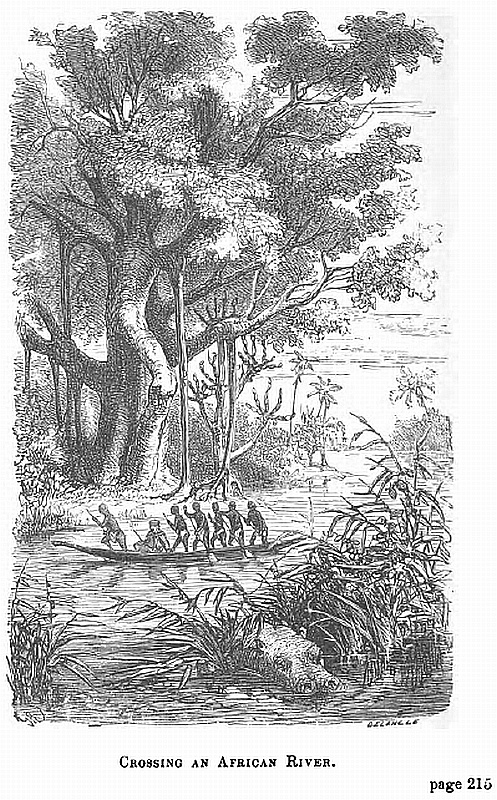
On setting out, the direction we took was that where, between two shelving plains, covered with bright green vegetation, a sparkling river flowed; for the koodoo requires water. Here we soon came upon several of them, which, with much caution, we proceeded to slay. It being a most wary animal, we, according to the Kaffir method, appearing at some distance, approached them by large, circles, as if the last thing we saw were the animals themselves, which proceeding apparently much puzzled them. This we continued to do, gradually lessening the distance till within shooting range, when, wheeling round, we hurled our assagais at the startled herd, who sprang off at full speed, but not before we had slain several, among which was a pretty little antelope, called an ourebi.
Before returning, we stretched ourselves upon the grass to enjoy the pleasant day and rest a little; but we had not been long in this position before we suddenly perceived a considerable party of Kaffirs, in all the native panoply of war, fording the river much higher up than where we were. Following the example of my companions, I instantly seized my shield and spears, and, wriggling like a snake through the grass, reached some bushes, from which concealment we inspected the strangers earnestly. The head man affirmed it must be a regiment of some hostile tribe, no doubt coming to attack our kraal, and, upon this surmise, was just sending off a swift messenger to give the alarm at home, when one of our party, uttering a cry of joy, declared that the men before us were our own warriors returning from their expedition. After a few moments’ inspection, this really proved to be the fact, whereupon we immediately quitted the bushes and advanced quickly towards them. In doing so, I noted that, while the men rapidly forded the river, they raised the water in the palms of their hands to their lips, as if suffering from thirst, and I could not help asking a Kaffir near me if he thought there was any reason for this haste.
“No doubt,” he said, “they are on a forced march, when the men are not permitted either to stop or leave ranks; though,” he added, pointing to some dead-looking logs, like tree-trunks, which lay here and there on the muddy banks of the river, “they would not in any case stop now. See—crocodiles!”
I gave almost a leap at the sound. Yes! those logs were indeed crocodiles, as I speedily was made aware, for, on our drawing near the river, several slipped into the water with a dull lazy splash. I remember that at the sight I felt no small amount of satisfaction that I had not to ford the river; for though they say if you walk straight forward, splashing the water as you go, these repulsive looking monsters dare not touch you, I had not the least desire to try the experiment.
We found the warriors much attenuated, having suffered greatly from want of food, which their hunger-belts drawn very tightly proved. These hunger-belts are made of leather, fastened several times round the body, and are gradually tightened over the stomach to stay the cravings of hunger. One or two “boys” of the party had suffered so much from lack of provisions that they had actually flawed their cow-hide shields.
Such being the state of things, it may be imagined with what alacrity they fell upon some koodoo flesh we had prepared; in fact I thought they would never stop. After a while, however, they left off, more from want of provender than appetite, and continued their march homeward, we joining company. They said they expected to be well received; for, beside the vengeance they had taken upon the enemy having been severe, they had also brought away with them numerous heads of cattle, which they were well aware would be regarded with extreme satisfaction by their chief, Metilulu.
Chapter Sixteen.
Metilulu Reviews his Troops—I Assist at a Hopo Battue.
As the warfare in which Metilulu’s warriors had been engaged was looked upon as very successful, the chief ordered a review to take place on the ensuing morning, when, as was customary, those who had done brave deeds were to be rewarded, while those who, on the contrary, had proved themselves unworthy of being ranked among soldiers, were to receive due punishment. This was the first review I had seen, strangers seldom being allowed to be present at them, but my long sojourn in the kraal made this rule waved in my case, for I had indeed become almost as one of themselves, therefore I was permitted to be a spectator.
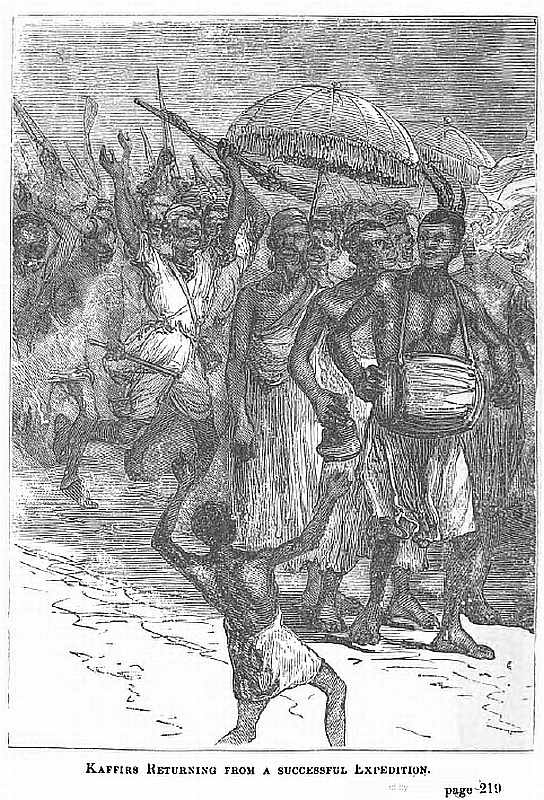
Like in our own affairs of the same kind, all the warriors assembled, each taking his right position in the ranks, but here they did so in perfect silence, while each placing his large shield on the ground upright before him, only permitted the upper part of his dark body to be seen. Thus they remained till it was Metilulu’s pleasure to make his appearance; and—for it seems the etiquette of great people in Caffraria, as well as in more civilised nations, to keep their inferiors waiting—fully an hour elapsed—the glaring sun blazing down all the time upon the poor fellows—before his pudgy majesty waddled upon the field, followed by his chief counsellor, and servants bearing the never-failing beer-jar and snuff, while one held a shield, which on such occasions was converted into a species of umbrella, to be held over the little man’s head to shade him from the sun; and Zenuta told me that woe would betide the bearer of it if he let a single beam of the luminary of the day rest upon the chief’s black skin, such negligence being severely punished—even occasionally by death when the royal personage happened to be in a bad humour.
Metilulu’s chair having been placed in an advantageous position, and his counsellors congregated about him, the august chief was so overcome by fatigue, owing to his unusual exertion, that he had to have recourse both to the beer and snuff to recruit his strength before commencing the review; then, I suppose, feeling stronger, he ordered the cattle taken from the enemy to be marched before him. There was a pretty considerable number, and I watched Metilulu’s eyes twinkle with delight as he beheld them. Suddenly he pointed to one, then to another, and, as the sign was made, with the speed of light, a Kaffir had sprung forward, and, with unerring aim, pierced the animal indicated by the chief to the heart.
Surprised at this summary destruction of the beloved cattle, I asked Tugela, who was standing by me, the reason, and learned that these were to feast Metilulu’s guests, for after a fortunate expedition he always treated the warriors handsomely. As the eyes of the remainder of the cattle rested upon their fallen companions, and their nostrils scented the blood, a panic seemed to seize them, for, lowing wildly, they dashed forward in all directions, and it was as much as their keepers could do to head them in, and get them all safely back to the isibaya.
When this was over, and all made ready, the ceremony of pointing out the “ama-doda,” or men and the “boys” who had proved themselves worthy of their chief’s approval, commenced. This is a trying time for the regiment, but a proud one to those who are conscious they have fought well. Those “boys” who have done their best look eagerly forward to receive the title of ama-doda, and become the bearer of a white shield; while those whose courage has failed them in the hour of battle secretly tremble in their feathers—not having shoes—at the possible, if not inevitable result. Stepping forward, the head warrior presented his report to Metilulu, who, on receiving it, uttered the names of those worthy of praise aloud. As each was pronounced, the assembled Kaffirs repeated it at the top of their voices, while they indicated with outstretched arm the fortunate soldier. The latter, to my eyes, appeared to have gone frantic with joy; for, with leaps only to be seen in Caffraria or in a circus, he sprang from the ranks and commenced executing the most peculiar antics, denoting extreme pleasure, I had ever witnessed. His springs were wondrous. He kicked up his heels, ran, and jumped, all the time flourishing his assagais and shield in such a manner that I should have felt my head in danger had I been in close proximity to him.
By this time three or four others had been specified, and were going through the same feats as the first—doing it with such a power and energy that the oil actually ran from their dark bodies in little streams. After having performed most of their military evolutions, with a bound the happy warriors leaped back into the ranks, and resumed their former rigid attitude.
The scene was so eccentric that it occasioned me much amusement, and had it ended here it would have been well enough; but now, the brave having been rewarded, the cowards had to be punished. These were pointed out without any shouting, and, as each was named, instant execution followed, without a murmur on the victim’s part. One who, I suppose, had either been a very great coward, or the head warrior had a spite against him, was barbarously beaten to death by knob-kerries. The bodies of these, not being considered worthy of the rites of sepulture, were dragged into the bush, and left there to become the meals of hyenas and jackals, who speedily would leave nothing visible but the bones to whiten in the sun.
This over, the paid minstrels of the tribes appeared, who, approaching, sung their great chief’s praises, using every title that had been given him during his life for any prowess, or names he had chosen for himself,—mostly those of animals. After which all the warriors defiled passed Metilulu, who was dressed in his most ceremonious costume of feathers and leopard tails, etc, no doubt to inspire respect and awe, each Kaffir as he went by bowing profoundly and lowering his shield and assagais to the ground.
This completing the review the feast commenced, which I need not recount, so therefore shall pass it over. The successful issue of this raid upon his enemy had so good an effect upon Metilulu, that he proposed a large slaughter of animals should take place, so as to make a grand feast—which meant every Kaffir was to have as much as he could eat, and, if the reader recollects the account I have already given of their capacity in that line, he will see that the quantity of provisions necessary to be provided would be great indeed.
It must not be thought that the generous fit of Metilulu extended so far as to the slaughtering his own cattle for the occasion; on the contrary, he meant the slaying of a good many head of game. To render this easy a large pit or hopo was dug in the neighbourhood of a frequent resort of the animals we required; from this diverged two strongly made fences, expanding one to the left the other to the right, till the farther extremities were nearly a mile apart.
The above method of entrapping animals has, I am aware, been frequently described before, for it is a custom practised in many parts of Africa; but having been an actor in this one myself, I should like here to recount it to my readers.
Most of the kraal joined the hunters, for many were required, and when we drew near the spot, orders were given to disperse ourselves so as to enclose a large space of bush. This being performed, by shouts and flourishes of our assagais we began to beat up the game, and drive the startled animals who sprang forth before us in the direction of the hopo. Few creatures, as I believe, I have remarked previously, will attack a party of men unless urged on by extreme hunger, thus even those of a more ferocious nature than the eland or gemsbok flew before the shrieking Kaffirs, who appeared like so many fiends broken loose, and never shall I forget the scene that ensued; the fleet eland, the gemsbok, the small graceful duiker bok, the gnoos, the zebras, and even here and there an elephant and a buffalo, all in one pell-mell frighted herd, fled on, in hope of safety, but, in fact, only hurrying to their sure destruction. Occasionally they would attempt to break the fences, but armed Kaffirs placed behind them would drive them back. The mouth of the hopo had been concealed by tree-trunks and branches, so that the creatures never perceived the trap laid, till, owing to the velocity of their speed, there was no drawing back, but with a plunge the first ranks disappeared, and the rest bounded upon the top of them. So when I reached the hopo I found it full of miserable, struggling, howling life, awful to see. Legs, bodies, and heads were in an inextricable mass, the pit being so crammed that the remainder of the animals had used it as a path to pass over and escape again to the cover of the bush.
Then into the heaving mass the hunters began to throw assagai after assagai, killing the uppermost, and leaving the under ones to be suffocated by the blood and weight, which speedily must have taken effect. When all had been rendered harmless, one by one the slaughtered beasts were raised by the aid of poles, and with songs of rejoicing—for, having captured nearly forty head of game, the hopo was considered most successful—we returned to the kraal, where preparations for a grand cooking had been made.
After the feasting had abated and much joila had been drunk, I saw one of the best dances I had yet witnessed in Caffraria—that is, more persons than usual joined in it, for as to figure one dance resembled another, each appearing to go through the performance according to his own taste and with the one idea, to show as much energy and agility as he possibly had in him.
The dancing girls had porcupine quills or hard thorns from the mimosa stuck erect in their woolly hair, and about their waists a leather belt covered in every part with beads, which barely answered the purpose of an apron, while their necks, arms, and legs were literally hidden by ornaments, they having apparently attired themselves in anything fine they possibly could procure—it being a sign of wealth; and there, as in other countries, the saying truly may be used, that pride is never pinched, for though the heavy weight of these beads, bones, shells, etc, must much incommode the dancers’ movements, yet not one of them would think of leaving a single ornament out of their toilette.
The dance commencing, the girls first formed themselves into a circle and began, only accompanied by the sound of their own voices, then, after a while, the warriors starting up, clashing their assagais on their shields—for to create as horrible a hubbub as possible seems the Kaffir’s particular delight—joined in the figure, first whirling round in an outer circle, then closing in and mingling together, never at any time ceasing to keep up the accompaniment of their clashing shields and shrill voices.
As usual their antics grew exceedingly violent, and as the evening was remarkably warm, the perspiration, I might say oil, rolled in greasy drops down the dancers’ faces, causing them some inconvenience, though each of the girls was provided with a long narrow piece of wood or bone, something similar to a blunt knife, with which she scraped the grease from her person wherever she felt it uncomfortable. I thought it was well, too, that the dances took place in the open air, and even then I was very glad to use my seaman’s knowledge, to keep to the windward of the performers.
Zenuta had once been one of the best dancers in the tribe, but, whether my words were taking effect in her heart, she now absolutely refused to join, for which I was not sorry, as I took care to tell her afterwards, and received a proud, happy smile from the poor girl’s eyes, for these dances do not conduce to the morality of the people, who seem to work themselves up to a perfectly mad frenzy, when they recognised no bounds to their desires.
I said “Poor Zenuta,” and each day I repeated the phrase with greater pity, for I had begun to pine for dear England and English faces with a true home sickness, and looked forward to every succeeding hour, hoping it might bring some chance to enable me to return, when I should be compelled to tell her that we must part for ever. It is true she had begged me to take her with me, saying she would never vex me, but work for me night and day; but whatever should I, Dick Galbraith, a poor seaman, do with a Kaffir girl in England? I respected the affection she displayed too much to have her treated with indignity as she might be in a strange and civilised land, and I could not have taken her home, so in all ways I saw it was best and kindest to leave her with her tribe, feeling sure among them she would soon get reconciled to the separation, and, no doubt, quickly marry after I left, as I intended to give her all my cows and other effects. The sequel will prove, however, how little I knew the really determined nature Zenuta possessed. That in intellect and sensibility she was far in advance of her people I had speedily become aware; but I never dreamed to what lengths her loving, humble devotion to one, who could only give her a friendly, pitying kindness in return, would carry her.
Chapter Seventeen.
Home Thoughts—The Drought and the Rain-Maker—I Receive Terrible News.
It was some time after the above that I sat just outside my hut enjoying a smoke, or rather I should not say enjoying, for I happened to be extremely sad at heart. I had now been nearly a year in Caffraria, and no doubt had long been supposed dead by my wife and friends, for the news of the wreck could not fail to have reached them by this time, accompanied no doubt by the sad intelligence that all the crew had perished.
I pictured to myself my wife’s despair on hearing it; how her pretty face would be bathed in tears; how she, in her great sorrow, might earnestly pray for death, till recalled from the wife’s grief, by the mother’s duties, she would clasp my children to her bosom, and, overcoming her heart-broken agony, resolve, if only for my sake, to live for them.
My little house, with its small comfortable parlour, all rose up clearly before me. There on the wall hung the curiosities I had brought from distant parts to Kate, and which she dusted so carefully every morning, while here on the mantelpiece stood the old clock, with its wooden case as black as ebony, supported right and left by a China shepherd and shepherdess, which were supported in their turn by little China vases containing spills ready for me, Dick Galbraith, when at home, to light my pipe as I sat on one side of the pleasant fire-grate, a glass of grog at my right hand, and Katie busily darning or mending the family linen opposite, chatting of village gossip—how Dan, the fisherman, had nearly been capsized in the last squall; or what a great haul he had had, which had put him into such a good humour that he had actually bought his missus a new gown; or, when not talking, listening so attentively to my yarns respecting the places I had visited and the people I had seen. Strange stories enough I should have to tell her this time!
A sigh escaped my lips as this reminded me how long it would be before I should smoke my pipe, if I really ever did again, in that comfortable, snug little parlour, with the smell of the briny sea in the air, and Katie by my side, while the children slumbered overhead, rocked to sleep, as their father had been before them, by the soothing lullaby of the ocean.
Such thoughts, as may be imagined, were not very conducive to the increase of my comfort where I was, and I felt in a very desponding mood, when, happening suddenly to raise my eyes, I became aware that Zenuta, carrying a gourd of corn she had been crushing to mix with amasi for my dinner, was standing motionless some little distance off, and gazing steadfastly, sadly upon me.
I somehow felt an unwillingness to meet her glance, so, lowering my eyes, appeared to be busy refilling my pipe. But what woman in the world, even including Kaffirland, will be put off if they have anything to say? Thus a moment after, Zenuta approaching placed her gourd upon the ground, then sitting down said plaintively, “You are thinking of your home far away, Galbrth. You are thinking of your wife.”
I could not, nor did I wish to deny it, so I said, “Yes, Zenuta, I am. It is very sad to be separated from all those whom I have loved, and who have loved me from childhood. Fancy how you would feel it.”
“I would go anywhere with you. I would leave all,” rejoined the girl earnestly, as she looked into my face.
“My dear Zenuta,” I said, taking her hand, “you must not speak thus for my sake. You do not know what our land is compared to yours—how different it is: you would be unhappy there.”
“Have you not told me,” she answered quickly, “that it is a better land—that its people know more; that they are kinder; that they are what you call civilised?”
“Yes, truly, they are all this; but, Zenuta, you would be a stranger among them—strange to their customs, strange to their language.”
“So were you when you came here,” she interrupted, “yet we were kind to you. You have become a hunter—almost one of us.”
I could not deny this, and warmly confessed that I had been most hospitably treated; “and yet,” I had it on my lips to say, “I am not happy, Zenuta, neither would you be were you in England;” but as I looked into the poor girl’s eager, earnest eyes, I had not the heart to make the speech, and she continued most touchingly—
“Besides, I should not be alone, Galbrth; you would still be kind to me would you not? And your wife, too, I would like her for your sake.”
I do not mind owning that tears dimmed my eyes as Zenuta spoke, and, with some emotion, I pressed her hand, saying—
“You are a good, affectionate girl, Zenuta, and, believe me, I will ever be a friend to you.”
They were simple words, and not much, considering the deep love she bestowed in return; yet they might have been the most affectionate expressions lover ever uttered to have seen the light of joy which quickly lit up her eyes and whole face, then, suddenly seizing my hand, she raised it to her lips and kissed it passionately; after which, getting up, without another word, she entered the hut with the crushed corn for my dinner.
I have forgotten to say that I had once detected Zenuta in administering a love powder to me, so that she might thus obtain the affection she felt she could not get otherwise; and it was with some difficulty, having even to resort to assumed anger, that I prevented her continuing this unpleasant practice; for I had no desire to swallow some mysterious compound concocted by a Kaffir witch-doctor. Afterwards I took an early opportunity to reason with her upon this foolish superstition, I fancy with some success, for, either through my arguments or fear of my anger, she never, to the best of my belief, had recourse to the charms again. I had reason to imagine, however, that she communicated my opinion respecting these superstitions to the witch-doctor himself, thereby making me a most dangerous enemy, and the time was drawing near when this was to be most disagreeably proved.
Zenuta had scarcely left me than, not feeling disposed to resume my former reverie, I got up to take a stroll through the kraal. There had been few hunting parties lately, owing to the necessity of driving the cattle every day a great distance to obtain water, as for some time past the neighbourhood of our dwelling had been suffering from drought—a terrible affair to both natives and cattle. No sooner do the signs show than the dread of famine immediately seizes the people, and not without reason, for owing to the pasturage growing scarce, being quickly scorched up by the fierce rays of the tropical sun, many cows perish; consequently the milk—the staff of life to the Kaffir—considerably fails in quantity. Both men and women are in horror, for the rivers begin to dry, then the wells and springs.
Such had been the state of things for some time with us, and Metilulu at last had recourse to the power of the prophets, or rain-makers; for they fully believe that these men are capable of bringing the rain they so desire.
There is little doubt that these rain-makers can read the nature of the clouds even better than the majority of the people, though all understand it pretty well, as most tribes do who live in a wild state and are much in the open air; yet it is certain that these men are very often at fault, and the rain will not come for all their arts. Of course they must feel aware of this, and, to prevent losing the good opinion of their devotees, they will demand almost impossible forms to be gone through, or things given them, to work their charms, averring that they could never succeed without.
I had had this proved to me by experience, as for the last few days the rain-maker—his lank, skeleton-like figure clothed in an attire something similar to the witch-doctors—had from the top of a high hill been beckoning to the clouds, which did not come. Sheep, goats, and other animals, had been sacrificed, but to no effect; the blue sky remained quite as clear, save where the sun, like a glowing furnace, shot his beams, of a white-heat intensity, down upon the parched land.
Owing to what I have stated above, the whole tribe were extremely downcast, while the cattle perished daily. Famine seemed inevitable. There yet was one more chance. The rain-maker had declared the next morning he would mention what he would require for another sacrifice, and this time he knew that he should succeed: the clouds would no longer be able to resist his power, but, on the contrary, would pour their sweet supply of refreshing life upon the earth, bringing pasturage and plenty to the tribe.
What the prophet required proved to be the hearts of three koodoos, cut from the animals while alive. I felt extremely disgusted and indignant at this cruel and absurd request, but I was yet to learn that these men could ask wilder things than this, and get them speedily obeyed by the miserable, ignorant people over whom they exert such arbitrary power.
This ceremony, the obtaining the koodoo’s hearts, had taken place three days before my talk with Zenuta, yet no rain had fallen, nor did there seem the least likelihood of its coming, as far as my nautical knowledge went. I had made no enquiry that day respecting the rain-maker’s prophecy, nor whether he had made any other requests, as his last had so signally failed; indeed, I took but little interest in the impostor, impostor even to himself, but my brain still occupied by those home thoughts, which I could not banish, I wandered indifferently about the kraal. Once or twice, however, I could not help fancying that several of the Kaffirs whom I passed looked upon me in a strange manner, while others, at my approach, dropping quickly on their knees, crept into their huts as if to avoid a meeting.
I was at the time too busy with other things to pay much, if any, attention to these signs, but having made the circuit of the kraal, came once more in sight of my own dwelling. As I did so I perceived Tugela abruptly issue from it, spring in to an erect position, and hurry off. Not having seen him all day, I hastened after to overtake him, but his speed being greater than mine, he soon distanced me, so giving the chase up, I entered my home with a very good appetite for my dinner.
It being ready, I sat down to it at once, and had somewhat allayed my hunger when, with a sudden cry, Zenuta cast herself beside me, apparently in an agony of grief, for looking down I saw tears rolling down her cheeks. In much concern I raised her from her kneeling position, and asked the cause of her emotion. For a few moments, however, sobs checked her utterance, then she let fall several brief, disconnected sentences, which made me sure that some imminent danger was threatening me. Earnestly I besought her to speak more clearly, even having recourse to the infallible reasoning, the love which she had so often expressed for me. The latter, as usual, had the effect I so anxiously desired, and sobbing as if her heart would break, she said how she had just learned from Tugela—what it now seemed the whole kraal had known some hours before—that the rain-maker, in an interview with Metilulu, had declared that the drought was entirely caused by the white man who was among them, whose disbelief in his (the prophet’s) power had also made his charms fail, and never would they succeed, nor rain come, till the Englishman had been removed—removed, meant death.
No one but those who had witnessed the barbarous cruelty and ignorance of these people, combined with their utter regardlessness to the suffering of others, can imagine the effect this intelligence had upon me. The first feeling that seized me was the certainty that after all my escapes my hour had come at last, and I was really never to see old England again, and the dear ones it contained. Zenuta, seeing my horror and despair, clung entreatingly to me, and with true woman’s tenderness, which is the same in all lands when their hearts are concerned, tried to calm and soothe me, by saying Tugela had also told her that Metilulu had seemed most averse to letting me suffer, and had even informed the prophet that he would defer his answer respecting the subject, and perhaps would talk to the white man himself, and see what his opinions really were upon the point.
These words gave me the relief which the affectionate girl desired, for they were to me what a respite is to a condemned man.—It showed me I had a few hours to reflect and to determine how to act; so, for the first time pressing my lips to Zenuta’s dusky forehead, for I could not but be deeply moved by the warm affection which she showed me, I bade her go about her household duties, and leave me awhile, as I wished to think how best to answer the Chief Metilulu on the morrow.
With a glow of intense happiness on her face at this token of friendship, she silently obeyed, while I, throwing myself on the ground, began to reflect how I could manage to escape from the awful danger impending over me.
Chapter Eighteen.
I Prepare to Escape—I Leave the Kraal, but Quickly Return—The Enemy—The Kraal in Flames.
Lying there on my sleeping-mat I contemplated my hazardous position with feelings better imagined than described. My flesh crept as I recalled the horrible torture I had seen practiced on the wretched wizard, and felt how in a few days, if fortune did not favour me, I too might undergo the same.
I tried to draw consolation from the fact, that Metilulu—for a great wonder—had shown much repugnance in accepting the rain-maker’s statement, and had declared he would reserve his decision, respecting the white man’s removal, till the morrow; but I could abstract but little comfort from this, feeling assured that if the drought continued the land would be brought into such a terrible state of famine, that, if not from his own will, Metilulu, to save himself from the fury of the people, would be compelled to give, me over into the merciless grasp of the enraged prophet. No; there was only one way left to me. I felt my life was no longer safe there—if reprieved by Metilulu’s friendship until the next day, it was but deferring my ultimate fate; therefore I resolved, if possible, to escape that very night, and take to the bush, being more willing to trust to its perils than those I knew I ran with the witch-doctors.
Having come to this resolve, I thought the best way to avoid creating any suspicions of my intent was to go about as usual; so, rising, I repaired to my cows to see if they required any care, then went to my small patch of tobacco land, where, collecting many leaves, and rolling them fit for use, I wrapped each separate parcel in reeds, according to the custom of the Kaffirs, who place them in their huts, where they can be seen by all, for the possession of a large store of tobacco is a great pride to the natives, as they reckon their superiority over their fellows by it.
As may be easily conceived, I did not do it for this purpose, but prepared them in these small portions so that I could easily carry them about my person in my intended flight; for I perfectly well knew the value of the plant in the bush, not only as a comfort to its possessor, but because it is equivalent to the use of money in England when you require services rendered, for a Kaffir will do anything to possess some of the much-prized weed.
Frequently, while so engaged, I cast anxious glances to windward to note if there was the least sign of rain clouds appearing, but from north to south, from east to west all continued to be one clear, blue, unbroken expanse. Once, noticing a slight mist on the horizon, I wetted the palm of my hand and held it up in that direction, when I fancied I could detect the faint touch of a cooler breeze. If so, there might really be rain before morning, but certainly not earlier; therefore, it made no change in my resolve to be off that night, if possible.
Having done all I could to my patch of land, which I mentally hoped never to see again, I took my packets of tobacco and turned homewards. The men having little to do, and no heart to do that, were mostly seated about the kraal, smoking or talking respecting the drought and the deaths of their cows. As well as I could, without making it perceptible, I avoided these groups, for the fear displayed on my approach—some retreating altogether, while all regarded me with a strange look of covert suspicion—was now fully explained, the truth being that they each regarded me as the wilful cause of their present dire suffering.
I wisely took no heed of their manner, pretending not to perceive it, though in truth it made me most uncomfortable, for I fancied it likely these men, urged to frenzy by reflecting on the approaching famine, might rise up at any moment, surround my hut, demand me of Metilulu, make me a prisoner, and torture me to their hearts’ content—a deed for which they would afterwards rejoice, and no doubt receive the praises of the Prophets and Metilulu himself, for, as far as I could judge, even as I had returned to the kraal, the wind had slightly shifted, and rain might not be two days off, when its subsequent arrival would of course be attributed to my death. No pleasant reflection; and I could have regarded the men about me with the same horror as did the poor mis-called wizard when the witch-doctor, after his farcical snuffing the air, suddenly, as if he had smelt him out, dropped upon the wretched victim; but, conquering any outward sign of uneasiness, I exchanged a few casual remarks with those I met, taking no note at their not always being returned.
On reaching my hut I found Zenuta still there, so, as I wished to be alone to make some little preparation for the night, I sent her out on an errand; then, placing the wicker-door before the entrance, that the interior could not be easily seen, I took two hard stones which I had brought in with me, and cautiously began rubbing up the heads of the few assagais I had managed to retain to as sharp a point as I could make them.
The work took me some little time, and had the effect of engaging my thoughts and preventing me dwelling too much upon my perilous position. I then selected the best skins I possessed, placing them ready to put on, with my kaross, which I intended to make serve for a sleeping-mat, as I should, no doubt, have to camp out for many nights in the bush; afterwards putting the rolls of tobacco in a piece of hide, I stowed it away with the rest, to be ready to hand when I started.
I had scarcely ended, and the hour was, as far as I could judge, about six o’clock European time, when a shadow fell over the doorway, and the next moment a “boy,” slim and handsome in figure, as Kaffirs all are in youth, crept in on hands and knees. I recognised him as one of those who attended on Metilulu, and my heart fell, fearing that the chief had changed his mind, and determined to surrender me to the rain-doctor even then; for when he had honoured me with any message before, it had usually come through Tugela. But the messenger’s first words allayed my fears at once on this point.
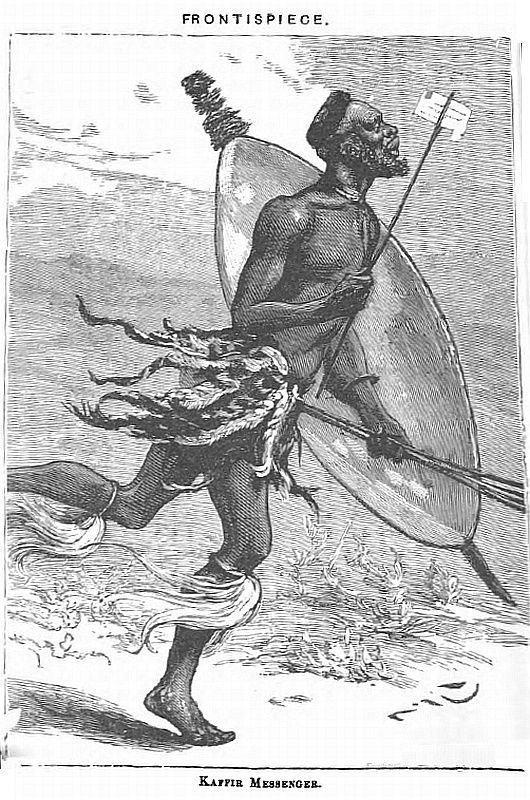
After the ordinary every-day salutations, the “boy” stated that Metilulu had sent to say he desired me not to take my cows out the next day, but entrust them to another, for he wished me to wait upon him, as he had something of much importance to communicate.
I answered directly that the noble Metilulu had ever shown me—a stranger—so much kindness, that his will was as law to me, even as to his own people; therefore I should certainly not take my cows out the next day, but would attend upon him as he desired. “I should like also,” I added, “if the chief would permit me to inform him that, as far as my knowledge as a sailor went, I hoped and believed we should have rain before two days were over.”
The messenger seemed much pleased at my reply, feeling, perhaps, that I was safe in their clutches, and started off to bear it immediately to Metilulu.
I had purposely made my answer touch upon the kindness of the chief, with the hope that the little praise might act in my favour, and I had also mentioned the coming rain, thinking it possible that it might excite Metilulu’s curiosity, so, if I did not effect my escape, that he would defer my execution, to see if the “white man’s” prophecy was correct. I knew my reply would be delivered verbatim; for these Kaffir messengers can carry them for miles, but never vary in a syllable.
Zenuta returning, I informed her of Metilulu’s wish. She displayed much concern on hearing it, and finally declared that she felt sure he meant mischief.
“Do you think so, Zenuta?” I said very indifferently, for I could not even trust her with the fact that I was about to escape; for I should have had to add that I must leave her behind, and we never again should meet. Poor girl! But what could I do? “I do not think so,” I continued; “he has proved himself so hospitable to me up to this time, that I do not believe he would change. At any rate, he will assuredly listen to my arguments; and finally, Zenuta, you are aware,” I added solemnly, pointing upward, “that my faith rests in One above, who has power to save me if He please, had all the chiefs in Caffraria willed my death.”
She looked doubtfully and with awe at me, then said, with touching earnestness, “May He, then, save you, Galbrth, if He really can, my beloved!”
Despite my apparent indifference, Zenuta’s behaviour naturally made me more certain than ever that to stay till the morrow would be like signing my own death-warrant; therefore, for all Metilulu’s peaceful message, I determined to be gone that night.
How long the time appeared before it came. When it did, however, it could not have been more kind to me, for the moon did not rise till late and the night was very dark. So, anxiously waiting alone in my hut, I listened till all grew silent in the kraal, and I felt sure its inmates were wrapped in sleep. Then I glided out, my kaross tied up, the tobacco strung round my shoulders, and my shield and assagais in my hand. Fearing to quit the place by the usual egress, lest the dogs should create a disturbance and alarm the sleepers, I stealthily skirted my hut till I reached the fence, where, with a strength made great by the imminence of my danger, I forced the poles asunder and squeezed myself through. When I was outside, I gave a long sigh of relief for I felt free, safe, but not quite safe enough. On the contrary, I was very anxious to put as great a distance between the kraal and myself as possible before my absence could be discovered. So quickly I hurried on, keeping a sharp look-out around and breathing many blessings upon the darkness; but I had not gone far when the moon, showing the tip of its broad disc over the hills, east a silver ray of light on the opposite horizon, warning me of its approach, and I glanced keenly on each side for some bushes to conceal my figure from view.
As I did so I came to a most abrupt halt, for among the trees some distance off, where the moonbeams fell, I could swear I saw the dusky forms of Kaffirs gliding in and out about the trunks. A moment’s careful inspection proved to me that they did not belong to the tribe I had just left, but were advancing apparently with the extremest caution. What could it mean? There was but one answer. Some Chief was retaliating upon Metilulu the attack he had not many days ago made upon him. But what was I to do? Make use of the confusion that must ensue to favour my escape! No; I could not do it; for I recalled the kindness I had experienced from these people, and thought of the helpless women, Zenuta above all, and children who lay sleeping, unconscious of the approaching enemy who, in a brief space, would massacre them with the most barbaric cruelty.
My resolve was instantly taken. With the greatest speed I could muster, I swiftly returned to the kraal, entering by the same way I had left. Then having flung my kaross and tobacco back into the hut, I ran first to the “boys’” huts, they being the nearest, afterwards to the men’s, whispering the word of alarm—“The enemy is upon us.”
Quickly the whole kraal was astir, and, hastily arming themselves with shields and assagais, commenced as quietly as possible driving the cattle to the bush, for the first thought of the besieger is to seize the cows, while that of the besieged is to prevent his doing so.
Through the enemy advancing at the back of the kraal, we were able to quit it unperceived with the oxen, women, and children, for the latter also were to take refuge in the bush till the fight was over. We were but just in time, for scarcely had all been safely placed than, ere we could get back, with yells like an army of fiends, the place was surrounded by the enemy, who scaled the fence like a swarm of black beetles, flourishing their weapons, and proving by their behaviour how little mercy the sleeping inmates would have obtained had they been there.
Speedily, however, they discovered that the kraal was empty, and their howls of baffled rage was only excelled by those they uttered when a shower of assagais from our party showed that they were expected and prepared for. Then for the first time I witnessed a Kaffir method of warfare. Each man crouched behind his shield, or held it so as to protect his head, only glancing out when he cast his weapon with unerring aim at his enemy.
The moon was now fully up, lighting the entire scene, which was both picturesque and animated. The air at first seemed darkened by the flying assagais, and I, forgetful of the danger I had so lately and perhaps still did run, threw mine with as good a will as any of them.
Many of our men fell; but I soon perceived that our numbers far exceeded the enemy, who no doubt had reckoned on a surprise for success. They began visibly to give way, and shortly after, forming into a compact body, the shields held in front like a wall, as against them the native spears are useless, they commenced a slow retreat, for they had speedily taken to the open field when the fight began. Slowly we followed, casting our spears as they did as we proceeded, when, suddenly, over the fence surrounding the huts, several black forms were seen to leap, and the next moment sharp pointed tongues of flame shot up from numerous parts into the air.
They had fired the kraal!
The yells of rage now came from our party, as frantic for revenge they made a furious charge on the enemy, who fled with all haste to the bush, leaving many wounded behind them, who were pitilessly slaughtered by the infuriated pursuers. But the bush once gained, it became useless to follow further, therefore the order was given to return and collect the cattle, which were becoming restive and ungovernable at the sight of the flames.
To have saved the kraal, I need not say, would have been impossible, constructed as it was of wood and thatch, so, having got the oxen safe, we encamped on the hillside, where—the Kaffirs breathing vows of a terrible vengeance—we sat to watch it burn out; and a fine sight truly it was, forming a grand picture, for the spiral masses of flame rushing with a roar upward, lighted for some distance around the strangely grand African scenery, while the broad faced moon, with her attendant stars, shone placidly down from above.
Chapter Nineteen.
Metilulu Expresses his Gratitude—His Revenge—The Lost Found.
Scarcely had morning dawned, than Metilulu, surrounded by his counsellors, coming up, warmly thanked me in words full of the sincerest gratitude for having saved the lives of his tribe, as assuredly, but for my warning, they would all have been massacred before the men could have even had time to seize their weapons in defence. The little Chief seemed indeed so vastly pleased that I thought his praises would never cease, and I began to be rather tired of listening, when he suddenly put to me a question, which I had expected he would from the first. This was, “How it happened that I had been so lucky to see the enemy’s approach at so late an hour?” Of course, I dared not give the right reason; but, on the contrary, seized the opportunity this occasion offered to improve my position and consequence in Metilulu’s eyes by saying,—
“That I had been much concerned respecting the drought, which threatened such great suffering to his people and cattle, particularly after sending the message to him regarding the coming rain. The thought that he would fancy I only intended to deceive him made it impossible for me to sleep; therefore, I had walked outside the huts to note what aspect the moon would possess on rising, feeling sure, if she displayed the slightest mistiness on her disc, that rain could not be far off. It was at the time when so engaged that, happening to glance through an opening in the fence towards the bush, I had become conscious of dark, moving figures in the distance, and, guessing foul play, had immediately given the alarm to the kraal.”
Metilulu listened very attentively, as did his counsellors, and, when I had finished, asked with much anxiety,—
“Did you see the moon rise? If so, what was its appearance?”
“It appeared with a slight halo about it,” I rejoined.
“We shall have rain, then?” he said interrogatively.
To answer this in the affirmative, I had only to look up to the heavens, without any aid from my previous knowledge of the halo, and I told him that I believed rain would fall very shortly, perhaps even before night.
He smiled with great satisfaction at this, saying, if it proved true, I should be his rain-maker for the future. Then taking his leave, I saw him proceed direct to the prophet and address that withered, sour specimen of humanity.
I learned afterwards, from Tugela, that Metilulu had accused him of wishing to destroy the man who had turned out to be the best friend the tribe had, while he ended by asserting, on the strength of my word alone, that the rain was coming, and very speedily too, though the white man yet lived. The rain-maker, perceiving the champion I had in the Chief, had muttered out something about a mistake; it must have been some one of their own people, whose evil spirit had caused his spells to fail till now. I rather admired that “till now,” the conceit was so extremely cool.
Such a flagrant act of imposture as this in our country would have speedily ruined all the prestige of a conjuror, much less a prophet; but there it had not the least effect, and if the rain had not come as I had predicted, no doubt the prophet would have triumphed enormously, and again been set to work to smell out another unfortunate victim, if he had not still persisted—as very likely he might—that the worker of all this evil was myself.
As it was, however, plenteous and refreshing rains fell that day; the rivers again began to flow, and the springs and wells to fill—all of which had an effect wonderful to behold upon the natives. They danced, they shouted, they sang, and fairly embraced each other and their dear cattle, the destruction of their kraal appearing to sink into quite a minor affair. It was far from doing so with Metilulu, a brave little fellow, despite his obesity. Before the day was out, he had called his chief warriors together, to arrange with them how and when to take dire vengeance upon his enemy. Not one of the tribe was loathe to do this; therefore, it was determined that, directly they could erect a kraal sufficiently large to keep the cattle and women in safety, the whole body of Kaffirs, with Metilulu himself at their head, should, leaving only enough behind to protect the women and cows, depart for the enemy’s dwellings, upon whom they swore to have a terrible retribution.
Consequently three days after, when an isibaya had been hurriedly constructed for the cattle and huts for the females, children, and those who were to remain as their guards, the war party set out, I among their number, by permission of the chief, who now seemed ready to grant anything I desired—a willingness on his Majesty’s part which I hoped soon to put to a great test, by stating my earnest desire to return to my own people and land.
We set forth after sun-down, so as to reach the enemy’s quarters in the middle of the night, which we succeeded in doing, for after having marched for nearly four hours, we came abruptly on the kraal, laying, bathed in moonlight, all silent and still just at the foot of a slight incline.
I think it need not be stated that I had no intention to play any part in the affair about to take place, for the men I was with were acting no better than had those who had attacked them, while from experience I knew they could be quite, as cruel. But aware my presence or absence could do neither harm nor good, I had really come hoping thereby to gain still further Metilulu’s friendship, so that perhaps he might the more readily grant my request to be passed on to a white settlement.
Falling back, therefore, to the rear as the Kaffirs advanced, I manoeuvred to remain in the shadow of the bush while they went on. In the kraal before me there was, unfortunately, no wakeful eye to warn the sleepers of their danger, and the Kaffirs, approaching silently with the stealthy tread of a cat, had even scaled the fences before a sound was heard. Then the dogs began to bark and the cows to low, for in Caffraria cattle can at times be made to serve in place of the watchful canine animals themselves; but, before their masters could be aroused by the warning, they were startled into consciousness of their peril by their huts being pierced by the assagais of the enemy, whose loud yells of triumph rang awfully through the still air.
A terrible scene ensued—warriors who had had only time to seize their weapons issued forth but to be slaughtered, while women and children mostly shared the same fate. Some of the fragile huts were crushed down altogether—the inmates under them—into which heaps the enemy frequently thrust their spears to destroy the miserable beings beneath.
I waited impatiently for an end to this frightful scene of bloodshed, and each moment expected to see the cattle drawn out to a place of safety and the kraal set on fire as ours had been; but there appeared no signs of this. Owing to the unfairness of the fight, it speedily began to subside; yet the cattle remained in the isibaya. Had the enemy been exterminated, or had they yielded?
I waited yet a little longer, then became certain one or other was the case, for the fight seemed over, while Metilulu’s regiment were already forming into order. Consequently, thinking it as well now to join them, I hastened from the bush and entered the kraal. It presented a horrible sight to one who, like myself, was unused to bloodshed and battlefields, though no doubt it was not so ghastly as that presented by one of our civilised engagements; for here were no shattered limbs, no torn gaping wounds, no headless trunks, and bodies rent in twain by cannon shot. The assagai, or, occasionally, the knob-kerrie, had alone been used; and strewn over the ground were the dead forms of the Kaffirs, the spears which had caused their deaths yet remaining buried deep up the shaft in the victims, the victors not having had time to collect them. In some parts, where the fight had been the thickest, they laid in heaps; yet, with but few exceptions, the positions of all retained a look of graceful, easy repose. Notwithstanding, to me, it was a sickening sight to behold so many who, but an hour before, had been full of healthful life, now lying there extended on the plain—dead.
On going a little further I perceived Metilulu standing in the isibaya, inspecting the numbering the cattle by some of his men, while others were forming the survivors into their proper regiments, to discover which of the tribe had fallen. Having no wish to join either I strolled on, wondering in my own mind as to what they intended to do with the slain, for to leave them where they were under the tropical sun of day would soon render the spot unbearable and detrimental to the existence of the survivors.
Just at this moment I chanced to come across Tugela, bearing a message from Metilulu to one of his warriors, and, as I was going his way, I asked him with some curiosity, “How the fight had terminated.”
“All those who had not been slain,” he said, “had finally yielded and consented to submit to Metilulu, accepting him for their chief. Therefore, as the kraal was ready for immediate occupation, and stood in a much better situation regarding vegetation and water than his, the little Chief had issued orders for all the huts to be taken care of, as he intended at once to make the place his own abode, while the vanquished were to build themselves a kraal a little distance off.”
“But what will you do with these heaps of slain?” I asked. “If they remain here long the air will be full of pestilential vapours.”
“Those who like to bury their friends have permission to do so,” rejoined Tugela, “The others will be dragged far into the bush for the wild beasts to devour, or thrown into the rivers for the crocodiles. We never bury them as you English do.”
Saying which he hurried on with his message; and, even as he went, I perceived numerous parties of “boys” removing the fallen men for the purpose Tugela had stated. Whether they ascertained if all they took were really dead, particularly when the bodies were those of the enemy, I cannot tell, but I rather think not.
On being once more alone I continued my walk, and had the satisfaction of relieving from under the débris of a fallen hut a poor woman with an assagai wound in her side, who immediately, with much chattering, scurried off to the bush, clasping a baby in her arms, and leaving me no time to tell her that she would be quite safe if she liked to remain at the kraal.
It was soon after this that I came to a second demolished dwelling, from whence I fancied there issued murmuring sounds of life. Thinking I might be so fortunate as to rescue another unfortunate being, I listened attentively, and speedily, by the slight upheaving of the rubbish, was convinced some person was beneath—whereupon I set to work as fast as I could to clear away the heap so as to make an opening, all the while assuring those inside that there was no cause for fear, the fight was over, and peace concluded. I had nearly effected my purpose, when suddenly a grizzled head was thrust up into the moonlight—the ruined hut looking something like a hencoop fastened about the neck. After glancing quickly round, the possessor of the head exclaimed, to my utter amazement, “Well, jib-booms and top-sails, but this is a queer scene, this is.”
I reeled back mute with astonishment at the words, which recalled to me the apparition’s attention, and he continued—
“Well, you black nigger, how long are you going to stand there? Why don’t you help a fellow out, instead of jabbering your confounded lingo, which I don’t understand a word of, though I’ve heerd nothin’ but it for nigh a year, and what’s more, I won’t understand it if I stay another; for it’s the devil’s own tongue itself, that it are.”
By this time I had recovered myself, and, dashing forward, tore away the remains of the ruins; then, as the other started up, I threw myself on his neck overcome with emotion.
“Now, I say, you nigger, what are you up to?” he exclaimed.
“Oh, Thompson. Dear old Jack. My old, old companion,” I cried, while actual tears rolled from my eyes, “don’t you know me—me, Dick Galbraith?”
“Dick Galbraith! and alive! By the Lord, is it possible; but how—how could I know you, dear Dick, my boy, with your face like a nigger’s, and rigged out in those queer togs. Oh, lor’! I’m glad of this indeed,” exclaimed the old fellow, laughing and crying at the same time as he hugged me and I hugged him, while both of us sobbed like very children for joy at once more looking into the face of a white man—and a friend.
Chapter Twenty.
We Go in Search of Mr Ferguson—Metilulu’s Reception of my Friends—Their Story.
No one but those who have lived nearly twelve months with a savage tribe can at all imagine the joy I experienced at once more looking upon the face of a white man and a fellow-countryman. It was some moments even before I could speak my delight, my voice being stifled by rising sobs, while Jack was no better than myself. When, however, we at last drew a few paces off to again look upon each other, I could not help bursting into a laugh as I beheld my companion and recalled his complimentary remarks respecting my personal appearance, for he was as eccentrically attired as myself.
His skin, already bronzed by many years at sea, had become nearly of a true Kaffir hue, while his fur clothing very much resembled a herald’s tabard, only it was longer to the knee, not so high at the throat, and was joined at each side; from this garment emerged his brown muscular bare legs and arms, while it was surmounted by his weather-beaten face, topped by grizzled hair, and covered half-way up by a large, unkempt, iron grey beard.
“Well, Jack,” I exclaimed, my own language sounding strangely in my ears, “’pon my life I don’t see what you had to laugh at in me, for your toggery is no better.”
“No, my stars, it ain’t; but who’d ever have believed to have seen another Christian dressed out like myself? But it’s all compulsion, Dick—it’s all compulsion; and if heaven wills it to be so, as the young minister says, I oughtn’t to have any objection.”
“Ah, that reminds me,” I interrupted quickly; “where is Mr Ferguson? I hope that he, like us, is safe. You can’t tell, Jack, how often I have thought, during the last twelve months, about his words, even to trying a little bit of his business myself.”
“What; preachifying! You don’t mean to say you’ve turned missionary?”
“Not quite,” I laughed; “but any man with religion in his heart would try, I am sure, to cast some seeds among these benighted people, hoping that they might take root. But where is Mr Ferguson—I am so anxious to see him; you can’t tell how anxious? Remember you have always had a companion to talk to, while I have been alone.”
“True, Jack, true,” responded Thompson, again affectionately wringing my hand. “Come along; I’ll lead you to his hut, where I trust to find he’s come safely out of the dangers of this terrible night. Why, how did those black fiends manage so to surprise us?”
“About the same way,” I said, “that the tribe you are with would have managed it the other night, if, fortunately through my means, we had not been prepared for them. But do come along and I’ll tell all about this afterwards, for I want to know if Mr Ferguson is safe; you cannot imagine how I have grown to like him.”
“Yes, I can, for I feel the same, Dick; that young missionary can do what he likes with me, else I think I should have long ago given some of these black fellows such a drubbing that I shouldn’t have been permitted to live many minutes afterwards. I should have sought him out directly I could have got rid of the ruins of the hut, had it not been for my joy at seeing you.”
Thompson now moved quickly on, and proceeded to a small hut a little way off, which he entered, but instantly re-appeared, his face indicating much alarm—for he had found the place empty.
“I can’t tell where he’s gone,” he said, “but he’s not there. We must seek him. If none of those bloodthirsty fiends you brought—”
“I brought, Jack!”
“Well, who brought you; if they haven’t hurt him, none of our tribe would I am sure, for they respect him too much.”
Anxiously we now searched among the slain for the young minister, whom it appeared even the Kaffirs had liked, and no one can tell with what relief we passed from heap to heap and found him not among the dead. We had proceeded some little way outside the kraal, our quest as yet in vain, when with a cry Jack hurried forward towards the figure of a man kneeling by the side of another either dying or dead.
We had found Mr Ferguson at last, and, like a true soldier of heaven as he was, at his post; for, on Thompson approaching, he arose, with, as I perceived, his well-remembered prayer-book in his hand.
“Ah, Jack,” he exclaimed joyfully; “thank heaven you are safe. I was about to seek you, when—”
“Never mind me, sir, please now,” interrupted Thompson excitedly, “for I’ve brought an old friend to see you—one you will rejoice as much to look upon as he rejoices to look upon you, sir.”
“A friend! Thompson—and here?”
“Yes, here sir, if you can reckernise in this noble Kaffir warrior, with his shield and assagais, our old mate in trouble—Dick Galbraith!”
“Dick Galbraith here! alive?” exclaimed Mr Ferguson. “Now, heaven be praised indeed, for this is good news. My heart is truly delighted—it has been much cast down at the thought of what might have been your fate.”
I seized his extended hand tremulously, but that greeting was too cold, and he too embraced me as a Frenchman might have embraced his brother. I need not recapitulate the sundry questions we put to each other, they surely may easily be imagined; suffice it that we kept on talking till we were interrupted by the approach of Tugela, who, by Metilulu’s orders, had come to find out where I had got to.
He looked with great surprise at seeing us three together, clothed very nearly alike, only the minister’s complexion was much fairer, and stared yet more at hearing us all talking the same language; but I had already told him about my lost companions, therefore a few words were now sufficient to explain the present state of affairs, and I frankly asked him the best way for me to act respecting them and Metilulu?
He advised me to take my friends to the Chief at once, and tell him everything; how we had been separated, and how we had again met. He also assured us that we need have little fear, for, as Metilulu had proved in my case, he leaned much towards white men when they, on their part, showed a disposition to be friendly. “But,” he added, “let alone this, he will no doubt treat your two friends hospitably for your sake, as he feels really deeply grateful for the service you so lately rendered the tribe. No time would be better than the present to make the introduction, as Metilulu is in the best of humours owing to his great success over his enemy, and is regaling in copious draughts of beer and supplies of snuff.”
I hope I have shown, as I have desired to, that Tugela’s stay in the English settlements, where he had obtained the language, had not only improved his own ideas, but had also caused him not to be blind to some of the peculiar manners of his tribe, though he yet preferred living among them to dwelling with white men. With Tugela one of our party, my two companions having consented to the introduction, we at once proceeded to the isibaya where Metilulu still remained.