"Life among the Kaffirs" (continued 2)
Reading edition
This repast made me acquainted with another Kaffir custom, and not a pleasant one.
The large pot containing the porridge is placed in the centre, the partakers sitting round it, when, to prevent one getting more than another, they all use the same spoon; thus the first plunges it into the porridge, brings it out as full as it can be, gulps down the contents, then passes the spoon to his neighbour.
As I had from a child adapted myself to the rocks, to the sunshine, to the ocean and to its storms, so did I try to do with these people among whom fate had cast me, and sitting on the floor making one of the circle I so strove to imitate them, that I soon might have passed for a Kaffir myself, save for the colour of my skin and dress.
The sour amasi—the natives never use fresh milk, calling it indigestible—was at first anything but pleasant; but I determined to make as good a meal as I could, not knowing when I might get another.
Scarcely had I finished when two or three, evidently Kaffirs of distinction, appeared, and notified by signs that I was to follow them. I immediately did so, and crawling out of the hut was again conducted to the chief Metilulu’s presence.
This time, however, the interview was not to take place in the hut, but an open space, where I found him seated, surrounded by his councillors, and with the rough jug containing the beloved joila, Kaffir beer, by his side. Indeed, it seemed to me that he never moved without it, and so it proved, eating and drinking being the prerogatives of a Kaffir chief. Thus they alone of the race are fat.
Metilulu’s dress was also different. No doubt he wished to awe me with his appearance. On his head, stuck into the issikoko, were numerous feathers of brilliant hues, some long and erect, others drooping by the side of his dusky face. Fastened round his throat, so as to fall on his chest, were the tails of wild animals, as the leopard; from his waist fell others to the knee, so thickly as to answer the purpose of the Kaffir apron, while hanging from the elbow and the calf of the leg was the long white silky hair of some kind of goat, finally, a kaross or cloak of splendid fur fell from his shoulders.
In his hand he carried an assagai, while a young Kaffir standing a little behind, held his high oval shield. The councillors’ costumes were something similar, though their head-dresses were rather eccentric, and they did not possess so many tails, which can only be procured by killing the animals to whom they belong, and the Kaffir who does that, will seldom be found to part with this trophy of his courage.
Being led up to Metilulu, I was told through the interpreter to sit down, upon doing which I was ordered to begin my description of my native land. They had heard of it—a country over there—pointing northward; but they would hear more.
I instantly complied, and gave a glowing account of the power of England, her wealth, and customs. To all, the chief and his councillors listened with the greatest attention, and the only time he expressed incredulity was on my mentioning it to be governed by a Queen.
“A woman!” he ejaculated, “impossible.”
I assured him it was not so: that four queens had ruled England at different periods.
“If so,” he rejoined, of course through the interpreter, “how would you have me believe the nation brave and warlike who could be governed by a woman?”
Such a speech was not surprising, when it is remembered that the Kaffir regards himself as a very superior being to a woman, whom, though termed wife, he knows only as a servant to fulfil his behests, and wait upon him in all minor offices. The only things a Kaffir does being to attend to his beloved cows, which often he values far more highly than his wives,—for polygamy is practised in Caffraria—to hunt, to smoke, and to sleep.
In conclusion, I begged him not to regard me as an enemy, assuring him if he were ever to visit my land that he would be treated as the great man he was; therefore though only a poor sailor, I hoped he would not hold me as a prisoner, but let me learn the habits and manners of his people, in which I took much interest.
I put this half authoritatively as became a native of the great country I had been describing, and half with suitable reverence for the mightiness of him I was addressing.
For some little while he talked with his councillors, and by the constant repetition of the word “Molonga,” which I had discovered to mean “white man,” I knew it was about myself. Then through the interpreter, he again addressed me, his speech signifying that lately they had been much troubled by attacks upon their cattle by the Boers, and had at first taken me for a spy of theirs; but if my words were true I should be at liberty to go where I liked about the kraal, during his chiefship’s pleasure, and that all they could show me they would; yet should I prove an enemy a thousand assagais should pierce my body through and through. He ended with a request to know if I had saved anything from the wreck.
I answered I had nothing but the few rags of clothes that covered me, whereupon I saw his little bead-like eyes fasten on my shirt front with a most unmistakeable expression. Glancing down in the same direction, I perceived it was the large pearl buttons which had attracted his notice; and having heard something of the cupidity of these tribes for such articles, I instantly plucked them off—no difficult matter—and with those at the wrists, presented them to him, saying I had nothing worthy his acceptance, nor to show the great gratitude I felt for his kind behaviour to me, than those.
With a pleased smile he took them, evidently much delighted, then plucking a string or fibre from some part of his dress, he strung the buttons upon it and suspended them round his neck. So proud was the little chief of this new ornament, that I am sure he held his head an inch higher for a good while after.
Then the interview broke up, and I returned to the “boys’” hut to partake of some of the game caught the evening before, now rather high. I was attended by the interpreter by Metilulu’s express orders, and he informed me that an elephant hunt was to take place that afternoon, they having tracked a splendid one, at which the chief had given permission for me to attend if I chose. It may be imagined that I did choose. Indeed, I was beginning to feel very anxious about my two companions; my position was looking brighter; and I hoped, if they had not escaped and were now upon some eligible point of land from whence they might signal a passing ship, that I might come across them, and, if they liked, introduce them to Metilulu and Kaffir life.
On entering the hut dinner was ready, to which I was invited, and found the repast no unsavoury one. When it was concluded I strolled out to wait for the hunt to start, too accustomed now to care for the observation I created. During my wandering I came across a rather amusing little scene to an European.
My approach concealed by a hut, it was as I glanced round it to windward that I was a witness of the following custom:—Leaning against the side, my white face concealed by the skull of a cow fixed on the thatch—stay, before going further, let me for a moment digress, and explain why these skulls, to which I have twice referred, are here. I have already remarked upon the great love of the Kaffir for his cows. All his ambition is to possess them; dreadful frays take place because of them; and stealing, or, as the Scotch term it, “cattle lifting,” is very prevalent; yet at some ceremonies, or when vanity, which exists in these uncivilised regions as elsewhere, steps in, the owner of the kine will kill a cow to entertain his friends; but to show that he did once possess, and was rich enough to spare it, he keeps the skull to place upon the thatch of his hut. Thus the residence of a chief, who is rich in cattle, has often several of these—I must say hideous adornments. But to go back to what I saw.
I had observed two Kaffirs advancing, and had drawn back, not anxious to meet them, when abruptly they came to a halt, and with all the gravity imaginable squatted on the ground. I was turning away, thinking I might disturb some private conference, when I perceived—for I was on the watch for everything peculiar—one of the Kaffirs take from his ear a kind of little bottle, and from his issikoko an ivory spoon with a round bowl. This he filled completely with snuff from the bottle, and afterwards passed it to the other, turning his head away, according to Kaffir etiquette, so that he might not appear to watch the quantity taken. His companion—not sufficiently rich, I suppose, to own a spoon—poured some on the palm of his hand, which he worked to a conical shape to fit the nostril, whereupon the two inhaled the luxury without losing a grain; which no sooner had they done than, not to my surprise, considering the enormous heap of the pungent powder they had taken, large tears began to roll down their cheeks. But this was not all. As their eyes overflowed, with their thumb-nails the Kaffirs made a channel down each cheek for the water to have free course to the corners of their mouths, and there they sat in solemn state, enjoying, as they really do, their snuff.
The sight, however, was so ludicrous to my English notions, that I had to beat a rapid retreat, lest by a burst of uncontrollable laughter I might betray my presence. I hurried round the other side of the hut, and came full upon the interpreter, who announced that the hunting party was prepared to start.
Chapter Eight.
A Visit to the Cattle—A Koodoo Hunt—My Position is Rather Improved.
The interpreter, had been coming in search of me, and I was no little pleased to meet him, for we got on very well together. Whether Tugela’s—that being his name—stay in the colonies had given him a liking for white men, or he desired to practice the language, I cannot tell, but certainly he was unremitting in his attentions, and I have to confess that I should never have witnessed many of the curious customs of Caffraria which I have now the pleasure of relating but for his kind aid; as a proof of this even at the present moment the young fellow had sought me out, that I might be a witness to the peculiar and cruel—but of the latter the Kaffir thinks little, being apparently incapable of understanding the suffering of others—practice of training the horns of the cattle.
In Tugela’s company, therefore, leaving the snuff-takers to enjoy the powder to their hearts’ content, or rather boxes’ contents, we proceeded to the isibaya, or enclosure, within the kraal. The place was full of the beloved oxen. The affection experienced for them, however, as I before remarked, does not keep the poor animals from being cruelly tortured, as I speedily found, when, from an advantageous position, I beheld the following scene.
The place was full of cattle, and I had the opportunity of noticing the peculiarities of these animals. Smaller than ours, their horns take the most eccentric shapes, some being bent downwards, curving back even to the head again; others curled outwards, while some of the cattle appeared to possess four, nay, eight horns.
I might, and no doubt should, have thought this a natural production, had I not witnessed the following. Those creatures which I have mentioned were browsing at pleasure, but a large number of calves were collected together, surrounded by “boys” and men; these were armed with knives and roughly made saws, with which, to my astonishment, they were cutting and sawing the horns, tender and soft as yet, owing to the age of the miserable animals. I could not help showing my surprise, and questioning Tugela upon it. He smiled, perhaps at my bad taste in not admiring the appearance it produced, and most decidedly laughed at my commiseration of the pain the poor brutes must suffer, he, like all the Kaffirs, appearing to think nothing of this. “See,” he said, directing my attention to one group, where a Kaffir was holding the nose of a calf, while another with a saw was sawing a cross on the top of the sprouting horns, “now, when they grow there will be four of them at each side of the head, instead of one.”
The Kaffir belief of the beauty this training gave to the animal was certainly not mine; and, seizing an opportunity, I strolled off to the other side of the isibaya. But, it seemed, I had got from the frying-pan into the fire; for, to my horror, I came upon a group of natives literally catting strips of hide from the face and neck of the wretched oxen, so as to hang down before them, bleeding now, but which I learned would, when dry, become a fringe, enhancing, according to their idea, the animal’s charms. I have no doubt my young readers will find it difficult to credit this barbarous custom, as in their case, so perhaps should I, had I not really witnessed it. As a mother takes pleasure in decking out her baby with gay ribbons and fine laces, so does the Kaffir cut the horns into eccentric shapes, and strip portions from the hide and dewlap of the animal, both from very love of the recipient.
I must admit, though not a member of that truly excellent Society for the Prevention of Cruelty to Animals, that I grew rather sick at the sight, and was not sorry to see Tugela coming towards me—evidently, from the expression of his features, the bearer of some intelligence.
“Something else to see, perhaps,” I thought; “I trust it will be of a more amusing character than this.”
To my joy it proved so, for he came to announce that the hunters were ready to start for the chase. This assuredly being more to my taste, I gladly quitted the isibaya, and, passing from the outer enclosure, found myself in the midst of a large number of Kaffirs, waiting with everything prepared. From the animation of their faces, especially the excited expression of the “boys,” it was very evident that with the strange race I was among, the chase was a particular feature of delight.
Their dress, if I may be permitted the term, was not in any way increased; and as I marked the free, easy, graceful manner, in which they moved, and how impervious their dark, shiny bodies were to the scorching sun, that was beginning to make even my bronzed countenance peel, I could not but, in the secret recesses of my heart, envy them. In respect to my face, however, Tugela speedily gave me relief by daubing it over with rancid fat. The operation was slightly disgusting at first to my European ideas, but this rapidly succumbed under the ease it occasioned me, and I soon found that to the skin, especially of the white man, this grease is absolutely necessary.
Three or four elder Kaffirs who, by the respect paid them, and a slight difference in the adornment of their issikoko, I divined were personages of importance—no doubt renowned hunters—took the lead; and owing to the chief’s permission, I being permitted to accompany them, we set out.
It was not to be an elephant hunt, it appeared, after all, that having been deferred for a day or two, as the chief had expressed his intention to be present at the killing of that animal himself; therefore a koodoo hunt had been substituted in its place. I have called it a hunt, but I might rather use the word “battue,” as will be seen, when I proceed with my recital.
Together we proceeded through the bush, and more splendid scenery it has never been my lot to look upon. Mountains rose afar, crowned with strange foliaged trees, while the land extended before us, undulating like billows, and covered by the brightest, greenest of vegetation. These undulations, however, on a nearer approach I found to consist of vast clefts, or ravines in the earth—called there, kloofs, through some of which silver streams flowed, while their rough, rugged sides, composed of masses of rock, trees, and bushes, interlaced together by a profusion of brilliant and luxuriant parasites, formed the safe home of numerous beasts of prey which are natives of Africa. We had proceeded some distance without anything worthy of mention having taken place, save that I now and then came across relations of my first Kaffir friend who had served me for a supper—the hyrat—and also a peculiar animal, at least, in my eyes, called the meerkat, a long-bodied thing with small ears, a pointed muzzle, long, tail and thin feet armed with claws. I enquired of Tugela respecting it; for I thought if I ever got back to dear old England again, that I should like to have as much to tell as possible. I could learn, however, little of its habits, more than that its fur was considered valuable owing to its tenacity of life, which renders it difficult to be captured.
After we had gone on for some time, we came to a halt, and I perceived the elder hunters were giving orders, which I saw, through their being obeyed, was that we should separate, for they divided immediately into parties.
The party I was among instantly set off to one of the kloofs which I have mentioned, where, separating again, the Kaffirs concealed themselves, with their assagais and knob-kerries ready to hand, behind the bushes and rocks. The other party, it appeared, had by a long détour encircled a whole herd of koodoos, elands, and others—all of the antelope species.
These animals are remarkably quick of scent—though, by the way, it does not require much sensitiveness on that head to detect a Kaffir—therefore the hunters wisely kept to the windward till they had the herd between themselves and the kloof; then suddenly they showed them to the browsing animals, which immediately fled from their pursuers in the direction of the ravine. As they would at times swerve from the right path, concealed Kaffirs started up, and with shouts headed them back. Apparently one path alone was left free to them, and on they sped till, with terrified yet graceful bounds, the poor creatures rushed into the kloof, apparently their only hope of safety.
Then truly an exciting scene commenced; from every rock, from every bush there seemed, to spring the dusky form of a Kaffir, his shield and assagais in his left hand, and his right armed with one of the spears, which he generally sent with unerring aim at the flying antelopes.
By much persuasion, I fancy, and with a great deal of doubt on the Kaffir’s part, Tugela had procured me a shield and a few assagais; therefore though, when I had seen the graceful animals being driven on to their death, I had felt some pity, I must confess it vanished under the excitement of the occasion, and, from my ambush, I, with as good an aim as my bad knowledge and want of skill permitted, cast my weapons also into the terrified herd.
Many fell in the death agonies; but the others, with the speed of light, dashed on to the other end of the ravine; hope, life seemed to be there for them. But not so—again they were doomed to disappointment. Suddenly an array of black figures starting up, barred their exit with assagais. Most of them fled wildly back again, while some, with a reckless bravery produced by fright, broke through the hunters’ ranks, and, gaining the open plain, escaped,—at which my heart felt a sensation of pleasure; for enough is as good as a feast, all the world over, and surely there were sufficient of the poor creatures left to glut the appetite of even a Kaffir.
It was indeed a most animating scene. The gloomy kloof, with its tropical vegetation—the dazzlingly blue sky, and intense sun overhead,—the sides of the ravine presenting, at every available point, the lithe form of the Kaffir, while beneath dashed the terror-stricken animals, or rolled here and there in the pangs of death. It was a magnificent battue I must own. During it I quite forgot my own uncertain position, and the fact that, in reality, I was as much in the power of the men about me as were the poor koodoos at my feet.
Now, after a brief space, the hunt terminated, and all quitted their places to collect the game and dine. The koodoo is much prized by the Kaffir, owing to the good flavour and tenderness of its flesh; and soon one was prepared for our eating. Utensils had been brought with the party, and, a fire being made, the meat was cast into a pot over it. Usually the Kaffir lets it boil till it’s in rags; but now, before it was half-done, it was out again, and being eagerly devoured by the hungry hunters, your humble servant fully doing his part. One thing, however, much disgusted me. On the death of the koodoo they broke the leg-bones, and ate the marrow warm, but not with cooking, for that is a preliminary which they entirely dispense with in enjoying this luxury.
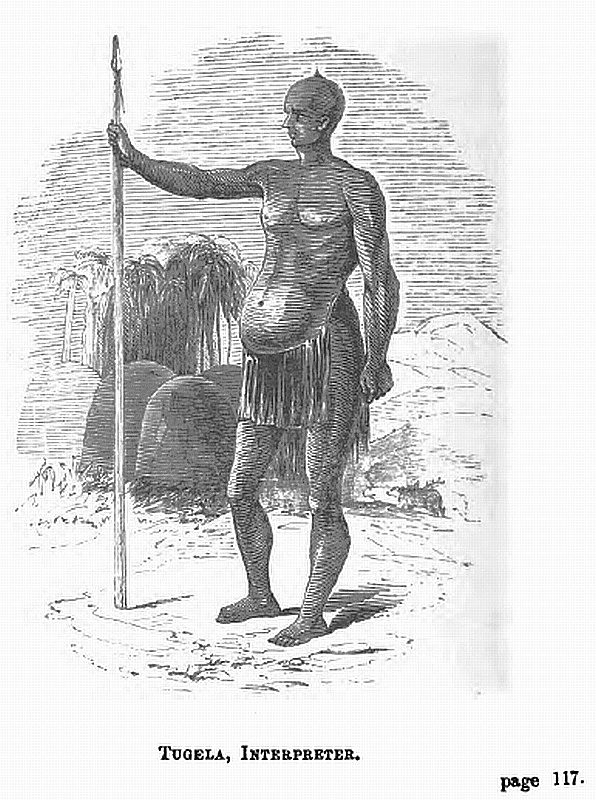
After we had regaled ourselves to our hearts’ content, and I had learned through Tugela that my conduct during the day had much surprised and pleased my companions, who predicted I might become a good hunter, we prepared to return to the kraal. The “boys” loaded themselves with the game, and we marched home. Home! I use the word now from habit, yet how sadly it sounded to me then. Truly, though no hostility had been shown to me by the natives, but, on the contrary, rather a friendliness, so that I felt I had no need to fear respecting my safety; still the mind of the Englishman, be he in whatever spot of this sphere he may, when he speaks of home, will revert to the well-known pleasant chimney-nook and the well-beloved faces of his dear native land.
The sun—ah, and what a sun!—was setting as we came in sight of the kraal, most of the inhabitants of which flocked out to meet us; for our load promised food in galore for the morrow.
Abruptly, however, the groups divided, and Metilulu issued forth, attended by his councillors and joila or beer. Upon his appearance we came to a halt on the plain till he had seated himself, when, all the slaughtered animals having been laid before him, the dance began, which I and my poor companions—how I longed to know what had become of them—had witnessed from the bush. While this ceremony took place, some young boys laid across the game to prevent their being attacked by evil spirits. After this was over, I became aware that my behaviour during the hunt had been communicated to the chief, and had met with his approbation. In Kaffir language he highly complimented me, and I in English responded in equally flowery terms respecting his nobleness, his kindness, and hospitality.
I uttered all my palaver, as we would say on board ship, with little thought of its after consequences. Indeed I did not know the good the gods had in store for me, or to what the approbation of the chief would lead. I soon found out, however; for when, wearied in every limb, we returned to the kraal, and I took leave of the mighty Eagle Metilulu, Tugela conducted me to a different and smaller hut than the one I had slept in on the previous night with the “boys.” This he gave me to understand for the future entirely belonged to me, with, thank Heaven! no Kaffir to share it.
Thanking my companion, and begging him to carry my acknowledgments to his chief for this great favour, I, with more comfort than I had felt on the previous night, and breathing a far purer atmosphere, placed the wicker-door over the entrance of the hut; then unrolling my sleeping-mat, and using my arm as a pillow (not yet being able to manage the native wooden ones), I, despite the insects, was soon wrapped in a sound, refreshing sleep.
Chapter Nine.
A Kaffir Wedding—The Chief Metilulu Makes me a Present, which I Refuse.
The unusual exertions of the previous day had so much fatigued me, that I did not awaken till my hut was invaded by a Kaffir, bearing a portion of the game we had killed at the kloof, ready cooked, for my breakfast. This was an additional proof of the chief’s hospitality and friendliness towards me; and I knew from it that, if I chose to conduct myself honourably towards them, they would do their best in their way to make me comfortable. Before I quitted the kraal, however, I was destined to learn what a little may change a Kaffir’s feelings; but at the time of which I now write I was quite ignorant of the power of witch-doctors, droughts, rain-makers, etc, so felt most easy in my mind respecting my position.
Having rolled up my bed, or mat, as I had seen the “boys” do, I took my breakfast near to the door; for though no native had slept there, yet the atmosphere was most close and oppressive.
It was a beautiful morning, and, as I regaled myself upon the portion of koodoo allotted to my share, I could not help recalling my own dear, simple, quiet, little nook of a home in Devonshire, and comparing it to the strange, wild African scenery and people about me. My appearance had now grown too familiar to the Kaffirs to be much remarked, so as I sat they continued their occupations without heeding me.
The time seemed to be that of milking, for several cows stood within a short distance, going through that operation. Most took it kindly enough; but one or two, like our own brindles, which kick over Sukey’s pail, were extremely restive, and no doubt would have given much trouble but for the method their masters had of quieting them. A stick placed through the animals’ nostrils was held at each end by a man, who, on the slightest show of temper on the creatures’ part, turned it sharply, thus occasioning considerable pain, to avoid which the cow wisely lets herself be milked in peace. The milker sits on his haunches, his knees up to his chin, and the roughly-constructed narrow jar pressed between them.
To an European taste the pure warm fluid would have been thought a refreshing morning draught; but the Kaffir never takes it fresh, regarding it as indigestible. The new milk is poured into large jars where, perhaps, some sour milk still remains; there it is left to ferment, when the thick part separates from the whey, and is highly prized by the natives under the name of amasi, a species of clotted cream.
My meal being finished, I amused myself by watching a party of women, all similarly attired—that is, with the short skirt, reaching from the waist barely to the knee, and most with a child slung on their back, proceeding with various implements of husbandry to the fields; for all this kind of labour is performed by the females, who yet have to be home in time to attend to their lord and master’s meals; and woe betide them if they are not ready, though, perhaps, the men have spent all the day in idleness, smoking, or sleeping. No wonder the feminine portion of these people grow absolutely haggish and hideous when but a few years over twenty.
I was surmising how my day would be passed, when I was rejoiced to see Tugela approaching. Getting up, I went to meet him, and soon asked what he could propose for me to do; for he and I had grown to be excellent friends.
He informed me that one of the head men was about to take a wife that day, and, did I please, I might witness the ceremony. As I look with much reverence upon that holy rite, I had a great curiosity to see how it was conducted here; though from the specimen I had seen of the married women, and the arduous life theirs was, I wondered to myself how any Kaffir gentleman could find a lady to have him; but a girl in Caffraria regards it as the greatest indignity conceivable to remain single.
It appeared, however, in the present case, that the bridegroom who was to be, had really had some difficulty to obtain the lady’s consent, having been on view for approval, with doubtful success.
This “view for approval” would rather astonish the young men of my land, and is vastly different to their pleasant little manoeuvrings to get a tête-à-tête with the dear one, so as to whisper in her ear their love, and, perhaps, listen to her charming avowal, given with a rosy blush and downcast eyes.
Here in Kaffirland, the bridegroom that would be arrays himself in his best, with leopard-tail isinene and umucha, or front and back aprons, necklaces on his neck, bracelets on his arms, a multiplicity of feathers in his head-ring, and then armed with his shield and assagais, his heart palpitating, according to his confidence, respecting the success of his visit, he repairs to his beloved one’s home, and, sitting down among her friends, explains his wishes, and enumerates how many cows and skins he is willing to give for the lady of his choice. Should his offer suit the parents, the girl is sent for, who, coming no farther than the door, stares silently at her suitor.
With the Kaffir about to be married, it seemed that, “when on view,” the lady, through a third party, as they do not address each other, had been most arbitrary in her demands. First he had to stand up in that way, then in this, after which he had to run and leap, to prove his merits; whereupon the lady left as silently as she had come. Shortly after, however, the parents brought the news to the delighted swain that he might send home the cows, as the girl had consented. It was this marriage which was to take place that day.
What Tugela had recounted informed me of one thing of which I was not previously aware, and certainly should not have imagined, from the servile way women were treated—that is, that in Kaffirland, save on rare occasions, the girls can select or reject a suitor as they please.
On walking about the kraal, I soon found that an affair of more than ordinary importance was going to take place, for all was bustle,—accounted for, perhaps, by the fact that at marriage feasts, when, as in the present instance, the parties are rich, much beer is drunk and beef is eaten.
Telling Tugela that, if it were possible, I should like to see the whole of the ceremony, he conducted me to a rising ground, where, hidden by some cacti bushes, he informed me that I could easily watch the approach of the bride; and I had not long ensconced myself behind the shrubs—seeking out as shady a spot as I could, for the sun burnt frightfully through my tattered seaman’s dress—when the murmur of voices informed me of the lady’s approach. Soon she appeared, led by two female friends, and followed by her family and companions, all in the gayest attire,—their woolly heads being decked with beads and porcupine spines, or white thorns; while those who were rich enough had arms and ankles covered with ornaments. The bride had evidently put on every available ornament that she could obtain; and if the Kaffir girl is no beauty, assuredly, when she is attired in the bridal costume which denotes her position as a wife, she is, I may say, hideous. Her hair had been all shaved off save one tuft at the top, which had been stuck together, in an erect position, by some red clay or paint, while for the apron of the virgin had been substituted the skirt of the matron. She was guarded by all her male relations, also dressed in their best, and armed with shields and assagais.
Waiting till the procession had passed, I followed at a short distance till near the husband’s kraal, when the bride sat down on the outside, while the giving over the cows, which constituted the marriage ceremony, took place. First an ox, termed ukutu, was given to the bride’s mother, which was intended to be cooked for the wedding feast. After this the male relatives proceeded with a slow, peculiar step, brandishing their weapons and uttering a monotonous, droning chant, up to the husband’s hut, he being as yet inside, and demanded of him the “father’s ox,” called umquoliswa. Upon, as a matter of form, his declaring that he had none to give, the father stated his intention of taking the bride home; to which the other made no reply till called upon to appear, when he did so with a rush, as if desiring to escape from the kraal, but the egress from which was instantly barred by the girls without, who, with much laughter and many jests, kept him in. Whereupon he ordered the umquoliswa to be brought, and, after it had been formally delivered over to the father, the bride entered the kraal, and the dances commenced.
I have already mentioned these dances as being most wild and grotesque. First the husband and his friends began, while the others remained seated; then vice versa—each casting their weapons and shields about in the most reckless fashion, yet keeping time to the songs they sang, during which beer was drunk ad libitum by the lookers on.
These dances were interspersed by harangues from the elder women and the father of the bride, giving advice to the girl about to enter upon the new life, and to the husband to treat her well and be kind; then followed more dancing, when the last ceremony was performed.
The bridegroom having seated himself on the ground, the bride, accompanied by two companions, danced up to him, and began most unceremoniously to kick the dust into his face, load him with abuse, and disarrange his head-gear,—all of which, perhaps feeling how soon it would be his turn to act the master in reality, he received with the greatest good humour.
Another ox was now brought forward, and presented by the bridegroom to the girl. This was solemnly slaughtered; and this last ceremony, Tugela told me, rendered the marriage complete, as, up to that time, either party could have cried off had they felt disposed. All the rites, therefore, being over, the feasting commenced, on the conclusion of which I learned the husband was permitted to take his wife home.
Having no desire to be more than a spectator, and being much oppressed by the heat, I managed to return alone to my hut; for I saw Tugela, who had come to me, was anxious to join the wedding party. When there, I threw myself down on my mat, and soon fell fast asleep, and dreamed of home and the dear ones it contained.
I was just fancying I was once more among them, with my children about my knees, and darling. Katie sitting by my side, her loving face either smiling into mine, or looking up with pretty terror, as I recounted my adventures and perils, when I awoke. The sun was sinking, and I had been aroused by a shadow falling over the entrance to the hut. Starting up, I found it was Tugela, who had come with a message from the chief; and a most surprising one it was, as my readers may imagine.
Metilulu had sent his compliments to the Englishman, and desired to say that, as I now had a hut of my own, I must require some one to cook my meals and attend to my wants; therefore he was condescending enough to wish that I should take a wife.
I regarded Tugela in horror; then concealing the feeling, which it might be dangerous to display, I, as politely and respectfully as I could, declined the offer, saying I was extremely conscious of, and grateful for, the kind intentions of the great chief respecting my comfort, but that I could cook meals and attend to my wants myself; for, being already married in my own country, it was against the custom of white men, as Tugela must know, to marry again.
“Ah,” he responded, “but the English wife is far away; she no good—she no cook—she no work for you.”
“Yes she does; she cooks and works for my children, awaiting my return,” I answered, with a slight tremor in my voice.
This reasoning seemed perfectly incomprehensible to Tugela; and I thought, with some trepidation, that if it were so with him, who had lived in white settlements, how might the chief Metilulu take my rejection of his offer.
“Tugela,” I said, “you are aware that it is our custom, our religion, to marry but one wife; therefore, I pray you, tell your chief how sincerely I feel his kindness, but how impossible it is for me to obey.”
He promised to do so, but added, as if he thought, perhaps, the information might make me change my mind, “The Great Eagle knows that you are poor—that you have no cows to give—so says he will purchase you a wife himself.”
This additional generosity quite overpowered me. Metilulu must be bent upon the fulfilment of his desire indeed; nevertheless I could only reiterate my thanks and refusal.
So, finding me in this humour, Tugela left to bear my answer to the chief, while I, extremely anxious as to the consequences, awaited the result.
A Kaffir wife! Oh, horror! Even if I had been a bachelor, and no dear Katie was in the way, the thought would have been quite as revolting in my idea. I felt that the comforts I thought I might expect during my compulsory stay in Caffraria were growing beautifully less; indeed, that at any moment, through such unforeseen causes as the present, the chief’s anger might be drawn upon me, to my ruin. So I inwardly resolved, did any danger threaten, to try to escape, though I had again to take to the bush.
I did not then know half my trouble, and was ignorant that my unfortunate self had, unknowingly, inspired with the soft passion the heart of a young Kaffir girl.
Chapter Ten.
My Anxiety is Calmed for a While—Illness of the Chief’s Wife—Finding the Wizard.
I need scarcely say that I did not stir from my hut that evening, being doubtful of doing so till I had ascertained how Metilulu had taken my refusal of his liberal offer; for liberal it was, as any one who is acquainted with the jealous love of the Kaffir for his cows would confess. So endeared, indeed, are these animals to them, that, to take one and place it in the midst of a strange herd, the owner can yet, without a moment’s hesitation, immediately select his own. Therefore, I repeat, the chief’s offer was generous, and consequently my refusal would be the greater insult to his royal desire. I waited and waited till the silver moon rose high; yet Tugela did not return. What was I to think of it? I could but read trouble, and my mind grew restless accordingly. As yet I had only witnessed the Kaffirs torture their cattle; how might they torture their victims? I had read how some of these wild tribes delighted in such things, and I shivered involuntarily; but of one thing I was resolved, that I would be true to Katie; and instinctively clutching an assagai, which had been left me, no doubt, by accident, I prayed that, if the worst came, it might not be considered a sin if I took, at one stroke, the life which, perhaps, these men about me would extract by slow torture.
So the time slipped away, and I was still engaged in painful thought, when the stillness of the night was abruptly broken by a sudden turmoil. Curiosity overcoming all other feeling, I crawled on hands and knees to the entrance of the hut and looked out. To my surprise, I beheld the young bride of that day’s ceremony in the midst of some three or four, other women much her elders, who, evidently uttering anything but complimentary epithets, were pulling and molesting her in a most extravagant manner, while she stood partly terrified and partly unable to return the assault upon her.
As an Englishman, I might have flown to the aid of the distressed; but I was in a strange country, and certainly at that moment in an equivocal position; therefore I felt I had much to learn of the customs of the natives before interfering, especially as I observed several Kaffirs placidly smoking at the entrance of their huts, and apparently enjoying the scene.
By their actions—for I could not understand a word of their language—I guessed that the four elder females were the wives of the bridegroom, and they had seized the first opportunity to show their jealousy of the new addition to the family.
The rage of the four assailants was increasing momentarily, and I began to fear the consequences, when there was a cry of terror, a lull, then a sudden skulking away of the group. A man—the bridegroom—had appeared in the midst, grasping a stick, with which he liberally belaboured the bare shoulders of his first wives, who, with affrighted cries, and amid the laughter of the spectators, hurried off to their hut, while the bridegroom followed at a more leisurely pace, accompanied by his new bride.
The event had made me for a while forget my own trouble; but when all again had become still, it returned to my mind, and I became more uneasy than ever at the delay.
I soon, however, felt convinced that Tugela would not come that night, for everything was growing quiet in the kraal, betokening rest. The smokers had crawled into their dwellings, the Southern Cross gleamed brightly overhead, and the stillness of nature was only broken by the occasional low of the cattle or the roar of some wild beast in the adjacent bush. So, stretching myself upon my mat, I tried to sleep by banishing my own troubles from my mind, and employing my brain by surmising what fate could have overtaken Jack Thompson and Mr Ferguson, the missionary. By this means I at last fell into an uneasy slumber, from which I did not awake till early morning, when my first thoughts naturally recurred to the chief’s proposal the day before, and, as I had waited on the previous evening, I now as anxiously did so for Tugela’s appearance. I also became aware that I was very hungry, and that no food had been sent me, which I was attributing to the first signs of Metilulu’s displeasure, when my attention was attracted by a commotion among the people. Peering stealthily out, I saw that concern was marked on the faces of every passer-by, as they went rapidly to and fro, casting suspicious glances at each other.
It was at this moment that Tugela at last appeared. I started up to receive him, and also make room for him to enter. On his doing so, my first question was as to how his chief had received my reply.
“Fortunately for you,” he answered, “the Great Eagle’s attention has been directed to another event—one which will affect all the kraal.”
“That has affected it, I should think,” I rejoined.
“You know what it is?” he questioned.
“No, not yet.”
“Then the favourite wife of Metilulu has been suddenly taken ill, and the kraal is all aroused to learn who has made her so. The chief has sent to the witch-doctor to find out.”
“The witch-doctor! Why?”
“Because it has been caused by magic.”
“What! do you think illness can come but by the influence of that?”
Tugela gravely shook his head.
“Yes; some one has a spite against Anzutu, and has cast the illness upon her. You need not now fear for yourself,” he added, “your rejection of the bride Metilulu would have given you is forgotten for the time by this last event.”
When he spoke thus, I was far from conceiving all that this superstition comprised, though I saw by his manner that it was something exceedingly serious; consequently, as he assured me that I was safe, I accepted his invitation to see the ceremony for discovering the wizard. He warned me, however, not to join the circle, as sometimes witch-doctors did not like white men.
Accordingly, having by his help satisfied my hunger, I left the hut with him, and soon heard that the witch-doctor had declared Anzutu’s illness arose from the hatred of one of the tribe—a wizard,—and that that person, having possessed himself of some article touched by the sufferer—a shell, some beads, or tuft of hair,—had buried it, and, by constantly repeating spells over the place, was occasioning the failing health of the chief’s wife, whose illness would certainly end in death if the wizard were not detected.
For the latter purpose, orders had been issued that all the Kaffirs should assemble together—the chief himself being present—at a given time, though time seems a strange term, for Caffraria knows little about it. The natives are aware that they wake in the morning, and, if the chief wills it, they may be dead before night; for the head man’s power is absolute, and the victim suffers without a murmur. Therefore with them time and life are very precarious possessions.
Advantageously placed by Tugela where I could see and not be seen, I soon beheld the space which had been selected for the trial begin to fill with Kaffirs, each with a very serious cast of countenance.
My common-sense told me that it was a farce I was about to witness—a farce which proved to have a terrible conclusion. I felt that the idea of these doctors detecting wizards must be an imposture, though the actors might even deceive themselves; and it seemed strange to me how the natives could put confidence in the infallibility of these men, when, by their faces, each dreaded that he would be the one accused, though knowing himself to be innocent.
Silently they all met; and my fat friend Metilulu, attended by a guard of “boys,” armed with knob-kerries, advanced and took a seat apart, smoking profoundly.
All, squatting down Kaffir fashion, awaited with evidently breathless suspense for the witch-doctor’s coming. At last he appeared, and a more hideous object I never beheld. He was of a most haggard, cadaverous aspect, and his lean body attenuated. In one hand he carried a stick—his wand,—to the top of which was fastened the tail of some animal. His garments consisted of the front and back fur aprons. About his neck was coiled a dead serpent, numerous tails of wild beasts hung over his breast and shoulders, while feathers of various hues adorned his issikoko, from which depended several charms; but the most striking sight was his face, which, like his body, had been daubed over with white earth; and the effect of this on the dark skin can be hardly conceived.
The entrance of this repulsive personage into the circle was received by a shout of welcome—a compulsory one it must have been, for none could have cared to have seen him. I did not, even from my place of concealment, and often thought that his horrible eyes, made startlingly apparent by the white earth, glared through the bushes and detected me.
With a slow pace the wizard made his circuit, quickening his speed as he went till it grew into a wild dance; while all the time he uttered some native chant, which increased in loudness as his movements did in rapidity. That any man could have been able to move his limbs with such swiftness, or leap so high, I never would have believed. It was rather the wild dance—the wild song of insanity. Song, did I say? The little melody it had at first possessed speedily vanished, and was replaced by frantic shrieks and cries as of a maniac; while tears actually streamed down his face, doing sad havoc with the white earth. First he sprang to this side, then to that—all cowering as he approached,—while he snuffed up the air, as if discovering the criminal by that means. I watched each movement with suspended breath, for I had been told that his wand would fall upon the victim, or the guilty person, according to these benighted people’s idea. Once he paused, and I saw those near him shiver perceptibly; then he fled off with a bound in another direction.
How long the scene lasted I cannot tell; but I know the excitement was beginning to tell upon me, when, with a sudden swoop, he struck the shoulder of one of the Kaffirs, then darted away. In an instant, like a swarm of locusts, the guard of knob-kerries were upon the unfortunate victim, preventing any attempt to escape; while I was afterwards told that the witch-doctor, dashing off, entered each hut he came across, sniffing violently to discover the spot where the charm was buried, and followed by a wondering awe-inspired crowd. Abruptly halting at one spot, he cast down an assagai, and ordered the people to dig—an operation which produced, as it generally did, a tuft of fur and some beads. This, in the Kaffirs’ opinion, proved the truth of the witch-doctor’s accusation; but, in mine, I fully believe that the articles had been placed there by himself previously.
All praise, say I, to those self-sacrificing men, the missionaries, who go among these people to improve them. Surely any one who can turn them a hair’s-breadth from their benighted ignorance is to be applauded. I am aware that some men, being utterly unsuited to the task, do more harm than good; but such men as Dr Livingstone—that truly noble missionary—we ought to honour with all our heart, as we should any man who will try to make civilisation take the place of such horrible barbarity as I have to record in the next chapter.
Chapter Eleven.
The Fate of the Wizard—Skin Dressing—The New Wife.
Leaving the witch-doctor to pursue his way and find the charm, I will return to the poor, wretched victim.
The “boys,” armed with the knob-kerries, had seized him, trembling but silent, in their grasp; while a decided expression of relief broke over the features of the rest. They, at any rate, were safe. Yet the accused must have been a friend of many there; but, strange to say, none spoke in his favour: on the contrary, all appeared even fearful to come in contact with him, and drew off to a little distance.
The so-called wizard was now interrogated, and commanded to produce the charm with which, by the aid of spells, he had brought the present illness upon Anzutu. In vain the poor fellow declared his innocence, protesting his loyalty to his chief and all belonging to him. It made little difference. The question was reiterated, till he exclaimed, “I have no charm—it is no use asking—I must die.”
It was at this moment that the witch-doctor returned, performing many eccentric bounds of triumph, and holding in his hand a little tuft of fur and a string of beads, which the chief Metilulu instantly declared to have belonged to his wife. This, as may be conceived, sealed the fate of the poor fellow whom they had so soon created into a wizard. He was immediately seized by his tormentors, who, flinging him upon the ground, began piercing the quivering body in every part with Kaffir needles. I put Kaffir; for when I say that they more resemble a skewer than the pretty little articles which look so well in our countrywomen’s fingers, the awful pain they inflict may be imagined.
I grew sick in watching these brutes, and, but for very fear, could have shrieked in compassion; though scarcely a groan escaped the victim. An European, I am sure, must have fainted over and over again under the torture; but the Kaffir never once lost consciousness; and in this case, as in many others I witnessed, I was perfectly assured that, whether from their hardy mode of life and healthy constitution, or from whatever other cause, these savage people are not so sensitive to pain as are the inhabitants of civilised countries.
While some five or six had been probing the miserable man’s body till their hands were tired, others had been kindling a fire, where they were heating several large stones. When these were thoroughly heated, the wizard was borne near, fastened firmly down, and—I shiver as I recall it—the red-hot stones were placed upon the quivering flesh, which cracked and shrivelled under the weight and heat.
Sick and dizzy with horror, I could bear it no longer, but fled—fled till I could get free of the smell and the murmurs of his tormentors—as to the victim, he bore all stoically,—then flung myself on to the ground, nearly fainting with disgust. I grew worse still when I remembered that, should I offend these people, the fate of this man might be mine.
My first instinct was to take at once to the bush, and quit the incarnate fiends; but after reflection told me the absurdity of such an act. First, it was broad day, and my figure might easily be distinguished; secondly, the Kaffirs were scattered everywhere about the kraal, so that at any time I might encounter one, whose suspicions would speedily be aroused by seeing me so far from the huts; while, lastly, I was utterly destitute of provisions or weapons.
Therefore, after a time, I saw the wisest course was for me to return, and to conform to their customs if necessary—save that of taking unto myself a wife,—and, by keeping my eyes open, seize the first opportunity to escape. So, making a considerable détour, to avoid the spot where the wretched wizard had suffered, and where, to my renewed horror, I perceived by the movements of the men in the distance the torture was still going on—indeed it was some hours before nature finally succumbed, and the man got rest at last in death—I proceeded towards the kraal, but changed my intention on coming across a group of Kaffirs engaged on some work. As I was now looked upon in the most neighbourly manner by them, and also myself desiring to appear friendly, I drew near, and, by signs, entered into conversation.
There were three of them squatting upon the ground, with an eland’s skin between them, which they were scraping with all their might. Having sat down, and with much gravity, suitable to the solemnity of the occasion, accepted snuff from one of the workers, I made them understand that I should like to know what they were doing.
By signs I managed to make out that they were tanning the skin, and watched the process with much interest. They continued to scrape and scrape the inside till it was perfectly free from grease, all the while—if not replying to my dumb-show interrogations, or speaking to me in the same manner—accompanying the operation with songs, snuff-taking, and smoking.
By Tugela’s kindness, I had been presented with a pipe—a most precious gift, it must be known, in Caffraria, where the natives look upon smoking as the ne plus ultra of life’s luxuries. A company of them, when tobacco’s scarce, will even smoke in the following original manner:—One will draw in from the pipe as much as his mouth will possibly hold, then pass it on to the next, and so on till all the company have been served; then they retain the fumes so long that all the vessels of the head grow surcharged with it, when the smoker drops intoxicated on to the ground—an insensibility from which he is recovered by the kindness of his friends, who, by buffets, pinches, and hair-pullings, will restore him at last to consciousness. However, on the present occasion each was fortunate enough to possess his own. Mine was a long reed, with a clumsy bowl, about four times the size of a large European pipe; for the Kaffir cannot get too much. This capacious hollow was filled with rough, coarse tobacco, which few Englishmen would smoke could they get better; but when better cannot be procured, I have no doubt they would do as I did—take what they could get.
So we sat smoking, and they, snuffing and singing, till every morsel of the hide having been well manipulated, they commenced the next process. Fastening several of their needles together—the sight of them made me again grow faint,—they began twirling the bundle between their hands, so that the sharp points tore the skin till it was roughed in every part; then taking a powder, made from the rotten root of the acacia tree, they rubbed it into the hide with all their might; and this, which answered the same purpose as our tan-pit, they continued to do till the skin was ready for use.
From these, and numerous other skins, the Kaffir kaross, or cloak, is made. That article, fastened round the neck, falls down the back, and, save in winter, is more for show than use. Many skins have to be used in their construction, especially when the hide is that of a small animal, such as the meerkat; and, in that case, it is most wonderful to see the neatness with which they are sewn together. It is truly surprising, when it is considered that their only implements are the needles previously mentioned, a stiff fibre for thread, and a stone to rub smooth the seams. Yet, despite these disadvantages, when completed, the kaross might be taken for a whole and perfect skin, did not the arrangement of the shades prove otherwise.
Having watched all this done, and by that means succeeded in whiling away the time, I bade farewell to the skin-dressers, and, no little dejected in spirits, returned to the kraal and to my own hut, where, finding some dried koodoo flesh and a little amasi left in the gourd which had been brought me, I stayed my hunger, then sat down on my mat, feeling sure that Tugela would, after the terrible ceremony of the day was over, pay me a visit.
I was not wrong; he soon made his appearance, his face bright and smiling—an expression I had noted on several Kaffir features as they passed my hut. This gave me much confidence; for I felt we had become such good friends that he would not smile did evil threaten me; so, with a sensation of relief, I bade him welcome, and asked the news. He replied upon a subject very different to that I was thinking about.
“The great chief Metilulu,” he said, “has ordered the elephant hunt to take place to-morrow, and I came to tell you.”
“To-morrow!” I exclaimed; “I thought Metilulu intended to be present himself.”
“He will be so.”
“But the illness of his wife.”
“Why should a woman keep the great chief from his pleasure?” responded Tugela, in a tone of contempt at the idea; “but Anzutu is better.”
“Better! I am delighted.”
“No sooner had the wizard suffered,” said Tugela innocently, “than Anzutu grew better. Had the charm not been found, she would have died.”
He spoke this so seriously that I dared not express my doubt upon the point; yet I could not refrain from saying—
“But supposing, Tugela, the witch-doctor had selected another as the wizard.”
“He would not, because the one he discovered was the right man.”
“Possibly; yet each Kaffir, I fancied, looked as if he feared the selection might fall upon himself.”
“Because they are all aware of the power of the witch-doctor. He knows more than we do,” said Tugela, with evidently a firm belief in his words. “The one he selected was the right one,” he added, “for, see, has not Anzutu recovered?”
I saw no arguments of mine would shake Tugela’s faith in the terrible superstition which gave such an awful power to the ignorant men who possessed it, so dropped the subject, and began to ask him respecting the hunt of the next morning. He told me that the footprint of a majestic elephant had been discovered some days back, and the Kaffirs were all eager to track it.
“Some days back,” I said; “will they be able to discover it again?”
“Certainly. We Kaffirs have a way so as never to forget the track of an elephant.”
He had begun to induct me into the method, when he was suddenly interrupted by a great hubbub without. He instantly started to the door, and I followed.
The bridegroom of the previous day stood outside, surrounded by a number of Kaffirs, to whom he was angrily gesticulating. Not being able to understand his harangue, I had to wait till I got it second-hand from Tugela, who told me that the bridegroom’s wives had that afternoon gone out gathering wood in the bush; but when the husband had returned, he had found all his wives at home save the youngest, whom he had paid so many cows for the previous day; while his questions respecting her whereabouts had elicited no satisfactory answers, though he had had liberal recourse to stick.
Though these people practice polygamy, giving for a cause, if asked, the necessity for keeping their huts right, getting their dinners cooked, and grounds tilled; and though, also, they treat their women not very much better than the Australian natives who regarded the softer sex but little above their dogs, yet they are extremely jealous respecting their wives’ fidelity. The chief has a regular harem, which, like in Turkey, has a special guard to watch who goes out or in. Should a wife be found unfaithful, the punishment is severe, sometimes death even.
I believe that, in the present case, the husband fancied his new wife had fled to another kraal, for he was extremely irate; but he first decided to go to the bush where the women had been, so he started off with several others, Tugela and myself among the number, and led by the boy—I mean a boy now, who had gone out with the women—not to help, be it understood, for even at an early age the male sex asserts its superiority.
Forward we went into the bush, lit up by the red glow of the setting sun, but not a sign could we discover of the lost wife. For over an hour we searched and called in vain, and the husband ordered a return, stating his resolve to visit the neighbouring kraals next morning, and demand to have his wife restored, as he felt certain she had fled to one of them. It was at this moment that a peculiar cry from one of the Kaffir’s brought all the rest to the spot.
There, on the grass, apparently dead, murdered, laid the body of the young wife. The horror I experienced at the sight was not seemingly felt by my companions, rage being the only feeling they exhibited, as, taking up the inanimate body, in which we yet detected signs of life, we bore it back to the kraal. A large wound was on the skull, while there were others about the body, such as, with an European, might in all probability have caused death, but to my surprise Tugela said that he had no doubt the woman would soon get over it.
“But who could have tried to murder her?” I asked.
“The other wives,” he replied coolly.
“The other wives! In Heaven’s name, why?”
“From jealousy. Old wives do not like young ones.”
“And what will they get for doing it?”
“Stick, a great deal of stick.”
Tugela was right; the wives did get stick considerably; while, a few days after, I saw the young wife working in the kraal as if nothing had happened. The tenacity of life in these people, I confessed, was great indeed.
Chapter Twelve.
The Elephant Hunt—My Mind Grows Easier.
When morning dawned, and I recollected that it was the day for the elephant hunt, in which Metilulu was to bear a part, I felt by no means easy in my mind respecting the meeting; but as it has always been my nature to put the best face on affairs, however gloomy, and to trust in that Providence which already had dealt so kindly by me, I placed a small kaross which had been given me over my shoulders, for my red seaman’s shirt was now absolutely in rags, and, taking my breakfast, awaited news.
The kraal was full of animation, occasioned, as I afterwards learned, by the fact that Metilulu had expressed his intention to bivouac out that night, so as to pay due honour to the elephant when killed.
Tugela had been telling me, when he had been interrupted by the hubbub outside, that one way in which they entrapped elephants was by means of a pit-fall, such as that into which poor Grimes had stumbled; but this did not succeed long together, for these animals have such reasoning powers that after one or two of the herd have been thus caught, the rest become most wary, and always place an old, sagacious one in front, which carefully feels the ground with his foot before advancing, so that directly it touches the branches laid over to conceal the pit, he detects the deception and avoids it. The hunt which was to take place was to be of a different kind to this. The footprint of a remarkably fine elephant had been discovered, the tusks belonging to which evidently would be a prize to the slayer.
I had already—as perhaps the reader may remember—expressed surprise as to how a Kaffir, finding these footprints, could find or track the elephant after some days had intervened. I now ascertained that the native, on coming across a foot-mark, took off the impression in soft clay; and so accurately do they manage this, that, among a hundred other prints, they can still keep to the one belonging to the animal they wish to kill.
Tugela having joined me, with the intelligence that the hunters were about to start, I proceeded to the outside of the kraal, and was no little pleased to find Metilulu not there. As, however, I had understood he was to be present, I could not help making a cautious inquiry respecting his non-attendance, and heard that it was his royal pleasure to come on afterwards—meaning thereby, as I divined, before the day was over,—to be in, according to English fox-hunters’ phraseology, at the death and the sumptuous feast of elephant feet.
Having used my weapons to so good a purpose before, I was again accommodated with some assagais and a shield; thus, with my trousers worn down to knee-breeches, my boots long discarded, my browned stockingless feet, bronzed face, and the fur kaross over my shoulders, I really began to look very like the Kaffirs about me.
One of the natural proclivities of mankind, I verily believe, is a decided love for the chase. Certainly, as I strode along, surrounded by the lithe, vigorous, armed forms of my companions, with the fresh morning air blowing on my cheek, the expanse of wondrous scenery stretching on every side, and my spears grasped in my hand, I felt the blood begin to beat with renewed energy in my pulses, and the depression which late events had cast upon me gradually wearing off.
The model of the elephant’s foot that we tracked was soon brought into requisition. We had scarcely gone half-an-hour’s sharp march before we came across several footprints, in which the one we were after was apparent. I did not think that these animals came so near the vicinity of man as the marks proved; but Tugela said that at times a herd of them would make a swoop in the night upon the kraal itself, and destroy all the crops growing near. The only way they had of scaring them was to light large fires, make as much noise as they could, and—think of it fond English mothers—to beat all the children in the community, so that the addition of their shrill infantine yells might terrify the ponderous animals.
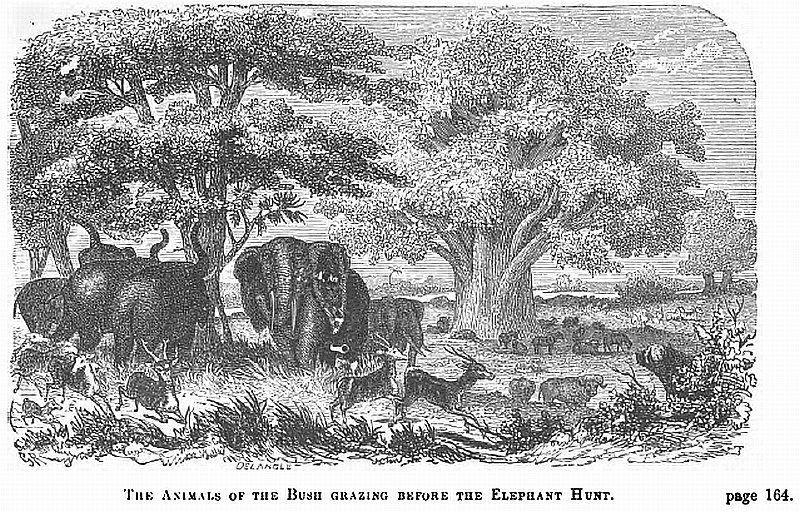
The track having been discovered, the hunters proceeded with much caution. Slowly we advanced, I finding some difficulty in making my way through the bush like the natives, with their smooth, well-oiled bodies, though I managed to keep on, carefully avoiding, however, any parasite at all resembling the uncaria procumbens, or hook plant.
About an hour after we had lighted upon the first footprints, we reached an opening or glade within the bush, where through the tall tree-trunks we perceived about four or five elephants browsing. My lack of knowledge respecting hunting in Caffraria would speedily have finished me entirely had not Tugela had the forethought to advise me to take to a tree, and hurl my assagais from thence; for to an European, with a body not devoid of clothes, neither well oiled nor accustomed to the exercise, it would be impossible to penetrate the bush rapidly, as it would soon become necessary to do to avoid the enraged animal, which, when struck, always took to the forest in the direction of his assailants.
Accepting his advice, I speedily selected a tall tree, which, thanks to my nautical experience, I climbed with ease, and from its branches looked down upon the black, shining bodies of the hunters and the browsing elephants, as yet unconscious of the danger which was so near at hand.
Tugela had pointed out to me the beast which was to be the victim—a fine fellow truly—and I longed for one of our English rifles, when I could have picked him off in two twos, whereas I soon found the assagai wounded only to irritation, and finally killed by exhaustion, such as a man might die from on being pricked to death by large pins. I have no doubt this is the reason which makes the Kaffirs, in a herd of these animals, attack one and one only. Looking down, I perceived that the hunters were approaching the edge of the bush, which yet concealed them, wriggling through it like snakes, with their assagais ready to hand. As they neared the open space, I fancied the elephants became aware of our presence, for the one we had spotted threw up his trunk suddenly, stamped with its foot, and uttered one of their loud, peculiar, trumpet-like cries. The next moment some twenty assagais shot with unerring aim through the air, and penetrated the animal’s thick leather-like hide.
His cry of fear and rage was terrible to hear. First he seemed confounded, then, while the rest fled in terror, conscious, no doubt, by his cries that danger was in their neighbourhood, he rushed blindly forward into the bush.
I now recognised the wisdom of Tugela’s advice to such an amateur hand as I; for as the enraged beast dashed on, trampling the underwood beneath his feet, it was as much as the Kaffirs themselves could do to avoid being crushed by slipping out of the way. Like monkeys, they dodged about him, darting their assagais at every opportunity that presented itself, while I from my vantage-ground hurled one now and then with all the force I could command.
I must not forget to mention one very important auxiliary of the hunters. This was their dogs. These little wretches, now let loose, snapped and barked about the ponderous creature, irritating him to such a degree as to render him at times quite regardless of the sharp stings—for they appeared little more—of the spears.
I have said that I cast one of my assagais only occasionally. I did so for this reason: I now had always the thought of escape before my eyes, so I refrained from parting with all my weapons, thinking they might prove of greater use hereafter; so I merely acted as spectator, and looked on till I began to fancy the miserable creature—whose trumpet-like bellowings were growing fainter and fainter—never would fall. It truly was a cruel kind of hunting. His massive body was covered with blood streaming from the many wounds, and he staggered on his thick legs; but he yet continued to dash at his assailants, maddened by rage and pain, and strove to turn sharply upon the snapping, barking dogs. At last, however, when his black hide resembled a lady’s pincushion supplied with many pins, he gave a great reel, a final cry, and sunk slowly upon his knees, apparently dead.
A delighted shout issued from the throats of the hunters, as, swarming forward, they repossessed themselves of their weapons, then proceeded to place on the animal’s tusks the mark of their owner, who, by hunters’ rules, was the one who had inflicted the first wound, after which they cut off its tail, that being, like the fox’s brush in England, considered a great trophy.
Seeing no reason why I should remain longer in my private box, as it were, the drama having come to an end, I made haste to descend; but whether it was through being incommoded with the spears I carried, or from some other reason, certain it is that I had not got more than half-way down, when I fell—fell, as ill luck would have it, right into the extended branches of a hook plant. Instantly aware of my danger, I strove to free myself; but quickly found that what Mr Ferguson had said was true—that the more one tried to clear themselves, the more entangled they would get. The plant seemed endowed with life, and with its fingers fastened closer and closer about me at the least move; therefore I wisely remained motionless, only exerting my voice, which I did to the top of my lungs.
For some while no heed was paid to me, all the Kaffirs being too busily engaged with their prize; but after about a quarter of an hour, as far as I could judge, Tugela came to ascertain the cause of my shouting. On perceiving the fix I was in, he burst into a fit of laughter, for the Kaffir dearly loves fun, or anything verging on a joke. Seeing nothing I could do better, I joined him, till his face growing rather more serious, I put the question as to how I was to get free.
There was but one method. Like the sheep in the fable, which got into a thorn bush to shelter itself from the storm, to quit it I was compelled to leave my fleece, or clothes, behind me. This, considering the state they were in, I found but little difficulty in doing, and when once extricated, with Tugela’s help, I managed to recover my rags by cutting them from the thorns. On donning them, however, I became aware that I should very speedily have to adopt the native dress entirely unless I intended to go without any costume, at all. This was the first time I had come in close contact with the unfriendly grasp of the hook plant, but, I am sorry to say, it was not the last. I shall have to recount a similar event farther on, when I was not so fortunate in getting so speedily extricated, but really believed that, after all my hair-breadth escapes, death had seized me indeed. But to return to the hunting party.
Metilulu had by this time arrived, and was waiting in the glade for the next ceremonies to begin. I had now of necessity to make my appearance before him, and did so with some trepidation, but to my great relief found that he welcomed me with a smile, and by a sign invited me to sit down by him. I instantly obeyed, and, as a natural consequence on such instances, Tugela took his place close at hand. I knew by his expression that the first remark the chief made was respecting my torn garments, the reason for which seemed to amuse him as much as it had the interpreter, for he laughed heartily; in fact, to my satisfaction, he appeared in the best of tempers; perhaps it arose from the prospect of the feast he was going to enjoy, and the joila or beer he had drunk, for a jar of that much beloved liquor stood within reach, and of which he condescendingly invited me to partake. He then, through Tugela, asked me what I had thought of the hunt, and how it was conducted in our country. I replied that we had no such animals in England, or even in Europe, but when our people settled in or visited Africa, or another great country called India, they used a rifle which killed the elephants in a quarter of the time the assagais did. This seemed much to astonish him, though he had heard of and even seen guns; the Boers had them, he said, and some travellers who had once stayed at the kraal a few days had carried such weapons.
My readers may imagine how my heart leaped at this last news, which showed that white men did occasionally come there, and were permitted to leave unmolested. I drew hope for my own deliverance from it, and the landscape, with its candelabra-looking euphorbia trees and parasitical monkey-ropes, seemed to put on a far brighter aspect to my eyes than they had the moment before.
So elated was I at the intelligence I had just heard, that I determined to win Metilulu’s good opinion as much as I possibly could, for which purpose I gave Tugela enough to do to interpret the enthusiastic praises I expressed for everything—omitting the wizard affair, of course—which I had witnessed in Caffraria; while I also gave the chief long accounts upon any subject respecting my own land that I thought would amuse him.
During our conversation the hunters had been engaged with the slain elephant. Having cut a large hole in its side, they removed the intestines, which in their opinion is the finest part; then as they were to camp out, and the feast to be held there, two of the animal’s massive feet were severed, and prepared to be baked with some slices of the trunk.
The method of baking is as follows:—A large hole is dug in the ground, which is filled with wood and dry moss; this is ignited, and kept supplied till the cavity is filled with bright glowing embers; these are removed by the Kaffirs with large poles—for the heat is intense,—then the large elephant’s foot is rolled into the burning hole, and immediately covered with fresh branches, which are lighted—a bonfire is made, indeed, and when it has burnt itself out the cooking is considered complete.
The foot presents when done a most gelatinous appearance, and, as I was honoured by dining with the chief, I suppose I was regaled with the best parts. I must own, whether it was hunger acting as an excellent sauce or not, that I thought it extremely good, and enjoyed the repast.
The feasting lasted some time; for when a Kaffir gets an opportunity of eating flesh ad libitum, he makes good use of it, and their capacity of consumption is immense, as will be seen when I state that, on looking round at the conclusion of the meal, I perceived the skeleton of the elephant alone remaining. Save a few strips hung over the branches of the trees to dry for the morrow—called “biltongue” in the native language—every atom of the flesh had been consumed.
The hunters, and especially Metilulu, having eaten and drank till nature could receive no more, rolled themselves in their karosses, and, having first placed a guard to keep up the fires, so as to scare off the wild beasts, extended themselves on the ground to seek the sleep which speedily comes to them.
With a fervent prayer that Metilulu might always keep in the same good humour that he had been in that day, I thought I could not do better than follow the excellent example of my companions; and I remember I fell asleep wondering how it was that the chief had never referred to the handsome present of a wife which he had wished to make me.
Chapter Thirteen.
Unpleasant News—Death of Anzutu—Funereal Rites.
The sun had not risen very high before the hunting party was astir and preparing to return to the kraal. The head of the elephant was left where it was to decompose, which, under such a sun, it would not take long doing, when the tusks could easily be removed. It may appear strange that so valuable a portion of the animal should be left unguarded in the bush; but there is a great amount of honour between Kaffir hunters, and each strictly respects the mark of the other. The Kaffir whose property they had become by right of the first wound—though the chief being present I found they were to be presented to him—was a great hunter, as could be seen by the leopard tails which formed his aprons and the teeth of wild beasts of which his necklaces and bracelets were composed; for in Caffraria, if a man wants to dress in these much-prized ornaments, he cannot purchase them, but must first slay their natural possessors. So proud is the hunter of these trophies of his prowess, that he will rarely part with them save to his chief or the exacting witch-doctor.
On nearing the kraal I remarked a sudden change in my companions’ manner, which I could not but attribute to the appearance of, or signs made by, some Kaffirs who stood at the entrance to the huts, evidently watching for our return, for no sooner did we come in sight than they advanced towards us. As they approached, I saw that they were divested of all ornaments, while they wore the oldest aprons and karosses they possessed. Guessing there must be some cause for this, I awaited the result with much curiosity.
The two parties had now advanced near enough to exchange sentences, and no sooner were the first uttered than a mournfully dolorous cry arose from the hunters, who frantically began tearing off their ornaments, even to the Chief Metilulu, who, instantly taking the lead, hurried on as fast as his obesity would permit.
Remembering how the Jews of old, on the illness or death of those dear to them, rent their garments and cast dust upon their heads, I could not help fancying that this removal of all decorations, accompanied by the cries of sorrow, must be occasioned by the same cause, and making my way to Tugela, I put the question as to the reason of the sudden change in the hunters to him.
He answered that during our absence Anzutu had been taken much worse, and was not expected to recover. He told me this in a round-about way, for the Kaffir avoids the word “death” as an Englishman might the plague, and it is not considered etiquette to mention it ever in a chief’s presence. Though a Kaffir has no idea of time, and regards his life as not his own, but his chief’s, who may order his execution at, any moment he please yet they, greatly dread death when it comes naturally, and would give anything, to conceal those precursors to old age—grey hairs.
When I heard that Anzutu would probably die after all, I could not help thinking that the death of the wretched wizard had not done much good. Whether Tugela had divined my thoughts I do not know, but when he spoke again he certainly answered them.
“Had Metilulu applied to the witch-doctor sooner,” he said, “this might not have been; the wizard had got too much power before he was stopped.”
We had now entered the kraal, where I found both men and women attired in their oldest aprons, without ornament, and all betraying the deepest signs of grief. Metilulu, attended only by his chief warriors, had hurried to his own hut to await further bulletins, which soon came, for we had not returned an hour before the news spread through the community that Anzutu was dead.
Never shall I forget the tremendous noise that then arose. Shriek after shriek—howl after howl—groan after groan. Had Pandemonium broken loose it could not have been worse. Work was suspended entirely, and, stranger still for a Kaffir, eating and drinking also. There they sat howling. Feeling myself, as a spectator, rather out of place in such a scene, I retired to my hut, and watched proceedings from the entrance.
Soon the news that Metilulu’s favourite wife had ceased to exist travelled to other kraals, and, to my consternation—for I was almost deafened by the noise already—fresh parties kept arriving all day, and, taking their places, added their voices to the rest; for it appeared Metilulu was a powerful chief among the tribes. The whole day and night they still kept coming, and the noise continued, while never did I see one of the people seek refreshment. Fortunately for myself, I had some dried eland flesh in my hut, with which I stayed my hunger, and so the most miserable twenty-four hours I had yet spent in Caffraria.
In the morning the cries had not ceased; but I went forth, feeling sure that some ceremony—perhaps the burial—would take place after such an uproar, as they could scarcely support it longer. I had seen a wedding—I had seen a Kaffir baby just after birth, and found it to be almost as white as an European’s, the skin darkening rapidly afterwards,—and now I desired to witness a funeral.
Proceeding towards Metilulu’s huts—that is, his own and those of his wives—I found him outside, dressed in full warrior costume, as were those who stood about him. They were engaged in singing a wild native song; then the chief issued some orders. I had no need to understand the language to learn what they were, as they were instantly followed by the execution of several of the tribe, this evidently being a custom. The poor fellows received their fate without a murmur; for, as before stated, in Caffraria the chief’s word is law, and one which his people obey even on some occasions with rejoicing. Indeed, as the miserable beings were now being executed, I perceived by the expression of their faces that they were uttering praises of the fat despot.
Since I saw this, I have read that, upon the death of persons of rank, frequently a general massacre will take place, not only by the chief’s direct orders, but rather as if by it the people wish to show their sympathy with him.
When the executions were over, the cries continued, till I beheld many fall down insensible from exhaustion; and glad enough I was when that day and night also came to an end, for I hoped it would be the last of it, as the following morning the remains of Anzutu were to be consigned to the earth; for it is a singular fact that the custom of burying the dead is prevalent all over the world, save in India with the Parsees, where the funeral pyre is raised and the body consumed by fire.
While speaking upon this subject, I may as well say a few words upon the ordinary rite of burial; for it must be remembered that I am here recounting the death and interment of a person of rank, and in that case the show ceremonies are as different in Caffraria as in our own land, where the plain hearse and mourning coach tell of a poor person’s demise, and waving feathers, velvet trappings, a long string of carriages, men with gilt-tipped rods, announce that of a rich man, who, even in death, cannot surrender the pomp and vanities of this world, but would, as it were, strive to prove the falsity of the saying, “In death all are equal.” But to return to the Kaffirs. On the death of a chief, the people mourn and fast, as above described, till the dead man is buried in the isibaya, where only the head men are permitted to be interred, and where women are never permitted to enter, dead or alive. The commoners are buried in a hole outside the kraal. A hole too, is the proper word to use, for it is small and deep, the body not lying horizontally, but in a sitting position, with the knees close up to the chin. By its side are buried the weapons it used in life, the points being bent to render them useless; while if it be a chief, and rich, oxen are at times killed at the grave.
The next morning all turned out to attend the funeral, I, of course, making one of the number, though I did not mingle with the chief mourners.
A very large hole had been made—about seven feet square,—which caused me to think, if it were for Anzutu, she must have far exceeded her husband in bulk; but my horror was again excited when I found that, as Metilulu desired to show every possible honour to his departed wife, he had issued an order that half-a-dozen young girls were to be buried alive with her.
I had often heard of the custom of immolating victims at the grave of a chief in savage countries, and I had read the adventures of that Marco Polo of Eastern romance, Sinbad, wherein he had, according to the custom of the country, been buried with his dead wife; but I had never known till now that the terrible rite of interring the living with the dead existed in Caffraria.
As I have, I believe, previously stated, female beauty in that part of the world where I then was is anything but prepossessing to European eyes; yet I felt my flesh creep, and my pulses throb with impotent rage, as any Englishman’s would, at the sight of these young girls being, without the least resistance, buried alive. The thought was too horrible, and, starting up, I determined to expostulate with Metilulu, regardless of the consequences, upon the performance of such a barbarous rite.
Hastening on, I came across Tugela, to whom, as I should require his assistance, I naturally confided my intention. He looked at me first in surprise; then most earnestly persuaded me, for my own safety, to refrain from such an absurd proceeding, affirming that, whatever I might say, Metilulu, in his present state of grief, would not listen, but, on the contrary, would very likely have me executed too for trying to insult the memory of his wife. Despite these assertions, I was yet persisting in my plan, when Tugela put a stop to it entirely by saying that if I was resolved, so was he not to interpret correctly a sentence of my request.
Therefore I had to give up my attempt, consoling myself with the belief—which was no doubt correct—that my words would have had little if any effect upon the despotic ruler. Meanwhile the rites went on, the awful burial took place, a special guard was placed over the spot to watch there for one year, and the mourners returned to the kraal, where another ceremony consequent upon a death took place, which again reminded me of the Jewish laws regarding cleansing and purification.
The prophets, or doctors, of the kraal, on the people’s return, sent them to bathe in an adjacent stream, and afterwards administered medicine to each, while those who had actually touched the body had to undergo this purification twice before they could resume their usual every-day’s labour; for a Kaffir has a great repugnance to touch a corpse. It is only their love which will make them do so at all, and cases are frequent, where the affection has not been great, that the relations of the dying person, not waiting for their demise, have cast them into a river, to save the necessity of handling the dead body a few hours later.
Oxen were now killed and prepared for the funereal feast, during the preparation of which the company unceasingly bewailed the loss of the departed; then, having heartily partaken of the meal, all repaired to their different kraals.
I was no little pleased to see an end of it, and, when all at last seemed quiet, I set out for a saunter, hoping to come across Tugela. This I soon did, and, after a little while, put to him the question which my curiosity—that feeling which, since the time of Mrs Bluebeard, has so often led both men and women into danger—urged me to. This was, why Metilulu had taken my refusal so indifferently, never, indeed, having noticed it.
Tugela explained the mystery in a few words, and to this effect—
“The wife Metilulu has chosen for you,” he said, “is the daughter of a head man, who died some time ago, leaving this only child. As there were no relations to take charge of her, Metilulu adopted Zenuta himself. When she grew old enough he proposed several suitors to her, but she refused all. Now, however, she has fallen in love with you, and has asked the chief to let you be her husband.”
“I feel deeply flattered by the lady’s preference,” I said, “but, as I have previously said, Tugela, having a wife already, by the laws of my religion I should commit a great crime by taking another, therefore must decline her advances. But this does not explain your chief’s silence.”
“That arises because Metilulu does not care about her marriage with a white man, and also that he has had trouble of his own since. No doubt he has forgotten the affair, but he will not for long.”
“Why not?”
“Because Zenuta is impetuous. She will remind him.”
“What will he do then?”
“Why, if he accepts your refusal, she will be enraged. He might offer you her only to attend upon you—not as a wife in that case.”
“If so, what would you advise me to do?” I asked.
“Take her,” he rejoined; “it may preserve you from Metilulu’s anger, for Zenuta makes a dreadful turmoil among the wives, and worries him.”