Chapter II · DUCKS, GEESE, SWANS, AND PELICANS. (continued 2)
Reading edition
When these birds have thoroughly feasted on fish, or any other of the marine creatures which constitute their food, they take flight landwards, and proceed to perch upon a tree, in order to digest their food in peace.
They assemble in large flocks on the islands where they are accustomed to breed. In the month of May they begin to repair their old, or construct new nests. They pluck off small dry branches with their beaks, and with these pieces of stick crossed and recrossed a foundation is formed. These nests are suspended from trees which hang over the water, or are placed on rocks in desert islands, overhanging the sea; in them they lay two or three eggs, said to be of a carnation colour dotted with crimson.
These birds are common in the Brazils, in the Island of Ascension, at Timor, the Ladrone Islands, and the Moluccas: in fact, they are to be found in most tropical countries. Navigators, struck with the lightness of their flight and their slender shape, have given them the name they bear, thus comparing them with the fleetest and most elegant of men-of-war. Sir Hans Sloane, who saw numbers of them at Jamaica, describes them under the name of Man-of-War Birds. "They fly," he says, "like Kites, look black, are very large-winged in proportion to their size, and they fight with Sea Gulls for their prey." They are eminently raptorial. Ray speaks of their eagle eye, vulturine claws, and cat-like gliding movements, their immense extent of wing, and their dashing swoop.
The Palmipede we are about to notice received from Linnæus the mythological name of Phaeton, in allusion to the son of Apollo and Clymene, who is said to have made an audacious attempt to drive the chariot of the Sun.
Pelicans.
The Pelicanidæ, which Mr. Gray makes his sixth and last family of Palmipedes, includes Cuvier's Totipalmes, or birds having the hind-toe united to the others by a single membrane. This extensive family comprehends the Tropic Birds (Phaeton), the Anhingas (Plotus), the Boobies (Sula), the Cormorants (Phalacrocorax), and the Pelicans (Pelicanus).
The group comprehends those birds which have the base of the bill denuded of feathers, the nostrils mere slots, in which the opening is scarcely perceptible; the skin of the throat more or less capable of distension; the tongue small. Some of the group are large and heavy birds, but they are all gifted with powerful wings; they are, at the same time, good swimmers.
The Tropic Bird (Phaeton).
Synonyms.—Lepturus: Mœhr. Tropicoliphus: Leach. Tropic Bird: Sloane, Catesby, and others.
These birds are well known to navigators as the harbingers which foretell the approach to the Tropics. They are distinguished by two long, slender tail-feathers, whence their French name of Paille-en-Queue. They are gifted with great length of wing, which, with their feeble feet, proclaims them formed especially for flight. They are accordingly swift and untiring on the wing, heedlessly going far out to sea; forming, as Lesson remarks, a well-defined and purely geographical group, their homes being in rocky islands, to which they usually return every night. Nevertheless, he frequently met with them in sea-tracks far from any land, possibly they having been swept, by the sudden squalls and hurricanes so frequent in equatorial seas, beyond their natural limits.
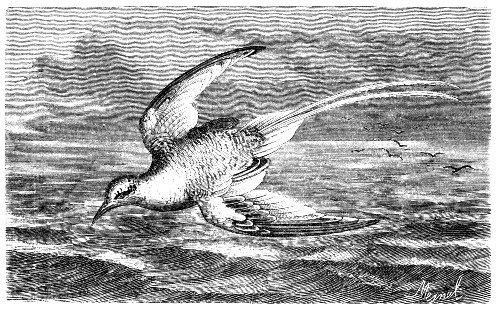
Fig. 101.—Tropic Bird (Phaeton æthereus, Linn.).
The Common Tropic Bird, Phaeton æthereus, seems to confine itself, according to this writer, to the Atlantic Ocean, stopping on the confines of the Indian Ocean; the other species, Phaeton Phœnicurus, seeming to belong further eastward, both meeting in nearly equal numbers at the Mauritius and other islands of the same group. Their flight is described as calm, quiet, and composed of frequent strokes of the wing, interrupted by sudden falls. The bird is about the size of a Partridge, with red bill and markings under the lower mandible; in general appearance it resembles the Gulls, but has longer and more powerful wings; the legs and feet are vermilion red, the latter webbed; the tail has two long, narrow feathers. One of their breeding-places is the Bermudas, where the high rocks which surround the island are a protection from the attacks of the fowler. P. Phœnicurus is a larger bird, being thirteen inches from the bill to the root of the tail; the long tail-feathers being red of the deepest hue.
The appearance of this bird announces, as we have said, that the navigators have entered the torrid zone, as this bird rarely goes beyond the limits of this region. It sometimes, however, pushes out to sea to a distance of a hundred leagues. When they are fatigued, aided by their large webbed feet, they rest upon the waves. Like many other ocean birds, their peculiar organisation prevents them settling from choice on the ground. They are, therefore, compelled to skim continually over the water, in which they feed upon the fish and mollusks, which form their principal food. When they are on the shore, the immense spread of their wings induces them to choose some elevated spot for a perch, such as the top of a tree or the summit of a rock. Worn out by fatigue, if they settle on the water, they are forced to wait until they are lifted up on the crest of a wave before they can again take flight. Their mode of flying is rather curious, for they communicate to their wings a kind of quivering motion, as if overcome by exhaustion.
These birds seek some remote and solitary islet for the purpose of breeding. They build their nests in holes in lofty trees, or in the clefts of rocks, but always in some position difficult of access. They lay two or three eggs. The young ones, when just hatched, owing to their dazzling-coloured down, bear a considerable resemblance to powder-puffs.
There are three species of the Phaeton—the Red-tailed Phaeton (Phaeton Phœnicurus), with white plumage, shaded with a light rose-coloured tint, having the two long feathers of the tail of a red hue. It inhabits the seas of India and Africa, Madagascar, the Isle of France, and the Pacific Ocean. The White-tailed Phaeton (Phaeton æthereus), with white plumage, with the two long feathers in the tail white. It is a native of the Atlantic Ocean. The Yellow-beaked Phaeton (Phaeton flavirostris) is distinguished by the colour of its beak. It is a native of the islands of Bourbon and Mauritius.
The Darter (Anhinga).
Synonyms.—Plotus: Linn., Klein, Scopoli. Anhinga: Brisson, Temminck. Darter of English and American writers.
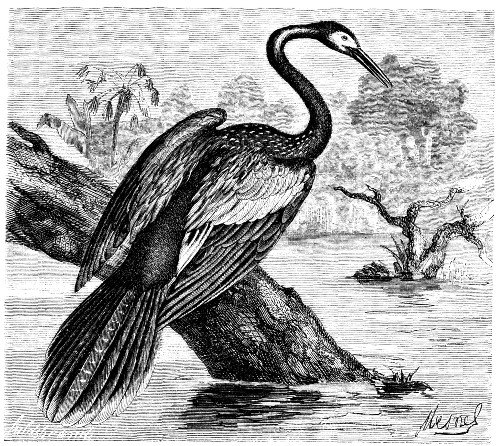
Fig. 102.—Darter (Anhinga, Levaillant).
The Darter (Fig. 102) has a straight and pointed bill, with indentations at the point, turned in a backward direction. Its head is slender and cylindrical, and forms the termination of a slim and excessively long neck, which gives it much the resemblance of a serpent grafted on a bird. In all its movements this neck is the counterpart of the reptile, and imitates its undulations; therefore, in the United States it has received the name of the "Serpent-Bird." They are untiring swimmers and excellent divers. When any danger threatens them, they dive completely under water, and do not reappear until they have found some tufts of reeds in which to hide, even should the distance be as much as one thousand feet from the spot where it disappeared. These birds are of a wild and suspicious nature, confining themselves to solitary places. They perch upon trees which grow by the sides of a pool or river, in order to dart upon any unfortunate fish which comes within their reach, which they seize with extraordinary address, swallowing it whole if not too large. If they cannot manage this, they carry it to a rock, where they dismember it with their beak and claws.
The Anhinga builds its nest on the topmost branches of trees, constructing it of dried twigs and reeds, and lining it inside with a thick layer of down.
Only two species of the Anhinga are known: the Anhinga (Plotus) Levaillantii, a native of Africa, the plumage of which is black from the breast to the tail; and the Black-bellied Darter (Plotus melanogaster), an American species.
Levaillant, in his usual lively manner, relates that he was induced to visit a rich proprietor in the Canton of the Twenty-four Rivers by a tempting description he received of two extraordinary birds which haunted the vicinity. They frequented a particular tree, and baffled him more than once by their skill; but at length he got within shot, and killed both of them right and left. He describes them as diving for fish. When they caught a small one it was swallowed; when a large one, it was carried to a rock or the trunk of a tree, when the bird, fixing it beneath its feet, picked it to pieces with its bill. Though the water is its favourite element, it is on trees and rocks, he tells us, that it establishes its nest and brings up its young, taking care to place the nest so that the young may be precipitated into the water as soon as they are able to swim, or when the safety of the family requires it.
The Gannet (Sula).
Synonyms.—Solan Goose, Booby; Fou de Bassan of the French.
The Gannet is a massively-made bird, not of graceful shape; it is larger than a Duck, and has white plumage.
They have obtained the name of "Booby" from the supposed stupidity which, rightly or wrongly, is attributed to them; for if a man finds one of these birds standing in his way, the creature offers no resistance, but will allow itself to be killed rather than abandon its position. The Frigate Bird, with audacious rapacity, when it observes the Gannet catch a fish, swoops down upon it and compels it to disgorge its prey. Their somewhat imperfect organisation explains this habit of non-resistance. The shortness of their legs and the excessive length of their wings prevent them escaping from their enemies when on shore, nor have they sufficient power of flight to avoid them in the air. But when they are aloft they soar wonderfully, with their necks stretched out, the tail expanded, and the wings almost motionless. Although they are strong on the wing, they do not venture very far from shore, consequently they are never met with more than twenty leagues at sea. Their appearance, therefore, is considered by the mariner as an indication of the proximity of land. In their flight they frequently skim over the surface of the sea, catching such fish as swim near the top. The skin of their throat is so readily distended that they can swallow their prey whole. The Gannet is also an excellent diver, for it is able to remain more than a minute under water when in pursuit of a favourite prey.
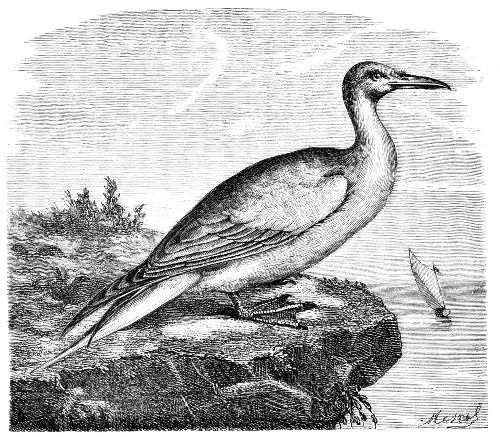
Fig. 103.—Gannet (Sula Bassan).
These birds are found in every part of the globe, giving the preference, however, to tropical countries; still they are plentiful in the Hebrides, in Norway, Scotland, and are even found as far north as Kamtschatka and the Gulf of Bothnia, according to Acerbi. But when residents of high latitudes, they migrate southward on the approach of cold weather. In the winter season they frequent the coast of Cornwall, and are found, in fact, in every part of the British and Irish Channel, generally keeping out at sea. They are constant attendants on the large quantities of herrings and pilchards that frequent our coast late in autumn.
This bird takes its prey by darting down on it with great velocity; yet it does not appear to dive—swimming, it floats upon the water with the buoyancy of a gull, not submerged, as is the case with the Shag and Cormorant.
Three species of them are known: the Solan Goose, or Gannet (Sula Bassan), which is very common on the Bass Rock, a small islet in the Firth of Forth, and on the northern islands—this is the only European species; the Common Gannet (Sula dactylatra), vulgarly called "Mouche de Velours"—this is smaller than the preceding, and is found in the Island of Ascension; the Brown Gannet (Sula fusca), which inhabits South America.
The Cormorant (Phalacrocorax).
English Synonyms.—Cormorant: Willoughby, Albin, Montagu. Great Cormorant: Bewick, Yarrell. Crested Cormorant: Bewick. Cormorant: Shaw, Latham, Lewin, Walcot, Pultney. Provincial: Great Black Cormorant, Cole Goose, Skart, Green Cormorant, Norie.
Latin Synonyms.—Carbo carboranus: Meyer. Pelicanus carbo: Linn., Latham, Gwellin. Corvus aquaticus: Ray, Willoughby. Phalacrocorax: Brisson, Temminck, Cuvier, Bonaparte. Halicus: Illiger. Hydrocorax: Vieillot.
The Cormorant is distinguished by a bill straight and compressed, the upper mandible curving downwards, and forming a hook at the termination; lower mandible inserted in a small membrane extending under the throat; feet strong, short; toes three before and one behind, united by a membrane; nail of the middle toe serrated; wings moderate, the first quill longer than the second, the whole being blackish; the upper part of the back and wings ashy brown, or bronzed in the middle, bordered by a large band of glossy greenish black.
The Common Cormorant (Fig. 104) has a massive and rather awkward body, feet short and drawn back to the abdomen, the head flattened and small, the guttural pouch very small. Their bulk varies, according to the species, from the size of a Goose to that of a Teal. On the south coast of England they are large birds, Pennant having weighed one which exceeded seven pounds, and measured three feet four inches. Their blackish plumage has given the idea of some resemblance existing between them and the Crow; hence their name, "Cormorant," from Corvus vorans, which signifies a voracious Crow.
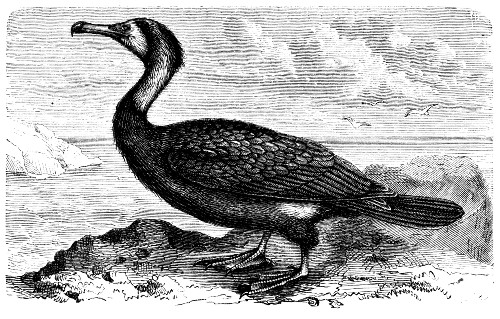
Fig. 104.—Cormorant (Phalacrocorax carbo, Gould).
These birds have a wide geographical distribution, being found in all parts of the globe, and always on the sea-coast or at the mouths of rivers. They are excellent swimmers and clever divers, pursuing with extraordinary rapidity the fish on which they feed.
The Cormorant swallows its prey head first; and if it happens to catch it by the wrong end, it will throw it up in the air, and seize it again in its bill as it descends in the proper position. When it has caught an eel, a good half-hour sometimes elapses before it can succeed in swallowing it. It may be seen making the most violent efforts to swallow its prey; and just at the moment when one would think that the slippery morsel was successfully absorbed, the fish suddenly reappears again from the depths of its living sepulchre, still straggling to escape; the Cormorant re-swallows it again; the eel still resists, and increases its efforts to escape; worn out at last by its prolonged and useless efforts, the victim is finally compelled to resign itself to its fate.
The appetite of the Cormorant is insatiable. The havoc which it commits in rivers is very great, for one day's consumption frequently amounts to six or eight pounds of fish: these it pursues principally under water, for it is an expert diver, and most successful in its search for its prey. In consequence of the skill displayed by the Cormorant in fishing, and the ease with which it is tamed, it is reared in a semi-domestic state in certain parts of Eastern Asia. The Chinese and Japanese are the nations who best know how to utilise the habits of these birds. When thus used a ring is placed round their necks to prevent them swallowing their prey, before turning them loose in waters which abound with the finny tribes. The Cormorants, trained to obey their master's voice, and balked in their attempts to swallow by the ring round the neck, bring to their owner all fish they capture. Sir George Stanton, in his embassy to China, having reached Len-tze, famed for its breed of these birds, found them to be a species somewhat resembling the Common Cormorant, described by Dr. Shaw as a Brown Cormorant with white throat, the body whitish beneath, spotted with brown; the tail rounded; irides blue, and bill yellow; which he named Phalacrocorax sinensis. "On a large lake," Sir George says, "close to this part of the canal, and to the eastward of it, are thousands of small boats and rafts built entirely for this species of fishery. On each boat or raft are ten or a dozen birds, which, at a signal from the owner, plunge into the water; and it is astonishing to see the enormous size of fish with which they return. They appeared to be so well trained that it did not require either ring or cord round their necks to prevent them swallowing their prey, except when they received the permission of their master to do so, as an encouragement for their labours."
The dexterity with which the Cormorant seizes its prey is such that if a dead fish is thrown into the water from a distance, the bird will dive immediately, pursuing its course in a direct line to the spot, never failing to secure it, even before it reaches to the bottom. On shore the Cormorant is a dull, heavy bird, and it is only in the water, and especially while fishing, that it appears to advantage. It floats so low in the water, and swims and dives so quickly, that it seldom fails to capture its prey. Now on the surface, next moment below, onward it plunges as if making an attack; then rising suddenly in some unexpected spot after a lengthened dive, it is certain to have the unfortunate fish in its bill.
Another peculiarity which belongs to this species is common with many other aquatic birds—that of violently beating the water with its wings without moving from the spot, followed by a vigorous shaking of the whole body, with the feathers ruffled, and, at the same time, covering itself with water. After repeating this several times with small intervals of rest, it will retire to an elevated place on shore, where it will remain with outspread wings until dry.
The flight of these birds is rapid and lasting; but they are as heavy and awkward when on land as they are nimble and active in the water. Their nature being unsuspicious and trustful, they can be easily approached, particularly when resting after their fishing exertions.
The Cormorant is widely diffused both in the Old and New World. It is a migratory bird, but is seen on our coast at all seasons. It breeds among rocks on the coast, selecting crags and inaccessible places, which sometimes are covered with their nests: these are composed of sticks and sea-weed, in which the female deposits her eggs, generally three in number, and which are of a whitish colour, weighing about two ounces.
In Egypt four species of Cormorants are known. The Great Cormorant (Carbo cormoranus) is the size of a Goose; this species is often domesticated, and is frequently met with in France.
The Green Cormorant, or Shag.
English Synonyms.—Green Cormorant: McGillivray, Morris, Selby. Shag: Montagu, Willoughby, McGillivray, Latham, Flemming. Crested Cormorant: Morris. Crested Shag: Montagu, Selby, Jenyns.
Latin Synonyms.—Pelicanus graculus: Linn., Latham, Montagu, Bewick. Phalacrocorax graculus: Cuvier, Brisson, Rennies, Montagu, McGillivray, Stephens, Flemming. Phalacrocorax cristatus: Meyer, Temminck.
French Synonyms.—Cormoran Larcup: Temminck. Petit Cormoran, or Nigaud: Buffon. Cormoran Nigaud: Figuier.
Local Synonyms.—Black Cormorant, Crested Cormorant, Shag, Scart, Scarer, Green Scout, and the Booby Cormorant.
This species is in weight about four pounds; the bill is dusky, and about four inches in length; a bare yellow skin is situated along the sides of the mouth and chin, the latter speckled with black. The whole bird appears black at a little distance, but on nearer examination, the head, neck, breast, and rump are of a glossy green. The feathers of the upper part of the back, scapulars, and wing coverts are pointed, and beautifully glossed with purple, violet, and green, each feather being edged with a velvety black; the under part of the body is less glossed with green; the legs are dusky black; middle claw serrated.
The female weighs over three pounds; the upper part of her body is dark, not so densely glossed as in the male; but the margin of the feathers of the scapulars and wing coverts is black, the under part dusky, with a mixture of grey.
Such is Colonel Montagu's description of a pair shot from the nest, but they vary in plumage and colour. In habit the Shag is strictly a salt-water bird, never visiting fresh water, breeding on our rocky coasts, where it builds a nest of stick and sea-weed. They resort to the maritime caves of the Hebrides in such vast numbers that they literally cover the sea to a considerable extent when on their passage from the caves of Liuir and Toehead to their fishing-grounds in the sound. Mr. McGillivray has counted a hundred and five in one flock. This picture Mr. McGillivray makes the text for one of his most delightful descriptions:—
"There is a large cave," he says, "on the west coast of Harris, celebrated for the number of Shags which reside on it, and so lofty that a boat can enter it to a considerable distance with lowering the masts. When we appear off the mouth of the cave a considerable number appear conspicuously perched on the little shelving rocks and projections, their dusky figures strongly relieved by the whitened surface of the rocks. Some of them fly overhead as we approach, but more drop into the water like a stone. On looking down we see them rapidly winding their way under the boat, swimming with outspread wings, and not at all in the manner represented by some writers, who say that it propels itself entirely under water by the feet and tail. Glancing aloft, we see many Black Guillemots in the clefts; and above them is the eyrie of the White-tailed Eagle. But our business is with the Shags, which are now seen writhing their long necks as they gaze upon us. Presently a shot is fired, and another; the dead birds drop on the water, the living plunge headlong into it, many advance on the wing, but, being frightened by the upraised oars, dart into the water.
"Advancing a little, we find that many still remain on the rocks; of these we shoot some more. Presently some of those which had escaped return, and perch; and we continue shooting until we have obtained as many as we desire. After all the uproar we have created, several still remain standing near their nests, loath to quit them. Although most of the nests are out of reach, some are accessible. We find them generally bulky, sometimes very scanty, formed of fuci, twigs, heath, and grass rudely put together, made flat, or with a shallow cavity, containing two, frequently three, sometimes four eggs, never more."
This bird has black plumage, as we have seen, is smaller than the one preceding, and inhabits the Arctic and Antarctic regions. A bird nearly resembling this (Phalacrocorax Desmarestii) is described by Temminck and figured by Gould, a species which has been observed in Corsica, and is of a blackish green. Montagu satisfied himself that the Crested Cormorant was only a seasonal variety of the Common Cormorant; and probably others of the species described, if carefully examined, would prove to be the same. McGillivray is of opinion, however, if Mr. Gould's figure is correct, the species must be distinct.
Pelicanidæ.
A comprehensive group of aquatic birds presenting a uniformity of structure quite apparent in the skeleton, and especially in the digestive organs, of which the Pelican is the type. They are mostly birds of large size, but of slender, elongated body, long neck, and head generally of moderate size. The bill is long, sometimes slender, at other times rather stout and straight; the upper mandible with the ridge separated by grooves, and terminated in a narrow, decurved, and pointed nail, or claw; the lower mandible elastic and extensible. The plumage is soft and blending, on the back and wings compact and imbricated; wings long, tail of moderate length and narrow.
The habits of the group vary considerably. Cormorants pursue their prey much in the same manner as Mergansers and Loons; the Anhingas are strictly territorial; the Pelicans combine the habits of both. The Gannets fly about in quest of food, plunging upon it from on high. The Frigate Birds range over the seas with unrivalled power of flight, and the Tropic Birds resemble in progression the Terns. The family comprises—
1. Pelicans. 2. Cormorants. 3. Gannets. 4. Phaetons. 5. Anhingas.
The Pelican (Fig. 105) has the bill long, straight, rather broad, and very much depressed; upper mandible flattened, terminating in a hooked tip much bent and compressed; lower mandible formed of two bony branches united at the point, from which a membranous naked skin is suspended, forming a purse, which can be distended into a voluminous bag. The Pelicans are large, heavy aquatic birds, with great extent of wing, and are excellent swimmers; their haunts are estuaries, the sea-coast, and the banks of rivers, lakes, and marshes. In its habitat, whenever a fish betrays its presence by leaping or flashing its glittering scales in the sun, the Pelican will be seen sailing towards it.
This bird has an appetite so insatiable, and a stomach so capacious, that, in one day's fishing, it devours as much fish as would satisfy six men. The Egyptians have nicknamed it the "River Camel," because it can imbibe at once more than twenty pints of water. Certainly it only makes two meals a day; but, oh! what meals they are!
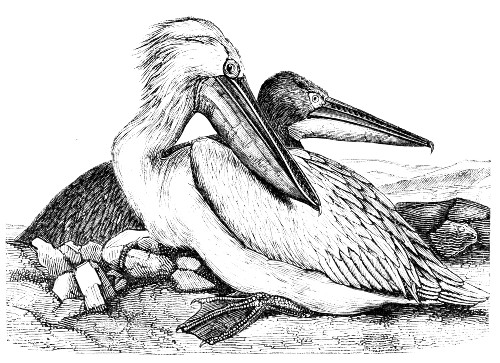
Fig. 105.—The Crested Pelican (P. onocrotalus, var. Orientalis, Linn.).
Pelicans often travel in considerable flocks, visiting the mouths of rivers or favourite retreats on the sea-coast. When they have made choice of a suitable place, they arrange themselves in a wide circle, and begin to beat the water with extended wing, so as to drive the fish before them, gradually diminishing the circle as they approach the shore or some inlet on the coast. In this manner they get all the fish together into a small space, when the common feast begins. After gorging themselves they retire to the shore, where the processes of digestion follow. Some rest with the neck over the back; others busily dress and smooth their plumage, waiting patiently until returning appetite invites all to fresh exertions. When thus quiescent, occasionally one of these birds empties his well-lined pouch, and spreads in front of him all the fish that it contains, in order to feed upon them at leisure.
This guttural pouch, which plays so important a part in the Pelican's life, is composed of two skins, the outer one being a prolongation of the skin of the neck; the inner one is contiguous to the coating of the œsophagus. The tongue is small: a delicate gizzard forms one large sac with the other stomachs.
In spite of its great size, the Pelican flies easily and to considerable distances. It is no diver, but will occasionally dash down on fish from a considerable height, and with such velocity that it becomes submerged; but its buoyancy instantly brings it to the surface again. It perches on trees, but seems to prefer rocks. When it builds a nest, it is generally formed of coarse reedy grass, lined with softer material, placed in the cleft of dry rocks near the water. Here the female deposits two, three, four, sometimes five white eggs, but most frequently only two. They are occasionally satisfied with placing their eggs in an indentation in the ground which they have roughly lined with blades of grass.
After an incubation lasting from forty to forty-five days, the young ones, covered with a greyish down, are hatched. The female feeds them: she presses the hooked red point of the mandible against her breast, which causes her to disgorge the fish it contains into the bills of the young ones, the male performing the same operation on himself for the benefit of his partner. This is probably the fact that has given origin to the absurd fable that the female Pelican is in the habit of piercing her breast in order to nourish her young with her maternal blood. The young birds are easily tamed. It is even asserted that they are susceptible of education, and that, like the young Cormorants, they can be taught to fish for their masters.
The Pelican is more common in tropical regions than in temperate climates. They are very numerous in Africa, Siam, Madagascar, the Sunda Isles, the Philippines, Manilla, and in the Western Hemisphere they abound from the Antilles to the northern temperate part of the South American continent. The true Pelicans are large birds with powerful wings, and are excellent swimmers. The pouch has extraordinary elasticity, and is capable of containing a number of fish either for its own consumption or the nourishment of its young. It haunts the neighbourhood of rivers and lakes and the sea-coast, being rarely seen more than twenty leagues from the land. Levaillant describes one of those wonderful ornithological scenes which only occur in uninhabited regions. At the entrance of Saldanha Bay, on the south-west coast of Africa, after wading through the surf and clambering up the rocks, "all of a sudden there arose from the surface of the Island of Dassen-Eyland an impenetrable cloud, which formed, at the distance of forty feet above our heads, an immense canopy, composed of birds of almost every kind of water-fowl—Cormorants, Sea Gulls, Sea Swallows, Pelicans, and I believe the whole winged tribes of this part of Africa were here assembled. Their voices, harsh and discordant, formed a noise so unmusical that I was every moment compelled to cover my head in order to relieve my ears. The alarm we created was so much the more general, inasmuch as the birds disturbed were chiefly sitting females. They had nests, eggs, and young to defend." In this scene the Pelican, from its peculiar appearance, was of course a prominent object. The best-known species are—1, the White Pelican; 2, the Crested Pelican; 3, the Brown Pelican; and 4, the Spectacled Pelican.
The White Pelican.
English Synonym.—White Pelican.
Latin Synonyms.—Pelicanus onocrotalus: Linn., Temminck, Selby. P. minor: Ruppell.
French Synonym.—Pélican Blanc: Temminck.
The White Pelican (Pelicanus onocrotalus) is as large as a Swan. Its bill is about fifteen inches in length. Its plumage is white, with a slightly rosy tint, which is brightest in the breeding season; the pinnaries and spurious wings are black; the crest and a few feathers on the neck yellowish.
This species received from the ancients the name of Onocrotalus, because they fancied that they discovered a resemblance in its cry to the braying of an ass. It is very common on the lakes and rivers of Hungary and Southern Russia, as well as on the banks of the Danube. If it is seen in France, it is purely accidental, as it is a rare visitor. A wild rocky shore, where it can look down on the sea, is the favourite haunt of the Pelican; but it is not uncommon for it to perch on trees. The nest is formed of coarse reedy grass, with a lining of finer quality; it is generally made on the ground, and is about eighteen inches in diameter, in which it lays four, sometimes five, white eggs, but more frequently two, slightly oblong, and alike at both ends. Fish forms its principal food, which it captures chiefly in shallow inlets; for it is no diver, although on the wing it dashes upon a fish occasionally from a great height, and that with such velocity that it submerges itself, but its buoyancy brings it immediately to the surface. Occasionally it flies very high, but it generally just poises itself over the water. Notwithstanding its webbed feet, it often perches on trees—a habit which Sonnerat describes as peculiar to the female in the evening, after having fed and protected her young during the day.
The Crested Pelican.
Synonyms.—Pelicanus crispus: Bonaparte, Temminck, Bruck. Pelican: English authors. P. onocrotalus (var. Orientalis): Linn, Pallas, Dalmatian. Riesen-pelikan: German authors.
The Crested Pelican, in common with the White Pelican, inhabits the south-east of Europe and Africa, and is also found in Hungary, Dalmatia, Greece, the Crimea, and the Ionian Islands, as well as in Algeria, and, according to some authors, it is frequently met with in China.
It has white plumage, with the exception that the ends of the feathers of the back and wings are black. The feathers of the head and upper part of the neck are twisted up so as to form a tolerably large tuft or crest: hence the name it bears. Its habitat is principally the marshes round the Black Sea, and the isles adjacent to the mouth of the Danube.
Of their habits, travellers in these regions give very interesting descriptions. Count Mükle states that they are plentiful on the lakes of Missolonghi, and in the marshy grounds near Thermopylæ. In situations incredibly difficult of access, especially on floating islands, scarcely over the water-line, they place their nests thickly together, supported among reeds and rushes. The vicinity of these congregated nests is rendered indescribably offensive by the foul fish they have dropped about, and the disagreeable white dung with which all the neighbourhood is covered.
"Time was," says Mr. W. H. Simpson, "and that not so long ago, when Pelicanus crispus lived in hundreds all the year round, from the rocky promontory of Kourtzalari, hard by the mouth of the Acheloüs, on the western extremity of the lagoon, near the island of Ætolico, up the northern arm, and on the east along the great mud flats which mark the limits of the present delta of Phidaris. Nowadays, however, a solitary individual may be seen fishing here and there throughout the vicinity; the remnant have betaken themselves to the islands which divide the Gulf of Procopanisto from that of Ætolico. Here, towards the end of February last, the community constituted a group of seven nests—a sad falling off from the year 1838, when thirty-four nests were grouped upon a neighbouring islet. As we approached the spot in a boat the Pelicans left their nests, and taking to the water, sailed away like a fleet of stately ships, leaving their preconcerted nursery in possession of the invader. The boat grounded in two or three feet of mud, and when the party had floundered through this, the seven nests were found to be empty. A fisherman had plundered them that morning, taking from each nest one egg, which we afterwards recovered. The nests were constructed in a great measure of the old reed palings used by the natives for enclosing fish, mixed with such pieces of the vegetation of the islet as were suitable for the purpose. The seven nests were contiguous, and disposed in the shape of an irregular cross, the navel of the cross, which was the tallest nest, being about thirty inches high, the two next in line being about two feet, and the two forming the arms being a few inches lower, the two extremes at either end being about fourteen inches from the ground.... The eggs are chalky, like others of the Pelicanidæ, very rough in texture, and some of them streaked with blood."—("Ibis," vii. p. 395.)
The Brown Pelican (P. fuscus).
The Brown Pelican is an American species, smaller than the preceding, and is described at some length by Nuttall. It has the head and the neck variegated with white and ash-colour; all the rest of the plumage of a brownish grey, with whitish marks on the back; the pouch is of an ashy blue, striped with a reddish hue. It is found in the Larger Antilles, on the coasts of Peru, in Bengal, and in South Carolina.
The Spectacled Pelican (Pelicanus conspicillatus).
The Spectacled Pelican, which is only found in southern climates, is thus named from the naked skin which surrounds the eye, reminding one of spectacles by its more or less circular form. Its plumage, like that of its congeners, is white.