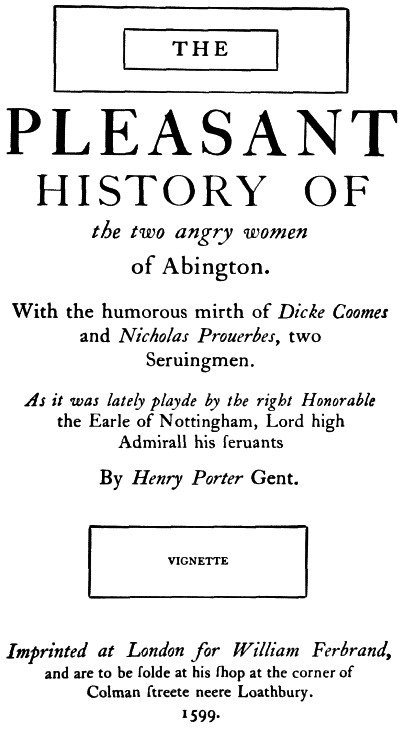
Henry Porter THE PLEASANT HISTORY OF THE TWO ANGRY WOMEN OF ABINGTON
Reading edition
Edited with Critical Essay and Notes by Charles Mills Gayley, LL. D., Professor in the University of California.
CRITICAL ESSAY
The Facts of Porter's Life.—The Two Angry Women of Abington is the only extant production of Henry Porter. In 1841 Mr. Collier, who was then editing Henslowe's Diary, supplied Mr. Dyce with what purported to be all the materials in that journal relative to this dramatist; and these, with the exception of one of August 23, 1597, connecting him with Nashe, which has been shown to be a forgery, are copied from Dyce's Percy Society edition of the Two Angrie Women by Mr. H. Ellis for the preface to the Mermaid edition of the play. The statement is there made that "the foregoing extracts—extending over the brief period of a single year ... contain all the definite information which has reached us concerning Henry Porter." An examination of Collier's Henslowe's Diary will show, however, that Mr. Ellis omits about a dozen entries[1580] affecting our poet which, though inaccessible to Dyce in 1841, have been available since 1845. A complete list of such notices in their chronological order has not been set before the public. I, therefore, subjoin the following, inserting an additional memorandum (No. 8) of January 17, 1598-9, from another source, and eliminating the suspicious Henslowe entries which Mr. George F. Warner[1581] has branded as Collier forgeries. The references are to the first volume of the Diary.
1. P. 77. Dd unto Mr Porter, the 16 of desembr 1596 vli
2. P. 77. Lent unto Mr Porter, the 7 of march 1597 iiijli
3. P. 124. Lent unto the Company, the 30 of maye 1598, to bye a boocke called love prevented, the some of fower powndes, dd to Thomas Dowton. Mr Porter[1582] iiijli
4. P. 126. Lent unto Cheattell, the 26 of June 1598, in earnest of a boocke called the 2 pte of blacke Battman of the north; and Mr Harey Porter hath geven me his worde for the performance of the same, and allso for my money xxs
5. P. 131. Lent unto the company, the 18 of Aguste 1598, to bye a Boocke called hoote anger sone cowld of Mr Porter, Mr cheattell, and bengemen Johnson, in fulle payment, the some of vjli
6. P. 141. Lent unto thomas Dowton, the 22 of desembr 1598, to bye a boocke of harey Poorter called the 2 pte of the 2 angrey wemen of abengton vli
7. P. 144. Lent unto harey Porter, the 17 of Janewary, 1598[-9] at the request of Richard Alleyn and Wm Birde the some of xxs
8. An acknowledgment of the transaction (No. 7) in the Bodleian. See note prefixed to Malone's copy (Malone, 184): as follows, "An acknowledgement of a debt of 20 s. owing to Philip Henslowe, dated Jan. 17th, 1598[-9], and bearing the autograph signature of Henry Porter, formerly lying loose in this volume is now to be found in MS. Eng. Hist. C. 4, fol. 15. (Signed) W. H. A., June 8, 1885."
9. P. 143. Lent unto Thomas Dowton, the 31 of Janewary 1598[-9], to bye tafetie for ij womones gownes, for the ij angrey wemen of abengton, the some of ixli
10. P. 145. Lent unto Thomas Downton, the 12 of febreary 1598[-9], to paye Mr Poorter, in fulle payment for his boocke called the 2 pte of the angry wemen of abington, the some of ijli
11. P. 145. Lent unto Thomas Downton, the 12 of febreary 1598[-9], to bye divers thinges for the playe called the 2 pte of the angrey wemen of abington ijli
12. P. 146. Lent unto harey porter, at the Requeste of the company, in earneste of his boocke called ij mery wemen of abenton the sume of forty shellings; and for the Resayte of that money he gave me his faythfull promysse that I shold have all the boockes which he writte, ether him selfe or with any other, which some was dd the 28 of febreary, 1598[-9]. I saye xxxxs
Thomas Downton, Robert Shawe[1583]
13. P. 146. Lent unto Harey Cheattell, the 4 of marche 1598[-9], in earneste of his boocke, which harey Porter and he is a writinge, the some of, called the Spencers xs
14. P. 146. Lent unto Robart Shawe, the 22 of marche 1598[-9], to paye unto Mr porter, in full paymente of his playe called the Spensers the some of vli xs
15. P. 147. Lent unto Harey Porter, at the apoyntment of Thomas Downton, the 7 of aprell 1599, the some of xxs
16. P. 151. [A note for the same in Porter's handwriting]—Borrowed of phillip Henchlowe, xxs, the vijth of Aprill, anno. dom. 1599. (Signed)
Henry Porter
17. P. 148. Lent unto Thomas Downton, the 9 of Aprell 1599, to bye dyvers thinges, as 4 clothe clockes, and macke up a womones gowne, the some of—For the Spencers xli
18. P. 94.[1584] Lent Harey Porter, the 11 of aprill 1599 the some of ijs vjd
19. P. 148. Lent unto Thomas Downton, the 14 of Aprell 1599, to macke divers thinges for the playe of the Spencers, the some of xvli
20. P. 148. Delyvered unto Thomas Downton boye, Thomas parsones, to bye divers thinges for the playe of the Spencers, the 16 of aprell 1599, the some of[1585] vli
21. P. 94. Lent Harey Porter, the 16 of aprell, 1599, the some of xijd
22. P. 261. Harey Porter tocke a somsete of me, Phillipe Henslowe, the 16 of Aprell 1599, upon this condition, that yf I would geve him xijd at that instant, for that xijd he bound hime seallfe unto me in xli of corant Inglishe mony, for this cawse to paye unto me the next daye folowinge all the money which he oweth unto me, or els to ferfette for that xijd tenn powndes; which deate wase unto me xxvs, which he hath not payd acordinge to his bonde, and so hath forfetted unto me: wittnes to this a sumsette,
John Haslett, Va[ul]ter MR Kyngman, the Elder.
[This entry which seems to refer to No. 21, would naturally be made on the 18th of April, 1599, but in the Diary it occurs at the end of a confused sequence running March 25, 1598, November 16, 1599, August 9, 1598, September 18, 1602, September 19, 1602. Between it and the next entry, undated but probably of February, 1601-2, leaves are missing or mutilated. According to Dyce, whose information came from Collier, the entry on p. 94 "is struck through, the money having been repaid." But Collier does not record the payment of the xijd in his edition of the Diary; nor, according to p. 261, was Porter released from the "deate of xxvs" or the "forfette of xli."]
23. P. 94. Lent Harey Porter, the 5 of may 1599 the some of ijs 6d
24. P. 94. Lent Harey Porter, the 15 of maye 1599, the some of ijs 6d
(Signed) Henry Porter
25. P. 94. Be it knowne unto all men, that I, Henry Porter, do owe unto Phillip Henchlowe the some of xs, of lawfull money of England, wch I did borrowe of hym the 26 of maye, aº dom. 1599.
Henry Porter[1586]
Other Early Notices.—Meres, in the Palladis Tamia, 1598, names our dramatist as one of the best for comedy among us, and places him in good company: Lyly, Lodge, Gascoigne, Greene, Shakespeare, Nashe, Thomas Heywood, Munday, Chapman, Wilson, Hathaway, and Chettle. It is perhaps worthy of remark that, beginning with Nashe, all these playwrights were at the time Porter's associates in the employ of Henslowe and the Admiral's company, and that in this list our poet rubs shoulders with Chapman and Wilson. Much less flattering are the references in Richard West's Court of Conscience or Dick Whipper's Sessions, 1607,[1587] to "ruffianly Dick Coomes" (Poem to Prophane Swearers) and "Nimble-tongued Nicholas as the Proverbe saith" (Address to Liers), which are undoubtedly allusions to our play[1588]: for although Porter's Nicholas is not a liar, his Coomes is, in the extreme, ruffianly and profane. The context of The Court of Conscience would indicate, however, that West was availing himself, to some extent, of nicknames proverbial among the vulgar, such as Suckblood, Tom Taylor, Money Monger, and Nicholas Newfangle. That Porter's play was still in circulation as late as 1661 is shown by its inclusion in Kirkman's Catalogue of that date.
Conjectural Identity.—Malone, Collier, and Dyce give no clue; in fact they do not exhaust the materials in Henslowe. Langbaine mentions only the printed play. Hunter, in his Chorus Vatum Anglicanorum[1589] says "it can hardly be doubted that this is the same Henry Porter of Christ Church who was made Bachelor of Music in July, 1600 (Alumn. Oxon. III. 1182). Wood says that he had seen some of his compositions, but thinks none were extant when he wrote. This Henry Porter was father of Walter Porter, Master of the Choristers at Westminster, who had friends in Sir Edward Spencer and Edward Laurence. He was related to Dr. John Wilson." Foster in the Alumni Oxonienses, tells us, in addition, that Walter became gentleman of the Chapel Royal of Charles I. This information is all traceable to Wood's Fasti,[1590] but Wood does not attempt to identify Henry Porter the dramatist with Henry Porter the musical composer. Of the latter we learn, from the Register of the University of Oxford,[1591] that he had studied music for twelve years and had "composed" before he took his degree, July 4, 1600. There is no record of a degree in arts, nor of matriculation, at Christ Church; this musical activity would seem, however, to have occupied the career of the future bachelor of music from a date eight years before Porter the dramatist appeared in Henslowe's employ to a date after our poet had borrowed his last half-crown from that employer. "The statutable conditions for the degree of Mus. Bac." at that time, say Boase and Clark,[1592] "were that the candidate should have been seven years in re musica, and that he should compose and cause to be sung in the university a canticum quinque partium, giving three days' notice of the performance of this exercise." That a student like Porter of Christ Church, who had proceeded leisurely through his course in music, taking twelve years instead of the seven prescribed, and who, meanwhile, was composing canticles on elevated and, probably, sacred themes, should be a man of maturity and acknowledged worth is only natural to suppose. And such was the esteem in which Porter of Christ Church was held by an Oxford undergraduate of that day, who addresses him in the following verses, published in 1599:[1593]—
"AD HENRICUM PORTER
Porter I durst not mell with sacred writ, Nor woe the mistris fore I win the maide; For my yong yeres are taskt; its yet unfitte, For youth as eld is never halfe so staid. Thy selfe which hath the summe of Art and Wit Thus much I know unto me would have said; Thy silver bell could not so sweetly sing If that too soone thou hadst begun her ring."
The Porter thus apostrophized by John Weever has set sacred writ to music, but only after careful discipline leading to the musical art; and his wisdom has been proved by the result: "Thy silver bell" of music, says his admirer, "could not so sweetly sing, If that too soon thou hadst begun her ring." Mr. Havelock Ellis,[1594] to whom these verses were communicated by Mr. Bullen, understands them to refer to Porter the dramatist, and concludes therefrom, that he was "at the period of his dramatic activity a man of mature age."
But there is nothing in Weever's verses applicable to the dramatist as we know that personage: his extant play is anything but sacred, it presents no particular evidence of mature authorship, betrays no interest in musical affairs, yields no bell-tones of style or verse. While Weever was writing his Epigrams, 1596 to 1599, the dramatist was pursuing anything but a staid and silvern course at the Rose Theatre on the Bankside. The slowly matured composer of canticles, on the other hand, was completing a leisurely discipline at Christ Church, and to such a student Weever's eulogy admirably applies.[1595] In all probability the composer stuck to his metier. He was of a musical family: his son obtained recognition from Court for his musical attainments; and a kinsman, Dr. John Wilson, "a very eminent musician of whom there is a long notice in Wood," was professor of music at Oxford in 1656.[1596]
The familiarity with Oxford and its surroundings displayed in the drama of the two angry women who meet in the neighboring village of Abington is, however, indicative of Oxonian authorship, and we are again driven to the registers of the university in search of some available Henry Porter. There is, I find, but one capable, in point of chronology, of fulfilling the conditions:
"Matriculations: 19 June, 1589, Brazenose, Porter, Henry; Lond., gen. f. 16."[1597]
Concerning the academic career of this Henry Porter there is no information to be gathered from the records of university or college—why he was not admitted B.A., or why or when he left his college. I am apprised, however, by Mr. C. B. Heberden, the Principal of Brasenose, who at my request kindly instituted the requisite search, that such absence of information is not unusual, for the College Register was very imperfectly kept in the sixteenth century. If this was our Henry Porter, the author of the Pleasant History of the Two Angry Women, he was born in 1573, the son of a gentleman of London, he kept an uneventful term or so at Brasenose, and was perhaps still there in 1592 when his future associate in Henslowe's employ, John Marston, was matriculated. After his return to London he must have taken speedily to play-writing, for he was not more than twenty-three years of age when we find him selling his dramas to the Admiral's company for distinctly reputable sums. A modest straw in favour of the supposition that this was our dramatist is the explicit statement in both editions of our play to the effect that its author was Henry Porter, Gent. We have no proof that the Porter of Christ Church, who took his only degree after our play was printed, had any right in 1599 to sign himself Gentleman.
Dramatic Career.—Although, as I have said, only one of Porter's plays is extant, the entries in Henslowe, and their context, enable us to form some conception of his relation to the contemporary drama. They indicate that between December 16, 1596, and May 26, 1599, he was associated as a writer of plays with the Admiral, the Earl of Nottingham's company of actors, and that after February 28, 1599, his services were pledged to that company alone. It is possible that he had also acquaintance among the Earl of Pembroke's men, who were acting at The Rose for a short time during October and November, 1597, in partnership with the Admiral's company; but of this we cannot be certain, for we have no record of Porter's actions between March 7, 1597, and May 30 of the ensuing year.
The payment of December 16, 1596, is not in loan nor "in earnest of a boocke," but delivered as for a play then completed; and the sum, even if it were not a final instalment, would in itself indicate a play of some promise, for £6 or £7 was as much as Henslowe usually gave for a production even by an author already distinguished. If the payment was for a completed "boocke," the play would, according to the procedure of the Admiral's men, have been ready for presentation within a period of ten days to six weeks after the date of purchase. The following were the new plays presented by this company during that period: That Will Be Shall Be, December 30, 1596; Alexander and Lodowick, January 14, and Woman Hard to Please, January 27, 1597. Of these Alexander was the most successful, and That Will Be next.[1598] It is possible that the third play was the work of Heywood who had been recently paid 30s.—for a "boocke."[1599] As to Alexander, it is mentioned two years later as the property of Martin Slater,[1600] and there is reason to conjecture that it was written by him. But, even if these attributions were conclusive, we should not be justified in assuming—that the book remaining unassigned, That Will Be Shall Be, was the property for which Porter was paid on December 16, 1596. It is not, however, impossible that his first production was one of the three most popular plays put upon the boards at The Rose that season. That Henslowe's loan to Porter on the following March 7 had any connection with a play of December 16, 1596, is most unlikely. Henslowe was not by way of disbursing £9 for one "boocke." The date is also too remote from May 30, 1598, to permit of our connecting this loan with the payment for Love Prevented, there mentioned, let alone the objection that if the entries of March 7, 1597, and May 30, 1598, refer to the same play, the author was paid the unusually high sum of £8. But though we cannot prove that Porter made much out of Henslowe and the Admiral's men, it would seem that they made a good deal out of him. For after certain purchases from Porter and during the period within which the first performances of his plays must naturally have occurred, the theatre receipts increased appreciably. The play of May 30, 1598, for instance, would, according to custom, have been presented some time between June 10 and June 30. The only other new play that could during those weeks have assisted to swell the profits of the theatre was the First Part of Blacke Battman of the North, by distinguished authors, to be sure, but not extant. Henslowe's weekly receipts from "my Lord Admerall's mean" during the month before June 10 had averaged £3 16s. 3d.; during the period between June 10 and June 30 they rose to an average of £5 4s. 4d.; the week after June 30 they fell again to £2 11s. 6d.[1601] That Porter was at that time held in respect by Henslowe is shown by the transaction of June 26, when the crafty manager took his surety for the performance of a literary and pecuniary obligation by Chettle, than whom no one could have been habitually more in arrears. And that Porter's plays were worth having is proved by Henslowe's engaging, in February of the next year, everything that he might write, whether in partnership or alone. That this appreciation of his plays was shared also by the company appears from the unusual sums which they expended for the apparel and properties necessary to their presentation.[1602]
Of the playwrights at that time attached to the Admiral's company, the most intimately associated with Porter would appear to have been Chettle; and, through him, our poet must have been brought into close relations with Robert Wilson, who was Chettle's colleague in that Second Part of Blacke Battman, for the completion of which Porter went surety,—also with Dekker and Drayton, who had assisted in the writing of the First Part, and were, maybe, interested in the Second. In fact, Chettle, Dekker, Drayton, Wilson were boon companions in productivity and the 'marshallsey': to go bail for one of them was presumably to pay for all. With Ben Jonson, who was just then coming into notice as a dramatist, Henry Porter must have drained many a flagon. In August, 1598, these two have just finished writing a play in company with Chettle, Hot Anger Soon Cold, and are paid a fair price for it by Henslowe, who seems to regard Porter, however, as the principal author, for he enters his name first in the record. But if the returns from this play are included in Henslowe's receipts of the next two months, it cannot have been more than an ordinarily successful production.[1603]
During the latter part of 1598 our dramatist is engaged upon a play called by Henslowe the 2 Pte of the 2 angrey women of abengton. This was rehearsed during January and February, 1599, and by February 12, the day on which final payment was made to Porter, £11[1604] had been expended on properties for the performance. It was probably ready for presentation at that time, and its success may have assisted the sudden leap in Henslowe's share of the receipts from £7 10s., for the week ending February 18, to £15 3s., for the ten days ending February 29,[1605] 1599. This play paid Porter £7, a higher figure than Hot Anger had brought. Some two weeks later he is under contract to produce a sequel, the ij mery wemen of abenton, and only four days later still, March 11, he is engaged in a new partnership with Chettle to produce a play entitled The Spencers, or Despencers, a magnificent and tragic subject perhaps suggested by the reprinting of Marlowe's Edward II. during the preceding year.[1606] The Spencers was finished by the 22d of the same month. That it was looked upon as a play of great promise appears from the large amounts which, as already stated, were expended in its preparation for the stage. It was first acted some time after April 14. On the 16th Henslowe enters a final small disbursement for properties, of which perhaps the need was perceived during the first performance. His receipts for the week ending April 15 rise to £13 7s., four times as much as for the week before; while the entry, £13 16s., for the week next ensuing, during which the play was surely on the stage, is, with the exception of those of February 29, already mentioned, and of June 3,[1607] the largest that year. Perhaps by April 22 the novelty of The Spencers had begun to wear off, for there is again a drop in Henslowe's receipts, to £11 5s., the week ending April 29.[1608] This partnership with Chettle existed, by the way, in the year when Every Man in his Humour was in course of composition, and it ended just about a month before 'Bengemen' passed a rapier through Gabriel Spenser in Hoxton Fields.
Beside the playwrights already mentioned, Porter must have known in varying degrees of intimacy Heywood, Haughton, Day, Munday, Chapman, Hathaway, and, perhaps, Rankins, who were then writing for the company; also Samuel Rowley and Martin Slater, who appear to have been serving as actor-dramatists. With the players Downton, Richard Alleyn, Robert Shaw, and the polyonymous William Bird, Porter was associated in various business negotiations. Of course he knew the above-mentioned Gabriel Spenser, and Henslowe's son-in-law, Edward Alleyn, and the two Jeffes, and Towne and Singer, and the other active members of the company.
Most of the playwrights in Henslowe's pay lived in hand-to-mouth style; but in art of cozening groats from the manager who in turn squeezed angels from the dramatist, none excelled 'Harey' Chettle. It is instructive to note that, from the period of close intimacy with Chettle, Porter sinks ever deeper in Henslowe's debt. On January 17, 1599, he had borrowed a pound of Henslowe. He was then, still, in the heyday of his success; but only six weeks later, February 28, we find Henslowe, under cover of a further beggarly advance, acquiring a lien on all his productivity. A few days after that the two 'Hareys,' doubtless with a hope of release from the moneylender's grip, are sweating out The Spencers for him; and Chettle, with or without Porter's knowledge, is borrowing another half-sovereign in earnest of its completion. When, on March 22, the joint production is finished, the dramatists are paid less for it than The Second Part of the Two Angry Women had brought to Porter alone; and before it is acted Porter has given his note of hand to Henslowe for another pound; and so proceeds the declension of 'Harey' Porter. Between December 16, 1596, and June 26, 1598, he had been Henslowe's 'Mr. Porter'; as soon as he begins to borrow, January 17, 1599, he is 'Harey' with a rare reversion to the ancient style; after April 7 there is no reversion. The loans, too, which at first were of a dignified amount, suddenly fall to 2s. 6d. Familiarity has bred as usual; and, by April 16, 'Harey,' who at this time owes the manager 25s., is compelled in consideration of 1s. to clear his debt on the morrow or forfeit £10. Next day Shylock has him, but for some reason continues to dribble out the sixpences until May 26. Then 'Harey' signs the last I. O. U. of which we have record, and drops out of history and Henslowe with as little warning as he had entered.
Date of the Extant Play.—Porter wrote two plays and engaged to write a third on the Women of Abington. Of a First Part of the Two Angry Women, there is no record in Henslowe, at least under that name. But of the Second Part the entries of December 22, 1598, and February 12, 1599, make explicit mention; and an intervening note of January 31, 1599, which records an outlay for the play without specification of the part is by date and position evidently a reference to this same Second Part. According to the entries of February 12, the sum of £2 was on that day expended in a concluding purchase of properties for the performance, and an equal amount was given to Porter in final payment for the "boocke" entitled the 2 pte. of the angry wemen of abington. So closes all record of that second part. The payment of £2, two weeks later, February 28, is the usual advance "in earneste of" a "boocke" not yet finished; but the title of it was the ij mery women of abenton, and it was undoubtedly intended to be a continuation of the general theme. There is, however, no record of final payment (of £4 or £5) as in other cases, and no proof that the play was completed. I have no doubt that the play of which the text is here given, The Pleasant History of the Two Angry Women of Abington, is the unrecorded First Part, above mentioned. Our drama was twice printed in 1599 "as it was lately playde by ... the ... Admirall his servants," and it had, in all probability, been in the possession of the company for some time before publication; whereas the Second Part was only first acted in that year, and would not, with the consent of the company, have been turned over to printers. For it was to the player's interest to restrict his dramatic stock-in-trade, while it was novel, to the play-house. That the non-extant play of December 22, 1598-February 12, 1599, which is explicitly called the Second Part, was preceded by The Pleasant History is, moreover, confirmed by the title-page of The Pleasant History, which is unconscious of predecessor and sequel alike. By how long a period, then, did our play precede the missing Second Part? The words "as it was lately playde" on the title-pages of both editions may or may not be advertisement. But there is, at any rate, no likelihood that the first performance antedated May 14, 1594, when the Admiral's men began their long engagement with Henslowe; nor that it fell between that date and December 16, 1596, for it does not appear (nor any name that suggests it) in Henslowe's consecutive list of plays performed by the Admiral's men during that period. And since Henslowe observed his method of entry by days and plays until November 5, 1597, the Pleasant History would have been specified in that part of the diary[1609] if the first payment to Porter, December 16, 1596, or the loan of the succeeding March 7, had been for a play bearing that name. Since there is no mention of a Pleasant History of the Two Angry Women of Abington before the close of Henslowe's daily register, nor of a First Part of the Two Angry Women between that date and December 22, 1598, when negotiations are in progress for a Second Part, it would seem that, whether our play came into existence before or after November 5, 1597, it must have first passed under some other name.
In the former alternative not even the wildest conjecture can identify it with any title recorded by Henslowe before March 7, 1597, except Woman Hard to Please, and that is more suitable to the subject of Heywood's Challenge for Beauty than of our Pleasant History. It is not until two months after the loan of March 7—four pounds to Porter—that one comes upon the first performance of the only play of that period that can at all correspond with the Pleasant History. This is the successful but as yet unidentified Comodey of Umers, for the writing of which Henslowe records no payment, although he marks it "new" and makes entries which show that it was acted no less than twelve times at his "howsse" between May 11 and October 11 of that year, and that it supplanted Alexander and That Will Be in the favour of the public. It has been held, to be sure, that this anonymous Comodey was Every Man in his Humour; but that is impossible, for Ben Jonson himself states that Every Man was brought out during the next year, 1598, and not by the Admiral's, but by the Lord Chamberlain's servants,[1610] while Henslowe includes The (Comodey of) Umers even the year after it had been acted by the Admiral's company in his "Note of all such bookes as belong to the Stocke [of that same company], and such as I have bought since the 3d of Marche, 1598."[1611] Mr. Fleay thinks that the Comodey was Chapman's Humerous Dayes Mirth, and Dr. Ward inclines to accept the conjecture; but I think that Mr. Fleay's plea in favour of Chapman's play will apply as well to Porter's Pleasant History, the subtitle of which advertises "the humorous mirth of Dick Coomes and Nicholas Proverbes," while the scenes develop "humours," which are much more natural than those of Chapman's play, and fall but little short, indeed, of the quality that characterizes B. J.'s Every Man in his Humour. As far as plot goes I cannot for a moment believe that the ineptitudes of the Humerous Dayes Mirth can have commanded the popularity which was achieved by the Comodey of Umers.
If, however, according to the latter alternative, the Pleasant History came into existence between November 5, 1597, and December 22, 1598, the attempt to identify it with the Comodey of Umers falls to the ground. But another possibility at once presents itself: for the only mention by Henslowe of a play produced in the interim by Porter alone is of "a boocke called Love Prevented."[1612] For this a payment of £4 is made on May 30, 1598; and until Love Prevented turns up, and turns out to be other than our play, it will be open to conjecture whether under this title we have not the earliest record of the Pleasant History of the Two Angry Women. For not only is this the sole title assigned to Porter alone during the period under consideration, it is also a title fairly descriptive of the central movement of the Pleasant History.[1613] The date of payment, moreover, would accord with the assertion of recent performance which appears upon the title-page of our play as printed; it would also allow for a reasonable lapse of time before the publication, which was not by license and was probably of a printed copy. If this conjecture be correct, the date of our play is May 30, 1598; and we have an explanation, in part, of Henslowe's increased receipts during the month following. If, on the other hand, our play be the Comodey of Umers, the date of its first presentation is May 11, 1597. Whether these identifications be correct or not, the play may be dated between December 16, 1596, and December 22, 1598, and it was probably known to Meres when during the latter year he included Porter among the writers of comedy.[1614]
Dramatic Qualities: Construction.—Of the plot we may cry with Goursey, "Here's adoe about a thing of nothing." Not this, but occasional situations and the subconscious qualities of humour and verisimilitude lend distinction to the play. The Pleasant History has atmosphere and therefore entity. It is a creation. Its characters stand out. Porter knew their ways and words before he knew their history. He had met them out Cumnor way or Hinksey, by Bagley, Abington, and Milton on many a cross-country stroll. What basis there was for Mrs. Barnes's jealousy, whether Master Barnes had too often gone to Milton "a-hunting or such ordinary sports," and, once too often, "chatted with" Mrs. Goursey "all day till night," we are not explicitly informed. Nor is the dramatist. That Mrs. Goursey has given no cause for offence goes without saying. But there is trouble in the air. The wives are angered: after a dissension sufficiently prolonged to afford us an insight into them and their surroundings, their wrath shall be appeased. How, we know not; nor does the dramatist, but it seems to him natural, if not novel, that the son and daughter of these foes should with their marriage "bury their parents' strife." That end he pursues, carrying all with him except those whom he most would carry. When the hour is nigh and we are expectant, and the star-crossed lovers have made for Carfax to be wed, they lose each other and everybody else in a midsummer night's "cunny greene," where, whence, and whither, darkling, the dramatic persons play blindman's buff with the plot till, frustrate of discovery, they despair. Then in steps Sir Raph Smith, ex tenebris et machina, to find the heroine, and prophesy solution and "the lanthorne of the day" and lend our hopes a fillip, but straight to lose us worse than ever in the devious night. Beholders and beheld all now despair. And Porter might still be spasmodically rounding his rabbits into the "cunny greene" and out again, had not the quarrelsome wives happened each on other, and on them in turn their husbands happened, who simulating mortal combat succeed at last in terrifying their women into peace. Only after the characters most concerned have thus by chance taken the solution into their own hands and effected the reconciliation, does the peacemaker intended by the dramatist drop in with the lost sweetheart on his arm; and the union of the young lovers, which had been designed to promote the union of their mothers, proceeds on its own merits, superfluous, like the second tail on the proverbial toad. The plot, therefore, is not the "thing." Not only does it pursue half a dozen possibilities, each of which it drops halfway; it starts another half-dozen, which it never pursues. But the auditor, unforewarned, pricks to each wild-goose chase in turn. The complication of the angry women and the subplot of the lovers, with its pretence of a solution, move rapidly through the first, third, sixth, and eighth scenes; but in the second and fourth the farcical element retards the pace; in the seventh a new and futile start is made, and in the ninth the platt itself slides into a kind of commedia all' improviso. From this it is rescued at the beginning of Scene xii. by Master Barnes's "pollicie." But although his "drift device" is of the utmost importance to the audience, I have my doubts whether any hearer has caught the hint, and I am sure that to most readers the sham combat between the husbands in Scene xiv. comes as something impromptu and secondary. Consequently a luxury of anticipation has been forfeited. The "pollicie" is in itself a capital ruse for curing shrewishness, and it has been frequently used of later years, as, for instance, in Gillette's Because She Loved Him So; but in 1597 it had the additional charm of novelty, and deserved a better handling. The situation in Scene vi., where Mrs. Goursey snatches and restores her husband's letter, is, conversely, well prepared, but lacks all consequent. The marksman draws his bow to the top of its bent, then gradually relaxes the tension—because he has forgot his arrow. But, though Porter is guilty of imperfect devices, few English comedies before his time can boast of scenes more realistic and humorous than the game at tables, the burlesque wooing of Mall at her window, and the comic irony of the climax between the disputatious mothers under whose beaks the debated chickens are eloping. In fact, with all crudities, the plot develops an interesting individuality, for which the author does not seem to be at all responsible; none the less interesting if "a German from the waist downward, all slops, and a Spaniard from the hip upward, no doublet."
Portrayal of Character.—When we turn to the "persons" and their "humours" we realize the architectonics of the play. There is something at once natural and masterly in the ease with which Porter introduces the condition of "neighbour amitie," wherewith the masters delude themselves, while their spouses blow upon the coals of hatred: the hostess, teeming with innuendo,—"malice embowelled in her tongue,"—the lady of Milton read in Æsop's fables, quick to conjecture, and "every day as good as Barnes's wife," whether to divert a moral or direct a curse. And as the women promise they develop: Mrs. Barnes, a "jealous, slandering, spiteful queane"; Mrs. Goursey, subtler and fairer spoken, but incapable of backgammon "if slanders by doe talke,"—patently obedient, but impatient of rebuke, soothing her husband with soft words, but, inward, fuming at his "Peace, be quiet, wife"; easily his better, bidding him "grow to the housetop with your anger, Sir," and then humouring his pleasure, not because of his "incensement," but his "health." The opprobrious epithets of Barnes's wife Mistress Goursey returns into her teeth; damns her as "mankind"; takes up the quarrel last and is last to lay it down. In fact, as Mistress Goursey is the more independent of the twain, she is also historically the more original. Mrs. Barnes, on the other hand, is an amalgam of stock shrews, gossips, and jealous wives: a descendant of Tom Tyler's more strenuous half, a kinswoman of Dame Chat, a Kitely in petticoats, the remote grandmother of Colman's Mrs. Oakly.
Barnes and Goursey are henpecked husbands of the remordent variety. Barnes, the more experienced in domestic infelicity, is correspondingly the more given to moral tags and pregnant sentences. He sometimes rises almost to poetry, as when he tells his wife:—
"Rough, wrathful words Are bastards got by rashness in the thoughts;"
from bathos he is just saved by a sense of the incongruous: "O doe not" begs he of the virago whom he styles "sweete,"
"O, doe not set the organ of thy voice On such a grunting tone of discontent! Doe not deforme the beautie of thy tongue With such mishapen answeres."
It is appropriate that upon him who has given rise to the brief unpleasantness by inviting guests without his wife's consent, should rest the onus of devising the effective "pollicie" of reconciliation.
From him Goursey is well differenced. Possessed of a finer wife and a quicker temper, when the former, contrary to expectation, crosses the latter he well-nigh falls into an apoplexy. Oaths he abhors, but in the access of his rage swears horribly and apologizes to the Almighty between breaths.
That the morals of the sons reproduce those of the sires in their salad days, I reluctantly suspect. It is the recital of young Frank's licentiousness that convinces young Philip that here is just the husband for Sister Mall. And—considering that Mall is frankly and squarely what her mother calls her, a "lustie guts" and "vile girl," in fact her mother's daughter, fit to "floute the devill and make blush the boldest face of man that ere man saw" a swearing wench whose only claim to morals is unmorality—Philip's judgment is correct. There is, in my opinion, no coarser-minded girl in Elizabethan comedy; and at the same time there obtains no dramatic portrayal of the animal more observantly conceived or more faithfully executed. That she is, as Mr. Ellis says, less sophisticated than Congreve's Prue, is not exactly to her credit. Nor need I make her out "a wholesome, robust English girl ... with a brave openness, loving and sincere," in order to justify my appreciation of Porter's skill in creating her. She is, indeed, robust and Elizabethan, seventeen and upward; but within she is a mate for Caliban; no relation to Prue,—rather a link between Wapull's Wilful Wanton and Vanbrugh's Hoyden. It is hardly necessary to point out the literary and dramatic affinities of Sir Raph and his wife: the buck-hunting squire and the lady tender-hearted and "pitous."
The foregoing are characters of broad outline; but each has, as well, his quirk of conduct, manners, or of style. The jealous wife with her "stopt compares"; "Mistresse Would-Have," who has "let restrainèd fancy lose," and sworn to lead no apes in hell; her brother, a poet at second-hand, and "sick discourser" of his sister's wit; Nan Lawson's lover of "quick invention" and "pleasure-aiming mind,"—these and others of the major movement are as palpably in their "humours" as Mrs. Otter, Doll Common, Master Stephen, or Kitely, or Truewit. And when we turn to the secondary group we find the "humours" not only advertised upon the title-page but specified in the text. Dick Coomes is "humord bluntly" to brag and swear and drink and quarrel and talk bawdy. "I see, by this dearth of good swords, that dearth of sword-and-buckler fight begins to grow out; I am sorry for it," complains this swashbuckler serving-man. With "Sbloud!" he comes upon the stage, and there's little left of God unhallowed when Coomes subsides beneath his buckler in the dark. "Why, what a swearing keeps this drunken asse," exclaims Francis. "Peace, do not marre his humour," Phil replies. "Away, bawdie man," cries Hodge, and even the Boy must say, "Here him no more, maister; he doth bedawbe ye with his durty speche." He has a "merrie humour," too, this Coomes, of punning, and has brought "the apparell of his wit ... into fashion of an honor." A Thraso of the servants' hall, he'll outswear any 'Pharaoh's foot' of a tailor's shop. He can dispute precedence with Ancient Pistol as "the foul-mouthedst rogue in England"; and when he's in his "quarreling humour," not Pistol, nor Bobadil, nor the 'humorous' Nim could swagger to Dawson's close or out of a horse-pond with a more humorous grace. It is to be noted that, in his first lines, Coomes animadverts upon "the humour of those young springals," his masters, who "will spend all their fathers' good at gaming"; also that Philip's servingman has his humour both of manners and of style: "a spruce slave," cross-gartered like Malvolio, "a nosegay bound with laces in his hat," "all proverbes in his speech ... because he would speak truth," a dramatic Camden or Ray, who quotes Latin withal, and is as marked in his "humour" as Coomes and Franke's Boy, and Mall and Mrs. Barnes in theirs.
Place in the History of Comedy.—It would, therefore, be of no small importance to determine whether this Pleasant History is Henslowe's Comodey of Umers of May 11, 1597; for if it be, this play of characteristics precedes Every Man in his Humour, and disputes the "place peculiar to itself in our dramatic literature" which most critics have assigned to that masterpiece of Ben Jonson. But even if it be not the play of May 11, 1597, our drama was certainly written before December 22, 1598, probably by May 30 of that year; and consequently to Porter, as an influential associate of Chapman and Jonson, must be given something of the credit of blazing the path toward the comedy of characteristic. The fun of the play has at once a Chaucerian shrewdness and a something of the careless guffaw of W. Wager. Its realism throws back to Mak, and Johan, Tom Tyler and Gammer Gurton. As a comedy of unadulterated native flavour, breathing rural life and manners and the modern spirit, constructed with knowledge of the stage, and without affectation or constraint, it has no foregoing analogue except perhaps The Pinner of Wakefield. No play preceding or contemporary yields an easier conversational prose, not even the Merry Wives.
We must not close this study without remarking certain resemblances to Shakespeare. In the matter of situations and language traces of the Romeo and Juliet of 1592, and the Midsummer-Night's Dream of 1594-1595, appear. The fanciful reader might, indeed, suspect something like a good-natured burlesque of the balcony scene in the conversation between Frank and Mall "at her window"; perhaps even of the motif of Shakespeare's tragedy, in the loves of the children of the inimical wives of Abington: "How, sir? your wife!" says Mrs. Barnes to Francis:—
"Wouldst thou my daughter have? Ile rather have her married to her grave."
Even so had spoken Lady Capulet. And Romeo seems to be muttering in his sleep through Philip's soliloquy:—
"The skie ... Is in three houres become an Ethiope ... She will not have one of those pearlèd starres To blab her sable metamorphosis."
If anything further were needed to illustrate Philip's taste in plays, it would be furnished by the hazy reminiscence of "the imperial votaress" and "the nun, for aye ... in shady cloister mewed." Indeed, if Porter did not have in mind the quadrilateral wanderings of the Midsummer-Night's Dream when Frank and Mall missed the way to Carfax, I am much surprised. That Dick Coomes, when he stood between his mistress and the angel to be tempted, was not thinking of Gobbo, is, of course, possible, but it is not possible that Dick Coomes's creator was not familiar with the Merchant of Venice. There is also, as I have already implied, a quality in Dick's sword-and-buckler voice that rings contemporaneous with the Henry IV., Pts. I. and II. To trace a connection between the well-known lines of Hamlet in 1602 and Porter's
"How loathsome is this beast man's shape to me This mould of reason so unreasonable"
(1597-98), would, I fear, be fanciful. The resemblance, faint as it is, may be due to mere coincidence or to derivation from a common source.
Previous Editions and the Present Text.—Two editions of this play were published in 1599: one for Joseph Hunt and William Ferbrand; the other for Ferbrand alone (in same place of business). From the variations in spelling and text which characterize the Ferbrand quarto and are evidently intended for improvements, and from the fact that Ferbrand was still alone when, in 1600, he published another play, Look About You, I conclude that the edition printed during the period of partnership was the earlier of the two. It will be indicated in the notes to the present text as Q 1. Of Q 1 a copy is to be found in the British Museum (162. d. 55). Of Q 2, published by Ferbrand alone, there are two copies in the Bodleian, one formerly owned by Malone, the other by Douce. Q 2 furnishes the more careful text. That it was made, however, not from manuscript, but from Q 1, is evidenced by the retention of occasional printers' errors and oddities characteristic of the earlier edition. Dyce, in his edition (Dy.) for the Percy Society, 1841, followed Q 1, with occasional readings from Q 2 and silent emendations. This edition, with modernized spelling, is included in Hazlitt's Dodsley, Vol. VII. (H.). Mr. Havelock Ellis's edition of the play (E.), with acts, scenes, and modernized spelling, for the Mermaid Series (Nero and Other Plays, 1888), appears to be based upon H. The present text is that of Q 2 (Bodl. Malone 184), with such substitutes from Q 1 as are indicated in the footnotes.
Charles Mills Gayley.
FOOTNOTES:
THE