VI.—EVIDENCE OF THE EFFECTS OF PREVENTIVE MEASURES IN RAISING THE STANDARD OF HEALTH AND THE CHANCES OF LIFE. (continued 2)
Reading edition
The Employers’ Influence on the Sobriety and Health of Workpeople by modes of Payment which do not lead to Temptations to Intemperance.
The power possessed by extensive employers of labour to influence beneficially their labourers, is not however confined to those who stand in the combined relation of employer and landlord. In the course of another inquiry as to the means of preventing crime, it appeared that a large class of crimes and disorders arose from drunkenness. On carrying the inquiry back into the causes out of which the drunkenness arose, they appeared to be extensively removable, and that by the employers of labour. The important influences that belong to this position will be displayed in the effects of alterations in detail in one point of management, namely, the mode of paying wages. The direct sanitary effects may be best displayed in the following evidence of Mr. Lomax, an army pensioner, which has been corroborated by superior officers:—
“When I was in the Life Guards, 14 or 16 years ago, there was a good deal of ill health prevalent amongst them. Before that time the men received part of their pay weekly, namely, 7s. at the end of the week. With this 7s. they had to provide the food which they required, except their dinner. The ration for dinner was three-quarters of a pound of uncooked meat, a pound of potatoes or vegetables, and a pound of bread. It was found, however, that many of the men spent the whole of the 7s. in a single day in drink or dissipation. During the remainder of the week the men would be on what was called the crib-bite, that is, living only on their dinner rations. I knew many of the men who drooped under this system, partly from the excess of drinking or dissipation, and partly from the privation of the necessaries of life and the work they had to undergo. This, again, led them to much temptation. If anything was lost it was amongst this class of men that we looked for it. The crime-book would speak as to the further bad consequences of these habits.
“The plan was then tried of paying the men 1s. each day. Over and above that the men were provided with coffee. It was universally felt that this change was highly beneficial to their health, and it stopped the dissipation, and the consequences of the dissipation.”
The incapacity to apportion their means for temperate consumption 246(which is not however confined to the working classes) is extensively shown in the mismanagement of the means for procuring food. It is a subject of complaint which frequently appears in the reports, that the ignorance of domestic economy leads to ill health, by the purchase of unsuitable, and at the same time, expensive food. We have been frequently besought to obtain and promulgate, for popular information, instructions in frugal cookery, and the management of supplies. It is observed by Mr. Brebner, the governor of the Glasgow bridewell, where the cost of maintaining the prisoners in health and increased strength is on average only 2¾d. per diem, that
“The regularity of diet in the prisons here is of vast importance, both as to the quantity and the time of serving it up. If the same persons were to get the same amount of food for a whole week, or for a less time, at their own discretion, they would suffer from surfeit at one time, and from long fasting at another. Irregularity of diet is one of the most fruitful sources of disease that occur in civilized life.”
In further illustration of the beneficial influence which employers may often exercise to assail such vices by regulations in detail, I cite the following instances from a communication I have received from Mr. Edwin Hill, the inspector of stamping machinery for the Government:—
“During a period of nine years (from 1818 to 1827) I was engaged in the superintendence of one of the largest works in the town of Birmingham, consisting of two distinct mills, one employed in rolling copper for the use of braziers and shipwrights, and the other in rolling silver, brass, and other metals. In each mill there was a set of skilled workmen, who undertook the work at fixed prices, and who themselves employed numerous assistants at weekly wages.
“Owing to difficulties in the way of making up the accounts at short intervals, it was the custom for the master to advance weekly to each workman in the silver mill a fixed sum of money (besides advancing a sum to pay the assistants with). The accounts were made up annually, and the balances due to the several workmen then paid. The payments, both weekly and annually, were almost always made not to the men but to their wives. The earnings of the men were considerable, varying from 80l. to 180l. a-year. The men were, almost without exception, highly respectable in their stations, their families were well provided for, their homes cleanly and not without pretensions to some degree of elegance, and their children sent to school at the sole expense of the parents. Some of them had made considerable accumulations of money, and even become proprietors of houses and land. The workmen employed in the copper mill, on the contrary, had been accustomed to receive the full amount of their earnings at the end of each week, and, after paying their assistants, to divide the surplus. These men were much addicted to drinking and feasting at the alehouse; and, although their earnings were nearly as great as those of the other men, their families were in wretchedness, 247and their wives obliged to eke out a slender pittance by washing and other laborious occupations. There were also several men employed as millwrights and engineers, at regular and good weekly wages. These men were, almost without exception, steady and respectable, and their families well provided for. About the year 1822 the inconvenience and annoyance, and loss, which arose from the unsteady habits of the second set of men, led me to inquire into the causes of their inferiority to the others, and I was soon led to attribute much of the evil to the great irregularity in the amount of their weekly incomes, which varied from about 10s. to 4l. 4s. per man.
“The effects were as follows:—The men were reckless, trusting to their luck to get ‘good work,’ i. e., that which bears a high price in proportion to the required labour. They were enabled to deceive their wives as to the amount of money obtained. They learned the minimum with which their wives could contrive to keep house, and, having learned it, they endeavoured to retain all above this minimum for their own gratifications. Their wives, under the pressure of necessity, picked their pockets, opened their drawers, &c., in search of money believed to be hidden. Their wives actually desired that their husbands might get drunk on Saturday night, because they could the more easily abstract the money from their persons.
“Upon the termination of my inquiries I induced the men, with little difficulty, to receive their money in the way the other men did, viz., by regular weekly advances, rather under their average earnings, with a quarterly or annual settlement; and I took care that the wives should know exactly what their husbands would receive; and from the day the plan commenced, a most decided and permanent improvement took place in the habits of the men, and in the appearance and general comforts of their families. One of the men commenced saving money immediately. This man’s savings, as I have lately been informed, now in January, 1841, considerably exceed 1000l.; whereas, during the five or six years which he passed in the same occupation before the change of plan, he made no saving whatever.”
Another valuable example of the easy means possessed by employers of preventing the formation of habits destructive to the health and prosperity of workmen, is set forth in the evidence of Mr. Peter Fairbairn, the extensive mechanist of Leeds.
Mr. Fairbairn examined.
“You are a mechanist at Leeds?—I am.
“What number of men do you employ?—Between 500 and 600.
“Have you ever observed any effects produced in the habits of the labouring classes in respect to drinking intoxicating liquors by the mode in which they are paid their wages?—Yes, there are two modes in which wages are most frequently paid, and both these modes are prejudicial in their effects. The first effect is connected with the place of payment. Some masters pay at the public-house, others pay the men at the counting-house after the work is completed. The effects produced by 248payment at the public-house are to oblige the workman to drink. He is kept waiting in the public-house during a long time, varying from two to three hours, sometimes as much as five hours. The workman cannot remain in the house without drinking, even if he were alone, as he must make some return to the landlord for the use of the room. But the payment of a number of men occupies time in proportion to their numbers. We find that to pay our own men in the most rapid way requires from two to three hours. The assembled workmen, of course, stimulate each other to drink. Out of 100 men, all of whom will, probably, have taken their quart of porter or ale, above a third will go home in a state of drunkenness—of drunkenness to the extent of imbecility. The evil is not confined to the men; the destructive habit is propagated in their families. At each public-house a proportion of the poor women, their wives, attend. According to my own observation, full 10 per cent. of the men have their wives and children in attendance at the public-house. The poor women have no other mode of getting money to market with on the Saturday night than attending at the public-house to get it from their husbands. They may have children whom they cannot leave at home, and these they bring with them. The wives are thus led to drink, and they and their children are made partakers at the scenes of drunkenness and riot; for there are not unfrequently quarrels leading to fights between the workmen when intoxicated.
“Do not these late hours, consequent on such a mode of payment, also lead them to the inferior markets, and prejudice the domestic economy of the labourer’s household?—Yes, they have the less money to purchase with, and must purchase an inferior quality of provisions. I have observed that they do so. They are driven to the inferior shopkeepers who keep open late; and they are also driven to make purchases on the Sunday morning. It is only the inferior shopkeepers or hucksters who will sell on the Sunday morning, and they sell an inferior commodity at a higher price. Then the Sunday morning is thus occupied; the husband, and sometimes the wife, is kept in a state of feverish excitement by the previous night’s debauch: they are kept in a state of filth and disorder; even the face is unwashed; no clean clothes are put on, and there is no church attendance, and no decency. Indeed, by the pressure of the wants created by habits of drinking, there is soon no means to purchase clean or respectable clothes, and lastly, no desire to purchase them. The man, instead of cleaning himself, and appearing at church on the Sunday, or walking out with his family on the Sunday afternoon in a respectable condition, remains at home in filth, and in a filthy hovel. Of course there are no contributions to sick-clubs under such circumstances; and if the workman has been previously led to join a club, he is almost always in arrear with his contributions, and is ultimately expelled. On the occurrence of the disease to which such habits predispose him, there is nothing but the most abject and complete destitution and pauperism. I have served the office of churchwarden and overseer in Leeds three years, and, having attended the weekly Board where applications for relief are made, I have seen the end of this train of circumstances in the applications for relief from parties who had previously been in the receipt of good and sufficient wages (and even high wages) to have prevented such applications. I have observed the whole 249train of these consequences in several large works in London as well as in this town.
“Are there not consequences too to the employers themselves, as well as to the ratepayers, in connexion with the habits of labourers thus created?—One consequence of these habits is the loss of time at the commencement of the week, and the comparative inefficiency of the workmen when they do come. The workman who has been absent from drunkenness comes to his work pale, emaciated, shattered, and unnerved. From my own observation in my own branch of manufacture, I should say that the quantity and quality of the work executed during the first day or so would be about one-fifth less than that obtainable from a steady and attentive workman.
“This deterioration, then, in a large number of workmen engaged in a manufactory, may be noted as an important item of saving for the consideration of a provident manufacturer?—Undoubtedly. Another consideration for the master is the fact that such workmen, the most idle and dissolute, are the most discontented, and are always the foremost in mischievous strikes and combinations.
“You have spoken of the consequences of making the public-house a place of payment; what are the comparative effects of making the payments at the counting-house?—A considerable reduction of the evil. Payments to large numbers at the counting-house is still, however, attended with much inconvenience and evil. The payment of the number of men employed at our works (between five and six hundred) would, as I have stated, occupy between two and three hours. This mode of payment, therefore, implies the keeping of a large crowd together during that time. During that time appointments are made of meetings at public-houses to drink that would not otherwise take place. It also generates discontent: it gives an opportunity, by assembling a crowd, for any discontented or mischievous person to operate upon a large mass of people. Formerly the business of my manufactory, and the welfare of the working people, were very seriously interrupted by strikes; and I could not help observing the facilities which such meetings gave to such mischievous persons.
“What is the mode of payment which you have adopted?—I send the pay clerk into each room in the manufactory immediately after the dinner hour, and he pays each man individually. Each man is scarcely taken from his work half a minute. I may observe, that some masters, to save themselves trouble, so as to avoid the inconvenience of getting small change, will pay several men together. This again leads to the public-house, where the men commonly go to get change to divide the money amongst them; I therefore avoid paying any two men together, and subjecting them to temptation as well as inconvenience and cost. Each of my workmen being paid in the shop, without the loss of a minute, may go at once directly home at the time when the work closes. He is thus afforded an opportunity of going at once to the market at an early hour, and is subjected to no factitious inducements to drink, disorder, improvidence, and destitution.
“What is the average time thus saved to each of the 550 workmen in your manufactory, as compared with the more ordinary mode of payment?—About an hour and a half, or half the three hours of payment.
250“Then, by this means, instead of bringing 550 persons to the one person, the pay clerk, sending that one person to the 550 persons, you save to them upwards of 800 hours of inconvenient waiting?—Just so.
“How many persons, on the average, have you absent from work on the Monday morning?—Not more than from four to five, until eight o’clock in the morning; and on the return to work after dinner from one to two persons.
“That is from one to two persons the entire day during the Monday, out of between five and six hundred workpeople?—Yes.
“What number would have been absent on the Monday under the ordinary circumstances?—About 30 per cent., or one-third, would be drunk on the Saturday night; and full 10 per cent. would not make their appearance until the Tuesday morning. Instead of only two absent during the whole of the day, I should have more than 50; or, in other words, more than 50 families not only distressed by what is spent in drink, but losing one-sixth of their earnings, and I as a master losing from their deteriorated work on the days when they do return. I beg leave further to observe, that mere education in reading or writing, precepts or preaching, are of very little avail against the temptations to drink held out to working men; and I am confident that if employers could be made to see and attend to their mutual interests, by a little care in the removal of temptations, they might generally prevent the most fruitful cause of disorder, destitution, and pauperism, at least as extensively as I have prevented those consequences to my workmen and their families by the adoption of the means I have described.”
In the course of a report on the sanitary condition of the labouring classes in the town of Lancaster, received from Dr. De Vitrie, the effects of an amended practice are thus noticed:—
“An excellent example is shown in this neighbourhood by the wealthy manufacturers and tradesmen almost universally paying their men’s weekly wages on a Friday evening (or, what is still better, early on Saturday morning) instead of Saturday, thus putting it into the power of all to spend their money to the best advantage at Saturday’s market, and obviating the great temptation which formerly existed of spending their earnings, or a large proportion of them, in the public-houses and beer-shops after the termination of the week’s labour. It may be said that such parties are as likely to dissipate on a Friday as on a Saturday evening. The propensity I grant may be the same, but there is no intervening day of rest to shake off the effects of intemperance and indulgence, and as workmen must resume their labours on the Saturday, hence it is that such a regulation exercises not only a salutary but a provident influence.”
The Rev. Whitwell Elwin observes—
“Where gain was dependant on the growth of better habits, I have seen, with the agency of judicious individuals, encouraging cases of complete reformation: an intelligent engineer in this neighbourhood was about paying off a man whose profligacy had left him without a decent covering, and who often depended for his victuals upon the generosity of 251his fellow-workmen. He begged hard to be retained, and his master at last consented, on condition that he himself should lay out his wages for the next three months. He provided the man with good lodgings, allowed him tea, sugar, and bread and butter night and morning; meat, and either bread or potatoes, with a pint of beer every day for his dinner; and before the appointed time was up, bought him with the surplus a new suit of clothes. The man was so sensible of the advantage of the change, that he became one of the most thrifty and valuable workmen; and his master has often since tried the same experiment with the same success. If we could collect all the philanthropy and much of the self-interest of the country into wise and profitable channels, we might, I believe in a twelvemonth, do much towards regenerating the most wretched classes.”
One employer of numerous labourers in a well-conducted establishment stated to me that after long experience he found it necessary, for the protection of the workpeople, as well as the efficiency of the establishment, invariably to discharge every workman who was guilty of drunkenness; and that the first visible sign to excite suspicion of the habits of intoxication was the absence of personal cleanliness, then a pallid countenance, on which inquiry was made. Another employer of numerous labourers, Mr. William Fairbairn, of Manchester (the brother of Mr. Fairbairn, of Leeds), who has had between one and two thousand workpeople engaged in the manufactories of machinery in the firm of which he is the first partner, stated, in answer to the question,—
“What are their habits in respect to sobriety?—I may mention that I strictly prohibit on my works the use of beer or fermented liquors of any sort, or of tobacco. I enforce the prohibition of fermented liquors so strongly that, if I found any man transgressing the rule in that respect, I would instantly discharge him without allowing him time to put on his coat.
“Have you any peculiar grounds for adopting this course?—No; but as respects myself I wish to have an orderly set of workmen; and in the next place I am decidedly of opinion that it is better for the men themselves and for their families.
“Are you aware that it is a prevalent opinion that strong drink is necessary as a stimulus for the performance of labour?—I am aware that that was a prevalent opinion amongst employers of labour, but it is now very generally abandoned; there are nevertheless some foundries in which there is drinking throughout the works all day long. It is observable, however, of the men employed as workmen, that they do not work so well; their perceptions are clouded, and they are stupified and heavy. I have provided water for the use of the men in every department of the works. In summer time the men engaged in the strongest work, such as the strikers to the heavy forges, drink water very copiously. In general the men who drink water are really more active, and do more work, and are more healthy than the workmen who drink fermented liquors. I observed on a late journey to Constantinople that the boatmen or rowers to the caiques, who are perhaps the first rowers in the 252world, drink nothing but water; and they drink that profusely during the hot months of the summer. The boatmen and water-carriers of Constantinople are decidedly in my opinion the finest men in Europe as regards their physical development, and they are all water drinkers: they may take a little sherbet, but in other respects are what we should call in this country, tee-totallers.
“What is their diet?—Chiefly bread; now and then a cucumber, with cherries, figs, dates, mulberries, or other fruits which are abundant there; now and then a little fish.
“Do they ever use animal food?—Occasionally I believe the flesh of goats, but I never saw them eating any other than the diet I have described.
“Did they appear to eat more than the European workmen?—About the same; if anything, more moderate as respects the quantity.”
I have collected much other information to the same effect. In the Appendix, I have given, as a contrast, an instance of arrangements which tend to promote the habit of drinking, and the consequences, a part of which are met and dealt with by the administrators of relief from the poor’s rates, in the shape of claims to relief on the ground of sickness and consequent destitution; and another part of which fall as disorders and crimes to be encountered by the police.
I submit here one important instance of the exercise of a wise influence on the habits of the agricultural population:—
In a form of lease used in leasing the Highland property of the Duke of Sutherland, which appears to be ably devised to ensure progressive improvement, care for the moral welfare of the population is not omitted. The poverty, disorder, and crime engendered by the destructive habit of whisky drinking, fostered by the practice of illicit distillation, is encountered by a clause which provides that if the tenant “distill whiskey, or shall permit any one to distill whisky, or shall sell or permit the same to be sold on the said premises hereby set, or on any part of the said estate, or shall contravene any of the regulations the said proprietors have established for the management thereof, and that if he or they shall be convicted of any of the said offences before the sheriff, depute, or substitute, or any two of his Majesty’s justices of the peace for the said county; then, in either of these events or cases, this agreement shall be, ipso facto, void and null, and the said tenant shall be forthwith removable by summary process before the judge ordinary, whereupon decree shall be pronounced upon relevant proof of the fact.”
The lease ensures the improvement of the tenements, and provides that “no earthen houses or huts are permitted to be built on any consideration.” The one provision is the proper complement of the other; and Mr. Hill gives his testimony to the excellent effect which the support given to the law, and the 253prevention of whisky drinking, produce on the habits of the population.
Employers’ Influence on the Health of Workpeople by the Promotion of Personal Cleanliness.
I proceed to another instance of the power of the employers to protect the health, as well as the morals of their workpeople, by influencing their habits of personal cleanliness.
But I shall first submit a few instances of the extent and prevalence of personal uncleanliness amongst whole classes of workpeople.
Mr. John Kennedy, in the course of the examinations of some colliers in Lancashire, asked one of them—
“How often do the drawers (those employed in drawing coals) wash their bodies?—None of the drawers ever wash their bodies. I never wash my body; I let my shirt rub the dirt off; my shirt will show that. I wash my neck and ears, and face, of course.
“Do you think it usual for the young women (engaged in the colliery) to do the same as you do?—I do not think it is usual for the lasses to wash their bodies; my sisters never wash themselves, and seeing is believing; they wash their faces, necks, and ears.
“When a collier is in full dress, he has white stockings, and very tall shirt necks, very stiffly starched, and ruffles?—That is very sure, sir; but they never wash their bodies underneath; I know that; and their legs and bodies are as black as your hat.”
One labourer remembered that a particular event took place at Easter, “because it was then he washed his feet.” The effects of these habits are seen at the workhouse on almost every one of the paupers admitted. When it is necessary to wash them on their admission, they usually manifest an extreme repugnance to the process. Their common feeling was expressed by one of them when he declared that he considered it “equal to robbing him of a great coat which he had had for some years.” The filthy condition in which they are found on admission into the hospitals is frequently sufficient to account for the state of disease in which they appear, and the act of cleansing them is itself the most efficient cure. The out-door service of the union medical officers amidst such a population is often most painful and disgusting: e. g.—
Mr. J. F. Handley, medical officer of the Chipping Norton union, states in his report—
“When the small pox was prevalent in this district, I attended a man, woman, and five children, all lying ill with the confluent species of that disorder, in one bed-room, and having only two beds amongst them. The walls of the cottage were black, the sheets were black, and the patients themselves were blacker still; two of the children were absolutely sticking together. It was indeed a gloomy scene. I have relished many 254a biscuit and glass of wine in Mr. Grainger’s dissecting-room when ten dead bodies were lying on the tables under dissection, but was entirely deprived of appetite during my attendance upon these cases. The smell on entering the apartments was exceedingly nauseous, and the room would not admit of free ventilation.”
Such conditions of the population, of habitual personal and domestic filth, are not necessary to any occupation; they are not the necessary consequence of poverty, and are the type of neglect and indolence; this is proved by the example of men engaged in the same occupations with improved habits. The medical officers of the Merthyr Tydvill union, in their returns, represent the health of the colliery population to be very good, a circumstance which is ascribed to their habitual cleanliness.
Mr. J. L. Roberts, surgeon, states—
“The colliers in our district invariably, on their return from the pits in the evening to their houses, strip to the skin, and wash themselves perfectly clean in a tub of lukewarm water, and wipe with towels until the cuticle is dry. The miners are not so particular. I firmly believe that the health of other workmen employed generally about the ironworks is not so permanently good as the colliers; they, generally speaking, not undergoing complete ablution as the colliers do. Generally, the colliers are quite free from any cutaneous disease, or at least not so much affected with psora, &c., as the generality of their fellow-workmen. Cutaneous diseases are frequent amongst children from want of cleanliness.”
In the places of work where there is the greatest need for cleanliness, in every place where there is a steam-engine, hot water, which is commonly allowed to run waste, is already provided in abundance for warm or tepid baths, not only for the workpeople, but, where there are numerous engines, for the whole population. If the same hot water arose at the same heat and abundance from any natural spring, baths would be erected, and medical treatises would be written in commendation of its medicinal virtues, which, the better opinion appears now to be, are ascribable, in the majority of instances, simply to the hot water, and to its application in cases where it had not before been used. Hot or tepid baths are deemed of more importance for the labouring classes in winter than are cold baths in summer, and they might be generally provided for the working classes in the manufacturing districts at a cost utterly inconsiderable.
A few years since a gentleman, observing some ditches in London, in the neighbourhood of the City-road, smoking with clean hot water running away from the steam-engine of a manufactory, directed attention to the waste, and suggested the expediency of using that water to supply public warm or tepid baths. After a time the suggestion was acted upon as a private speculation, and large swimming-baths were constructed; one, 255with superior accommodation and decorations at 1s.; another, with less costly fittings-up, at 6d. the bath. These were luxurious tepid baths, kept at a heat of 84°. The example appears to have been followed in Westminster by the establishment of similar tepid swimming-baths, where only 3d. is charged to persons of the working-class. As many as 2000 and 3000 of this class have resorted to these baths in one day, and the bath at the lowest charge is stated to make the best return for the capital invested in it. Similar establishments are, we believe, in progress in other parts of the metropolis. Mr. Samuel Greg, at Bollington, has formed baths for the use of his workpeople, which he thus describes:—
“The bathing-room is a small building, close behind the mill, about 25 feet by 15. The baths, to the number of seven, are ranged along the walls, and a screen about six feet high, with benches on each side of it, is fixed down the middle of the room. The cold water is supplied from a cistern above the engine-house, and the hot water from a large tub which receives the waste steam from the dressing-room, and is kept constantly at boiling temperature. A pipe from each of these cisterns opens into every bath, so that they are ready for instant use. The men and women bathe on alternate days; and a bath-keeper for each attends for an hour and a half in the evening. This person has the entire care of the room, and is answerable for everything that goes on in it. When any one wishes to bathe he comes to the counting-house for a ticket, for which he pays a penny, and without which he cannot be admitted to the bathing-room. Some families, however, subscribe a shilling a-month, which entitles them to five baths weekly; and these hold a general subscriber’s ticket, which always gives him admittance to the room. I think the number of baths taken weekly varies from about 25 to 70 or 80. We pay the bath-keepers 2s. 6d. and 2s. a-week, and I believe this amount has been more than covered by the receipts. The first cost of erecting the baths was about 80l.”
The feet of the female as well of the male workers in such establishments, who work in the mills without their stockings, are seen coated with the filth of years, for which there is no other necessity than their own habitual indolence. These habits mere admonitions will not always remove from the adult population. A manufacturer in London, who did not care to take this trouble with them, began with his apprentices, and took them several times to the new tepid baths, as a holiday and a reward, until they had experienced the comfort, and had formed a habit, when he left them to themselves, and they paid out of their own pocket-money the small amount necessary to defray the expenses. Where the use of hot or warm water has been given to the workpeople, and baths have been provided, they have frequently been defective in some important point. Dr. Barham states that the miners, on their ascent to the ground, have commonly only the means of using the hot water from a rivulet on a bleak and exposed situation; in other places, as where bath-rooms are provided, 256the accommodation for dressing was defective, in being cold and chilling instead of being made warm, as it might be at a very trifling expense. It was only at Camborne, the mine already noticed, that anything deserving the name of proper baths had been erected. Dr. Barham observes, in a communication on this subject—
“The security from chill during the ablution, and the abundance and comfortable temperature of the water in the cases mentioned as examples of superior accommodation, have no doubt contributed to a comparative immunity from pulmonary disease and catarrhal affections, which the managers and the men themselves have noticed since this provision has been made.
“The cost of the practice is so inconsiderable as to be unworthy notice. Timber and iron for such purposes are always to be found in our mines among what is no longer fit for its original destination. No charge of any kind is made for the use of these accommodations.
“The owners of steam-engines might always supply hot water, in proportion to the amount of condensation effected, without any extra cost to themselves, when they do not employ the heated water to some purpose of their own. In some mines the warm water is husbanded for the cleansing of the ores, but this is an exceptional case. Generally speaking, there is a great quantity of iron cylinder and other materials convertible to the conveyance of the water, which maybe supplied at a very low rate, as unserviceable for engine-work.
“I have thought that steam-engines are not the only sources for the supply of hot water to the public at an insignificant cost. All works in which great heat is employed, or almost all such works, might supply heat to large bodies of water after the fuel has been most economically applied to their own purposes. Smelting-houses, foundries, glass-houses, for instances, have always heat enough to spare for the warming of extensive thermæ. By the use of brick pipes, surrounded by wood or some bad conductor, such heat, first applied to the bottom of large reservoirs, might be distributed over extensive districts, and buildings might be warmed and workshops supplied with warm water for the thorough purification of the labourers, at a very trifling expense. My own opinion is, that a system of washing is more desirable as a national habit than a system of bathing. The latter is doubtless excellent for bodies of men who are under effectual control, and for the young.”
Employers’ Influence on the Health of Workpeople by the Ventilation of Places of Work, and the Prevention of Noxious Fumes, Dust, &c.
In some of the “dusty trades,” the excessive amount of premature mortality is so great as to justify interference, defensively, as against the charges which, from the neglect of sanitary measures, fall neither upon the employer nor upon the consumer, who directly benefit by the produce of the industry, but upon ratepayers, to whom the manufactory itself may be a nuisance. In the instance of such trades, personal cleanliness 257is so far a requisite as to justify an additional rate of insurance where it is neglected. Yet the regulations preventive of disease are by no means onerous, either in their cost or their interference with the processes. Some of the noxious manufactures, and especially those in lead, have been the subject of examination by the “Conseil de Salubrité of Paris,” and the preventive rules they prescribed were as follows:—1. The establishment of a good ventilation in the workshops or manufactories. 2. Exacting from the workpeople close attention to personal cleanliness; obliging them to wash the hands and face before dining, and before leaving the workshop; forbidding them taking any of their meals in the workshop, and, by reasoning and information, directing their attention to the dangers by which they are surrounded. 3. Employing the practicable means for conducting the processes so as to raise the least dust possible. 4. Boarding off the mills and sieves, so as to prevent the escape of the smaller particles. 5. Requiring of the workmen engaged in the processes where there is lead-dust or any other injurious dust suspended in the air, that they cover the nose and mouth with a handkerchief slightly moistened. 6. Subjecting the workshop to occasional medical inspection, in order to prevent the intensity of any maladies that break out, and with that view to examine the workmen from time to time to detect any symptoms of disease, and to oblige the workman attacked to abstain from work until the medical officer declares that he may resume it without inconvenience. 7. Obliging workmen to wear frocks or blouses, which they should leave in the workshop when they quit work; and these blouses should from time to time be washed. 8. Sending away from the workshop every workman who gives himself up to debauchery or drunkenness. 9. Endeavouring to get the workmen, (i. e. workers in lead) to form the habit of drinking every day, on leaving the workshop, a little hydro-sulphuretted water, to neutralize the effects of the lead that may have been taken into the stomach.
All these regulations, with the medical attendance for the purpose of prevention, would be greatly below any charge of insurance to the individual workman for procuring medical attendance and remedies when thrown out of work by sickness.
In some of the trades, scattered instances of attention to cleanliness and measures of prevention are found: for example, amongst the journeymen painters. In answer to a question put by Dr. Mitchell to Mr. Tomlins, the clerk to the Painters’ Company, whether painters suffer so much as formerly from the disease to which they are peculiarly liable, the clerk says,—
“Not so much as formerly. This has been ascertained by a charity administered at Painters’ Hall to men labouring under sickness. The men are now more attentive to cleanliness. Formerly they would throw their clothes on their beds and go to their meals without washing their 258hands. A large proportion of the journeymen now carry a workingdress to their job with them, and when they quit work at night they exchange and put on clean clothes which are free from paint. This applies more particularly to the westward of Temple Bar. One master-painter of my acquaintance, Mr. Thornton, of Doctors’ Commons, keeps a pail of solution of potash in his shop, in which the men wash their hands, and which takes off every particle of paint; and it is worthy of remark that only two men in 20 years have been afflicted with paralysis in his employ. This is taken from 15 men constantly employed on an average for seven years.”
It will suggest itself that another generation of workpeople, and their premature sickness and death, ought not to pass away leaving this practice confined to the painters to the west of Temple Bar, and leaving the beneficent expedient exclusively to the shop of Mr. Thornton, of Doctors’ Commons.
In connexion with the instance of the painters, I may give the following from Mr. James Gibbins, a manufacturer of colours at the Mile-end road. He was asked—“Are there any peculiar hazards to health connected with the trade?” He replies,—
“Arsenic and lead are employed in making colours, and hence injury does arise, but such need not necessarily be the case; but although water, towels, and soap are placed at the use of the men, there is no persuading them to be habitually cleanly. After making or grinding colours, they will not take the trouble to wash their hands, but merely wipe them a little on their clothes, and then will take their bread and meat, by which particles are carried off into the stomach. It is impossible to persuade the men to be more cautious. The lead is much more in use than the arsenic, and on the whole does more harm, as the men are more on their guard against the arsenic.”
The prevalent impression upon such instances would be expressed by such phrases as, “If men will be so careless, there is no help for it; they must take the consequences:” but they only take a part of the consequences—the sickness; the main part of the consequences are taken by others, especially if they are married, when the premature widowhood and orphanage are sustained by the wife and children, who are maintained at the expense of the relations or of the public. This recklessness is however the result of neglected education, of which the workmen are the victims, and for measures of beneficence such workmen are to be regarded and treated as children, for they are children in intellect. An instance of a beneficial measure of compulsory prevention taken by some employers of labour is mentioned by Mr. John Kennedy, jun., in a report on the condition of some classes of workpeople examined under the Commission of Inquiry into the Employment of Children, not included in the regulations of the Factory Act. Some workmen employed in “Kyanizing” wood became frequently ill from the fumes created in the process, to which fumes they unnecessarily exposed themselves. Admonitions to care were found 259to be of no avail, and the employer at length gave notice that he would discharge entirely from employment the first that was attacked with the peculiar illness produced by the fumes of the metal. This threat was acted upon, and no other cases of illness afterwards occurred.
In France, where the diseases by which the working classes are afflicted have been investigated by those medical men who have given their attention to the improvement of the public health, the general conclusion has been established of the futility of leaving protective measures to the voluntary adoption of the individual workman. In the course of one of his reports, M. Duchâtelet observes, that—
“It appears certain that the greatest part of the attacks of asphyxia which have taken place in the sewers have arisen from the traps being closed. I know that it is now enjoined on the workmen to open these traps while they are at their labour. But do they do this? Assuredly not in by far the majority of cases. Is it not a maxim to render independent of the will and superintendence of men, and above all of workmen, everything which appertains in a notable manner to their preservation? In the grave and learned discussions which have occupied this year (1824) the Academy of Sciences, on the means of preventing the dangers arising from steam-engines, not only all the members of the Commission, but the entire Academy, have been unanimous on the necessity of rendering independent of the workmen the direction of the level of the water in the boilers, and the tension of the steam. It evidently appeared that on this depended the solution of the problem. The same thing is now discussing on the subject of lighting by hydrogen gas.”
I will further adduce parallel examples, drawn from experience, in respect to the condition of the working population in France. It is contained in a treatise by M. Emile Beres, on the Means of Ameliorating the Condition of Artisans:—
“The condition of the labouring population would be less precarious, and their lives less exposed to accidents of every kind, if more foresight presided over their operations. Employers are often guilty of unpardonable carelessness with respect to the employed. To see their conduct, one would suppose that the men in their service were inert machines, or else that they possessed the power of the Creator to reconstruct broken limbs, to restore exhausted constitutions, or to give life to the dead. Here a deleterious atmosphere, which ought to be carefully purified, is imprudently allowed to be inhaled; there a poison, which ought to be handled with precaution, is allowed to penetrate every pore. Further on, as if man had wings, he is embarked on the most fragile scaffolds. Again, he is inconsiderately left to prosecute dangerous researches which demand the utmost care. It is not thus that we should act when the health and life of human beings are in question. To such neglects how many families owe their poverty and misery!
“There have long existed mills to grind plaster, which have not, nevertheless, prevented the unhappy workmen from being employed, in 260many places, and even in Paris, to pound it with a wooden club, their bodies bent towards the ground, and thus inhaling it in such quantities that the greatest number of them die young, of pulmonary phthisis.
“The use of the moveable inodorous tanks has been long understood in Paris. It consists in substituting for the tanks of masonry vessels of oak, painted, and strongly hooped with iron, so as to allow neither matter nor smell to escape. They are placed beneath the pipe which conveys the contents of the water-closet, and, when full, are carried away, and replaced by others at every hour of the day, without difficulty, without danger to the workmen, without inconvenience to the inhabitants. Well; not only are the ancient tanks not suppressed in favour of this system, so convenient in all respects, but every day new ones are constructed, though not a year passes in which we do not hear of unhappy men perishing in the process of emptying, suffocated by the gas which escapes in their disgusting operation. Now, if we add to the danger of emptying the receptacles, the nuisance to all the inhabitants of the house, which is infected in its remotest corners, as well as the neighbouring houses of the same street, or even quarter; when we take into account the damage to furniture (especially to things that are gilt) by the escape of sulphureous gas, we shall have the measure of the negligence, I will not say of the proprietors only who maintain such an abuse without any justifiable motive, but even of the authority that suffers it. It is no rare thing, after the emptying has taken place, to see asphyxia produced in the masons who are employed in repairing the walls, or in remedying the infiltrations from the privies.
“There is another method, more recent, and, in all probability, more advantageous, of preventing the inconveniences of the ancient receptacles; it is the system of disinfecting fecal matter, discovered by a learned chemist, M. Payen. Independently of its hygienic advantages, and the procuring a powerful manure, this method comprises a question of human dignity of great value. It is necessary, as far as possible, to take from our fellow men the mischievous necessity to perform labours which invest them with ideas of disgust.
“Since the use of gas for lighting, several accidents have happened. Are they not due, for the most part, to the want of precaution in the directors of these manufactories, who have not sufficiently prescribed to their men the necessary measures of prevention? Should they not all know that one must not run with a candle into a place where there is a stream of gas, as one would go in search of a stream of water? It is this imprudence which commonly occasions the explosions that happen, and which are ordinarily followed by the gravest accidents. Do we not find the same carelessness in our mines, followed by the same catastrophes? It is in vain, therefore, that Sir Humphry Davy applied his genius to the discovery of the safety-lamp! Do not the most ordinary rules of health condemn the ignorance with which the preparations of mercury, of sulphur, of lead, of oxide of copper, &c., are made? In the places, lastly, in which wool, hides, and other animal substances are prepared, why not purify the atmosphere in which the workmen exist with such difficulty? This omission is the more strange, that some centimes of solution of chlorine every day would be sufficient to purify the largest shops.
261“I insist strongly on the contents of this chapter, because it reveals one of the deepest plague-spots of the labouring population of towns, and because the remedies that it indicates are neither difficult to discover, nor expensive in their application. With more solicitude and surveillance on the part of the government, with more philanthropy on the part of masters, with more precaution as well as self-love on the part of the workmen, would our hospitals receive so many unhappy beings, and death reap so many victims?”
Employers’ Means of influencing the Condition of the Working Population by regard to respectability in Dress.
Besides those means which affect immediately the health and moral condition of the workpeople, others are within the control of their employers which affect the personal appearance, and, through the self-respect, the morality of the population. Mr. William Fairbairn, in the course of an examination, adverted to the means of promoting respectability in personal appearance:—
“It is always,” said he, “an indication of looseness of character, and a low standard of moral conduct, to see a mechanic in dirt or in his working-clothes on Sunday. Thirty years’ experience leads me to draw a very unfavourable conclusion as to the future usefulness to me, and of success to himself, of any workman whom I see in dirt on a Sunday.
“As a general rule, does the advance of his house keep pace with the advance in condition of the person?—As a general rule, it does. Better personal condition leads to better associates, and commonly to better marriage, on which the improved condition of the house is entirely dependent. It is due to the labouring classes of females in Lancashire and the surrounding districts to state that, in the important household virtue of cleanliness, they are superior to the females of the same class in Scotland.
“Are you aware of what is the condition of their houses. Have you visited them?—I have not made it a practice to visit them, I chiefly judge of their circumstances from seeing them with their wives and families, and their well-dressed and respectable condition on the Sundays. These externals are always indications of greater comforts and respectability at home. I am a strong advocate for dress, and encourage the working men to dress well; if I see any workman in a dirty condition and in his working-clothes in the streets on the Sunday, I do not, perhaps, speak to him then, but on the Monday I tell him that I have been looking over the books, that I find that he has had as good wages as other men who dress respectably, and that I do not like to have any one about me who will not dress well on the Sunday. This intimation has generally had the desired effect.”
Employers’ or Owners’ Influence in the Improvement of Habitations and sanitary Arrangements for the Protection of the Labouring Classes in the Rural Districts.
I would now submit, for consideration the evidence collected to show the appropriate means for the improvement of the condition 262of the labouring; classes in the rural districts; and first, as to the effects produced by improved residences:—
These are stated in a letter from the chairman of the Bedford union to Mr. Weale, the Assistant-Commissioner of the district, who had been requested by the Board to inquire as to the moral as well as the sanitary effects of improved tenements:—
“Turvey Abbey, January 4, 1841.
“My dear Sir,—I beg to acknowledge the receipt of your letter of the 1st of January. You there state that, in a Return made to you by the Board of Guardians of the Bedford Union on the sanitary condition of the labouring population, it is reported that, in a few instances, cottages of an improved description have been erected by the employers of labour, the advantages of which have had a salutary influence on the moral habits of the inmates: and you request to know in what particular acts the improvement in moral conduct is displayed.
“I have much pleasure in saying that some cases of the kind have come under my own observation, and I consider that the improvement has arisen a good deal from the parties feeling that they are somewhat raised in the scale of society. The man sees his wife and family more comfortable than formerly; he has a better cottage and garden: he is stimulated to industry, and as he rises in respectability of station, he becomes aware that he has a character to lose. Thus an important point is gained. Having acquired certain advantages, he is anxious to retain and improve them; he strives more to preserve his independence, and becomes a member of benefit, medical, and clothing societies; and frequently, besides this, lays up a certain sum, quarterly or half-yearly, in the savings’ bank. Almost always attendant upon these advantages, we find the man sending his children to be regularly instructed in a Sunday, and, where possible, in a day-school, and himself and family more constant in their attendance at some place of worship on the Lord’s-day. I know of more instances than one where, in consequence of encouragement of the kind above mentioned to the father of a poor family, the children were regularly sent to school, and there became so much improved in character and learning that they are now filling situations of high respectability, (one a confidential clerk in a large mercantile house in London,) and are assisting to support their parents in a manner as delightful as it is creditable.
“A man who comes home to a poor, comfortless hovel after his day’s labour, and sees all miserable around him, has his spirits more often depressed than excited by it. He feels that, do his best, he shall be miserable still, and is too apt to fly for a temporary refuge to the alehouse or beer-shop. But give him the means of making himself comfortable by his own industry, and I am convinced by experience that, in many cases, he will avail himself of it.
“Believe me, my dear sir, sincerely yours,
“Charles Longuet Higgins.
“To Robert Weale, Esq.,
“Assistant Poor Law Commissioner.”
263The next exemplification is afforded in a letter from the clerk of the Stafford Union:—
“Marston, Stafford, January 20, 1841.
“Sir,—I beg to acknowledge the receipt of your letter of the 1st instant, as to the Return made by the Board of Guardians on the sanitary condition of the labouring population of this Union, in which it is stated that improved cottages have been erected by landed proprietors for their labourers, and the advantages afforded by such cottages have had a salutary influence on the moral habits of the inmates, and requesting to be informed in what particular acts the improvement in moral conduct is displayed.
“In answer thereto, I will endeavour to illustrate the remark of the Board of Guardians by contrasting the habits, the condition, and prospects of a labourer occupying an improved cottage with the occupier of a cottage of a contrary description. If we follow the agricultural labourer into his miserable dwelling, we shall find it consisting of two rooms only; the day-room, in addition to the family, contains the cooking utensils, the washing apparatus, agricultural implements, and dirty clothes, the windows broken, and stuffed full of rags. In the sleeping apartment, the parents and their children, boys and girls, are indiscriminately mixed, and frequently a lodger sleeping in the same and the only room; generally no window, the openings in the half-thatched roof admit light, and expose the family to every vicissitude of the weather; the liability of the children so situated to contagious maladies frequently plunges the family into the greatest misery. The husband, enjoying but little comfort under his own roof, resorts to the beer-shop, neglects the cultivation of his garden, and impoverishes his family. The children are brought up without any regard to decency of behaviour, to habits of foresight, or self-restraint; they make indifferent servants; the girls become the mothers of bastards, and return home a burden to their parents, or to the parish, and fill the workhouse. The boys spend the Christmas week’s holiday and their year’s wages in the beer shop, and enter upon their new situation in rags. Soon tired of the restraint imposed upon them under the roof of their master, they leave his service before the termination of the year’s engagement, seek employment as day-labourers, not with a view of improving their condition, but with a desire to receive and spend their earnings weekly in the beer-shop; associating with the worst of characters, they become the worst of labourers, resort to poaching, commit petty thefts, and add to the county rates by commitments and prosecutions.
“On the contrary, on entering an improved cottage, consisting on the ground-floor of a room for the family, a wash-house and a pantry, and three sleeping-rooms over, with a neat and well-cultivated garden, in which the leisure hours of the husband being both pleasantly and profitably employed, he has no desire to frequent the beer-shop or spend his evenings from home; the children are trained to labour, to habits and feelings of independence, and taught to connect happiness with industry, and to shrink from idleness and immorality: the girls make good servants, obtain the confidence of their employers, and get promoted to the best situations. The boys, at the termination of the year’s engagement, spend the Christmas week’s holiday comfortably under the roof of their parents; clothes suitable for the next year’s service are 264provided, and the residue of wages is deposited in the savings’ bank; a system of frugality is engrafted with the first deposit, increasing with every addition to the fund: they are gradually employed in those departments of labour requiring greater skill, and implying more confidence in their integrity and industry, and they attain a position in society of comparative independence.
“I have selected an extreme case to show more fully the advantages derived from improved cottages, and the immoral effects of inferior dwellings, unfortunately too numerous, in this Union.
“I have the honour to be, sir,
“Your obedient servant,
“Peter Lowe.
“To Robert Veale, Esq.,
“Assistant Poor Law Commissioner.”
Much regret is frequently expressed at the change of condition which has taken place in the cultivation of the soil by farm labourers instead of farm servants living in the house of the farmer, and subject to the household rules at his board; but whatever real ground there may be to regret the change, it appears to be one generally preferred by both parties, and there appears to be no reason to expect that the ancient system will be revived. In the Appendix I have given an examination of the Rev. Thomas Whately, in reference to some frequent and most important mistakes in respect to cottage economy.
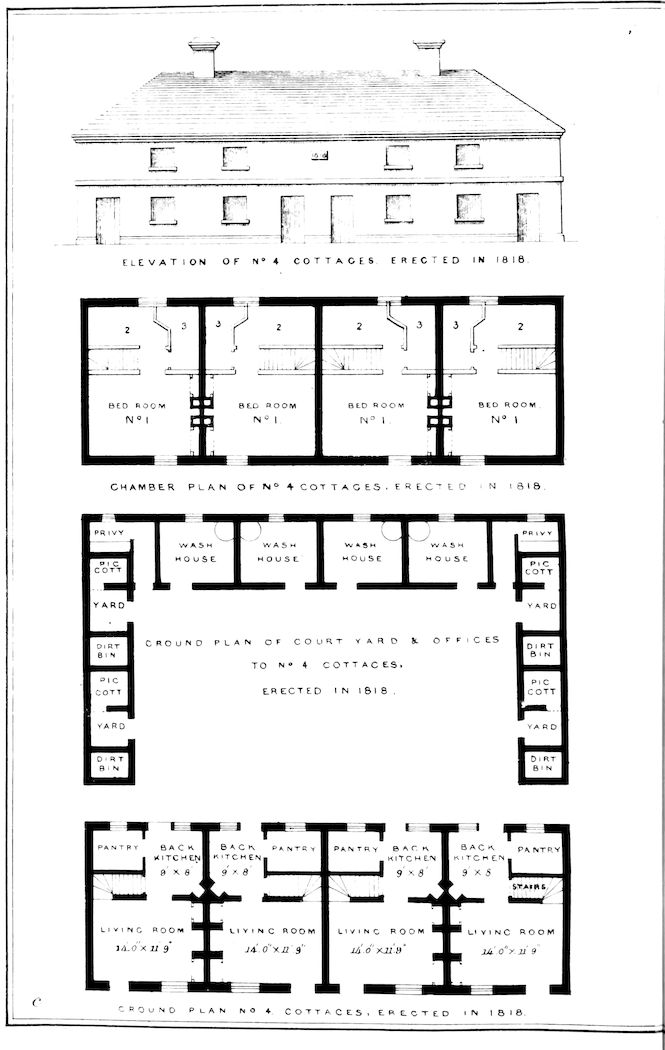
The Board agreeing that the most important leading examples of improvement were to be expected from the benevolence and public spirit of opulent individuals, requested the assistant commissioners in England to note the most conspicuous improvements of labourers’ tenements they have met with in their districts, and procure plans with a view to their promulgation. From these I have selected several examples, and have added several that I have met with in the course of my own inquiries.
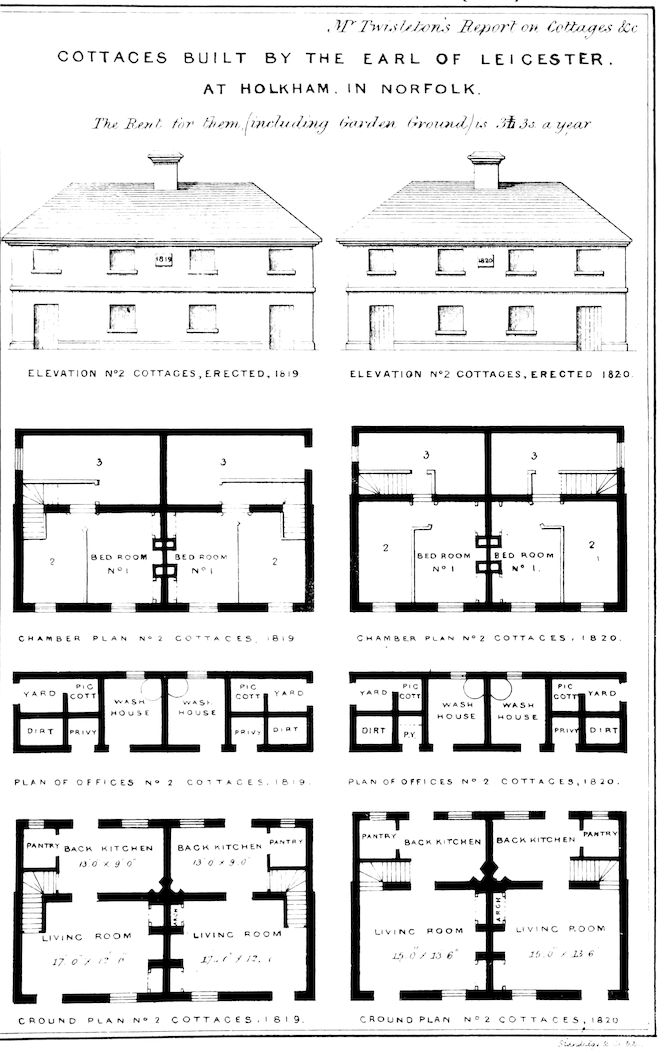
Some eligible plans of cottage tenements are thus described in Mr. Twisleton’s report from Norfolk and Suffolk:—
“Although the general aspect of the cottages in Norfolk and Suffolk is pleasing and attractive, I do not think that these counties can be generally cited as abounding with model cottages. Some of the best which I have seen belong to the Earl of Stradbroke, at Henham, near Halesworth in Suffolk; to the Earl of Leicester, at Holkham; and to the Rev. Mr. Benyon, at Culford, about five miles from Bury St. Edmunds. Those of the Earl of Stradbroke are built of brick, roofed with tiles, have four rooms at least, and have all proper conveniences of pantries, cupboards, and out-offices; but, at the same time, as they are principally with only one story, so that the bed-rooms are on the same floor with the parlour and kitchen, such cottages would only be built where land is no object; and they must be considered in the light of luxuries and ornaments. Some of the cottages of the Earl of Leicester, at Holkham, are perhaps the most substantial and comfortable which are to be seen in any part of England; and if all the English peasantry could be lodged in similar ones, it would be the realization of 265an Utopia. I have obtained from Mr. Emerson, of Holkham, their builder, drawings of the plans and of the elevation of eight of these cottages, which are built of brick roofed with tiles. I herewith transmit them to you, and it will be observed that there are three sets, two of two cottages each, and one of four cottages. Without entering into details respecting all the eight, I will draw your attention to the double cottages of 1819. Each of these has a front room, 17 feet by 12 feet in width, and 7 feet to 7 feet 6 inches high; a back kitchen of the same height, and 13 feet by 9 feet wide, together with a pantry on the same floor. Above these are three bed-rooms which, in different proportions, cover the space already specified for the ground-floor. At a convenient distance behind, each cottage has attached to it a wash-house, a dirt-bin, a privy, and a pig-cot. I may add that the drainage is excellent, that the water is good, that each cottage has about 20 rods of garden-ground, and that the rent, including gardens, is only three guineas a-year. Hence it is not to be wondered at that Mr. Emerson the builder has been enabled to say, in a letter to me: ‘I have never known in them an instance of fever or any epidemic.’
“These cottages are cited as showing what may be done by a landed proprietor who takes as great a pride in his good cottages and farms as others in fine hunters and race-horses, rather than with the least intention of asserting that the example is ever likely to be universally imitated. The cost of building two such cottages is stated by Mr. Emerson to be 220l. or 230l., which would be 110l. or 115l. each. Now, although individuals, here and there, may build cottages without regard to the pecuniary return, it may be assumed as incontrovertible, that no class of cottages will be universally adopted which does not command a reasonable interest for the money expended on them. But considering the cost of repairs, and the frequent trouble and uncertainty of obtaining the rents, it will probably not be denied that 6l. a-year would be the minimum as a remunerative rent for the outlay of 110l. or 115l. on a cottage. However, the rent of 6l. would scarcely be paid by the agricultural population generally at the present wages: for reckoning the rate of wages at 12s. a-week (which would be high for some parts of the country), very few would be willing, out of that sum, to expend 2s. 3¾d. a-week, or nearly a fifth of their earnings, for the rent of their cottage.
“I would take, therefore, a more attainable standard of excellence in the cottages of the Rev. E. Benyon, at Culford. This is a remarkable village of about fifty cottages, built within the last twenty years by Mr. Benyon de Beuvoir. The outward appearance of them is pretty, and it was this which first attracted my attention to them. They are built with bricks, faced with blue flint-stones, which harmonize agreeably with the blue slate of the roofs. They have each four rooms—two below and two above—with a pantry and a cupboard. I herewith transmit to you plans and drawings of five of these cottages in two sets—one consisting of double tenements, and one of three tenements. It will be observed that the principal room is 14 feet by 12 feet wide, and 7 feet high, which is inferior in size to those at Holkham, and that they have only two bed-rooms, while those at Holkham have three. At the distance of a few feet from each set of cottages there is a wooden building, roofed with tiles, which comprises a space for fuel, and a 266privy for each cottage, and a common oven. The average cost of the double cottages at Culford is stated to have been 170l., or 85l. each.”
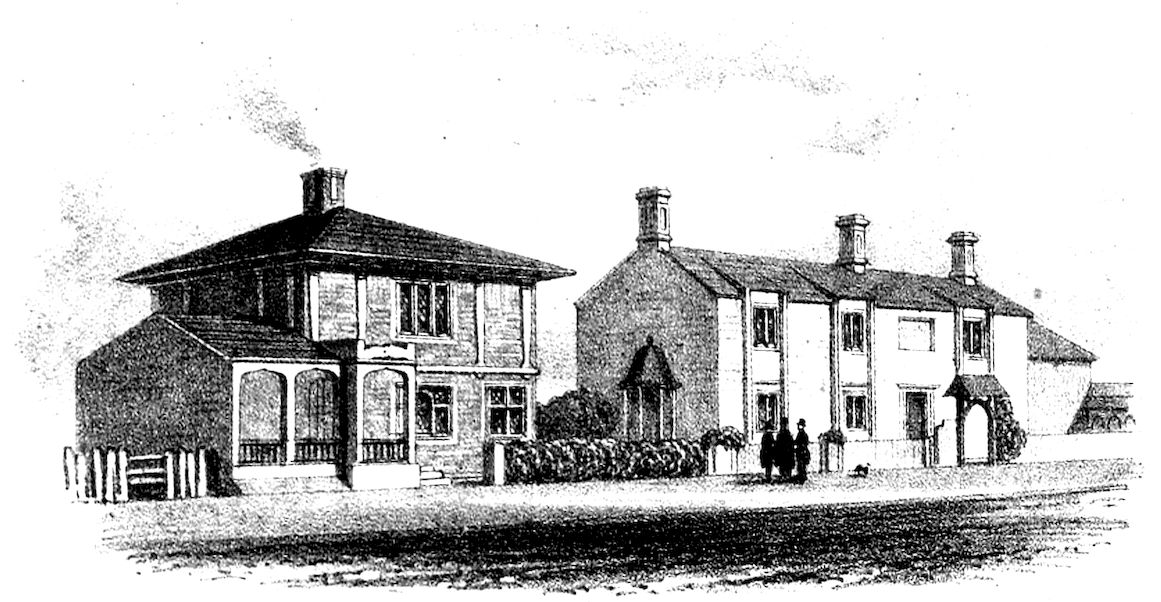
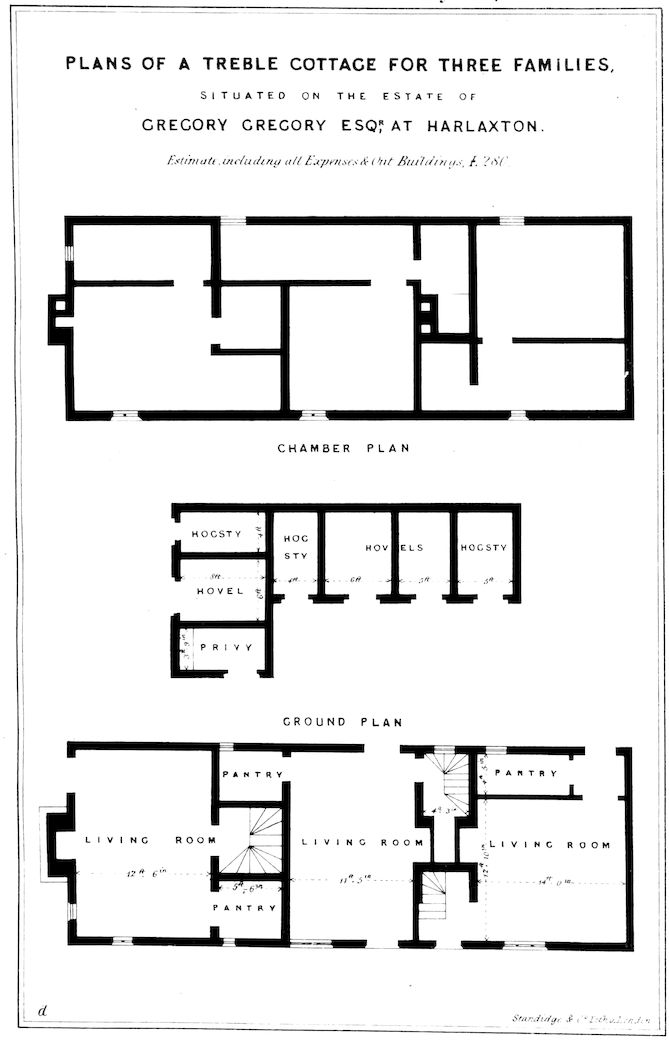
Mr. Loudon, who has paid great attention to the subject of cottage architecture, directs attention to the labourers’ cottages, either newly erected, or altered, or improved, on the estate of Gregory Gregory, Esq., at Harlaxton, near Grantham, Lincolnshire.
“The village of Harlaxton,” says Mr. Loudon, “is, if possible, more interesting to us than even the new mansion and gardens. We have seen many ornamented villages both at home and abroad, but none so original and so much to our taste as this of Mr. Gregory’s. Some of old date are too like rows of street houses, such as those of Newnham Courtenay, near Oxford; and Harewood, near Leeds; others are too affectedly varied and picturesque, such as that at Blaize Castle, near Bristol; and some have the houses bedaubed with ornaments that have not sufficient relation to use, as when rosettes and sculptures are stuck on the walls, instead of applying facings to the windows, porches to the doors, and characteristic shafts to the chimney tops. We recollect one near Warsaw, which is a repetition of the Grecian temple, with a portico at each end; and one at Peckra, near Moscow, every opening in which has a pediment over it, with highly enriched barge-boards. In some villages the attempt is made to ornament every house with trellis-work round the doors and windows, which produces great sameness of appearance, and if ornamental, is so at the expense of comfort, the creepers by which the trellis-work is covered darkening the rooms, and encouraging insects; while, in other villages, the cottages are so low and so small, that it is obvious to a passing spectator they cannot contain a single wholesome room. However, though we find fault with villages ornamented in these ways, we are still glad to see them, because any kind of alteration in the dwellings and gardens of country labourers can hardly fail to be an improvement, both with reference to the occupiers and to the country at large.”
The external condition of the residence, and the apparent rank it holds, is not without a beneficial moral effect on the occupants, by increasing their self-respect and pride in the decencies of life. Mr. Loudon’s enumeration of the requisites for cottage building are given in the Appendix, together with views of the groups of cottages Mr. Gregory has erected; contrasted with these is a group of hinds’ cottages, as described by Dr. Gilly, in his appeal in behalf of the border peasantry, from which a conception may be formed of the great difference in morals as well as in health that may be anticipated from the effects of the different order of residences on the population.
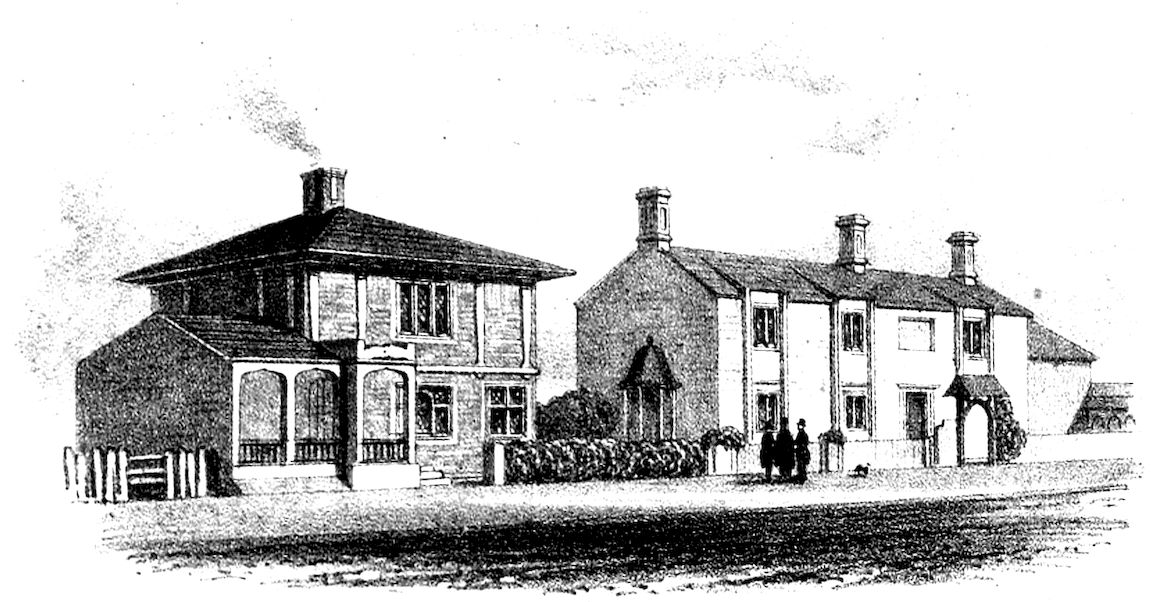
GROUP OF NORTHUMBRIAN COTTAGES COPIED FROM REVD. DR. GILLY
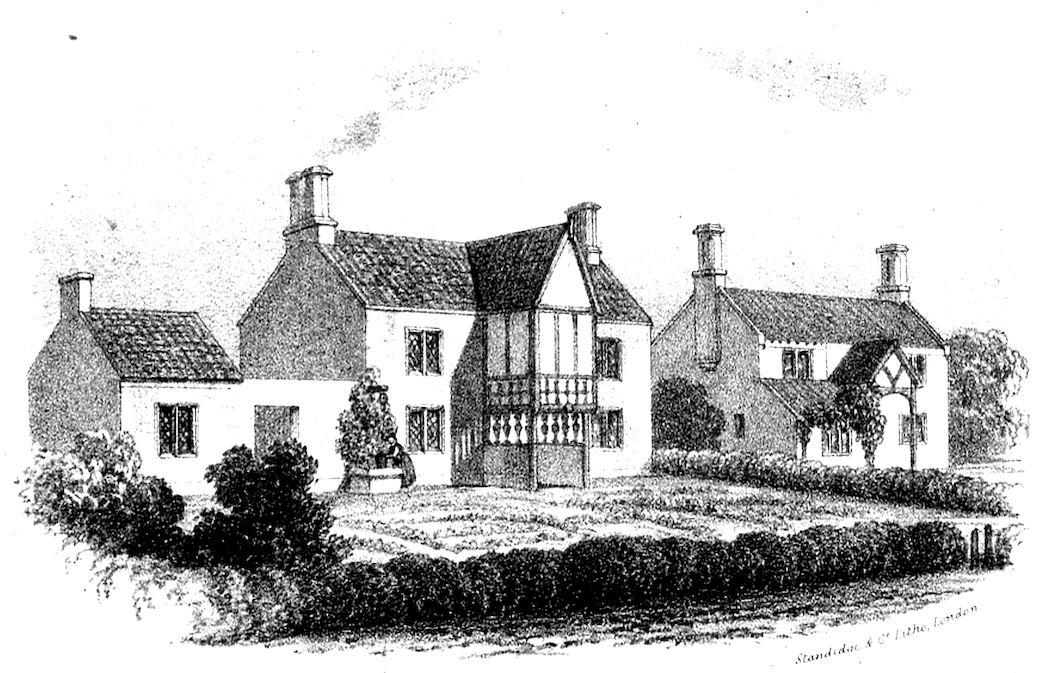
GROUPS OF DOUBLE COTTAGES AT HARLAXTON.
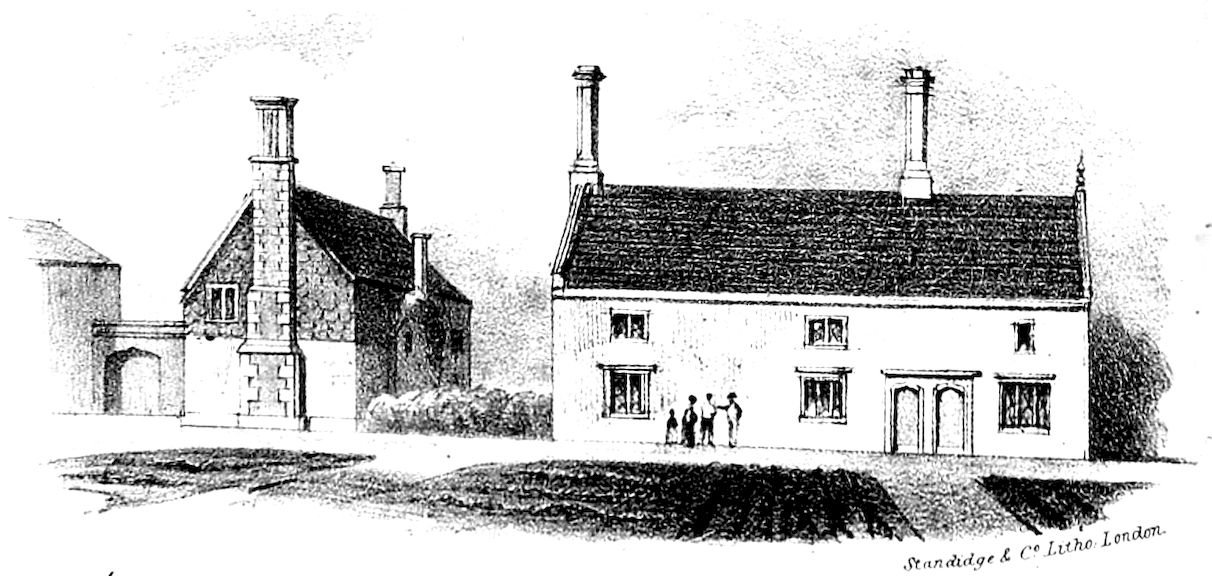
VILLAGE SHOP AND DOUBLE COTTAGE AT HARLAXTON.
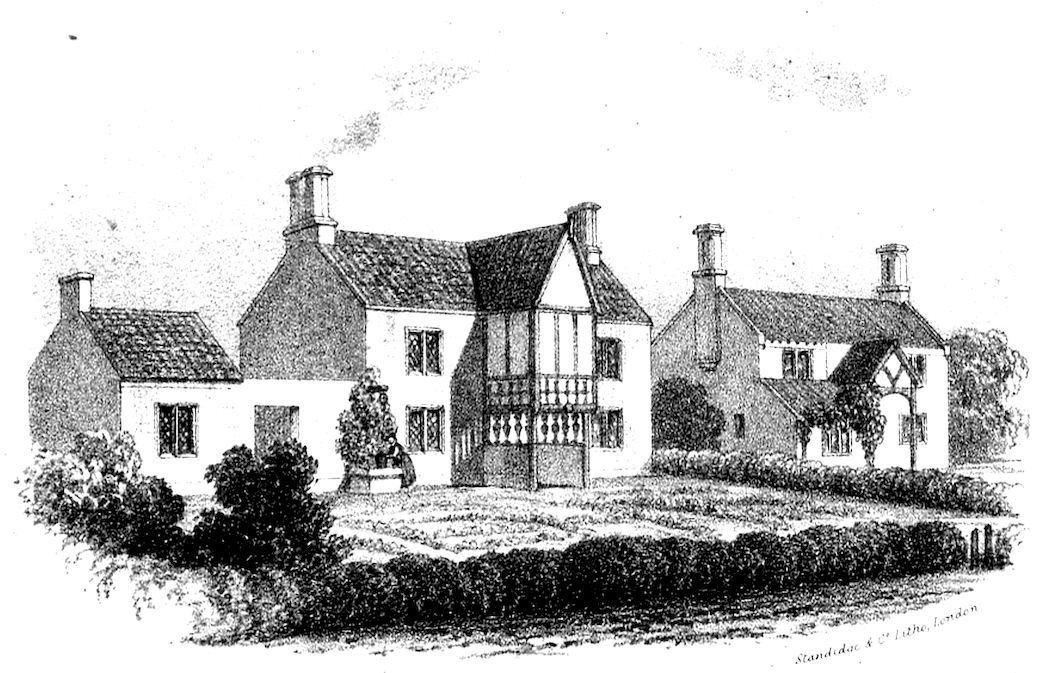
GROUP OF COTTAGES AT HARLAXTON.
PLANS OF A TREBLE COTTAGE FOR THREE FAMILIES,
SITUATED ON THE ESTATE OF
GREGORY GREGORY ESQR, AT HARLAXTON.
Estimate, inducting all Expenses & Out Buildings, £ 280.
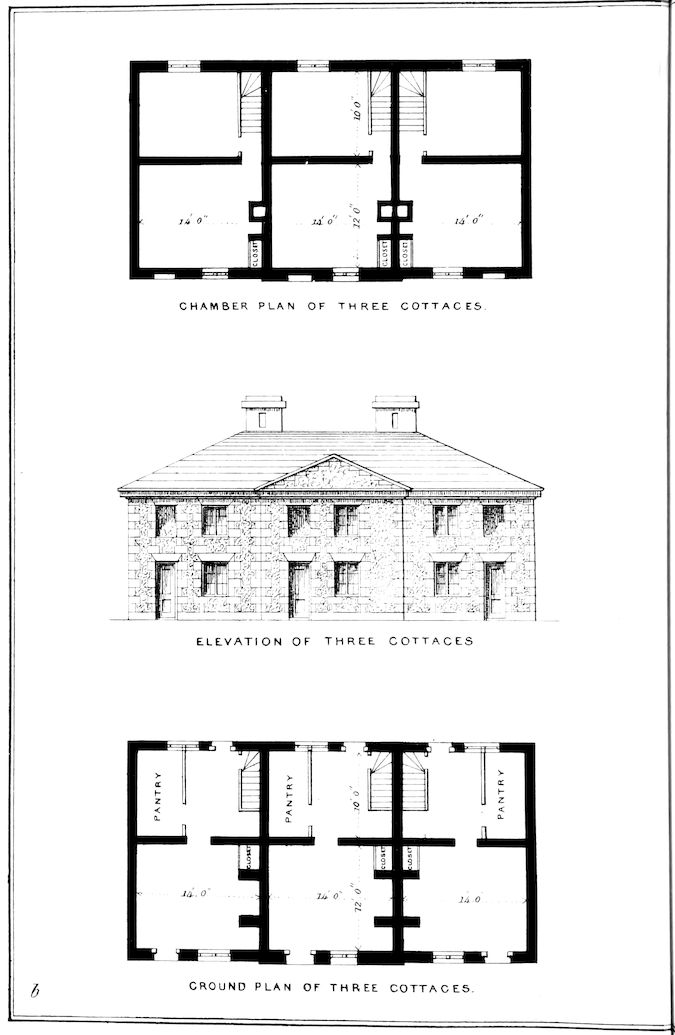
Mr. Twistleton’s Report on Cottages &c.
COTTAGES
BUILT BY
BENYON de BEAUVOIR, ESQR.
AT
CULFORD in SUFFOLK.
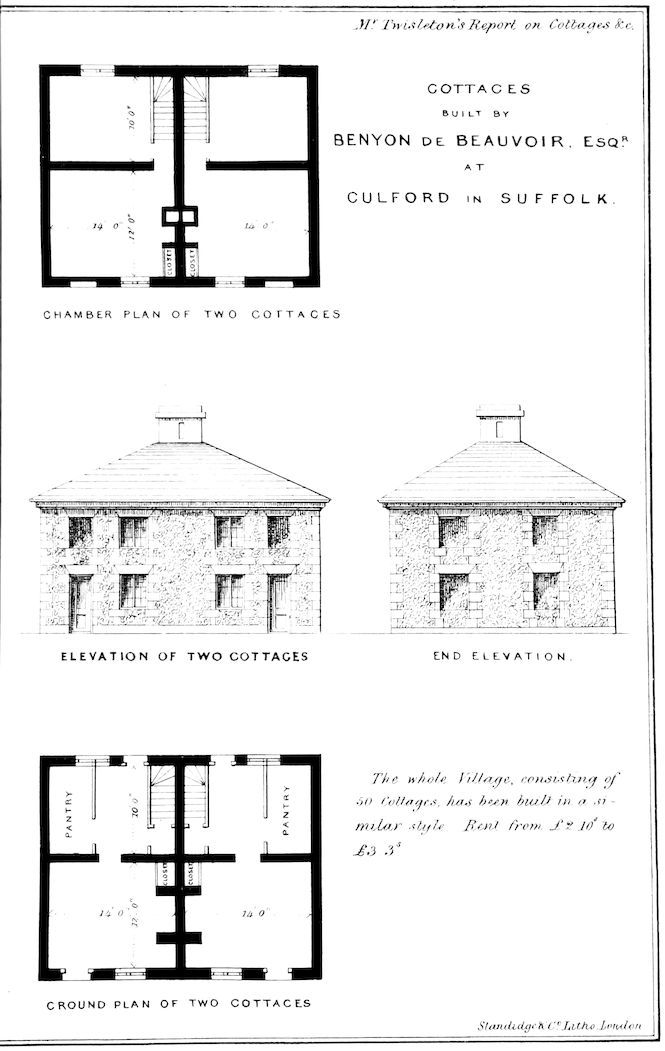
Mr. Twistleton’s Report on Cottages &c.
COTTAGES BUILT BY THE EARL OF LEICESTER.
AT HOLKHAM. IN NORFOLK.
Dimensions of Cottage.
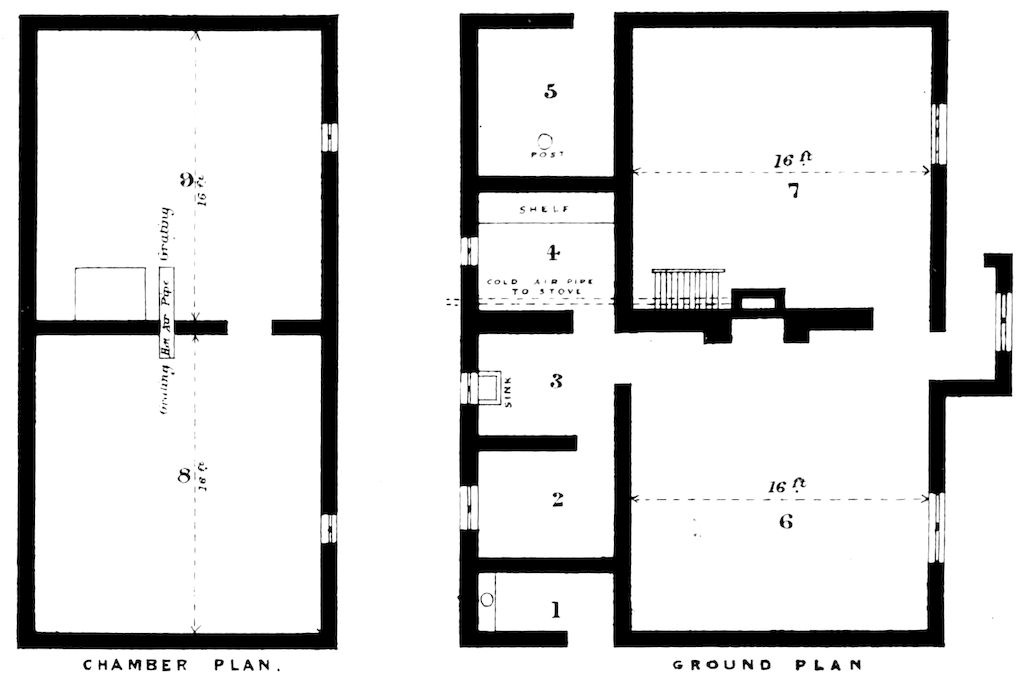
1. It is 36 feet in front. Its cost about £70.
2. Each room is 16 feet square & 8 feet in height.
3. There are two Garrets, used for sleeping rooms.
2
Apartments.
Nº 1
Is a necessary.
2
Coal, Wood & Peat House.
3
Scullery.
4
Larder.
5
Cowhouse.
6
Kitchen.
7
Sitting room.
8 & 9
are Garrets.
3
Warming Apparatus.
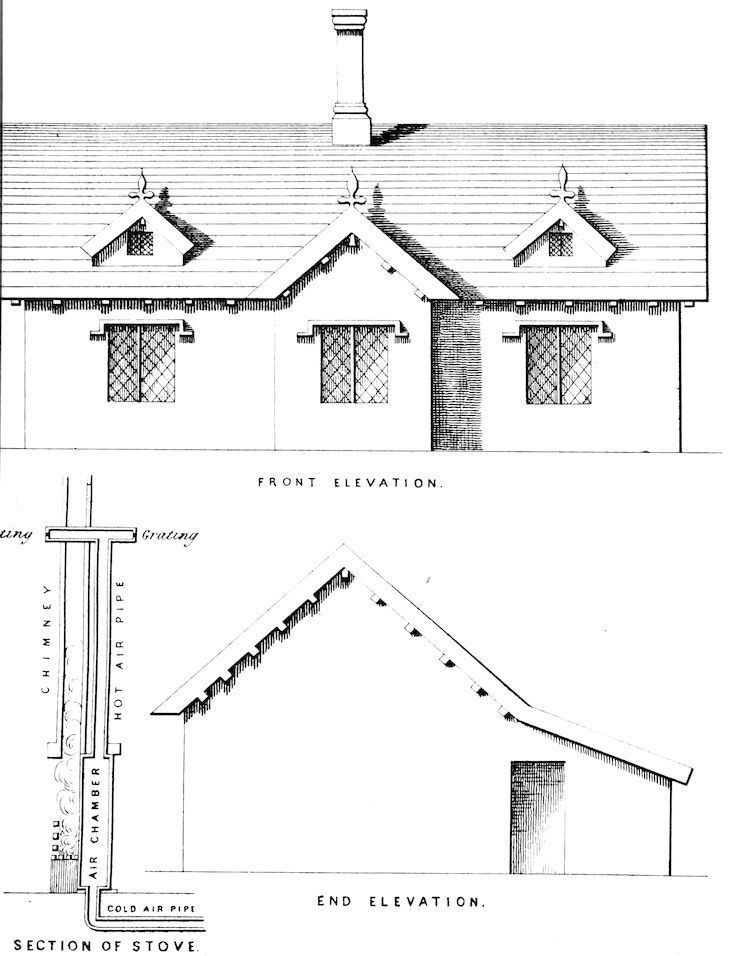
Behind the fire place of No. 6, Kitchen, is an Iron box, one side of this Iron box, made of strong sheet or plate Iron, forms the back of the fire place of No. 6. As two plates of iron are rivetted together, leaving a space of 6 inches between the plates which forms a box, a passage or pipe below the door as seen in the Plan, opened through the wall. This pipe or passage made of stone or brick, or of iron, admits a current of cold air to pass into the Iron box. This air entering the box and being heated by the fire in No. 6, gives its warmth out to No. 7. By means of a pipe which ascends from the top of the Iron box the two garret rooms are warmed. Wet linen may be dried by placing a screen with it before the Iron box in room No. 7.
4
The advantages of a fire place No. 7, constructed with an Iron plate for its back, and made into a box having two Iron plates fastened together, as seen in the Iron box between rooms No. 6 & 7, are that
1. One fire place is made to warm two apartments on the same floor, and by means of an Iron pipe, warm air is conveyed into the two garrets above.
2. The house can never be damp with such a simple economical method of heating.
3. In the Southern, Eastern & Midland Counties of England, where fuel is sold at a high price, it is beneficial for the labourer to heat his house in the manner just shown in the Closeburn Cottage.
4. Much of the sickness of the labourer and delicacy of his children proceed from damp Cottages.
PLAN OF COTTAGES
ERECTED BY SIR STEWART MENTEATH, BARONET,
FOR HIS LABOURERS AT CLOSEBURN.
PLANS OF COTTAGES ERECTED AT EGERTON FOR H. & E. ASHWORTH.
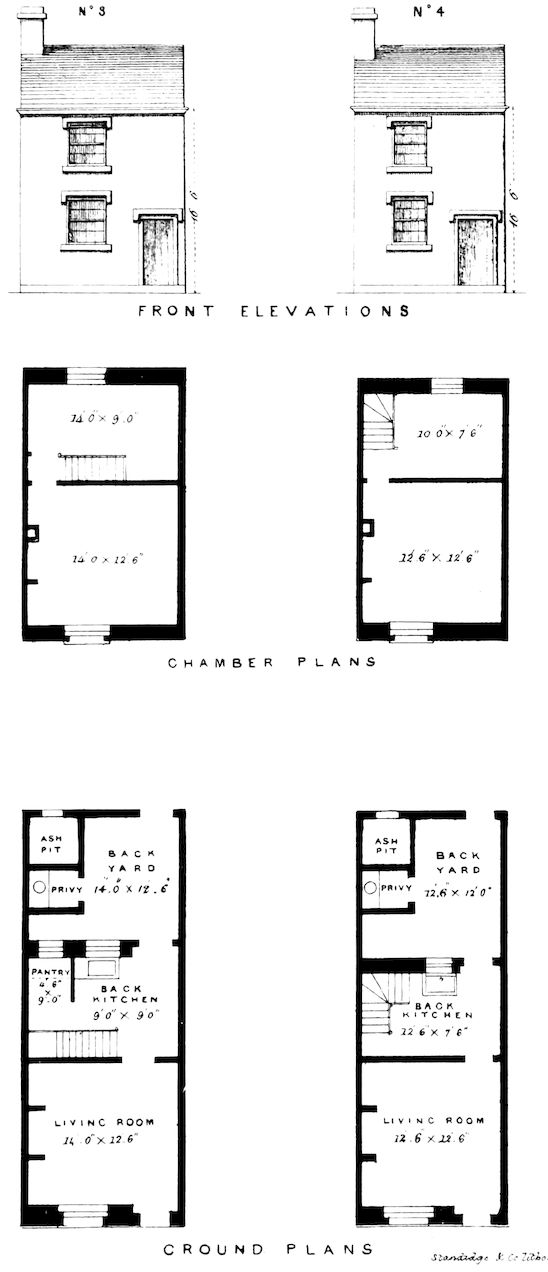
PLANS OF A DOUBLE COTTAGE, ERECTED AT BOLLINGTON.
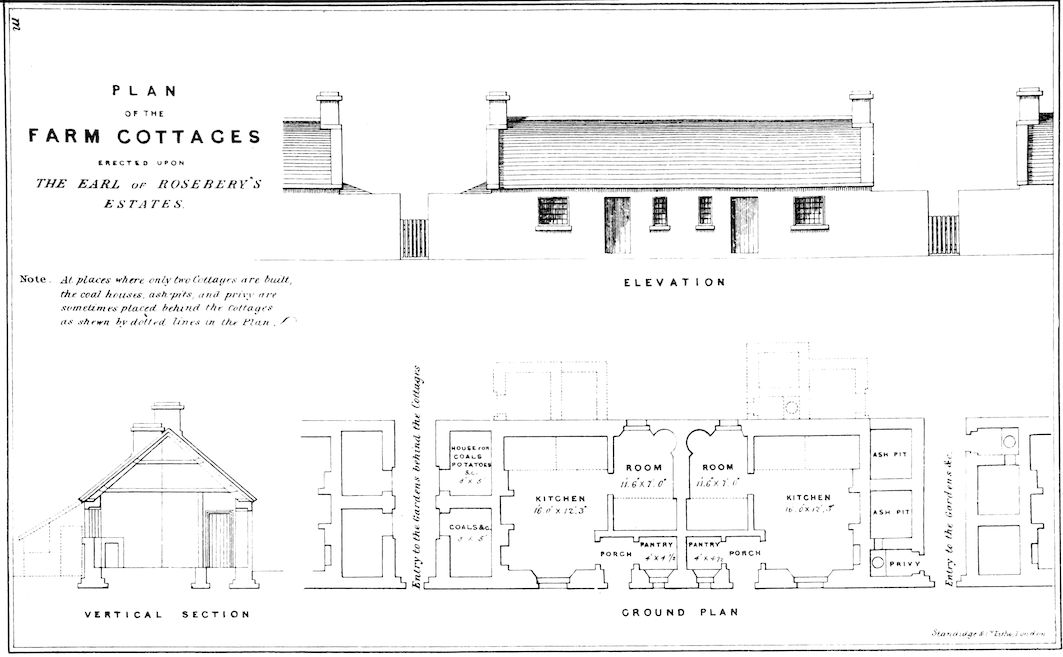
PLAN
OF THE
FARM COTTAGES
ERECTED UPON
THE EARL of ROSEBERRY’S ESTATES.
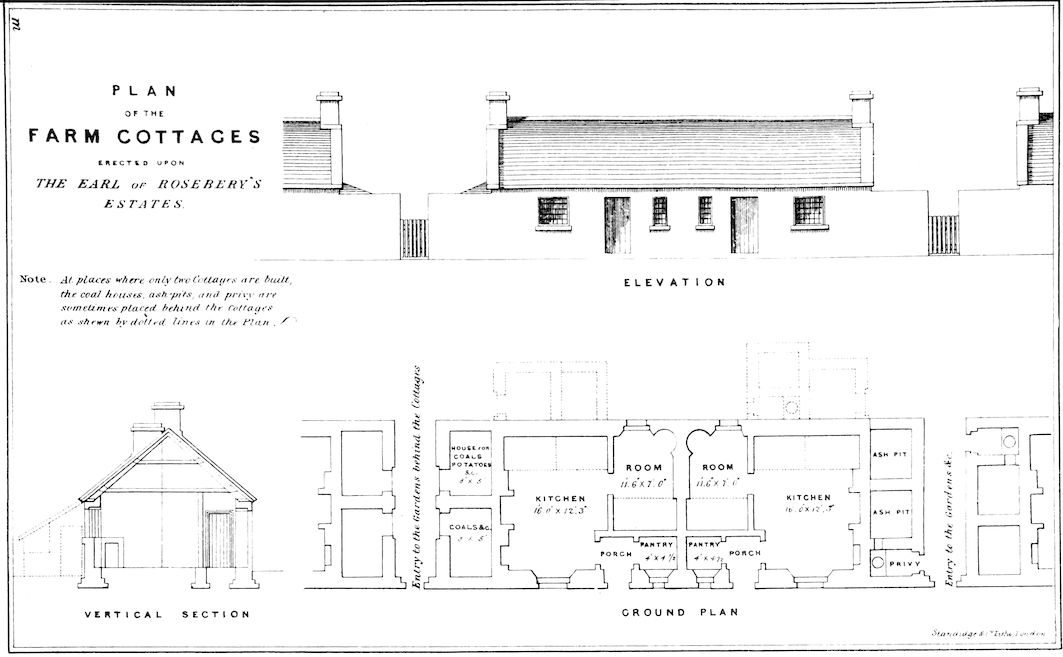
267I have been favoured by the Earl of Roseberry with plans of the new labourers’ cottages he has built on his property in Scotland, which have been highly approved by the Highland Society, who have inserted the plans for publication in their “Transactions,” vide Appendix. I have been favoured by James Monteath, Esq., with a model of the cottages erected by his father, Sir Stewart Monteath, Bart., for his labourers at Closeburn. The plan of these cottages presents an important improvement, by which one fire-place is made to warm two apartments on the same floor, and by means of an air pipe warms the air in the two rooms above them. I was informed that it admits of a further improvement in practice, namely, of some means of closing the access of the warm air to the sleeping-rooms during summer.
The best plans I have obtained of tenements in actual occupation of the rural manufacturing population appear to be those at Turton, and those erected at Bollington. The best plans of labourers’ tenements in towns are those supplied by Mr. Hodgson, and the Committee of Physicians and Surgeons at Birmingham; the drawings and working plans of which I have appended.
In several of the plans for the rural districts there is one appendage of the cottage of which the best-informed witnesses consider they ought invariably to be divested, namely, a pigsty. The medical witnesses strongly object that it is injurious to the health, especially in rows of cottages, as it occasions accumulations of filthy refuse. Other witnesses, such as the Rev. Thomas Whately, object that the pig is not economical to the labourer, and that it furnishes a temptation to dishonesty. His evidence on that subject, and on the other more important question of large cottage allotments, will be found in the Appendix.
Mr. Loudon has favoured me with two drawings and plans of model cottages, which need no other explanation than the specification. These comprise the best examples that have come under observation during the present inquiry of tenements in occupation that are well approved on trial.
Every detail, however, of the materials with which the cottage is constructed, and the mode of its construction, deserve, and there is little doubt will obtain, most careful attention, for it is only by considering their comforts in detail that they can be improved, or the aggregate effect on the immense masses of the community can be analyzed and estimated. For example, it has been mentioned that a decided difference is perceptible in the health and condition of workmen of the same class who live in houses made of brick as compared with those living in houses made of stone.
A gentleman who has attentively observed the condition of the working classes in the north of Lancashire, and the north of Cheshire, states that the general health of the labourers in the north of Lancashire is decidedly inferior. This inferiority he ascribes to several causes, and, amongst others, to damp cottages, and—
“Wood and wattled houses, such as our forefathers built, are the driest and warmest of all; brick is inferior in both these requisites of a comfortable house; but stone, especially the unhewn stone as it is necessarily employed for cottages, is the very worst material possible 268for the purpose. I prefer the Irish mud cottages. The evil arises from two causes. The stone is not impervious to water, especially when the rain is accompanied by high winds; and it sucks up the moisture of the ground, and gives it out into the rooms; but principally, stone is a good conductor of heat and cold, so that the walls cooled down by the outer air are continually condensing the moisture contained in the warmer air of the cottage, just as the windows steam on a frosty morning; besides, the abstraction of heat in stone houses must be a serious inconvenience. The effect of this condensation must be, and is, to make clothes, bedding, &c., damp, whenever they are placed near the wall, and therefore extremely prejudicial to those who wear the clothes or sleep in the beds. Of course I do not attribute all the damp of our cottages in this neighbourhood to the stone; much of it is due to the wet climate, wet soil, and building so near the ground; but the stone, as a material of building, must bear a considerable share of the blame. I believe, too, it is partly the cause of the very great difference of cleanliness of the Cheshire farming people and ours of the same class.
“Indeed the Cheshire people were brought up to wooden cottages: brick was of later introduction. The greater facilities and inducements to cleanliness in a dry house would, in the course of time, form a more cleanly people, and superior healthiness would follow.”
Mr. Parker observes, that the construction of the cottages in Buckinghamshire is frequently unwholsome:—
“The improper materials of which cottages are built, and their defective construction, are also the frequent cause of the serious indisposition of the inmates. The cottages at Waddesdon, and some of the surrounding parishes in the Vale of Aylesbury, are constructed of mud, with earth floors and thatched roofs. The vegetable substances mixed with the mud to make it bind, rapidly decompose, leaving the walls porous. The earth of the floor is full of vegetable matter, and from there being nothing to cut off its contact with the surrounding mould, it is peculiarly liable to damp. The floor is frequently charged with animal matter thrown upon it by the inmates, and this rapidly decomposes by the alternate action of heat and moisture. Thatch placed in contact with such walls speedily decays, yielding a gas of the most deleterious quality. Fever of every type and diarrhœa are endemic diseases in the parish and neighbourhood. Next to good drainage and thorough ventilation, the foundation of a cottage is the most important consideration. A foundation, to be good, must not only be sufficiently strong to bear the superstructure, and of sufficient depth to cut off all connexion with the surrounding vegetable mould and that beneath the floor, but also be constructed of materials calculated to resist moisture. The best materials for this purpose are concrete and sound bricks, partially vitrified in the kiln or clamp. If such bricks be well laid with mortar composed of sharp sand, containing no vegetable substances, and the concrete be free from earthy particles, well mixed and firmly thrown together, the admission of damp will be entirely avoided. Stone, chalk, bricks which are not thoroughly burnt, impure mortar, and wood, have all a tendency to absorb moisture, which, if once received by such materials, ascends, or ‘creeps up,’ as it is technically called by builders, and thus affects the whole building. To avoid this “creeping up,” builders are in the habit of placing a tire 269of slate in foundations above the surface mould, a remedy of a temporary character only, for the action of damp entirely destroys slate. Roman cement has also been used for this purpose, but the sand mixed with this material renders it in some degree porous. It has lately been suggested that a course of well-burnt bricks set in asphalte would effectually prevent this absorption of surface-water, and a favourable opinion of this plan has been expressed by two intelligent architects.”
He adds that—
“In Berkshire the floors of the cottages are laid with red tiles, called ‘flats,’ or with bricks of a remarkable porous quality, and as each of these tiles or bricks will absorb half a pint of water, so do they become the means by which vapour is generated. The cleanly housewife, who prides herself upon the neat and fresh appearance of her cottage, pours several pails of water upon the floor, and when she has completed her task with the besom, she proceeds to remove with a mop or flannel so much of the water as the bricks have not absorbed.
“After having cleansed the cottage, the fire is usually made up to prepare the evening meal, and vapour is created by the action of the heat upon the saturated floor. Thus the means adopted to purify the apartment are equally as injurious to the health of the inmates as the filth and dirt frequently too abundant in the cottages of labouring persons.
“It is usual to insert in local Acts for the regulation of towns a clause prohibiting the use of straw and similar vegetable substances for roofing; and it appears to me to be desirable that some provision should be made for the rural districts, by which the thatch of cottages, when in a decomposed state, might be required to be removed. In the parishes of Binton, Dorsington, and Long Marston, in the neighbourhood of Stratford-on-Avon, simple continued fever, described to be similar in character to the form of fever which frequently occurs in the autumn and beginning of winter throughout England, prevailed very extensively in the winter of 1839. Of 31 patients attacked by it, seven died. Dr. Thompson of Stratford-on-Avon, the physician who visited all the cases by the desire of the Board of Guardians of the Stratford-on-Avon union, observes:—‘As almost all the cottages in which there has been fever are thatched, and the thatch in many of them is in a very rotten and insufficient condition, it is not improbable that slow decomposition in the thatch, from the unusual quantities of rain which has fallen, may have been going on, and contributed to the production and continuance of fever. It has been observed by others, I believe, that it is more difficult to get rid of fever in thatched than in slated cottages.’ Dr. Thompson also remarks, that in thatched cottages it is not usual to ceil or plaster the inside of the roof; and he recommends that this should be done, and that the plaster should be lime-washed once a-year.”
In the course of some observations made on the construction of the cottages of the labouring classes in France, it is observed that—
“It is in vain that the workman breathes a pure air out of doors, if on his return to his home he finds an infected atmosphere. Air, which is so necessary to life and health, and which it is of the last importance to renew often, especially in small rooms, remains thick and loaded in the abode of the workman, because no currents can exist in consequence of 270the window being almost always placed alongside the door. The form of the chimney is another great evil in the construction of country cottages. With a shaft very short and very large, it is impossible for the room to get warm, and the heat produced is almost entirely lost. This form of the chimneys is only explicable by the ignorance of the constructors. However large a fire may be required by the diverse needs of the family, it does not involve the necessity to make the chimney shaft of a corresponding size; on the contrary, the facility with which the smoke ascends is altogether proportioned to the smallness of the latter, as may be seen in the chimneys of stoves, which are always extremely narrow.”
The Rev. C. Walkey, of Collumpton, gives instances of the want of provision for ventilation in the cottages of the labouring classes:—
“Cottages for the most part are without sufficient ventilation, particularly in the up-stairs apartment, this being almost invariably without a chimney, with a low window, commonly about two feet from the floor, and having no ceiling, therefore the thatched roof, lofty in itself, and full of cobwebs, contains the foul air; and in several instances I have been the means of restoring health apparently by blowing gunpowder in cases where fever has raged for months, the ground-floors being often damp—very seldom above the level of the land.”
The proceedings of the Highland Society for the improvement of the material condition of the labourer, especially on the subject of cottage economy, appear to be extremely well directed. They have sought to make improvements in detail, which are thus described in one of the reports of a committee appointed to inquire into the subject:—
“Medals have been offered by the society to proprietors for building cottages of a good construction; and these medals are already in demand. The subject was again brought forward by the Marquis of Tweeddale, who filled the chair at the last general meeting; and throughout the whole of Scotland it is attracting increasing attention. The style of such buildings is everywhere improving, and the measures of the society will make the country acquainted with the best models. Still, without a considerable diminution of the expense, the rapid introduction of a better system is hardly to be expected. To that point, accordingly, the directors have turned their serious attention.
“Their first object has been the improvement of the windows, which always form one of the principal items of charge, and have been generally one of the worst constructed parts of the building. In many districts of the Highlands the huts of the peasantry have nothing of the kind, nor are there tradesmen within reach from whom they can be obtained; and even in many of the more improved parts of the country the cottage windows are seldom large enough to admit a sufficiency of light; they are almost never provided with the means of ventilation; and in a few instances can they be repaired without applying to a tradesman. This is always attended with considerable expense; and, in remote situations, skilful workmen are hardly to be obtained on any terms. Accordingly, when glass is broken, recourse is had to the most unseemly substitutes. These may annoy the inmate at first, but he 271soon becomes habituated to them; one eyesore prepares him for another, and in a short time the same slovenliness and disorder spread over the whole establishment.
“It appeared to the directors that much of this would be avoided if the public could be made acquainted with the best description of a cottage window. The demand would necessarily lead to their being extensively manufactured, and consequently supplied at a moderate price; and, what is of still more consequence, the general adoption of such windows would lead to glass of the proper size being kept in every village, and labourers would then be enabled to repair their own windows. A premium was accordingly offered last year for the best cottage window, not so much in the expectation of bringing forward anything altogether new, as of enabling the directors to select the best of the forms now in use.
“Various specimens were sent in. Some were made of zinc; but these were rejected, on the advice of tradesmen, as being too weak to admit of repair by an unpractised hand. Wood and lead are, for the same reason, equally unsuitable. One was constructed with astragals of malleable iron, so thin as very little to impede the light, and consequently admitting of glass of a very small size; but the astragals not being provided with flanges for the glass to rest upon, the repair must necessarily be a work of some difficulty; and these also were consequently deemed unfit for the purpose. Cast-iron appears to be the material least liable to objection; but astragals of cast-metal must be of considerable thickness; and such frames, therefore, could not be adapted to a very small size of glass without materially obscuring the light. It was made by Messrs. Moses M’Culloch and Co., Gallowgate, Glasgow; and, without the wooden frame, it costs 5s. Glass for such a window may be purchased at 2¾d. per square. These windows would appear adapted for farm-houses and workshops as well as for cottages. They admit of being made of every variety of size, and, in most cases, they may thus be fitted with ease to houses already built. In many situations, it will thus deserve consideration whether it may be better to repair the glass of old frames, or to adopt windows of this construction, which may be purchased and kept up at so very moderate an expense. It is understood that Messrs. M’Cullock intend to establish agencies in all parts of the country, and light and pure air will thus be supplied to the humbler classes everywhere at a much cheaper rate than they have hitherto been obtained.”
The directors have next turned their attention to the means of economizing fuel; and a premium for the best mode of accomplishing this will be found in the list of this year. It will be observed, that the object of the premium is not to obtain plans merely from Scottish tradesmen, but to ascertain the devices which are practised in foreign countries. In America, and several of the continental states, it is understood that stoves are generally used for this purpose, and some of these are said to be so perfect that no one who has been accustomed to them would tolerate the fire-places of the Scottish cottages. There may be a difficulty in introducing a novelty of this kind here; but if it should promise to be beneficial, it would be at least deserving of a trial; and if it should be generally adopted, this also would become the subject of an extensive manufacture, and be obtained at a cheap rate.
272“It appears to the committee, that still further facilities would be afforded, both for the construction of new cottages and the improvement of those already built, were doors, shelving, and the other wooden work of the building manufactured in the same way as the windows. The committee do not at present see any means of contributing to the establishment of such works by the offer of premiums; but it occurs to them that extensive proprietors might find it worth their while to try the experiment, as an addition to the work of saw-mills. If it should succeed with them, it could not fail in the hands of tradesmen devoting their whole attention to the subject; and there would be no want of men ready to embark in such undertakings. Should an experiment of this kind be made, the committee hope that the directors will be made acquainted with the result.
“Such a supply of the leading materials would not only greatly facilitate the work of proprietors both in the erection of new cottages and the improvement of old ones, but labourers who have the prospect of being permanent tenants would likewise be induced, at their own expense, to make improvements, which they would at present find quite impracticable. As the reduction of the price of every article of dress now enables the humblest labourer to appear respectably clothed, so the reduction of the expense of so many of the essentials in the construction of a house would bring comfortable lodging equally within his reach.”
To the above-recited measures of the Highland Society, which are so well directed to the improvement of the structure of cottages in the important points of economy as well as of efficiency, they have added prizes for the best-kept cottages and the best cottage gardens, which have everywhere excited competition, and have been attended with beneficial results.
I have as yet met with no similar instance of attention given by large and influential public bodies, to the improvement of the residences of the working-classes in towns. I have, however, been favoured with one communication from Mr. Sydney Smirke, the architect, who has had experience in planning and superintending the erection of residences for the men of the coast-guard service, and who, in some suggestions for the improvement of the metropolis, has endeavoured to direct public attention to the improvement of the structure of the residences of the labouring classes. He states that—
“The course that has been adopted by great manufacturers and others in some rural districts, of erecting ranges of distinct cottages for their labourers, is plainly inapplicable to large towns. If there were no other obstacle to this arrangement, the value of land would alone be fatal to it in such places; but my belief is that, without ultimate pecuniary loss, and with the utmost direct and indirect benefit, buildings, placed under some public control, might be erected for the joint occupation of many families or individuals, and so arranged that each tenant might feel that he had the exclusive enjoyment of a home in the room or rooms which he occupied, and yet 273might partake, in common with his neighbours, of many important comforts and advantages now utterly unknown to him.
“I propose that there should be erected buildings, in various parts of the suburbs, consisting of perhaps 50 or 60 rooms, high, airy, dry, well ventilated, light and warm, comfortably filled up, fire-proof, abundantly supplied with water and thoroughly drained; such regulations might be laid down for the conduct of the inmates as may be necessary for the common good, without undue rigour or interference with natural and proper feelings of independence.
“Another class of structures should be raised, perhaps rather as dormitories than for permanent residence, from which families would be excluded; these should be arranged like some of the wards of Chelsea Hospital, with separate compartments appropriated to each tenant. Unlike the frail and worthless tenements that rise in great profusion around London, these buildings should be studiously planned and strongly constructed; all that the builder’s art can contribute towards the safety, health, and comfort of each individual, should here be found. In the former class of buildings, a room or rooms should be let at a low weekly rent to any decent family that should apply: in the latter, each compartment should be let by the night.
“The exterior of these locanda, or public lodging-houses, should have a cheerful, inviting appearance, not entirely without architectural character, although free, of course, from the mere ornament and frippery of architecture.
“In throwing out these suggestions for such consideration as they may deserve, it seems superfluous at present to trouble you with explanatory plans and other details; it may be enough for me to assure you that buildings can be erected, affording all the accommodations above described, and offering to their inmates the luxury of a decent, cleanly, and healthy abode, at a cost less than is usually required by them for the purchase of the squalid resting-places they now resort to, and yet enough to repay a fair interest on the original expense of the new building.
“It may be said that in providing these commodious dwellings for their needy inmates, we shall be furnishing them with that which they do not desire; that habitual and long acquaintance with privation has taught them to regard and to endure, without any lively distaste, much of that misery from which others, more delicately educated, would shrink with disgust; but I consider this objection quite unfounded. A tainted atmosphere cannot be less injurious because by long habit it is breathed without nausea. If these deplorable habits have really acquired so much force, it should be our part to make corresponding efforts to teach the victims of them to become more sensible of their misery, not indeed by inculcating lessons of discontent, but by affording to them facilities for providing themselves with healthier and happier abodes.
“It is the true saying of an eloquent writer, that ‘les esclaves perdent tout dans leur esclavage, jusqu’au désir d’en sortir;’ yet surely no benevolent person would think himself idly or unprofitably employed in loosing from bondage those whom long endurance has caused to forget the blessings of freedom. I am, however, unwilling to believe, even now, that the classes of whom I am speaking are insensible to the 274comforts of cleanliness, or unable to appreciate the benefit to be derived from improved habitations.