APPENDIX.
Reading edition
1.—Evidence of Mr. John Roe, Civil Engineer, on the Practical Improvement in Sewerage and Drainage tried in the Holborn and Finsbury Divisions of the Metropolis.
You are the surveyor to the Holborn and Finsbury Commission of Sewers?—Yes, I am.
By profession you are an engineer?—Yes; I have been engaged as an engineer in the formation of canals and railways, and in the drainage incident to such works.
How long have you acted as surveyor to this branch of sewerage in the metropolis?—Nearly four years.
Have you observed the general state of the sewerage of the metropolis?—I have only seen some of the sewers of other divisions, but I am generally acquainted with the principle of their construction.
Is it generally the same as that in which you found the sewers in the Holborn and Finsbury divisions?—Yes, except that the forms differ in a degree; some are flat-bottomed sewers, others segment-bottomed. For a long time the Holborn and Finsbury divisions have used bottoms of a semicircular form.
The effect of a flat-bottomed sewer, it is to be presumed, when the water is shallow and the flow slow, is to leave a larger quantity of deposit?—Yes; it flows sometimes in a channel, leaving a deposit on each side; sometimes the water flows on one side, leaving a deposit on the other; but in all cases the flat-bottomed sewers occasion a larger amount of deposit with the same flow of water: it is more than one-half difference of the deposit which is left.
What proportion of the sewerage of the metropolis do you believe to be flat-bottomed?—I have not examined the other divisions, but I believe the greater proportion of the sewerage to be flat-bottomed. In the City they have built some of their sewers in a form nearly similar to those adopted in the Holborn and Finsbury divisions; that is, approaching to semicircular. In the Westminster division the invert is a segment of a circle, whose chord being three feet the versed sine is six inches. Most new sewers are making an approach to the better form by having segments.
Is it not the fact that in proportion as the bottom approaches a plane it approaches to the inconvenience of the flat-bottomed sewers, and weakens the force of the current?—Yes, in a degree, it does.
Are there any practical inconveniences, or is there any material increase of expense in building semicircular bottoms?—None; and if the sides are curved also it forms the stronger sewer for the same expense.
How are the sides of the sewers generally built?—As far as I am informed, they are built with upright walls. I know none but the new sewers in the Holborn and Finsbury divisions that are built with curved sides, though I have no doubt that if any new sewers are built under the superintendence of Mr. Walker, who is president of the Engineers’ Society, he would build them with curved sides.
What are the disadvantages of the flat-sided sewers?—They are not calculated 374to afford the greatest strength. In clayey or slippery ground, where there is a pressure on the sides, they are more easily forced in. I have myself seen instances where expensive sewers have been forced in at the sides. The curved side gives the strength of an arch in resisting such pressure.
Is there any addition of expense in the construction of such forms of sewers as you describe?—Less expense; there is less brick-work required. As compared with some upright sewers with footings, the difference will be two shillings in first size sewers, and four shillings per foot lineal in sewers of the second size, in favour of the curved sewers.
In respect to the levels, how have you found the sewers?—They appear to have been entirely constructed with reference to the locality, to drain to the nearest outlet, and not on an extended view for the whole district, or with any view to sewerage on a large scale. In the Holborn and Finsbury divisions the Commissioners now adopt a series of levels suited from the lowest outlets to the surrounding districts.
Have you heard of any alterations made in the surrounding districts on the same principle?—I have heard of none as adopted generally. The City have lowered several of their outlets; and Mr. Donaldson, on the Westminster, has had the subject under consideration for some time.
What are the chief effects of the piecemeal town drainage without reference to extended levels?—Chiefly that when new lines of houses are built and require new sewers, either the old sewers must be taken up and re-constructed at a great expense, to adjust them to a new and effective sewerage, or the new sewers, if they are adjusted to the old ones, are deficient in fall, and they have greater deposits.
Does the existing form or system of sewerage answer fully and at the least expense the chief objects of sewerage in house and street cleansing, and the removal of noxious substances?—No, it does not, except where the outlets have been lowered, and the sewers continued at a proper level; great accumulations of deposit are occasioned in the sewers, and from their containing the refuse that was at one time deposited in the cesspools, the deposit is more noxious than formerly; the gas is more considerable, it escapes more extensively into streets and into the houses, where the drains are not well trapped. My opinion is that the general health of the men who work and have been accustomed to the sewers, has become still worse; they are more pale and thin, and lower in general health than formerly. The effect of the noxious gases upon men working in these places is to lower the general health. Since I have had the superintendence of the sewers, the men have encountered about half a dozen accidents by explosions of gas.
But is the health of these men who work in the sewers to be taken as a criterion of the health of persons who are not accustomed to such places?—I have had no means of forming a comparison, though I am of opinion that gases which they encounter without any immediate injury would be very injurious to the health of susceptible persons, or of any persons not habituated to it.
The first prejudicial effect of the defective system, then, is to occasion these noxious accumulations; how are they removed?—Formerly, in the Holborn and Finsbury sewers, and at present, I believe, in all other sewers, the streets were opened at a great expense and obstruction (they are so now, I believe, elsewhere); men descend, scoop up the deposit into pails, which are raised by a windlass to the surface, and laid there until the carts come; it is laid there until it is carted away, sometimes for several hours, to the public annoyance and prejudice. The contract price for removal from the old sewers without man-holes was 11s. per cubic yard of slop removed; where they have man-holes it was 6s. 10d. per cubic yard. This practice also involves injury and expense as respects the pavement; a street may be well paved when it is broken up for the cleansing of the sewers, but the portions of pavements so disturbed are never so well put down again; neither can accidents be effectually guarded against.
375By what means may these effects be obviated?—In the Holborn and Finsbury divisions I suggested a plan of flushing the sewers, and of carrying off all the refuse by water. This plan has been adopted, and it is now in operation. The breaking up of the streets is avoided by the formation of side entrances; cast-iron flushing gates are fixed in the sewers; the ordinary flow of water in the sewers accumulates at these gates; the gates are opened, and the force of the water is sufficient to sweep off the deposit; and the system may be further extended.
What is the comparative difference in the expense of construction?—The cost of side entrances and flood-gates, as compared with the cost of man-holes, is from 6d. to 1s. less per foot lineal of the length of new sewers.
What other expense is attendant on this improved practice?—The main expense is the attendance of a man to shut and open the flood-gates.
The structural expense being lower, is the ultimate expense of cleansing lower also?—Yes; the expense of cleansing the sewers is about 50 per cent. less than the prevalent mode. Our expense of cleansing the sewers was about 1200l. per annum; we save 600l. of that, and expect to save more; but to this must be added the saving to the public of the cleansing of the private drains, formerly choked by the accumulations in the sewers. This saving, on a moderate calculation, is found to be upwards of 300l. per annum. There is also the diminution of the escapes of gas from the old and continued accumulations.
During what intervals are deposits allowed to remain on the old mode?—The average is in one set of sewers about five years, and in another about ten years.
During which time the public are subjected to all the escapes of gas from the decomposing accumulation?—Exactly so. It could not, however, go on so long but for heavy falls of rain or snow, which occasion partial clearances.
What is the effect of these accumulations upon the private drainage?—That the drains to the private houses are stopped: the first intimation of the foul state of the main sewer arises from complaints of individuals whose drains are affected; the accumulations in the private drains also occasion an expense to the individuals and much annoyance. By flushing the sewers this expense might be, and in the Holborn and Finsbury division it is, avoided.
Might not the price of sewers be reduced even below those you have now in use, the egg-shaped sewers?—With the radiated bricks, I think that the same capacity of sewerage may be secured with less thickness of brick-work. I have given in an estimate of second-class sewers at 10s. 6d. per foot lineal; which is 7s. 6d. per foot less than the common flat-bottomed sewer with footing.
In these main drains a man may go up to examine them. Admitting them to be necessary for the large towns, might not a smaller and less expensive drainage suffice for small towns and villages?—There are situations in courts, alleys, and small streets, where a less expensive form of drainage would suffice. In fact 18–inch drains for short lengths, costing, if made of radiated bricks, 4s. 6d. per foot, would suffice; they would act well in proportion to the goodness of the falls.
Have you found the system of cleansing the large drains by flushing with proper supplies of water equally applicable to small drains?—Yes, equally applicable. A gentleman has tried it on a private drain of 18–inch capacity, and 1200 feet length, and it answers equally well. It is cleansed by the collection of refuse water from 30 or 40 houses.
Might not the drains from private houses be also cleansed in the same mode?—Yes, they might have a small and cheap apparatus for carrying away all ordinary refuse. If in the small drain a brick fell in, it could not be removed by the force of the small quantity of water which could be obtained in such a situation. In our large sewers the heads of water are in some cases strong enough to sweep away loose bricks.
Would it not be of advantage to the occupier, if the private drains were under the same general superintendence?—I conceive it would in management. 376They are frequently put to great expense by getting persons to attend to them who really do not understand them. They are often now obliged to have recourse to the contractor’s men. Private property is often drained through other private property, and when the drains are choked, if the parties are not on good terms they will not allow each other facilities for cleansing. Under the Finsbury local Act there is a power to enforce the cleansing of private drains, and by way of appeal that power is sometimes resorted to by private individuals.
May we not presume that the same principles of hydraulics, as to the advantages of a flow over a semi circular bottom, are as applicable to small drains as to large ones?—More so from the flow of water being smaller; the greater necessity for keeping it in a body to enable it to carry away the common deposit.
Then there is a proportionate loss in having the private drainage made with flat-bottomed bricks or boards?—Yes, there is proportionate loss from the extra cost of cleansing. Semicircular drains of tiles would be better, and cheaper than brick, for private houses.
Are there any other defects you have, as an engineer, noticed in the prevalent mode of constructing the sewers?—Yes, the prevalent practice is to join sewers at angles, frequently at right angles; this occasions eddies and deposits of sediment that would otherwise pass off with the water; it injures the capacity of the main sewers by obstructing the current of water along them: I ascertained by experiment that the time occupied in the passage of an equal quantity of water, along similar lengths of sewer with equal falls, was—
Seconds.
Along a straight line 90
With a true curve 100
With a turn at right angles 140
The Commissioners of the Holborn and Finsbury divisions agreed to require that the curves in sewers, passing from one street to another, shall be formed with a radius of not less than 20 feet; it is also required that the inclination or fall shall be increased at the junction, in order to preserve an equal capacity for the passage of water, and of effect in sweeping away the deposit.
When by heavy falls of snow or otherwise the refuse of the streets is carried into such sewers, is there any difficulty in sweeping it away?—None whatsoever.
How are the gully-holes or entrances to the drains affected by such deposits?—Under the prevalent system the gullies and shoots are formed so as to retain deposit, on the principle that it is cheaper to get the deposit out of those than out of the sewers. The Commissioners in Holborn and Finsbury, having adopted the flushing principle, have also adopted a new description of gully and shoot, which I proposed to them for the purpose of conveying the whole of the deposit into the sewers; it is then washed away by the flushing.
In what number of years would the saving in cleansing sewers by flushing repay the expense of applying the apparatus to the existing sewers in the Holborn and Finsbury divisions?—In seven years.
What would be the expense of the construction of chimneys to remove the foul air from sewers?—The expense would depend upon the sort and form of chimney that might be used. A suggestion of Mr. Stable, one of the chief clerks of the Holborn and Finsbury commission, appears to meet the case at the least expense. He suggests that the pipes used to carry off the rain-water from the roofs of houses should be connected with the crown of the sewers; thus forming a chimney for carrying off the effluvia from the sewers, and also a conveyance for the rain-water into the sewers. The cost of connecting one such pipe with a sewer would, on an average, be about 3l. 16s. 2d.
Have you any doubt of the practicability of carrying all the surface cleansing of the streets into the sewers, and removing it by conveyance in water, as was proposed at Paris, instead of by hand labour and cartage?—I entertain no doubt whatever that it might be done, where there is a good 377sewer and proper gully-holes and shoots; with a good supply of water these would carry away rapidly all the surface refuse; the experience of the sewerage in the Holborn and Finsbury divisions prove it.
How does it prove it?—At every opportunity the street-sweepers sweep all they can into the gully-holes, and it is swept away without inconvenience.
One practical witness states that the expense of the cartage alone of the refuse from a Macadamised street of half a mile, in the winter time in the metropolis, is 5l. weekly. What would be the comparative expense of carrying it away by the sewers?—It would save the whole expense of the cartage; it would be less than the present expense of sweeping and filling into the carts, and if there were a sufficient supply of water on the surface, the work might be conducted with great rapidity.
You are aware that one inconvenience of the existing mode of street cleansing, independently of the great expense, is the length of time during which the wet refuse remains to the public annoyance on the surface, until removed by the slow process of sweeping and cartage?—Yes; and the men would appear to delay for the purpose of the dirt being removed, by being washed by rain into the sewers.
Do you conceive that all the business of street cleansing and house draining might be consolidated advantageously to the public?—Yes, clearly so, and with great economy.
Have you, as an engineer, had experience in road construction?—Yes, I have, having taken the levels and surveys preparatory to an Act of Parliament being obtained for lowering the Long Compton Hills in Warwickshire; I afterwards constructed the new line of road on Mr. Telford’s principle.
Considering the drainage of a new district: the under-drainage of the roads and houses and the surface cleansing, would not the public gain by putting the drainage, the road-construction, repair and maintenance of the roads, under the same management?—Yes, the public would get it done much better by one surveyor and one Board than by two. In the old districts, besides the double expense of officers, inconveniences arise from the want of unity between the contractors for the paving and the contractors for the drainage; there is always conflicting interests between the two, and the work is not in many cases done with the economy and expedition which would be practicable.
If the public, who may be ignorant of the science of sewerage and of what it may accomplish, make no complaints, and do not agitate for the adoption of any improved system, in how long a time do you think the improvements demonstrated in the Holborn and Finsbury divisions would reach the other end of the metropolis by the force of imitation and voluntary adoption?—From the apathy shown and prejudice against anything new, however valuable it may be as an improvement, and the various interests affected, such as the contractors for cleansing, I do not expect that they would become general in the metropolis during my life-time. The public are passive, and the adverse interests are active.
You know the description of persons engaged as surveyors of various descriptions in the rural districts and in the smaller towns?—Yes, I do.
Unless care be taken, is it to be apprehended that any new expenditure will be made on imperfect and unwholesome drains with flat bottoms and on false principles at a disproportionate expense?—Undoubtedly, except they have to act on rule, it will certainly be so throughout the country. The drainage that I have seen in the country districts is worse than in the metropolis.
Have you found the sewerage produce any effect in the drainage of the surrounding land?—Yes, we have found it lower the water in the wells, often at great distances. For instance, in forming a sewer in the City Road we found that it lowered by four feet a well nearly a quarter of a mile distance. The only remedy we could advise to the parties was to lower the well: they did so. We afterwards had occasion to lower the same sewer three feet, when the well was lowered again in proportion; so that the construction of the sewer, in this instance, drained an area of 40 or 50 acres on that side, and perhaps further. The water is sometimes in such quantities and so strong in 378the land springs as to require openings to be left in the side of the sewer for its passage.
Are there any fees taken in the Holborn and Finsbury divisions?—None.
Do you think the system of the payment of officers by fees objectionable?—Yes, highly so.
“Have you met with instances where the drains have not acted, owing to the inadequacy of the supplies of water?—I have not had my attention called particularly to any private drain, so as to notice whether it did not act owing to an inadequate supply of water, but taking the question on the broad principle of the effect of a sufficient supply of water to drains or sewers as beneficial in keeping them free from deposit, I beg to state that I have noticed the effect on sewers of the same form and having the same fall or inclination, and I have found that where there has been an adequate supply of water no deposit has remained in them, whereas where the supply of water was inadequate, deposit has accumulated so much as to render cleansing necessary in a few years: the effect must be the same in private drains.”
[Figure 1 is a representation of the form of the common sewers built in the Westminster division. It is a transverse section, representing, on a scale of a quarter of an inch to a foot, a sewer of the larger sort, the greatest height being five feet six inches and the width three feet. The smaller sewers are made of the same form, but only five feet high and two feet six inches wide. It chiefly differs from the more common form of sewers in not having a perfectly flat bottom.
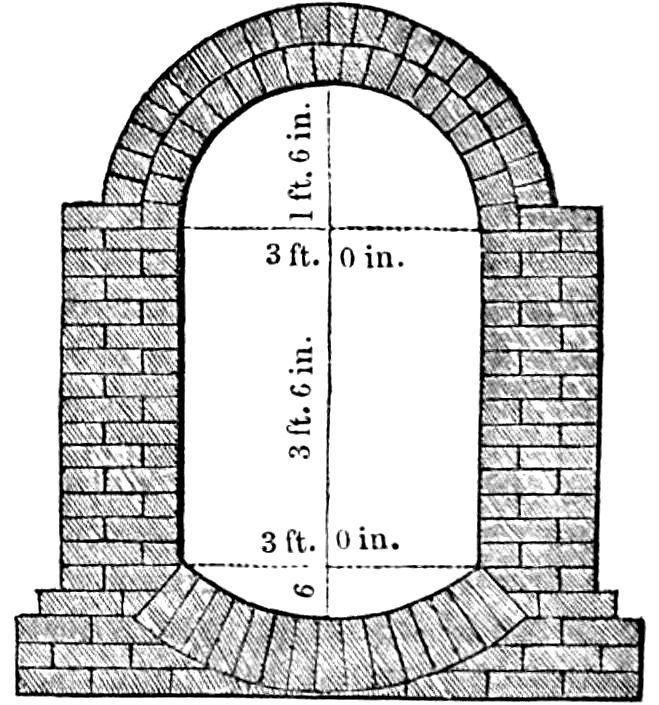
Fig. 1.
The following figures, 1, 2, are representations of the sewers in the Holborn and Finsbury division of the metropolis, on the same scale as the above. The part in which the joints are marked in the cut is, according to the directions, to be worked in blocks with cement.
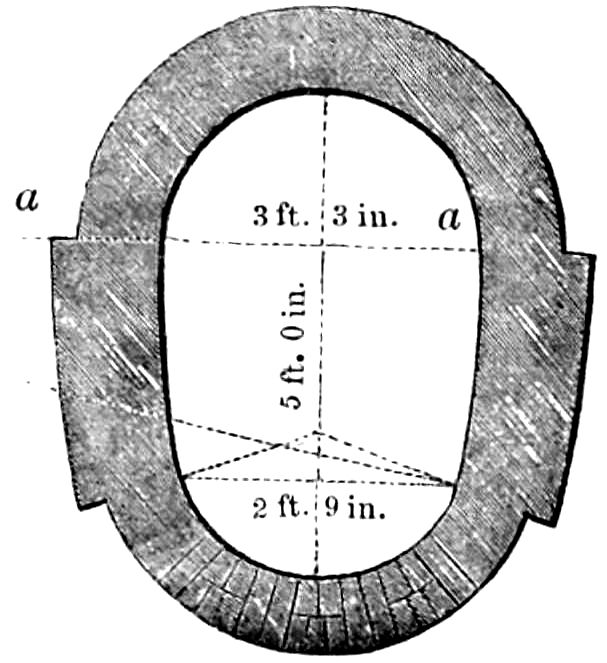
Fig. 1.
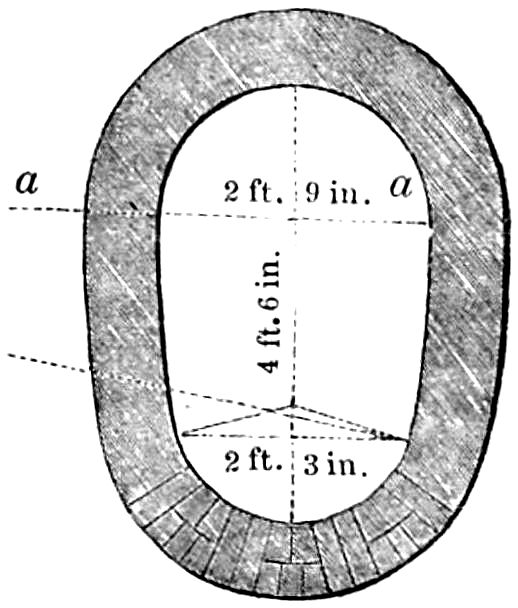
Fig. 2.
379The sides of these sewers form the curves of large radii struck from the centres on the lines a a, the radius for the larger size being about 13 feet, and that for the smaller size in proportion.
The spaciousness of the sewerage in the Westminster division of the metropolis has been an object of pride; and it is stated that the commissioners have walked in procession down one main sewer prepared for the purpose. It was the glory of Rome that some of its cloacæ were so large that boats and chariots might pass through them. All this, however, appears to have been mistaken in principle, and in ignorance of the mischiefs of the generation of gases and of the principles of hydraulics, and their application for the attainment of the objects in question. Mr. Smith, of Deanston, who has introduced the greatest improvements in land drainage, advances the general principle, that the size of sewers should be so adjusted as to have them always as full as possible, with a quick flow; and he contends that the drainage of a city might and should be so constructed as to give rise to as little occasion for men to go through the main drains as there is for men to go through the main pipes for conveying supplies of water. He would make the drains narrow. “Their transverse section should exhibit an oval or egg-shape, having the vertical diameter at least double the length of the horizontal. The bricks used should be made on purpose, with radiating sides.” “Care should be taken to make the building water-tight and air-tight, and to prevent the foul water and effluvia passing into the contiguous soil. Where land drainage is to be received, special openings can be made at intervals to receive it. All private drainage should pass into the sewers under ground by well-secured channels or pipes. Strong clay pipes, of an oval section, hard burned, and with a good arrangement for secure jointing, might be cheaply procured for the purpose.” It may be said that there is scarcely any drainage, even in the opulent districts, that at present meets these conditions. E. C.]
2.—Evidence of Mr. John Darke, Contractor for Cleansing, as to the Obstacles to Cleansing, and the Conversion of the Refuse of the Metropolis to Productive Use.
What are the practical difficulties you find in the way of the cheap cleansing of the streets and houses of the metropolis?—The great difficulty of the cleansing of the metropolis arises from the want of proper receptacles for the filth. There is no filth in the metropolis that now, as a general rule, will pay the expense of collection and removal by cart, except the ashes from the houses and the soap lees from the soap-boilers; and some of the night-soil from the east end of the town, where there happen to be in the immediate vicinity some market-gardens, where it can be used at once, without distant or expensive cartage. The charge for removing night-soil from the poorest tenements may be about 1l. per tenement. One house with another, the expense may be said to be in London about 10s. per year, as the cesspools may be emptied once in two years. One house with another they will not produce more than a load of refuse from the cesspools, which, not being composed, there is great absorption of the liquid refuse. I have given away thousands of loads of night-soil; as we have no means of disposing of it, we know not what to do with it.
What is the distance from the metropolis at which refuse is used?—The expense of cartage of course increases with the distance. The average extent of use of it as deposit does not exceed three miles from the Post-office district in the city of London. Some night-soil has been dried, packed up in the returned sugar hogsheads, and sent to the West Indies for use as manure.
Is it not conveyed away from London by canal?—We do not at present, but it might be. There is a penalty in the local Act of 5l., for depositing it on the wharf.
Cannot you convey such manure by railway?—No, there is no mode of conveyance provided. The charge, I believe, is a halfpenny per mile, but that is 380for the use of the rails only; and the company do not favour the transit of manure, and the farmer or contractor who would convey it must provide engines for himself, which again would not pay. Night soil has not yet been used systematically, and there are no places provided for its reception.
Might not the refuse be disposed of to better advantage than it now is?—The refuse of a great portion of the metropolis might be disposed of to immense advantage, but it must be by operations on a scale beyond the power of private capitalists. The sweepings of the paved streets is good as manure: on grassland it is nearly equal to horse-dung; but it contains so much seed that it scarcely does on ploughed land for immediate use. It produces great quantities of herbage; every year, however, it improves, because the weed is lost from it and the manure is left. When the streets are dry, and it will pay for transit, we sell a few loads. The sweepings from the Macadamized roads consist so much of granite that it is of very little use indeed; and in general the street-sweepings are mixed up with other manure for sale.
3.—Evidence of Mr. John Treble, Contractor for Cleansing, as to the Obstacles to Cleansing, and the Conversion of the Refuse of the Metropolis to Productive Uses.
You have been engaged in the cleansing of the metropolis, have you not?—Yes; I have been engaged, and my father before me, in the general cartage of materials, and also in extensive business as a nightman, but I have now retired from business.
What is the usual expense of emptying cesspools?—The full price to respectable private houses is 15s. per load, but the contract price is about 10s. per load. The period of emptying is dependent on whether there is any drainage from the cesspool, or whether there are any land-springs. Some would require to be emptied twice or three times a-year, whilst others would go two or three years without being filled. About 1l. per annum per tenement would perhaps be the expense one with another.
Where the cesspools are relieved, is not the ground about saturated?—Yes, it is; in digging the foundations of old houses for new buildings, the earth is found to be saturated. We have frequently to empty one person’s place because it is found that the soil has penetrated through to the neighbours’ houses.
Does not this moisture affect the condition of the house?—Yes, and it would be good economy for the sake of the house, and keeping a dry foundation, to have water-closets and good drainage from the house to the sewers.
By having the water-closets, the expense of the removal of the soil, annually or otherwise, would be saved?—Yes; and the expense of the dearest water-closets bears no proportion to the annual expense of cleansing, though water-closets I think might be constructed at a less expense, on a more simple plan, than they now are. They might be constructed on a principle to receive the rain-water and all the liquid refuse from the houses, which would increase the cleansing.
To effect cleansing on this principle, it will of course be necessary to have the water laid on in the house?—Of course it will. It would greatly assist the cleansing, if the water-companies were required to draw their plugs once at least in the fortnight. It would cleanse their own pipes, and assist in the cleansing of the sewers. The company would say that that would be a great waste of water, but a sufficient body of water might be obtained for the purpose in a quarter of an hour.
Does not the soil bear any value as a manure?—In general it bears no value to the nightman as a manure. One hinderance to any removal to a distance is, that, by the police regulations, cesspools can only be emptied in the night within certain hours. This prevents cartage to any great distance, and cartage is very dear. Some nightmen have paid 6d. per load for the liberty of 381depositing it. The object of the nightmen is to get rid of the soil early, and return with the cart to complete the emptying in one night. Formerly, before the new police were so much about, the men would empty the cart in any bye street or place where they could; they would, when it was in a liquid state, empty it down the sewers; they do so now when they have an opportunity, and return to complete the job. Formerly the site of the New London University was a place in which the refuse was deposited; so was the site of the new row of grand houses in Hyde Park Gardens. I think the site of Belgrave Square was another place of deposit; but those places being built over, there is now much difficulty in getting rid of the refuse.
What is the expense of cartage in London?—As a contractor, for the use of a cart, a man, and horse a-day, I used to charge 9s. the day for carting stone and rubbish. My successor did it for 7s., but I saw his name yesterday in the Gazette. The cost of the man’s work and the horse will amount to 6s. or 7s. in London.
What distance do your carts in full work travel in London?—A good day’s work to send a load out and return empty would be about ten miles; over hilly parts not so far.
Is the street refuse of the paved streets valuable as manure?—Yes it is; but it is only worth removal when it can be easily carted, that is, when it is in a dry state. The contractor being obliged to cleanse the streets in a given time, it would not pay to have such a number of carts as to complete the cleansing within the time and carry the refuse to a distance. They get rid of the refuse at the nearest place of deposit. In dry weather they have less to do and can turn their carts to account. The refuse is then dry, and it rides well, and may be sold to an advantage, and it sometimes fetches half-a-crown a load.
At what distance from the place of work would it be delivered at that price?—At about three miles distance; not exceeding that.
Is none of the refuse of the metropolis carried further as manure?—Yes; some of the farmers who bring produce to market return with their carts loaded with dung to greater distances.
Is not canal conveyance used?—Much of the street cleansing is taken down the canals.
Do the contractors in general pay for the deposit of the refuse of streets?—They would pay if they could get places of deposit near their work; but all the places out to the outskirts, where any refuse whatever could be deposited, are built upon.
Do not the men sometimes get rid of the surface sweepings into the sewers?—Yes; they do when it is in a liquid state, and when they are not watched.
Do you happen to know what is the expense of cleansing a street of a given length?—I once contracted to remove the stuff from Bond-street away; each cleansing took four teams and two stands, as it is called; or two teams and one stand, that is, two two horse carts, and one single horse cart standing to be loaded two days in the winter time. The cost of cartage in the winter season for cleansing that street was about 5l. for each cleansing. It was cleansed less frequently than weekly: that street is Macadamised. In the summer-time the expense would be less than one-half. The expense of cleansing the whole of Marylebone, that is, the expense of cartage, is about 2,200l. per annum, the parish finding the sweepers.
4.—Extract from the Report of Fourcroy and others, showing the Calculation of the Extent of Pollution of the Seine from the Discharge of the Refuse of the Streets of Paris.
“Not to neglect the details into which the Ministry desire us to enter, 382we observe that the maximum of daily street-sweepings is, in winter, 684 cubic metres; the minimum is 410; the average is 547.
“On the other hand, the velocity of the waters of the Seine, measured at their lowest level, being 6 decimetres 5 centimetres a second, and the profile of the Seine, measured also at low water, at the bridge of the Revolution, being 118 metres, we observe that there results, supposing an uniform velocity in the whole mass, a flow of water of 76 cubic metres a second; and in one day a flow of water 9,600 times greater at low water than the most considerable volume of the street-sweepings of Paris for the same space of time. This volume of water would be 16,015 times greater than that of the street-sweepings, if compared with the minimum of these last; that is to say, with the sweepings in summer, or the time at which the waters of the Seine are lowest. Any error in the calculation, arising from the inequality of the velocity in the different parts of the column formed by the current, is too amply compensated by other circumstances to need our consideration.
“To this is to be added, that the season when the street-sweepings are greatest, necessarily accords, all other things being equal, with the period when the water is highest and most rapid, as the period of low water answers to that when the refuse is least; and admitting the preceding calculations, the volume of water would be more than 16,000 times greater than the street-sweepings; and this proportion would increase considerably when the water is highest, by reason of the double proportion of height and velocity.
“It is to be further considered, that a great portion of these sweepings being insoluble in the water, would become precipitated, and unite with the mud; that a larger portion still, deposited unequally on the two banks, would never reach the bleaching-grounds, or the places where the water is drawn, and that consequently their possible relation to the water used in the city, reduces itself to a quantity excessively small, and absolutely inappreciable.”
5.—Communication from Captain Vetch, of the Royal Engineers, on the Structural Arrangements of New Buildings, and Protection of the Public Health.
Dear Sir,—Agreeable to promise, I forward the following observations on the improvement of large towns, as affecting the health, economy, and comfort of the inhabitants, and so far as these depend on structural arrangement.
The points requiring the attention of the engineer and architect may be stated as follows:—complete ventilation, complete drainage, ample sewerage, ample supply of water, and lastly, a ready and good communication between the various portions of the town.
I should have commenced my observations with the subject of drainage as the first in point of order were a new district or town to be built, but as both drainage, and ventilation, and communication, &c., depend so much on the arrangement of the streets, it may not be superfluous to premise something on that head. It will be sufficiently obvious that where towns are constructed on a regular plan with straight streets, the communication, ventilation, and drainage is comparatively easy, and far more effectual than under contrary circumstances; but it unfortunately happens that our large towns contain many narrow, crooked streets, with little or no arrangement, and though it may not be practicable materially to mend what we now find so bad, we cannot fail to perceive that a little timeous system and arrangement would have avoided many evils we now complain of, with a less structural expense and a much improved value of property to the owners.
Many or most of the towns, both in British and Spanish America, are 383formed on regular plans, commencing with a square as a nucleus, to the faces of which the streets (as they rise) are made parallel, so that whatever may be the extent of the town the increments take place in regular order, until stopped by some natural obstruction; and though it may be true we cannot now enjoy the good effect of any such original precaution, yet as respects the extension or future increments of our cities and towns, much benefit may still be derived by resorting to system; and though we cannot now remodel what has been built by proceeding regularly from a central point to the circumference, yet we may adopt an external line or periphery as a basis of operation for the construction of the future extension of the town on a regular plan or system.
It is fortunate for the metropolis that there existed some large landowners in its vicinity, as the families of Bedford, Grosvenor, and Portman, whose taste and spirit corresponded with their means, and that large portions of the increments of London consequently possess all the advantages that a well-considered system of utility could require; and the benefit of such a circumstance will be best felt by contemplating what effects a contrary proceeding would have produced; and further, the plans pursued by the above-named families have not only been highly beneficial in themselves, but they have served to stimulate the small proprietors in their vicinity to the same useful ends; and what seems to be wanted from the authority of the state is the means of ensuring such beneficial measures in all cases, or at least protection against antagonist or vicious proceedings in the owners of land adjoining towns.
It will not fail to be remarked that the increments of London just alluded to have been constructed chiefly for the abodes of the wealthy, who can generally protect themselves, and remove from any noxious neighbourhood. But the state, as the natural guardian of the poor, is the more called upon to interfere with its authority to see that the streets and houses intended for the labouring classes are constructed on comfortable and sanitary principles.
Most of our large towns have increased upon small, irregular nuclei, and received their increments chiefly from buildings erected along the roads branching into the country, presenting so many main streets radiating from a centre, but leaving the intervening spaces to be irregularly and imperfectly filled up at subsequent periods as chance or necessity directed, and in this manner has arisen the great defect (to be generally observed) of a good lateral connexion between the great radiating streets.
So great indeed is the above defect that it is often difficult to pass from one site in the skirts of a town to an adjacent one without passing towards the centre of the town by one radiating street and returning by another; this defective construction of towns is the natural result when they extend without any reference to a general plan or public convenience, and the mode which, in my opinion, would best restore the condition of a town so constructed to a commodious and useful state would be as follows:
I would propose, in the first instance, to connect all the radiating streets of the town by straight lines drawn as near to the mass of buildings in the town as the vacant or unbuilt ground would admit of; this operation would have the effect of inclosing the town in an irregular polygon, upon each side of which, as a normal line, I would propose to lay out the future streets, one series of which would be parallel to the normal lines, and another series would be perpendicular to them, and in this manner the future increments of the town would proceed on a fixed and uniform system, and would render the lateral lines of communication as effective as the others, and would afford at the same time increased facilities for ventilation and sewerage, and for the supplies of water, gas, &c.; and proceeding on this system, it may fully be anticipated that the building sites would become much more valuable to their owners than if they remained to be laid out by individual caprice on a disjointed plan. It would be valuable in most 384cases that the normal polygon should be formed into a series of streets of ample dimensions, fit for the reception of public buildings, particularly schools; and occurring (as it would do) as the nearest great lateral line of communication to the irregular mass of the town, it would serve to do much of the duty in way of communication and ventilation which the interior mass had left undone, and was unable to effect, and might answer as the great respiratory of the town, and would be well adapted to serve, if wide enough, and planted, for alamedas, or public walks.
In London, the line of the New Road and City Road furnishes almost the only sample the metropolis possesses of polygon lines of communication, and the utility of the sample is duly felt and appreciated. In Paris the line of the Boulevards presents a favourable specimen of the convenience and comfort of such a construction of streets.
The advantage of adhering to system in laying out new towns, or additions to old towns, will be much enhanced when we take into consideration the means of supplying water, gas, &c. to the houses; and as the application of science and machinery becomes more extended in administering to the comforts of towns, it is manifest the more regular the field of their action the more efficacious and economical will be the results. On the score of ventilation, as well as for other conveniences, it is important the streets should intersect and not abut on each other, that the currents of air may have free escape.[49]
One of the greatest evils arising from towns extending at caprice, without reference to any general plan, is the vast expense that subsequently arises when necessity demands communications to be made through crowded masses of buildings; such events are of frequent occurrence in the metropolis and other large towns, and so great is the outlay to remedy what might have been avoided, that no measures proposed for the improvement of towns merit such deep attention as these; and it has sometimes occurred to me, that instead of applying the funds to enlarging the leading thoroughfares, the object would in many cases be better served by forming entirely new communications through the worst constructed and less costly sites. In this manner we should have two good communications instead of one; we should open the means of communication, ventilation, and sewerage to places where at present they exist most imperfectly, and we should expunge from the map of the town a number of noxious, ill-ventilated ruinous buildings, the seats of dirt, disease, and demoralization.
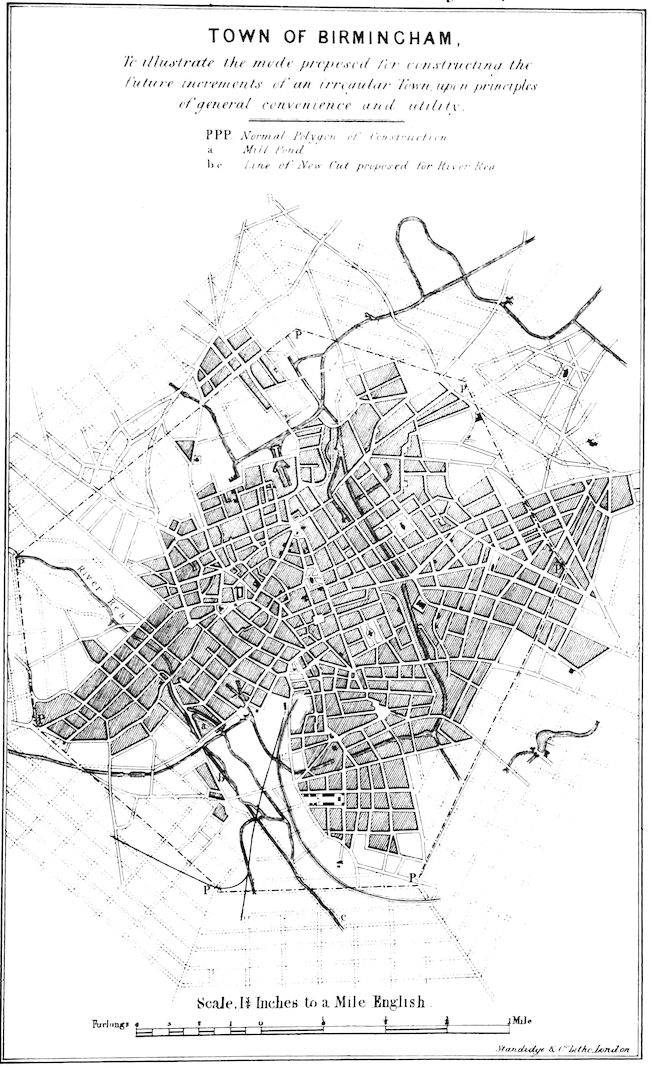
Annexed is a plan of the town of Birmingham, on which is traced a study or design for the future increments of that town on the principles above proposed, which will serve to illustrate the views of the writer. The figure P P P P represents the normal polygon.
Increments.—It is hardly to be expected that any very uniform plan of building can be rigidly adhered to; moral as well as physical difficulties may demand departure from regularity in the construction of the future increments of a town, particularly where the field to be occupied is extensive; but so long as the general principles are adhered to, and the new streets proceeded with, upon a general preconceived and authorized plan, all the needful objects may be attained; and it has occurred to me that the mode most likely to give satisfaction to the inhabitants would be for the municipal authorities to offer a premium for the best design for the extension of the town, and of leaving the selection to the majority of the ratepayers.
TOWN OF BIRMINGHAM,
To illustrate the mode proposed for constructing the future increments of an irregular Town, upon principles of general convenience and utility.
385Proprietors of large spaces of ground, or a combination of small ones, might also claim and be authorized to form and execute their own plans, provided always that they were previously submitted to examination and approval by properly constituted authorities.
It has been omitted to mention, that towns built on a regular plan, and upon sanitary and commodious principles, are much less liable to the accidents of fire, and the consequent loss of life and property; and when such do occur, the facility of extinguishing them is much greater; and one might also venture to predict that it will be found that the new town of Edinburgh has suffered less from fire than any other town in Great Britain.
Prevention against fire is a subject well meriting consideration when treating of the improvement of towns. It would seem that fires more particularly occur in large public and private buildings, as for instance, the Albion Mills, the theatres of Drury-lane and Covent-garden, the Houses of Parliament, the Great Armoury in the Tower, Royal Exchange, &c.; and it would be well to provide that all such buildings should be detached, as well as manufactories and all buildings containing steam-engines: but previous to legislating on the subject it would be desirable to collect the statistics of conflagration, which might readily be obtained from the fire-insurance offices.
Ventilation.—In new towns, or the increments of old towns, good ventilation will be best secured by attending to the principles laid down for the construction of such.
The noxious ingredients which must exist more or less in the atmospheres of all large towns may be dissipated by currents of air, or diluted by access to large open spaces, while the origin of the evil may be much reduced by a good system of sewerage.
For the removal of noxious vapours existing in crowded towns the following points deserve attention:—
1. The conversion of blind alleys into thoroughfares.
2. The continuation of leading streets through blocks of houses on which at present they abut.
3. The opening of wide and straight streets through the meanest, most complex, and crowded parts of cities; this will prove the most important measure for meeting the object in view; and what merits the next consideration is the preservation of such good and healthy avenues as already exist free from encroachments: for it has happened in the metropolis while exertions were making in some districts to open wide streets, in other districts a contrary system was at work. The New and City Roads, the most commodious avenue in the vicinity of London for length, width, useful and healthy communication, is in a constant process of invasion, as may be noted more particularly in the vicinities of Tottenham-court Road and King’s-cross; and unless some measures are taken to preserve this noble respiratory of the metropolis, it is to be feared in a short time its character will be entirely changed.
4. Another mode of improving the air of towns is to open squares, or public walks, or gardens, by the removal of some of the buildings, by which means a reservoir of pure air is created, and in this manner the city of Seville was essentially benefited; the streets are there numerous, narrow, and dirty, but the city, abounding in large convents, the removal of some of them, and the conversion of their ample sites into piazzas or squares, afforded the air and space so much required for the public health.
In London there are some institutions that might be advantageously removed to the suburbs or skirts of the town, such as the Charter-house School and the Fleet Prison, and their sites converted into open squares; but if such operations are too costly and difficult, we may at least guard against the converse operation, viz., the covering of open sites with masses of buildings. Thus we have seen in recent times the gardens of Lincoln’s-inn and Gray’s-inn invaded; and we had lately a proposition to convert Lincoln’s-inn-square into piles of buildings, and to demolish what no art can supply, the finest reservoir of air which the metropolis offers to a crowded neighbourhood.
3865. The circulation of pure air would be much increased by pulling down all dead walls, and by substituting iron railings in their stead; and too much credit cannot be given for what has already been effected in this respect in the neighbourhood of Knightsbridge, &c.
6. The prohibition of all burials in the metropolis and other large towns, and the consequent diffusion of unwholesome effluvia.
Drainage and Sewerage.—As towns become more crowded, the value of good drainage and sewerage as a sanitary measure becomes the more apparent; and as the means of draining the site of a town above and below the surface is to be effected in part by the same means as the sewerage or removal of the liquid filth, the subject becomes of great importance, and second only to the choice of the site of the town and distribution of its streets; and if a due regard to system has been shown to be so desirable in the one case, it is no less so in the other, and before any buildings are commenced the plan of drainage should be matured.
In order to arrive at a good system of drainage for a piece of ground intended to be built upon, or in a town where the sewerage requires improvement, a necessary step in the process would be to add to the plan of the town lines of equal altitudes, drawn at every two or three feet of elevation, which would present at one view the means of comparing the levels over the whole extent of the town; they would show the deepest valleys where the main sewers would most conveniently run, and the most efficient mode of combining the several classes of drains, so that the declivities might be turned to the best account; in addition, the plan should be so far geological as to show the boundaries of the strata, as a body of marl or clay often upholds a quantity of water which might prove injurious as a building site if not previously tapped.
A notorious instance of this nature occurred at the village of Moseley, near Birmingham. Preliminary to carrying the Gloucester Railway through the village, in deep cutting, it had been ascertained by trial shafts that the bottom consisted of quicksand, which rendered it difficult either to construct a tunnel or to support the slopes in open cutting until the water was removed; and for this object a drift or level was brought up from a distance of a quarter of a mile through a bed of marl; the miners proceeded for some distance perfectly dry until they reached the quicksand, when the water flowed into the drift at the rate of 253 cubic feet per hour, or 77½ gallons per minute, and the wells in the village in a short time were laid dry, and had to be deepened at the expense of the Railway company. It so happened in this instance that the level of the quicksand was so deep that the surface of the land had not been affected by the pending up of the water below; but if it had been otherwise, the measure resorted to would have proved as useful to the land as it was to the Railway.
In laying out a plan of drainage and sewerage when a river or brook passes through or alongside of a town, it will naturally become the main drain of the place, and be the normal line from whence the second-class sewers would diverge; but it not unfrequently happens when such a brook is small and becomes the cloaca maxima, that, being left open, and insufficiently supplied with water in the summer season, it constitutes, instead of a benefit, a serious nuisance to the inhabitants; instances of this kind may be observed at Edinburgh, Birmingham, Coventry, Camberwell, &c., &c. It also happens at many towns that a stream passing through or by them is dammed up to turn a mill just above or below the town, or even in the middle of it, by which means the current useful to clear away the filth is diverted, the water in the bed of the stream into which sewers are discharged is left stagnant, while the vicinity of the town is rendered wet and unwholesome from the pent up water.
At Birmingham the Rea Brook is dammed up in its course through the town to supply a mill. In the very excellent sanitary report of the town by Dr. Hodgson and other medical gentlemen, it is stated that “the river Rea may be considered the cloaca or main sewer of the town, but 387that its condition is very bad;” the report also states, “that the stream is sluggish, and the quantity of water which it supplies is not sufficient to dilute and wash away the refuse which it receives in passing through the town, and that in hot weather it is consequently very offensive; and in some situations in these seasons is covered with a thick scum of decomposing matters; and this filthy condition of the river near the railway stations is a subject of constant and merited animadversions, and that it requires especial attention lest it should become a source of disease, &c.”
The cloaca maxima of Birmingham differs from that of ancient Rome; that whereas in the latter art was employed to effect what nature had left undone, here art has been employed to obstruct the useful course of nature. I quite agree with the sanitary report as to the present noxious state of the brook; and even those who travel on the railway may at times be very sensible of the effluvia when crossing it.
I am inclined to differ from the sanitary report as to insufficiency of the water of the Rea for cleansing its own bed; but that report has not adverted to the fact of the abstraction and diversion of the water of the Rea from its natural bed to turn a mill, a fact which will amply account for the deficiency and sluggishness of the current in the very places where the contrary condition is most wanted.
From my inspection of the locality, I am inclined to believe that the descent of the Rea and its quantity of water in passing through the town of Birmingham is sufficient under good arrangements for the efficient and wholesome sewerage of its bed.
If we take a distance of half a mile above the weir and half a mile below it, that is, nearly from Morley-street to Lawley-street, I consider I shall be justified in saying there is a descent of about 14 feet, for I find a slight weir in Floodgate-street; at the dam itself the fall is about eight feet, and from thence for a considerable distance downwards the fall is considerable.
Above the weir the stream for a short distance is sluggish from want of declivity, and the water being pent up, keeps the houses there wet or damp, while below the weir the bed of the Rea being left nearly dry, the filth from the sewers which discharge there must stagnate, while at the same time the water of the Rea passing through the mill-race with a good body and current, applies to no act of cleansing.
The mill-pool is extensive but shallow, and there the filth from above accumulates. When the pool is filled with water it is worked off by the mill, but the gratings prevent dead dogs and such like matter from passing, and are there left to fester at low water.
The remedy is as easy as the evil is great; all obstruction being removed from the course of the brook and the water restored to its original bed, the object would be effected; as to the value of the mill-power which would thus be subverted, it cannot be a matter of much amount in a place where coals and steam-engines are so cheap, and where the constant and regular work of the mill must be an object of some importance.
In applying a remedy to the great evil under notice, the engineer should not be content by merely restoring matters to their original and natural state, but in so populous a town should apply all the aid which art can bestow to assist natural circumstances. The bed of the Rea should be formed with an uniform descent through the town and for some distance below it, by dredging in some places and filling it in others with coarse gravel or broken stones; or, better still, if funds will afford it, by forming an inverted arch of stone or blue bricks to give full effect to the scour of the stream; further, the engineer would render the course of the brook through the town as straight as circumstances would permit by cutting off loops and sinuosities. In this manner, and by reserving the whole body of the water of the Rea for cleansing its own bed, I have no doubt that this main sewer of Birmingham would become as conspicuous for its wholesome and efficient action as it is now for the contrary.
388About a mile above the town of Birmingham, there is another mill which I am disposed to think would act rather beneficially than otherwise, in removing the filth from the bed of the brook in its course through the town; for in summer weather when the stream is scanty, by pooling it up and letting the water down with force at intervals, the effect is much increased. Whether the stream of the Rea be so deficient in summer as to require this process, I would not now give a positive opinion, but there are many somewhat analogous cases where the stream in summer is not sufficient and where the pooling up and flushing off at intervals could not but prove of great utility; and if I have now brought the case of Birmingham into considerable detail, it is owing to the circumstance of its exemplifying certain conditions that are common to a great number of towns, and which, in a sanitary point of view, and more especially in regard to the poorer classes of the community, are the most urgent for remedy of any that have fallen under my observation.
In the town of Haddington, a mill-dam crosses the river Tyne in its passage through the place and into the mill-pool; the main sewer is discharged with a diminished and sluggish descent; and on occasion of floods in the river, the water passes up the sewers and occasionally lays the lowest part of the town under water. It would not be difficult to direct the main sewer into the bed of the river below the dam or weir, and by the additional declivity give some current to the water of the sewer, which from the pending up of the river at its present outlet has rendered it almost stagnant, so much so, that in hot weather, and where it is not covered over, the exhalations are very offensive; but was the sewer improved by the alteration mentioned, still the pooling up of the river for the mill keeps the lower part of the town damp, and even subjects it to partial inundations.
One of the medical officers reports, that when “fever has been at any time prevalent in the town, it has been most so in a portion of it called the Nungate,[50] lying close by the river, when during the summer and autumn it is occasionally almost stagnant, and where there is a considerable decomposition of vegetable matter.”
Another medical gentleman, speaking of the main sewer, says, “this small burn is a receptacle of the privies and refuse of vegetable matters from the houses near which it passes; and in those parts where it is uncovered, it forms an excellent index of the weather; previous to rain the smell is intolerable.”
The same gentleman proposes as a remedy that another small burn, having a parallel course at a short distance, should be turned into the sewer to aid the sewerage. From my knowledge of the locality, the recommendation, I should say, is judicious, but in this manner, though the supply of water would be increased, the declivity or rather want of declivity of the sewer would remain the same, and could only be improved by removing the mill-dam, or directing the sewer into the bed of the river below it, as already mentioned. Unquestionably from the pending up of the river, the lower part of the town is at present very ill drained, and it is somewhat remarkable that it was the first site in Scotland visited by the Asiatic cholera.
In reference to the two cases cited and to others of a similar nature, it should be remarked, that the vicinities of the nuisances are chiefly inhabited by the poorer classes, and who from want of influence in their own parts are the more necessarily thrown under the protection of state regulations.
The sewers of a city or town may be conveniently divided into four classes:—First, the main drain or sewer, and this, whether natural or artificial, being fixed, becomes the basis of the system, and upon it the second drains or district class will be directed: these again will receive the third class or street drains; and lastly, the house or fourth class drains, will be discharged into the street drains. In small towns, only the third and fourth class drains will be required; in large towns, three classes of drains may be necessary; and in great cities, all the four classes will be required.
PLAN OF SEWERAGE
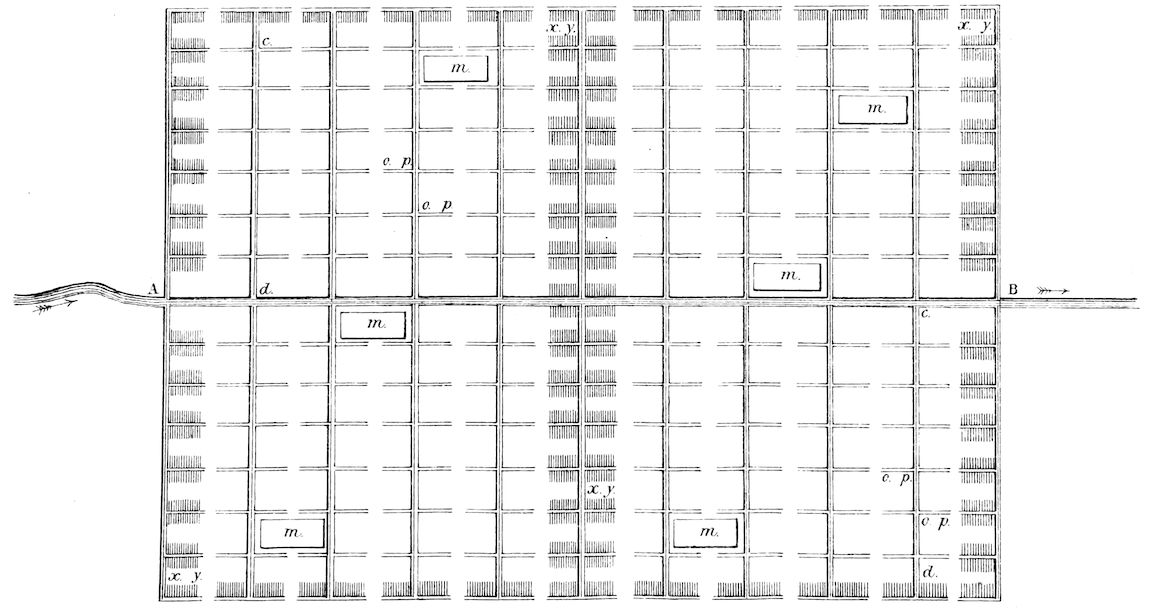

STREET SEWERS (o. p.)

DISTRICT SEWERS (c. d.)

MAIN SEWERS (A. B.)
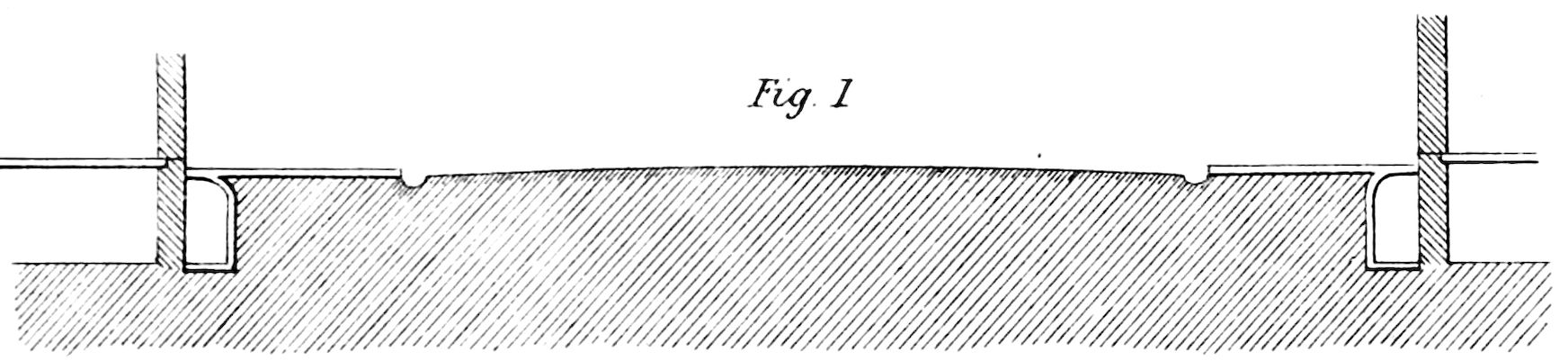
Fig. 1.
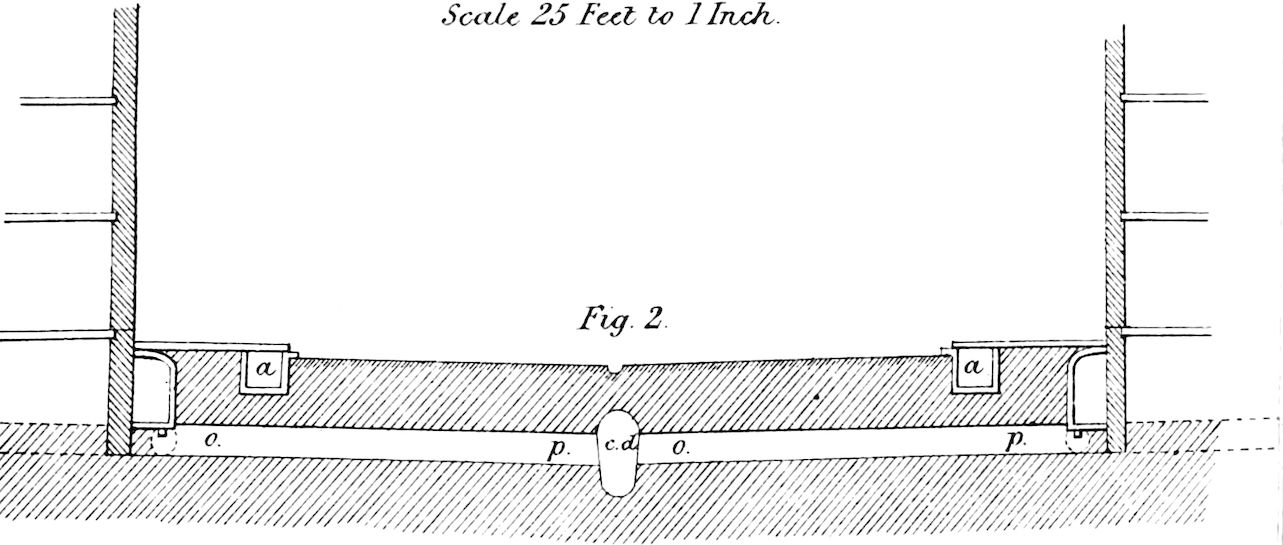
Fig. 2.
389With respect to the form of the drains, when bricks are used as building materials, the bottoms of the drains will be best formed of inverted arches of blue bricks, as forming a cheap, hard, and durable surface, and giving every facility from the form, for the scouring force of the water to remove the filth brought into the drain; but whether the curve of the bottom shall be a semicircle or a segment will, I apprehend, depend on the size of the drain. For very small drains a circular form would be the cheapest and best; the next size would be more advantageously constructed of an oval or egg shape, but still of bricks. Drains of a still larger size, viz. the second class, may be conveniently made either of brick or stone, arched and counter-arched at top and bottom with battered sides, either straight or curved; the counter-arches or curved bottoms will conveniently become flatter as the drains increase in capacity to afford greater room for the accumulated water to pass without rising and flooding back into the feeders. The first and second-class sewers must be deep seated to receive their respective tributaries or feeders, with some overfall; and though a sufficient width for large drains may generally be procured, it is difficult in many cases to command enough of depth, another circumstance that can best be obviated by flattening the arches both at top and bottom; but in large drains, where there is a body of water, the scourage will be sufficient, without resorting to deeply curved bottoms.
When bricks abound as a building material, they are particularly convenient for the construction of deep sewers and drains, from the facility of handling in confined spaces; but it is important their quality should be of the best, since if they scale and decay, great expense must be involved in the repair of the drain. The Tipton, or blue brick, is the best for the facework of drains.
In parts of the country where stone abounds, bricks are often little known, and the resources of the district must be made use of; where the blue lias limestone occurs, I have found it a cheap and excellent material for forming culverts and drains of all sizes; and it was used largely for that purpose on the Birmingham and Gloucester Railway.
Annexed is a sketch of the sections of drains varying in form according to their size. The batter which I found most useful and convenient for wall-sided drains was 1 in 9, either curved or straight; the first is the best form in theory, but in small works I found the bricklayers’ and masons’ work more accurately to the straight batter; and the last is, from its simplicity, better adapted to receive any sluices or flush-gates that may be necessary.
Annexed is also a sketch to show the distribution of drains in a town supposed to be built on a regular plan, with a pretty uniform descent towards an axis, which constitutes the site of the main drain; each class of drains consisting of several sizes, it would be most useful as well as economical that the drain of a particular class (if large) should commence with the smaller size, and discharge or terminate with the greater size, a plan that would aid the sewerage of the water.
In a system of drainage, it is necessary to consider that the greater the body of water, or in other words, the class of the drain, the less declivity is sufficient; and the converse, the less the body of water, or class of drain, the greater declivity is required; in the first case, the hydraulic depth compensates for the want of declivity; and in the second case, the declivity compensates for the want of hydraulic depth; the multiplication of these qualities being a function of the velocity or force of the current, due attention to the above is important in economizing or turning to the best account the declivity for the drainage of a large town.
Having arranged the system of sewerage for a town, the next object will 390be to render it as extensively useful as practice will admit of; and from the experiments and practice of Mr. Roe, the surveyor to the Holborn and Finsbury Commission of Sewers, we are warranted in the belief that a good system of sewerage, aided by a sufficient supply of water, will, in most localities, be sufficient to remove all the dirt which arises in the streets, without the necessity of cartage, and also all the filth of private dwellings which is at present led through drains or pipes, or which by the aid of water may be practised more extensively in future.
We have first to consider the conveyance or discharge of the street dirt into the main sewers, and the discontinuance of the present expense, and annoyance of using carts for that purpose, at least with some few exceptions.
It is pretty obvious, that if the mud of London, like water, could be made to flow through the drains much trouble and expense of cartage would be saved; and it does happen that the street-dirt of London is so diffusible with water, that with a little arrangement such a mode of cleansing maybe followed; indeed it is highly probable that at present more than one-half of the whole mud is carried off by the rains in that manner.
The mud of London, and other great towns in England, may be assumed in wet weather[51] to arise, in three-fourths of its amount, from the grinding or abrasion of the paving-stones, the remaining one-fourth part consisting of soot, shop-sweepings, and cattle dung.
The dirt arising from the detritus of the stones may be obviated in two ways; 1st, by substituting for the green-stone forming the carriage-way, quartz-rock, or quartzose stones. The green-stones contain hornblende and felspar, which grind, like all argillaceous stones, into fine mud or powder mixable in water, whereas quartz rock retains when ground the form of clean sand, neither soiling nor capable of forming mud in itself. The Lickey Hills in Worcestershire are composed of quartz rock, and the roads in their vicinity show its excellence as a material for road making. The quartz rock, however, of the island of Jura is much purer, and that island contains an inexhaustible supply already broken by nature into sizes nearly fit for laying on the roads; and Small’s Bay in the island of Jura would form a convenient loading place, and by means of a jetty and tram-way vessels might be laden at a small expense, and much of the country supplied with the best of all materials for road-making. The substance of the stone is hard and durable, and consequently suffering little by abrasion; and it would be well worth while to try the experiment of Macadamizing one of the leading streets of London with this material, as the means of forming a good road, and at the same avoiding the creating of a great quantity of street dirt.
The other mode of avoiding the formation of mud is the substitution of wooden pavements; of the success of these I have little doubt, though for the present many failures have occurred, either from The foundation not having been truly and firmly laid, or from the blocks of wood not being massive enough. The greatest objection to wood pavements at present is the slipping of the horses, but this I believe might be obviated.
The question, however, at present is to get rid of the street dirt, such as it is; and for that purpose I apprehend it would only be necessary in wet weather during rains that the street-cleaner should sweep the dirt into the kennels, and aid the water by stirring the mud, to carry off the material in a state of diffusion; in dry weather, the opening of pipes with hose attached would serve the same purpose as the rains, and at the same time aid the sewerage at the time most required. After a short but heavy fall of rain, the cleansing effect of the water is fully perceived: and if any means could be devised of saving the rain-water that falls on the houses and in the streets, so as to apply it in considerable quantities at intervals, it is probable that the rain-water would be amply sufficient for all the purposes in question.
391I have heard of the plan pursued by the West Middlesex Water Company for cleansing their reservoir at Kensington, at little expense, by diffusing the muddy deposit in water, and allowing it to run off in pipes.
In the city of Guanaxuato in Mexico, a similar mode of cleansing has been long practised; a splendid tank of ample dimensions contains the water used by the inhabitants; the tank is supplied by mountain torrents, which bring down a considerable quantity of mud or silt, and which makes a deposit in the bottom of the tank, which is formed by a fine dam of masonry crossing a narrow valley, and provided with sluices. The rainy season commences in the latter part of June, and a short time previous the ceremony of emptying and cleansing the tank is gone through; a kind of fair and holiday is held on the ground, to which most of the inhabitants resort; the sluices are opened, and as the water recedes, the watermen, boys, and all those who relish the fun, get into the tank and keep stirring up the silt with sticks and spades, &c., and in this manner the mud is annually carried off by the remaining water of the past season, a subsidiary tank serving for use until the principal one is replenished.
By some sort of a similar process it is alleged that much of the mud-banks of the Thames above the bridges have been removed, viz., by the action of the paddle-wheels of the numerous steam-boats running there. Some of the effect observed must be owing to the greater scour of the tides since the removal of Old London-bridge, though some part may also be due to the steam-boats.
For the purpose of giving more aid to the surface-water in cleansing the streets, and at the same time for keeping the footways and houses drier and more free from mud, I should propose (at least as an experiment) a different structure of the carriage-way, viz., to make it incline to a centre kennel, instead of to two side ones. At present, in many places, the centre of the carriage-way is elevated above the level of the shop doors, and at the same time we often find the footway but three inches higher than the kennel; and it is pretty obvious from this arrangement, in dry weather, the dust will blow from the more elevated carriage-way on to the footways, and into the shops and areas; and in wet weather the water and mud being chiefly accumulated in the side gutters, the carriage wheels and horses’ feet will distribute it plentifully on the footways, and not unfrequently on the passengers, and all tending to keep the houses damp and dirty, whereas it is obvious that, was the descent constant from the houses[52] on either side to the centre of the street, these evils would be avoided, and it will be no less evident that all the surface-water flowing to one common channel would possess more force and convenience for running the street dirt into the sewers. I am inclined to believe that the carriage-ways are getting gradually elevated above their proper level, from the contractors for paving not excavating deep enough for the foundation of the pavement.
Annexed is a sketch, showing in juxta-position the form of the street-ways as at present, and as proposed to be; the street is supposed to be a shop-street, 90 feet wide, having two areas of three feet each, two footways of 12 feet, and 60 feet of carriage-way; on the section of the proposed plan a fall of six inches, or 1 in 30, is given from the shop door to the edge of the pavement; there is then a descent by two steps of six inches each to the carriage way; and lastly, a descent of 1 in 30, or of one foot to the kennel in the centre of the carriage-way. The kennel may either be open or covered; if the latter, it must have many gratings. In the city of Mexico the kennel is chiefly in the centre of the street, and covered by large flat stones.
On the proposed plan, if we suppose a step from the foot pavement to 392the floor of the shop or house, the latter will be elevated about 3 feet above the gutter, whereas at present we often find it not more than six inches, and it will readily be admitted that such a difference in the disposal of the surface-water cannot but keep the houses much drier and more cleanly.
By having one gutter in the centre of the streets instead of two, (one at each side,) we remove two sluggish and inefficient kennels, which are the source of damp to the pavement and to the houses, and we create one which is at a distance and doubly effective.
The subject of street pavements having been introduced as the means of surface-drainage, it may be remarked how difficult it must ever be to keep them in good order so long as they are liable to be broken up whenever water or gas-pipes require altering or repairing, besides the extreme annoyance occasioned during that operation; and though it may not be possible to obviate the inconvenience in all cases, yet I conceive the evil may be reduced to very narrow limits by resorting to system, and I would suggest that under the foot pavements passages should be formed, lined with brick-work or masonry, as a common receptacle for all the water and gas-pipes, having the flagging over the passage so laid as to be easily lifted in case of need, and being provided at intervals with side entrances for inspection and all such repairs as could be effected without raising the flagging. The position of the gas-pipes under the foot-pavement would be convenient for the street and shop lights, and the water-pipes would be then equally so for the use of the houses. But in respect to the sewer of the street, I should propose to place it near the centre of the carriage-way, as more distant from the dwellings, but as equally convenient to both sides of the street. (See the section for new form of carriage-way.)
Having noticed the subject of diminishing the amount of street mud, and of conveying the same into the sewers, as well as that portion of the house filth which it may be practicable to discharge into them, we have next to notice the mode of further disposing of the matter thus lodged in the sewers. The practice has hitherto been (in a great degree) to accumulate the filth in cesspools, and at intervals of five to ten years to open the sewers by breaking into them, or to get access by man-holes left for that purpose, and then drawing out the semiliquid contents of the cesspool by means of a windlass and buckets; but in the Finsbury division the surveyor, Mr. Roe, has had the merit of introducing a very superior, less expensive, and less offensive mode of operation. Finding that the surface-water did not generally enter the sewer in sufficient quantity and with sufficient force to carry off the more solid contents, he contrived, by sluices or flush-gates, to dam up the water to a certain height, and then, by opening the same, to obtain a force of water sufficient for the purpose; and the working of this new plan is said to be highly satisfactory, the filth being prevented accumulating in the sewers, and, as a necessary consequence, then choaking their feeders, the house drains; and in this manner also the filth is removed at less expense, and without any annoyance and noxious effluvia which attend the old practice.
Mr. Roe has adopted also side entrances to the sewers instead of man-holes, for the inspection and repair of the flushing apparatus. The chief expense beyond the first cost of Mr. Roe’s plan is the attendance of a person to open the flush-gates; but it is probable that some contrivance may be found by which the pent-up water on reaching a certain point may be able to open its own gate. It has, however, occurred to me, in respect to this mode of flushing off the filth, that, instead of damming up the water in the sewers, and forming them into reservoirs, the purpose might be more easily and more effectually performed by accumulating the surface-water from the gutters into reservoirs before entering the street or district drains; a greater head, or force of water, might thus be obtained, while the sewers themselves would always be open and free from the obstruction of the sluices and pent-up water.
393In respect to the final deposit of the filth of London and other great towns, it does seem a pity that so much valuable manure should be lost to the land, and be discharged into rivers to their contamination and obstruction, if any practicable and innocuous plan can be hit upon to avoid the alternative.
One plan has been suggested of receiving the contents of the sewers into pits, and then by means of steam-power and a sufficient supply of water, forcing the matter of the sewers in a diluted state through iron pipes into the country, and then applying it to irrigate the land in the same liquid state. It would require much calculation to form an accurate estimate of the cost and profit of such an undertaking; but there can be no doubt if the matter was so applied it would prove exceedingly valuable in enriching the land to which it was applied, as we may judge from what has occurred in the vicinity of Edinburgh from a similar kind of irrigation.
At Edinburgh, however, the liquid manure being conveyed from the town for a distance in open ditches or sewers exposed to the sun and atmosphere, it undergoes such a fœtid decomposition as to render the operation no common nuisance to the public. But such effects would not occur (at least, to the same extent) if the matter was conveyed in close pipes with a plentiful effusion of water; and it is known that animal carcases, when kept constantly exposed to fresh supplies of water, do not suffer corrupt decomposition, but are changed into a fatty matter. It seems necessary also that a certain degree of heat and exposure of surface should be present to originate and promote fœtid decomposition, as it is well known that in the pits in Paris, where so many dead bodies were thrown, the result was not a fœtid decomposition, but a change of the animal matter into adipocire, a comparatively inoffensive substance; we may therefore expect that the discharge of the contents of the sewers in pipes, excluded (as they would be) from heat, and copiously charged with water, would be comparatively free from noxious exhalations.
Another plan of reserving the contents of sewers for the purpose of manure would be to continue the sewers to some distance from the town, and then to discharge them into a series of covered catch-pits, allowing the water to filter off after depositing the solid particles; when the first series of pits were deemed sufficiently charged, the sewers might then be discharged into a subsidiary series, until the matter in the first had become sufficiently consistent for cartage. Upon the first plan of proceeding, the liquid manure could only be applied to land quite near at hand, and fit for irrigation; on the second plan the manure might be conveyed to a distance and applied to arable land.
It will be evident the great importance of applying such quantities of manure as the sewers supply to useful purposes, but it is no less evident that no system can be introduced to effect the object until preceded by satisfactory experiments of cost, profit, and efficiency. Some localities might offer facilities for one mode of action, and some for another; and it is much to be desired that parties may be induced to make experiments on both plans; and it is to be noted that though the expense of raising the liquid manure from pits or tanks would be necessary in some cases, yet in many situations no such operation would be necessary.
On the subject of purifying the air of sewers, and of preventing the escape of foul air by any crevices or chinks, I have heard of the ingenious contrivance of erecting a tall chimney and connecting it by a pipe with the crown of a sewer, for the purpose of creating such a draft up the chimney as would occasion an indraft at any leak that might occur in the ramified mass of drains of the district to which the chimney belonged. It appears to me that there are some objections to this plan; but not being acquainted with all the details, I shall avoid entering into any controversy on the subject, further than stating that I should rather propose an opposite 394process for purifying the air of sewers. I would recommend that they should be kept excluded as much as possible from external heat and ascending columns of air; but at the same time I would endeavour by all means to send down as copious a flow of water as practicable; and in London, though the Thames water may not be proper for domestic purposes, it would be sufficiently pure for watering the streets and cleansing the drains; and the supply being inexhaustible, its application would only be limited by the cost, of steam power and iron pipes.
In conclusion, I have to express my obligations to yourself for the useful hints you have afforded me on several of the subjects above treated of, and to say I shall be happy if any of the observations I have submitted should prove conducive to the ends in view.
I remain, dear Sir,
Yours truly,
James Vetch.
Edwin Chadwick, Esq.,
&c. &c. &c.
London, 1st March, 1842.
6.—Evidence of George Gutch, Esq., District Surveyor, on Shifting and Building of Inferior Tenements in the Suburbs to avoid the Provisions of the Metropolis Building Act.
Is there any distinction in the character of the buildings built out of the limits of the Metropolitan Building Act, or out of the limits of your own district as surveyor?—Yes; there is a less expensive description of buildings built out of these limits. In the adjoining parish of Kensington, there are tenements run up four stories in height with only a nine-inch wall from the top to the bottom, whereas in any parish under the Building Act the walls of the same description of houses would be required to be 18 inches thick in the basement and 14 inches upwards: this, however, is not a sized house for the occupation of the poorer classes. At the Potteries, Notting Dale, Kensington, however, there is a nest of houses huddled together without party-walls and without drainage; many of them are built of wood and four-inch work, and of such materials as would not be permitted where the Building Act is in force. This is with reference to houses which are contiguous to each other.
Have you not seen instances where sewers are made and drains in action where the state of the premises is nevertheless dangerous?—Yes; only recently the parochial officers of Paddington inspected the workhouses and buildings belonging to the Kensington union, when we found the drains formed but not trapped, and the inmates exposed to the foul air from the drains themselves. I have read Mr. Oldfield’s statement, and I think it very true and very important.
7.—Estimate by Mr. Howell, of the Cost of Structural Arrangements of Sewerage, Drainage, Water-tank, and means of House Cleansing for Labourers’ Tenements in the Metropolis.
FEET £ s. d.
55. Drain and digging, with pantile bottom, three courses high, arched over and cemented 4 2 6
10. Small drain from water pipe 0 10 0
46. Sup. slate slab cistern, 4 ft. by 3 ft. 9, and 2 ft. deep, holding 150 gallons 4 12 0
62. Three-quarter pipe to serve cistern, including joints and fixing 3 2 0
12. Three-quarter pipe to serve yard, including joints and fixing 0 12 0
Two three-quarter cocks—10s.; one cock-ball and boss—8s. 0 18 0
3957. Inch standing and under waste 0 10 6
1¾ washer and waste 0 2 6
Pan closet, with basin, &c., complete 3 10 0
Strong D. trap—20s., service box—10s. 6d. 1 10 6
Cover to cistern 0 15 0
20 5 0
Deduct 7½ per cent. if done at contract prices. 1 10 0
18 15 0
From the above estimate the following items should be deducted, as appertaining to the present objectionable system:—
£. s. d.
Cesspool 1 0 0
Root of privy and ceiling 0 15 0
Drain, say 65 ft. 3 5 0
Water butt and stand 1 5 0
Service pipe, 40 ft. 2 0 0
Cock and ball—8s.; waste pipe—7s. 0 15 0
9 0 0
Less 7½ per cent. 0 13 6
8 6 6
13 8 6
8.—Description or Specification of Mr. Loudon’s Agriculturist Model Cottage.
The plan and elevation which I have given are intended for an Agricultural labourer in the north of England or in Scotland, where it is customary to have the sleeping room on the ground floor. The walls are supposed to be 18 inches thick, and the roof thatched, as being the warmest covering in a cold bleak country. The front entrance is by a porch, which contains a step-ladder to the garrets, which, being lighted by windows in the gable ends, may be used as sleeping places for grown-up children, while the younger children may sleep below in the same room with their parents. a, is the kitchen; b, the sleeping room; c, the back kitchen; d, the pantry; e, the dairy, if the occupant should have a cow, which is generally the case with agricultural labourers in Scotland; and f, a place for fuel, for poultry, or for a furnace to heat a flue passing under the floors of the two rooms in the direction of the dotted line g, the smoke escaping by the upright flue h. The highest point of the sleeping-room floor is at g, and of the kitchen floor at i; the highest point of the pantry floor is at d, and of the dairy floor at e, and from these four points the floors gradually slope at the rate of 1 inch to 7 feet to the sill of the back kitchen door at m, so that no water can stand in any part of these floors; and hence, when they are being washed with a mop in the direction of the slope the water will readily flow towards the back door.
A place for wood or other fuel, or for a pig or rabbits, according to the taste or circumstances of the occupant, is shown at n; a privy at o; a tank for liquid manure, communicating with the privy, at p; and a pit for ashes and solid manure at q. Both these pits may have movable roofs.
The surface of the yard slopes from the entrance door r, to the liquid 396manure tank s. The back kitchen is entered by one step; the terrace in front at t is entered by three steps, and the door of the porch by a half-step.
The garden is only partially shown, the portion omitted being a parallelogram of sufficient length to constitute the contents of the whole ground allotted to the cottage, one-sixth of an acre. It is surrounded by a hedge, which may be shown architecturally to give an appearance of design and taste on the part of the occupant.
The slope of the terrace may be covered with grass or flowers, strawberries or ivy. The narrow border next the hedge may be planted with flowers, and the larger compartments in front of the porch with gooseberries, raspberries, currants, and dwarf apples. The culinary crops are supposed to be grown in the back compartment, only a portion of which is shown at w.
A B, is the elevation of the front hedge.
C D, a part of the side hedge.
E F, a section on the dotted line E F, to a double scale.
G H, a section on the dotted line G H.
The upper part of the drawing is an isometrical view.
9.—Statement of the Requisites of Cottage Architecture, by J. C. Loudon, Esq.
The essential requisites of a comfortable labourer’s cottage may be thus summed up:—
1. The cottage should be placed alongside a public road, as being more cheerful than a solitary situation; and in order that the cottager may enjoy the applause of the public when he has his garden in good order and keeping.
2. The cottage should be so placed that the sun may shine on every side of it every day throughout the year, when he is visible. For this reason, the front of the cottage can only be parallel to the public road in the case of roads in the direction of north-east, south-west, north-west, and south-east; in all other cases the front must be placed obliquely to the road, which, as we have previously shown, is greatly preferable to having the front parallel to the road.
3. Every cottage ought to have the floor elevated, that it may be dry; the walls double or hollow, or battened, or not less than eighteen inches thick, that they may retain heat; with a course of slate or flagstone, or tiles bedded in cement, six inches above the surface, to prevent the rising of damp; the roof thick, or double, for the sake of warmth; and projecting eighteen inches or two feet at the eaves, in order to keep the walls dry, and to check the radiation of heat from their exterior surface.
4. In general, every cottage ought to be two stories high, so that the sleeping-rooms may not be on the ground floor; and the ground floor ought to be from six inches to one foot above the outer surface.
5. The minimum of accommodation ought to be a kitchen or living-room, a back kitchen or wash-house, and a pantry, on the ground floor, with three bed-rooms over; or two rooms and a wash-house on the ground floor, and two bed-rooms over.
6. Every cottage, including its garden, yard, &c., ought to occupy not less than one-sixth of an acre; and the garden ought to surround the cottage, or at all events to extend both before and behind. In general, there ought to be a front garden and a back yard, the latter being entered from the back kitchen, and containing a privy, liquid-manure tank, place for dust and ashes, and place for fuel.
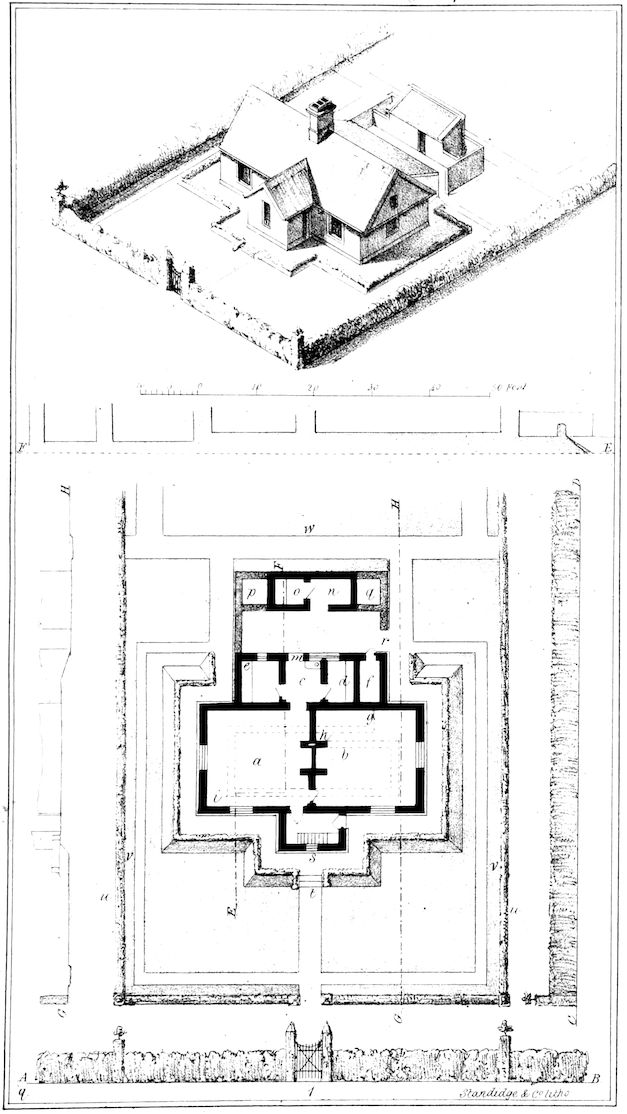
3977. If practicable, every cottage ought to stand singly, and surrounded by its garden, or, at all events, not more than two cottages ought to be joined together. Among other important arguments in favour of this arrangement, it may be mentioned, that it is the only one by which the sun can shine every day on every side of the cottage. When cottages are joined together in a row, unless that row is in a diagonal direction, with reference to a south and north line, the sun will shine chiefly on one side. By having cottages singly or in pairs, they may always be placed along any road in such a manner that the sun may shine on every side of them, provided the point be given up of having the front parallel to the road; a point which, in our opinion, ought not for a moment to be put in competition with the advantages of an equal diffusion of sunshine.