CHAPTER FOUR Building a Christian Community
Reading edition
John Hammond, in his pamphlet Leah and Rachel sketched briefly conditions which existed in Virginia between the "starving time" of 1609-10 and the year 1656. His attempt was to correct an opinion widely held in England of the lawlessness of colonial life. He interpreted the great massacre of 1622 as the end of one phase and the beginning of another. He showed that in each phase there was an inevitable period of laxity of life and disregard of moral and legal conventions which was overcome finally by the better element of citizenry. His writing presents a dark picture of conditions, possibly too dark in some phases; but his picture of the power of the growing colony to establish and maintain general concepts of decency of life and conduct is impressive.
Of the period following the great massacre he wrote:
Receiving a supply of men, ammunition and victuals out of England, they again gathered heart, pursued their enemies, and so often worsted them, that the Indians were glad to sue for peace, and they, (desirous of a cessation) consented to it.
They again began to bud forth, to spread further, to gather wealth, which they rather profusely spent (as gotten with ease) than providently husbanded, or aimed at any public good; or to make a country for posterity; but from hand to mouth, and for a present being; neglecting discoveries, planting orchards, providing for the winter preservation of their stocks, or thinking of anything stable or firm; and whilst tobacco, the only commodity they had to subsist on, bore a price, they wholly and eagerly followed that, neglecting their very planting of corn, and much relyed on England for the chiefest part of their provisions; so that being not alwayes amply supplied, they were often in such want, that their case and condition being relayted in England, it hindred and kept off many from going thither, who rather cast their eyes on the barren and freezing soyle of New-England, than to joyn with such an indigent and sottish people as were reported to be in Virginia.
Yet was not Virginia all this while without divers honest and vertuous inhabitants, who, observing the general neglect and licensiousnesses there, caused Assemblies to be call'd and laws to be made tending to the glory of God, the severe suppression of vices, and the compelling them not to neglect (upon strickt punishments) planting and tending such quantities of corn, as would not onely serve themselves, their cattle and hogs plentifully, but to be enabled to supply New-England (then in want) with such proportions, as were extream reliefs to them in their necessities.
From this industry of theirs and great plenty of corn, (the main staffe of life), proceeded that great plenty of cattle and hogs, (now innumerable) and out of which not only New-England hath been stocked and relieved, but all others parts of the Indies inhabited by Englishmen.
The inhabitants now finding the benefit of their industries, began to look with delight on their increasing stocks; (as nothing more pleasurable than profit), to take pride in their plentifully furnished tables, to grow not onely civil, but great observers of the Sabbath, to stand upon their reputations, and to be ashamed of that notorious manner of life they had formerly lived and wallowed in....
Then began the Gospel to flourish, civil, honourable, and men of great estates flocked in; famous buildings went forward, orchards innumerable were planted and preserved; tradesmen set on work and encouraged, staple commodities, as silk, flax, pot-ashes, etc., of which I shall speak further hereafter, attempted on, and with good success brought to perfection; so that this country which had a mean beginning, many back friends, two ruinous and bloody massacres, hath by God's grace out-grown all, and is become a place of pleasure and plenty.
It may possibly be worthwhile to compare the life of Virginia during its first two generations with the far west of the United States from the gold-rush days of 1849 to the end of the nineteenth century. There again, as in the Virginia of 1607, bona fide settlers of moral ideals and stability of life prevailed in the long run and developed self-governing states which maintained the moral code.
But Virginia had an advantage which the far west of the gold-rush days lacked. Virginia had an Established Church which in spite of its own problems and difficulties created a parish in every section, and provided clergymen as far as they could be obtained. It is granted that some at least of the clergymen were unworthy. The vestries themselves ejected men of that kind and services could be maintained by readers. And so the Word of God was read and prayer was offered regularly; and every man who could read had the Ten Commandments staring him in the face from the tablets on the wall behind the Holy Table. The individual might scorn and sneer but in the end the Law of God became the law of the community.
Men came to church in those early days. For one reason, the law of the colony required it and there was the threat of punishment if absence from church was reported to the grand jury. But there was another reason also, even though men and women were compelled to walk five or six miles to attend. That other reason was the loneliness of farm life in the early days of colonial Virginia. The churchyard on a Sunday morning was then the meeting-place of the whole community, and the only place where all could meet on the same level. The only other meetings were when elections were held at the Court House, every three or four years. And men might attend the meetings of the county court; but women could not vote, and they did not go to elections; nor were they apt to attend meetings of the county court except in rare instances when they were engaged in litigation. And the amount of hard liquor consumed on election days and county court days was also a deterrent.
Before the day of parish aid societies and women's guilds, the church service of a Sunday morning was moreover the only meeting to which everybody might come as of right; and while at church the women discussed affairs and neighbors within the church building the men outside walked about or sat on stumps or logs and held their discussions before and after the service hour.
The church with its churchyard was the public forum at which matters of public policy and public interest were discussed. It was here also that business was transacted; and it was here that community spirit of fellowship, of sympathy and of understanding was developed. The colonial government recognized all this by directing that every public communication which had to be brought to the attention of the people as a whole be read to the congregation of every church or chapel in the colony. And the Church recognized the same thing by providing that such announcements should be made immediately after the reading of the second lesson or New Testament lesson in the morning service. The approaching worshipper never knew what interesting announcement might be made at that time; so there was always an element of expectancy and suspense; perhaps an announcement of the banns of matrimony; perhaps the reading of a new law, or of some proclamation by the Governor and Council; perhaps the baptism of a baby, or even a marriage.
So it was that men and women of all classes came under the influence of Christian teaching whether they would or no; and the constant teaching and stressing of moral and Christian ideals of life had their effect in changing and improving the character of the community life.
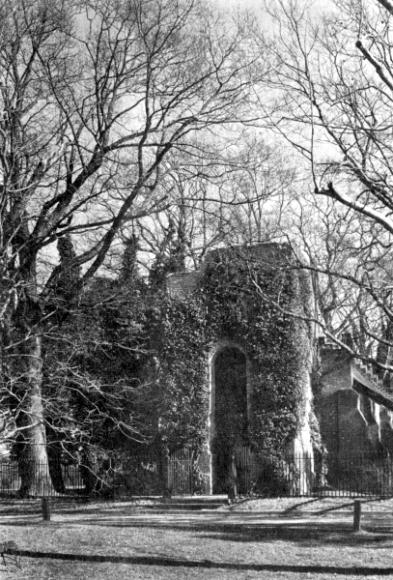
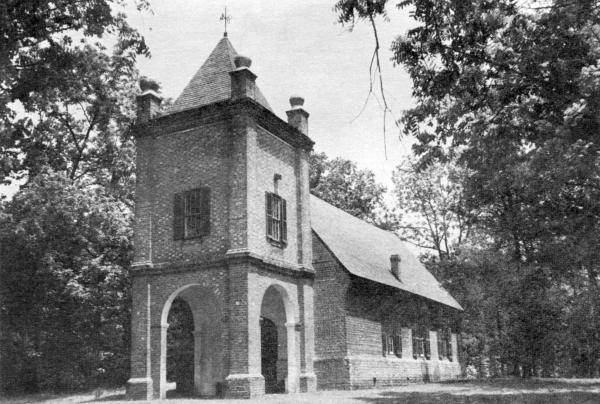
Old Church Tower, Jamestown, Virginia Photo by Flournoy, Virginia State Chamber of Commerce
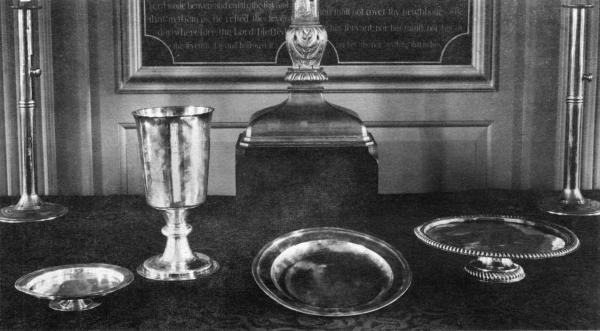
Jamestown Church Communion Service Chalice and paten given by Governor Francis Moryson, in 1661. Both bearing the inscription: Mix not holy things with profane. Ex dono Francisco Morrison, Armigeri Anno Domi, 1661. Large paten at the right given by Sir Edmund Andros, Governor, 1694. Inscribed: In usum Ecclesiae Jacobi-Polis. Ex dono Dni Edmundi Andros, Equitis, Virginiae Gubernatoris, Anno Dom. MDCXCIV. Alms basin, London, 1739. Second on the right. Inscription: For the use of James City Parish Church. Given by the old church at Jamestown in 1758 to Bruton Parish Church. Courtesy Miss Emily Hall
COMMUNION SERVICE IN USE AT SMITH'S HUNDRED, 1618. This three piece communion service now at St. John's Church, Elizabeth City Parish, Hampton, Virginia, has the longest history of use in the United States of any church silver. The set, a gift to the church founded in 1618 at Smith's Hundred in Charles City County, was made possible by a legacy in the will (date 1617) of Mrs. Mary Robinson of London. Smith's Hundred renamed Southampton Hundred, 1620, was practically wiped out in the Indian Massacre of 1622. This communion set delivered in 1627 to the Court at Jamestown for safe keeping, supposedly, then was given to the second Elizabeth City Church built on Southampton (now Hampton) River. The inscription in one line on the base of the Chalice is: The Communion Cupp for Snt Marys Church in Smiths Hundred in Virginia. Hall marks on all three pieces bear London date-letters for 1618-19. Courtesy Mrs. L. T. Jester and Mrs. P. W. Hiden

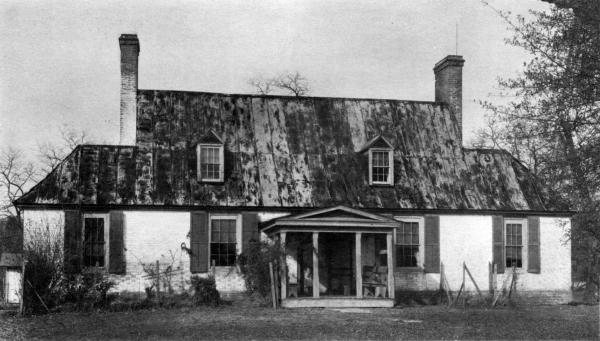
The Glebe House, Charles City County, Virginia Courtesy Valentine Museum, Richmond
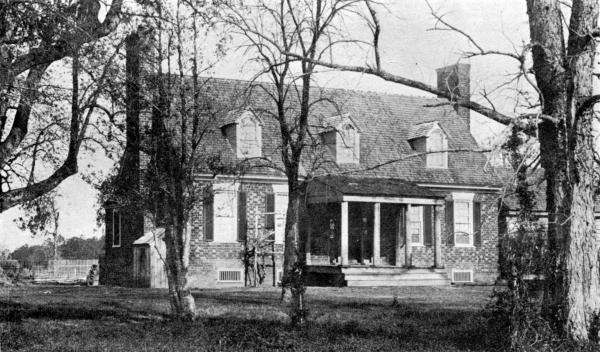
Glebe House, Gloucester County, Virginia Photo by Flournoy, Virginia State Chamber of Commerce
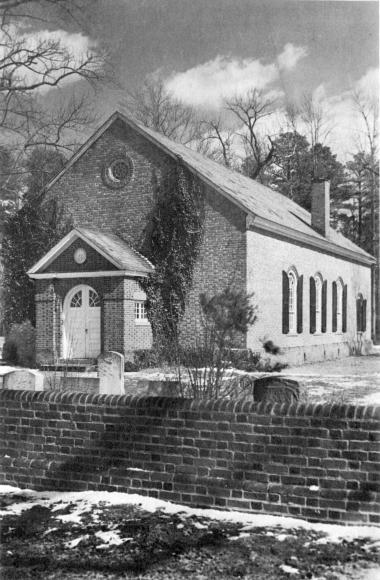
Christ Church, Middlesex County, Virginia Photo by Flournoy, Virginia State Chamber of Commerce
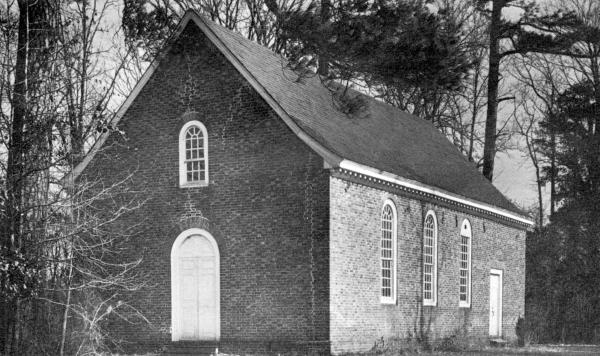
Merchant's Hope Church, Prince George County, Virginia Photo by Flournoy, Virginia State Chamber of Commerce
Saint Lukes Church, Isle of Wight County, Virginia Photo by Flournoy, Virginia State Chamber of Commerce
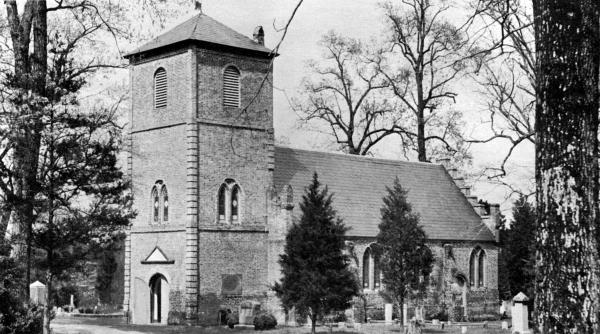
Saint Peters Church, New Kent County, Virginia Photo by Flournoy, Virginia State Chamber of Commerce
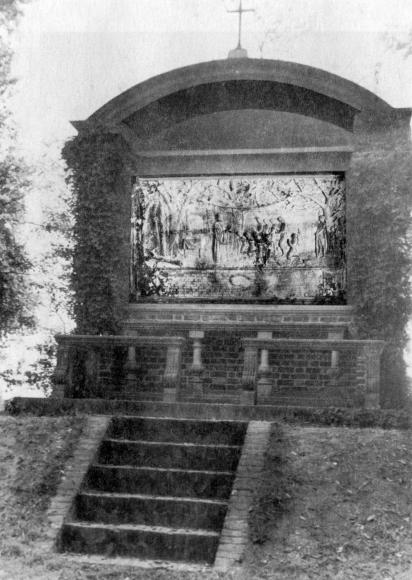
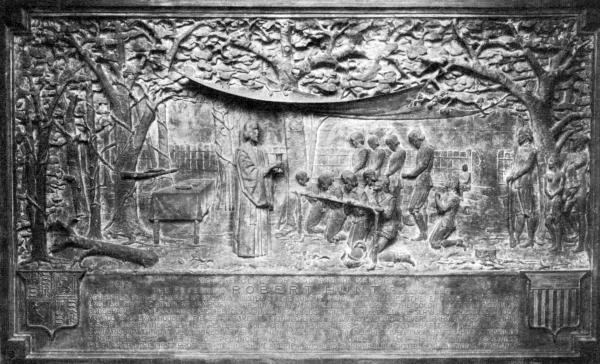
Robert Hunt Memorial Plaque Altar-piece. A bronze bas-relief representing the administration of the first Anglican communion in America, June 21, 1607. George T. Brewster, sc. Gorham Co., founders. Courtesy Cook Collection, Valentine Museum
Robert Hunt Memorial Shrine Erected by the National Society of Colonial Dames of America in the State of Virginia. Presented to the Diocese of Southern Virginia of the Protestant Episcopal Church, June 15, 1922. It was placed in the perpetual care of the Association for the Preservation of Virginia Antiquities. Courtesy Cook Collection, Valentine Museum and National Park Service