[THE PLAY OF WIT AND SCIENCE
Reading edition
Made by Master JOHN REDFORD
The Names of the Players:
Wit
Science
Reason
Experience
Confidence
Honest Recreation
Study
Diligence
Instruction
Tediousness
Idleness
Ingnorancy[1]
Shame
Comfort
Quickness
Strength
Fame
Riches
Favour
Worship
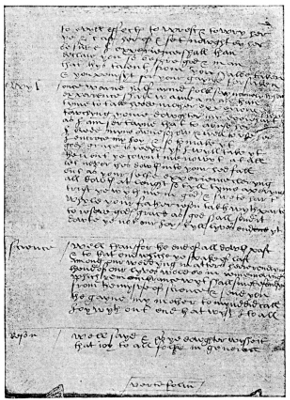
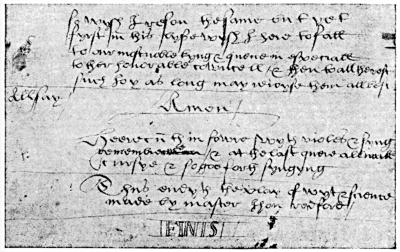
[Reduced facsimile of the penultimate page of manuscript copy of "Wit and Science" now in the British Museum.]
THE PLAY OF WIT AND SCIENCE.
[By John Redford.]
* * * * * Reason. Then, in remembrance of Reason, hold ye A glass of Reason, wherein behold ye Yourself to yourself. Namely, when ye Come near my daughter, Science, then see That all things be clean and trick about ye; Lest of some sluggishness she might doubt ye; This glass of Reason shall show ye all; While ye have that, ye have me, and shall. Get ye forth, now! Instruction, farewell! Instruction. Sir, God keep ye!
Here all go out save Reason.
Rea. And ye all from peril! If any man now marvel that I Would bestow my daughter thus basely, Of truth I, Reason, am of this mind: Where parties together be inclined, By gifts of graces, to love each other, There let them join the one with the tother. This Wit such gifts of graces hath in him That maketh my daughter to wish to win him: Young, painful, tractable and capax— These be Wit's gifts which Science doth axe. And, as for her, as soon as Wit sees her, For all the world he would not then lese her. Wherefore, since they both be so meet matches To love each other, straw for the patches Of worldly muck! Science hath enough For them both to live. If Wit be through Stricken in love, as he since hath showed, I doubt not my daughter well bestowed: Th' end of his journey will prove all. If Wit hold out, no more proof can fall; And, that the better hold out he may, To refresh me soon, Wit, now, by the way, Some solace for him I will provide. An honest woman dwelleth here, beside, Whose name is called Honest Recreation; As men report, for Wit's consolation She hath no peer; if Wit were half dead, She could revive him—thus is it said. Wherefore, if money or love can hire her, To hie after Wit I will desire her. [Reason goeth out.
Confidence cometh in with a picture of Wit.
[Confidence.] Ah, sir! what time of day is't, who can tell? The day is not far past, I wot well; For I have gone fast, and yet I see I am far from whereas I would be. Well! I have day enough yet, I spy; Wherefore, or I pass hence, now must I See this same token here, a plain case, What Wit hath sent to my lady's grace. [Examines his packet. Now, will ye see a goodly picture Of Wit himself? his own image sure! Face, body, arms, legs, both limb and joint, As like him as can be, in every point; It lacketh but life. Well I can him thank; This token indeed shall make some crank; For, what with this picture so well favoured, And what with those sweet words so well savoured— Distilling from the mouth of Confidence— Shall not this appease the heart of Science? Yes! I thank God I am of that nature, Able to compass this matter sure; As ye shall see now, who list to mark it, How neatly and featly I shall work it.
[Confidence goeth out.
Wit cometh in without Instruction, with Study, etc.
[Wit.] Now, sirs! come on! which is the way now? This way or that way? Study! how say you?
[Study reflecteth.
Speak, Diligence! while he hath bethought him. Diligence. That way, belike; most usage hath wrought him. Study. Yea, hold your peace! Best we here now stay For Instruction; I like not that way. Wit. Instruction, Study? I ween we have lost him.
[Instruction cometh in.
[Inst.] Indeed, full gently about ye have tossed him! What mean you, Wit, still to delight Running before thus, still out of sight; And, thereby, out of your way now quite. What do ye here except he would fight? Come back again, Wit! for, I must choose ye An easier way than this, or else lose ye. Wit. What aileth this way? Peril here is none. Inst. But as much as your life standeth upon; Your enemy, man! lieth here before ye: Tediousness, to brain or to gore ye! Wit. Tediousness? Doth that tyrant rest In my way now? Lord! how am I blest That occasion so near me stirs, For my dear heart's sake, to win my spurs! Sir! would ye fear me with that foul thief, With whom to meet my desire is chief? Inst. And what would ye do, you having nought For your defence? for, though ye have caught Garments of Science upon your back, Yet weapons of Science ye do lack! Wit. What weapons of Science should I have? Inst. Such as all lovers of their loves crave: A token from Lady Science whereby Hope of her favour may spring, and thereby Comfort; which is the weapon doubtless That must serve you against Tediousness. Wit. If hope or comfort may be my weapon, Then never with Tediousness me threaten; For, as for hope of my dear heart's favour— And thereby comfort—enough I gather. Inst. Wit, hear me! Till I see Confidence Have brought some token from Lady Science, That I may feel that she favoureth you, Ye pass not this way, I tell you true. Wit. Which way then? Inst. A plainer way, I told ye, Out of danger from your foe to hold ye. Wit. Instruction, hear me! Or my sweetheart Shall hear that Wit from that wretch shall start One foot, this body and all shall crack! Forth I will, sure, whatever I lack! Dil. If ye lack weapon, sir, here is one! Wit. Well said, Diligence, thou art alone! How say ye, sir? is not here weapon? Inst. With that weapon your enemy never threaten; For without the return of Confidence Ye may be slain, sure, for all Diligence! Dil. Good, sir! and Diligence, I tell you plain, Will play the man or my master be slain! Inst. Yea, but what? saith Study no word to this? Wit. No, sir! ye know Study's office is Meet for the chamber, not for the field— But tell me, Study, wilt thou now yield? Study. My head acheth sore; I would we return. Wit. Thy head ache now? I would it were burn! Come on! walking may hap to ease thee. Inst. And will ye be gone, then, without me? Wit. Yea, by my faith, except ye hie ye after, Reason shall know ye are but an hafter.
Exeat Wit, Study and Diligence.
Inst. Well, go your way! When your father, Reason, Heareth how ye obey me, at this season, I think he will think his daughter now May marry another man for you. When wits stand so in their own conceit, Best let them go; till pride, at his height, Turn and cast them down headlong again: And ye shall see proved by this Wit, plain. If Reason hap not to come, the rather His own destruction he will sure gather; Wherefore to Reason will I now get me, Leaving that charge whereabout he set me.
[Exeat Instruction.
Tediousness cometh in with a visor over his head.
[Tediousness.] Oh, the body of me! What caitiffs be those That will not once flee From Tediousness' nose; But thus disease me Out of my nest, When I should ease me This body to rest! That Wit, that villain, That wretch—a shame take him! It is he plain That thus bold doth make him, Without my licence To stalk by my door To that drab, Science, To wed that whore! But I defy her; And, for that drab's sake, Or Wit come nigh her, The knave's head shall ache; These bones, this mall, Shall beat him to dust Or that drab shall Once quench that knave's lust! But, ha! methinks I am not half lusty; These joints, these links, Be rough and half rusty; I must go shake them, Supple to make them! Stand back, ye wretches! Beware the fetches Of Tediousness. These caitiffs to bless, Make room, I say; Round every way— This way, that way! What cares what way? Before me, behind me, Round about wind me! Now I begin To sweat in my skin; Now am I nemble To make them tremble. Pash head! pash brain! The knaves are slain, All that I hit! Where art thou, Wit! Thou art but dead! Off goeth thy head At the first blow! Ho, ho! ho ho! [Wit speaketh at the door. [Wit.] Study! Study. Here, sir! Wit. How, doth thy head ache? Study. Yea, God wot, sir! much pain I do take! Wit. Diligence! Dil. Here, sir, here! Wit. How dost thou? Doth thy stomach serve thee to fight now? Dil. Yea, sir, with yonder wretch—a vengeance on him That threateneth you thus. Set even upon him! Study. Upon him, Diligence? Better nay! Dil. Better nay, Study? Why should we fray? Study. For I am weary; my head acheth sore.
[The last three lines are, in the manuscript, scored through.]
Dil. Why, foolish Study! thou shalt do no more But aid my master with thy presence. Wit. No more shalt thou neither, Diligence! Aid me with your presence, both you twain; And, for my love, myself shall take pain! Study. Sir! we be ready to aid you so. Wit. I ask no more, Study! Come then, go!
[Tediousness riseth up.
[Ted.] Why, art thou come? Wit. Yea, wretch, to thy pain! Ted. Then have at thee! Wit. Have at thee, again!
[Here Wit falleth down and dieth.
[Ted.] Lie thou there! Now have at ye, caitiffs! Do ye flee, i' faith? A, whoreson thieves! By Mahound's bones! had the wretches tarried, Their necks without heads they should have carried! Yea, by Mahound's nose! might I have patted them, In twenty gobbets I should have squatted them, To teach the knaves to come near the snout Of Tediousness! Walk further about I trow, now, they will! And, as for thee, Thou wilt no more now trouble me. Yet, lest the knave be not safe enough, The whoreson shall bear me another cuff.
[Striketh him.
Now, lie still, caitiff! and take thy rest While I take mine, in mine own nest.
[Exeat Tedi[ousness].
Here cometh in Honest Recreation, Comfort, Quickness, and Strength, and go and kneel about Wit; and at the last verse raiseth him up upon his feet, and so make an end.
Give place, give place to Honest Recreation; Give place, we say now, for thy consolation. When travels great, in matters thick, Have dulled your wits and made them sick, What medicine then your wits to quick? If ye will know, the best physick Is to give place to Honest Recreation; Give place, we say now, for thy consolation! Where is that Wit that we seek than? Alas! he lieth here, pale and wan. Help him at once now, if we can: O Wit! how doest thou? Look up, man! O Wit, give place to Honest Recreation! Give place, we say now, for thy consolation! After place given, let ear obey; Give an ear, O Wit! now we thee pray; Give ear to that we sing and say! Give an ear, and help will come straightway! Give an ear to Honest Recreation! Give an ear now for thy consolation! After ear given, now give an eye! Behold! thy friends about thee lie: Recreation I, and Comfort I, Quickness am I, and Strength, hereby. Give an eye to Honest Recreation! Give an eye now for thy consolation! After eye given, an hand give ye! Give an hand, O Wit! feel that ye see! Recreation feel! feel Comfort free! Feel Quickness here! feel Strength to thee! Give an hand to Honest Recreation! Give an hand now for thy consolation! Upon his feet, would God he were! To raise him now we need not fear. Stay you his hands, while we him bear; Now, all at once, upright him rear! O Wit, give place to Honest Recreation! Give place, we say now, for thy consolation!
And then Honest Recreation saith as followeth:
[Honest Recreation.] Now, Wit! how do ye? Will ye be lusty? Wit. The lustier for you needs be must I. Hon. Rec. Be ye all whole yet, after your fall? Wit. As ever I was, thanks to you all! Reason cometh in, and saith as followeth: [Rea.] Ye might thank Reason that sent them to ye; But since the[y] have done that the[y] should, do ye Send them home soon, and get ye forward! Wit. Oh father Reason! I have had an hard Chance since ye saw me! Rea. I wot well that. The more to blame ye, when ye would not Obey Instruction, as Reason willed ye. What marvel though Tediousness had killed ye? But let pass now, since ye are well again. Set forward again Science to attain! Wit. Good father Reason, be not too hasty! In honest company no time waste I. I shall to your daughter all at leisure. Rea. Yea, Wit, is that the great love ye raise her? I say, if ye love my daughter, Science, Get ye forth at once, and get ye hence!
[Here Comfort, Quickness, Strength go out.
Wit. Nay, by Saint George! they go not all yet. Rea. No? will ye disobey Reason, Wit? Wit. Father Reason! I pray ye, content ye! For we part not yet. Rea. Well, Wit! I went ye Had been no such man as now I see. Farewell! [Exeat. Hon. Rec. He is angry. Wit. Yea, let him be! I do not pass! Come now, a bass! Hon. Rec. Nay, sir, as for basses, From hence none passes But as in gage Of marriage. Wit. Marry, even so! A bargain, lo! Hon. Rec. What, without licence Of Lady Science? Wit. Shall I tell you truth? I never loved her. Hon. Rec. The common voice goeth That marriage ye moved her. Wit. Promise hath she none. If we shall be one, Without mo words grant! Hon. Rec. What, upon this sudden? Then might ye plain Bid me avaunt! Nay, let me see In honesty What ye can do To win Recreation; Upon that probation I grant thereto. Wit. Small be my doings, But apt to all things I am, I trust. Hon. Rec. Can ye dance than? Wit. Even as I can. Prove me ye must. Hon. Rec. Then, for a while, Ye must exile This garment cumbering. Wit. Indeed, as ye say, This cumbrous array Would make Wit slumbering. Hon. Rec. It is gay gear Of Science clear— It seemeth her array. Wit. Whosever it were, It lieth now there! [Taketh off his gown. Hon. Rec. Go to, my men, play!
Here they dance, and in the meanwhile Idleness cometh in and sitteth down, and when the galliard is done, Wit saith as followeth, and so falleth down in Idleness' lap.
Wit. Sweetheart, gramercys! Hon. Rec. Why, whither now? Have ye done, since? Wit. Yea, in faith! with weary bones ye have possessed me; Among these damsels now will I rest me. Hon. Rec. What, there? Wit. Yea, here; I will be so bold. Idleness. Yea, and welcome, by him that God sold! Hon. Rec. It is an harlot; may ye not see? Idle. As honest a woman as ye be! Hon. Rec. Her name is Idleness. Wit! what mean you? Idle. Nay! what mean you to scold thus, you quean, you? Wit. There, go to! Lo! now for the best game! While I take my ease, your tongues now frame! Hon. Rec. Yea, Wit! by your faith, is that your fashion? Will ye leave me, Honest Recreation, For that common strumpet, Idleness, The very root of all viciousness? Wit. She saith she is as honest as ye. Declare yourselves both now as ye be! Hon. Rec. What would ye more for my declaration Than even my name, Honest Recreation? And what would ye more her to express Than even her name, too, Idleness— Destruction of all that with her tarry? Wherefore come away, Wit! she will mar ye! Idle. Will I mar him, drab? thou callet, thou! When thou hast marred him already now? Callest thou thyself Honest Recreation, Ordering a poor man after this fashion, To lame him thus, and make his limbs fail, Even with the swinging there of thy tail? The devil set fire on thee! for now must I, Idleness, heal him again, I spy. I must now lull him, rock him, and frame him To his lust again, where thou didst lame him. Am I the root, sayest thou, of viciousness? Nay! thou art root of all vice, doubtless! Thou art occasion, lo! of more evil Than I, poor girl—nay, more than the devil! The devil and his dam cannot devise More devilishness than by thee doth rise! Under the name of Honest Recreation, She, lo! bringeth in her abomination! Mark her dancing, her masking, and mumming— Where more concupiscence than there coming? Her carding, her dicing, daily and nightly— Where find ye more falsehood than there? Not lightly! With lying and swearing, by no poppets; But tearing God in a thousand gobbets. As for her singing, piping and fiddling— What unthriftiness therein is twiddling! Search the taverns and ye shall hear, clear, Such bawdry as beasts would spue to hear. And yet, this is called Honest Recreation! And I, poor Idleness, abomination! But which is worst of us twain, now judge, Wit! Wit. By'r Lady! not thou! wench! I judge yet. Hon. Rec. No? Is your judgment such then that ye Can neither pe[r]ceive that beast, how she Goeth about to deceive you, nor yet Remember how I saved your life, Wit? Think you her meet with me to compare By whom so many wits cured are? When will she do such an act as I did, Saving your life when I you revived? And, as I saved you, so save I all That in like jeopardy chance to fall. When Tediousness to ground hath smitten them, Honest Recreation up doth quicken them With such honest pastimes, sports or games, As unto mine honest nature frames; And not, as she saith, with pastimes such As be abused little or much: For, where honest pastimes be abused, Honest Recreation is refused; Honest Recreation is present never But where honest pastimes be well used ever. But, indeed, Idleness, she is cause Of all such abuses; she, lo! draws Her sort to abuse mine honest games; And, thereby, full falsely my name defames. Under the name of Honest Recreation She bringeth in all her abomination, Destroying all wits that her embrace, As yourself shall see within short space. She will bring you to shameful end, Wit, Except the sooner from her ye flit. Wherefore, come away, Wit, out of her paws! Hence, drab! let him go out of thy claws! Idle. Will ye get ye hence? or, by the mace! These claws shall claw you by your drab's face! Hon. Rec. Ye shall not need; since Wit lieth as one That neither heareth nor seeth, I am gone. [Exeat. Idle. Yea, so? farewell! And well fare thou, tongue! Of a short peal, this peal was well rung, To ring her hence, and him fast asleep, As full of sloth as the knave can creep! How, Wit! awake! How doth my baby? Neque vox neque sensus, by'r Lady! A meet man for Idleness, no doubt. Hark, my pig! how the knave doth rout! Well, while he sleepeth in Idleness' lap, Idleness' mark on him shall I clap. Some say that Idleness cannot wark; But those that so say, now let them mark! I trow they shall see that Idleness Can set herself about some business; Or, at the least, ye shall see her tried, Neither idle, nor well occupied. [She marketh Wit. Lo, sir! yet ye lack another toy! Where is my whistle to call my boy?
Here she whistleth, and Ingnorancy cometh in.
[Ingnorancy.] I come! I come! Idle. Come on, ye fool! All this day or ye can come to school? Ingn. Um! mother will not let me come. Idle. I would thy mother had kissed thy bum! She will never let thee thrive, I trow! Come on, goose! Now, lo! men shall know That Idleness can do somewhat, yea! And play the schoolmistress, too, if need be. Mark what doctrine by Idleness comes! Say thy lesson, fool! Ingn. Upon my thumbs? Idle. Yea, upon thy thumbs: is not there thy name? Ingn. Yeas. Idle. Go too, then; spell me that same! Where was thou born? Ingn. Chwas i-bore in England, mother said. Idle. In Ingland? Ingn. Yea! Idle. And what's half Ingland? Here's Ing; and here's land. What's 'tis? Ingn. What's 'tis? Idle. What's 'tis? whoreson! what's 'tis? Here's Ing; and here's land. What's 'tis? Ingn. 'Tis my thumb. Idle. Thy thumb? Ing, whoreson! Ing, Ing! Ingn. Ing, Ing, Ing, Ing! Idle. Forth! Shall I beat thy narse, now? Ingn. Um-m-m— Idle. Shall I not beat thy narse, now? Ingn. Um-um-um— Idle. Say no, fool! say no. Ingn. Noo, noo, noo, noo, noo! Idle. Go to, put together! Ing! Ingn. Ing. Idle. No! Ingn. Noo. Idle. Forth now! What saith the dog? Ingn. Dog bark. Idle. Dog bark? Dog ran, whoreson! dog ran! Ingn. Dog ran, whoreson! dog ran, dog ran! Idle. Put together: Ing! Ingn. Ing. Idle. No! Ingn. Noo. Idle. Ran! Ingn. Ran. Idle. Forth now; what saith the goose? Ingn. Lag! lag! Idle. His, whoreson! his! Ingn. His, his-s-s-s-s! Idle. Go to, put together: Ing. Ingn. Ing. Idle. No. Ingn. Noo. Idle. Ran. Ingn. Ran. Idle. Hys. Ingn. His-s-s-s-s-s-s. Idle. Now, who is a good boy? Ingn. I, I, I! I, I, I! Idle. Go to, put together: Ing. Ingn. Ing. Idle. No. Ingn. Noo. Idle. Ran. Ingn. Ran. Idle. His. Ingn. His-s-s-s-s-s-s. Idle. I. Ingn. I. Idle. Ing-no-ran-his-I. Ingn. Ing-no-ran-his-s-s-s. Idle. I. Ingn. I. Idle. Ing. Ingn. Ing. Idle. Foorth! Ingn. His-s-s-s. Idle. Yea, no, whoreson! no! Ingn. Noo, noo, noo, noo. Idle. Ing-no. Ingn. Ing-noo. Idle. Forth now! Ingn. His-s-s-s-s. Idle. Yet again; ran, whoreson! ran, ran! Ingn. Ran, whoreson, ran, ran. Idle. Ran, say! Ingn. Ran-say. Idle. Ran, whoreson! Ingn. Ran, whoreson. Idle. Ran. Ingn. Ran. Idle. Ing-no-ran. Ingn. Ing-no-ran. Idle. Foorth, now! What said the goose? Ingn. Dog bark. Idle. Dog bark? His, whoreson! his-s-s-s-s-s. Ingn. His-s-s-s-s-s. Idle. I: Ing-no-ran-his-I. Ingn. Ing-no-ran-his-I-s-s-s. Idle. I. Ingn. I. Idle. How sayest, now, fool? Is not there thy name? Ingn. Yea. Idle. Well then; can me that same! What hast thou learned? Ingn. Ich cannot tell. Idle. Ich cannot tell—thou sayest even very well! For, if thou couldst tell, then had not I well Taught thee thy lesson which must be taught; To tell all, when thou canst tell right naught. Ingn. Ich can my lesson. Idle. Yea; and, therefore, Shalt have a new coat, by God I swore! Ingn. A new coat? Idle. Yea, a new coat, by-and-by. Off with this old coat! a new coat, cry! Ingn. A new coat, a new coat! a new coat! Idle. Peace! whoreson fool! Wilt thou wake him now? Unbutton thy coat, fool! Canst thou do nothing? Ingn. I note how choold be. Idle. I note how choold be! A fool betide thee! So wisely it speaketh; come on, now! when? Put back thine arm, fool!
[Taketh off Ingnorancy's coat.
Ingn. Put back? Idle. So, lo! now let me see how this gear Will trim this gentleman that lieth here. Ah! God save it! so sweetly it doth sleep! While on your back this gay coat can creep, As feat as can be for this one arm.
[Putteth Wit's gown on Ingnorancy.
Ingn. Oh! cham a-cold. Idle. Hold, fool! keep thee warm! And, come hither! hold this head here! soft now, for waking! Ye shall see one here brought in such taking That he shall soon scantily know himself. Here is a coat as fit for this elf As it had been made even for this body!
[Putteth Ingnorancy's coat on Wit.
So! It beginneth to look like a noddie! Ingn. Um-m-m-m— Idle. What ailest now, fool? Ingn. New coat is gone! Idle. And why is it gone? Ingn. 'Twool not bide on. Idle. 'Twool not bide on? 'Twould if it could! But marvel it were that it should— Science['s] garment on Ingnorancy['s] back! But now, let's see, sir! what do ye lack? Nothing but even to buckle here this throat, So well this Wit becometh a fool's coat! Ingn. He is I, now! Idle. Yea; how likest him now? Is he not a fool as well as thou? Ingn. Yeas! Idle. Well, then, one fool keep another! Give me this, and take thou that, brother! Ingn. Um-m— Idle. Pike thee home, go! Ingn. Chill go tell my moother! [Exit. Idle. Yea, do! But yet, to take my leave of my dear, lo! With a skip or twain, here lo! and here lo! And, here again! and now, this heel To bless his weak brain! Now are ye weel, By virtue of Idleness' blessing tool, Conjured from Wit unto a stark fool! [Exit Idleness.
Confidence cometh in with a sword by his side; and sayeth as followeth:
[Confidence.] I seek and seek, as one on no ground Can rest; but, like a masterless hound, Wandering all about seeking his master. Alas, gentle Wit! I fear the faster That my true service cleaveth unto thee, The slacker thy mind cleaveth unto me; I have done thy message, in such sort, That I not only, for thy comfort, To vanquish thine enemy have brought here A sword of comfort from thy love dear; But also, further, I have so inclined her That, upon my words, she hath assigned her, In her own person, half-way to meet thee: And, hitherward, she came for to greet thee. And sure, except she be turned again, Hither will she come or be long, plain, To seek to meet thee here in this coast. But now, alas! thyself thou hast lost; Or, at the least, thou wilt not be found. Alas! gentle Wit, how dost thou wound Thy trusty and true servant, Confidence, To lese my credence to Lady Science? Thou lesest me, too; for if I cannot Find thee shortly, longer live I may not; But shortly get me even into a corner And die for sorrow through such a scorner! [Exit.
Here they [Fame, Favour, Riches, and Worship] come in with viols.
Fame. Come, sirs! let us not disdain to do That the World hath appointed us to. Favour. Since, to serve Science, the World hath sent us, As the World willeth us, let us content us. Riches. Content us we may, since we be assigned To the fairest lady that liveth, in my mind! Worship. Then, let us not stay here mute and mum; But taste we these instruments till she come.
Here the[y] sing "Exceeding Measure."
Exceeding measure, with pains continual, Languishing in absence, alas! what shall I do? Unfortunate wretch! devoid of joys all, Sighs upon sighs redoubling my woe; And tears down falling from mine eyes too. Beauty with truth so doth me constrain Ever to serve where I may not attain! Truth bindeth me ever to be true, Howso that fortune favoureth my chance. During my life none other but you Of my true heart shall have the governance! O, good sweet heart! have you remembrance Now, of your own, which for no smart Exile shall you from my true heart!
[Experience and Science entereth while they sing.]
Experience. Daughter, what meaneth that ye did not sing? Science. Oh mother, for here remaineth a thing! Friends! we thank you for these your pleasures, Taken on us as chance to us measures. Wor. Lady! these our pleasures, and persons, too, Are sent to you, you service to do. Fame. Lady Science! to set forth your name The World, to wait on you, hath sent me, Fame. Fav. Lady Science! for your virtues most plenty The World, to cherish you, Favour hath sent ye. Rich. Lady Science! for your benefits known The World, to maintain you, Riches hath thrown. Wor. And as the World hath sent you these three, So he sendeth me, Worship, to advance your degree. Sci. I thank thee, World! but, chiefly, God be praised! That, in the World, such love to Science hath raised! But yet, to tell you plain, ye four are such As Science looketh for, little nor much; For being, as I am, a lone woman, Need of your service I neither have nor can. But, thanking the World, and you, for your pain, I send ye to the World even now again! Wor. Why, lady! set ye no more store by me, Worship? Ye set nought by yourself, I see! Fame. She setteth nought by Fame; whereby I spy her— She careth not what the World sayeth by her. Fav. She setteth nought by Favour; whereby I try her— She careth not what the World sayeth or doeth by her. Rich. She setteth nought by Riches; which doth show She careth not for the World. Come, let us go!
[Fame, Favour, Riches, and Worship go out.
Sci. Indeed, small cause given to care for the World's favouring, Seeing the wits of [the] World be so wavering! Exp. What is the matter, daughter, that ye Be so sad? Open your mind to me. Sci. My marvel is no less, my good mother, Than my grief is great, to see, of all other, The proud scorn of Wit, son to Dame Nature, Who sent me a picture of his stature, With all the shape of himself there opening: His amorous love thereby betokening, Borne toward me in abundant fashion; And also, further, to make right relation Of this his love, he put in commission Such a messenger as no suspicion Could grow, in me, of him—Confidence. Exp. Um! Sci. Who, I ensure ye, with such vehemence, And faithful behaviour in his moving, Set forth the pith of his master's loving That no living creature could conjecte But that pure love did that Wit direct. Exp. So? Sci. Now, this being since the space Of three times sending from place to place, Between Wit and his man, I hear no more Neither of Wit, nor his love so sore! How think you by this, my own dear mother? Exp. Daughter! in this I can think none other But that it is true—this proverb old: Hasty love is soon hot, and soon cold! Take heed, daughter! how you put your trust To light lovers, too hot at the first! For had this love of Wit been grounded, And on a sure foundation founded, Little void time would have been between ye But that this Wit would have sent or seen ye. Sci. I think so. Exp. Yea; think ye so or no, Your mother, Experience, proof shall show That Wit hath set his love, I dare say— And make ye warrantise!—another way.
[Wit cometh before.
[Wit.] But your warrantise warrant no troth! Fair lady! I pray you be not wroth Till you hear more; for, dear Lady Science! Had your lover, Wit—yea, or Confidence, His man—been in health all this time spent, Long or this time Wit had come or sent; But the truth is, they have been both sick, Wit and his man: yea, and with pains thick Both stayed by the way, so that your lover Could neither come nor send by none other. Wherefore blame not him, but chance of sickness! Sci. Who is this? Exp. Ingnorancy, or his likeness. Sci. What, the common fool? Exp. It is much like him. Sci. By my sooth! his tongue serveth him now trim. What sayest thou, Ingnorancy? Speak again! Wit. Nay, lady! I am not Ingnorancy, plain, But I am your own dear lover, Wit, That hath long loved you, and loveth you yet; Wherefore I pray thee now, my own sweeting! Let me have a kiss at this our meeting. Sci. Yea, so ye shall, anon, but not yet. Ah, sir! this fool here hath got some wit. Fall you to kissing, sir, now-a-days? Your mother shall charm you; go your ways! Wit. What needeth all this, my love of long grown? Will ye be so strange to me, your own? Your acquaintance to me was thought easy; But now your words make my heart all queasy, Your darts at me so strangely be shot. Sci. Hear ye what terms this fool here hath got? Wit. Well, I perceive my foolishness now; Indeed, ladies no dastards allow; I will be bold with my own darling! Come now, a bass, my own proper sparling! Sci. What wilt thou, arrant fool? Wit. Nay, by the mass! I will have a bass or I hence pass! Sci. What wilt thou, arrant fool? Hence, fool, I say! Wit. What! nothing but fool, and fool, all this day? By the mass, madam! ye can no good. Sci. Art a-swearing, too? Now, by my hood! Your foolish knave's breech six stripes shall bear! Wit. Yea, God's bones! fool and knave too? be ye there? By the mass, call me fool once again, And thou shalt sure call a blow or twain! Exp. Come away, daughter! the fool is mad. Wit. Nay, nor yet neither hence ye shall gad! We will gree better, or ye pass hence. I pray thee now, good sweet Lady Science! All this strange manner now hide and cover, And play the goodfellow with thy lover! Sci. What good-fellowship would ye of me, Whom ye know not, neither yet I know ye? Wit. Know ye not me? Sci. No! how should I know ye? Wit. Doth not my picture my person show ye? Sci. Your picture? Wit. Yea, my picture, lady! That ye spake of. Who sent it but I? Sci. If that be your picture, then shall we Soon see how you and your picture agree. Lo, here! the picture that I named is this. Wit. Yea, marry! mine own likeness this is. You having this, lady! and so loth To know me, which this so plain showeth? Sci. Why, you are nothing like, in mine eye. Wit. No? How say ye? [To Experience. Exp. As she saith, so say I. Wit. By the mass, then are ye both stark blind! What difference between this and this can ye find? Exp. Marry, this is fair, pleasant, and goodly; And ye are foul, displeasant, and ugly. Wit. Marry, avaunt, thou foul ugly whore! Sci. So, lo! now I perceive ye more and more. Wit. What! perceive you me as ye would make me A natural fool? Sci. Nay, ye mistake me; I take ye for no fool natural, But I take ye thus—shall I tell all? Wit. Yea, marry! tell me your mind, I pray ye, Whereto I shall trust. No more delay ye! Sci. I take ye for no natural fool, Brought up among the innocents' school; But for a naughty, vicious fool, Brought up with Idleness in her school: Of all arrogant fools thou art one! Wit. Yea, God's body! Exp. Come, let us be gone! [The two go out. Wit. My sword! is it gone? A vengeance on them! Be they gone, too, and their heads upon them? But, proud queans! the devil go with you both! Not one point of courtesy in them goeth. A man is well at ease by suit to pain him For such a drab, that so doth disdain him! So mocked, so louted, so made a sot— Never was I erst, since I was begot! Am I so foul as those drabs would make me? Where is my glass that Reason did take me? Now shall this glass of Reason soon try me As fair as those drabs that so doth belie me. Ha! God's soul! what have we here? a devil? This glass, I see well, hath been kept evil. God's soul! a fool, a fool, by the mass! What—a very vengeance!—aileth this glass? Other this glass is shamefully spotted, Or else am I too shamefully blotted! Nay, by God's arms! I am so, no doubt! How look their faces here round about? All fair and clear they, everyone; And I, by the mass, a fool alone, Decked, by God's bones, like a very ass! Ignorance['s] coat, hood, ears—yea, by the mass!— Cockscomb and all; I lack but a bauble! And as for this face it is abominable; As black as the devil! God, for His passion! Where have I been rayed after this fashion? This same is Idleness—a shame take her! This same is her work—the devil in hell rake her! The whore hath shamed me forever, I trow! I trow? Nay, verily, I know! Now it is so, the stark fool I play Before all people; now see it I may. Every man I see laugh me to scorn; Alas, alas! that ever I was born! It was not for nought, now well I see, That those two ladies disdained me. Alas! Lady Science, of all other— How have I railed on her and her mother! Alas! that lady I have now lost Whom all the world loveth and honoureth most! Alas! from Reason had I not varied, Lady Science or this I had married; And those four gifts which the World gave her I had won, too, had I kept her favour; Where now, instead of that lady bright With all those gallants seen in my sight— Favour, Riches, yea, Worship and Fame— I have won Hatred, Beggary and Open Shame!
Shame cometh in with a whip. [Reason followeth him.]
Wit. Out upon thee, Shame! what doest thou here? Rea. Marry! I, Reason, bade him here appear. Upon him, Shame! with stripes enow smitten, While I rehearse his faults herein written! First, he hath broken his promise formerly Made to me, Reason, my daughter to marry; Next, he hath broken his promise promised To obey Instruction, and him despised; Thirdly, my daughter Science to reprove, Upon Idleness he hath set his love; Fourthly, he hath followed Idleness' school Till she hath made him a very stark fool; Lastly, offending both God and man, Swearing great oaths as any man can, He hath abused himself, to the great shame Of all his kindred, and loss of his good name. Wherefore, spare him not, Shame! beat him well there! He hath deserved more than he can bear.
[Wit kneeleth down.
[Wit.] Oh father Reason, be good unto me! Alas! these stripes of Shame will undo me! Rea. Be still awhile, Shame! Wit, what sayest thou? Wit. Oh sir! forgive me, I beseech you! Rea. If I forgive thee thy punishment, Wilt thou then follow thy first intent And promise made, my daughter to marry? Wit. Oh sir! I am not worthy to carry The dust out where your daughter should sit. Rea. I wot well that; but if I admit Thee, unworthy, again to her wooer, Wilt thou then follow thy suit unto her? Wit. Yea, sir! I promise you, while life endureth. Rea. Come near, masters! here is one ensureth
Here cometh Instruction, Study, and Diligence in.
In words to become an honest man! Take him, Instruction; do what ye can! Inst. What, to the purpose he went before? Rea. Yea to my daughter prove him once more! Take him, and trim him in new apparel, And give that to Shame there to his farewell! Inst. Come on your way, Wit! be of good cheer! After stormy clouds cometh weather clear.
[Instruction, Study, Wit and Diligence go out.
Rea. Who list to mark now this chance here done, May see what Wit is without Reason. What was this Wit better than an ass Being from Reason strayed, as he was? But, let pass now! since he is well punished; And thereby, I trust, meetly well monished. Yea, and I like him never the worse, I, Though Shame hath handled him shamefully; For like as if Wit had proudly bent him To resist Shame, to make Shame absent him, I would have thought then that Wit had been— As the saying is, and daily seen— Past Shame once, and past all amendment: So contrary, since he did relent To Shame, when Shame punished him even ill, I have, I say, good hope in him still. I think, as I thought—if join they can— My daughter well bestowed on this man. But all the doubt now is to think how My daughter taketh this; for I may tell you I think she knew this Wit even as well As she seemed here to know him no deal, For lack of knowledge in Science there is none; Wherefore, she knew him, and thereupon His misbehaviour perchance even striking Her heart against him, she—now misliking, As women oft-times will be hard-hearted— Will be the stranger to be reverted. This must I help; Reason must now walk, On Wit's part with my Science to talk. A near way to her know I, whereby My son's coming prevent now must I. Perchance, I may bring my daughter hither; If so, I doubt not to join them together
[Exeat Reason.
Confidence cometh in.
[Conf.] I thank God, yet at last I have found him; I was afraid some mischance had drowned him, My master, Wit, with whom I have spoken; Yea, and delivered token for token, And have another to Science again— A heart of gold, signifying, plain, That Science hath won Wit's heart forever— Whereby, I trust, by my good endeavour, To that good lady, so sweet and so sortly, A marriage between them ye shall see shortly.
[Confidence exeat.
Instruction cometh in with Wit, Study, and Diligence.
[Inst.] Lo, sir! now ye be entered again Toward that passage where doth remain Tediousness, your mortal enemy; Now may ye choose whether ye will try Your hands again on that tyrant stout, Or else walking a little about. Wit. Nay; for God's passion, sir, let me meet him! Ye see I am able now for to greet him: This sword of comfort, sent from my love, Upon her enemy needs must I prove! Inst. Then, forth there! and turn on your right hand Up that mount, before ye shall see stand. But hear ye! If your enemy chance to rise, Follow my counsel in anywise; Let Study and Diligence flee their touch— The stroke of Tediousness—and then couch Themselves, as I told ye: ye wot how. Wit. Yea, sir! for that how, mark the proof now! Inst. To mark it, indeed, here will I abide, To see what chance of them will betide; For here cometh the pith, lo! of this journey. That mountain, before which they must assay, Is called in Latin Mons Parnassus; Which mountain, as old authors discuss, Who attaineth once to sleep on that mount, Lady Science his own he may count. But or he come there ye shall see fought A fight with no less policy wrought Than strength, I trow, if that may be praised. Ted. Oh! ho! ho! Inst. Hark! Ted. [entering]. Out, ye caitiffs! Inst. The fiend is raised! Ted. Out, ye villains! be ye come again? Have at ye, wretches! Wit. Flee, sirs! ye twain! Ted. They flee not far hence! Dil. Turn again, Study! Study. Now, Diligence! Inst. Well said! Hold fast now! Study. He fleeth! Dil. Then follow! Inst. With his own weapon now work him sorrow! Wit lieth at receipt! Ted. (dieth). Oh! ho! ho! Inst. Hark! he dieth! Where strength lacketh, policy supplieth.
Here Wit cometh in and bringeth in the head upon his sword, and sayeth as followeth:
[Wit.] I can ye thank, sirs! this was well done! Study. Nay, yours is the deed! Dil. To you is the thank! Inst. I can ye thank, all; this was well done! Wit. How say ye, man? Is this field well won?
Confidence cometh running in.
[Conf.] Yea, by my faith, so sayeth your dear heart. Wit. Why, where is she, that here now thou art? Conf. Upon yonder mountain, on high, She saw ye strike that head from the body; Whereby ye have won her, body and all; In token whereof receive here ye shall A gown of knowledge, wherein you must Receive her here straight. Wit. But sayest thou just? [Conf.] So just I say that, except ye hie ye, Or ye be ready, she will be by ye. Wit. Hold! Present unto her this head here, And give me warning when she cometh near.
[Exit Confidence.
Instruction! will ye help to devise To trim this gear now in the best wise? Inst. Give me that gown, and come with me, all! Dil. Oh, how this gear to the purpose doth fall!
Confidence cometh running in.
[Conf.] How, master, master! Where be ye now? Wit. Here, Confidence! what tidings bring'st thou? Conf. My lady at hand here doth abide ye; Bid her welcome! What, do ye hide ye?
Here Wit, Instruction, Study, and Diligence sing "Welcome, my own," and Science, Experience, Reason and Confidence come in at L[eft], and answer every second verse:
Welcome, mine own! Welcome, mine own! Wit and his Company. O lady dear, Be ye so near To be known? My heart you cheer Your voice to hear; Welcome, mine own! Sci. and her Company. As ye rejoice To hear my voice Fro me thus blown, So in my choice I show my voice To be your own. Wit and his Company. Then draw we near To see and hear My love long grown! Where is my dear? Here I appear To see mine own. Sci. and her Company. To see and try Your love truly Till death be flown, Lo! here am I, That ye may spy I am your own. Wit and his Company. Then let us meet, My love so sweet, Half-way here thrown! Sci. and her Company. I will not sleet My love to greet. Welcome, mine own! Wit and his Company. Welcome, mine own! All sing: Welcome, mine own!
[And when the song is done, Reason sendeth Instruction, Study, and Diligence, and Confidence out; and then, standing in the middle of the place, Wit sayeth as followeth:
Wit. Welcome, mine own! with all my whole heart, Which shall be your own till death us depart! I trust, lady! this knot even since knit. Sci. I trust the same; for since ye have smit Down my great enemy, Tediousness, Ye have won me forever, doubtless, Although ye have won a clog withal! Wit. A clog, sweetheart? what? Sci. Such as doth fall To all men that join themselves in marriage, In keeping their wives; a careful carriage! Wit. Careful? Nay, lady! that care shall employ No clog, but a key of my most joy. To keep you, sweet heart! as shall be fit, Shall be no care, but most joy to Wit! Sci. Well, yet I say—mark well what I say!— My presence bringeth you a clog; no nay! Not in the keeping of me only, But in the use of Science chiefly; For I, Science, am, in this degree, As all, or most part, of women be: If ye use me well, in a good sort, Then shall I be your joy and comfort; But if ye use me not well, then doubt me, For sure ye were better then without me! Wit. Why, lady! think you me such a wit, As being affianced by you, and yet Would misuse ye? Nay, if ye doubt that, Here is one loveth thee more than somewhat: If Wit misuse ye at any season, Correct me then your own father, Reason. Rea. Ho, daughter! can ye desire any more? What need these doubts? Avoid them, therefore! Exp. By' lakyn, sir! but, under your favour, This doubt our daughter doth well to gather For a good warning now, at beginning, What Wit, in the end, shall look for in winning. Which shall be this, sir! if Science here, Which is God's gift, be used mere Unto God's honour, and profit both Of you and your neighbour, which goth In her, of kind, to do good to all: This seen to, Experience! I, shall Set you forth, Wit, by her to employ Double increase to your double joy; But if you use her contrariwise To her good nature, and so devise To evil effects to wrest and to wry her, Yea, and cast her off and set nought by her, Be sure I, Experience, shall than Declare you so before God and man; That this talent from you shall be taken And you punished for your gain forsaken. Wit. "Once warned, half-armed," folk say, namely when Experience shall warn a man, then Time to take heed. Mother Experience! Touching your daughter, my dear heart, Science, As I am certain that to abuse her I breed mine own sorrow, and well to use her I increase my joy; and so to make it God's grace is ready if I will take it: Then—but ye count me no wit at all— Let never these doubts into your head fall; But, as yourself, Experience, clearing All doubts at length, so, till time appearing, Trust ye with me in God; and, sweetheart, While your father, Reason, taketh with part To receive God's grace as God shall send it, Doubt ye not our joy till life's end [end] it! Sci. Well, then, for the end of all doubts past, And to that end which ye spake of last, Among our wedding matters here rendering, Th' end of our lives would be in remembering; Which remembrance, Wit, shall sure defend ye From the misuse of Science and send ye The gain my mother to mind did call: Joy without end—that wish I to all! Rea. Well said! and as ye, daughter! wish it, That joy, to all folk in general, So wish I, Reason, the same; but yet First in this life wish I here to fall To our most noble King and Queen in especial, To their honourable Council, and then to all the rest, Such joy as long may rejoice them all best! [All say Amen.
Here cometh in four with viols and sing, "Remember me," and, at the last, choir all make curtsey, and so go forth singing.
Thus endeth the Play of Wit and Science, made by Master John Redford.