Front matter
Reading edition
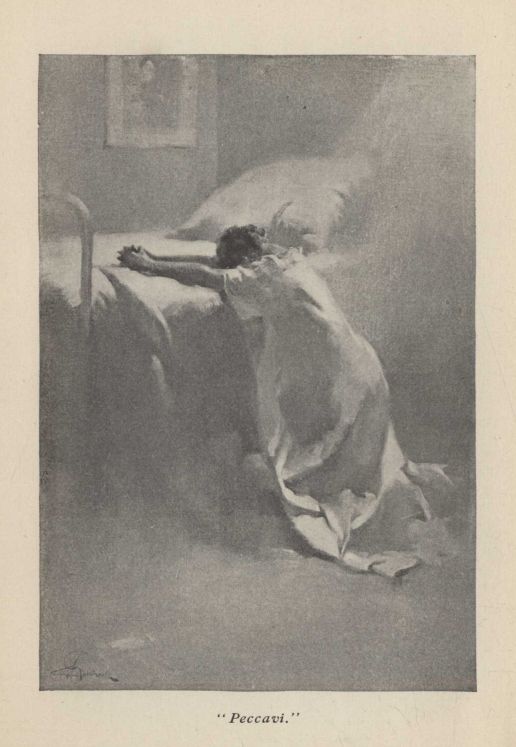
"Peccavi."
Rebellion
By
Joseph Medill Patterson
Author of "A Little Brother of the Rich," etc.
Illustrated by Walter Dean Goldbeck
Publishers The Reilly & Britton Co. Chicago
Copyright, 1911 by The Reilly & Britton Co.
All rights reserved
Entered At Stationers' Hall
First Printing, September 1911
REBELLION
Published October 2, 1911
Illustrations
"Peccavi" . . . . . . . . . Frontispiece
"He Doesn't Live Here Any More"
"Georgia Laughed"
Rebellion
List of Chapters
CHAPTER
I Jim Connor II One Flesh III An Economic Unit IV The Head of the House V For Idle Hands to Do VI Triangulation VII A Sentimental Journey VIII The Life Force IX The Pretenders X Moxey XI Fusion XII Moxey's Sister XIII Reenter Jim XIV The Palace of the Unborn XV Mr. Silverman XVI Georgia Leaves Home XVII The Light Flickers XVIII The Priest XIX Sacred Heart XX Surrender XXI Worship XXII Kansas City XXIII The Last of the Old Man XXIV The New King XXV Jim Reenlists XXVI Eve XXVII The Naphthaline River XXVIII Albert Talbot Connor XXIX The Doctor Talks XXX Frankland & Connor XXXI The Stodgy Man XXXII Rebellion XXXIII The Ape XXXIV Which Begins Another Story
NOTE
I wish to thank Mr. Francis Hackett for reading the unrevised proofs of this story. J. M. Patterson.
I JIM CONNOR
"Nope, promised to be home on time for supper."
"Get panned last night!"
"Yep."
The group of men turned to the clock which was ticking high up on the wall between the smudgy painting of Leda and The Swan and the framed group photograph of famous pugilists from Paddy Ryan to the present day.
"It's only nineteen past; plenty time for just one more."
Jim Connor compared his watch with the clock and found they tallied. The grave bartender took the dice and box from behind the cigar counter and courteously placed them upon the bar.
"Well," bargained Jim, "if it is just one more."
"J.O.M." they chorused, and the dice rolled upon the polished oak.
"What'll it be, gents?"
"Beer."
"Scotch high."
"Bourbon."
"A small beer, Jack."
"Beer."
"Yours, Jim?" prompted the watchful bartender.
"Well—I guess you can give me a cigar this time, Jack."
The practiced bartender, standing by his beer pump, slid the whisky glasses along the slippery counter with a delicate touch, as a skillful dealer distributes cards. He set out the red and smoky whiskies, the charged water, the tumbler, with its cube of ice; drew two glasses of beer, scraped the top foam into the copper runway, and almost simultaneously, as if he had four hands, laid three open cigar boxes before Jim, who selected a dark "Joe Tinker."
"Join us, Jack," invited the loser of the dice game, hospitably waving his hand. The efficient bartender drew a small half-glass of lithia for himself. Five feet rested upon the comfortable rail before the bar, there was the little pause imposed by etiquette, six glasses were raised to eye-level.
"Here's whatever."
"Happy days."
"S'looking at you," ran the murmur.
"The big fellow!" exclaimed one.
Chorus: "Yes, the big fellow!"
"I'll sure have to come in on that," said Jim, pressing between two shoulders to the bar. "A little bourbon, Jack," he asked briskly.
The other glasses were lowered until Jim also received his.
Then all were again raised to eye-level. Unanimously, "The big fellow!"
Heads were thrown back and each ego there, except the bartender, received a charming little thrill.
The beer men wandered to the back of the saloon and dipped into a large pink hemisphere of cheese. The whisky men suppressed coughs. Jim tipped his head back about five degrees and inquired, "Is the big fellow coming 'round to-night?"
"He's due," replied Jack, wiping his bar dry again.
"How's things looking to you?"
"We—ell, there's always a lot of knockers about."
"Yes, 'pikers' like Ben Birch and Coffey Neal, that line up with the big fellow for ten years and then throw him overnight because he won't let 'em name the alderman this time. And he always treated 'em right. Better than me. An' jou ever hear me kicking?"
"Nary once, Jim."
"That's because I am a white man with my friends. But these other Indians—well," said Jim earnestly, "God knows ingratitude gets my goat."
Jim Connor was a ward heeler and the big fellow was his ward boss. Jim was allowed to handle some of the money in his precinct at primaries and elections; he landed on the public pay-roll now and then; he was expected to attend funerals, bowling matches, saloons, picnics, cigar shops and secret society meetings throughout the year; his influence lay in his strength with the big fellow. Did a storekeeper want an awning over the sidewalk, or did he not want vigorous building inspection, if he lived in Jim's precinct, he told Jim, and Jim told the big fellow, and the big fellow told the alderman, and the alderman arranged it with his colleagues on a basis of friendship. In return, the storekeeper voted with the organization, which was the big fellow, who was thus enabled always to nominate and usually to elect candidates who would do what he told them. He told them to line up with the interests who had subscribed to the campaign fund—and he was the campaign fund. The entire process is pretty well known nowadays through the efforts of Mr. Lincoln Steffens and his associate muckrakers.
But there is no immediate cause for alarm; this is not a political novel.
The clock pointed nearly to seven and Jim, when he saw it, sighed. That meant unpleasantness. His supper certainly would be cold, but he wasn't thinking of that. He was thinking of his wife. She was sure to make him uncomfortable in some way or other, because he had broken his promise about being home on time. Probably she would be silent. If there was anything he hated, it was one of her silent spells. Just "No" and "Yes," and when he asked her what in hell was the matter, she would say "Nothing."
The trouble was, though, that he always knew what the matter was, even when she said "Nothing." What devil's power was there in wives, anyway, that enabled them to hurt by merely not speaking? He had tried silences on her a lot of times, but they never worked, not once. He liked the old days better, when she used to scold and plead and weep.
He remembered the first time he had come home drunk, half a dozen years ago, when he had barely turned from bridegroom to husband. She helped him that night to undress and to go to bed. And she had done other things for him, too, that even now he was ashamed to remember. And the next day she hadn't scolded once, but had fetched him a cup of coffee in bed as soon as he woke up. It surprised him; overwhelmed him. It had made him very humble. He had never been so repentant before or since.
She didn't reproach him that time—not a word. He didn't mean she had one of her silences—those didn't begin until much later; but she tried to talk about their usual affairs, as if nothing had happened. And everything had happened. They both knew that.
It wasn't until the next evening, thirty-six hours later, that he came home to find her a miserable heap upon the front room sofa, her face buried. He stood in the middle of the room looking at her helplessly, his words of greeting cut short. Every now and then her small shoulders heaved up and he heard her sob. She must have been crying a long time. He implored her, "Oh, don't, Georgia, don't; please don't; won't you please not?"
After a little while she stood up and put her arms about him and kissed him. He had never had such a feeling for her, it seemed to him, not even when they walked down the aisle together and she leaned on him so heavily. And then he kissed her solemnly, in a different way than ever before. He took the pledge that night, and he kept it, too, for a long time, nearly a year. That was the happy time of his life.
When he did begin again, it was gradually. She knew, after a time, he wasn't teetotal any more, and she didn't seem to mind so much. He remembered they talked about it. He explained that he could drink moderately, that she could trust him now, and mustn't ever be afraid of any more—accidents. And that very same night he came home drunk.
She cried again, but it wasn't as solemn and as terrible for either of them as the time before.
There had been other times since, many of them. And she had grown so cursedly contemptuous and cold. Well—he didn't know that it was altogether his fault. He had heard that alcoholism was a disease. But she had said it was a curable disease, and if he couldn't cure it, he had better die. His own wife had told him that. God knows he had tried to cure it. He had put every pound he had into the fight; not once, but a hundred times. He had gone to Father Hervey and taken the pledge last Easter Day, and—here he was with a whiskey glass in his hand.
He looked across into the high bar mirror. His eyes were yellow and his cheeks seemed to sag down. He put his hand to them to touch their flaccidity. His hair was thinning, there were red patches about his jaws where veins had broken, and his mouth seemed loose and ill-defined under the mustache which he wore to conceal it. He frowned fiercely, thrust his chin forward and gritted his teeth tightly to make of himself the reflection of a strong man—one who could domineer, like the big fellow. But it was no use—the mirror gave him back his lie.
The afternoon rush was over, the evening trade had not begun, and the saloon was empty, save for a group of scat-players at the farther end.
Jim's friends had gone, but he remained behind, in gloomy self-commiseration, his shoulders propped against the partition which marked off the cigar stand. He was thinking over his troubles, which was his commonest way of handling them.
Whoever it was that invented the saying, "Life is just one damned thing after another"—he knew, he knew. Jim had bought three or four post-cards variously framing the sentiment and placed them upon his bureau, side by side, for Georgia to see. It was his criticism of life.
You politicians and publicists, if you want to know what the public wants, linger at the rack in your corner drug store and look over the saws and sayings on the post-cards.
Jim hoped that the ones he had picked out would subtly convey to his wife that all were adrift together upon a most perplexing journey and that it ill-behooved any of them to—well there was a post-card poem that just about hit it off—and he put it on the bureau with the others:
"THERE IS SO MUCH BAD IN THE BEST OF US AND SO MUCH GOOD IN THE WORST OF US, THAT IT HARDLY BEHOOVES ANY OF US TO TALK ABOUT THE REST OF US."
But she hadn't taken the least notice. She didn't seem to understand him at all. Oh, well—women were light creatures of clothes and moods and two-edged swords for tongues—or deadly silence. What could they know about the deep springs of life—about how a man felt when in trouble?
Jim shifted his position slightly, for the hinge was beginning to trouble his shoulder blade, and fetched a sigh that was almost a moan. Such had been his life, merely that, and the future looked as bad or worse. The shilling bar grew a bit misty before him and he knew it wouldn't take much to make his eyes run over.
"Anything wrong, Jim?" inquired the sympathetic bartender.
"Just a little blue to-night, Jack, that's all."
"Sometimes I get into those spells myself. Hell, ain't they?"
Jim nodded. "I suppose they come from nervousness."
The bartender nodded back. "Or liver," said he, setting out the red bottle. "Have a smile."
"No, I don't want any more of that damned stuff. A man's a fool to let it get away with him, and sometimes I figure I better watch out—not but what I can't control myself, y'understand." There was the slightest interrogation in his tone.
"Sure y'can, Jim; I know that. Still," dubiously, "like you say, a fellow ought to watch out. It'll land the K.O. on the stoutest lad in shoes, if he keeps a-fightin' it."
"It's for use and not abuse. Ain't I right?"
The bartender conspicuously helped himself to a swallow of lithia. "Yep, sure," he said. "D'you know, Jim, I'm kind of sorry you didn't go home to supper to-night."
"So'm I, but I got to talking——"
"Why don't you go now?"
"Too blue, Jack, and home is fierce when I get there with a breath."
"Remember the time the little woman come here after you?"
"Oh, it's no use bringing that up now," said Jim sadly. "She liked me then. Give me a ginger ale."
Jim took his glass and sat alone at a round table by the wall, under the painting of Pasiphae and The Shower of Gold. This saloon, like many others, in Chicago, ran to classical subjects.
Jim relit his cigar and slowly turned the pages of a Fliegende Blätter, looking at the pictures and habitually picking out those letters in the text which resembled English letters. It was a frayed copy which had inhabited the saloon for many months, and showed it. Jim had thumbed it twenty times before, but he was doing it again to appease his subconsciousness, to give himself the appearance of activity of some sort.
But he was looking through the German pages to the years behind him. Politics—maybe that was the trouble. Politicians, at least little fellows like him, got more feathers than chicken out of it. If he hadn't quit that job with the railroad—but no, they were drivers, and there was no future in the railroad business for a fellow like him, a bookkeeper. He might have stayed there all his life and not thirty men in the entire offices have been the wiser, or have ever heard of him.
In fact, he had bettered himself by going with the publishing firm. He seemed to have prospects there. It wasn't his fault they blew up and he was out on the street again. That was how he got into politics—sort of drifted in after meeting the big fellow canvassing the saloons one night, when he, Jim, had nothing else to do.
The big fellow was so attractive, so sure of himself, and Jim would have seemed a fool if he had refused the offer to clerk in an election precinct that fall. There was a little money in it, and a little importance.
The big fellow had asked him to please see what he could do for the ticket that fall, and of course he had. It was agreeable to be consulted by the famous Ed Miles about plans and all that. He had never been consulted in the railroad office, or even by those publishers.
After election, without solicitation, Miles had Jim appointed a deputy sheriff for the State of Illinois, County of Cook, ss. Of course, he took it. There was nothing else in sight just then. The pay was fair, the hours good, and besides, there was no time-clock to punch and no superintendent always hovering about.
After a time the big fellow told Jim pleasantly, but firmly, that his job had to be passed around to some of the other boys, and Jim resigned. But the big fellow let it be known that Jim was still a trusted scout. That was an asset. The landlord knocked something off the rent of his flat, the street car company gave him a book of tickets, one of the bill-board companies sent him a nice check for Christmas; but he had done some rather particular work for them. He had respectable charge accounts in several places and wasn't pressed.
But, after all, one cannot get rich on that sort of thing; so when the child died, his wife went back downtown as a stenographer in a life insurance office. She had been a stenographer before their marriage.
II ONE FLESH
The short swinging doors opened briskly and five tall men entered quietly. Jim tipped his chair forward upon its four legs. The scat game delayed itself.
The five lined up at the bar. "Beer," said the one with the boiled shirt. The skillful bartender drew five glasses of foam.
Jim sat still in his chair, hesitating to glance even obliquely toward the proceedings. What was one against five?
The tall man with the boiled shirt pointed to his glass, but did not touch it. Nor did any of his companions touch theirs. The saloon knighthood has not abandoned symbolism.
"Does that go?"
"It goes, Coffey Neal."
"And we don't get a lithograph in the front window?"
"You don't."
The five men withdrew a little for conference. Then Coffey Neal paid his reckoning with a quarter and a nickel.
The bartender rang up twenty-five cents on the register. Neal pointed to the five-cent piece upon the bar.
"That's for yourself, Jack."
The sardonic bartender placed it between his teeth. "It's phony," said he. "Take it back and put it in your campaign fund." He smiled, keeping his right hand below the bar.
"After election," Coffey Neal remarked through his nose, "your old man (he meant Jack's father-in-law) can't sell this place for the fixtures in it."
Jack concealed a yawn with his left hand.
"You're the twenty-second wop since the first of the year was going to put us out of business, and we're signing a lease for our new place next Monday. It's where your brother used to be located."
One of the enemy, a stocky fellow with a brakeman's black shirt, was constructing sandwiches of sliced bologna and rye at the lunch counter.
"I know you're not eating much lately, old boy, since you begun stringing with Coffey," smiled Jack from the corner of his mouth, "but those is for our customers."
Blackshirt turned quickly about, sweeping the pink hemisphere of cheese upon the floor and shivering it.
"Oh, dreadful!" he protested, falsetto. "My word, how sad!"
He trod some of the cheese into the sawdust. "Mr. Barman, ah, Mr. Barman, you may charge the damages to me—at the Blackstone."
There was a roar of laughter from the others. It looked like rough-housing, and damage to fixtures. The scat players had vanished, in their naïve Teutonic way, through the side door. Jack began to hope he wouldn't have to draw, for a shooting always black-eyes a saloon's good name and quiet scat custom shies at it.
Neal delivered Jim a tremendous thump on the shoulder. "Why, if it isn't my dear old college chump." Another thump. "Maybe you can buy us a drink with the collar off." A third thump.
"Now, can the comedy stuff, Coffey," Jim snarled, smilingly. If only he could steer Coffey away from the fight he seemed bent on picking. "I'll buy—sure. Why not?"
"Then you'll go across the street to do it," Jack inserted. "This ain't a barrel house."
Neal seized Jim's ear and lifted him to his feet. "You'll buy here, and now." Three of the men gathered about Jim. The other two, standing well apart, were watching Jack. There would be three pistols out, or none.
Jim was being slowly propelled to the bar, when the straw doors swung briskly and the big fellow entered. His shoulders, hands, legs and jaw were thick, and his eyes were amazingly alert.
Unspeakable peace spread through Jim. He knew that somehow or other the big fellow was going to get him out of this.
Indeed, that was what the boss had come for. News of the foray on this citadel of his had been grapevined to him up the block and around a corner.
He sized up the situation very quickly. There was Coffey Neal, the trouble-maker, the Judas who had refused to take his orders any longer. He was the one to be done for. The other four were merely Hessians, torsos, not headpieces. They slugged for a living, on either side of industrial disputes, according to the price—sometimes on both sides in the same strike.
"Have a drink, boys," said the great Ed Miles.
It surprised every man in the room. Jim's heart sank down again. Could it be that the big fellow was going to take water? Then it was the end of his reign and the end of Jim's days at court. There was a pause, a whispering. Ed, standing sidewise to the bar, held his open right hand, palm upwards, behind his coat so that only Jack could see it.
"And what if we wouldn't!" Coffey spoke with slow bravado.
"This." The big fellow flashed at him, and dropped the bung-starter heavily behind his ear. Coffey crumpled upon the floor. The sluggers hesitated half a second, then piled on Ed so quickly that Jack didn't dare use his gun. Instead, he ran around the bar and twisted his arm under the chin of blackshirt, pulling him away from the heap. He thrust him up in the air, using his own knee for a lever, then dropped him heavily on his back on the floor and kicked his head. There was no time for niceties.
Meanwhile, Jim had taken futile hold of another slugger's foot, who easily shook him off. He was cautiously planning for another hold—very cautiously indeed, not being anxious to become too completely immersed in the proceedings, when all at once the place became full of people.
Strong and willing arms eagerly and quickly unraveled the tangle.
"This is a hell of a game for eight o'clock in the evenin'." It was the bass voice of public peace. "Oh!" concernedly, "is it you, Mr. Miles? Are you hurted?"
The big fellow felt his shaven skull where, in the melee, a brass knuckle had struck him a glancing blow. He looked at his red fingers. "Just a scrape, Sarje, not cracked," he laughed.
"What's the charge?" asked the detective sergeant, solicitously.
"Tell 'em the facts," enjoined the big fellow.
"Well," began the efficient bartender, "Mr. Miles and me was talking quietly together here; he was standing just there with his back to the door, and I heard an awful yelling going up and down in the street. I knew it was Coffey Neal, hunting trouble, and drunk. They come in the cigar stand, swearing and cursing, saying they were looking for Ed Miles—to cut his heart out. But Ed says to me he didn't want any trouble in the place, so's he'd walk out, and he started out the side door, when Coffey and this blackshirt fellow come running in and threw that bowl of cheese at him—see it there—and jumped him. Then these other bad actors began kicking him, too, and I went in to separate 'em—and I guess that's all. Lucky you came in or there might have been trouble."
"What charge will I put agin 'em?"
"Drunk and disorderly; assault; assault and battery; assault with intent to kill; unprovoked assault; mayhem; assault with a deadly weapon—and I guess they ain't got no visible means of support," suggested the big fellow. "Oh! yes, and conspiracy."
"Let it go at that," said Jack.
The sergeant wrote it down. The sluggers were silent. The case had become one for lawyers' fees. Their own talking couldn't do any good.
"Any witnesses?" asked the sergeant.
"Me," said Jim. "It was the way Jack says."
"Put 'em in the wagon," commanded law and order.
Coffey Neal was picking up his threads again at the place he had dropped them.
"And what if we won't drink with you, Ed Miles!" he muttered, somewhat scattered.
"Likely the Bridewell, Coffey," laughed the big fellow.
The vanquished were escorted out into the night.
The victor and his vassals, perhaps a dozen of them by this time, remained in possession of the field.
"Good thing I had those coppers planted before I started anything," commented the big fellow. "Those strong-arm guys like to got me going at the end."
"They certainly handled themselves very useful," Jack acknowledged.
"They gotta be with us after this, or get out of town." The big fellow turned suddenly on Jim. "And you, you yellow pup," he roared, seizing him by the collar, "what were you doing while they was pounding me up? D'you think you were at a ball game, hey?" He shook him back and forth until his jaws cracked.
"I—I was trying—I got one of 'em by the leg, and he——"
"Yes, like you'd pick flowers in the spring—sweet and pretty—that's the way you grabbed his leg." He lifted Jim from the ground and flung him on the floor. "Yellow pup!" he repeated passionately, over and over again.
Jim raised himself to his elbow, but did not dare to go further. The big fellow's eyes were still blazing.
"Honest, Ed, I was trying to help."
Miles took a step toward him. "You're a G—d d—d liar!" he shouted.
Jim tried to meet his look. It was a wretched business to be called that name before a dozen others—it had happened to him before, but he always hated it. Still the big fellow seemed especially vicious and dangerous just now; Jim knew how senseless it was to cross him when he was having one of his spells, and besides, they never lasted long, anyway. Jim dropped his eyes again, acknowledging the justice of the discipline.
Miles threw a ten-dollar bill on the bar and broke the tension with a jolly laugh. "Well, I guess we've put Coffey Neal out o' this primary," said he. "Plunge in, lads." Jack served each man, but nothing for Jim. The code provided for a final display of magnanimity by the fountainhead. "Come ahead, Jim," he growled, kindly.
Serenity unfolded again her frightened wings and the smoke of peace increased and multiplied over a leader fitted to lead and followers fitted to follow.
The ensuing celebration spread itself over many hours and into many taverns. There was some agreeable close harmony, to which Jim joined a pleasant baritone, and much revilement of all double-crossers, from Judas and Benedict Arnold down to Coffey Neal, and a certain Irish party whose name now escapes me, but who grievously misbehaved himself during a Fenian incident.
Very frequently they reached the shank of the evening—as often, indeed, as anybody wanted to go home. And in the big fellow's mouth the shank was ever a cogent argument.
Eventually the ultimate question as to their further destination was put, and here the big fellow stood aside, permitting perfect latitude of decision. He was a politician and he knew that he could not possibly afford to have it said by the wives of the ward that he influenced their husbands toward sin. He could afford to have almost everything else said about him, but not that.
Jim wavered, then resisted temptation. His record in that particular respect had been almost absolutely clean.
He walked home stiffly, fighting with the skill of the practiced alcoholic for the upright position and the shortest distance between two points.
His early morbidity had vanished. If he had done one thing badly that evening, he had done another thing well. Whatever his wife, Georgia, might urge against him in regard to his conviviality, wasn't he, after all, one of the most faithful husbands he knew? For all her superior airs, she had much to be grateful for in him.
He entered his flat with little scraping of the keyhole, and cautiously undressed in the front room. It was late—much later than he had hoped for. He could just make out the hands of the clock on the mantelpiece by the light from the street lamp.
He opened the door to their bedroom so slowly, so slowly and steadily, and then—as usual, that cursed hinge betrayed him. The number of times he had determined to oil it—yet he always forgot to. To-morrow he wouldn't forget—that was his flaming purpose.
Psychological flux and flow may be deduced from door hinges as well as from the second cup of coffee for breakfast or the plaintive lady standing immediately before your hard-won seat in the street car. Jim would never oil the hinge in the morning, because that would somehow imply he expected to come in very late again at night, and he never expected to—in the morning.
But her breathing remained regular, absolutely regular; he had this time escaped the snare of the hinge.
The gas jet burned in a tiny flame. She had fallen into the habit of keeping a night-light during the past three or four years. At first he had objected that it interfered with his sleep, but she had been singularly persistent about it. She hadn't given him her reasons; indeed, she had never analyzed them. It was nothing but a bit of preposterous feminism, which she kept to herself, that the light made a third in their room.
She lay with her back to him, far over on her side of the bed. He could see where her hip rose, and vaguely through the covering the outline of her limbs. Her shoulders were crumpled forward, and the upper one responded to her breathing, and marked it. Under her arm, crossed in front of her, he knew was the swelling of her breast.
And then at the neck was the place where the hair was parted and braided, the braids wound forward about her eyes—a very peculiar way to treat one's hair.
What a different thing a woman was! He had seen her lying so countless times, and yet the strangeness had never worn off. Indeed, curiously enough, there seemed even more of it now than when they had just married, and she was entirely new.
He often thought a woman didn't seem exactly a person—that is, not like him, and he was certainly a person—but something else; just as good, perhaps, but quite other. Her body, of course—well, agreeable as it might be, still he was glad he wasn't made that way, for it seemed so ineffective.
And one of them could stand a good man on his head. He simply couldn't get the hang of that. If a man was angry and sulked, he didn't mind. In fact, he preferred it to being knocked about as the big fellow sometimes did to him. He had never cared what man sulked, his brother or father or any of them.
And yet this woman, she——he looked at her intently, earnestly, as if finally to solve her—she was very beautiful. And she was his wife.
He crept into bed, very softly, for she might wake up. But then, it briefly occurred to him, what if she did! He was perfectly sober—at least to all intents and purposes. He could talk perfectly straight; he felt sure of that.
Perhaps she would now wake of her own accord. That would be the best solution, and then he could appear drowsy, as if he, too, had just been aroused from sleep.
He sighed loudly and turned himself over in the bed, but she gave no sign.
"Georgia," he whispered very low.
Pause.
"Georgia," a little louder, "are you awake?"
No answer.
He touched her, as if carelessly. She stirred. Ah, she would—no, her breathing was markedly the breathing of slumber. Perhaps she was pretending. Oh, well, what was the use of his trying, if she was going to act so?
He turned noisily back to his side of the bed. He was disappointed in her. Was it fair of her to pretend—if she was pretending? After all, she was his wife.
A husband has his rights. That was what the church said. Otherwise, what was the use of getting married and supporting a woman—well, most men supported their wives, and he intended to do so again soon, very soon.
Yes, he had the teachings on his side. He wanted nothing beyond the bond. It was holy wedlock, wasn't it?
He placed his hand upon her waist. And yet she would give no sign. More resolutely than before she counterfeited the presentment of sleep.
"Georgia!" he spoke aloud.
"What is it!" she said, quickly, sitting up, her black braids falling back on her slim shoulders.
"I just wanted to say good night," he muttered, huskily.
"Good night," she answered, curtly. "Please don't disturb me again. I am very tired."
She was turning from him, when he placed his hand on her shoulder.
"Georgia, I love you. You know I do."
The foulness of his poisoned breath filled her with loathing.
"No, Jim," she gasped, afraid. "Oh, no!"
"Georgia, you dunno how I love you," he pleaded, almost tearfully, taking her in his arms.
Quickly she jumped from the bed. "Where are you going?" asked the annoyed husband.
"I can't sleep here, Jim; I can't." She took up her underskirt and her thin flannel dressing sack and passed from the room. She made her couch on the lounge in the front room and after a time fell asleep.
Jim twitched with nightmare throughout the night, and long after she had gone downtown in the morning.
III AN ECONOMIC UNIT
Georgia's desk was in a rectangular room which was over one hundred feet long and half as wide. There was light on three sides. Near the ceiling was a series of little gratings, each with a small silkoline American flag in front of it. These flags were constantly fluttering, indicating forced ventilation; so that although the desks were near together and the place contained its full complement of busy people, there was plenty of oxygen for them.
This arrangement was designed primarily for economic rather than philanthropic purposes. The increased average output of work due to the fresh air yielded a satisfactory interest on the cost of the ventilating apparatus; and, besides, it impressed customers favorably and had a tendency to hold employes. The office dealt in life insurance.
The desks were mounted on castors so that they could be wheeled out of the way at night while the tiled floor was being washed down with hose and long-handled mops and brooms and sometimes sand, as sailors holystone a deck. Much of the hands-and-knees scrubbing was in this way done away with.
Rubber disks hinged against the desks and set to the floor held them in place during working hours. Narrow black right-angular marks showed where each desk belonged and to what point, exactly, it must be moved back when the nightly cleaning was finished.
These details were all of profound interest to Georgia, for her desk was the most important thing in the world to her at this time in her life.
She delighted in neatness, order, precision, in the adjustment of the means to the end. Every morning just before nine, she punched the clock, which gave her a professional feeling; and hung her hat and jacket in locker 31, which seemed to her a better, a more self-respecting place for them to be than her small, untidy bedroom closet, all littered up with so many things—hers and Jim's.
Her mother, who kept house for them, was a good deal at loose ends, in Georgia's opinion. And it didn't seem quite the decent thing that a woman who had nothing else in the world to do should fail to keep a six-room flat in order. Of course her mother was getting a little old, but hardly too old to do that.
Georgia had lately had a trial promotion to "take" the general agent's letters—the previous functionary, a tall blonde girl, having married very well.
It was the first stenographic position in the office and carried the best salary, so there was a good deal of human jealousy about it—much the same sort as freshmen feel who are out for the class eleven.
Georgia had tried her hardest for five days. She had stayed overtime to rewrite whole pages for the sake of a single omitted letter; she had bought half a dozen severely plain shirt waists, and yielded up her puffs. Everyone knew how the old man hated the first sign of nonsense.
But in spite of all that the day before he had called in Miss Gerson to take his dictation.
Well—it was pretty hard, but she had done her best. And she was a better workman than Miss Gerson, she would stick to that. Only yesterday she had seen Miss G. twice hunting in a pocket dictionary hidden in her lap—and she never had to do that, practically.
Life was just one damn thing after another, as Jim was always complaining—only he could never possibly have apprehended the full truth and implication of that saying—in spite of its rather common way of putting it. She knew that he never saw deeply, really fundamentally into the dreadful mystery of being here; he couldn't for he was coarse and masculine and he drank.
Her fingers were working rapidly casting up purple letter after purple letter before her eyes, but the physiologists tell us that she was using only the front part of her brain for it. The rest of it was free to contemplate the Ultimate Purpose, or gross favoritism in the office especially in relation to Miss Gerson, or whether an ice cream soda was a silly thing to have before lunch, as she knew it was, but then one had to have some pleasure.
Rat-tat-tat-tat went the keys; ding, there was her bell. Ten letters more on this line said the front part of her brain. One thing she was sure of, said the back, she devoutly hoped her young brother Al wouldn't develop into a mere white-collared clerk—though of course she certainly wanted him to be always a gentleman. She slid her carriage for the new line.
Rat-tat-tat-tat—and again, ding. There, the end of the page. Single space and not an error. She would like to see Miss Gerson do that at her speed.
The shuffle of the old man's office boy sounded behind her. Now, wait—what would to-day's verdict be? Would he pass or stop?
"Miss Connor," a-a-ah—"the old man wants you to take some letters." (Georgia had let them suppose she was unmarried.)
The benison of perfect peace now enfolded her.
Poor little Miss Gerson—well, after all, life is a game, the loser pays, and the winner can be perfectly philosophical about it.
Georgia went to the old man's private office and closed the door behind her.
"Yes, sir." She stood at attention, pad and pencil ready.
"Will you take these please, Miss Connor? Mr. James Serviss—here's his address," the old man tossed the letter he was answering over to her. "Dear Sir: Replying to yours of the 16th inst, we regret that——. Well, tell him it's impossible. Write the letter yourself. You understand!" He was observing her as if to probe her resourcefulness.
"Perfectly, sir."
"Miss Belmont saved me a great deal of trouble in that way. She could tell what I would want to say." Miss Belmont was the blonde girl who had married and left a vacancy.
"I can do the same, sir."
"Well, here are some more," continued the old man. "This—No." He tossed another letter to her. She made a shorthand notation in the corner of it. "This—By all means,—and be polite about it. This—An appointment to-morrow afternoon."
"Yes, sir."
"This—Routine. And these—Send them to the proper departments." More notations.
"Yes, sir."
"You can start on those. Bring them in when they're ready."
"Yes, sir." Exit Georgia.
She summoned the deeper layers of her vitality, settled to her work and her fingers flew. She knew the joy—if joy it be—of creation.
Quietly she slipped back into the old man's office, without knocking. His secretary had entrance except at such times as he shut his telephone off.
She seemed very slim and neat, and calm and steady—almost prim, perhaps, as she stood with pen and blotter in her hand to take the old man's signatures.
But her being surged within her like that of a mother who waits to hear if her boy is to be expelled from school or forgiven.
The old man had been going over a campaign plan for business with one of his quickest witted solicitors, and after Georgia had waited standing for a few moments, dismissed him with, "Yes, that's the right line, Stevens. Just keep plugging along it."
As Stevens passed her on his way out he bowed slightly. He had been doing that for some time now, though he had not yet spoken to her.
Stevens was still under thirty, she concluded, though she had heard he had been with the company for ten years. A silent, sharp-featured, tall young fellow with chilly blue eyes, who had the name in the office of keeping himself to himself and being all business.
The old man, having glanced over and signed the letters, passed his verdict on her work—"Hmm, hmm, Miss Connor, you may move your things to Miss Belmont's desk. And here's a note——"
When an author conquers a stage manager; or Atchison rises 4% the very next day; or the Cubs bat it out in the tenth on a darkening September afternoon; when on the third and last trial, it's a boy; or when Handsome Harry Matinee returns you his curled likeness signed; or you first sip Mai Wein, you know what it is to move your things to Miss Belmont's desk.
"And here's a note," continued the old man, without the gap which we have made to put in analogues, "to Mr. Edward Miles—I'd better dictate this one myself—'Dear Mr. Miles: I should be happy to have you call—' No, strike that out. 'In response to your letter of even date, I should be glad to see you at any time that suits you, here in my office—' no, make it three o'clock to-morrow afternoon—'to confer over the subject of the Senatorial campaign in your district.' Read what you've got."
Georgia did so.
The old man changed his eyeglasses. "Maybe you'd better telephone him instead," he said. "It's Ed Miles, the politician. You can probably locate him at——"
"Yes, sir, I know," suggested Georgia.
"And get Mr. Somers on the phone—Mr. Somers does some of our legal work——"
"Yes, sir."
"And ask him to be here at the same time. Make a note of it on my list of appointments."
"Yes, sir."
"Tell him Miles is coming, and to get up a little résumé for me of the situation in those districts over there, and ah—perhaps an estimate in a general way of what we ought to do for, ah—Mr. Miles. You will indicate that to him."
"Yes, sir."
"Well, telephone him that." Georgia rose and went to the door. "Ah—Miss Connor——" She turned and looked at her employer, her head tilted forward, with a peculiar open-eyed, steady little stare, which was a trick of hers when wholly interested.
"Did I indicate to you," said he, "that you are my private secretary now?"
"I understand, sir. Thank you."
IV THE HEAD OF THE HOUSE
Each morning as Georgia entered the elevated train and spread open her paper, she cast off the centuries, being transformed from a housewife to a "modern economic unit."
She smiled at the morning cartoon or perhaps, in the celebrated phrase of Dr. Hackett, she sighed softly for the sake of its meticulous futility. Her penny to the news stand gave her full and free franchise upon the ever anxious question of the popularity of popular art. Other Georgias of Chicago were simultaneously passing like judgments in like elevated cars and the sum of their verdicts would ultimately readjust social distinctions in Cook and Lake counties, Illinois.
She always turned to the Insurance Notes next. It was her Duty to be Well-informed and Interested in the Success of Her Employer, for His Success was Hers. She hadn't been to business college for eight weeks not to know that.
Next a peek at Marion Jean Delorme's column of heart throbs, which she frankly regarded as dissipation, because she enjoyed it, and everybody who read it called it common.
By this time, home and its squabbling; its everlasting question of how far a pay envelope can stretch; her sullen contemplation of Jim's alcoholism; and irritability at her mother's pottering way had vanished into the background of her mind, where they slept through her working day.
She engaged herself with more appealing problems and a larger world. She deplored the litter of torn-up streets and the thunder of the loop, instead of the litter of the breakfast dishes and the squeak of the hinge. Not that clean dishes are less meritorious than clean streets, but, to such minds as hers had grown to be, less captivating. To change desks downtown was more fun than to change chairs at home.
She felt her solidarity with the other people who streamed into the business district at eight forty-five, to get money by writing or talking. It was the master's end of the game and she belonged to it. Outside-the-loop worked with its arms and hands—she worked merely with her fingers. The time might come when she would need to work only with her tongue—and triple her income. She was in line for that.
She was no mean citizen of no mean city throughout the day: at the lunch club where she coöperated; in the big white-tiled vestibule of her building where she exchanged ten words of weather prophecy with the elevator starter between clicks; in the rest room where they talked office politics, and shows, and woman suffrage, as well as beaux and hats; behind her machine which rattled "twenty dollars a week by your own ten fingers and no man's gratuity."
There were no oaths, no bonds unbreakable, no church to tell her she couldn't change her job, as it tells the housed and covered women who get their bread by wifehood.
If she didn't like the temperature of the room, or the size of her employer's ears, she could walk across the street and do as well—perhaps better.
If he had sworn at her, or come ugly drunk into her presence—but that was inconceivable. Employers didn't do that, only husbands, because they knew they had you.
It was the full life and the free life which she lived, she and her sisters of the skyscrapers. It was the emancipation of woman, and the curse of Eve was lifted from them.
But the tide of her being which flowed regularly each work-morning, ebbed regularly each night. Her horizon became smaller and less bold after she had slid her nickel over the glass to the spectacled cashier in the L cage and was herded for home on the jammed platform. Her boldness continuously diminished as station after station was called and she stood to her strap, glancing from the direct imperatives, "Uneeda Union Suit and We Can Prove It," "Hasten to the House of Hoopelheimer," "Smart Set Collars for Swell Spenders," "Blemishes Blasted by Blackfeeto," to the limp, sallow people who, like herself, had left their vitality downtown.
When she pushed away from the light of her home station into the gloom and up the ineffectually lighted street between rows upon rows of three and four story flats, her head slightly bent, scurrying along with the working woman's nightfall pace, like Lucifer, she felt the mighty distance. She had shrunk into a middle-class wife who had been a poor picker.
So it usually happened. But the day of her triumph over Miss Gerson was an exception, and the corona of the office extended and enveloped her through the rows of flat buildings and up two flights of stairs to the door of her own apartment.
She entered happily, gaily. And there was Jim sprawled in one chair, his dusty boots in another, without a coat to hide his soiled shirt sleeves, without a collar to apologize for his unshaven chin, a frazzled cigar between his fingers and a heap of ashes beside him where he had let them fall upon the carpet—her carpet that she had earned and paid for.
Ashes had fallen, too, upon his protruding abdomen. He breathed very heavily, almost wheezed. He looked up to speak. His eyes were rather swinish in recovery from debauch. His teeth were bad and the gap which had come under the cut lip was not a scar of honor. She hoped he wouldn't speak—but of course he did.
"Hello, Georgia."
"Hello," she answered mechanically.
"What you been doing?"
What a stupid question. What did he suppose she had been doing? For when a husband doesn't suit, he doesn't suit at all—his very attempts at peacemaking become an offense in him.
"Working," she said curtly and passed on to their bedroom.
"Oh, hell! cut out the everlasting grouch," he called after her, and went to the window and looked out, kneeling moodily on the window seat. He was Henpecko the Monk, all right. What she needed was a firm hand. Women took all the rope you gave them—they took advantage of you. He ought to have begun long ago to shut down on her nonsense. Other husbands did, and by God, he would begin. Then he rubbed his prickly chin and smiled ruefully. For hadn't he begun a great many times and had he ever been able to finish?
Besides, he was broke, and it was strictly necessary, most unfortunately in view of his present disfavor, for him to obtain a loan.
Maybe Al would help him out and he wouldn't have to ask Georgia. There was an idea. It was more dignified, too.
He didn't know whether Al had come in yet.
He himself had occupied a twenty-five cent seat that afternoon near Mr. Frank Schulte, most graceful of Cubs, to get a little fresh air. It did a fellow good and took his mind off home, which a fellow had to do now and then if he was going to stand it at all.
On the return trip, to be sure, he had suffered from a twinge of fans' conscience as he realized that his activities of the day had taken about fifty cents out instead of putting any cents in. A rather keen twinge, too, inasmuch as Matty had been strictly "right." There is no fun in giving up half a dollar to see the Cubs vivisected.
"Oh, Al," he called to the back of the flat.
"What?" came the call back.
"Hear about the game?"
"Nope."
"I was out," said Jim.
That ought to fetch him—and it did.
Al entered expectant. He was an extremely good-looking boy of sixteen, with pink cheeks, clear blue eyes, and a kink to his hair. He might have been called pretty if his shoulders were not quite so broad.
"Who win? I was north on an errand late and couldn't get a peek at an extra after the fifth." So Al apologized to his brother-in-law for his ignorance. "It was one and one then."
"The Giants win, three to two, and believe me there was a rank decision at the plate against Johnny Evers. He beefed on it proper and got chased. That's what smeared us."
"Johnny ought to learn to control himself," said Al pathetically.
"Yep. He's got too much pep—that's what's the matter with that lad."
"And all the umpires in the league have banded together against him. I heard it straight to-day. And believe me"—there was an element of mystery in the boy's voice, "there's something in it."
Jim clenched his fist and brought it down hard. "If the Cubs win out against the empires this year," he stated his proposition with a vehement brandish of his fist, "they'll be going some," but his peroration rather flattened out—"believe me."
"Yes, sir, Jim. That's no damn lie."
"Say, Al, loan me a quarter?"
Unhappy pause.
All sportsmen, from polo players and tarpon fishers to Kaffirs in their kraals, like to talk it over afterwards. Al didn't want to interrupt his baseball palaver with Jim. It might last right through supper and until bedtime, as it often did when Jim stayed home.
He had a vast fund of hypotheses to tell Jim again, and some new ones. If he refused Jim the loan their interesting talk would stop. But if he granted it he would be a boob. It was certainly one dilemma.
Jim smiled and repeated his thought. "I'll do as much for you some time. Go on now."
Georgia came in quickly and angrily. "I should think you'd be ashamed, Jim Connor, trying to do a boy."
"Oh, so you've been rubbering, eh?" Jim sneered.
She had; but this, her weakness, was one she shared with many other women—likewise men. In petty lives are petty deeds. Downtown she did not listen, or tattle, or read other people's letters. There were more important matters to attend to.
"I got to have a little loan," said Jim—now was his time for boldness—"to tide me over till Monday."
She was obstinately mute.
"Let me have a two-dollar bill till then?"
"No."
"One?"
"No."
"What then?"
"Nothing."
"You didn't use to be such a tightwad."
"You taught me that, too, Jim. I'll never give you another cent to drink. It isn't fair to the rest of us."
Mrs. Talbot, Georgia's mother, the homebody of the household, came in from the kitchen to say that supper was now ready and she was sick and tired of the irregularity of the family meals, which she had never been accustomed to as a girl.
"Oh, cheer up, mother. I've good news to-day—a raise."
Georgia took her pay envelope from her handbag. "See!"
Mrs. Talbot flattened out the creases in it and read it aloud. "Georgia Connor—weekly—twenty dollars." And drew forth a wonderful, round, golden double eagle. Whereupon Jim let his angry passions rise.
His wife—this cold-blooded, high-and-mighty creature, with her chin in the air, refused him a loan on the very same day she was raised. It was plain viciousness. It was almost a form of perversion. Forbearance, even his, had its limits.
"Why, Georgia," continued the mother, reading the inscription from the envelope in her hand, "how's this, they call you 'Miss,' Miss Georgia Connor—weekly—twenty dollars."
"Oh—ho," exclaimed Jim roughly, for now he felt that it was his turn. "Passing yourself off as unmarried, eh? A little fly work—hey? If I am easy, I draw the line somewhere."
"I was ashamed to let them know I was married and still had to work out," she responded evenly.
That was just the way it always happened. Georgia invariably ended up with the best of it.
"Well, well, let it pass, though it's not right. But you ought to let me have a dollar or two, considering. Why, I've got a right to some of your money. You've had plenty of mine in your time."
"For value received."
"You talk of marriage as if it was bargain and sale."
Georgia's voice, which had been thin and colorless, grew suddenly thick with the bitter memories of seven years. "It is oftentimes," she said. "Bad bargain and cheap sale."
"And now and then it's a damned high buy, too, when a man gives up his liberty for a daily panning from his wife, and his mother-in-law, and kid brother."
"If I am a kid," the boy interrupted passionately, "I've brought in more and taken out less than you the last year."
Blood called to blood, and the clan of Talbot closed around the lone Connor.
"When he had to come out of school and go to work because you couldn't keep a job!" screamed the elder lady.
"You big stiff," Al brought up the reënforcement half-crying with rage.
"You shut up or I'll—" Jim answered hoarsely, drawing back his fist in menace.
Al jumped for a light chair and swung it just off the ground, meeting the challenge. So standing, the two glowered at each other—Jim wishing that he was twenty years younger, Al that he was three years older.
As Georgia stood back from them hoping that she would not have to interpose physically between the two, as had happened once or twice in the past year, she felt more intensely than she ever had before that her home life was very sordid and degrading to her. This eternal jangling which seemed to run on just the same whether she took part in it or not, was the life for snarling hyenas, not for a young woman with an ambition for "getting on," for rising in the social scale.
The two males, finally impelled by a common doubt of the outcome, tacitly agreed upon verbal rather than physical violence. The raucous quarrel broke out anew. Mrs. Talbot—but you, gentle reader, undoubtedly can surmise substantially what followed. You must have friends who have family quarrels.
Finally there was a lull, after all three had had their says several times over, and were trying to think up new ones.
"Jim," said Georgia slowly and deliberately, for she felt that the hour had come, "why not make this our last quarrel?"
"That's up to you," he returned belligerently.
"By making it permanent."
"What do you mean!" answered Jim, now a trifle alarmed.
"I mean that the time has come for us to separate, for the good of all of us."
She looked straight at him, until he dropped his red and watery eyes before her strong gray ones. There was a pause, a solemn pause in that poor family.
"Children," said the older woman softly and timidly, "there is such a thing as carrying bitter words too far."
"Mother, when two people come to the situation we're in, Jim and I," for the first time there was a semblance of sympathy for the man in her voice, "then I believe the only thing they can do, and stay decent, is to separate. To go on living together when they neither like nor love each other——"
"How do you know? I never said that," Jim said humbly.
"It is not what you say that counts. We don't love each other any more; that was over long ago; that's the whole trouble; that's why we quarrel; that's why you drink and I'm hateful to you—and it'll get worse and worse and more degrading if we keep on. Oh, I feel no better than a woman of the streets when I——"
"Georgia," Mrs. Talbot raised her eyes significantly, glancing at Al, to warn her daughter against letting her son know a truth.
"Oh, I have been thinking this over and over—for months," continued the wife, "and I kept putting it off. But now I'm glad I said it and it's done."
"The church admits of only one ground for this," said Mrs. Talbot desperately, fighting for respectability; "do you mean that Jim has——"
"I don't know——"
"No," Jim denied indignantly, "you can't accuse me of that anyway."
"And I don't care."
"You don't care?" That was a most astounding remark, clear outside his calculations. Why—wives always cared tremendously. Every man knew that.
"No, if need be I could forgive an act, but not a state of mind."
Mrs. Talbot found herself literally forced to take sides with Jim. This was an attack on all tradition, on everything that she had been taught. "Why, I never heard of such talk in my life."
But Georgia would not qualify. "Well, I think that's all." She walked to the door. "I suppose I have seemed very hard, but it was best to make the cut sharp and clean." There was no sign of relenting in the set of her mouth or in her narrowed eyes; and Jim knew it was nearly impossible to do anything with her when her nostrils grew wide like that.
"All right," he mumbled, "have it your own way."
"Try to brace up for your own sake, if you wouldn't for mine." That was her good-bye. She went from the room with Al.
The mother waited behind. "She'll think better of this by and by, Jim. I'll speak to her about it now and then," she said, "and keep you in her mind. And I'm going to the priest about it, too. It's sin she's doing. And Jim——"
"Yes?" he grieved humbly, almost crying.
"You better go over to Father Hervey and tell him all about it."
"Yes, I'll do that same."
"Well, good-bye for now—you better go to some hotel to-night," she gave him a dollar from the purse in her bosom, "and try and get work. It'll make your coming back easier."
"Thanks, mother, I'll do that same. Er—I guess I'll go in and change my collar. That'll be all right, won't it?"
"Yes, Georgia's in the dining room."
Mrs. Talbot left him. He rubbed his knuckles slowly across his eye, his breath catching quickly. Then he spied Georgia's hand bag. There was the trouble-money—twenty dollars, a round, golden double eagle. He opened the handbag to—well, to look at it. He spun it; he palmed it; he tossed it in the air, calling heads. It came tails. He tried it again and it came heads. That settled it. He slipped the coin into his pocket, and went out of the room. At least there was salvage in leaving one's wife.
After supper Georgia packed up his things, every stick and stitch of them, and with the aid of Al drew them out into the hallway.
Later in the evening a politician, one of Ed Miles', knocked at the door.
"Good evening, ma'am, I'm from the Fortieth Ward Club. I have a message for Mr. Connor. He's wanted at headquarters right away."
"He doesn't live here any more."
"He doesn't live here any more."
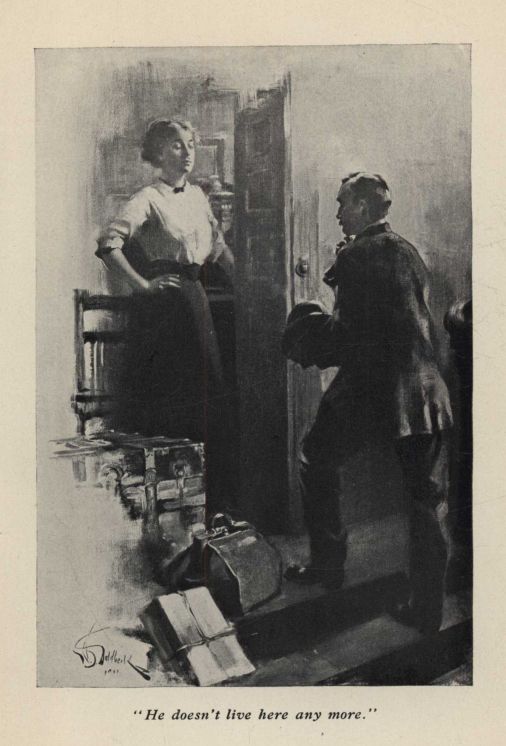
The politician was perplexed.
"Where does he live?"
"I don't know," answered Georgia, shutting the door.
It was not until the next morning that she discovered the loss of her money.
V FOR IDLE HANDS TO DO
The old man had gone to Europe for his summer vacation, leaving Georgia secure in her place with nothing to worry about. She had no more than half work to do. Business had slackened and the whole office was in the doldrums. Life's fitful fever had abated to subnormal placidity. Even her mother's chronic indignation over trifles had been quieted by the summer's drowse.
The only interesting moments in Georgia's day were nine o'clock when she came and five o'clock when she left—noon on Saturdays. The Sundays were amazingly dull.
So was her home. Al stayed away from it from breakfast unto bedtime, with a brief interval for supper. He was engrossed in prairie league baseball for one thing. That occupied him all day Sunday and half of Saturday. Of course he couldn't play after dark, but whenever Georgia asked him where he was going as he bolted from the table with his cap, he answered, "Out to see some fellahs."
If she hoped that he would stay at home to-night, for he was out last night and the one before, he would explain, with as much conviction as if he offered a clinching argument, that "the fellahs" were a-calling and he must go.
She was rather put out to find herself unable to speak with the same vehemence and authority to him as she had been able to use with Jim concerning the folly and wickedness of going out after supper. For when it comes to putting fingers on a man's destiny, a wife is a more effective agency than a sister. Even in unhappy marriages husband and wife are as two circles which intersect. They have common, identical ground between them. It may not be large, but such as it is it inevitably gives them moments of oneness. Brother and sister are as two circles, whose rims just touch. They may be very near each other, but at no time are they each other.
Georgia's restlessness and discontent increased as the summer went on, probably because she was affecting nobody else's destiny to any calculable extent. Her young brother Al kept away, perhaps warned by a deep race instinct that sisters are not meant to affect destinies. Her old mother was a settled case already. She wouldn't change; she couldn't change; she could hardly be modified, except by the weather or the rheumatism; she would merely grow old and die. No satisfaction for a young adventurous woman in experimenting on such a soul.
It has been said that neither the woman nor the man alone is the complete human being, but the man and the woman together. This woman, Georgia, who for seven years had been completed by the addition of the masculine element, was now made incomplete. She struggled in vain to find contentment in regular hours, regular sleep, regular work and regular pay.
She had supposed for years that peace and quiet, and enough money, and never the smell of whiskey were all she wanted. And here was her subconsciousness, which she couldn't understand, making her perfectly wretched, though she couldn't tell why; calling insistently for another man, though she didn't in the least realize it. She only knew she was tired of being cooped up in the house evenings; she wanted to get out now and then for a change and to see people who had some ideas.
She went for a Saturday evening supper to the Kaiser Wilhelm Zweite Beer and Music Garden with a school-girl friend and her husband. This pleasure-ground was well north, out of the smoke. The night was soft and the music lovely. She was much entertained by the husband's talk, and considered that she held up her end with him very well.
The next time they invited her she spent some little time before hand, "fixing-up" for the occasion. Ribbons were put back where they used to be long ago when she first met Jim. Her hat underwent revolutionary readjustment, as the school friend made plain by heated compliments on Georgia's millinery skill.
However, the husband seemed absolutely content with its effect and Georgia's animation increased throughout the evening, calling back a long neglected flush to her cheeks and a gay pace to her bearing. She was not asked a third time, however, which did not unflatter her. It was evidence that she had not slowed down completely—that she was not finished.
Meanwhile Jim, after spreeing away his twenty dollars, had gone West.
VI TRIANGULATION
Mason Stevens, Sr., was a horse doctor in Rogersville, Peoria County, Illinois. He wore a gray mustache and imperial beard in tribute to that famous Chicago veterinarian who has made more race horses stand on four legs than any other man in the Mississippi Valley.
Besides horses, Mr. Stevens knew cattle, hogs, sheep, tumbler and carrier pigeons, bred-to-type poultry, and whiskey. If he hadn't carried a bottle about with him in his buggy he might be alive now.
Mason Stevens, Jr., wanted to be a real doctor, so he came up to Chicago to the Rush Medical College. After his first year, whiskey took his father, the funeral took the rest, and the young man after a brief fight gave up the vision of some day substituting "M.D." in place of "Jr." after his name.
He had been a respected boy at school, green but positive. To help him out, some of his friends persuaded their fathers, uncles or other sources of supply to give "Old Mase" a chance to write their fire insurance. He took the opening. Presently his acquaintance was wide enough for him to branch out into life as well as fire. After ten years in the city he was able to go to the general agent of his company and ask for a regular salary, in addition to his commissions, on the ground that there wasn't another solicitor in the state he had to take his hat off to.
He was a highly concentrated product, like most successful countrymen in the city. He hadn't been scattered in culture. He knew no foreign languages, no art save that on calendars, no music he could not hum, no drama save very occasionally a burlesque show when he felt that he needs must see women.
He knew, if he hadn't forgotten, how to find a kingfisher's nest up a small tunnel in the river bank, or a red-winged blackbird's pendant above the swamp waters, or a butcher-bird's in a thornbush with beheaded field mice hanging from its spears. Even now, with farmer's instinct, he looked up quickly through the skyscrapers at a sudden shift in wind.
He lived in a rooming house and ate where he happened to be. His bureau was bare of everything save the towel across the top, his derby hat, when he was in bed, and a handful of matches. His upper drawer, usually half-pulled out, was filled not with collars and ties, but with papers relating to his business; actuaries' figures; reports from all companies, his own and his rivals'; records of "prospects" that he had brought home for evening study; rough drafts of solicitation "literature" he was getting up for the company. He usually worked at night in his shirt sleeves, his hat cocked on the back of his head, his chair tilted back against the wall under a single gas jet with a ground glass globe that diverted most of the light upward toward the ceiling.
Even after he reached the point where he could afford more expensive living, he did not change. He wore better clothes because a "front" was mere business intelligence, but otherwise his habits were within a hundred and fifty dollars of his first year.
Pleasure he regarded as the enemy, not so much because of its money-cost, as because it was diverting. He didn't wish to be diverted; he wished to sell life insurance and more and more. That was as far as he went with his plans. He didn't want to get rich so as to gratify dreams, to have a beautiful wife and buy her a big house and motors. He simply wanted to get rich.
He had had no romance since he left the Rogersville High School. That one had been sweet enough for awhile, but nothing came of it. And he remembered that on account of it he had neglected his studies senior year and not graduated at the top of the class. Indeed, the object of his affection, with fitting irony, had herself achieved that distinction, which cooled his fever for her.
Mason was a great believer in the value of "bumps." When he made a failure in any enterprise, he was wont to analyze why, in order to double-guard himself against a repetition of it. None but a fool repeats a mistake. He drummed that into himself. Thus in the long run he was ready to turn every "bump" into an asset instead of a liability. It is a system of philosophy widespread in this nation, especially among country-bred people of Puritan tradition, strong, rugged people who believe in the supreme power of the individual will, who minimize luck and take no stock in fatalism. These are usually termed "the backbone of the American people," and though of course they know that God is everywhere and omnipotent, they likewise believe that He has appointed them His deputies, with a pretty free hand to act, in the conduct of the earth.
Mason Stevens came of this stock. And though his father was a backslider, his mother was not, and she brought him up on the saying, "Maybe this will teach you a lesson, my son, next time you think of doing so-and-so."
This shows why Mason Stevens did not fall in love with any woman, after the high school girl, until he fell most desperately in love with Georgia Connor.
He resisted love from conviction. One female ten years before had defeated his brains and his purpose by her charm. He wanted no more of that.
But he had to fight. Often enough as he walked through the long office through the double row of shirt-waisted figures bending over typewriters and desks, it seemed imperative for him to know them better, to wait for one of them after office hours and ride home with her on the car.
Everything else was wiped out of him for the moment but just the question of riding home with a twelve-dollar-a-week girl. Then he would walk quickly on past the girl who absorbed his imagination, his mouth set and his brows scowling. And she would confide in her neighbor that he was crazy about himself.
Sometimes when he was at home under the gas jet with his business papers on his knee, the vision of fair women would float before him, all the most beautiful in his imaginings as he had seen them in pictures or on the stage. He might dream for an hour before remembering that he was in the world to sell life insurance and that women would hamper his single-mindedness as surely as whiskey.
Who was the man he was surest of making sign an application blank when he set out after him? The man who had a woman in his head, every time; the man with the wife, and children, which are the consequences of a wife; or one who was gibbering in a fool's heaven because a young girl had graciously promised to allow him to support her for the rest of her days.
So he kept away from bad women as much as he could, and from good women always.
Especially from those in the office. Their constant propinquity was a constant menace and he had known a lot of fellows to get tangled up that way, and he wouldn't—if he could help it.
But he couldn't help it after he knew Georgia. She was so useful mentally and physically, and that was what he first noticed about her. He hated slackness of any sort, especially in women, because he had trained himself to dwell on women's faults rather than on men's.
Her manners, he thought, were precisely perfect. She seemed to hit a happy medium between gushing and shyness, and to hit it in the dead center. Her teeth were white and good, and she smiled often, but not too often. She never overdid anything, and her voice was low and full. She knew what you were driving at before you half started telling her; also she could make a fresh clerk feel foolish in one minute by the clock.
She had the charm of perfect health. About her dark irises the whites of her eyes were very white, touched with the faintest bluish tinge from the arterial blood beneath. There was a natural lustre in her hair, uncommon among indoor people. Her steps took her straight to where she wanted to go. She made no false motions. When she looked for something in her desk, she opened the drawer where it was, not the one above or below. Her muscles, nerves and proportions were so balanced that it was difficult for her to fall into an ungraceful posture.
Considering these manifold excellent qualities, the most remarkable thing about her, he thought, was that she had not long before been invited to embellish the mansion and the motors of a millionaire. He wrote enthusiastically to his mother suggesting that it would be nice to invite her to Rogersville for a portion at least of her coming summer vacation, which brought a most unhappy smile to his mother's lips. But since he did not repeat his request, the invitation was not extended.
The first time that he knew he regarded her as a woman rather than as a workwoman was one afternoon when the declining sun threw its light higher and higher into the big office. A ray shone on and from her patent leather belt and into his eyes. He looked up annoyed from his work. She was sitting a few desks ahead by the window, her back toward him. Before very long the thing had fascinated him and he found himself immensely concerned with the climb of the sun up her shirt waist.
It reached her collar in a manner entirely marvelous and then precisely at the moment when he was finally to know its effect upon her hair, she lowered the shade. What luck!
The next day was cloudy. The next was Saturday and she quit at twelve, before the sun got around to her window. Monday she lowered the shade before the light got even to her shoulder. Little did she know of the repressed anguish she was so bringing to the gloomy young hustler behind her. But on Tuesday the sunlight reached her hair momentarily as she leaned back in her chair and gleamed and glittered there, a coruscation of glory for fully thirty seconds—long enough to overturn in catastrophe his thirty years and their slowly built purposes.
He resolved hereafter to deal primarily not in life insurance, but in life, which meant Georgia.
VII A SENTIMENTAL JOURNEY
During the ensuing days Mason was hopeless for work.
From the office books he found out where she lived, slyly as he supposed, but not so slyly that the information clerk didn't tell someone, who told someone who teased Georgia at the luncheon club, not thereby displeasing her. For he was a good-looking fellow and capable; furthermore, he had always kept himself to himself, so putting several noses out of joint, it was said.
He had moments of anguished self-reproach as he sat in his room in his boarding house, his chair tilted against the wall under the gas jet, his coat on his bed, his derby hat tilted back on his head.
He knew that his life had been utterly unworthy. He had drunk it to the lees, pretty near. But now he was through with all that. Hereafter, for her sake, he would conquer himself and others.
His sense of beauty was limited by inheritance and by disuse, but now he began to draw upon all the poetry in his soul—not to write to her, but to think of her.
His imagination, naturally fertile and strengthened by the practice of his profession, centered itself on the question of his first kiss from her—where, when and how should it happen? He called all great lovers from Romeo to Robert W. Chambers to his aid—it must be under the moon, the fragrance about them. And a lake, a little lake, for the moon to shine upon and magically increase its magic. He remembered the moon on the river back in Rogersville, with the other girl—the first one. What mere children they were. That was puppy love, but this was love; love such as no man ever felt before for a woman.
He was hard hit.
The lake suggested a train of thought, so he packed his bag on Saturday and went to southern Wisconsin. The resort dining room was full of noisy youths and maidens who, in his decided opinion had no proper reverence for love, though they seemed perfectly amorous whenever he suddenly came upon a pair of them as much as one hundred yards from the hotel.
He chartered a flatbottom after supper to row out alone and contemplate the moon and her, but the voices of the night and the frogs were overwhelmed by the detestable mandolins tinkling "My Wife's Gone to the Country, Hurray."
When finally he turned in he discovered there was a drummers' poker party on the other side of the pine partition, so it wasn't until nearly daylight he dozed off, to wake a couple of hours later when the dishes began to rattle.
The boat concessionaire reported pickerel in the lake and he joined the Sunday piscatorial posse. He returned with two croppies and the record of many bites, mostly on himself.
He concluded he wasn't interested in fishing anyway. It was just a device to cheat himself and make himself suppose he was having a good time. He couldn't have a good time and wouldn't if he could, until he knew her, until at least he knew her. Why he had never said ten words to her more than "Good morning" and "Good evening." He would call on her; he had her address. He would go to her apartment and ring the bell and say, "Miss Connor, I have come to call on you. Do you mind?"
No, that would hardly do. It was too bold. He mustn't seem at all crude to her, but mannerly and suave and self-possessed. A girl, and especially one of her sort, would object to crudeness. He must be very courtly, knightly. Flowers on her desk every morning, perhaps, not a card, not a word. A handful of sweet blossoms each day to greet her and bear her silent testimony that there was one who—— She would know, of course, in due time whence they came. Not that he would ever so much as hint at his gifts, but her woman's intuition would tell her. And when she did realize in this way his silent though passionate devotion, she would thank him, gently and sadly, and a bond would be made between them.
But then, what if the other people in the office had intuition, too, or saw him bringing in flowers! No, decidedly that wouldn't do.
And then—just in time for him to catch the 3:40—a blinding flash of warning illumined his whole being. What if, while he was there shilly-shallying at a summer resort, some other fellow was with her in Chicago at that very moment!
"What if"—a ridiculous way to put it. Wasn't it sure in the nature of things, that at that very moment some other man was with her?
He caught the 3:40. He would call on her that very evening and if indeed he didn't declare himself bluntly in so many words—hadn't he heard of numberless women who had been won at first sight!—he would at least intimate to her strongly, unmistakably, that she was the object of his respectful consideration and attention.
There were others in the field. It was time he declared himself in, too.
It wasn't until 5:37, when the train reached Clybourn Junction, that he began to repent his precipitancy. He was going to see her again in the office to-morrow, wasn't he? Wouldn't it look queer if he went out to call on her to-night without warning? She might be wholly unprepared for callers and annoyed.
But his presumable rival bobbed up again and spoiled his supper, so after dropping his bag at home, he walked presently into the entry way of 2667 Pearl Avenue. Her name was not on the left side; perhaps she had moved. No, here on the right, floor 3, in letters of glory—"Connor." Above it, "Talbot."
Who was Talbot? Married sister, roommate or landlady from whom she sublet? He raised his thumb to the bell. He had never before experienced a moment of such acute consciousness.
Wait a second—she might not be in. He walked out and looked up at the third floor right. There was certainly a light, a bright one, and the window was open and the curtain fluttering out.
Somebody was in. It might be Talbot. In that case he wouldn't go up or leave his name either. It certainly was none of Talbot's business, whoever Talbot was.
He pressed the button under her name. "Yes?" Heavens above, it was she, Georgia, the woman herself.
"Yes, who is it!" came the voice once more.
"Stevens."
"Mr. Stevens?" with a decided tone of interrogation. Evidently she did not place him at all. Probably not, with so many other men about her. It would be absurd to suppose anything else. She didn't place him—might not even recognize him out of the office.
"Mason Stevens of the office."
"Oh, Mr. Stevens of the office. How do you do?" and she spoke with a delightful access of cordiality. "Will you come up?"
"Just for a minute, if I may. I won't keep you long."
"Wait, I'll let you in." The click-click-click sounded and he was on his way upstairs. She opened the door for him.
A quick glance. There was no other man in the room, anyway.
"Good evening," she said. "Won't you come in?"
"Why, yes," then very apologetically; "that is, if I'm not putting you out."
"No, indeed." He sat and paused. She smiled and did not help him.
"You're nicely located here, Miss Connor."
"Oh, yes, we like it."
"Near the express station?"
"Yes. I usually get a seat in the morning, but not coming back, of course."
"About three blocks, isn't it?"
"Three long ones."
"A nice walk."
"Yes, this time of year, but not so nice in winter when they don't clean the snow off the sidewalks."
He felt that it was a bit jerky. Perhaps he should first have asked her permission to call. What a goat he was not to think of that beforehand instead of now. He paused until the pause grew uncomfortable.
She tried to help him out, "We're out of the smoke belt, that's one thing."
He was seated in a rocking chair and began to rock violently, then suddenly he stopped and leaned toward her, his elbows on his knees.
"I've been slow getting to the point," he remarked abruptly, "but I came here on business."
"Oh, I wasn't just sure what."
Stevens took half a dozen life insurance advertising folders from his pocket. "You know this literature we're using," he said, running two or three through his fingers and indicating them by their titles, "'Do You Want Your Wife to Want When She's a Widow?' 'Friendship for the Fatherless,' 'Death's Dice Are Loaded.'"
"Oh, yes." She took them from him and read aloud. "'Over the Hills to the Poorhouse,' with a photograph of it, 'Will Your Little Girl Have to Scrub?' with thumbnail pictures of scrub ladies. Ugh, what a gloomy trade we're in, aren't we, Mr. Stevens?"
"This is the line of talk that gets the business." He spoke earnestly, tapping the folders. "You can't make papa dig up premiums for forty or fifty years unless you first scare him and scare him blue about his family."
"Yes, I suppose so."
"And what I came for is—well, will you—would you just as soon help me get up some more of these?"
"You mean work with you on them?" She was truly surprised.
"Exactly."
She hesitated and then she said it was impossible, but that she appreciated his kind compliment, was flattered by it and thanked him deeply, deeply. For, of course, she realized that Mr. Stevens was one of the very best men in town at that sort of work and she was afraid she couldn't possibly be of any real use to him.
"Not at all, not at all;" he was talking business now and waved aside her objections with his customary confidence. Everybody always objected to his plans for them when he began talking, but in the end he was apt to change their minds. That was why he was considered a premier solicitor. "You've a clear head and a good ear for words, that's what's needed, and——"
"But—" she tried to interrupt.
"And ideas, that's the point, ideas. You're clever."
"What makes you think so?"
"I don't think so; I know."
"I'm flattered," she said firmly. "But no—really."
"Well, I won't take that for a definite answer yet." Of course not. He never did. "I want you to think it over. I have the utmost confidence in the scheme and your ability to carry it out. You can tell me Monday in the office what you decide."
"I can tell you now, Mr. Stevens."
He rose. "Think it over anyway. You may change your mind."
She rose, too, not encouraging him to stay.
"Miss Connor," he spoke gravely, "there was something else I came to ask you. I'd like to know you personally as well as in a business way, if you'd just as soon. May I come to see you now and then?"
She did not answer. She saw that it counted with him. He seemed really to care. She must not be brusque with him. He must not think her merely light-minded, unappreciative of the compliment of his interest. She must tell him of her marriage.
"Of course, if you'd rather not for any reason, why, that settles it," there was a check in his voice, "and we'll say no more about it." Still she did not answer. He held out his hand. "Well, good-bye, then."
"Good-bye."
He went to the door and opened it.
"Mr. Stevens."
"Yes, Miss Connor."
"I think you ought to know that isn't my name."
"What is it, then?"
"Mrs. Connor."
"Mrs. Connor? Missis Connor?"
"Yes."
He came down into the room. His glance traveled rapidly to the four corners, like a wild animal dodging men and dogs. He had one question left, one chance of escape.
"Are you a widow?" he said.
"No, a married woman."
Stevens went slowly out of the door without replying. The woman whom he loved belonged to another man. It was like the end of the world.
VIII THE LIFE FORCE
If Mason had been in the jeunesse dorée he must now have gone to Monte Carlo to buck the tiger or to India to shoot him.
As it was, he smoked all night and turned up at the office half an hour ahead of time in a voluble, erratic mood, brought about by suppressing so much excitement within himself. If he had known how to tell his troubles to a friend over a glass of beer he might have had an easier time of it in his life. But he wasn't that sort. He took things hard and kept them in.
He decided that the best thing to do with his sentiment for Georgia was to strangle it. Whenever he caught himself thinking of her, which would certainly be often at first, he must turn his mind away. He must avoid seeing her; if they met accidentally he would give no further sign than a curt nod.
He remembered the farmers used to say that there was one thing to do with Canada thistles—keep them under, never let the sun shine on them. His love for this other man's wife was like a thistle. He must keep it under, never let the sun shine on it.
He did it thoroughly. He nodded to her in the most indifferent way in the world when they happened to meet, but he found no occasion to stop at her desk to chat an instant. Two weeks of his change of manner began to pique her. He was acting in a rather absurd way, she thought. After all they weren't lovers who had quarreled, but simply acquaintances, friends after a fashion, fellow workers. Why shouldn't they continue to be friends? It would be amusing to have some one besides the family and the girls to talk to.
She would not let him treat her in this stiff way any longer, just because she had had the bad luck to marry a bad man years before. What rubbish that was. And what self-consciousness on his part. Men had a very guilty way of looking at things.
They met quite or almost quite by accident in front of the office building during the noon hour of the following day. He was about to pass without stopping.
"How do you do, Mr. Stevens?" Her voice was quite distinct.
So he turned and lifted his hat. "How do you do!"
She did not precisely move toward him, but she did so contrive the pause that it was up to him, if he weren't to be boorish, to stop for a moment and speak with her.
She threw a disarming candor into her first question. "Is there any particular reason," said she, "why we are no longer friends?"
"Friends?"
"Yes. You've been frowning at me for about three weeks and I haven't the least idea how I've offended you."
He did not answer immediately and his expression hardened.
"There, you're doing it now," said she with apparent perplexity. "Why?"
"You know," he spoke doggedly.
"No, I don't."
"Yes you do, too," he answered curtly and roughly. "You do."
"Just as you please." She turned from him, apparently offended by his tone, slightly nodded and walked slowly away. She was of medium height, no more than that, and slender. A brute of a man bumped her with his shoulder as he passed her.
Stevens waited for the brute of a man, dug his elbow into his ribs and overtook her at the Madison Street corner.
"Miss—Mrs. Connor, I didn't mean to be rude."
"You were a little, you know."
"Will you excuse me?"
"Why, of course."
He didn't quite know what to do next, so he awkwardly extended his hand. She took it with a man-to-man shake of wiping out the score, which completely demolished his cynical attitude in reference to platonic friendship.
"Where were you bound for?" he asked.
"Nowhere, just strolling. Over to the lake front for a breath of air."
"May I walk along?"
"Surely."
On their way back they reflected that they had been without lunch, so they stopped at a drug store for a malted milk with egg, chocolate flavor, nutmeg on top.
They touched their glasses together.
"It's very nourishing," said he with wonderment.
"Very," she replied, delightedly; "very."
They returned to their work in that state of high elation induced by interviews such as theirs, wherein the spoken words mean twenty times what they say—and more.
IX THE PRETENDERS
Georgia and Mason did not overpass the outward signs and boundaries of platonism, learning to avoid not merely evil, but the appearance of evil. When they met in the hundred-eyed office they were casual.
During the autumn they took long walks together every Sunday. There had been a dry spell that year, lasting with hardly a break from the fore part of June, which baked the land and sucked out the wells and put the Northern woods in danger of their lives. The broad corn leaves withered yellow and the husbandmen of the great valley protested that the ears were but "lil' nubbins with three inches of nuthin' at the tips, taperin' down to a point, and where'll we get our seed next spring?"
When the huge downpour came at last and by its miracle saved the crop which had been given up for lost a fortnight since, Mason cursed the day, for it fell on the first day of the week and cost him, item, one walk and talk with Georgia Connor. She stood so near his eyes as to hide from his sight a billion bushels parching in the valley—though he was country bred.
To her their Sundays together brought not a joy as definite as his, but rather a sense of contentment, of relief from the precision of the other days of her week. It pleased her to wander to the big aviary and look at the condors and cockatoos and wonder about South America where they came from, then to stroll slowly over to the animals and have a vague difference of opinion with him about whether a lion could whip a tiger.