Front matter (continued 4)
Reading edition
And the best of it was that the whiskey didn't seem to tempt him any more. It was almost too easy, this being good. Nothing to it, if a fellow simply made up his mind.
Old Col. E. E. Morse had certainly stampeded him the other morning when he was getting over his headache. He smiled a trifle wryly. Yes, he'd actually gone so far as to contemplate suicide, which was a great sin, to avoid getting full, which was a less one—and now here he was, never feeling better in his life and not touching a drop.
The old colonel certainly did make a goat of a fellow. He had acted more like a boy than a grown-up man. The blood curdling oaths he'd taken with eyes and hands raised to heaven, by his mother's soul and his hope of meeting her again. The memory of his hysterical state somewhat embarrassed him.
Some drank and some didn't; just as some had blue eyes and some brown. Bismarck and Grant, for instance, drank. It was foolish on the face of it to suppose that those giants among men were in the habit of lying awake nights, agonizing over the question of a glass of beer or two with their evening meal. That wouldn't show they were strong, but weak.
At this point he dropped from his vocabulary the word "drunk," with its essentially ugly sound, and substituted "loaded," which is pleasanter, then "jagged," which is pleasanter still, especially if one humorously places the accent on the final ed. A further alteration in his barroom terminology made it stewed, soused, plastered, anointed, all lit up, sprung, ossified.
When a periodical gets around again to the point of calling intoxication by pet names his next spiflication is not very far ahead of him.
In gradually divesting itself of the hideous and demonic character which he was wont to ascribe to it in the first moments of his passionate remorse after a debauch, alcohol achieved the necessary preliminary work preparatory to his next one. The curious thing was that he always realized in the heat of a new resolution precisely how the next attack would presently begin against him.
"Never again," he would say to himself, "never again, Jim Connor, if you're worth the powder to blow you to hell. Never again, understand! Never mind about George Washington and Grover Cleveland. You quit. Don't you care if the doctors say it's a food. It isn't a food for you. Leave it alone or die. It's been your steady enemy since you got into long pants. Hate it."
But in spite of efforts that were sometimes gallant he could not keep his hate hot. The further he got from his last spree, the less horrible and more amusing it seemed in retrospection.
The furiously emotional character of his resolution gradually cooled off and lost its driving power.
Only near the end of a period of abstinence did alcohol make a direct assault upon his body, and even then in skillful disguise. His digestion went back on him. He would conscientiously seek to fend off his misery by pills, powders, salts, extracts, soda and charcoal tablets, pepsin gum, by giving up smoking, coffee, dessert, by hot water before meals and brisk walks; but he adopted these measures dispiritedly. A still small voice had begun to whisper that they wouldn't do and that only one thing would.
If that one thing were taken privately just before supper, say downtown where the crowd wasn't around to kid him for seeming backsliding and if it were immediately followed by half a teaspoonful of ground coffee from the receptacle made and provided for such contingencies, Georgia would be neither the worse nor the wiser and he would get his appetite back.
"Mind," said the small voice, "just one." Why of course, he quickly agreed with himself, just one. That was all he needed. He didn't want the stuff for its own sake. He got no pleasure out of it. In fact he rather disliked the taste of it. But purely and simply for medicine, as a last resort. Hadn't he already tried every other damn thing on the market?
Usually he escaped detection the first day or two and went to bed at night triumphant and respectable, his secret locked successfully in his breast, excitedly convinced that at last he had learned to drink like a gentleman.
Presently he sensed the need of a more exact definition. How many drinks did a gentleman take a day? Two or three, or even more on special occasions? Was getting wet or cold a special occasion? What was a "drink" anyway—two fingers, three, or a whiskey-glassful? How much beer equaled how much spirits? Wasn't liquor mixed with seltzer less harmful to the lining of the stomach than the same amount taken straight? It ought to be, for a highball, according to test, averaged no more alcohol than the light wines of France and Italy, and as was well known, a drunken man was seldom seen over there. This being indisputable, might not one increase one's prescribed allowance of whiskey if one diluted it conscientiously?
He never tired of these and similar questions. They fascinated him and centered his consciousness. His mind revolved around the whiskey proposition like a satellite around its principal. He might hate, loathe, abominate whiskey, or pooh-pooh it, or compromise with it, or succumb to it. But he thought of it most of the time, endlessly readjusting his relations with it, like an old man in the power of a harlot.
Sometimes he would admit that there was much to be said against the cumulative effect of a drink every day. Twenty-four hours was hardly long enough to get wholly rid of the last one before you put the next one in on top of it. Would it not, possibly, be more advantageous to one's system, for instance, to get a slight skate on Saturday night, nothing serious, a mere jolly, harmless bun, and cut it out altogether for the rest of the week, than to go against it daily? This suggestion usually presented itself early on Saturday evening, after he had got a good start. After a little argument pro and con, the pros won.
The pros always won without exception, yet Jim never once neglected to go through the form of argument. It was astonishing with what perfect regularity he repeated time after time the same mental sequence in his circlings around whiskey.
He did not necessarily lose his job at each spree. He was not the explosive type of drunkard. He managed sometimes to drag himself wearily through the motions of work in the day time, slipping out every hour or two, on some excuse, to "baby it along." But from night to night his drunkenness would deepen until at last, with his nerves shattered and money gone, he stumbled home to his women folk to be nursed, to threaten suicide, while they telephoned lies to his employer, to take his solemn pledge, and to begin his cycle over again.
Four times during his wife's second pregnancy he made the complete circle.
She put up with his lapses more humbly than ever before in their married life. Each time that he renewed his pledge her sustaining hope returned that he would keep it this time, until at least the baby was born and she was well enough to return to work.
Then she wouldn't be afraid any more. Disencumbered, her strength restored, she would be wholly able to take care of herself and her child. She could earn two livings. She knew precisely how to go about it. There was nothing haphazard in her plans. Either she would promptly find another first class secretarial position or else she would go into business on her own hook, get a small room about eight feet by eight, at $1.50 or $1.75 a square foot, in a big office building and put on the door
G. CONNOR STENOGRAPHER—COURT REPORTER NOTARY PUBLIC
She could see it in her mind's eye. It looked fine. But it was several months off yet, slow months of discomfort, culminating in hours of the acutest agony a human being can suffer and live. She knew. She had been through it once already.
But she would never go through it again, after this time. Never. They might say what they liked about race suicide, this was the last for her.
In the meantime she must keep Jim as straight as possible and get all she could out of him. For presently there would be some heavy bills to pay. She kissed and flattered him, and went through his pockets at night, racing the bartenders for his money. Wasn't a business woman a big fool, she often asked herself, to get in this fix for a man she didn't love?
The Church—the Church took a pretty theoretical view of some things.
XXVIII ALBERT TALBOT CONNOR
When her grandson was eight days old, Mrs. Talbot took him to be baptized. Georgia, not yet out of bed, protested against the precipitancy, but her mother was armored in shining faith and prevailed.
"You know your baby's sickly," she explained, "and not doing well. We cannot afford to take any chances—in case anything happened."
So she dressed up the mite in his best white lace, and herself in her best black silk and sailed off to church in a closed carriage. He was named Albert Talbot.
Until he was brought back to her, Georgia felt savagely that there was something ridiculously primitive, something almost grotesque in the proceeding. To take her baby from her, she could hear him crying all down stairs, to a church a mile away, to be breathed on by a priest and touched with spittle and anointed with oil and wetted with water—how could such things make her perfect babe more perfect!
Why should this naïve physical rite send her son to Paradise if he died; and more especially why should the lack of it bar him out of Paradise forever? It was not fair to put such mighty conditions upon him. He was only a baby.
When young Albert was returned to her arms and her breast, she forgot her grievance. Anyway, he was on the safe side of baptism now. It couldn't do him any harm and it might do him an eternal and supreme good. It was better to take no chances with the supernatural.
She asked the doctor when she could wean him. "I am behind in my bills, you know," she explained, "especially yours, doctor. I'd better get to work."
"I can't conscientiously advise you to do anything of the sort," he answered.
"But why not? Most babies are put on a bottle nowadays."
"This one is a delicate little fellow—not five pounds at birth. You want him to get strong—mother's milk is the best medicine."
"That settles it," she said slowly. "How long will it be? Six months?"
"Yes, six months anyway, perhaps more—perhaps a year. It depends on how he does. I won't disguise it from you—he's worried me once or twice."
A year! She didn't know a child was ever nursed a year. A year more of humbleness to Jim, of asking money from her brother, now called big Al, of fear that Mr. Kane might get annoyed and leave, of contriving and skimping and bill dodging. Another year of "womanly" womanhood, clinging to males for support.
The doctor saw her disappointment. "It's your sex' share of the world's work, you know," he said, "your duty to society."
"I have a baby and we're poor. If I'd had none, we'd be well off this moment," she said sharply. "If I really have done a duty to society why does society punish me for it?"
"I don't know," said the doctor.
He came rather frequently to the flat at this time, partly on the baby's account, partly on Mrs. Talbot's.
The river of life in the elder woman was becoming sluggish; rheumatism crippled her. The doctor veiled his explanation. "Synovial infusion," he called it, "but," he added reassuringly, "pericarditis is not in the least to be apprehended. I will stake my reputation on that." Which gave her new heart.
The rivulet of life in the child trickled uncertainly, obstinately refusing to increase. "Hmm," he muttered once, "microcephalic."
"What does that mean?" Georgia asked with quick suspicion.
"It means that he has a rather small head," smiled the doctor, "but then he is a rather small boy."
"Yes, he is tiny, isn't he?" said the mother pressing him to her soft, distended breast. "Little one—little one of mine." She looked at the doctor proudly. "He knows me," she said, "don't you think so?"
"Of course he does," he answered, and she knew that nothing else which had ever been or ever would be really mattered.
Whenever the doctor came to the flat he found time to tarry in the midst of his busy life of many patients and small fees for a chat with Georgia. He was a happy, crinkled, red faced, blue-gilled little man, who inevitably suggested outdoors, though he wasn't there much, for he drove a closed electric runabout. He always meant some day to write a novel, a true novel, something on the order of "The Old Wives' Tale," showing people as they really were. He thought he had the necessary information. He had seen all sorts of folks come and go for thirty years. But he never seemed to get around to the actual writing. He was so pressed for time.
Georgia Connor, nicely disguised, would be a good character for his book. Change the color of her hair, for instance, put a couple of inches on her height, make her something else but a stenographer, say a cashier—and neither she nor anybody else would suspect. So he had many little talks with his model, getting material. Besides, he liked her. She was intelligent, she never bored him and she always had her own point of view, and half the time an unexpected one. She had been twice educated—first by the convent and next by the loop. One could never tell which side of her was going to speak next.
Eventually one side would prevail. Which it would be depended on the baby question. If she had enough of them tugging at her skirts she'd revert to type. He knew. He'd seen 'em come and go for thirty years. Persistent mothers don't aviate.
When little Al was a month old, shortly after midnight on the thirteenth of November—she will never forget the day—Georgia awoke suddenly as if a pistol had been shot off by her ear. The baby was wailing in a feeble little singsong. She looked at the clock. It wanted half an hour to his feeding time.
She walked slowly up and down the room, whispering to her son. Sometimes she stopped at the open window to look out into the cool pleasant night, but nothing she knew how to do made any difference. He kept steadily on with his heart-breaking little singsong wail.
At one precisely, before the single stroke of the small clock had stopped ringing through the room, she gave him breast. He took a little, then gasped and choked and "spit it up" again. She waited ten minutes as she had been instructed, then gave him a very little—not more than three or four swallows. He rejected it. After twenty minutes she tried again. The warm, white life-giving fluid ran over his lips and chin, and trickled down his neck, wetting the neckband and sleeve of his thin woolen garment. But he kept a little down she thought. And then after awhile a little more. She did not wish him to be as far from her as his crib, so he dozed off in the crook of her elbow, while she took short naps a few minutes at a time until dawn.
At five she took in Mr. Kane's coffee. This duty now accrued to her, because the doctor had warned Mrs. Talbot not to overdo.
When Georgia returned with her empty tray she dropped into a chair for just a moment's rest. An hour later when she awoke she found little Al lying rigid on the bed, his small fists clenched, his eyes rolled up until only the whites could be seen through his half-closed lids, his under lip sucked in between his gums. She was not sure that he breathed.
Hastily she ran to the bathroom and turned the hot water tap on full. Hastily she ran back, and took the child in her arms. She knocked at the door of big Al's room.
"Al," she cried, "Al, Al, Al—wake up."
"What—eh, oh, what?" came a sleepy voice.
"Telephone the doctor, quick, quick, quick, the baby is—Oh, hurry, Al."
She ran to the bathroom and put her hand in the running stream from the faucet. Tepid, only tepid. Would it never get warm? If God ever wanted anything more from her—in the way of belief or devotion—let Him make this water hot, now, on the instant.
Her wet hand and her dry one moved rapidly together at her baby's clothes, unpinning the safety pins. Even in her haste she put them in her mouth mechanically, one after another. Once more she plunged her hand into the water. Warmer now, yes, almost warm enough. She put the round rubber stopper in the escape.
She lowered the stiff and naked little child into the tub, one hand behind his neck, the other held to shelter his face from the spray of the hot water which was pouring from the open tap.
Al stood at the door in bare feet, his trousers slipped on over his nightshirt.
"D'you want the doctor to come right away?" he asked.
"Do you mean to say you haven't gone yet?" she said piteously without turning her head as she knelt by the bathtub, "of course, right away—now, this instant."
The young fellow departed on the run for the janitor's telephone in the basement.
The water had become quite hot, but still the child did not relax. Georgia tried to undo one tiny fist with her forefinger, but she felt with agony of heart that it would not unclench easily. She sensed a touch on her shoulder, then saw another older hand put in the water behind the child's head.
"No, mother, you shan't," she said, "it is my baby, leave him to me."
"Shall I ask Father Hervey to come?" said Mrs. Talbot.
Georgia was too intent to answer.
Mrs. Talbot walked slowly down stairs, stiff with rheumatism. She met Al coming up, four steps at a time.
"How is he?" he shouted as he passed. She turned to explain, but he vanished out of sight around the turn at the landing, not waiting for an answer.
When she got Father Hervey on the telephone he asked if she was speaking of the young child he had baptized a month or so back.
"Three weeks come Tuesday," she said.
"Ah, then he has been baptized. That, at least, is well."
"But Father, if you could come, and pray, maybe it would save his life here, too."
He hesitated but a moment. Truly there was no priestly obligation to visit sick infants who had already been baptized, whenever their grandparents became excited. To baptize dying babies or to administer the last rites to those who had reached the age of reason was his duty. This was not. But if he did it, it would be an act of human kindness.
"I will come," he said over the wire, "at once."
XXIX THE DOCTOR TALKS
When the doctor arrived the convulsion had passed. Little Al was lying in his crib, asleep, breathing easily, the snarls in his nerves unravelled. Georgia explained what had happened.
"You did just the right thing," said the physician.
"Doctor," she asked slowly, "will he ever be well?"
"What do you mean by well?"
"I mean, when he grows up will he be as strong—and—and bright as other men?"
"That is impossible to answer, Mrs. Connor, without the gift of prophecy."
"Don't put me off," said she staring at him, "tell me the truth. I have a right to know."
"I should first have to have a little more definite knowledge of his antecedents, his family history. Is there anything which might explain—"
"Not on our side of the family," Mrs. Talbot interrupted quickly, "they're clean people, every one."
"His father," said Georgia, "is a drunkard and the son of a drunkard."
"In that case it is possible, mind you I only say possible, that he has inherited a—a nervous tendency."
"Inherited, ah, I knew. There was something in me that warned me steadily not to go back to him. Something that made me shudder to think of it. But at last I gave in, because everyone in the world seemed in a conspiracy to make me."
"Yes," the doctor answered drily, "we run into such histories frequently."
"But," she pleaded suppliantly, as if he had the power to do or undo, "surely my baby can grow out of this—nervous tendency. Tell me he can grow out of it. With the right care and training, surely he can grow out of it."
He placed his hand on her shoulder, and honesty seemed to her to be patent and apparent in his voice. "Yes," he said, "it is possible, it is probable. I have seen many a mother make her child over with love."
"Ah, that's all I want," she gave a happy little sigh, "for I can do what they have done."
There was a tap at the door. Mrs. Talbot opened it and Father Hervey came in. "Oh," she said, "Father, the baby's well again. I shouldn't have bothered you."
"I'm glad for once it's an occasion for rejoicing," he said quietly. "Good morning, doctor."
"Good morning, Father. Was the poor fellow long after I left?"
"About half an hour."
"Were you at a deathbed last night, you two?" asked Georgia.
"Yes, Georgia, we were," said the priest.
"It seems somehow strange," she pondered, "that you two, so different, should be called together at the end."
"Oh, it happens often enough," explained the doctor. "Poor people. They want to keep them here a little longer, and the priest to bid them Godspeed in case they've got to go."
"It must be terrible," reflected Mrs. Talbot, "to die without a priest."
"Yes," answered the doctor, "Catholics have the best of us there. They always go hopefully, and they're the only ones that do. I've sometimes wished that I could accept the faith, but—" he shook his head slowly.
"Why can't you?" said Georgia quickly. Father Hervey smiled. He and the doctor were trusted friends. There was no poaching on each other's preserves.
"Do you honestly believe in a future life?" she asked again, staring at the man of science with her peculiar little wide-eyed stare.
"Yes, I believe all of us here will probably have it—except perhaps Father Hervey."
"Well, doctor," said Mrs. Talbot most indignantly, "I must say you've no call to be disrespectful. If any of us is certain to have it, it's him."
"Oh, that's one of his little jokes," he said, "he means the rest of you'll likely leave children behind you to be carrying your living eyes and nose and mouth about the earth long after the headstones are atop of you—and that's denied me."
"If they'd been denied me," its chronic undertone of humor momentarily leaving the doctor's voice, "or were taken now—I'd just as soon quit. I've four; one's learning to crawl, one to walk, one to read and the oldest," he made a vain effort to conceal his pride in such a son, "Oh—he's a boy. He can work his mother as easy as grease with a sore throat story whenever he wants to stay out of school. Pretty clever, eh, with a doctor right in the family? He'll be a great bunco steerer—or a great lawyer—some day and make his name—he's a junior—bristle in the headlines of 1950. That's the real life after death—our blood lives on, we don't."
"Yes," said Georgia tenderly glancing at the crib, "our blood lives on, it lives on."
"When a little shop girl takes the boat over to St. Joe," said the medical man, folding his arms, well started on his favorite eugenics, "she may be preparing a blend that will endure as long as the race—ten thousand or one hundred thousand years, while any of the descendants are alive. Marriage—true marriage, where children grow up and beget others—outlasts death by centuries, perhaps eons." He paused to let it sink in. "Whatever else there may be in addition," he said, bowing slightly in the direction of the priest, "this much is certain true—in our children we find immortality."
"Yes," said Georgia softly, looking at the crib where lay her child, "in our children there is immortality. My sweet little lamb," she whispered, going to her child, "my sweet—" her voice changed suddenly, growing very harsh. "Doctor," she said, "come here."
The doctor placed his ear to the child's heart, then took his stethoscope from his satchel to listen for the least fluttering. He heard none. As he straightened up again, she saw his answer in his face.
"Is—he—dead!" she asked.
"Yes." He spoke to the priest. "I will come this afternoon, in case I can be of any use," he whispered, and quietly withdrew.
The priest sprinkled the small dead body with holy water. Mrs. Talbot and Al fell on their knees, but Georgia stood. She was unable to kneel to a God who had done that. The priest prayed, half murmuring. Then in a louder voice he said, "As for me, Thou hast received me because of mine innocence."
"And hast set me before Thy face forever," muttered Mrs. Talbot, who knew the response. Al was silent, for he was not sure of the words. Georgia stood dumb, watching her child with her wide-eyed little stare.
"The Lord be with thee—" came the deep musical voice of the priest.
"And with thy spirit," muttered Mrs. Talbot.
There was a moment of silence, then came a knock at the door. It was repeated twice, imperatively.
Then the door was opened from outside and Carl Schroeder, president of the Fortieth Ward Club, entered, half carrying and half guiding Jim Connor, who was stupidly drunk.
Schroeder placed Jim in a chair and quickly slunk out. Jim swayed an instant in the chair, trying to hold his balance, then fell forward out of it. His hand struck the crib as he lay inert, unknowing, obscene.
Georgia looked at him for an instant, she began to giggle, to laugh. Her laughter grew louder and louder. It came in waves, each wilder and higher than the last.
Georgia Laughed.
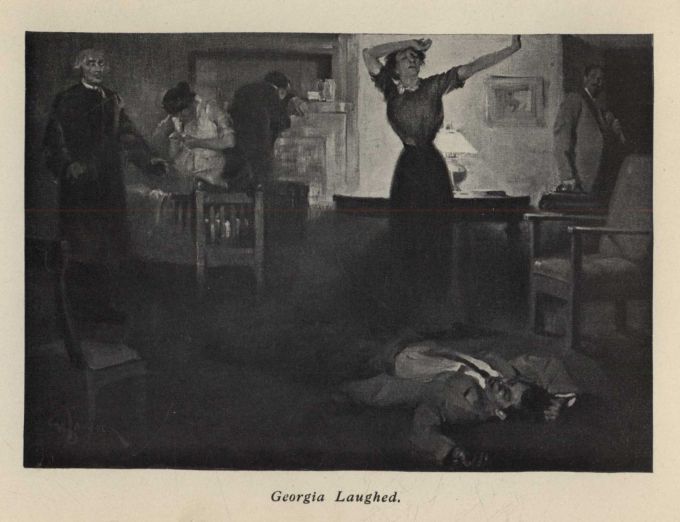
It was long before they could quiet her.
XXX FRANKLAND & CONNOR
Georgia and Jim Connor parted at the cemetery gate after the burial of their son. They have not, since then, seen each other.
Exclusive of her debt to Stevens, Georgia owed more than two hundred dollars, nearly half of which was for the funeral. Mrs. Talbot had ordered eight carriages.
Big Al behaved very well, turning in everything beyond carfare and lunch money for several weeks. Then he relaxed to the extent of five bright neckties and a pair of pointed patent leathers. But on the whole he was a very good boy, and Georgia told him so.
Her own wardrobe was in no condition for effective job-hunting. "Old faithful," the tan suit, once the pride of her heart and the queen of her closet, had dated beyond hope. Time had robbed the tan, not so much of substance as of essence, of smartness and caste.
The models of Paris hadn't worn a six yard pleated skirt for three years. So Georgia couldn't either, without proclaiming to her kind that she was either green or broke.
As for the blue serge, that was out of the question too, because it was simply worn out. She bought a black broadcloth coat and skirt that fitted wonderfully, as if they had been made for her, and a half dozen ruffled shirt waists. To these she added a severe black toque and low laced shoes. The total outlay ran to eighty-five dollars, but she considered it essentially a business investment, as no doubt it was.
She was pale, and her face had grown thin, which made her big eyes seem bigger. Her heavy black hair worn low on her forehead accentuated her pallor. She was what is frequently termed "interesting looking." At all events many people on the street were interested enough to turn and look again.
She clung to the idea of an office of her own some day, but because of the impracticability of starting business with a capital of five hundred dollars less than nothing, concluded to begin as assistant to some already established stenographer. Thus, she could learn the game, make acquaintances, get a following. Then when it was time to take the plunge, it would be simple enough to circularize this trade and switch at least part of it over to herself from her former employer.
She went up and down in many elevators and through many ground-glass doors in her hunt for work. One prosperous-looking, buxom, extreme blonde of thirty-eight, dressed a coquettish twenty-five, paid her a compliment.
"Listen," she said in a stage whisper, motioning to Georgia with a stubby forefinger to bend her head nearer, "listen. I wouldn't hire you for a dollar a week." She laughed merrily. "You're too much of a doll-baby yourself."
Georgia noted that the blonde lady's two assistants, hammering away in the dark inside corners of the room, were without menace, sallow and flat-chested.
In a small suite in the newest, highest-rented building in town, she found three tall, thin young men, apparently brothers. They were all very busy, writing by touch, their eyes fixed steadily on their notes. She spoke to the nearest, but his flying fingers did not even pause for her. "No women," he replied succinctly.
Many of the public stenographers had no employes; few more than one. Georgia found several places where they had just hired a girl. Apparently it was nowhere near so easy to find a place where they had just fired one. It was getting discouraging.
But her luck turned at the sign of L. Frankland, room 1241, the Sixth National Building. 1241 had a single narrow window which gave upon eight hundred others in the tall rectangular court. The room was not strategically desirable because there was another stenographic office between it and the elevator bank. Georgia felt sure she had seen L. Frankland before, but couldn't just place her.
"Do you need help? I am an expert stenographer." That was her formula.
"Yes, I do," came the wholly surprising answer. Georgia promptly sat down.
"But," continued L. Frankland, "I cannot afford to pay for it."
Georgia rose. "In that case," she said stiffly, "good-day."
"Why not," suggested L. Frankland, "go in with me as partner?"
"Partner—that would be fine—but I haven't any money."
"Neither have I—and I'll be turned out of here a week from to-morrow if I haven't twenty-seven fifty by then. That's how much I'm behind." She smiled cheerfully. Then Georgia remembered her. She was the nice old maid who had given her the seat in the car on the day she had met Mason.
"What's your rent!"
"Twenty-seven fifty."
"What arrangements do you want to make?"
"Fifty-fifty on everything."
"I'll take a chance," said Georgia, removing her hat. "But," she exclaimed, looking around, "why you've only got one machine—and a double keyboard at that. I'm not used to them."
"We can rent another for a dollar a week—any sort you want," L. Frankland suggested with ready resource.
"We can't get it here to-day. Let's see, Miss, Miss ah—what is your name?" They told each other. "Miss Frankland, are you a fast writer?"
"No," she answered, composedly rattling off a few test lines—"Now is the time for all good men to come to the aid of their party." It was true enough. She was slow.
"How much work do you get?"
"Four ten-cent letters and a short brief this morning. That's all to-day."
"What's the idea now—wait?" asked Georgia, taking off her coat and leaning against the solitary desk.
"Yep—like young lawyers."
"No use our both waiting with one machine between us. I tell you what—you go over to the Standard Company, on Wabash Avenue, and order a number four sent here, then traipse around to some other public offices—you can find plenty in the back of the telephone book—and see if they won't sublet us some of their work at half rates. I'll hold down the place, and get the hang of this keyboard while you're gone."
L. Frankland saluted. "Aye, aye, ma'am," said she. "I likewise do now promote you to be captain of this brig."
When she returned she brought a sheaf, the manuscript of a drama.
Georgia knocked it out in twenty-four hours, in triplicate, and took it back to the firm of origin in the Opera House Block. "Z. & Z.—Theatrical Typists" was the sign on the door.
The room was small, and thick with smoke. There must have been a dozen men in it, all important-looking. Mr. Zingmeister, the senior partner, a fat young Hebrew, received Georgia's work.
"Rotten," he said, glancing through it.
"Why?" she asked sharply.
"Wrong spacing. A script plays a minute to the page if typed right. How could anyone tell how long this would play?" He held it up between two fingers, contemptuously.
"Give me a sample act for a guide and I'll do it over for nothing."
He hesitated. "Too many novices in this profession already," he grumbled.
"My time's up," said she, reaching for her work. "If you don't want to pay me for it, I'll take it back."
He laid his hand on it.
"Come, come," said she, impatiently.
"Oh, keep your shirt on while I think it over," he answered. "All right, do it over again and do it right," he sighed plaintively, "and space it this way. Speeches solid. Drop two for character's name. Capitalize them—caps, understand?—with red underlines. Also red underline the business, so."
He demonstrated with a spoiled page from the waste basket.
"That'll give you the code, understand," he concluded, shoving it in her hand. "Now shake a foot."
The important-looking beings in the room apparently neither saw nor heard. Save for the clouds of smoke that issued from them they might have been graven.
When she got back to 1241 she was bursting with an idea.
"How long does your lease run, Miss Frankland?" she asked.
"Until May first."
"You can't get out of it!"
"No, I signed up."
"Well, if we don't pay our rent they'll put us out." It proved to be a prophecy.
Frankland & Connor found a bigger room for sixteen a month in the theatrical district, which for some unexplained reason converges from three sides upon the Court House. They described themselves as "experts in theatrical work," and presently they were.
They learned to give a dramatic criticism with each receipted bill. The play they had just transcribed was deeply moving, especially in the big scene, or one long roar, sure-fire. Playwrights were as thick as July blackberries and the firm prospered.
Occasionally Georgia sat up most of the night with a scared author and an impatient stage director, altering the script of a play after it had flivvered on the opening, and getting out new parts for it.
At first, she and L. Frankland found themselves forced into overtime almost every evening, because the theatrical people were invariably in such a raging hurry to get their work done, vast enterprises apparently hanging upon the rapid, if not the immediate, completion thereof. With growing experience, however, the firm learned to promise impossibilities for the sake of peace, but not to attempt them.
When the orders came in faster than they could handle them, Frankland & Connor jobbed them out again at fifty per cent. Georgia had three or four private stenographers on her list who were glad to pick up a little pin money on their employers' machines after hours. Perhaps in hours, too. She didn't know or care.
At the end of a twelvemonth she had paid off her debts, except the one to Mason, on which she sent interest.
She was also able to employ a woman to help her mother with the housework two afternoons a week.
Early in the firm's second year of existence, L. Frankland came in one Monday morning with a long face, a rare thing for her.
"I want to make a change," she said, "I'm not satisfied. I've been thinking it over. This isn't an impulse."
"A change?"
"Yes."
Georgia was genuinely distressed, because she had grown very fond of Miss Frankland. There was no more cheerful person in the world, she thought, than this dry, twinkling old maid. And she had hoped her feeling was returned. Real friendships were too rare to be tossed away so suddenly.
"I'm not satisfied," repeated L. Frankland, "because the present deal between us isn't fair. You've pulled the big half of the load ever since we started—so, give me a third interest instead of a half—I'd be better pleased, honest Injun, hope to die."
"Oh, shut up, Frank, and get to work. I've no time for foolishness," responded Georgia, much relieved. "Fifty-fifty it started and fifty-fifty it sticks."
Which it did.
XXXI THE STODGY MAN
Mrs. Talbot was beginning to break. Her bones ached barometrically before rain; she noticed that after she had been on her feet a great deal, on cleaning days for instance, her ankles began to puff. Also she learned to avoid short breath by taking the stairs more easily. Sometimes she grew dizzy and little black specks floated before her eyes.
Fortunately she regarded her symptoms as a series of disconnected, unrelated phenomena. The heart was one thing, the liver another, rheumatism a third. Swollen joints were still different. That came from overdoing. For different diseases different remedies. She took her medicine very conscientiously, treating her symptoms, not her annodomini.
She thought of her children as young, not of herself as old. She wasn't sixty yet, just the time when people learn at last to profit by experience—the same age as most of the people she knew, Mrs. Conway, for instance, and Mrs. Schweppe, Mrs. Keough and Mrs. Cochrane.
The last two had recently been the victims of a sad and striking coincidence. They had lost their husbands within twenty-four hours of each other, in the preceding February, on the seventh and eighth of the month as Mrs. Talbot recalled it, anyway it was of a Tuesday and Wednesday. Dan Keough, to be sure, had been ailing some time, but it would have been a day's journey to find a heartier looking man than Jerry Cochrane, up to the very day he came home coughing. And a week after, they laid him out.
They say a green Christmas makes a fat churchyard, and goodness knows last winter proved it. It had been very wet and sloppy, hardly any snow at all until January, and then it didn't last long. She had followed the hearse to Calvary one, two, three, four times in a twelvemonth. The climate had lately changed for the worse. She could remember when all the Christmases were white and didn't use to kill people.
The first time that Georgia suggested giving up housekeeping, mama vehemently repudiated the idea. The third time she agreed to it, but on one sole condition, namely, that the change was to be only temporary. They were to take another flat as soon as she got to feeling more like herself again.
The family moved to the parlor floor of a long and narrow gray block house farther north. What had been designed, in 1880, for the front parlor was now the living room of the suite. Georgia put a piano in it, and Al a rack of bulldog pipes and a row of steins, like college men. The back parlor became Mrs. Talbot's room, the dining room Georgia's, and Al took the small one in the rear, overlooking the back yard.
The meals were served, 7 to 8:30, 1 to 2, 6 to 7, in the half-basement immediately under the front parlor. They were standardized—corned beef Thursday, fish Friday, roast beef Saturday, chicken Sunday. Mrs. Talbot and her children had their own private table, and they gave her the best seat with her back to the window, as titular head of the family. They had an arrangement that the young folks were never to be away from supper at the same time and leave mama alone.
Georgia saw no reason why she should not now and then accept an invitation from some man or other to dine and go to the theatre, provided she had sized him up for a decent sort. She always made the condition, though, that she would provide the theatre seats, which she usually managed to do inexpensively, owing to her acquaintance with advance men and agents in a rush to get their Sunday flimsies written.
At intervals she received an avowal which flattered her sufficiently, if made well. And she had plenty of hints that she might evoke a declaration without any serious difficulty.
But she had very little trouble in keeping men where she wanted them, for she had the faculty of knowing what they were going to think before they thought it.
A young, pink-cheeked, country lawyer lately moved in from Iowa, and famous there as a stump orator, gave her the biggest surprise. She liked him; she appreciated he had real brains. But on the very first evening that they ever went anywhere together, when he was driving her home from the play, he became suddenly and violently obsessed with the idea that a taxicab was liberty hall. After a few seconds' struggle, she rapped on the window, made the chauffeur stop, and went home in the car after a few pat words to her host.
There came from him next morning by special messenger sixteen closely and cleverly written pages, which started with a graceful and humble expression of contrition and ended with an offer of marriage.
The messenger was to wait an answer. He didn't have to wait long. She at once accepted the apology and rejected the proposal.
She admitted frankly that as a rule she liked men much better than women (except, of course, L. Frankland). They had a bigger outlook. But she didn't want and wouldn't have even the mildest sort of a flirtation.
She thought it would be cheap and cowardly and absurd, after murdering real love as she had done, to philander across its grave.
When at last she was able to pay back Mason's loan in full, with accumulated interest, she was surprised to find how little happier it made her. For nearly three years she had lived with her debt on the assumption that it was life's most insupportable burden. Now that it was settled, she began to realize that she had entertained the angel of success in disguise. The debt had been her most dynamic inspiration.
The man she loved had borrowed to lend to her. Quite possibly in so doing he had saved her life. In return she had broken her promise to marry him. Immediately he had begun to prosper and she to fall on evil days. Pride could not be more humiliated. To save her face before him, it was absolutely indispensable for her to prosper also in her turn, by her own will and skill; to pay him off to the last accumulated mill of interest; to prove to him that she had done as well without him as he had done without her; to make him know that she was very, very happy and content.
When her hopes came true and she enlarged her quarters and took a third assistant and opened a checking account, and alternated Saturdays off with L. Frankland; when her hopes came true they weren't hopes any more, but history. For anyone with the gambler's instinct, and Georgia had more than a little of it, yesterday is a dull affair compared with to-morrow.
It gives one a mighty respectable feeling to have the receiving teller smile and say, "What—you—again?" when you come to his window. Then he writes a new total in your book in purple ink and you peek at it once or twice on your way back to the office.
Yes, success was very sweet and creditable. It did away with a heap of worry around the first of the month; any woman is happier for not having to make last year's suit do; and people are certainly more polite. Money's the oil of life. But it isn't life.
If you're only thirty, and the dollar's all you want, or get—Georgia leaned back in her pivot chair and stretched her arms above her head and yawned, ho-ho-hum, the stodgy man will get you if you don't watch out.
"Frank," she asked, "do you ever feel like an automaton that's been wound up and has to keep going till it runs down!"
"Sure. Everybody does, now and then."
"But what's the use? what's the answer?" continued Georgia querulously.
L. Frankland looked over her spectacles and her shoulder, her hands still on the keyboard. "The answer," she said vivaciously, "for a woman is a man; for a man the answer is a woman. Whoever made us knew what he was about, and don't you forget it. What's your idea?"
"Let's hear yours out first."
"Once when I was a young thing," said L. Frankland, swinging around, "I waited for an hour in my wedding dress, but—he never came. He was killed on the way to the church by a runaway horse. I decided to remain true to his memory. I had other chances afterwards, when I was still a young thing," she smiled whimsically, "but I refused them. I'm sorry now."
"Frank, you remember my telling you about that money I owed to the man I—spoke about?"
"Yes."
"And how it worried me?"
"Yes."
"Well, I paid it off last week, and I've been miserable ever since."
"That's because you felt you were snapping the last thread. Is he still in love with you?"
"No. At least I don't see how he could be. It's been so long, and the last time he saw me," Georgia laughed unhappily, "I wasn't very lovely."
"If he saw you now, young lady, he'd have nothing to complain of," was the cheerful retort. "By the way, has he sent you a receipt for the money?"
"No, not yet."
"The best sign in the world," said L. Frankland, slapping her knee excitedly.
"Why?"
"Because it shows he's thinking about it. It's not routine to him. Georgia, if you have another chance given you, don't be afraid to take life in your own hands," the old maid said gently, "if you know that you love him."
"I have always known that, since the beginning," the young woman answered slowly, "but even if by a miracle he still—does, it is too late now. I've taken three of the best years of my life away from him and wasted them, thrown them away. You know how it is with us women. We have only twenty years or so when men really want us. More than half of mine are gone. It wouldn't be fair to go to him now. He should marry a young girl. He is a young man."
"You've wasted a lot of time already, and to make up for it you'll waste the rest. That's supreme logic. And yet," with heavy sarcasm, "man says we can't reason."
Georgia smiled at her friend's earnestness. "Oh, I'm in the rut, Frank. What's the use of talking any more about me? Come on to lunch. The girls," she nodded in the direction of the three employes in the outer office, "can hold the fort for an hour. There isn't much doing."
When their meal was finished they matched for the check, and L. Frankland was stuck. "Do one thing anyway," she said as she swept up her change, minus a quarter, "get your divorce. Then you can marry him straight off, if he asks you again—and you change your mind. You wouldn't like to go through all that rigmarole under his eyes, while he was standing by, waiting."
"No—I guess I won't bother. What's the use? I won't change my mind. Here I be and here I stay."
"You're a big fool," responded L. Frankland. "That's what I think."
XXXII REBELLION
Georgia walked home to the boarding house that evening, as was her custom when the weather was fair. It was quite a tramp, three miles, but then the fresh air and exercise made one feel so well. Besides, if one wants to be sure of staying slim—
Mrs. Plew, the landlady, was standing on the front stoop when she arrived, talking of carving knives to an old-fashioned scissor-grinding man, the sort who advertise with a bell and a chant.
"Good evening, Mrs. Connor."
"Good evening, Mrs. Plew."
"Lovely weather we're having."
"Yes indeed, isn't it? My partner—she lives in Woodlawn—saw two robins this morning. The buds ought to be out pretty soon now."
Mrs. Plew laughed. "The German bands are out already. That's the surest sign I know. Oh, Mrs. Connor," Georgia, who was on the top step turned, "there was a young man came to see you this afternoon. He waited nearly an hour. He didn't leave his name."
"Did he say anything about coming back?"
"No."
"And he didn't leave his name?"
"No."
"What did he look like?"
"Well, he was tall, blue clothes, black derby hat. He had on a blue tie with white dots. I don't know as I can describe him exactly. It was kind of dark in the hall and I didn't get a good look at him."
Georgia paused with her hand on the knob of the living room door, as she heard talking within, her mother's uninflected murmuring and a musical masculine voice, deeper than Al's. It must be Father Hervey, patient man, who came regularly once a fortnight, nominally to confer with Mrs. Talbot as to the activities of the ladies' advisory board of the children's summer-camp school. But his visits were less for the summer school than for mama, to cheer her in her feeble loneliness.
Georgia slipped back to her own room, by way of the hall. An instinct has been growing in her of recent months to avoid falling into talk with the priest. He was so sure and strong and dominating; and she wanted to think for herself.
Al was whistling loudly in his back little cubicle, performing sartorial miracles before his square pine-framed mirror, with a tall collar that lapped in front and a very Princeton tie, orange and black, broad stripes.
She smiled reminiscently, regretfully, as she stood in the shadow and watched his gay evolutions through the partly opened door. He had so very much ahead of him that was behind her. He had the spring.
"Why such splendor?" she asked finally.
"Oh, I didn't know you were there. Why," he explained, amazed that explanation was necessary, "to-night is the big night. Our Bachelor's Dance. Don't you remember you were invited—as chaperone. I'm on the committee."
"Hope you have a good time. Who are you taking?"
He colored defiantly. "Annie Traeger."
"Oh-ho, I thought it was Delia Williamson that you—"
"It was, but she got too gay, so I thought I'd teach her a lesson."
"Poor Delia," sighed Georgia, mischievously.
"Oh, I'll have a dance or two with her," Al promised, putting on his coat and giving his hair a last pat with the tips of his fingers. He departed with the trill of a mocking bird. He had been a famous whistler from childhood.
Georgia tiptoed to the door of the living room. There was no sound. Father Hervey must have gone. She turned the knob and went in.
"Good evening, my child," said the priest, rising courteously and extending his hand. "I was resting a moment, hoping you might be home."
"Good evening, Father. Thank you so much."
"Your mother," he lowered his voice, "isn't as strong as her friends might hope, I'm afraid. She just had a faint spell, and she's in there now, lying down. It quite worried me, Georgia."
"Yes, sometimes I'm afraid she won't get better."
"She has told me she wished to resign from the advisory board of our summer school. That shows how she thinks she is. You know how much interest she always took in the work as long as she was able."
"Yes—poor mama."
"It would be a great comfort to her if you would take her place."
"Me!" exclaimed Georgia, startled.
"Yes. She is very anxious to keep it in the family, as it were," he explained, smiling.
"Let's see," asked Georgia slowly, "who's on that board?"
"Mrs. Conway."
"Mrs. Conway," she repeated, picking up a newspaper and writing on the margin.
"Mrs. Keough, Mrs. Schweppe, Mrs. Cochrane."
Georgia wrote on the newspaper after each name. "And mama," she added. She footed the total. "Those five women aggregate more than two hundred and fifty years," she bitterly exclaimed. "They're an advisory board, because they can only advise about life. They're past living it. And I—am just thirty. No, Father, I won't go on the board—yet."
She was curiously resentful, as if she had received an insult. She walked quickly to the window and threw it open, looking out and turning her back to the priest until she might collect herself and control her strange agitation.
"Very well," he answered gently, "I only hoped that it might please your mother." He took his hat in his hand and stood up. "Before I go," he said, "I think I should tell you that I have had news from your husband." He took a letter from his pocket and held it out toward her.
"No—I won't read it, thank you."
"He's on a farm in Iowa," the priest said, "I managed it. He's been doing hard work—and is much better."
"Yes, he may raise himself up a little, and then just when people are beginning to hope for the hundredth time, he'll relapse and—wallow."
"Yes, I am afraid sometimes he is hopeless." The despondency was plain in his voice.
"He's quite hopeless. He's incurable. It's a disease; but it works slowly on him, like leprosy."
"Do you think a drunkard is wholly to blame—for his malady!"
"Oh," said Georgia, "I'm not sure that anyone's ever to blame for anything. It just happens, that's all."
Mrs. Plew knocked and half opened the door. "That young man's back," she said, "shall I show him in?" Before Georgia could answer Stevens came into the room.
Without greeting of any kind, in rapid, mechanical words, as if he had learned his piece by heart, he explained his abrupt coming.
"I have received a business offer," he began, "which if I accept will take me away from America for a term of years. It is to superintend, on behalf of Mr. Silverman, the reorganization of certain life companies along modern American lines in South America. Headquarters, Rio de Janiero, Brazil. I have come for your advice, and your advice will govern. Shall I or shall I not accept the offer?" He stopped abruptly, looking at her with a harsh, almost savage expression, as he waited for her reply.
"You know what I mean," he burst out. "Answer me yes or no."
"You know Father Hervey, Mr. Stevens," she said coolly.
"I think I have heard of you before, Mr. Stevens," the priest bowed slightly.
"And I have heard of you," answered the young man bitterly. He turned to Georgia. "Answer me," he repeated, "yes or no."
"If it is an advantageous offer from a business point of view," she said gently, "I think you should go, Mason."
"That settles it," said he between his teeth. "You'd made it plain enough with your silence. I said I'd come when you sent for me. I waited and waited, but you never sent. Every single day I've looked in the mail hoping, and the only thing I got from you was—money. And when I found that Connor had left you, had been gone a year, I had a little hope again that—Oh, Georgia," he exclaimed in his wretchedness, "you did care for me once. Why did you stop?"
"I haven't stopped, Mason, but—" she motioned toward the priest in his black and solemn garments, standing beside them like a stern guardian, "but—" she said, and her shoulders seemed to droop forward irresolutely, "I'm helpless."
Stevens took a step toward Father Hervey and there was almost a threat in his gesture. "Don't you see," he said, his two fists clenched, "that if someone in the barroom had cracked Jim Connor over the head with a whiskey bottle during his last spree or if DTs had hit him five per cent harder afterwards—I could have her with your blessing—and we'd be happy—oh, so happy as we'd be, Georgia! It isn't as if I wanted to break up a home. The home's broken up already. Don't you see? And you're telling her she can't move out of the wreck. She's got to sit in the rubbish as long as the man who made it is able to make more."
"Young man," the priest answered not unkindly, "will you listen for a moment to an old man? I believe that you are a decent sort—that your love for Georgia is honest—"
"If there is any honesty in me," and Stevens' voice caught and broke.
"Yours, I am afraid," Father Hervey went on, including them both in his words, "is an example of those rare and exceptional cases where at the first sight marriage and divorce would seem almost permissible—"
"Yes," Stevens interrupted eagerly.
"But those cases, too," continued the priest in his melodious, resonant, trained voice, "have been thoroughly contemplated and considered by the deep wisdom of the Church." He waited an instant, then pronounced sentence.
"They must be sacrificed for the rest. For if a single exception were once made, others would inevitably follow; and just as a trickle through a dike becomes a stream, and the stream a torrent, so whole people would be inundated in a flood of bestiality. If Georgia is, as you say—in any sense deprived of her womanhood, it is for the sake of millions on millions of others, who while the Church can raise her voice—and that, my friend, will be while the world lasts—shall not be abandoned in their helplessness."
But Stevens, who had not been listening to the priest's words as soon as he saw what conclusion they were coming to, clapped his hands softly together and smiled.
"I have it," he said, "I have it at last. I will give Jim Connor a job in the Rio branch—with good pay, too—to drink himself to death on. Why not," he asked himself vehemently, as if he would convince himself, "that's practical."
"It would be murder," the priest spoke in a voice of horror.
"Not by the letter of the law—and that's what you're enforcing."
"Of course I shall warn him."
"My pay will talk louder," said Stevens, knowing that the drunkard is always on ticket-of-leave, "and he'll have all the time off he wants for aguardiente, stronger than whiskey, and cheaper. No white man can go against it for long in that climate."
Georgia stood back, fascinated by the duel of the two men.
"You must be mad, Stevens," said the priest with a note of fear in his voice, as if he realized that for the first time he was losing control of the situation.
"I'm a grown man. No other man can say 'No' to me forever. If Connor's the one obstacle to our marriage—I'll remove it."
The two men looked at each other with steady and increasing anger.
The woman laid her hand upon her lover's shoulder. "I will get an absolute divorce, Mason," she said.
"What is the meaning of that?" the priest asked, and his deep voice shook.
"I could give you my soul, Father, but not his, too."
Stevens took her hands in his and they stood together, separated by nearly the width of the room from the old priest. He turned his eyes from them as from an impious spectacle, and looked upward, his lips moving silently as if in prayer. When he spoke, there was new force in his voice, as if he had received help and strength.
"Georgia," he spoke with conscious dignity, in the full authority of his office, "for fifteen hundred years your people whoever they were, artisans, farmers, lords and beggars, have belonged to our faith. The tradition is in your blood. You cannot cast it out. And as you grow older, and your blood cools, the fifteen hundred years will speak to you; you will regret your sin bitterly; and in the end you will leave him or you will die in fear."
"No, Father," she said, slowly as if feeling for her words. "It is all much plainer now. God is not a secret from the common people. He talks to each of us direct, not roundabout through priests and books and churches. He has put His purpose straight into our natures. He doesn't deal with us at second hand. And I begin to see His meaning—He gave us life to live—and to make again."
"According to His ordinance."
"Yes," her answer came quickly and boldly, "according to his ordinance, written in the heart of every woman—that the sin of sins for her is to live with a man in hate. When she does that—street girl or wife—she's much the same. Oh, there's many and many a degradation blessed by the wedding ring. That's against His plan, or why should He warn us so! Women—at least common, average women like me—were put here to love, not just to submit. If you forbid us to love in honor, you forbid us to live in honor. And the life God gave me, I will use and not refuse."
"My child! If you do not repent in time—" the suffering was plain in the old man's voice.
Rebellion.
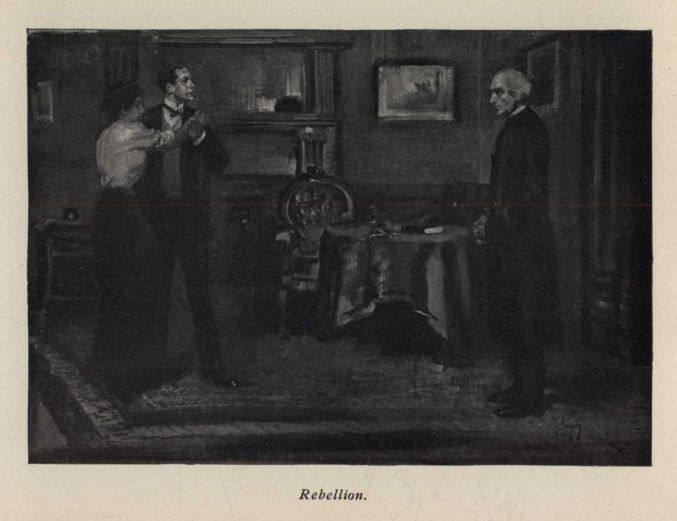
"I cannot repent that I have become myself."
"Then," he slowly uttered the inexorable words, "you cannot receive absolution."
"Father," she answered, "the only thing I am sorry about, and I am sorrier than you know, is that it will make you, personally so unhappy!"
For a few seconds there was neither movement nor sound in the room. Then the old priest, with trembling hands and bent shoulders, passed from the room, and forever from Georgia's sight.
XXXIII THE APE
Father Hervey went slowly and cautiously down the front steps, holding to the rail with his right hand and putting his left foot forward for each separate step. He did not remember being so weary and discouraged for many years. He walked back to the parish house, his head slightly bowed, his hands clasped behind him, unnoting, or nodding slightly and in silence to those who greeted him.
Among all the backslidings that he could remember in his long pastorate there had been few, perhaps none, that had saddened him more than this one. He had grieved for many a vain and foolish sheep that had strayed away into the briers of sin, not to be found again, until, wounded and wasted, it stumbled home to die. For such is the nature of sheep and poor souls.
But Georgia's case was not within that parable. She was not weak or will-less. Her sin had been with cold deliberation, in open, defiant rebellion against the Church, knowing the price of what she did. Very well, let her pay it. His old lips drew together in a thin bloodless line, as in his mind he condemned her in reprisal for her few years of rebellious happiness to eternal and infinite woe. God was merciful, but also he was just, and that was justice. Yet the priest could not persist in the mood. Presently, in spite of himself he softened toward her. That she—the little child whom he had held in his arms and breathed upon at the baptismal font, had come at last to this—
It was the age, this wicked age of atheism, he told himself fiercely, that had corrupted her. She could not be altogether, altogether to blame that the current had been too swift for her to swim against. Perhaps the gentle Savior would yet touch her spirit with His mercy and guide her at last to the foot of His throne.
Doubt poisoned the very air she breathed; it broke out like boils and deep sores in the newspapers and books, symptoms of the corruption beneath; it was strident in the crass levity of the talk and slang of the street. It could not be escaped.
America, save for the Catholic fifteen million, doubted. The faithful stood like an island rising out of the waters of agnosticism. Was it strange that where the waves beat hardest, some of the sand was washed away?
Fifty years ago when he was a young man there had arisen in the world the great anti-Christ, who had been more harmful than Luther—Darwin, the monkey man. The Protestant churches, as ever uninspired, had first fought, then compromised with him. They tried to swallow and digest Darwinism. But Darwinism had digested them. The anthropoid ape had shaken the throne of Luther's Jehovan God. The greater anti-Christ had consumed the lesser.
The Church alone stood firm. She had admitted no orang-outangs to her communion table, and now her policy was justified by its fruits. Her faithful remained the only Christians in Christendom.
Ecclesia Depopulata, ran the old prophecy, the Church deserted. And the time was near upon them for the fulfillment of the words. France, Italy, Portugal, and even Spain, were in revolution against the Keys of Peter. The evil days were coming, Ecclesia Depopulata.
But a new age of faith was to follow, so also it was prophesied. The deathless Church could not die. Once again she was to rule a pious world in might, majesty, dominion and power—and her sway would endure until the last day.
He fell upon his knees in his bare ascetic study and presently arose refreshed, a fighting veteran in the army that will make no peace but a victor's.
XXXIV WHICH BEGINS ANOTHER STORY
MAKES DIVORCE SPEED RECORD
Judge Peebles Sets New Pace for Untying Nuptial Knots.
Cupid went down for the count in the courtroom of Circuit Judge James M. Peebles when five couples were legally separated yesterday afternoon between 3 and 4 o'clock—about ten minutes for each case. This is said to establish a new record in Cook county for rapid-fire divorce. The cases, which were uncontested, were as follows:
Rachel Sieglinde vs. Max Sieglinde; abandonment.
Harmon A. Darroch vs. Lottie Darroch; infidelity.
Mary Stiles vs. Jonathan Stiles; drunkenness.
Georgia Connor vs. James Connor; drunkenness.
Sarah Bush vs. Oscar Bush; drunkenness and cruelty.
None of the defendants appearing, the decrees were entered by default.
Georgia read the item twice and smiled bitterly. So her divorce was one of the "rapid fire" variety! They said it had taken ten minutes. She knew it had taken ten years.
And Bush, Darroch, those other people—might they not also have walked in Gethsemane? Was this what the papers meant by their humorous accounts of "divorce mills"? She had received an especially vivid impression of Mr. Darroch and never would forget him. His case had come just before her own. He had spoken in a nasal, penetrating voice and she heard plainly every word when he testified. He was a short middle-aged man whose young wife, after ruining him by her extravagance, had run away with a tall traveling salesman. Even after that Mr. Darroch had offered to forgive her and take her back. But she wouldn't come. Then finally he divorced her, as the reporter put it, with record-breaking speed.
The day after her decree was granted Georgia Talbot Connor and Mason Stevens went by automobile to Crown Point, Indiana, where, with Albert Talbot and Leila Frankland as witnesses, they were presently assured by a justice of the peace that they now were man and wife.
She was compelled to cross the state line for the ceremony because the laws of Illinois forbade her remarriage within a year; and she thought that she had waited long enough, the state legislature to the contrary notwithstanding.
The party of four, when they returned to Chicago had a bridal dinner in a private room, with white ribbons and cake. When it was finished Georgia kissed L. Frankland for the second time in their lives. The first time was in the automobile on the way back from Crown Point.
"Good-bye, Al," she said to her brother. "You must come to see us in Kansas City soon."
"Yes, indeed," said Stevens.
"I certainly will," promised Al.
"And mama," she spoke a little wistfully, "tell her we'd like her to come too if she would. Tell her, Al."
"Yes, all right."
"I'll send you something every week for her. Maybe, I'm not sure, maybe I'll keep on working."
"Maybe you won't," Mason interjected with conjugal promptitude.
"Don't be too sure," she laughed, "and anyway, if you don't behave nicely I can always go back to L. Frankland."
When the man and his wife were alone in their room he returned to the moment of their betrothal.
"Dearest," he said, "when the priest went out and left us—"
"Yes."
"I felt almost as if he were trying to lay a curse on us."
"Yes, that was the meaning of it."
"When he said you couldn't receive absolution."
"Yes, our—their teaching is that without absolution a soul in sin is damned eternally."
"And you will never be afraid?" he asked, almost fearful of his wonderful new happiness.
She pressed her husband's hand against her breast, so that he felt the strong and steady beating of her heart.
"No," she answered him, "I will never be afraid. For I believe that God will understand everything."
THE END.