"Real Gold" (continued 4)
Reading edition
Then going right to the edge, he tried to look over, but drew back a little and stretched out his hand to John Manning, hooking his fingers the while.
The old soldier stepped forward. Long discipline and training had made him ready to grasp his master’s wishes, and planting his right foot against a projecting piece of the rock, he hooked his fingers in the colonel’s, and then hung slightly back, giving a little and a little more, till the latter was able to lean right out and gaze down.
It was by this time far lighter, and the mist was here and there transparent, as it came eddying up more and more like the clouds of smoke from a fire, but there was no piercing even the lightest parts; and giving this up in despair, Colonel Campion rose up, made a sign to them to stand firm, and then stepped rapidly in the direction from which they had seen him come.
One minute they saw his figure growing fainter along by the side of the rock-wall, the next he had disappeared in the gloom and mist.
“Let’s follow,” said Cyril, with his lips to John Manning’s ear.
The man shook his head.
“Soldier never leaves his post without orders,” he replied. “Better stay, sir.”
Cyril hesitated, but stayed; now watching the spot where the colonel had disappeared, now letting his eyes wander round the place, which, as the growing light of day penetrated it more and more, was still awful enough, with its whirling mist, gloom, and deafening roar of invisible water falling behind the pearly veil, but far from being as terrible as when it was all shrouded in deep obscurity.
For the light came down softly from high above their heads, showing that though the rocky walls nearly approached, there was a firmly-defined band that would probably be bright and golden when the sun rose, but John Manning’s words were justified as he suddenly leaned forward and said:
“What a place, sir! It’s a wonder there ain’t four of us gone for good.”
Just then the colonel reappeared with half-a-dozen of the raw hide ropes used about the mules for lassoes, tethering, and binding on their loads.
These he threw down, and John Manning followed his example as he began to knot them together.
“Bear me?” shouted the colonel to the old soldier.
“Two of you, sir,” said the latter; “but you lower, I’ll go.”
The colonel shook his head angrily—the task of speaking was too much in his state of anguish—and he went on trying the knots he made, while Cyril picked up one end and examined a couple of the knots before making a strong loop, and passing it over his head and shoulders.
His action passed un-noticed for a few moments, for he had drawn back; but when the last rope was joined to the others, the colonel turned and grasped the boy’s intention.
“God bless you, my lad,” he cried, “but I cannot let you go.”
Cyril hardly heard a word in the midst of that deep-toned, booming thunder, but he grasped their import, and stood firm.
“Yes,” he shouted. “I’m light. Lower me down.”
A curious sensation attacked him as he spoke, and he knew that he was turning pale, but he faced in the direction of the gulf, and tried hard to pull himself together.
“Perry would have gone down after me,” he said to himself, “and it isn’t so very dangerous after all.”
But all the while he knew that it was, and also that it was a task calling for nerve, determination, and strength, all three of which he seemed to be wanting in when face to face with the dense, wreathing mist of that terrible gulf.
“I don’t care. I’m afraid, horribly afraid,” he muttered between his teeth. “But I’ll go. I’d go if it was twice as dangerous, if it’s only to let father know I’m not all bad.”
Meanwhile, a short discussion, painfully hard, went on between the colonel and John Manning, the former hesitating, the latter insisting.
“He’s light, and can do it better than you. Perhaps we couldn’t pull you up, nor you me.”
Then the colonel held out his hand to Cyril, who grasped it eagerly, but in an instant the colonel’s face began to work, and he drew the lad to his breast, held him there for a brief moment, and then released him.
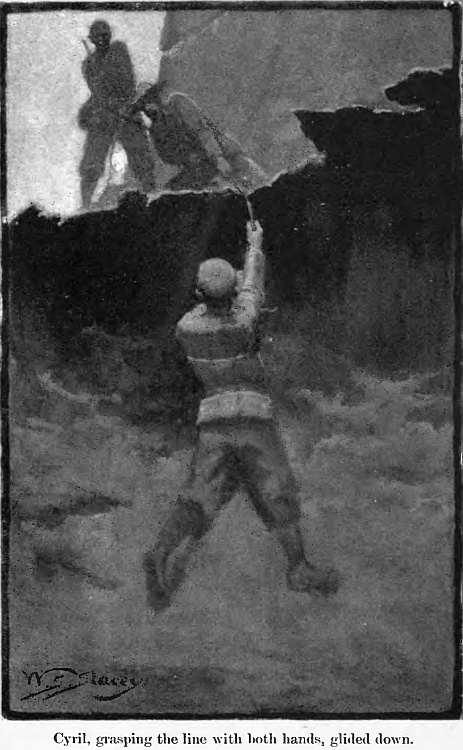
“I’m not afraid now,” shouted Cyril, and he stepped at once to the edge, and, as the line was tightened, went down on his face, passed his legs over, and, grasping the line with both hands, glided down; seeing the faces of the two men who held the rope disappear, then the shelf; and the next minute, as he was lowered, he saw nothing but the light mist which closed him in, and struck dank and chilly to his face and hands.
He had expected to swing to and fro in the air, and had prepared himself to grasp at the rock, and try to prevent himself from turning round and round; but to his surprise he found that he was on a sharp incline, down which he was sliding easily, for the rock was covered with a slippery mossy growth, over which his hands glided whenever he tried to check his course; for, in spite of his determination, the desire to do this mastered him. Anything to stop himself from going down into that awful place at some terrible depth below, where the water was churning round and round, and tossing up this mist of spray. To go down into that must mean instant death; and after all, what good was he going to do? Poor Perry had slipped, gone over the edge, and then not fallen headlong, but glided down at a terrible rate, with no power to arrest his course; and, if he were not down there below, he must have been swept out by the stream, and be far away down the river by then.
These thoughts came quickly as he slipped gently down, keeping his face toward the roaring water and churning mist, but seeing nothing; for the darkness now, as he was lowered more, began to increase.
Down, down, down! Was there no end to the rope? How long it seemed before it was checked. Still Cyril tried hard to make out something of the whereabouts of his friend. But no; if he turned to the right, toward where there was the hissing noise of the falling water, all was black, as black as it was below in the fearful hollow into which it plunged, to send up that deafening, reverberating thunder. At last to the left there, where he knew the chasm must open into the valley by which they came, he could see a faint suggestion of light, such light as one sees when looking towards a candle with the eyes tightly closed, and when trying to peer through the veined lids.
Then, to his horror, he was being lowered again, for he had believed that the end of the hide rope was reached.
It seemed a great depth down before there was another check, though probably it was not more than a dozen or twenty feet; and once more, as he tried to grasp the slimy rock behind him, he peered about vainly, knowing that if poor Perry had once begun to glide down that horrible slope, he must have gone right on down to the bottom.
Then there was a heavier strain upon his chest, and to his intense relief, now that he felt how vain his effort had been, he turned his face toward the rocks, and tried to help by climbing, as he was being drawn up.
Vain effort. Hands and feet glided over the slippery moss, and he soon subsided, and waited in increasing agony, while he was steadily hauled up. For, in descending, his senses were hard at work, and he was momentarily hoping to rest upon some shelf where he might come upon Perry. But now he had nothing to do but think of himself and his risks, and, in spite of the effort to be brave, he could not keep his mind from dwelling upon the knots of the several ropes, and wondering whether those John Manning tied were as firm as the colonel’s, and whether the rope itself might not have been frayed by passing over the rocks, and give way just before he reached the shelf.
At last, with head burning, hands and feet like ice, and clothes drenched with the spray, he felt himself seized by John Manning’s strong fingers and lifted into safety.
It had now become light enough for him to see well around; the mist on high was turning roseate and warm by reflection, for the sun was rising; and the colonel turned from him with a look of agony, and stood with his back to them, while John Manning unloosed the rope.
“Nobody could come out of such a place as that, my lad,” he said, “alive.”
Chapter Twenty One.
The Pursuit.
“I’ll go down again, sir,” said Cyril, when the colonel had turned back, and he had tried to make him understand the nature of the place, as far as he had been able to make out.
But the colonel shook his head.
“We must go back, and try to reach the stream where it flows out, my boy,” he said. “We can do no good here.—Come, Manning, and fetch the mules.”
John Manning stared, and seemed as if he could not understand.
“The mules, sir—go back and find the stream? What about the Indians, if they are coming on?” The colonel had forgotten their pursuers. “The mules,” he said then; and he led the way on into the mist, Cyril following him wonderingly along the continuation of the rocky shelf for about a hundred yards, and glancing back from time to time to see that John Manning was close behind, untying the knots of the hide ropes as he came.
Every step took them nearer to the great waterfall, and in the dim light Cyril now made out that the path was wider; but all at once it seemed to end in front of a gleaming sheet of water reaching from the thick mist below right up to where the rock-walls appeared to give place to the spray-clouded sky. And there, just before them, all huddled together, stood the mules, ready to turn toward them as they approached.
“They brought me as far as this last night,” said the colonel, “and then stopped. No wonder, poor brutes, they would go no farther; and I was lost in the darkness, and dared not turn back. I stood with them till daybreak, hoping you all were safe, and then—”
Cyril uttered a wild cry of joy, one which made itself heard by all, for a bare-headed misty figure, whose presence they had not been aware of as it followed them, suddenly caught the colonel’s arm, placed its lips to his ear, and cried:
“Quick, father—the Indians; they’re coming down the valley fast.”
In the face of such news as Perry bore, there was no time to ask questions about his escape, but as the colonel grasped the boy’s arm, trembling the while with excitement, his heart throbbing with joy, he cried:
“How far away?”
“Not half a mile. I could see them coming down the valley.”
“This way,” said the colonel promptly, and he supplemented his words with gestures, as, still holding his son’s arm tightly, he led them on through the mist of fine spray inward toward where the mules were standing together. And now as they approached the fall, a great deal of the horror caused by the darkness and noise passed away, for the mist grew opalescent from the sunshine far above, and though progress looked terribly perilous, they could see the extent of their danger, and there was no mystery of hidden peril, no constant dread of unknown chasms waiting to engulf them at their next stride.
For they knew now that they were in one of Nature’s wildest and grandest rifts, where a goodly-sized river, after tearing its way along the profound depths of a narrow gorge, had reached a spot where by some earthquake convulsion this gorge had suddenly, as it were, broken in two. One part had dropped several hundred feet, forming a profound chasm into which the water from above leaped in one great glistening wave, smooth as so much gleaming glass, to be broken up into spray as it reached the jagged rocks below, and there eddy and foam in what was undoubtedly a huge basin, from which the mist arose, while the broken water swept on down into the valley to join the little stream by whose side they had come.
The leading mule threw up its head as the colonel approached, and its parted teeth and drawn-back lips suggested that it was whinnying a welcome or a demand for food. But the great fall before them, and the knowledge that at any time the Indians might appear from out of the dense mist and commence their attack, gave the colonel eyes for only one thing, and that a way out of what seemed to be a perfect cul de sac.
The deafening roar, of course, prevented all consultation, and the mist added to the confusion; but these had their advantages for the fugitives, veiling their actions from their pursuers, and preventing any sound made by the mules from being heard.
And as Cyril watched their leader’s actions, and then caught an encouraging look from John Manning, who gave his head a jerk in the colonel’s direction, as if to say: “It’s all right, he’ll find his way out,” the boy felt in better spirits. The terrors of the night were gone; they were all there safe, and there was the possibility of the Indians feeling as much in awe of the terrible chasm as they had themselves, and hence shrinking from making their way through the mist, and giving them the credit of going on down the valley by the greater stream which issued from beneath the falls.
Cyril’s thoughts were many, and in the reaction from the terrible despair from which he had suffered, he was ready to accept anything short of the marvellous; and consequently he was in nowise surprised on seeing their leader go right on into the darkness, peering here and there, and the leading mule follow him and Perry, the rest getting in motion directly, and going on into the mist till the last had disappeared.
Just then John Manning, who had turned to look back, wiping the moisture from his face, clapped Cyril on the shoulder, and placed his lips close to the boy’s ear.
“Can’t see ’em coming. This’ll scare ’em from following. They’ll think nobody but mad folk would ever come along here. I say, he’s found a way behind the fall.”
But John Manning was wrong.
They followed the direction taken by the last mule, together stepping cautiously onward through the mist, for the rugged shelf they were on was dripping with moisture, and felt slippery beneath their feet, while to their left there was the huge body of water always gliding down into the spray which eddied up to meet it. Then, to their intense astonishment, they stepped right out of the dense, clinging mist, which hid everything, into a clear atmosphere. It was quite in twilight that they stood, but the falling water brought with it a cool current of air; and as they both stopped for a moment to gaze and wonder, there to their left was the great fall rushing down clear of the rock behind, and leaving plenty of room for any one to pass through to the other side, beneath the water, had the shelf been continued there; but it passed round to their right, as if Nature had made a natural staircase, zigzagging up the side of the gorge; and there, some distance above them, were the colonel and Perry, mounting slowly after the leading mule, which showed no hesitation about proceeding now that it was day.
John Manning nodded, and they followed up and up the giddy path, now leaving the fall some distance behind, now approaching it again, but always near enough to be terribly impressed by the vast curve of gleaming black water, which, as they rose higher, could be plainly seen plunging down into what appeared to them as a dark grey cloud.
From time to time the colonel looked back and waved his hand, stopping at last at a spot where the natural track curved suddenly round a sharp point of rock. The mules followed one by one, their heads right down, and their feet carefully planted at every step, till the last had gone round; and then in turn Cyril and John Manning climbed up, and before passing the sharp rock, stopped to gaze down into the vast rift up whose side they had mounted so far.
From this point the whole of the wild zigzag was visible right to where the grey veil of mist shut off the level shelf where they had passed the night, and John Manning’s lips had just parted to utter some words about the horrible nature of the place, when Cyril started back and jerked his garment, to make him follow suit.
The old soldier was keenly alive to danger, and dropping upon his knees, he joined Cyril in cautiously looking over the edge of the rocks they had just ascended, softly bringing the muzzle of his piece to bear upon what he saw.
For, as he gazed down, there in the gloom, not two hundred yards away as an arrow would fly, but at a distance which it had taken them nearly half an hour to climb by the gradual ascent, was the figure of an Indian standing out just clear of the mist, and peering cautiously about, as if searching every rock and crevice around.
The next minute another had joined him, coming out of the mist cautiously, and with the tentative motion of one who was on strange ground.
Then came another and another, with their figures looking huge and grotesque as they stood in the mist, and then suddenly shrinking into the stature as of dwarfs, as soon as they were clear.
One by one they came on, till there were at least thirty collected together, and all gazing about cautiously, as if in dread.
As Cyril knew from his own experience, they could only converse with difficulty, so that he was not surprised to see that one of them, who appeared to be the leader, was gesticulating and pointing here and there, and finally upward toward where the two fugitives were watching every act.
But, as the boy watched the Indians keenly, it was very evident that they were far from confident, and he soon decided that they were as much panic-stricken by the horror of the place as he and his friends had been overnight. At last, though after a great deal of pointing upward and hesitation, it seemed as if they were all reluctantly about to continue the pursuit, for their leader took a few steps forward and waved them on.
But they did not stir, save to crowd together a little more and press toward the wall of rock, away from the fall.
“They don’t like it,” whispered John Manning, for it was becoming possible, where they lay, to make a few words audible without shouting. “Strikes me they’re so scared, that if we were to send one of these big pieces of rock rolling down, they’d beat a retreat.”
“Look, look!” whispered Cyril.
“I am,” said John Manning, for all at once a couple more of the Indians suddenly appeared from out of the mist, in whom they recognised Diego and his fellow-guide, the former holding something in his hand which he was showing to all in turn with a great deal of gesticulation, accompanied by eager pointings down into the depths below the fall, and back through the mist.
“What’s he got there?” whispered John Manning. “Something to eat? He wants them to go back.”
“I know,” said Cyril so loudly that his companion caught his arm. “It’s Perry’s cap.”
“What!” cried the old soldier. “I know how it is. They’ve found it somewhere down the stream, where it had been washed, and he’s saying that we must all have tumbled in there and been swept away.”
This appeared to be a very likely interpretation, for, with a great display of eagerness, the men hurried back through the mist till all were gone.
“Let’s make haste on and overtake them,” said Cyril eagerly. “I want to ask Perry where he left his cap.”
“And he’ll tell you, sir, that he didn’t leave it anywhere, but had it took away by the water.”
“Are they in sight?” said the colonel, bending down over them. “You were quite right. This is an excellent place to keep them back. Yes,” he continued, on hearing the surmises of the two watchers, “that must be it, and they have gone back to follow the stream.”
He led the way again, and they followed to where Perry was anxiously looking back, as the mules steadily went on higher and higher up the gloomy gorge, where the great stream was hurrying and foaming along toward where it would make its plunge; while the thunderous roar of the fall was rapidly dying away, shut out, as it now was, by curve after curve of the valley.
The place was black and forbidding enough, but as they got on another mile or two, their journey was brightened by the glow upon the ridges and slopes on high where the sun reached, and the grassy sides of the lower mountains looked delightful after their long experience of black, dripping stone.
Many a look back was given as they went on higher and higher, every step taking them more into the mighty range, and fortunately due west; and, weary as they all were, intense was the longing to hurry their steps. But that last was impossible. They were dependent upon the mules for their supply of food, and the cautious animals only had one pace, and this regulated their masters’.
At last, when utterly exhausted, a halt was called just at a sharp turn in the gorge, where water could be reached, and the rocks sheltered them and the mules from pursuers; while they gave them the opportunity of scanning the narrow way for nearly a mile, so that if a watch was kept, it was impossible for them to be taken by surprise.
There was some stunted herbage too, here, upon which, as soon as they had drunk, the mules began to browse. But no load was removed, arms were ready for an attack, and the only mule that was lightened was the one that bore the provisions.
And now Perry was questioned more closely about his escape, and Cyril heard it from his lips for the first time.
Chapter Twenty Two.
Perry’s Peril.
“There isn’t much to tell,” said the boy with a shiver.
“Never mind; tell me: I want to know. What’s the matter—cold?”
“No, I’m warm enough now,” said Perry, “for my clothes have got dry; but it makes me shiver as soon as I think about it, and I feel as if I always shall. It’s a thing I shall dream about of a night, and wake up feeling the water strangling me.”
Cyril looked at him in wonder, and the boy tried to smile, but it was a very pitiful attempt, and he went on hurriedly.
“You know how horrible all that was when I felt sure that my father had gone down somewhere, and something forced me to go and try to find him. And then, as I went on through the mist, I only took three or four steps before my feet gave way, and I was sliding at a terrible rate down, down to where the water was thundering and roaring.”
“Was it very deep?” said Cyril, for his companion paused.
“I don’t know; I seemed to be sliding along very fast, and then I was fighting for breath, and being dashed here and there, and I suppose I was carried along by the water almost as swiftly as I slid down that dreadful slope. Then, after fighting for my breath, all was confusion and darkness, and I can’t remember any more till I found myself lying among some rocks. The water was rushing and foaming over my legs, and every now and then rushing up over my chest, and making me feel so in fear of being drowned that I climbed a little, and then a little more, till I was out of the water, but afraid to move in the darkness in case I should fall in again.”
“Where were you?” said Cyril.
“I didn’t know then, but lay aching with the cold, and listening to the rushing water; while it was so dark, that I felt sure that I must have been washed into some great hole underground, where I should lie till I was dead.”
“We felt all kinds of horrors about you,” said Cyril, “but you seem to have suffered more than we did.”
“I don’t know,” said Perry plaintively. “It was very bad, though, and if I hadn’t fallen at last into a sort of stupor, I’ve thought since that I should have gone mad.”
“Stupor!” said Cyril, smiling. “You mean you went to sleep.”
Perry looked at him so reproachfully that Cyril felt the blood flush into his cheeks, and the colour deepened as his companion said: “How could a fellow go to sleep when he believes his father has been killed, and he has himself just escaped from a horrible death?”
“Don’t take any notice of what I said,” cried Cyril hurriedly; “I did not mean it.”
“I know you did not. I suppose it was from being so exhausted. I felt as if I had been stunned, and could neither think nor stir, and then this curious feeling came over me, and everything passed away. It was not sleep.”
“No, no; don’t say that again,” cried Cyril apologetically. “How long were you like that?”
“I don’t know, only that it was still dark when I came to, and sat wondering where I was, and whether I should ever see the light again, so miserable and desolate you cannot think.”
“Yes, I can,” said Cyril warmly; “I felt bad, too, when I thought you were drowned, and went down to try to find you.”
“What!” cried Perry excitedly. “You went down to try to find me?”
“Oh yes,” said Cyril coolly. “Didn’t you know? They put a rope round me and let me down.”
“Cil!”
“Well, don’t make a fuss about it,” said Cyril, laughing. “They had hold of the rope.”
“But the place was so awful. Didn’t you feel frightened?”
“Horribly, of course, and it was ever so much worse when I’d got to the end of the rope, and felt that you must be gone. But never mind that. Go on. You were saying how miserable you were.”
“Yes,” said Perry thoughtfully, “till all at once I caught sight of something high up, just as if it was a point of light coming through a crack in the roof of the cavern into which I had been washed.”
“And was it?”
“No,” said the boy, with his eyes brightening, “it was the first light of morning shining miles up on the ice of one of the great peaks, and as I watched it, I saw it get brighter and then begin to glow as if it were a precious stone. The light gradually stole down lower and lower, till it seemed to come right into my heart; and from that moment I began to grow strong and hopeful, and something seemed to tell me that I should see you all again.”
“Hah!” ejaculated Cyril, as he watched his friend’s countenance; “I wish something of that kind had come to me when I was feeling worst.”
“You weren’t alone,” said Perry, smiling. “Well, as soon as I found that I was just at the edge of a rushing torrent, I knew that if I followed it up, I should come to the mouth of the gorge where you must be, and I began to climb along the side, getting warmer every minute; and I felt more hopeful too, for I began to think how clever my father was, and that he would have been able to save himself, or have been saved, just as I was.”
“And then you soon found the mouth of the gorge where the water came out?”
“Yes, and the place where we turned in last night, instead of going right on down the main valley. It was quite a climb up to the path, but I dragged myself up; and just then I happened to turn my eyes along the way we came just as I was warmest, and then I turned cold again.”
“Because you saw the Indians?”
Perry nodded, and the boys sat in silence for a few minutes, looking up at the sunlit sky, which appeared like a broad jagged path running along high above their heads.
“What are you thinking about?” said Perry suddenly, as he noted the thoughtful, deeply-lined brow of his companion.
“Eh? Oh, nothing much,” replied Cyril. “Only that when I knew you were coming up into the mountains, I felt so jealous of you, and I fancied that you were coming to see all kinds of wonders and make great discoveries, and that it would be one grand holiday, day after day, and instead of that—I say, we haven’t had so very much fun yet, have we?”
“Plenty of adventures,” replied Perry thoughtfully.
“Yes, plenty of adventures.”
“It’s been so hard upon you, though, from the first. You were so upset when you joined us.”
“And serve me right,” cried Cyril angrily. “I’d no business to do it; I believe they think at home that I’m dead. Nothing’s too bad to happen to me.”
“Then you’re sorry you came?”
“Yes; horribly. I don’t mind all we’ve gone through, because it has seemed to stir me up so, and made me feel as if I’d got more stuff in me; and it ought to, for sometimes I’ve felt, since we came, that I behaved like a miserable, thoughtless coward.”
“No one could call you a coward,” said Perry firmly.
“Oh yes, they could—a miserable, selfish coward.”
“I should just like to hear any one call you one,” said Perry viciously, and with a hard, fierce look in his countenance.
“Then you soon shall,” said Cyril. “I call myself one a dozen times a day. There, I’m a coward.”
“But I meant some one else.”
“You wait long enough, and you’ll hear my father call me one.”
“You’re not.”
“Yes, I am, and I shall deserve all he says—that is, if we ever get back to San Geronimo.”
“Don’t talk like that,” said Perry. “What’s to prevent us?”
“Indians,” said Cyril mournfully.
“But we’ve left them behind.”
“For a bit. They’ll hunt us out again somewhere. They’ve got all the advantage of us. I daresay there are thirty or forty of them hunting us, and what one doesn’t know of the country, another does; and as they spread out, they’ll warn every Indian they meet, so as to run us down, for they’re sure to feel now that we’re after the buried treasures, and they’ll give us credit for having found them.”
“Why?”
“Because we have escaped. Every pass will be guarded, and every valley searched, so that they are sure to come across us at last.—Look, they’re going to start. Come along.” And picking up their guns, the boys joined the colonel and John Manning, who were tightening up the ropes round two of the loads.
“Better trust the leader, Manning,” said the colonel.
“Yes, sir. He seems as good as a guide; and if you set his head straight, he’ll take us somewhere; and where he goes, the others’ll follow. Rum thing, too, sir.”
“Oh, I don’t know,” said the colonel; “these animals have passed their lives in the mountains.”
“Of course, sir, but I didn’t mean that. I meant it was a rum thing for them to follow their leader in this way, for they all hate him like poison, and kick at him whenever they have a chance; and as for the way he kicks at them, I wonder sometimes he doesn’t get his heels stuck in their ribs, so that he can’t get out no more. ’Tis their natur’ to, eh, Master Cyril, sir?—Ah, would yer!”
This to one of the mules, whose heels must have itched, for it was softly turning itself round as if seeking somewhere to administer a good round kick.
Then all was ready for a start; but first the colonel mounted the side among the rocks, to search the valley with his glass.
He was soon satisfied that the Indians were nowhere within sight, and taking advantage of the high position he occupied, he turned the glass in the other direction, to scan the way they were about to go.
All there was utterly silent and desolate. There were the rocks everywhere, hardly relieved by a patch of green, and he was about to descend and start the mules, when he caught sight of Cyril hurrying back toward him, and signing to him to stay where he was.
“What is it?” he cried, as he saw the boy’s anxious face.
“Look up to your left, sir, just above where that big rock sticks out just as if it must fall.”
“Yes, I see,” said the colonel; “with another just above.”
“That’s it, sir. Look just between those two blocks.”
“Yes, I have the place.”
“Well, sir, there are two Indians there watching us.”
“No, my lad, there are no Indians there. Take the glass and look for yourself.”
Cyril snatched the glass, directed it to the steep, precipitous side of the gorge, and then uttered an ejaculation full of annoyance.
“They’re gone, sir, but I’m sure there were two men there.”
“Then if so, they must be close to the same spot now. I hope you are wrong, but of course you may be right. Let’s go on, and if they are there, we shall be sure to catch sight of them, for they must go forward or backward.”
“Would you go on?” said Cyril dubiously.
“At any cost, boy. We cannot go back to that awful chasm to pass another night. There, back with you, but keep your eyes on the position in which you saw the men.”
Cyril was silenced, and half ready to suppose that in his anxiety he had deceived himself; and in a few minutes he was back with the colonel, beside Perry and the mules, but without seeing anything in the direction he had pointed out.
“Ready?”
“Yes, sir, but my eyes are not quite so good as they were, sir, and I fancied I saw some one creeping along the side of the rock, up yonder to the right.”
“Left, John Manning,” cried Cyril, “and I saw it too.”
“You saw something on your left, sir? Then I am right, and my eyes are true. There’s Injuns watching us, sir, and if we don’t look out, we shall have arrows sticking in our skins.”
Chapter Twenty Three.
At the Bivouac.
The boys were heartily glad when, just before nightfall—night, which fell much sooner, shut in there in the deep valleys of the Andes—the colonel snatched at a suggestion made by John Manning.
“Water, sir, coming out of that slit in the rock, plenty o’ breastwork, and a bit of green stuff for the mules.”
“Yes, we’ll halt here. We are not likely to find a better place,” said the colonel.
So instead of tramping on for another hour, a halt was called early, the packages formed into a shelter in front of the “slit” in the rock, as John Manning called it, a place which suggested its being a way into a good-sized cavern, and then a fire was lit, and they prepared their meal.
For no more had been seen of the Indians, and though the colonel had a shrewd suspicion that they might still be in chase of them, those which had been seen in the valley were, he concluded, only wanderers, whom they had startled while on some hunting expedition, and whom they would probably see no more.
The fire was only used to heat the water for their coffee, and as soon as this was made, carefully extinguished by John Manning, so as not to attract attention if any one was still about; and then they sat, glad of the rest, eating biscuit and charqui, and sipping coffee from the tin.
Over the meal, John Manning made a report respecting what he called the commissariat department.
“Stores getting low, sir,” he said.
“Yes, I must supplement them with one of the guns,” said the colonel. “I have been so much taken up with getting the cinchona seed, that I have hardly thought of anything else.”
Very little was said then for some time, the weariness mentally felt by all making them ill disposed for conversation; but just before dark the colonel carefully inspected their surroundings, and with John Manning’s help, made a few arrangements for their defence.
“I don’t think they would dare to attack us if they found where we are,” said the colonel; “but we must be prepared.”
“Is it worth all this trouble and risk, father?” said Perry, who was, in addition to being weary and low-spirited, stiff, and a good deal bruised.
“What! to get the seed, boy?”
Perry nodded.
“Lie down and rest, and wait till the knowledge comes to you, boy. There, I’ll speak out and ask you a question. Do you think it is good for humanity at large for one of the greatest blessings discovered by them, for the prevention and cure of a terrible ill, to be solely under the control of one petty, narrow-minded government, who dole it out to the world just as they please, and at what price they like? Why, such a blessing as quinine ought to be easily accessible all the world round, and if I can succeed in getting our precious little store safely to England, it will be the beginning of a very great work. Worth the trouble? Why, the tenth part of what I have obtained of full ripe seed, of what is undoubtedly the finest white-flowered kind, would be worth a hundred times the labour and risk we have gone through—worth even giving up life, my lad, so that others might benefit by what I have done.”
“But suppose, when we get it to England, it won’t grow,” said Perry.
“Why, you doleful young croaker!” cried the colonel merrily, “I don’t expect it to grow in England. Tropic plants do not flourish in our little, cool, damp isle. There are plenty of places, though, where it would grow, if we get it safely home.”
“Getting it wet isn’t good for it, is it?” said Perry sleepily.
“You are thinking of what you have in your pockets,” said the colonel. “That will not have hurt, for it would dry again pretty soon.—You have yours safe, Cyril?”
“Yes, sir, there’s about three pounds in my pockets.”
“I have as much, and John Manning a little more, while I have a small packet in each of the mules’ loads.”
“So as to make sure of saving some of it?” said Cyril eagerly.
“Yes, that is the idea, my lad,” said the colonel. “Now, boys, Manning and I will take it in turns to watch. There, get a good rest, and don’t think that I should have gone through all this labour, risk, and excitement unless I had felt that I was doing something well worthy of the trouble; so make up your minds to get it safely to San Geronimo.”
He left them, as usual, to see where the mules were grazing, and Cyril sat gazing down before him.
“What’s the matter?” said Perry.
“I was thinking that it’s all very well for you people to get back home, only it isn’t so pleasant for me.”
“Father will speak to Captain Norton for you,” said Perry.
“No: I don’t want him to. I shall speak myself. I wouldn’t have my father see me sneak in behind yours in that cowardly way. Oh dear, I wish it was over!”
“Mules feeding well and all quiet, boys,” said the colonel; “and to all appearance there isn’t a soul near us for miles.—By the way, Manning, did you go into the cave?”
“No, sir. Did you tell me? Seemed too damp to use for sleeping.”
“No, I did not tell you; but get the lantern and let’s look inside. We don’t want to be disturbed by some animal coming out in the night.”
Manning took the battered lantern, and led the way to where the spring came gushing out of what at a distance looked like a long, narrow, sloping crack, but which proved to be, on closer acquaintance, large enough for a man to walk in upright by stepping from stone to stone, round about which the water came gurgling and bubbling out.
It was about a dozen yards from where their fire had been lit, amongst the stones fallen at different times from the heights above; and as they approached, a low musical rippling greeted their ear in a pleasant murmur, suggesting that the spring must come for some distance through a low, natural passage, whose stony walls caused the echoings of silvery splashings, which now grew louder and more strange.
“Yes, too damp-looking for a resting-place,” said the colonel; “and it does not look like the lair of any dangerous beast, but we may as well examine it, and we ought to have done so before. Why, boys, it would make quite a fortress if we had to defend ourselves. Plenty of water-supply, and ample room to drive in the mules.”
John Manning had gone inside at once, and as soon as he was a short distance from the narrow entrance, he struck a light and applied it to the candle within the lantern, holding it above his head, and then cautiously picking his steps along from stone to stone in the bed of the stream.
Whish, whirr, came a peculiar sound, and, as if moved by one impulse, the two boys rushed out, startled, to stand looking back, wondering why the colonel had not followed.
“What was that?” cried Cyril.
“I don’t know. Something rushed by my head,” said Perry excitedly, as he looked vainly round in the dim light, and then back at the faintly lit-up entrance to the cave, where the lantern, now invisible behind a curve, shone upon the moist stone wall.
“Come along back,” cried Cyril; “what cowards they will think us. It must have been birds. Ah! yes; look, dozens of them,” he cried, pointing to where what seemed to be faint shadows kept gliding out and shooting upward over the face of the rock, to disappear at once in the evening gloom.
“Think they are birds?” said Perry, in an awe-stricken voice.
“Birds or bats,” said Cyril. “How stupid to be startled like that! Come along.”
He sturdily led the way back, ashamed of the sudden access of fear which had come upon him; though entering so strangely weird-looking a place by the feeble light of a lantern, and when unnerved by long toil and the dangers they had lately passed through, it was not surprising, and stronger folk might easily have been scared.
He had hardly got well inside again before his face was brushed by a soft wing, and he felt ready to run back once more, but this time he mastered the dread, and felt that Perry’s hand was laid upon his arm just as the colonel’s voice, which sounded hollow, echoing, and strange, said softly: “Goes in, perhaps, for miles.—Look, boys.”
The voice sounded close to his ear; but to his surprise he found that the lantern was quite a hundred yards in, and the light glimmering from the surface of the tiny stream, while there was plenty of room on either side for them to walk.
“Where are you, boys?” said the colonel, more loudly.
“Here, sir; coming,” cried Cyril, who grasped the fact, now, that their sudden rush out had not been noticed.
“It’s all safe so far; no crevices or chasms,” said the colonel; and as the two lads approached, “Did you see the birds? They are flying about overhead in flocks. Hark at the rush of their wings!”
As he ceased speaking, and his voice was no longer reverberating and whispering about overhead, a peculiar fluttering, whirring sound, as of many wheels in rapid motion, struck upon the boys’ ears, a sound which added strangely to the mysterious air of the place. It was evident, too, that the roof was now far above their heads, giving room for the strange dwellers in darkness to wheel and swoop about, often so close that the wind raised by their pinions beat upon the explorers’ cheeks.
“Lucky I’d got the lantern door shut,” said John Manning, in a strange whisper, “or they’d have blown it out a dozen times over.—Shall I go any farther, sir?”
“No; it is of no use. But what a hiding-place! There’s room, Manning, for quite a brigade.—What’s that?”
A sharp crash fell upon their ears, as of a stone dislodged somewhere high up in the distance; and this was evidently the case, for they heard it rattle down, loosening others, and sending a reverberating echo along the cavern, which told of its vastness being greater than they had before imagined.
“One of the birds loosened a stone, sir,” said John Manning. “Look out: here they come.”
For, evidently alarmed by the falling stones, there was now the rush as of a mighty wind, and the little party could feel that a great flock of birds was passing overhead toward the entrance, hurriedly making their escape out into the open air.
“Let’s follow their example,” said the colonel; “we are only wasting time. But this would make a capital retreat if we were attacked; and we could defend it against hundreds.”
“Till we were starved, or burned out,” grumbled John Manning.
“It would take a forest on fire to burn us out of this, sir,” said the colonel. “What! make difficulties? We have plenty to encounter without. Now then, forward with the light.”
John Manning faced round, and led on at once, while, as he held up the lantern, the dark mass of birds in a regular train could be seen passing on toward the entrance, which was reached directly after, both boys uttering a sigh of relief on finding themselves once more in the outer darkness, where they could breathe freely, and feel as if a great danger had been escaped.
Chapter Twenty Four.
The Cave’s Mouth.
As soon as they were outside, Cyril looked round for the birds, expecting to see them swooping about in all directions, but there was nothing visible between him and the stars; and with the peculiar nervous feeling which he had felt in the cavern assailing him again, he turned to the colonel, who laughed.
“Well,” he said, “did you think it was something of what the Scotch call ‘no canny,’ my lad?”
Cyril felt more uncomfortable still.
“Do you think they really were birds?” he said.
“Of course; the South American cave-bird. A regular nocturnal creature.”
“What! a sort of owl, sir?”
“No. Perry here has seen their relatives at home.”
“I? No, father,” said the boy wonderingly.
“Nonsense. What about the nightjars you have seen hawking round the oak trees in Surrey, after sunset?”
“Oh yes, I remember them,” cried Perry.
“Well, these are, I fancy, birds of a similar kind, but instead of frequenting trees, they live in flocks in these dark caverns, and go out of a night to feed. Our light startled them just as they were about to take flight. This must be one of their great breeding-places.—But no more chatter. Sleep, and get a good night’s rest.”
Easier said than done. The boys lay down in company with John Manning, but it was long enough before either Cyril or Perry could drop off! They would close their eyes, but only by an effort, for they were always ready to start open again at some sound high up on one or the other side of the narrow winding valley. It was cold too, in spite of the blankets, and when Cyril did at last slumber, he felt that he could hardly have been asleep an hour, as he started up into wakefulness again.
Something was wrong he was sure, and he stretched out his hand to touch John Manning, who awoke instantly and sat up.
“All right,” he said, in a low voice.
“No, no, don’t move,” whispered Cyril, grasping his arm. “I fancied I heard something.”
“Eh? Fancied? Perhaps it was fancy, sir. I’ll ask the colonel.”
“Listen first.”
They knelt there in the darkness, attent for some minutes.
“Don’t hear anything, sir. I’ll go and speak to the colonel. What did you fancy?”
“I—I don’t know,” faltered Cyril. “It must have been while I was asleep. Yes,” he whispered excitedly, “that was it.”
“The mules!” said the old soldier. “What are they doing here in camp?”
For there came plainly now the soft pattering of hoofs on the stony ground, and directly after a tall figure loomed up out of the darkness.
“Want me, sir?” said John Manning, in a quick whisper.
“As you are awake, yes. There is something stirring close at hand, whether wild beast or Indian I can’t say. Keep watch, and cover us while I get the mules into that cave.”
John Manning’s double gun was already in his hand, and he stood fast while the colonel went by with the leading mule, the others following. Then directly after the soft pattering ceased, and the watchers knew that the patient animals had been led right into the cave.
“Hear anything, Master Cyril?” whispered John Manning.
“No.”
“And one can’t see down in this dark gash,” grumbled the man. “We humans are worse off than any of the animals. We can’t see so well, nor hear so well, nor smell so well, nor run, nor fly. Lucky for us, we’ve got gumption enough to make telescopes and steam-engines and ships, or I don’t know what we should do.”
“Who’s that?” said the colonel, returning. “Cyril?”
“Yes, sir.”
“Go and stand at the mouth of the cave, and mind that the mules don’t come out.”
Cyril obeyed, and took up his position on a stone in the gurgling stream, to stand listening to the soft patter of the mules within, and to the faint whispers which came time after time from where he had left the colonel and John Manning.
He had been at his position for some few minutes, turning from time to time in the darkness to cast a furtive look back into the entrance of the cavern, hardly able to restrain a shudder, as he thought of its unknown depths and the strange sound they had heard of the stone falling, and he could not help wishing that Perry was with him for company’s sake.
For there was a terrible feeling of lonesomeness there in the darkness, especially at a time like that, when he had just been roused from an uneasy sleep by something unexplained at which the colonel had taken alarm.
“He said either Indian or wild beast,” mused the boy. “What wild beast could there be?” There were, he knew, the wild varieties of the llamas, guanacoes, and the like, but they were timid, sheep-like creatures; and there were, he knew, pumas, the South American lions, as they were called, and perhaps jaguars—both these latter cat-like, nocturnal creatures; but they were animals of the forests, and not of these sterile, rocky valleys. Still, there might be other dangerous beasts in plenty, and his eyes wandered here and there, and he held his gun ready, though in that deep gloom he felt that he would be quite at the mercy of anything which attacked.
He had just reached this point, when his thoughts took a fresh direction—suppose some savage creature should be in the cave, and suddenly spring upon him from behind.
He turned cold with horror, and tried to call for help, but his mouth and throat were dry from the nervous trepidation he suffered; for he had suddenly been touched just below the shoulders, something big having given him a rude thrust. This was followed by another, which nearly sent him down into the water from the stone.
But he recovered himself, turned sharply, and struck out with his right hand—a quick angry blow, while he felt as angry with himself for his absurd cowardice, the second thrust having awakened him to the fact that he had received a heavy push from the head of one of the mules, which had come silently close up, and was desirous of getting out again into the open air.
Cyril’s blow drove the animal hastily back, and as he stood listening, he heard the effect of his sharp action, for there was a good deal of pattering about when the mule turned sharply to its companions, driving them farther in. Then there was silence once more.
“How easy it is to let one’s self be frightened,” thought Cyril. “I wish I were braver, and more like a man.”
Then he wondered why the colonel and John Manning did not come to him, and whether they were searching about for the cause of alarm. All was very still now, and it was some time since he had heard a whisper.
“Very likely I shall hear a shot fired,” he thought, and making up his mind not to be startled if he did, for that it would be a good sign and a proof that the cause of their night alarm had either been killed or frightened away, he stood gazing out into the darkness in all directions, and then smiled and complimented himself on his firmness.
“Not going to be scared at that,” he muttered, for there had been a sudden clattering of hoofs among the stones inside the cavern—just such a sound as would be made if one of the mules had kicked out at its companions, and made them start.
All was silent again for a minute, and then there was a faint splash.
“One of them gone down to drink,” said Cyril to himself, and he turned now and looked inward along the narrow opening, and could see faintly one of the stars reflected in the black water, now twinkling, now burning brightly. Then it disappeared, as if a cloud had passed across the heavens, though that could not be, for another star gleamed closer to him, but that was blotted out too.
“One of the mules coming out,” he said, starting and raising his hand, when there was a sudden bound made by something which had been crawling slowly out of the cave’s mouth; and as the boy struck at it wildly, his fist touched something warm and soft, and the object, whatever it was, made a stone or two rattle where it alighted, and then was gone.
Cyril raised his gun, but he did not draw trigger, for it was folly to fire quite at random, and he was leaning forward, peering into the darkness, when a faint click made him turn again toward the mouth of the cave, just in time to be driven backward and lose his feet as another of the creatures leaped out and dashed away into the darkness.
Two, and they were not mules, though evidently four-footed creatures. But what could they be? he asked himself, as he recovered his feet and stood with presented piece, his heart throbbing, and his finger on the trigger, ready to fire at the next movement from the cave. They could not be pumas, for the touch he had of the first one’s body was not furry; neither could they be large monkeys, for they would not have smooth bodies, and besides, these creatures were too large.
He was still in doubt, when there was a sound behind him, and as he turned sharply, a husky whisper:
“Don’t fire, my lad. What was that?”
“Did you hear it, Manning?”
“Yes, and had a glint of some one running by me.”
“Some one?”
“Yes. Indian, I think; did you see him?”
Cyril told him of what he had seen, and was just finishing, when there was a faint whisper and a movement of a stone or two as some one hurried up.
“Manning—Cyril—”
“Yes, sir.”—“Yes, sir.”
“Look out. Some one passed me just now. Who’s this—Perry?”
“Yes, father,” came in excited tones from out of the darkness. “Was it you who fell over me?”
“No: when? where?”
“Just now. Then it must have been Cyril. He went down heavily, but jumped up and ran away.”
“Indians, sir,” said John Manning, in a low angry growl. “They passed the line of sentries, and must have been trying to spot the camp.”
“Absurd.”
“Fact, sir. Ask Mr Cyril here.”
“Yes, sir; two Indians—I thought they were wild beasts—came crawling out of the cave and jumped by me.”
“You saw them?”
“Oh no, sir: it was so dark; but I hit at one of them and felt him.”
“Came out of the cavern?”
“Yes, sir.”
“But are you sure?”
“Quite, sir; I heard them frighten the mules, which began trampling, and then one of the men sprang out.”
“Shall I light the lantern, sir, and go in and see if there’s any more?” growled John Manning.
“No, my man; in all probability there were only the two, and perhaps they were not enemies to be feared. Possibly we have scared them more than they scared us.”
Cyril mentally demurred to that, but said nothing, and the colonel went on:
“I’m afraid our night’s rest has gone,” he said, “for it is impossible to lie down with the knowledge that Indians who may be enemies are about.—Did you see anything as you made your round, John Manning?”
“No, sir; but I heard something twice. It may have been only an animal, but something moved a few little stones up to the left. When I went cautiously up, whatever it was had gone. Did you see or hear anything, sir?”
“I thought I heard a whisper a short distance away, but I could not be sure. I am sure, though, that some one glided by me, and Perry here had the best of evidence that one of the Indians fell over him.”
“Unless it was Cyril; he did lie down to sleep by me, father.”
“I’ve been on guard here by the cave’s mouth for ever so long,” said Cyril sharply, as if resenting the fact that his companion should have been sleeping while he watched.
“Then it was an Indian,” said the boy sharply.
“We have the mules safe, Manning,” said the colonel, “and now we must make sure of the baggage. Stand together, boys, facing two ways, while Manning and I get the packs into the cave.”
“But there may be more Indians in there, sir,” said Cyril.
“If there are, we must drive them out. That must be our fort for the present.”
At that moment there was a faint whistle from a distance, and it was answered from somewhere high up on the mountain-side.
Chapter Twenty Five.
Between Two Stools.
No time was lost. The two boys were posted at the cavern entrance, one to try to check any advance from the valley, the other to guard against the escape of the mules, and stay by his presence any Indian who might still be in hiding.
This latter was Cyril’s duty, and this time he set his teeth and stepped right within the opening, encouraged by the fact that he had the colonel and John Manning constantly coming and going with the mule-packs, till only two were left to bring in.
“I can hear people coming nearer,” whispered Perry just then, and the colonel threw his load down at his son’s feet.
“You lads carry that in,” he said.—“Manning, quick, we must get those other packs. They’re coming on.”
John Manning, who was walking back from the cave, hastened his pace, and the two men hurried through the darkness to where the last two packages lay.
“You keep watch,” said Cyril. “I’m the stronger, and will get the pack inside.”
Perry said nothing, but felt glad and yet sorry, for he dreaded to re-enter the cave alone, and at the same time was ashamed to relegate the task to his companion.
But there was no time for hesitation. Something serious was evidently going on by the spot where the packages had been stacked, for there were shouts and cries, and Cyril stooped to lift the pack, meaning to hurry into the cave and then return to pick up the gun he left with Perry, and stand ready to support their companions, in case he could do any good.
The package was heavy, but he hoisted it on to one shoulder, and was about to bear it into the cave, when he was driven backward, and fell heavily, to be trampled under foot by a couple of men who charged out, plainly showing that there were others inside.
It was almost momentary work. The men were there and then gone in the darkness, and, sore and angry, Cyril struggled to his feet.
“Why didn’t you fire?” he cried.
“What at? I might have hit you, or perhaps my father,” protested Perry.
“Trampling on a fellow like that,” grumbled Cyril, rehoisting his load.
“Yes; they had each got a pack.”
“What! our packs?” cried Cyril excitedly.
“Yes; I could just make that out,” said Perry.
“Oh!” ejaculated Cyril, stepping close in, and throwing down his load so as to regain his gun, “what will the colonel say?”
Not what the boy expected, for just then he came panting up with John Manning, carrying a pack between them; while the rattling of the loose stones told that they were being pursued.
“Quick, both of you,” cried the colonel, “fire in the direction of the noise.”
Cyril’s gun spoke out with both barrels rapidly, one after the other, the flashes cutting through the darkness, and the reports being followed a few seconds later by quite a volley of echoes, which ran reverberating along the gorge, to die away slowly in the distance; but before they had ceased, the little party was well inside the very doubtful shelter they had chosen, and John Manning posted at the entrance with his loaded piece.
“Why didn’t you fire?” whispered Cyril.
“I did.”
“That you didn’t. I did twice.”
“I mean,” said Perry, “I pulled the trigger, but the thing wouldn’t go off.—Oh!”
“What’s the matter?” said Cyril eagerly, as he reloaded his piece.
“Don’t say anything,” whispered Perry. “I forgot to cock it.”
“A narrow escape, Manning,” said the colonel just then.
“Tidy, sir,” replied the old soldier; “but I don’t like losing that pack. Shall I make a charge and fetch it in?”
“Madness, man,” said the colonel. “Let it go. We’ve got all the others safe.”
“No, father,” cried Perry excitedly; “two Indians rushed out of this place while you were gone, and each man had one of the packs.”
“What!” cried the colonel in a despairing tone; “three of my precious packages of seed—gone?”
No one spoke; but from out of the darkness came the peculiar sound of one grinding his teeth, and a pang of misery and disappointment shot through Cyril as the colonel said bitterly:
“Two of you with guns, and you could not check those brutes.”
“No, sir,” growled John Manning; “how could they without bay’nets? ’tain’t to be done.”
“It was all so sudden, father,” put in Perry, his words saving John Manning from a stern reproof. “Cyril was knocked down, and there was not time to fire.”
“And if there had been,” whispered Cyril maliciously, “your gun would not have gone off.”
“Beg pardon, sir,” said John Manning, “I daresay we can get back the seed in the morning: they’ll keep the good things, and throw what they think is rubbish away.”
“No,” said the colonel, speaking sternly, “the three bags in those packages are gone. It is the main object of these men to keep the seed from being taken out of the country. Where is the lantern, Manning?”
“Somewhere along with the packages, sir. I think we brought it in with the second lot.”
“You keep guard, while we search the cave. A sharp lookout, mind.—Perry, come with me.—You stay with Manning, Cyril, till I return.”
“Sharp lookout, sir!” growled the old soldier. “Who’s to keep a sharp lookout in the dark, and how’s a man to guard the inside and outside together?—Say, Master Cyril, we’re in a pretty tidy hole here, and it’ll take all we know to get out of it again.”
“Oh, we shall manage,” said Cyril sharply; “but three packs gone. That’s terrible!”
“’Tis, sir, and they’d all got in what’s of more consequence to us now than seed—a whole bag each of rice and meal, without counting delicacies in the shape o’ pepper and mustard.”
Just then there was the crackling of a match, followed by a faint glow, and the lantern shed its light around, gleaming from the running water, and showing dimly the mules standing in a group with their heads together. Then as Cyril stood waiting and watchful, he saw the lantern go on and on as if the colonel were zigzagging about to and fro, now approaching the little stream, now going right away. Sometimes the light passed beyond intervening rocks, and disappeared for a minute, then came into sight again; but there was no sign of other occupant in the great cave, whose extent was evidently vast.
“Don’t see no more o’ they bat birds buzzing about,” said Manning suddenly. “I hope they’ll come back.”
“Why?” said Cyril.
“Foodling,” growled the old soldier. “We may have to stand a siege, and it ain’t bad to know you’ve got plenty of meat and water on the spot.”
“What’s that noise?” whispered Cyril.
“Some on ’em crawling about on the stones outside yonder. I heered ’em, and if they don’t keep off—I don’t want to shoot no one, had enough of it when I was out in Indy, sir; but duty’s duty, and if they won’t leave us alone, they must be taught how. See anything o’ the lantern now?”
“No; it has gone out of sight some time.”
“Humph! I hope they won’t go too far and lose theirselves, sir, because they can’t be spared. I knowed of a man losing himself in a stone quarry once under ground, but they found him afterwards.”
“Half-starved?” said Cyril eagerly.
“Quite, sir. It was a year after he went down. I don’t like work under ground. It’s only fit for rats or worms. See the light now?”
“No: what’s that?”
“Something moving inside, sir.”
“The mules?”
“No, sir; their hoofs are not so soft as that. Sounds to me as if some of ’em was going to make a rush, and we haven’t a bay’net to bless ourselves with. You fire, sir, at once before they come on.”
Cyril did not hesitate, but without shouldering his piece, he drew trigger with the result that they heard, mingled with the reverberations of the report, a faint pattering noise as of retreating feet.
“Well done, sir. Reload quickly. They were going to rush us, and that’s taught ’em we were on the kwy wyve as the Frenchies call it.”
“Keep a sharp lookout your way,” said Cyril as he hurriedly reloaded, his fingers trembling from his excitement.
“That’s what I’m doing, sir, with my ears. I’ve been on sentry before with different kind of Indians on the lookout to bring you down with bullets. I shall hear ’em, I dessay.”
“But look here, John Manning, we’ve stopped those men from coming, and driven them back on the colonel.”
“Yes, sir, and all the worse for them, for he’s sure to hear them and be on the lookout. Strikes me that the cave swarms with Indians, and that our first job ought to be to clear the place. But look out, and don’t be in too great a hurry to shoot now, sir, because your shot ’ll bring our friends back to us. Perhaps it came in quite right, for they may have lost their way.”
Then some minutes passed, and a noise was heard which made Cyril lower his gun again, but a voice warned him that he must not fire.
“Where are you?” cried the colonel.
“Here, sir.”
“Thank goodness. We had an accident, fell over a stone, and put out the light. This place is tremendous, and we should have hardly found our way out of it, had it not been for your shot. Did you mean it as a recall?”
Cyril explained, and the colonel came to the conclusion that it was useless to explore farther, for there was room for a hundred of the enemy to hide and elude them, so vast was the number of huge blocks lying about, masses which had fallen from the roof during some convulsion of nature.
“We must wait for daylight,” he said at last. “It is impossible to make any plans till then.”
But all the same the colonel arranged his little force so that it might tell to the best advantage; he and Perry securing themselves behind a block of stone to guard from an attack within, while Cyril had to join John Manning in guarding the entrance from an attack from outside, where they had the satisfaction soon after of seeing one of the mountain peaks appear, pale and ghastly looking, over the other side of the gorge, while all below was intensely black.
Once they heard a peculiar cry which might have come from Indians or some wild creature, quadruped or night-bird; but otherwise all was still in the gorge, as they strained their eyes in their endeavours to pierce the darkness in search of danger.
At last weariness began to tell upon Cyril, and his head nodded gently, then went down so suddenly that he started up, angry, and in dread lest Manning should have been aware of his lapse. For it was horrible at a time like that, when perhaps the lives of all depended upon his watchfulness.
“It was too dark, and he did not notice it,” thought Cyril, with a glow of satisfaction pervading his breast.
“Yes, it’s hard work, as I well know, sir,” said Manning quietly. “When I was a soldier first, I used to think it killing work to keep on sentry when one would have given anything to have a good sleep.”
“You noticed it, then,” said Cyril.
“Noticed it, my lad? why, of course. Seeing how dark it is, you might have had a doze and me not known anything but there you were, very quiet; but when you says to me, as plain as a young man can speak, ‘I’m tired out, and my eyes won’t keep open any longer,’ why, of course, I know you’re off.”
“But did I say that?”
“Not exactly, sir, but you said ‘gug,’ and I heered your teeth chop together when your chin went down upon your chest.”
“Oh!” ejaculated Cyril bitterly, “and I did try so hard.”
“Course you did, sir, but human nature’s the nat’ralist thing there is, and it will have its own way. I’d say have a snooze, but orders were that you was to watch, and watch you must.”
“Yes,” said Cyril firmly, “and I will keep awake now.”
He kept his word for fully ten minutes, and then his efforts were vain. If the peril had been ten times greater, he would have dropped off all the same; but he had not slept a minute before there was the sharp report of a gun which came bellowing out of the cave’s mouth, and the boy started up once more as if it were he who had been shot; while from close at hand there was a rush of feet, and John Manning fired at once into the darkness, with the result that there was another rush from Cyril’s right.
Chapter Twenty Six.
In the Gorge.
“Well,” cried the colonel, as the echoing died away, “are they coming on?”
“They were, sir, without us knowing it,” said Cyril. “Your shot frightened them, and then Manning fired and startled some more.”
“The mules warned me,” said the colonel, “as they did you, but a shot sent the rascals back.—Hah! the light coming at last.”
For the mountain peaks were beginning to glow, and the clouds which hung round the highest showed tints that were quite crimson, while the light was now slowly stealing down into the deep gorge, bringing with it relief from the terrible anxiety of the night.
Then, as it grew brighter, it became evident that the Indians had drawn off for a time, not a sign being visible of their presence anywhere in the deep valley, while inside the cavern all was so still that it was almost impossible to believe that any danger could be lurking there.
But the danger was ever present, and it was not until John Manning had been posted well inside the cavern, ready to fire in the event of any fresh advance, that preparations were made for a very necessary meal; after which it became requisite to hold a council of war, when it was decided that to stay where they were would be madness, and that nothing remained for them but to show a bold front and push on at once.
Perry looked so dubious that his father smiled.
“Don’t you see, my boy, how dependent we are upon the mules? Well, the mules must be turned out to graze, and we shall be as safe journeying on as posting ourselves to guard them. Besides, if we stop here, the Indians will conclude that we are afraid to go on, and this will give them courage; whereas, if we advance boldly, they will give us the credit of being braver than we are.”
“And if we shut ourselves up in that cave, how long will the provisions hold, sir, if I may make so bold?” said John Manning.
“Quite right,” said the colonel nodding. “Don’t you know, Perry, that a wise man once said that an army does not gallop along, but crawls upon its stomach?”
“Crawls?” said Perry.
“You don’t understand, boy. He meant that an army can only move as fast as provisions can be supplied to it. That is our case. If we take the risk of shutting ourselves up here—a dreary, depressing plan, by the way—we can only hold out till our provisions come to an end. Better far make a bold dash onward toward the other side of the mountains. Every step we take will be toward civilisation and safety, while every step the Indians take in pursuit will be toward land where they know that they will be at a disadvantage. There, I do not see why I should explain all this to you, but I want you to have confidence in me. And you too, sir.”
“Oh, I have, father,” cried Perry.
“And I’m sure I have, sir,” said Cyril warmly, “only I can’t help feeling that we shall be safer in the cavern than out there in the narrow valley, where these people can shoot us down when they like.”
“Of course you feel that, my lad,” said the colonel, “but I am under the impression that they will hesitate about shooting at us. I fancy that they will strain every nerve to master us and capture all our stores, in the full belief that we are taking out of the country valuables that their traditions and the teachings of their rulers bind them to defend. If they had liked, I feel convinced that some one of us, perhaps two, would be wounded and helpless by now.—What do you say, John Manning?”
“Well, sir, I’m ’bout divided in my opinions. One time I think they must be such bad shots, they’re afraid to show it, and another I get thinking that they’ve got an idea of your being an indefatigable sort of a gentleman.”
“Well, I am, John Manning,” replied the colonel smiling; “and you know it too.”
“Course I do, sir, but that isn’t what I mean, sir: ’tain’t indefatigable; it’s a word that means something to do with armour, and the more you shoot at any one, the more you won’t hurt him.”
“Invulnerable,” said Cyril.
“That’s it, sir,” cried the old soldier, slapping his leg. “Lor’, what a fine thing it is to have been brought up a scholar.”
“You are right, Manning. I impressed them, I suppose, by my shooting, and they have evidently some idea of that kind in their ignorance. We’ll take advantage of it and start at once.—Very tired, boys?”
They were silent.
“Shall we start now, or try to get some rest, and then start at night?”
“Let’s start now, sir,” said Cyril firmly. “The darkness makes cowards of us—I mean, makes one of me, for I’m always fancying dangers all around.”
“Are you ready, Perry?”
“Yes, father. Let’s go at once.”
“We will,” said the colonel, “for I’m afraid that we should make very poor progress after dark. In with you then, and let’s load up the mules; they must take a mouthful of grass wherever there is any as we go.”
The very thought of getting on chased away a great deal of the weariness, and the little party were soon hard at work in the semi-darkness, just inside the cave, fastening on the packs. Then all mounted the riding mules, and without a moment’s hesitation rode out, the colonel with the leading mule turning up the gorge, which ran pretty nearly due west and rising higher at every step, while John Manning and the two lads formed the rearguard.
“Ten times better than being shut up there in the dark, my lads,” said the old soldier, sitting up erect in his saddle, with the butt of his piece resting upon his thigh. “It’s like being in the cavalry.—See any of ’em, Master Cyril, sir?”
“No, not a soul in sight. Have they gone right away?”
John Manning chuckled.
“Just far enough to keep a sharp eye on us, sir. They’re hiding somewhere behind the stones.”
But for the space of an hour, as they rode on in the shade of the early morning, there was no sign of an enemy either to front or rear, and inspirited by the crisp mountain air, the boys felt their spirits rise, and were ready to banter John Manning about what they looked upon as his mistake.
“Depend upon it,” said Perry, “they drew right back to go and camp for the day, and rest, before coming to attack us again.”
“They were soon rested then, sir,” said the old soldier drily, “for there’s two of ’em up yonder behind those pieces of rock.”
“Where? Nonsense. Birds: condors, perhaps, on a shelf.”
“Perhaps so, sir,” said John Manning; “but they’re birds that can make signals, and your father sees them too.” For just then the colonel drew his mule aside, and let the rest pass on, while he waited for the rearguard to come up.
“Be on the alert,” he said as they came up; “the Indians are high above us on the mountain-side, and they are making signs to others right up the gorge. Close up.”
Then going nearer to his old servant, he whispered:
“Keep a sharp eye up to right and left, and if they open the ball, jump down, and don’t hesitate about taking good aim at the first who tries to stop us.”
“Right, sir. But how do you think they will open the ball, sir? Arrows?”
“No: as our old friends in the North-west did, John Manning. Ah, look, they have begun.”
“Yes, sir; I expected it,” cried John Manning, as the mules all stopped short, their leader having suddenly swerved aside to avoid a little avalanche of stones and masses of rocks which came tearing down from far on high, right across their course.
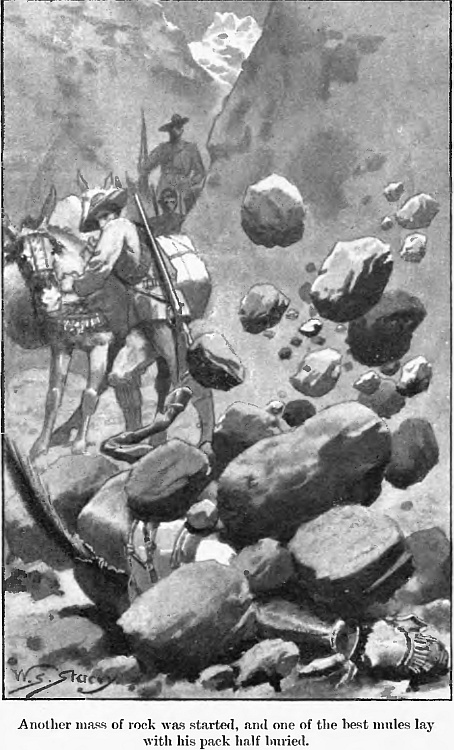
It began by the dislodging of one great mass, which was forced over from a rocky shelf, and before this had rolled half-way, it had started hundreds more, the attempt being so well contrived that the pieces of rock, which came leaping and bounding down with a clashing sound like thunder, would certainly have crushed one or more of the mules, but for their quick appreciation of the danger.
Two sharp replies to this attack were given from the loaded pieces, and the Indians disappeared; but when, after a great deal of coaxing, the mules were got into motion once more, the colonel urging the leader round beyond where the stones had fallen, the boys uttered a warning cry, for another mass of rock was started from high up on the other side, and with such good effect that the rush of stones it started caught the tiny caravan half-way, and to the misery and despair of all, one of the best mules lay with its pack half buried, and the poor creature’s head crushed almost flat.
This time the boys fired up at a single man perched fully twelve hundred feet above the narrow bottom of the gorge, and he dropped out of sight, while the colonel and John Manning leaped down again, and rapidly removed the stones which impeded them in their efforts to loosen the pack-ropes and remove the load to another mule.
This was a hindrance of a good half-hour, and the colonel looked very stern as he gave the order to advance again, when they gained about a mile, the gorge opening a little. Then the huge towering walls contracted once more, and a black-looking prospect opened before them, for there, so narrow that there was barely room for the mules to go singly, was their way, through a black-looking rift, above which the mountains on either side rose in shelves admirably adapted for the enemy’s defence, and promising so ill for the little party, that the colonel hesitated for a minute while he used his glass. Then, as all was still, no sign of an enemy visible, he gave the order to advance, in the hope that the place was too precipitous for the Indians to occupy.
Vain hope! Ten minutes later the mule he rode lay quivering on the ground; the colonel having the narrowest of narrow escapes from a terrible death.
“Forward!” he said firmly, but as he spoke, another avalanche and another came thundering down, and seeing the madness of attempting to proceed, he gave the word to retreat.
It was needless, for the mules had already sprung round, and were hurrying back at a rate that was faster than anything they had yet shown.
There was no yell of triumph from on high, and no sign of enemy on either hand as they rode back, face to face with the fact that exit from the gorge in that direction was impossible, and that unless they could find some side ravine leading in the direction they wished to pursue, there was nothing for it but to retrace their steps right to the cinchona cutters’ camp, and from thence make their way home by the road they came.
“It does seem so strange,” said Perry, as they rode back; “they don’t pursue us, but let us ride quietly on. Are they satisfied with the mischief they have done?”
Cyril made no answer, for he was watching the colonel, where he rode by himself, grave and stern, impressed as he was by the feeling that all his efforts would be brought to nought, if he could not devise some means of reaching San Geronimo. At that moment it looked hopeless, and as if he would be thwarted at every step, for though the enemy were invisible, he had had bitter experience of the fact that their knowledge of the mountain paths placed them at a tremendous advantage, and he felt that in all probability they were even then where they could watch every movement, and had perhaps got well ahead, ready to stop them by another attack upon the mules.
It was past mid-day now, and the hope of getting well onward toward safety was completely crushed; the sun was now shining fiercely down into the gorge, heating the rocks so, that the reflection was almost worse than the scorching rays from above. The mules were panting and thirsty, and the exertions of the day, coming upon such a broken night, were telling terribly upon all, so that reluctantly, and as their only resource, the colonel allowed the old leading mule to make straight for the stream which came gurgling out of the cave they had left that morning. Here, to the surprise of all, the intelligent beast, instead of stooping to drink at once, stepped carefully among the stones right into the cool shade within, the rest following, and five minutes later Perry and Cyril were seated inside upon one of the packs.
“And all that day’s work thrown away,” said Cyril sadly.
“And two mules dead,” whispered Perry, so that his father should not hear.
“But we saved their loads,” replied Cyril.
“What for?” said Perry, in the same low voice. “It’s of no use: we shall never get away alive.”
Chapter Twenty Seven.
Ready for the Worst.
Nature must be satisfied at whatever cost, and, as soon as possible, the provisions were unpacked, while a fire, which had been lit with the scraps of wood collected as they returned, burned brightly, the smoke drawing farther into the cavern, and being rapidly dispersed. Then, as soon as the kettle, suspended by an iron rod over the flames, began to boil, a very small handful of tea was thrown in, and the tin lifted off and laid aside.
Only some very wooden cake bread, and some very dry tough beef, with a strong flavour of being imperfectly sun-cured; but how delicious it was when washed down by the warm, unsweetened, milkless tea!
They sat on the stones a little way inside the entrance, where the cool dampness of the cave was relieved by the soft, warm, sunny air which floated in from the gorge; and a sharp lookout was kept for the Indians, but not a sign betrayed their presence. A short exploration of the interior, too, was made, but there was not a sound to be heard, save an impatient stamp or two from the mules; and, concluding that the enemy had all left the place, the colonel returned to where he had left the boys on guard, but only to find them both fast asleep, and John Manning walking up and down slowly by the stream, with his gun over his shoulder.
“Don’t wake ’em, sir,” said the man appealingly: “they tried very hard to hold up, but it warn’t to be done; and if I hadn’t got up and taken to marching here on sentry-go, I should have been fast asleep too.”
“Poor fellows,” said the colonel sadly, “it was too much to expect after what they have gone through. There, lie down for a couple of hours, and then I’ll wake you to relieve me.”
“Begging your pardon, sir, if you’d take first turn,” began the old soldier, but he was cut short directly by a sharp gesture, and, without a word, he lay down with his piece in his hand, and was asleep directly. The colonel took his place, and then began to walk slowly to and fro, now right out where the sinking sun glistened upon the surface of the stream, now back inward, with the walk growing darker, till it was quite black.
And as he marched to and fro, the colonel reflected upon the hopelessness of their position. As he approached the open sunshine, he felt lighter-hearted; but as he turned and walked inward toward the cold and darkness, his spirits sank once more, and he saw no way out of their difficulties save the giving up of that for which he had come all those many thousand miles. Then he stopped short, for Cyril had suddenly sprung to his feet, looking horribly guilty and ashamed.
“I am so sorry, sir,” he faltered. “I did not mean to go to sleep.”
“You could not help it, my lad,” said the colonel, laying his hand upon the boy’s shoulder. “You had reached the limit of human endurance. But, Cyril, my lad, you are being sharply punished for your mad escapade.”
“Yes, sir,” said the boy sadly, “and I suppose I deserve it. I should mind all this much less if we had arranged with my father that I should come.”
“Well done, young philosopher,” said the colonel, as he kept his hand on the lad’s shoulder, and marched him to and fro. “Come, as you can think so well, give me your advice. You know why I have come—to obtain this seed to place in the hands of those who will cultivate it, and make the world independent of the one source of supply.”
“Yes, sir,” said Cyril wonderingly.
“And you see the position to which I am reduced.”
“Yes, sir. Will the Indians kill us?”
“Not without paying dearly for it,” said the colonel sternly. Then changing his manner: “No, my lad. These people are only half-savage, and look upon what they are doing as a duty. I do not think they will kill us if they can get possession of all our baggage. They might keep us in captivity until means are taken to free us; but I don’t know—I hardly feel that our lives are safe.”
“Not very, sir,” said Cyril grimly, “if they rolled big stones. It might have been us instead of the mules this morning.”
“Yes, we have had some narrow escapes; but what shall I do now—give up and own that I am beaten?”
“And let them have the kina seed, sir? No, that I wouldn’t; I’d fight for it first,” cried Cyril excitedly.
“Do you know what you are talking about?” said the colonel excitedly.
“Yes, sir,” cried Cyril, “I was very much down a while ago; but I’ve had something to eat now, and a sleep and—What! give up to a pack of savages, and let them rob you of all we have worked so hard to get? That I wouldn’t while there was a charge of powder left.”
“Humph!” ejaculated the colonel, looking at the boy searchingly.
“That’s what my father would say if he were here. I wish he were.”
“To thrash you for leaving home in that cowardly way?”
“No, sir,” said Cyril quietly. “My father never thrashed me, and he never would. He always said it was degrading a boy to beat him, and that he was a poor parent who could not rule his children without blows. He told me he thought he could hurt me a good deal more by his words, and so he always could.”
“Perhaps so, sir,” said the colonel sternly; “but see what a mistake he has made, and what a miserable young dog you have turned out.”
Cyril was silent for a few moments.
“I hope I’m not all bad, sir,” he said. “I’m sure I’ve bitterly repented what I have done.”
“And been severely punished, too, my lad,” said the colonel kindly. “Your father is quite right, and when I tell him how you have behaved—as, please God, I hope I shall—if he is the man I believe him to be, he will shake hands with you as I do now, and say, ‘Let’s forget the past!’”
“Colonel Campion!” cried Cyril, snatching at the hand extended to him.
He could say no more, for something seemed to rise in his throat and choke him, while the colonel rested his arm affectionately upon his shoulder once more, and walked him up and down toward the light and back again.
“So you’d fight for it and stand out, eh?” said the colonel at last.
“Yes, sir, that I would,” cried Cyril excitedly, “and I’m sure Perry will say the same.”
The colonel was silent for a few moments, gazing straight before him into the darkness, and he asked himself whether he would be justified in running all these risks. He shook his head, and they turned and marched down again toward the light, where the rippling stream looked rosy in the evening, and the rocks on the other side of the gorge were all aglow. And there was so much in the brightness and hope and prospect of success that the feelings of dread, the shrinking from a terrible ordeal, and all hesitation fled away.
“Yes,” he said firmly as he stopped short; “a civilian might hesitate and give up, but I cannot, my lad. I determined to carry out this task, believing that by it I should vastly benefit suffering humanity at large, and Heaven helping me, I will achieve my aims.”
“And you will fight it out, sir?” cried Cyril.
“I will, my boy, to the bitter end. I made the Indians fear me, and if they attack us now, they shall fear me more, for I have our lives to save as well. Now, go and lie down.”
“No, sir, I don’t feel sleepy; let me watch with you.”
“You are a soldier for the time being, my lad, and if we are to succeed, discipline must be observed. In an hour’s time I rouse up John Manning to relieve me, and toward morning, when you are rested and refreshed, you shall be called to take your watch.”
Cyril lay down without a word, meaning to think out all that had been said, and feeling happier than he had since he left home. But he did not think, for in a few seconds after he had stretched his weary limbs upon the rocky floor, all the corners and points of his bed became soft as eider-down, and he dropped into a deep dreamless sleep, leaving the colonel seated on a rock, leaning forward with his gun between his legs, and his form looking black against the soft glowing light at the entrance of the cave.
Chapter Twenty Eight.
Nature is Mistress.
“I haven’t slept long,” thought Cyril as he woke with a start to see the colonel seated as he had left him when sleep came. He did not appear to have moved, and all was perfectly still. One thing, however, puzzled him, and that was the light. It was soft and warm and glowing then; now it was clear and bright.
All at once he saw something come into sight from the side and stand looking in. It was the old leading mule, and it stood there munching away at a tuft of green stuff which it held in its teeth, and then dropped, and stooped its head to take a long drink of water.