"Real Gold" (continued 3)
Reading edition
“I begin to think he has.”
“But I could have taken him down in Surrey, sir, and showed him into woods where they were doing all that to the oak trees, without coming out here, or running any risks of getting an arrow sent through you, just as if you was a chicken got ready to roast.”
“I don’t quite understand it yet,” said Cyril; “but don’t talk any more now. Look, look! what is he going to do?”
Chapter Thirteen.
In Treasure Land.
They were by this time close up in front of the huts of the bark gatherers, when all at once one of the huge condors came swooping along overhead, looking gigantic up against the sky. And then it was as if a sudden idea had struck the colonel, who raised his piece, took aim, lowered it, and hesitated; for the huge bird was at a great distance, and the people looked at him wonderingly. The next moment his rifle was at his shoulder again, there was the flash and puff of white smoke, the sharp crack, and the rumbling echoing roar in the mountains, as the condor was seen to swerve and then dart straight upward.
“Missed!” muttered John Manning, “but he felt the bullet.”
“Hit!” cried Cyril excitedly, for all at once the bird’s wings closed, and it fell over and over and then dropped like a stone, crashing in among the trees about a hundred yards away.
The Indians had looked on at first incredulously, and several of them exchanged glances as the condor shot upward as if to escape unharmed; but the moment it turned over and began to fall, they set up a loud shout and rushed off to pick up the fallen bird, the whole crowd making for the dense patch of forest, and then walking back steadily, bearing the bird in triumph.
“Rather a risky thing to do, boys,” said the colonel, reloading as he spoke. “If I had missed, I should have done harm to the position we have made in these people’s estimation. But I felt that I could hit the bird, and now they will believe that I may prove a terrible enemy in anger.”
“Do it? Of course he could,” whispered John Manning. “I’ve known him take a rifle from one of our men lots of times, and pick off one of the Beloochees who was doing no end of mischief in our ranks up in the mountains.”
By this time the Indians were back, looking full of excitement, and ready almost to worship the white chief who had come amongst them, with such power of life and death in his hands—powers beside which their bows and arrows and poison-dealing blowpipes seemed to them to be pitiful in the extreme. They laid the body of the great bird, which was stone-dead, at his feet, and then looked at him wonderingly, as if to say, “What next?”
That shot had the effect which the colonel had intended to produce, for to a man the Indians felt the terrible power their white visitor held in his hand, and each felt that he might be the object of his vengeance if any attack was made.
But Colonel Campion felt that the effect was only likely to be temporary, and that he must gain the object for which he had made his perilous journey as quickly as possible, and begin to return before the impression had worn off.
Bidding Cyril then tell their guide that he should camp there for a few days, he sent the two men back for the mules, giving orders that they should take a couple of the Indians who had followed them to help.
His manner carried the day, and the party of four departed.
“I suppose it’s all right, Master Cyril,” whispered John Manning; “but I should have thought we’d ha’ done better by fortifying our own camp, and not running our heads right into the lion’s mouth; but the colonel knows best, and we’ve only got to obey orders.”
Certainly that seemed to be the safest course to pursue—a bold one; so in this spirit, and as if the colonel felt that there was nothing whatever to be feared from the people, the mules and packages were brought up. A snugly-sheltered spot was selected, close to a spring which came gushing from the rock, and a fresh camp made; the party going and coming among the cinchona gatherers as if they were invited visitors; while the Indians themselves looked puzzled, and watched every action from a distance.
That night, beside the fire, surrounded by the dense growth of the life-preserving trees he had sought, the colonel became more communicative.
“You boys have, I daresay, canvassed why I undertook this expedition,” he said, “and, I suppose, took it for granted that I came in search of the gold supposed to be hidden by the Peruvians, to save it from the rapacity of the Spaniards.”
“Yes, sir; that’s what I thought,” said Cyril.
“Or else to find one of the di’mond walleys,” growled John Manning.
“This is not the right direction for them, my man,” said the colonel, smiling. “You have to seek for them between the leaves of books. No, boys; I came to seek something of far greater value to my fellow-creatures than a buried store of yellow metal, which may or may not exist. It is possible that a number of the sacred vessels from some of the old temples may have been hidden by the priests, who, at their death, handed down the secret to their successors; but I think it is far more likely to be a fable. Still, the Indians believe in it, and if they knew that a discovery had been made, they would destroy the lives of the finders, sooner than that the gold should be taken out of the country.”
“Then you have not come to find the gold, sir?” said Cyril; while Perry lay there upon his chest, resting his chin upon his hands, and elbows on the earth, gazing up in his father’s face.
“No, boy; I have come, and I am running some risks, I know, to drag out into the light of day the wondrous medicine which has saved the lives of hundreds of thousands, and made it possible for men to exist in the fever-haunted countries spread around the globe.”
“You mean quinine,” said Cyril. “Father always keeps a bottle in his desk.”
“Yes, I mean quinine, the beautiful crystals obtained from the bark of these trees, boy; the medicine kept so jealously guarded here, the only place where it is produced, high up on the eastern slope of these mountains. I have come to seek it, and have found it far more easily than I expected: we are sitting and lying here right in the middle of one of the cinchona groves.”
“But we can’t take away much, father, even if they will let us,” said Perry.
“Wrong, boy. I hope that we shall be able to bear away, unseen, enough to stock the world, and to make the drug, which is a blessing to humanity, plentiful, instead of civilised Europe having to depend upon the supply from here—from this carefully-guarded place.”
“You mean to take away some young trees,” said Cyril excitedly.
“I should like to do so, but that is a doubtful way, my boy. The young trees would be awkward to carry, and transplanting trees often means killing them. We must try something better than that, though. I shall see what I can do in making one bundle, with the roots carefully bound up in damp moss.”
“Yes, we might do that,” assented Cyril, “but we didn’t bring a spade.”
“Let us find some tiny trees, and we’ll do without a spade,” said the colonel quietly. “But I am in this position, boys. I know very little about the trees we see around us. That they are the right ones there can be no doubt, for the Indians are camped here, cutting them down, and peeling off and drying the bark. There are several kinds which produce inferior kinds of quinine; but these laurel-like evergreen trees produce the true, the best Peruvian bark; and it is to take away the means of propagating these trees in suitable hot mountainous colonies of our own, that we are here. Now, how is it to be done?”
“Indians won’t let it be done, sir,” said Manning. “Here, I know lots o’ places up Simla way where it would grow fine. Up there, north o’ Calcutta, sir.”
“Yes; there are spots there where it might be grown, or in the mountains of Ceylon,” said the colonel; “but we have to get it there.”
“I know,” said Cyril. “Let’s get heaps of seed. Why, we might till our pockets that way.”
“Yes; that is my great hope, boys; so, whenever you see seed-pods or berries nearly ripe, secure them. But we are surrounded by difficulties. We may be here at the wrong time of year, though I calculated that as well as I could; and now that we are here, I have been terribly disappointed, for so far, instead of seeing seed, I have noted nothing but the blossoms. It is as if we are too early, though I hope these are only a second crop of flowers, and that we may find seed after all.”
“But these sweet-smelling flowers, something like small lilac, are not the blossoms of the trees, are they?” said Perry.
“Yes, those are they,” said the colonel. “Now my secret is out, and you know what we have to do.—Well, Manning, what is it?”
“My old father had a garden, sir, and he used to grow little shrubs by cutting up roots in little bits, which were often dry as a bone when he put them in, but they used to grow.”
“Yes,” said the colonel. “Quite right; and now we are here, in spite of all opposition, we must take away with us seeds, cuttings of twigs, and roots, and if possible, and we can find them, a number of the tiny seedlings which spring up beneath the old trees from the scattered seed. There, that is our work, and all must help.—Do you hear, Manning?”
“Oh yes, sir, I hear, and if you show me exactly what you want, I’ll do my best; but, begging your pardon, sir, ain’t it taking a deal o’ trouble for very small gains?”
“No, my man, the reward will be incalculable.”
“All right, sir, you know best. I’ll do what you tell me, and when we’ve got what we want, I’ll fight for it. That’s more in my way. But, begging your pardon once more, wouldn’t it be better for you to go to the head-man, and say, through Master Cyril here: ‘Look here, young fellow, we’ve come a long journey to get some seed and young plants of this stuff; can’t you make a sort of trade of it, and sell us a few pen’orth civilly.’”
The colonel laughed.
“No. They will not let us take a seed out of the country if they can prevent it. I will tell you all the worst at once. They will make a bold effort to master the dread with which I have succeeded in inspiring them, and fight desperately to stop us when we get our little store.”
“Then, begging your pardon again, colonel, wouldn’t it ha’ been better to have come with a couple of companies of foot, and marched up with fixed bayonets, and told him that you didn’t mean to stand any nonsense, but were going to take as much seed as you liked?”
“Invited the rulers of the country to send a little army after us?”
“Yes, of course, sir; but they’ve got no soldiers out here as could face British Grenadiers.”
The colonel was ready to listen to every opinion that night, and he replied quietly:
“I thought it all out before I started, and this was the only way—to come up into the mountains as simple travellers, reach the hot slopes and valley regions where the cinchona grows, and then trust to our good fortune to get a good supply of the seed. But, even now, from our start from San Geronimo we have been watched. You have noticed it too, boys. Even the guide we took has arrayed himself against us from the first, and, while seeming to obey my orders, has taken care to communicate with every one we passed that he was suspicious of my motives. Every mile we have come through the mountain-range has been noted, and will be noted, till we get back.”
“Why not go back, then, some other way, sir?”
“Because we cannot cross the mountains where we please. The road we followed is one which, no doubt, dates from the days when the Incas ruled, and there are others here and there at intervals, but they will be of no use to us. Somehow or other, we must go back by the way we came, and I hope to take at least one mule-load with us to get safely to England. There, that is enough for to-night. Now for a good rest and we shall see what to-morrow brings forth. Cyril and Perry, you will be on sentry till as near midnight as you can guess, and then rouse me. I’m going now to take a look round at the mules, and then I shall lie down.”
He rose and walked away to where the mules were cropping the grass, which grew abundantly in the open places, and as soon as he was out of hearing, John Manning began to growl.
“All right, young gentlemen,” he said, “I’m ready for anything; but, of all the wild scarum-harum games I was ever in, this is about the wildest. Come up here to steal stuff! for that’s what it is, and you can’t call it anything else. I’ve know’d people steal every mortal thing nearly, from a horse down to a pocket-knife. I’ve been where the niggers tickled you when you was asleep and made you roll over, so that they could steal the blanket you lay upon. I’ve seen the crows in Indy steal the food out of the dogs’ mouths; but this beats everything.”
“Why?” said Perry shortly.
“Why, sir? Because physic’s a thing as everybody’s willing enough to give to someone else; I didn’t think it was a thing as anybody would ever dream o’ stealing. As you may say, it’s a thing as couldn’t be stole.”
“Father knows what he is about,” said Perry shortly.
“Course he does, sir. Nobody denies that. We’ve got to begin taking physic with a vengeance. All right: I’m ready. And I was thinking all the time as we should bring back those four-legged jackasses loaded with gold and precious stones. All right, gentlemen. As I said before, I’m ready; and it’s a good beginning for me, for I shall get a long night’s rest; so here goes.”
He rolled himself in his blanket, then lay down with his feet near the fire, and began to breathe the heavy breath of a sleeper the next minute.
“Well, Cil,” said Perry, “what do you think of it?”
“Don’t know,” said Cyril. “Yes, I do. They’re wonderfully watchful over the bark, and as soon as they know what we are after, they’ll stop us.”
“Then we must not let them see what we are after, my lad,” said the colonel, who had returned unseen. “We must collect plants and flowers of all kinds, and load a couple of the mules. That will help to disarm suspicion.—Pieces loaded?”
“Yes, sir.”
“That’s right. We must keep military watch now regularly; but there will be nothing to fear to-night.”
Chapter Fourteen.
The Night-Watch.
Those were very encouraging words, and they seemed to tingle in the boys’ ears as the colonel followed his servant’s example, rolled a blanket about his shoulders, and lay down with his head resting on one of the mules’ loads; but the impression soon died away, leaving the lads close together, with their guns resting on the grass, listening in the deep silence of the starlit night, and for some time without speaking a word.
“Come a little farther away,” whispered Perry at last. “I want to talk.”
They moved a few yards away from the sleepers, and stopped beneath a great spreading tree at about equal distance from the colonel and the fire, which glowed faintly, but gave sufficient light for them to see Diego and the other Indian squatted down, making tents of their long garments, and with their chins bent down upon their breasts; but whether asleep, or waking and watchful, it was impossible to say.
“Well?” said Perry at last, after they had been straining their ears to catch different sounds, now the trickling murmur of falling water, now some strange cry from far away in the woods, or the whisper of a breeze which came down from the mountains to pass away among the trees.
“Well?” said Cyril.
“Isn’t it awfully quiet?”
“Yes.”
“Look over there, just to the left of the fire. Isn’t that some one watching us?”
“Tree trunk,” said Cyril laconically.
There was a pause, and then Perry whispered again.
“I say, I don’t want to be cowardly, but there’s some one coming slowly through the trees. I caught a glimpse of his back. He’s stooping down—there, between those two big trunks, where it’s open. Don’t you see—stooping?”
“Yes, I see, and nibbling the grass as he comes. One of the mules.”
Perry shaded his eyes—needlessly, for there was no glare to shut out—and he soon convinced himself that his companion was right.
But he felt annoyed, and said testily:
“I wish you wouldn’t be so ready to contradict everything I say.”
Cyril laughed softly.
“Why, you didn’t want it to be an enemy, did you?”
Perry made no reply, and they stood for some time together in silence, listening to the crop, crop sound made by the mules, and the whispering sighs of the wind, which came down sharp and chill from the mountains. At last Cyril spoke again.
“Let’s walk round the camp.”
“You can’t for the trees.”
“Oh yes, we can. It’s cold standing here. We’ll work in and out of the trees, and make a regular path round. It will be better than standing still.”
“Very well,” said Perry shortly. “Go on first.”
Cyril shouldered his piece and stepped off cautiously for a couple of dozen yards, and then struck off to the left, meaning to make the fire act as a centre round which they could walk, keeping guard and themselves warm; but before he had gone many steps he stopped short.
“Look here,” he whispered, “you are a soldier’s son, and ought to teach me what to do in keeping guard.”
“There’s nothing to teach,” said Perry. “All you’ve got to do is to keep a sharp lookout.”
“Yes, there is. If we keep together like this, we leave a lot of the camp exposed. What we ought to do is for one to go one way, and one the other; then meet, cross, and go on again. It would be far better.”
“But then we should be alone so long. We had better keep together.”
“Very well,” said Cyril shortly; but he owned to himself that he felt better satisfied, for it was lonely, depressing work there in the darkness.
Cyril stepped forward again, going slowly and carefully through the thick growth, making as little noise as possible, and trying to keep as nearly as possible to the same distance from the fire—no easy task, by the way—but he had not gone far before he stopped short and started aside, bringing his gun down to the present. For, all at once, from out of the darkness, some one seemed to strike at him, the blow cutting through the twigs and leaves by which he was surrounded with a loud whistling noise, while the stroke was so near, that he felt the air move close to his face.
“Fire—fire!” whispered Perry excitedly.
“What at? I can’t see any one,” replied Cyril, as he stood with his finger on the trigger.
He felt his heart beat with a heavy throb, and his hands grew moist, as he tried hard to pierce the darkness, and fix his eyes upon the enemy who had made so cowardly a blow at him; but the thick branches shut out every ray of light, and the silence was now painful in the extreme. The position was the more startling from the fact that neither could tell from which side the next blow would come.
But still that blow did not fall, and it seemed to Cyril, as he stood there holding his breath, that the Indian who had struck at him so treacherously was waiting until he moved, so as to make sure before striking again. At last the painful tension came to an end, for suddenly, from just in front, there was a heavy sigh, and crop, crop, crop, followed by a burst of laughter from the boy.
“Oh, I say, Perry,” he cried, “what a game! Fancy being scared like that by a mule.”
“Then it was one of the mules?”
“Of course; we frightened the poor thing, and it kicked out at us. Come along.”
He bore off a little to one side, and they passed the browsing animal, and, though describing rather an irregular circle, made their way round the fire, getting back pretty exactly to the place from which they started.
This was repeated several times, and then, for a change, Cyril proposed that they should strike off a little, straight away from the camp.
Perry was willing, and they put their plan in operation, for no special reason other than that of seeing the ground was clear in different directions, and to relieve the monotony of the watch.
“You lead now,” said Cyril, in a low voice, so as not to disturb the others, who, in thorough confidence that a good watch would be kept, and that there was no fear of any danger, were sound asleep.
Perry led on, finding the way more open a short distance from the camp, but he had not led thirty yards when he stopped short.
“Hallo! another mule?” said Cyril.
“Indian!” said Perry huskily; and, as Cyril pressed forward to his companion’s side, there, hard to define, but plain at last, stood one of the Indians, who raised his arm and pointed back, uttering two or three words in a guttural tone.
“What does he say?”
“That we must go back to the fire. Perhaps we had better,” said Cyril. “I don’t like his being there, though. Look here,” he said quickly; “let’s make haste back, and go right out the other way.”
“What for?” said Perry, following his companion.
“I’ll tell you directly.”
Five minutes later they were checked just on the other side by another Indian who started up right in their path.
“Come and warn my father,” said Perry excitedly. “They’re going to attack us.”
“No; I think not,” replied Cyril decisively. “They’re sentries. Come and try another way.”
He led off again, after they had returned to the fire, finding that they were not followed, and that all was still; and again they were stopped by an Indian starting up and ordering them back.
“That’s it,” said Cyril quietly; “they’ve surrounded us with sentries.”
“To attack us?”
“No; to see that we don’t escape; and while we were walking round and round, they were within a few yards of us, listening to all our movements.”
“But they couldn’t have been there then, or they would have started up as they did just now.”
“No; we weren’t doing anything they minded; but as soon as we tried to go straight away, they stopped us. Let’s try once more.”
He led off quickly again, with the same result; and then Perry turned back to where his father lay asleep.
“What are you going to do?” whispered Cyril.
“Wake up my father, of course. We are attacked.”
“Don’t do that,” said Cyril decisively. “We are not attacked, or they would have seized us at once. I’m sure they are only guarding us, to make sure that we don’t try to escape. It’s of no use to wake him till the proper time.”
Perry hesitated.
“But we are in danger.”
“No; I don’t think we are. They are watching us, but they don’t mean to attack us, or they would do so. You’ll see now. We’ve come among them, and they’ll keep us under their eye, and perhaps will not let us go again. Look here: let’s go and speak to Diego.”
Perry was easily led, and yielding to his companion’s decisive manner, he followed to the fire and then round to the other side, where the Indian guide and his companion were squatted down with their chins resting upon their chests.
They made no sign as the boys came silently up, and appeared to be fast asleep; but Cyril knew better, for he saw in the dim glow shed by the fire, a slight tightening of the man’s hand upon his bow.
“They’re asleep,” whispered Perry. “Better come to my father.”
“Asleep with one eye open, and on the watch,” said Cyril quietly, and he bent down and whispered a few words.
They were electric in their effect, for both men raised their heads, and their eyes glittered in the faint light from the fire.
“Didn’t take much waking,” said Cyril, with a little laugh. Then turning to Diego, he said, in the man’s half-Spanish jargon:
“Why are the Indians on the watch all round here?”
The man looked at the speaker intently.
“Are the Indians watching all round?” he said quietly.
“You know they are. Why is it? To keep us from going away?”
The man looked at him intently, and then nodded his head.
“And suppose we try to go away, what then? Would they fight?”
“Yes,” said the guide gravely.
“And try to kill us?”
“Yes, they would kill you.”
“Try to, you mean.”
“No,” said the man gravely. “Kill you. You are few, they are many.”
“Stop a moment,” said Cyril, as the man turned his head aside wearily. “Will they try to kill us if we stay?”
“No.”
Cyril tried to get more information from the man, but he shook his head, and made a pretence of being so lazy and unable to comprehend the boy’s words, that Cyril gave up in disgust, and turned impatiently away.
“It’s of no good to-night,” he said. “We heard all that he is likely to know. Let’s walk round again.”
“But they may strike at us in the dark.”
“No, they will not do that. I’m not afraid. Let’s go through with our watching, till we think it’s midnight, and then wake up the colonel.”
“We’d better call him now.”
“No; if we did, it would only be giving a false alarm, when we know that there is no danger. Come along.”
The weaker mind yielded to the stronger, and the march round was begun again, one which required no little courage, knowing, as the boys did, that there must be quite a dozen Indians within striking distance, and every rustle they heard, made probably by one of the grazing mules, might be caused by an enemy creeping forward to strike a blow.
At last, when they felt that it must be getting toward midnight, Cyril proposed that they should go back close to where the colonel lay asleep, and they had not been standing near him ten minutes, hesitating to call him for fear he should be awakened too soon, when he suddenly made a hasty movement, opened his eyes, looked round, and sprang to his feet.
“Midnight, boys,” he said, “is it not?”
“We don’t know, father, and did not like to call you too soon.”
“Yes, it must be about midnight,” he said decisively, “or I should not have woke up. Well, is all right?”
“No, father,” whispered Perry.
“Oh yes; there’s nothing to mind,” said Cyril hastily. “We only found that there are a lot of Indians round about the camp.”
“You saw them?”
“Yes, sir. So soon as we moved a little way, a man rose up and stopped us.”
“On one side?” said the colonel.
“All round, sir.”
“On guard, then, in case we wished to escape. We’re prisoners, my lad, for the present. However, they will not venture to hurt us, unless we give them good reason, by loading up the mules to take away something they consider ought to be kept here, and that we shall not be ready to do for some days to come.”
“That’s what I wanted Perry to feel sir,” said Cyril, “but he would have it that they were going to attack us to-night.”
“There is no fear of that, my boy,” said the colonel firmly. “There, lie down, and sleep till breakfast-time; there is nothing to fear.”
“But are you going to watch alone, sir?”
“Yes, quite alone, my lad,” said the colonel, smiling. “There, take my place; I’m rested now, and you have nothing to mind. Don’t meet perils half-way; its bad enough when they come. Till they do, it is our duty to be patient and watch. Afterwards we must fight—if it is necessary. Now—to bed.”
The boys obeyed, and the colonel commenced his solitary watch.
Chapter Fifteen.
Collecting the Gold.
“Ever see ’em ketch eels at home, Master Cyril?” said John Manning one morning.
“We used to set night lines in the lake at school,” said Cyril. “We threw the bait out ever so far, and tied the other end to a brick sunk in the water.”
“Oh yes: but I don’t mean that way, where every twopenny eel spoils four pen’orth o’ good line and hooks. I mean with an eel-trap, one of those made of osiers, so that it’s very easy to get in, but very hard to get out.”
“Yes; I saw some of those once,” cried Perry, “up by a weir. But why? There are no eels here.”
John Manning chuckled, and shook all over, as if he enjoyed what he was saying.
“Not many, sir, but quite enough. We’re the eels, and we’ve wriggled ourselves right into a trap, and there’s no getting out again.”
“It doesn’t seem as if there were,” said Cyril thoughtfully; “but we’re getting what the colonel wanted, and I don’t think the Indians have noticed it yet.”
“’Tain’t for want of looking, sir,” said the old soldier. “I go for a bit of a walk in one direction, and begin picking something, and feel a tickling about the back. ‘Some one’s eyes on me,’ I says to myself, and I go a bit farther, and feel the same tickling in front. Then one side, then t’other, and it’s always eyes watching.”
“Yes,” said Perry. “We’ve been a week here, and I get so sick of it: I never move without there being some one after me; and the worst of it is, you don’t see him coming, but find him watching you from behind a rock, or out of a bush.”
“Yes,” said Cyril, “it isn’t nice. They crawl about like snakes, and almost as quietly.”
“Don’t matter,” said John Manning, with another chuckle. “We can be as cunning as they. How have you young gents got on since the colonel give his orders?”
“Pretty well,” said Cyril. “Of course it’s of no use to try and get roots or cuttings, they look too sharp after us; but I’ve found some seed, and he has got more than I have.”
“How much have you got, both of you together?” asked the old soldier, with his eyes twinkling.
“Nearly a handful, I should say,” replied Cyril.
“A handful, sir! Why, what’s that? I’ve got quite half a gallon.”
“You have?” cried Perry. “Father will be so pleased.”
“Course he will, sir,” said John Manning, with a self-satisfied smile. “‘Get every seed you can,’ he says, ‘and they’ll hardly notice you.’
“‘Right, sir,’ I says, and I set to work quietly, going a bit here, and a bit there, in among the trees, making believe I was making for them cocoa-nut leaves as the Indians chew; and whenever I caught one of the Injuns watching me, I picked a leaf, and began to chew it, and nodded at him, and said bono, bono. You should have seen how he grinned and showed his teeth at me, Master Cyril, and I could see he was thinking what a fool this Englishman was. But I wasn’t quite so stupid as he thought, eh?”
“But that’s not cocoa-nut leaf,” said Cyril, “but the leaf of the coca.”
“Well, sir, that’s what I say. I know it isn’t the nuts but the leaves they chew.”
“But the coca leaf’s a different thing.”
“Course it is, sir; one’s a leaf and t’other’s a nut.”
“But, don’t you see, cocoa-nut leaf and coca leaf are different things?”
“No, sir; but it don’t matter. They think I’m hunting for them leaves to chew, and they laugh at me, and all the time I’m getting a good heap of the seeds the colonel wants. ’Tain’t the first time he’s sent me to forage.”
“But where are the seeds?” said Cyril.
“All right, sir,” said John Manning, with a look full of cunning. “Never you put all your eggs in one basket, sir.”
“Of course not; but I hope you’ve put them in a dry place. Seeds are no use if they’re not kept dry.”
“They’re all right, sir. I’ve got some in each of my pockets, and some along with my cartridges in my satchel, and some inside the lining of my coat, and a lot more round my waist.”
“Round your waist?” cried Cyril. “You can’t wear seeds round your waist.”
John Manning chuckled once more.
“Can, if you put ’em in an old stocking first, sir,” he said. “But look here, young gents, as I’m so much more lucky than you are, and know better where to go for ’em, you’d better take part o’ mine, and leave me free to fill up again.”
“Yes, that will be best,” assented Perry. “I can take a lot in my pockets.”
“Any one looking, sir?”
“Very likely; but I shall take no notice. They won’t know what we’re changing from one pocket to the other, so let them watch.”
“All right, sir; then here goes,” said the old soldier, thrusting a hand deep down into his trousers pocket, and drawing out a quantity of seed. “Here you are, sir; and I’d make believe to eat a bit in case any one is watching.”
But as they were seated out of the sun, in the shade of the rough hut that had originally been put up for drying the kina bark, they were pretty well hidden from watchers, and able to carry on the transfer in comparative secrecy.
“But this isn’t seed of the cinchona tree,” cried Cyril excitedly.
“What!” said the old soldier sharply, and as if startled. Then altering his tone to one of easy confidence, with a dash of the supercilious. “Don’t you talk about what you can’t understand, sir. These here are what the colonel showed me, and told me to pick for him.”
“They’re not the same as my father told me to pick,” cried Perry.
“Well, seeing as you’re young gents, and I’m only a sarvant,” grumbled the man, “it ain’t for me to contradict, and I won’t; but I will say them’s the seeds the colonel told me to pick, and there they are, and you’d better put ’em away.”
“I’m not going to put these in my pocket,” said Cyril, “for I know they’re wrong.”
“And I certainly shan’t put them in mine,” said Perry.
“Look here, young gents, ain’t this a bit mutinous?” said John Manning. “Colonel’s orders were that we should collect them seeds, and if you’d got the best lot, I should have helped you; but as you haven’t got the best lot, and I have, ain’t it your duty to help me?”
“Yes; and so we should, if you hadn’t made a blunder.”
“But I ain’t, young gents; these here are right.”
“No,” said Perry. “These are right,” and he took a few seeds from his pocket.
“And these,” said Cyril, following his companion’s example.
“Not they,” cried John Manning warmly. “They ain’t a bit like mine.”
“No, not a bit,” said Cyril triumphantly.
“No, nor his ain’t like yours, Master Perry.”
The boys stared, for this was a new phase of the question, and they eagerly inspected the treasures.
“I’m sure I’m right,” said Perry confidently.
“And I’m sure I’m right,” cried Cyril.
John Manning put his arms round his knees, as he sat on the ground, and rocked himself to and fro, chuckling softly.
At that point the colonel came up, and looked round wonderingly.
“You’re just in time, father,” cried Perry. “Look at this seed John Manning has collected.—Show him, John.”
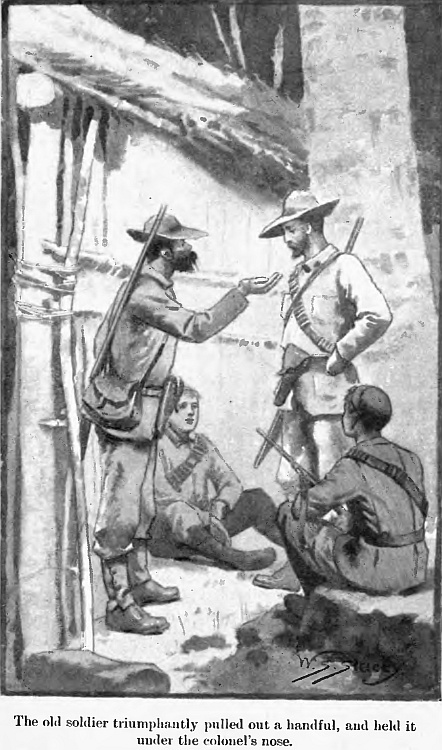
The old soldier triumphantly pulled out a handful, and held it under the colonel’s nose.
“What’s that?” said his master.
“The seed you told me to forage for, sir.”
“Absurd! There: throw it away.”
“Throw it away, sir?”
“Of course. It is not what I told you. There, take and throw it away, where the Indians see you do it, and they will pay less attention next time they see you collecting.”
John Manning said nothing then, but went out of the slight hut frowning, came back, and the colonel turned to the boys.
“Well,” he said, “what have you got?”
They both eagerly showed a little of the seed, and the colonel uttered an ejaculation full of impatience.
“No, no,” he said; “pray be careful. That is not the same as you got for me the day before yesterday.”
“Not mine?” cried Perry.
“No, sir; nor yours either, Cyril. They are both cinchona, but of the inferior, comparatively useless kinds.”
John Manning chuckled.
“But the seeds are so much alike, sir,” said Cyril.
“Yes, but the broken capsules with them are not, boy. The good splits down one way, the inferior the other. There, I suppose I must give you all another lesson. Come and have a walk at once.”
He led the way out, all taking their guns, in the hope of getting a little fresh provision, as well as to throw off the attention of the Indians, who smiled at them pleasantly enough, as they looked up from their tasks of cutting and peeling the bark from the trunks and branches, most of the men with their jaws working, as they chewed away at the coca leaf, which every one seemed to carry in a little pouch attached to the waist.
No one seemed to pay further heed to them, but they were soon conscious that they were being watched, for an Indian was visible, when they went past the spot where their two guides were watching the browsing mules; and then, as they plunged into the forest, from time to time there was an indication that they were being well guarded, and that any attempt at evasion would result in an alarm being spread at once.
Once well out among the trees, the colonel began picking leaf and flower indiscriminately, to take off the watcher’s attention; but he contrived, at the same time, to rivet the boys’ attention upon the flower and seed of the most valuable of the cinchona trees, indicating the colour of the blossom, and the peculiarities of the seed-vessels, till even John Manning declared himself perfect.
“Seeds only,” said the colonel. “I give up all thought of trying to take plants. We must depend upon the seeds alone, and we ought to get a good collection before we have done.”
“And then, father?” asked Perry.
“Then we go back as fast as we can, if—”
“If what?” asked Perry.
“The Indians will let us depart.”
“That’s it, sir,” put in John Manning. “What I was saying to the young gentleman this morning. They don’t mean to let us go. We’ve regularly walked into a trap.”
There was silence for a few moments, the colonel frowning, as if resenting the interference of his servant, but directly after he said quietly:
“I’m afraid you are right, John Manning, but we must set our wits against theirs. In another week we shall have quite sufficient of the treasured seed to satisfy me—that is, if you three are more careful—then we must start back, before our stores begin to fail.”
“What about the guides, sir?” said Cyril. “They will not help us.”
“No,” said the colonel. “Not the Indian guides, but I have a little English guide here, upon which we shall have to depend. There must be other passes through the mountains, and we know that our course is due west. We shall have to trust to this.”
He held out a little pocket-compass as he spoke, and then, after they had added somewhat to the store of seed already collected, both boys this time making the proper selection of tree from which to gather the reproductive seeds, they walked slowly back toward the camp.
But not alone: the Indians who had followed them outward, returning slowly behind them, carefully keeping far in the background, and trying to conceal the fact that they were on the watch; but it was only too plain to all that it would require a great deal of ingenuity to escape notice and get a fair start when the time came for making their escape.
Chapter Sixteen.
Preparing for Flight.
“I say, Cil, I don’t quite know what to make of it,” said Perry, a few days later. “These people are as civil and amiable as can be; they surely won’t try to stop us when we want to go?”
“You wait and see,” was the reply. “They will. I know them better than you do.”
“But they don’t think we have got anything to take away.”
“Perhaps not; but they will think that as soon as we are out of their sight we shall be searching for and taking something away that they want to preserve, and if we do get away unseen, they will be after us directly.”
“Well, we shall soon see,” said Perry rather gloomily, as he sat gazing down into a deep valley running due south, in whose depths a bright gleam here and there told of the presence of water.
“Yes, we shall soon know now. Your father and John Manning have been carefully examining the mules, and going over the stores and packages.”
“Have they? I didn’t know.”
“I did, and then they came out here and sat for some time over their guns.”
“On the lookout for birds?”
“On the lookout to see if this way would do for us to escape.”
Perry whistled.
“Did they tell you so?”
“No; but I put that and that together.”
“Put why go this way? This does not lead over the mountains.”
“Because the Indians will not think we should choose this route.”
“But we couldn’t get over the mountains from down there.”
“We must,” said Cyril quietly.
“But,” said Perry, “we can’t get the mules and their loads away without Diego knowing.”
“Must again,” replied Cyril. “We can’t escape without a supply of food, and we must have the mules to carry it, for we may be weeks wandering about in the gorges of the mountains. So it’s must, must, must, my lad. We’ve got it to do, and we’re going to do it.”
“I say.”
“Well—what?”
“Do you think it will come to a fight?”
“Not if your father can help it; but if it does, we shall have to do some shooting.”
Perry drew his breath hard.
“Don’t stare down the valley any more,” said Cyril, after a pause.
“Why? It’s very beautiful.”
“Because you’re watched. We’re watched always, sleeping or waking.”
“Then we shall never be able to get away,” said Perry despondently.
“Must, my lad. Why, we’re not going to let a pack of half-savage Indians prove too clever for us. What are you thinking about? There, let’s get back at once, or they’ll be thinking we mean something by sitting here.”
Perry rose and followed his companion, who made several halts in the forest before they reached the shelter-hut, to find the colonel and John Manning away; but they returned soon after, each carrying a couple of good-sized birds, which gave a colour to their morning’s walk.
This game John Manning bore off to prepare by the fire which Diego and his companion kept going night and day; and as soon as he had gone, the colonel seated himself, and looked curiously from one boy to the other.
“Well Cyril,” he said sharply, “ready to go home and meet your father?”
“Yes, sir,” replied the boy promptly. “I want to get it over.”
“And you, Perry, ready to go back to where you can sleep in a decent bed again?”
“Yes, father,” replied Perry; but there was a dubious tone to his words.
“That’s right. Listen, then, both of you. I trust to you to make no sign whatever, but to go on precisely the same as usual, so as to keep the Indians in ignorance of our intentions.”
“Then you are going to make a start, sir?” said Cyril eagerly.
“All being well, very soon, my lad.”
“But the mules, sir?”
“Ah, we shall see about that,” said the colonel. “I have now got together quite as much of the seed as I dared to hope for, and it would be foolish to delay longer. These Indian labourers are only working for somebody of importance, and if whoever he may be comes and finds us here, our position may be made very unpleasant, so I have decided for us to start at dark, to-morrow evening.”
This announcement caused a peculiar fluttering in the breasts of both lads, for they felt that they would not be able to get away without a struggle, since that they were detained here until some one in authority arrived, seemed certain; and they well understood how necessary it was for them to get away if possible.
The rest of the day passed like a feverish dream to Cyril, whose thoughts were of a very mingled nature. On the one hand, there was the risk to be run in making their escape, and the long perilous journey before them; on the other hand, there was home at San Geronimo, and his father’s stern face rose before him, full of reproach for his conduct; and now, more than ever, he asked himself how he could have been so mad and so cruel to those who loved him, as to leave in the way he had.
Too late for repentance then, as he knew, and he had to face the inevitable, and take the punishment he deserved as patiently as he could.
Toward dark the boys found themselves alone with John Manning, who whispered: “Been over the arms and ammunition, gentlemen, and they’re in splendid order. Bit touched with rust, but that won’t interfere with their shooting.”
“Don’t talk about it,” said Perry petulantly.
“Can’t help it, sir. We’re off to-morrow night, and some of us may have to cover the retreat. You can’t do that sort o’ work without tools.”
“Look here,” said Cyril eagerly. “How about the mules?”
“I don’t know, sir,” replied the old soldier. “That’s the puzzle of it. But the colonel knows what he means to do, of course. I’ve been with him before, when he was going to make an advance.”
“But this is a retreat,” said Cyril sharply.
“What, sir? Retreat? British soldiers don’t retreat. Of course they have to make an advance the other way on sometimes. You can’t always be going in one direction; but they don’t retreat. It’ll be all right, though, sir. You’ll see: for following orders, I’ve got all the packs ready to stow on the saddles at a moment’s notice, and we shan’t leave nothing behind.”
They had a hint soon after of there being a plan all ready, for the colonel came and hunted Cyril out to act as interpreter, and walked down with him to where Diego and his companion were seated, while the mules were browsing here and there, some fifty yards away.
“Now, interpret as well as you can,” said the colonel. “Tell him that I am very angry about the state of the mules, which look half-starved. The feed about here is disgraceful, and all the time there is a splendid supply on the other side of the clearing, beyond where the Indians are cutting and stacking the bark.”
Cyril’s voice shook a little from anxiety as he began his interpretation, but it soon grew stronger, and he gave the colonel’s wishes with so much energy that the guide looked terribly disturbed as he replied.
“What does he say?” cried the colonel angrily.
“That the head-man of the kina gatherers gave orders that they were to be pastured here.”
“Then tell him to go to the head-man, and say I order them to be moved at once over to the other side of the huts, ready for me when I wish to go on.”
Diego started off at once, and returned soon after with the head-man and about a dozen of the Indians, to whom the colonel’s wishes were repeated; and then came quite a deprecating reply that it was impossible, for the woodcutters were going in that direction the very next day, and the mules would be disturbed again.
“Tell him my mules are of more consequence than his bark gatherers,” said the colonel, “and that I insist upon the mules being moved.”
There was a laboured interpretation, a short buzz of conversation, and then a reply came through Diego that the head-man would obey the white chief’s orders, and remove the mules to better pasture; but it could not be there, in the place he wished.
“Tell him anywhere, so long as the poor beasts are properly fed.”
The colonel stalked away, with his rifle in the hollow of his arm, the Indians giving place obsequiously; but he turned back to Cyril. “Tell John Manning to stop and see where they are driven, and then come and report to me.—You two follow.”
Cyril gave the colonel’s orders, and then went after him to the hut, where they sat waiting for nearly an hour before Manning arrived.
“Well, where are the mules?”
“They’ve driven ’em out of the bit of forest, sir, and down on the other side toward the slope of that big valley.”
“Hah!” ejaculated the colonel; and then, after a pause, “The very spot.”
“But you said the other side,” said Cyril; “at the back of their huts.”
“Where I knew they would not have them,” said the colonel. “It looked to them, in their childish cunning, like an attempt on my part to get the animals down toward the point from which we came; and, of course, they would not do that. I hardly expected such good fortune, boys; but the mules are in the very place I wish. Now we have to devise a means of getting those mules loaded unseen, and then starting off down the valley as soon after dark to-morrow night as possible.”
A long conversation followed as to those best means, and the colonel heard each one’s proposal impatiently.
Perry said it was impossible, and that they must all take as much provision as they could carry, and leave the mules behind.
John Manning said there was only one way of doing it, and that was for him to take the stock off one of the guns, and as soon as it was dusk creep round the camp, and catch every one of the sentries by surprise, and then club him, and bind his hands and feet.
“I could stun ’em, sir, and then they couldn’t give no alarm.”
“You mean, murder the poor wretches,” said the colonel quietly.
“No, no, sir; not so bad as that,” grumbled the man. “These Injuns have got heads as thick as rams. More likely to spoil the gun.”
“Now you, Cyril,” said the colonel quietly.
“I can’t propose anything, sir,” said Cyril frankly. “It seems to me that we might pass one or two of the Indians, but the others would see or hear the mules.”
“And you can propose nothing else?”
Cyril shook his head, and the colonel got up and went out of the hut, to go and walk up and down where the Indians were busy, giving first one a friendly nod, and then another, evidently to their great satisfaction.
The party in the hut watched him for a few moments, and then John Manning said:
“There aren’t no better way, gentlemen, than mine. I don’t want to kill none of ’em, so long as they don’t try to kill me, or any of you. If they do, why, of course, it makes me feel nasty, and as if I could do anything to stop ’em.”
“It’s too horrid and butcher like,” said Cyril firmly.
“Yes,” assented Perry.
“Very well, then, gentlemen, suppose you propose a better way. It’s of no use to go an’ say, ‘Please we’re tired of staying here, and want to go,’ because that only would be waste of breath.”
“Yes,” said Perry sadly. “We shall never get away till they give us leave.”
“Hear that, Mr Cyril, sir; that’s my young master, and the son of a stout soldier as never turned his back on an enemy in his life. Don’t say you’re going to give up like that, sir.”
“No,” said Cyril, setting his teeth. “I’m not going to give up, and he is not going to give up either. We’ll get away somehow, though we can’t see the way just now.”
“That we will, sir,” cried John Manning excitedly. “Bri’sh wits again’ Injun wits. Bah! who says we can’t beat them? It’s all right, gentlemen. I know the colonel, and have known him since he was a slip of an ensign, and I was not much more than a raw Johnny of a boy fresh from the awkward squad. I say I know the colonel, and he’s only been leading us on. Wait till to-morrow night. He’s got some dodge or another ready to fire off, and this time two days we shall be on our way back, and the Injuns’ll be howling like mad, because they can’t make out which way we’ve gone.”
Chapter Seventeen.
Perry’s Horror.
“How do you feel, Cil?” said Perry, in the middle of that same night.
“Horrible. Can’t sleep. I am hot and itchy, and all of a fidget about things.”
“Father said we were to take things coolly, when he said good-night.”
“Didn’t say how, did he?” whispered Cyril. “I shall be so glad when we begin doing something. Anything’s better than this waiting to begin. I say—”
“Yes.”
“Isn’t it near morning?”
“No, it ain’t,” said a gruff voice in an ill-used tone. “How’s a man to get a good sleep before he relieves the colonel, if you two young gents keep on twisting about and talking?”
“All right, we’ll be quiet now.”
“Ay, do, my lads. Get a good sleep, and have a nap or two to-morrow, for we shall be travelling all night.”
There was silence for the rest of the time in the little camp, broken only by a weary sigh or two, for no sleep came to the restless lads; and the next morning found them red-eyed and feverish in spite of the bathe they had in the intensely cold water of the neighbouring mountain rill.
And all that day they were on the strain, and constantly on the watch for the colonel, hoping that he would become communicative. But he was very quiet, and spent the greater part of the day either sleeping or pretending, and lounging about watching the Indians busy cutting down trees, or peeling the boughs and twigs.
John Manning, too, looked wonderfully lazy, and avoided the boys, who at last began to look at each other in despair.
“I can’t make it out,” said Perry at last. “We are not going to-night, or father would have said something—don’t you think so?”
“Don’t know.”
“But you don’t think we can be going?”
“I think we are,” replied Cyril, “and they are doing all this to throw the Indians off their guard.”
Dinner-time came, for which meal John Manning had prepared a very satisfactory dish from some charqui flavoured with fruit and vegetables, and the boys anxiously waited again for some communication from the colonel. But he was still reticent, and after the meal was over, Diego and his companion were summoned and left to clear the tin bowl which did duty as a dish, a duty they always carried out to perfection, never leaving it so long as there was a scrap to finish.
Then came the long, hot, weary afternoon, which the two boys started to pass under the boughs of a sturdy tree, both feeling their irritability increase as they listened to the crackling and breaking of wood near at hand, and the murmur of voices from the Indians, who kept on busily with their work.
There was a humming noise in the air, as the insects darted here and there in the hot afternoon sunshine; and from where the two lads lay, they could see the mountains slope down rapidly into the long deep valley, filled now with a soft golden haze, while the air was delicious with the aromatic perfume shed by the trees around.
Cyril felt hot, feverish, and weary still, but at the same time, as he lay there, it seemed as if that valley at his feet was very beautiful with the sun lighting it up from end to end, and that it would be a pity to start that night, before he had had a good restful sleep, and then—directly after it seemed to him—he felt vexed with Perry for worrying and shaking him. The next moment he started up to find that the valley below looked dark, and the sun was on the other side of the mountains, while the colonel was standing over him, smiling.
“That’s better, boys,” he said. “I’m glad that you have both had a good rest. You will be all the fresher for your walk.”
“Then you are going to-night, sir?”
“Hush! Yes; of course.—Perry.”
“Yes, father.”
“Don’t go away, either of you, and you must not look excited. Come and have supper—it is ready—and then wait about by the hut while the guides have theirs. You will take no notice of anything, but loiter about outside while John Manning and I act. But be ready to help, if I call upon you.”
“We’ll do all you wish, sir,” said Cyril excitedly.
“Then do it calmly,” said the colonel. “Mind this, the Indians must not have a suggestion that shall make them suspicious. To them everything must seem as if we were patiently submitting to our rather easy captivity. Come.”
The colonel led the way back to the fire, close to which their meal was spread by John Manning, and as the boys drew nearer, they saw that Diego and his companion were hanging about as if wondering why they had not been summoned sooner to partake of the meal.
“Yes, we’re late,” said the colonel aloud, and setting the example, he took his place and began to eat as calmly as if nothing important was on the way.
“Come, boys,” he said quietly, “make a good meal, and don’t look anxious; there are some of the Indians coming up. Recollect what I said.”
Cyril tried to act his part, and said something in a laughing way to Perry, but it fell very flat. Still, there was nothing in the scene to attract attention, and though they were all aware that work for the day had long ceased near the huts, and the Indians who were not partaking of their simple meal, were strolling about, and many of them keenly watching the white party, no head was turned. At last the colonel asked if all were done, and then rose and signed to Diego and the other man to come and take their places.
This they did eagerly, and from where Cyril stood now in the semi-darkness, he could see the men’s faces by the light of the fire, and that they were eating hungrily.
“Did you look to the mules?” said the colonel in a low voice.
“Yes, sir, all ready.”
“That’s right. Now, boys, the Indians have strolled back, and I don’t think they have set any watch yet. Keep on walking to and fro as you do sometimes, with your arms on each other’s shoulders. Keep between the fire and the Indians’ clearing, and take no notice of anything you see. We shall not leave you behind.”
Cyril’s heart beat violently, and he heard Perry utter a low sigh as he threw his arm over his companion’s shoulder and they began walking to and fro about twenty yards from their fire, while the low hum of many voices came from the clearing where the Indians were talking together before settling themselves for the night.
Meanwhile Diego and his companion were eating away as if they had suffered a three days’ fast, and showed no sign of leaving off, till all at once, just as the boys turned, they became aware of the fact that the colonel had gone from the spot where they had seen him last, and that he and John Manning had suddenly appeared in front of the guides, where they were eating. By the light of the fire they saw that guns were presented at the men’s heads, with the effect of making them throw out their arms to seize their weapons, but before they could effect anything for their defence, they were thrust backward, and Cyril at the same moment saw by the firelight Diego lying upon his back, with the colonel’s foot upon his chest, and the other man in a similar position, held down by John Manning.
“Keep on walking,” Cyril said aloud to Perry, for the latter had stopped, panting and startled, and Cyril felt him quiver as he half-forced him along.
“What are they going to do? Kill them?” whispered Perry.
“They’re going to master them,” replied Cyril. “Don’t speak like that. Recollect our orders. It is to save them from being seen.”
The boys kept on their walk, watching the proceedings by the fire as much as they could, but in less than five minutes there was nothing to see, for both the guides were bound with a hide rope from the mules’ packages; and urged onward by threats from the colonel’s and John Manning’s pieces, they had passed out of sight among the bushes in an enforced stooping position, a faint crackling telling of the direction in which they had gone, while a louder crackling and snapping told, with the accompanying blaze, that something had been thrown upon the fire.
“The bows and arrows,” whispered Perry, and they kept up their monotonous tramp to and fro.
“What are they doing now?” said Perry suddenly, and then he started, for Cyril burst out into a merry laugh, and gave him a sharp slap on the back, so suddenly, and with such force, that Perry stumbled forward, and nearly fell.
“Are you mad?” cried the boy furiously.
“Not quite,” said Cyril merrily. “Here, give us your hand, old chap: I’ll haul up. That’s your sort. Ahoy! There you are again.”
He said all this boisterously, and then in a low whisper:
“Keep it up. Hit me, or do something. Two Indians have come up close to watch.”
Perry trembled violently, but he tried to follow out his companion’s plan, and turning upon him, engaged in a mock struggle, each making believe to throw the other for a minute or two, and then laughingly resuming their walk to and fro.
Those laughs were very hysterical, though, and Perry’s next words came with gasps as he said:
“See the Indians now?”
“No; they’re either gone back or they’re hiding.”
“Which? Let’s go and see.”
“We can’t,” replied Cyril. “Our orders are to walk up and down here, as if nothing were wrong. Can’t you see it will make them believe we are going on as usual?”
“Yes,” said Perry huskily; “but I wish my father would come now.”
“So do I.”
“Those two may have got the better of them.”
“Not they,” said Cyril stoutly. “It would take three Indians to get rid of your John Manning. Your father will take care they do nothing. Don’t take any notice. Hear that?”
“Yes, some one going away through the bushes. Those two hadn’t gone, and they were hiding.”
“Yes.”
“But are they both gone now?”
“I only heard one,” said Cyril, beginning to whistle a merry tune, but before he had got through the first strain, there was another faint rustling among the trees.
“There goes the other,” said Cyril quietly, and then he broke into a loud yawn. “Heigh—he—ha—hum,” he said. “How dark it has grown.”
“Listen,” whispered Perry.
“I heard it,” said Cyril. “One of the mules squeaking.”
“No, it was a horrible cry. Some one has been killed.”
“There goes another then,” said Cyril, as a peculiar sound came from the forest.
“Yes, they are killing the guides.”
“I tell you, it was the squeaking of the mules. I know the sound well enough.”
“I’m sure you’re wrong,” protested Perry.
“And I’m sure you are. If it was the cry of some one being killed, wouldn’t there be a rush of the Indians, to see what was the matter?”
“If they heard it.”
“And they would. Trust them for that. The mules are excited and calling to one another. I believe they are being loaded.”
“Oh, how can you take it all so coolly?” groaned Perry. “My heart beats as if it would break, and I feel a curious choking sensation at the throat, and all the time you take it as if there was nothing the matter.”
“Do I? You don’t know,” said Cyril. “I believe I’m worse than you are; but never mind, try to laugh.”
“Laugh,” said Perry piteously. “I feel as if I could sit down and cry.”
“Leave that to the girls, lad. We’ve got something else to do. Don’t stop. We must keep on, so as to keep the Indians from thinking there’s anything wrong. There, cheer up. Can you sing any thing?”
“Sing!” cried Perry, in a voice full of reproach.
“Very well, then, I must whistle softly.”
He commenced a tune, and got through a few bare. Then he ceased as suddenly as he had begun, and began talking.
“I say it was very plucky of your father, wasn’t it? The boldness of the plan has made it do. The Indians could not even think we should make such an attempt.”
For a full hour the boys kept up that painful tramp up and down, Perry growing more and more silent, and Cyril bursting out from time to time with a little peal of forced laughter. Twice over, they were conscious of the presence of the watchful Indians creeping furtively among the trees; but the actions of the boys allayed their suspicions, and they went back as softly as they came.
“Was it never to end?” the lads asked themselves, and though neither made any allusion to their thoughts, they were tortured by fancies of what might have happened, till at last Perry was certain that, instead of the colonel and John Manning killing the two guides, these two men had turned upon them and stabbed them to the heart.
At last the boy could bear this thought no longer. He fought hard to keep it to himself, but it would have vent finally, and as they turned to continue their weary tramp, he suddenly caught Cyril fiercely by the arm.
“They won’t come back to us,” he whispered. “They cannot. Diego and the other man turned upon them, killed them, and those were their cries we heard. They’re both dead, Cil—they’re both dead.”
“And your father has come to tell us he has been killed,” said Cyril, with a forced laugh, which was more like a hoarse cry of agony. “At last,” he groaned: “I don’t think I could have borne it any longer.”
“What do you mean?” said Perry.
“There—by the fire. Here they come.”
Perry looked sharply round in the direction pointed out by his companion, and then the pulses of both seemed to stand still, for they heard the approach of Indians from the direction of the clearing. Almost at the same moment, they could plainly see by the faint light of the fire, not the colonel and John Manning coming to fetch them at last, but the figures of the guides bending down, and then beginning to approach, in the soft furtive manner of a couple of wild beasts about to make their fatal spring.
Chapter Eighteen.
Adventures of a Night.
“He was right,” muttered Cyril, as the blood rushed to his head and made him feel giddy; “and now they mean to have us, but—”
He stopped short, and his teeth made a grating sound as he seized Perry by the shoulder. “Can you fight?” he whispered. “I—I don’t half know,” groaned Perry. “I’ll try.”
“That’s right. We must,” the boy continued. “They shall find we’re English after all.”
“What are you going to do?” said Perry, holding on by his companion’s arm.
“Get our guns. They’re close by the fire there. What are those two doing?”
“I don’t know,” was the reply, and Perry gazed hard at the two guides, who were stooping about the fire. “Yes, I do; they’re putting on more wood.”
“Then, as soon as they come toward us, we must run round and try to get our guns.”
They stood in the darkness watching for some moments, while the guides still busied themselves about the fire, wandering here and there, as if busy about something; though, after seeing the flames rise, on the first portion of wood being added, their object appeared vague.
All at once the rustling toward the clearing recommenced, and the boys looked sharply in that direction, fully expecting that the first attack would come from there; but the sound grew fainter, and they knew that the Indians must be going back, apparently satisfied with their scrutiny. This meant the danger lessened for the moment by one half; and Cyril now gripped his companion’s shoulder more tightly.
“Now, then,” he said, “let’s get round by the trees to the other side.”
“Too late,” said Perry; “they are coming here.”
Cyril glanced toward the fire, but no one was visible. In the brief moments during which their backs were turned, the guides had disappeared, and all was silent; not a sound suggested the spot from which the enemy would advance.
“We must chance it,” whispered Cyril. “Quick; come along this way. Quiet.”
They started away to their right, so as to get round to the back of the fire; but as fate had it, they went right into the arms of those whom they were seeking to avoid. Not forty steps had been taken cautiously through the dark shadows beneath the trees, before Perry uttered a cry as the two guides sprang up in their path.
“This way, Cil; run,” he whispered.
“Hush! Silence!” came in a familiar voice. “Don’t you know us, boys?”
Both Cyril and Perry were speechless, so great was the emotion caused by the surprise, and they stared at the dimly-seen, bare-headed figures wearing the Indians’ long, loose garments.
“Now, quick,” said the colonel, stripping off the Indian frock, “off with yours, too, Manning.”
The man obeyed with all a well-drilled soldier’s celerity and silence, and, stooping down, the colonel was about to thrust the cotton garments in amongst the undergrowth, when Cyril, who had now recovered himself, whispered a few words to the colonel.
“Good! Capital!” he said. “Only quick, and we’ll wait here.”
Cyril snatched at the two frocks, and, stooping down, laid them, well stretched out, at a short distance from the fire, where, in the dim light, they gave a rough idea of covering a couple of Indians stretched out in sleep.
It was only the work of a minute, and then Cyril was back to where Perry stood excited and nervous, for the feeling was strong upon him that, after all, his father and Manning had slain the two guides.
“Where are the mules?” said Cyril to the colonel.
“Silence! Follow. Stoop till we are well beyond the fire.”
“But our guns, sir?” said Cyril.
“I said silence, boy!” replied the colonel, and they went off in single file for about a couple of hundred yards in and out among the trees, till the colonel stopped short, and the boys made out that they were standing by the mules, which were waiting, all ready laden, and with hanging heads, ready to proceed on their journey. Then, without another word, the colonel took the rein of the old leader, started off, and steadily and quietly the others followed, the unladen last, while John Manning and the two boys followed for some time.
“Here, take your fireworks, my lads,” whispered John Manning at last. “Pouches are fastened to ’em, and well filled with ammunition. I’ll help you to put ’em on as we go.”
All this in a whisper, and then Perry said: “You thought of our wanting them, then?”
“Rum sort of soldier if I hadn’t, my lad,” growled the man. “Steady. Keep on walking. Under your right arm, my lad. That’s it.—Now you, Mr Cyril.”
“Mine’s on all right,” was the reply; and then it was always onward and downward, in and out among the trees, with all around so dark beneath branches, that, but for the steady, slow pace of the mules, which never hesitated for a moment, the journey would have been next to impossible. And all the time, as the rustling, soft, trampling noise made by the animals’ hoofs went on, very few words were spoken, for every ear was attent and strained to catch the first announcement of the pursuit having begun.
The two boys felt no inclination to converse, but tramped on silent enough, while, when anything was said, John Manning was the speaker. He would begin by enjoining silence in the ranks, and the minute after, find he had something he must say.
“Don’t think they’ve took the alarm yet, gentlemen,” he said, after a long time. “That dodge o’ yourn with the Injuns’ frocks was splendid. When they do come, take your word from me, as I command the rearguard; and fire low, for we must give them a volley.”
Perry shrank from their old servant involuntarily, for it seemed to him horrible that John Manning should speak in so cheery a tone from time to time, when, only a short time back, he had imbrued his hand in the blood of their two guides. But at last he felt constrained to speak, the words coming forth unbidden.
“Those two guides,” he said huskily.
“Ay, poor chaps, it seemed hard, sir,” replied the old soldier; “but it was us or them, and, of course, it had to be them. We was obliged to do it, or else how was I to get the mules loaded?”
“But it seems so horrible,” said Cyril.
“Oh, I don’t know, sir. Sort o’ tit for tat. They wouldn’t ha’ been very particular about us, and it was, as you may say, in self-defence. But, I say, Mr Cyril, don’t you think I got all those packs down to the mules pretty quick, and the beasts laden?”
“Wonderfully quickly,” said Cyril.
“It was, sir, though I say it as shouldn’t say it. I did get warm over the job. Thought I should have had no end o’ trouble with ’em, but they took it as quietly as lambs; and as soon as they found out what was going on, the pack-mules all hung together and waited their turns, while the saddle mules seemed to be looking on.”
“Of course that was after the—after Diego and the other man—”
“Of course, sir. There’d ha’ been no mule packing if we’d left those two chaps to lift up their lovely voices, and shout to their friends for help. That would not have done, eh, Mr Cyril?”
“No; I suppose not, if we were to escape.”
“And that’s what we had to do, sir; for, as the colonel said to me more than once, ‘We’re not safe, John Manning, for sooner or later they’ll find out why I have come, and then I would not answer for our lives.’ But we’re off now in spite of ’em, and well provisioned too. My word, I did get a warming over those mules; but the colonel’s wonderful handy at the loading, and helped me well. You see, he superintended a lot out in India, when we had mules and camels to carry our baggage. And we did it all fine. Listen.”
They paused, but the faint pattering of the mules’ hoofs was the only sound; and they followed on again, John Manning keeping silence for a time, and then bursting out with a chuckle.
“I told you so yes’day, young gentlemen. The colonel ’ll have some dodge to get us off, and there you are! He led, and it was grand the way in which he had worked it out. He didn’t tell me till to-night, and when he had done, I laughed out. ‘Think it will do, John Manning?’ he said. ‘Do, sir?’ I says. ‘Of course it’ll do;’ and it’s done. Don’t suppose those two liked it much, poor fellows, but they had to put up with it.”
“Oh, John Manning,” cried Perry excitedly, unable to bear it any longer, “how can you treat it so lightly? If you had tied and bound the poor wretches, it would have been different, but to drag them away and kill them in cold blood! It is horrible.”
“Well I am blessed!” exclaimed the old soldier, in a tone and with an emphasis that showed how he was startled.
“And I’ll never believe that my father meant it to be so.”
John Manning gave Cyril a dig with his elbow, and he winked one eye, but the act was invisible in the darkness.
“Why, it was him as ’vented the plan, sir. I only helped carry it out.”
“Oh!” ejaculated Perry.
“Hadn’t we got to escape, sir?”
“But in such a way!”
“Why, it was a splendid way, Master Perry. But I say I am ashamed of you to go private court-martialling your own father in that way, and find such fault with him for helping you to get off!”
“I’m not going to judge him,” said Perry. “I only say it was horrible.”
“Well, yes, sir, it was, and is,” said the old soldier, giving Cyril another dig. “Can’t say as I should like to lie all night on my back with my hands tied behind me to a big pole, and my ankles and knees served the same, just as if I was going to be roasted for a cannibal’s dinner, and to make it worse, an old worsted stocking rammed into my mouth, and a cloth tied over it and behind my neck, to make sure I didn’t get it out.”
“What!” cried Perry.
“I said a stocking rammed into my month, sir, so as I shouldn’t holler, only breathe. It is hard on a man, but what was you to do?”
“Then you didn’t kill them,” cried Perry joyfully.
“Kill ’em,” said John Manning, in a tone full of disgust. “Did you ever know a British soldier, as was a soldier, go killing folk in that way, sir, when they’d been made prisoners? Master Perry, sir, I’m ashamed o’ you for thinking such a thing o’ your father, as is as fine an officer as ever stepped.”
“Not so much ashamed of me as I am of myself,” said Perry huskily. “Then Diego and the other man are all right?”
“They don’t think so,” said the old soldier with a chuckle. “They’re precious uncomfortable by this time, for I rammed the stockings pretty far, and I tied them knots with those new hide ropes as tight as they’d draw.”
“Quiet there, quiet,” said the colonel sternly, for he had stopped and let the mules pass him. “No more talking for the present. Can you hear anything?”
“No, sir, not a sound,” said John Manning. But even as he spoke there was a faint cry borne on the night wind from high up the valley, and situated as they were, that sound could only have one meaning—pursuit.
Chapter Nineteen.
The Dark Way.
“They’ve missed us,” said Cyril excitedly. “Shall I run to the leader, sir, and hurry him on?”
“No, my lad,” said the colonel, “we shall do nothing by hurrying. Our retreat must be carried out slowly. We can get on no faster than the mules will walk. Keep on as we are.”
He left them after listening for a few minutes, and hurried forward to reach his place again by the leading mule, for the sagacious beast had gone steadily on, followed by the others, acting as if it knew its duty as well as a human being—that duty being to follow the easiest course offered by the valley, which ran parallel with one of the outer ranges of foot-hills, there being no track whatever to act as guide.
“Sounds quite reviving,” said John Manning in a whisper. “We’ve had so much dull do-nothing times, that it quite freshens one up.”
“How long will it be before they overtake us?” said Perry anxiously.
“How long have we been coming here, sir?” replied the old soldier.
“I don’t know—an hour, I suppose.”
“Yes, sir, an hour. Well, if they knew the way we came and followed on, it would take them hours more than it has taken us.”
“Why?” said Cyril sharply.
“Why, sir? because,” said John Manning, with one of his dry chuckles, “they’ll have to come along very slowly, searching among the trees as they come, for fear of overrunning the scent; for as it’s dark, they’ve got nothing to guide ’em, and I hope they won’t find much when it’s light, for the sun will soon dry up the dew which shows the marks made by brushing it off. We’re all right till they hit the track we’ve come, and that won’t be till some time to-morrow, if they hit it then.”
“Oh, they’ll know the way we’ve come,” said Perry, who was breathing hard from excitement.
“They must be very clever then, sir,” said John Manning drily. “I should say they’ll think we’ve made for the way we came.”
“Speak lower,” said Cyril. “Why?”
“Because, says they, these white fellows haven’t got any guides now, and they only know one road, so they’re sure to take it.”
“Yes, that sounds likely,” said Perry sharply; “but how was it we could hear them shouting?”
“I know that,” said Cyril. “The air is so clear right up here in the mountains, and the wind is this way. It’s like seeing. You know how close the peaks seem when they’re twenty miles away.”
“Yes, sir, and sounds run along a hollow like this wonderfully. Why, I remember in one of the passes up in India, we in the rearguard could hear the men talking right away in the front as easily as if we were close to them.”
“But look here,” said Cyril. “Diego or the other fellow must have seen which way we came.”
“They must have been very sharp then, sir, for I took care to tie a little biscuit bag over each of their heads, only I left holes for their noses to come out and breathe. Don’t you fret, young gentlemen; we’ve got the start, and I don’t believe the fight ’ll begin ’fore to-morrow evening, if it do then.”
“You know, then, that it will come to a fight,” said Perry.
“Well, say a skirmish, sir. We in the rearguard ’ll have to be divided into three companies, and keep on retiring one after the other, and taking up fresh ground to protect the baggage-train. It’s all right, gentlemen, and it’ll be quite a new experience for you both. You’ll like it as soon as the excitement begins.”
“Excitement?” cried Perry. “Suppose one of us is shot.”
“Ah, we don’t think of that, sir, in the army,” said John Manning. “We think of the enemy getting that. But, if one of us is so unlucky, why, then, he’ll be clapped on a mule’s back and go on with the baggage-train.”
The two boys stopped then to listen, but all was silent save the faint rustling made by the mules in front as they went steadily onward in their leader’s track. The night was dark, but the stars glittered brilliantly overhead in a broad strip which showed how deep down the valley had grown, and how wall-like the sides rose in their blackness.
“I say,” whispered Perry, stopping short. “Doesn’t it make you feel shivery?”
“No,” said Cyril. “Shuddery. We seem to be going on, down and down, as if this were a slope leading right underground. I shall be glad when the daylight comes, so that we can see where we are going.—Hear any one coming?”
“No, but let’s go on, or we may be left behind.”
“Well, we are left behind now.”
“But suppose we missed the others. It would be horrible.”
“No fear,” said Cyril; “the valley’s getting narrower and narrower, and if we keep on, we’re sure to overtake the mules.”
Cyril was right, for in a few minutes they heard the faint patter of the hoofs again, and were glad to keep close in the rear, for instinctively the patient beasts picked out the easiest way. And now from being a smooth, grassy, park-like, open valley, the route they followed began to contract into a gorge, from whose wall-like sides masses of stone had been tumbled down in the course of ages, till the bottom was growing more difficult to traverse every mile they passed; while, for aught they knew in the darkness, they might be skirting precipice and pitfall of the most dangerous kind, depending, as they were, entirely upon the mules.
They had suggestions of there being unknown depths around, for to their left there was the gurgling, rushing sound of water, apparently deep down beneath the fallen stones, sometimes louder, sometimes dying away into a murmur; till all at once, as they turned a corner into sudden, complete darkness—for the long band of starry light overhead was now shut out—they were startled by a deep echoing, booming roar, and a chilling damp air smote them in the face as it came down, evidently from some gorge to their right, which joined the one along which they had travelled.
It needed no explanation. Light failed, but they knew as well as if they were in broad sunshine that they were face to face with a huge cascade which came gliding down from far on high into some terrific chasm far below, while the change from the calm silence of the valley they had traversed to the deafening sound which rose from below, was confusing and strange to such a degree, that they came to a stand.
It was not that the noise was so great, as that it seemed, paradoxical as it may sound, so huge and soft, and to pervade all space, to the exclusion of everything else. As Cyril said afterwards, it was a noise that did not pierce and ring in your ears, but stopped them up and smothered all speech; while the darkness was so deep, that no one felt the slightest desire to take a step forward.
Perry was the first to make any move, for all at once he felt for Cyril, placed his lips close to his ear, and said excitedly:
“My father: can you hear him?”
“No,” replied his companion, after a pause. “I can only hear the water.”
“Then he must have fallen in.—Here, John Manning. Where is the lantern?”
“Tied to the first mule’s pack, sir.”
“Oh!” exclaimed Perry excitedly, and then he shouted “Father!” as loudly as he could, but the cry seemed to be driven back in his face.
“I’ll light a match, sir,” cried Manning, and after a few moments there was a flash, the gleam of a light, and the shape of the old soldier’s hands, with the tiny flame gleaming ruddily between his fingers; but, save that the boys saw the familiar rugged features of the man’s face for a few moments, they saw nothing more, and the darkness grew painful as the match went out.
John Manning struck another light, got the splint well in a blaze, and tossed it from him; but there was nothing to be seen but mist. The boys now shouted together, but without result, and a chilling sensation of dread came over them as they grasped each other’s wet cold hand, not daring to stir, and with the horrible feeling increasing upon them that some terrible tragedy must have happened to their leader.
Just when the sensation of horror was at its height, John Manning’s voice was heard.
“What had we best do, gentlemen—go forward or go back?”
“We ought to go forward,” said Cyril.
“Yes, that’s what I feel, sir,” shouted the man; “but next step may be down into the pit.”
“We must go on,” said Perry excitedly; “my father wants help. He’s in danger, I’m sure, or he would have made some sign.”
As he spoke, he snatched his hand from Cyril’s grasp, and took a step or two forward into the black darkness.
“Perry!” shouted Cyril, in a voice which sounded like a faint whisper, as he felt himself seized by the shoulder, John Manning’s great hand closing upon it like a vice, and holding it firmly.
“Where’s Master Perry?”
No answer escaped Cyril’s lips for a minute. He felt suffocated, and it was not until John Manning had shaken him violently and repeated his question twice, that he panted out the single word, “Gone.”
“Can you see where—has he fallen in?” was panted in his ear.
“No; he stepped from me to help the colonel, and then he was gone.”
John Manning groaned, and Cyril felt the strong man’s hand trembling, and the vibration thrilled through the boy’s frame until every nerve quivered with the horrible dread which assailed him.
All at once he felt the lips at his ear again.
“Let’s shout together, sir,” was whispered, and they tried hard to make their voices heard, calling together with all their strength, but they did not seem to be able to pierce the roar which pressed, as it were, upon them; and though they repeated the cry at intervals and listened for a reply, none came.
“It’s no good, Mr Cyril, sir,” groaned John Manning. “I’m ready, sir, to do anything to try and save my poor colonel and Master Perry; what can I do? It’s like chucking away my life and yours, sir, to stir a step.”
“Yes, and I’d help you,” said Cyril despairingly; “but we dare not move in this terrible darkness.”
“Shall we try to go back, sir?”
“No,” shouted Cyril firmly. “We must not do that.”
“What then, sir? What can we do?”
“Wait for daylight,” Cyril shouted back in the man’s ear. Then softly to himself: “And pray.”
Chapter Twenty.
Waiting for Daylight.
As John Manning afterwards said, those were hours to make a man’s hair turn grey, and to Cyril every minute seemed to be indefinitely prolonged, as he stood till he felt his knees begin to give way beneath him, and finally sank cautiously down upon them—John Manning imitating his movement—till they both rested upon wet, slippery rock.
There they crouched with strained ears, waiting for the light which seemed as if it would never come, while the noise was crushing them back, as it were, upon themselves, and dulling their brains till all was to Cyril like some terrible dream. There were moments when he felt as if his senses were leaving him, and the sensation was almost welcome, for the agony at last grew greater than he could bear.
He had reached this pitch as he crouched there with his arm drawn tightly through John Manning’s, when he felt the man’s grasp upon him loosened, and the next moment he felt a thrust.
He knew directly what it meant. Following the movement, he became conscious of some pale, bluish-looking smoke on his left, and as this grew clearer, he realised that it was not smoke, but a thick mist between him and the coming light of day; but for a few minutes there was nothing more.
Then by slow degrees this dim, grey appearance grew and expanded, till the boy made out that the mist rose out of the depths before them, and at last that he and John Manning were crouching upon a ledge of rock on one side of a great gulf, down into which the waters thundered from their right, while overhead the wall of rock rose up nearly straight, the light of day being shut out by the dense mist which rose from below.
This light increased rapidly now in pale gleams from the left, and a faint, soft diffusion from above, showing that they were where a vast rift in the mountain joined at right angles the valley they had descended, while the rocky sides were so close that they nearly met overhead. But some time elapsed before they could make out more, the steamy mist obscuring everything, and preventing them from seeing anything of Perry or the colonel.
They had both risen to their feet, and clasping hands, began, as soon as it was possible to see a step or two, to try to penetrate farther in; but before they had gone half-a-dozen steps, John Manning, who looked misty and unsubstantial to Cyril, stopped short and pointed downward in front of him to where the rock looked slippery as glass.
“He went down there, sir,” he shouted, and loosening his grasp, threw himself down upon his chest, and wormed himself forward, so as to get his head over the gulf and look down.
Cyril watched the man in agony, fully expecting to see him glide forward out of sight; but in a few minutes he worked himself back, rose, and placed his lips to the boy’s ear again.
“Can’t see. All one thick cloud of spray.”
Cyril gave a great start, for at that moment, from out of the misty gloom, the colonel strode forward to meet them.
“Thank goodness,” he shouted. “I was very nervous about—Where’s Perry?”
Cyril and John Manning, whose faces had lit up with pleasure, now gave him a despairing look, which made him seize Cyril by both arms.
“My boy!” he gasped. “Where’s my boy?”
There was no reply. There was none needed, for the colonel read in their faces what was wrong. He had seen them, too, trying to look down into the misty gulf below, and there was a horrible look of despair in his countenance as he pointed mutely down into the terrible-looking gloom.