RAMBLE I.
Reading edition
PIAZZA DEL POPOLO—THE OBELISK—S. MARIA DEL POPOLO—THE CORSO—S. LORENZO IN LUCINA—POST OFFICE—ENGLISH CHURCH—COLUMN OF MARCUS AURELIUS—MONTE CITORIO—PARLIAMENT HOUSE—OBELISK—TEMPLE OF NEPTUNE—S. MARIA IN VIA LATA—THE SEPTA—THE DORIA GALLERY—TOMBS OF ATTIA CLAUDIA AND BIBULUS—THE MAMERTINE PRISON—THE FORUM OF JULIUS CÆSAR—THE ROMAN FORUM AND ITS RUINS—THE VIA SACRA—TEMPLES OF ROMULUS, VENUS AND ROMA—TEMPLE OF THE PENATES—HOUSE OF JULIUS CÆSAR—BASILICA OF CONSTANTINE—S. FRANCISCA ROMANA—THE PALATINE HILL AND THE PALACE OF THE CÆSARS—ARCH OF TITUS—THE TEMPLE OF THE SUN—THE FORUM OF CUPID—PEDESTAL OF NERO'S COLOSSUS—META SUDANS—ARCH OF CONSTANTINE—THE COLOSSEUM.
THE CENTRE OF ROME.
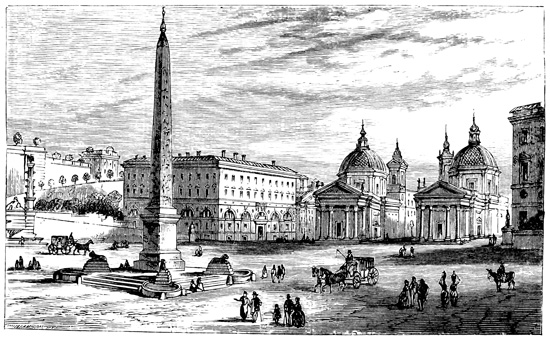
PIAZZA DEL POPOLO. View larger image.
THE PIAZZA DEL POPOLO
is a circular open space, adorned with fountains, and surrounded with foliage. From this circle Rome spreads itself out like a fan southwards. The four principal lines of thoroughfare diverge from this spot—the Pincio, the Via Sistina, and the Via Quattro Fontane, leading to the Esquiline, on the extreme left, along the hills; the Via Babuino, leading into the Piazza di Spagna, on the left; the Corso, leading into the Forum, in the centre; and the Via Ripetta, leading into the oldest part of the present city, on the right: at the corners of the three latter are the twin churches S. Maria in Monte Santo, and S. Maria dei Miracoli, with domes and vestibules designed by Rinaldi, and completed by Bernini and Fontana. In the centre of the Piazza is an Egyptian obelisk, supported by a fountain with four lionesses at the corners spouting water. On the right, under the Terraces of the Pincio, are the statue of Rome by Ceccarini, of Neptune between two Tritons, and statues of Spring and Summer, by Laboureur. On the left are the statues of Autumn, by Stocchi, and Winter, by Baini.
THE EGYPTIAN OBELISK
of the Piazza del Popolo was brought to Rome by Augustus, and erected in the Circus Maximus. It is 78 feet 6 inches high, and was erected on its present site by Pope Sixtus V. in 1589. This was the first obelisk erected in Rome, having been brought by Augustus after the death of Antony and Cleopatra. Pliny (xxxvi. 16) says:—
"But the most difficult enterprise of all was the carriage of these obelisks by sea to Rome, in vessels which excited the greatest admiration. Indeed, the late Emperor Augustus consecrated the one which brought over the first obelisk, as a lasting memorial of this marvellous undertaking, in the docks at Puteoli; but it was destroyed by fire.
"And then, besides, there was the necessity of constructing other vessels to carry these obelisks up the Tiber; by which it became practically ascertained that the depth of water in that river is not less than that of the river Nile.
"The one that he erected in the Campus Martius is nine feet less in height, and was originally made by order of Sesothis. They are both of them covered with inscriptions which interpret the operations of Nature according to the philosophy of the Egyptians."
This has the name of two kings upon it: Seti, who went blind, and his son Rameses, who succeeded him. It stood before the Temple of the Sun at Heliopolis, and was placed by Augustus on the Spina of the Circus Maximus, and re-dedicated, 10 B.C., to the Sun, as the inscription informs us: IMP. CAES. DIVI. F.—AUGUSTUS—PONTIFEX MAXIMUS—IMP. XII. COS. XI. TRIB. POT.—POPULI ROMANI REDACTA.—SOLI DONUM DEDIT.
Ammianus Marcellinus (xvii. 4) supplies us with the following information relative to obelisks:—
"In this city of Thebes, among many works of art and different structures recording the tales relating to the Egyptian deities, we saw several obelisks in their places, and others which had been thrown down and broken, which the ancient kings, when elated at some victory or at the general prosperity of their affairs, had caused to be hewn out of mountains in distant parts of the world, and erected in honour of the gods, to whom they solemnly consecrated them.
"Now, an obelisk is a rough stone, rising to a great height, shaped like a pillar in the stadium; and it tapers upwards in imitation of a sunbeam, keeping its quadrilateral shape, till it rises almost to a point, being made smooth by the hand of a sculptor.
"On these obelisks the ancient authority of elementary wisdom has caused innumerable marks of strange forms all over them, which are called hieroglyphics.
"For the workmen, carving many kinds of birds and beasts, some even such as must belong to another world, in order that the recollection of the exploits which the obelisk was designed to commemorate might reach to subsequent ages, showed by them the accomplishment of vows which the kings had made.
"For it was not the case then, as it is now, that the established number of letters can distinctly express whatever the human mind conceives; nor did the ancient Egyptians write in such a manner, but each separate character served for a separate noun or verb, and sometimes even for an entire sentence.
"Of which fact the two following may for the present be sufficient instances:—By the figure of a vulture they indicate the name of nature; because naturalists declare that no males are found in this class of bird. And by the figure of a bee making honey they indicate a king; showing by such a sign that stings as well as sweetness are the characteristics of a ruler. And there are many similar emblems."
To the right of the Porta del Popolo is the
CHURCH OF S. MARIA DEL POPOLO,
founded by Paschal II. in 1099. Its interior consists of nave, aisles, transept, and octagonal dome lavishly decorated by Bernini.
In the first chapel, to the right, the picture over the altar, the Nativity of Jesus Christ, and the frescoes of the lunettes are by Pinturicchio. The second chapel is that of the Cibo family—rich in marbles, and adorned with forty-six columns of Sicilian jasper. The picture of the Conception is by Maratta. The third chapel is painted by Pinturicchio. In the fourth chapel is an interesting bas-relief of the fifteenth century. The painting of the Virgin, on the high altar, is one of those attributed to S. Luke; the paintings of the vault in the choir are by Pinturicchio. The two monuments in marble ornamented by statues are by Contucci da S. Savino. The last chapel but one, in the small nave, is that of the Chigi family, and is one of the most celebrated in Rome. Raphael gave the design for the dome, for the paintings of the frieze, and for the picture of the altar, which was commenced by Sebastiano del Piombo, and terminated by Francesco Salviati. The statues of Daniel and Habakkuk were executed by Bernini. The front of the altar and the statues of Elias and Jonah are by Lorenzetti; but the design of the last is by Raphael.
THE CORSO (Il Corso).
Starting on our first ramble, we will take the line of the principal street, the Corso, which takes its name from the races held during the Carnival. It is on the line of the old Via Flaminia, the great highroad which ran through the Campus Martius to the north. Many handsome churches and palaces face the street, which is rather narrow compared with our modern requirements. The Corso is the principal promenade of the Romans, and possesses many points of interest. At No. 18, on the left, lived Goethe; just beyond, on the right, in the short Via S. Giacomo, was Canova's studio. On the right, further down, is the Church of S. Carlo; passing by which, crossing the line of the Via Condotti, on our right opens out the small square of S. Lorenzo, in which is the
CHURCH OF S. LORENZO IN LUCINA,
containing the grand work of Guido Reni, "The Crucifixion." It is said that, being absorbed in his subject, he crucified his model. The church contains a monument to Poussin, the relief being a copy of his landscape of the tomb of Sappho in Arcadia. Opposite this church is the English Baptist Chapel, under the Rev. James Wall, founded for Romans.
Turning to the right, down the Corso, on the left, the Via Convertite leads to
THE GENERAL POST OFFICE (La Posta),
in the Piazza S. Silvestro, on the left. It is a new building, recently opened, and is fitted up with every modern appliance. The garden in the centre, and the surrounding arcade with its frescoes, present a refreshing appearance, and give a good idea of what the court of a palace should be.
Opposite, in the right corner of the square, is
THE ENGLISH CHURCH OF THE HOLY TRINITY,
being the first Protestant church erected in Rome. It is in the form of a basilica without aisles, and was designed by the late architect Cipolla.
Regaining the Corso, we soon arrive at the Piazza Colonna, in which is
THE COLUMN OF MARCUS AURELIUS.
On the spot where the Palazzo Chigi now stands (on our right) a temple was erected to M. Aurelius, in front of which was placed a splendid pillar, with a spiral frieze winding up the shaft, and representing the chief incidents of the war against the Marcomanni (A.D. 174).
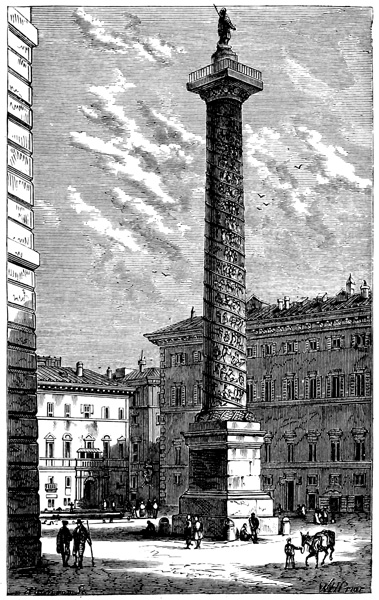
COLUMN OF MARCUS AURELIUS. View larger image.
The shaft of this pillar is of precisely the same height as that of the Pillar of Trajan. The pedestal, on the other hand, is much higher, and rises considerably above the level of the modern pavement. The present marble facing of this pedestal has been employed to strengthen the foundations of the monument, which had been much injured. The pillar, after having been frequently struck and much damaged by lightning, was restored, at the command of Sixtus V., by Fontana and his nephew Carlo Maderno. Looking up, we perceive the iron cramps used to keep together the blocks of marble, which had slipped out of their original position. But for this support, this fine monument would long since have sunk beneath the pressure of its own weight.
The sculptures are very interesting, but can no more be enjoyed on the spot than those on the Pillar of Trajan. They represent scenes from the battles fought in Germany. The column is formed of 28 blocks of white marble, is 137 feet high, and is crowned with a statue of S. Paul. Sixtus V., in restoring the Column of Marcus Aurelius, in error inscribed it to Antoninus Pius.
Facing the Piazza Colonna is a large palace. The columns which form the portico were found in the ruins of Veii. Our attention is next attracted by
THE PARLIAMENT HOUSE,
situated in the Piazza Monte Citorio, behind the Palace. Orders for admission to special seats may be obtained from any deputy, but there is a compartment in the gallery open to the public.
Opposite the Parliament House is an
EGYPTIAN OBELISK.
It was erected originally at Heliopolis to Psammeticus I., of the twenty-fourth dynasty, more than six centuries B.C. It is 72 feet high. Its first site in Rome was in the Campus Martius, where is now the Piazza dell'Impresa, where it was found and taken to its present site. The Roman pedestal with inscription is in the Church of S. Lorenzo in Lucina. The obelisk was repaired, and its present pedestal formed of fragments of the Antonine Column, which stood near by. The obelisk was brought to Rome by Augustus at the same time as the one in the Piazza del Popolo, and was put up, according to Pliny (xxxvi. 15), as a sun-dial:—
"The one that has been erected in the Campus Martius has been applied to a singular purpose by the late Emperor Augustus—that of marking the shadows projected by the sun, and so measuring the length of the days and nights. With this object, a stone pavement was laid, the extreme length of which corresponded exactly with the length of the shadow thrown by the obelisk at the sixth hour on the day of the winter solstice. After this period the shadow would go on day by day gradually decreasing, and then again would as gradually increase, correspondingly with certain lines of brass that were inserted in the stone—a device well deserving to be known, and due to the ingenuity of Facundus Novus, the mathematician. Upon the apex of the obelisk he placed a gilded ball, in order that the shadow of the summit might be condensed and agglomerated, and so prevent the shadow of the apex itself from running to a fine point of enormous extent, the plan being first suggested to him, it is said, by the shadow that is projected by the human head. For nearly the last thirty years, however, the observations derived from this dial have been found not to agree,—whether it is that the sun itself has changed its course, in consequence of some derangement of the heavenly system; or whether that the whole earth has been in some degree displaced from its centre—a thing that, I have heard say, has been remarked in other places as well; or whether that some earthquake, confined to this city only, has wrenched the dial from its original position; or whether it is that, in consequence of the inundations of the Tiber, the foundations of the mass have subsided, in spite of the general assertion that they are sunk as deep into the earth as the obelisk erected upon them is high."
Regaining the Corso, the first turning on the right, Via Pietra, leads into the Piazza di Pietra, in which are the ruins of
THE TEMPLE OF NEPTUNE.
Eleven Corinthian columns, which formed a part of one side of the temple, still stand, forming the entrance into a building once used as a custom-house. They are 42½ feet high and 4½ feet in diameter, supporting an architrave of marble which has been recently restored. In the interior are some immense blocks of marble which formed part of the vaulting. The temple, with the Portico of the Argonauts which surrounded it, was erected by Agrippa. It is now used as a chamber of commerce.
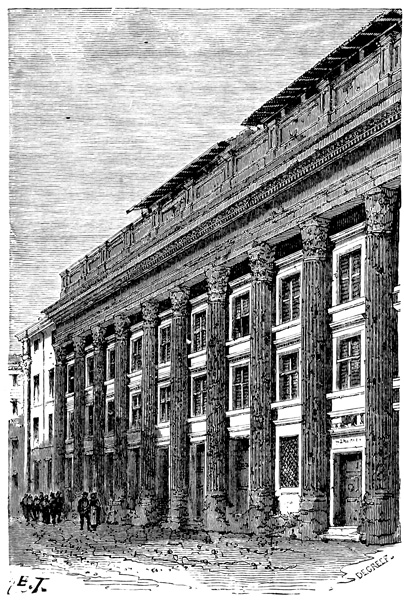
TEMPLE OF NEPTUNE. View larger image.
Continuing our ramble along the Corso, on the right is the Palazzo Simonetti, on the left the Palazzo Sciarra. The pictures here have not been shown to the public for some years. Beyond, standing back, is the Church of S. Marcello, containing the celebrated cherubs of Pierino del Vaga, the most exquisite things ever done in fresco. The tomb of Cardinal Weld is also here.
Rienzi's body was hung up by the feet for two days in front of this church.
THE CHURCH OF S. MARIA IN VIA LATA
was founded in the eighth century, but was rebuilt in 1485, when the tradition arose that it was on the site of the hired house of S. Paul in Rome. Dodwell, the English explorer in Greece, was buried here. There are also tombs of several members of the Bonaparte family. A door on the left of the portico, built in 1662 from the designs of Pietro da Cortona, leads down into the subterranean chambers, where a well is shown said to have been used by S. Paul to baptize his converts. In an adjoining chamber S. Luke is said to have painted his Madonna. Here are some remains of the materials of the Arch of Claudius, which spanned the Via Flaminia at this point; and an old piece of fresco, said to be by S. Luke. These remains below the church formed part of
THE SEPTA.
Cicero Ad Atticum (iv. 15) informs us that Julius Cæsar commenced a septa in the Campus Martius for the Comitia Centuriata and Tributa. It consisted of a beautiful building of marble, surrounded with a portico a mile square. It adjoined the Villa Publica. It was completed by Lepidus the triumvir, and dedicated by Agrippa (Dion Cassius, liii. 23). Frontinus (Aq. xxii.) says the arches of the Aqua Virgo ended in the Campus Martius, in front of the Septa.
The Comitia Centuriata, when the people assembled in their military order, to elect their highest magistrates, to pass their laws, and to vote upon peace or war, always met outside the walls in the Campus Martius.
Comitia Tributa, for less important magistrates, tribunes, and ædiles, met sometimes in the Campus Martius.
The Septa consisted of pens (hence the name), into which the tribes passed to record their votes, which were given by ballot. Every voter received a tabella (tablet), on which he wrote the name of the candidate for whom he voted. He then dropped it into an urn.
Near by, Agrippa built the Diribitorium, a large building used for distributing and counting the ballot tickets. It was dedicated by Augustus (Dion Cassius, lv. 8; Pliny, xvi. 40). During a fire Claudius passed two nights here (Suetonius, "Claudius," xviii.).
These ruins extend under the Doria Palace, and have nothing to do with any house. There were no houses on the Campus Martius in Paul's time. (See page 197.)
Just beyond, on the same side of the way, is
THE DORIA PALACE GALLERY (Palazzo Doria),
open on Tuesday and Friday from 10 till 2. Catalogues in each room. Fee, half-franc.
First Room contains four sarcophagi. A picture of the Deluge, by Scarsellino.
Second Room.—4. Caritas Romana, by Valentin. (See page 191.) 24. Madonna and Child, by F. Francia. 28. Annunciation, by Lippi. 33. S. Agnese, by Guercino.
Fourth Room.—Bust of Leo X., Doria.
Fifth Room.—17. Money-Changers, by Quentin Matsys. 25. S. Joseph, by Guercino.
Sixth Room.—13. Madonna, by Carlo Maratta. 30. Sketch of a Boy.
Seventh Room.—8. Belisarius in the Desert, by Salvator Rosa. 19. Slaughter of the Innocents, by Mazzolini.
First Gallery.—3. Magdalen, by Annibale Caracci. 9. Holy Family, by Sassoferrato. 14. A Titian. 20. Three Ages of Man, by Titian. 25. Flight into Egypt, by Claude Lorraine. 45. Madonna, by Guido Reni. 50. Holy Family, by Giulio Romano.
Second Gallery.—6. Madonna, by Francia. 14. Bartolo and Baldo, by Raphael. 24. Calvin, Luther, and Catherine, by Giorgione. 40. Herodias, by Pordenone. 50. Confessor, by Rubens. 53. Joanna of Arragon, School of Leonardo da Vinci. Bust of Andrea Doria. 80. Wife and Self, by Titian.
Third Gallery.—5. Landscape, by Claude Lorraine. 12. The Mill, by same, a most extraordinary complication. 18. Pietà, by Caracci.
Cabinet of Gems.—1. Portrait of a Letterato, by Lucas van Leyden. 2. Andrea Doria, by Sebastiano del Piombo. 3. Giannetto Doria, by Bronzino. 4. S. Philip Neri, by Barocci. 5. Innocent X., by Velasquez. 6. Entombment, by John Emelingk. Bust of Lady Mary Talbot.
Proceeding down the Corso, we reach the Piazza di Venezia. On the left is the Tolonia Palace, and on the right the Venetian Palace (now the Austrian Embassy), a building of the middle ages. On the right-hand side of the narrow street, in a line with the Corso, Via Morforio, is the
TOMB OF ATTIA CLAUDIA,
converted into a house, the lower part being shops. By descending into the vault, it will be seen that it is hewn out of the natural rock. The Claudii family "received, from the state, lands beyond the Anio for their followers, and a burying-place for themselves near the Capitol" (Suetonius, "Claudius," i. 1).
Adjoining is the house where Giulio Romano was born.
A few steps beyond, on the left-hand side of the same street, is the
TOMB OF BIBULUS.
The inscription records the virtue and public honour of a Roman magistrate of the time of the republic. It is supposed to be two thousand years old.
C. PUBLICO . L. Q. F. BIBULO . AED . PL. HONORIS VIRTUTISQUE . CAUSSA . SENATUS CONSULTO . POPULIQUE . IUSSU . LOCUS. MONUMENTO . QUO . IPSE . POSTEREIQUE EIUS . INFERRENTUR . PUBLICE . DATUS . EST.
It is of travertine stone and plain Doric architecture. There is some talk of pulling the house down, so that this interesting monument may be better seen.
Continuing our ramble down the street, we arrive, on the right, at the Church of S. Giuseppe dei Falegnami. It is built over part of
THE MAMERTINE PRISON,
erected, according to Livy (i. 33) by Ancus Martius. "In order to suppress the terror, the boldness which the vicious assumed from hence (A.U.C. 121),[1] and which gained ground continually, a prison was built in the middle of the city, adjoining the Forum." Servius Tullius added a lower cell, called the Tullianum, 6½ feet high and 19 feet by 9. Prisoners who were condemned to be strangled or to die of hunger were thrust down the aperture; hence the phrase, "to cast into prison." Sallust ("Catiline," lv.) thus describes it:—
"There is a place in the prison which is called the Tullianum Dungeon. It is about 12 feet deep in the ground when you have ascended a little to the left.[2] It is secured round the sides by walls, and over it is a vaulted roof, connected with stone arches; but its appearance is disgusting and horrible, by reason of the filth, the obscurity, and the stench. When Lentulus had been let down into this place, certain men, to whom orders had been given, strangled him with a cord."
The upper part of the Mamertine Prison was partly rebuilt in the time of Tiberius, as we know from an inscription remaining in the cornice over the flight of steps under the church.
C. VIBIUS . C. F. RUFINUS . M. COCCEIUS . NERVA . COS . EX . S. C. Consuls A.D. 23.
It seems to have been used exclusively for state prisoners. We have records of the following, amongst others, who were confined here:—
Manlius, who had defended the Capitol against the Gauls.—B.C. 382.
Quintus Pleminius, a prisoner for sedition.—B.C. 194.
Jugurtha, King of Numidia, who was starved to death B.C. 104. He exclaimed, when cast in, "By Hercules! how cold is this bath of yours!" (Plutarch, in "Caius Marius"), evidently speaking of the spring as existing in those days.
Catiline conspirators, strangled by order of the Consul Cicero.—B.C. 55.
Vercingetorix, King of the Gauls, by order of Julius Cæsar.
Sejanus, the minister of Tiberius.—A.D. 31.
Simon, the son of Giora, the defender of Jerusalem against Vespasian.—A.D. 69.
In the centre of the upper chamber is the round aperture, covered by a grate, down which the prisoners were cast.
Juvenal says: "Happy ages of the just, happy centuries, it may be said, those which saw, formerly under the kings, as under the tribunes, Rome content with one prison."
One prison may have been enough in those times when it was against the law to confine a Roman citizen before he was tried. We have records of other prisons. Appius Claudius constructed a prison for common offenders near the Forum Olitorium, the scene of "Roman Charity." (See page 190.) Pliny mentions "Stationes Municipiorum"—barracks of the municipal soldiers—near the Forum of Julius Cæsar. These may likewise have been prisons. In addition to these, there was the Lautumiæ.
Below the church, the Chapel of the Crucifixion occupies part of the buildings of the prison, and from the sacristy a flight of modern steps leads down into a lower cell, the Chapel of SS. Peter and Paul. The entrance and steps from the street are also modern. In this chamber, to the right of the altar, is a closed-up passage; it evidently communicated with other chambers. On the tufa, carefully guarded by iron bars, an indentation is shown which, they say, was caused by the jailers beating Peter's face against the rock. (He must have had rather a hard head!)
Another flight of modern stairs leads down into the Tullianum: the opening down which the prisoners were cast can still be seen. The iron door is the opening of a sewer leading into the Cloaca Maxima, by which means the dead bodies, &c., were taken away. This drain is of the same construction as the Cloaca Maxima, and comes from beyond the other chambers, mentioned below, with which it also communicates.
The Roman Catholic tradition is, that SS. Peter and Paul were confined here, and they show the pillar to which they are said to have been chained, though there are no marks of a staple having been fixed in the stone, as represented in the bronze bas-relief; and a fountain which miraculously sprang up when they had converted their keepers, and they wished to be baptized: this was evidently alluded to by Jugurtha.
The name Mamertine Prison is medieval. By the ancients it was called the Prison, or the Tullian Prison.[3] The two chambers are only a small part of the ancient prison, which extended up the left side of the Clivus Argentarius, the modern Via Marforio, and evidences of its extent can be seen in the cellars of the houses. It evidently extended up as far as No. 68, for under that wine shop we found two chambers corresponding with the two under the church. The prison was approached from the Forum by a flight of stairs called
THE SCALÆ GEMONIÆ,
or Stairs of Wailing. Criminals were often put to death on them, and others were exposed there after death. "Those who were put to death were exposed on the Scalæ Gemoniæ, and then dragged into the Tiber" (Suetonius, "Tiberius," lxi.).
At a short distance from the church in the little lane opposite, Via Marmorelle, 29, are some more remains of the Prison, which eventually became the
"STATIONES MUNICIPIORUM" AND FORUM OF JULIUS CÆSAR.
"Julius Cæsar, with money raised from the spoils of war, began to construct a new Forum" (Suetonius, "Cæsar," xxvi.)—the site costing about £807,291. This new Forum was necessary, on account of the old Forum becoming too small for the public business. Pliny (xvi. 86) mentions the barracks of the municipal guards as being between the Vulcanal and the Forum of Julius Cæsar. These remains consist of a series of five large chambers; one is forty feet long and fourteen wide, divided by modern walls and partitions in various ways, and not easy of access. The walls are of tufa. The vaults are of brick, with openings for letting down prisoners. These are of later date than the tufa walls, and one of them is supported by a fine arch of travertine.
THE ROMAN FORUM (Il Foro).
(The new excavations are open to the public every day without fee.
To understand the Roman Forum and its surroundings, visitors should attend the lectures given on the spot by the author of these Rambles, descend with him to its level, and examine each remaining object in detail; thus they may learn something of the buildings and the history that crowded on its space. For particulars, apply at 93 Via Babuino, Rome.
Mutilated fragments still speak of the former grandeur of the spot, dead men of its fame, and living authors of its past and present history.
In these Rambles we shall only treat of the most important and present remains, which are classed in the order in which they should be visited, and not chronologically.
The real foundation of the ancient city has long been covered over by the heaping up, during ages, of earth, stones, rubbish, &c., to the depth of thirty feet. The thick crust had lain untouched by shovel during the long series of popes; especially was this, until recently, the condition of the Roman Forum. The latter is to be entirely excavated, and the removal of the superincumbent earth is at this present moment being made with a vigour never before attempted.
In short, the Forum is dressed up in quite a new attire, and many old visitors would scarcely recognize it in its modern garb. Crowds of spectators lean against the barriers every day, anxiously reviewing the carting of the earth, and awaiting for artistic valuables to "turn up."
The picturesqueness of the crowds, of the costumes and scenery, the variety of language and nationality, the past associations, all go to make up a spectacle quite unique.
We will follow the modern road, which crosses the Forum, and turning to the left, proceed along the side of the Basilica Julia to the Temple of Castor and Pollux, where a flight of steps gives access to the Forum.
Standing upon the platform of the temple, we propose to explain the various buildings that surrounded the Forum, and then to descend to its ancient level to examine the chief points of interest.
The word forum, in its simple signification, means market-place; and the Roman Forum was the market-place when Rome consisted of but two hills, the Palatine and Capitoline. It soon lost its primitive use, and became the centre of the religious, civil, and political life of the Romans. Then other market-places were formed, and called after the principal commodity sold therein. In the time of Cæsar the Forum was found too small, and then was commenced the first of the Imperial Fora. The Forum, from the time of Constantine, gradually fell into decay, and was finally ruined in the year 1084, when Robert Guiscard, the Norman chief, burned all Rome from the Lateran to the Capitol.
HOW THE SOIL ACCUMULATED.
We may learn from the erection of the Column of Phocas, in A.D. 608, that the Forum was then unencumbered with soil. Rome having been at that time deserted for a long period by its emperors, its principal monuments began to fall into decay, the Romans themselves hastening on the work for the sake of the marble; the steady hand of time, allied with the luxuriant vegetation, working slowly but surely, added to the débris; whilst deposits from the Tiber floods, the wind, and the wash of the rain-shed, helped still more to fill in the valleys. During a long course of years Rome was almost abandoned; the streets remained unswept, and the rubbish of the city collected upon them. At length a new life sprang up, and to the dust of ages was added the refuse of building materials for the new city, till in the year 1650 we have the Forum presented to us on a level with the modern streets, under the name of the Campo Vaccino (the Cow-field); and thus was the Forum filled up. Such are the fluctuations of worldly splendour!
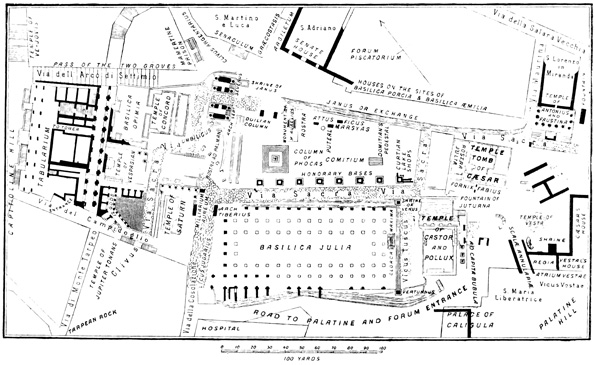
PLAN OF THE ROMAN FORUM. View larger image.
EXTENT OF THE FORUM.
The Forum was not, as many have supposed, a building, but an open space surrounded with buildings, the whole forming the Forum. It was 260 yards long, and 55 yards wide at the bottom. The top, under the Capitol, was 140 yards wide. The temples were built on lofty platforms (podia), to give them a more commanding appearance.
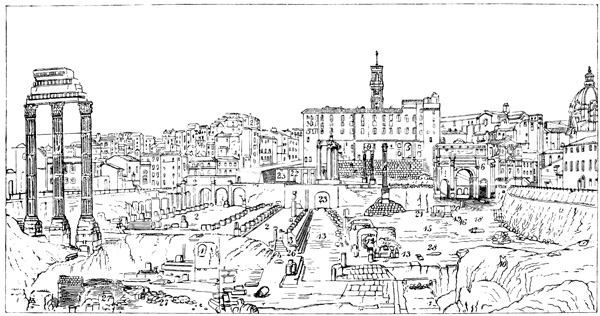
THE ROMAN FORUM, LOOKING TOWARDS THE CAPITOLINE HILL.
1. The Temple of Castor and Pollux.
2. The Basilica Julia.
3. Shrine of Venus.
4. Temple of Saturn.
5. Tabularium.
6. Arch of Severus.
7. Mamertine Prison.
8. Column of Phocas.
9. Temple of Vespasian.
10. Temple-tomb of Cæsar.
11. Senate House.
12. Shop.
13. Via Sacra.
14. Bases.
15. Pedestal of Domitian's Statue.
16. Puteal.
17. Marsyas.
18. Attus Navius.
19. Old Rostra.
20. Reliefs of M. Aurelius.
21. Site of Statue.
22. Portico of the 12 Gods.
23. Clivus Capitolinus.
24. Tarpeian Rock.
25. Tower of Capitol.
26. Vicus Tuscus.
27. Street of Ox Heads.
28. Curtian Lake.
View larger image.
TEMPLE OF CASTOR AND POLLUX.
Founded by Aulus Posthumius, A.U.C. 268–74, in commemoration of the battle of Lake Regillus. It was afterwards rebuilt by Lucius Metellus. "Tiberius dedicated the Temple of Castor and Pollux, which had been rebuilt out of the spoils of the German war, in his own and his brother's name" (Suetonius, "Tiberius," xx.). "Caligula converted it into a kind of vestibule to his house" (Ibid., "Caligula," xxii.).
The three magnificent pillars still standing belonged to the side facing the Palatine. They indicate approximately the south-east boundary of the Forum. The narrower front looked down from a terrace of considerable elevation upon the Forum, and was connected with it by means of a double flight of stairs, the remains of which were discovered during excavations made some time ago. These pillars, as well as the fragments of the architrave and cornice supported by them, are among the most beautiful architectural remains of ancient Rome. The ornaments of the capitals and of the entablature are as rich and splendid as they are pure and simple. It is therefore probable that they belong to the time of Tiberius.
Pliny (x. 60) tells us of "a raven that was hatched upon the roof of the Temple of Castor and Pollux, and flew into a bootmaker's shop opposite. Every morning it used to fly to the Rostra which looked towards the Forum (the Rostra Julia), where he would salute the Emperor Tiberius, Germanicus, Drusus, and others, as they passed; after which he returned to the shop. This the bird did for several years, till the owner of an opposition shop, through jealousy, killed him, for which the man was put to death; and such a favourite had the bird become that he had a public funeral, and was buried in the field of Rediculus, on the right-hand side of the Via Appia, at the second milestone. No such crowds had ever escorted the funeral of any one out of the whole number of Rome's distinguished men."
The Church of S. Maria Liberatrice, on our right, occupies the site of
THE REGIA NUMÆ.
"Numa erected a palace near the Temple of Vesta, called to this day Regia" (Plutarch, "Numa"). Horace (O. i. 2) says: "We see the tawny Tiber, its waves violently forced back from the Tuscan shore, proceed to demolish the monumental Regia (Numæ) and the Temple of Vesta." It was the residence of the Pontifex Maximus, or chief priest, down to the time of Augustus. "Augustus presented the Regia to the Vestal Virgins, because it adjoined their residence" (Dion Cassius, lxv. 27). In the sixteenth century twelve inscriptions relative to the Virgins were found near the church.
Opposite the church, on the level of the Forum, is the round podium of
THE TEMPLE OF VESTA.
"Numa erected the Temple of Vesta (A.U.C. 37) between the Capitoline and Palatine Hills; the Forum in which this temple was built lying between them" (Dionysius, ii. 66). "It was made round, as a symbol of the earth" (Ovid, "Fasti," vi. 265). "The roof was covered with bronze of Syracuse" (Pliny, xxxiv. 7). It was destroyed by fire under Nero and Commodus, and rebuilt by Vespasian and Septimius Severus. It was the conservatory of the Palladium and holy fire. The number of Virgins was originally four, afterwards increased to six. They were bound to their ministry for thirty years. If they broke their vow they were buried alive: they took their vows for thirty years. "Ten years they were being instructed in their duties, ten years they practised them, and ten years they passed in instructing others" (Plutarch).
On the opposite corner of the Forum ten columns and the side walls remain of
THE TEMPLE OF ANTONINUS AND FAUSTINA.
Erected by Antoninus Pius, A.D. 160; and dedicated by the Senate on his death to himself and wife, who were deified, as we learn from the inscription,—
DIVO . ANTONINO . ET . DIVAE . FAUSTINAE . EX . S. C.
The vestibule of this edifice, composed of ten Corinthian pillars of variegated green marble (cipollino) supporting an architrave and part of the cellæ, built of square blocks of peperino, still remain. The architrave is adorned at each side with arabesque candelabra guarded, as it were, by griffins.
The portico was excavated in 1876: the ascent to the Temple from the Via Sacra was found to be by a flight of twenty-one steps, fifteen feet in height. The portico now fulfils the same office to the Church of S. Lorenzo in Miranda, which we understand is to be pulled down.
Between this temple and our vantage point a mass of rubble work marks the site of
THE TEMPLE-TOMB OF JULIUS CÆSAR.
Ovid ("Met." xv., "Let." ii. 2), describes it as "close to Castor and Pollux, having its aspect towards the Forum and the Capitol." "They [the Triumvirs] likewise built a tomb to Julius Cæsar in the middle of the Forum, with an asylum, that should be for ever inviolable" (Dion Cassius, "Aug."). Before the temple was built, "a column of Numidian marble, formed of one stone twenty feet high, was erected to Cæsar in the Forum, inscribed—TO THE FATHER OF HIS COUNTRY" (Suetonius, "Cæsar," lxxxv.). This gave place to the temple, which had four columns in front, as we learn from a relief and a coin. It was decorated with the statues of the Julian line. "About the time of the death of Nero, the Temple of Cæsar being struck with lightning, the heads of all the statues in it fell off at once; and Augustus's sceptre was dashed from his hand" (Suetonius, "Galba").
We must now call attention to the buildings between the Temple of Antoninus and the Church of S. Adriano on the line of the houses shortly to be pulled down; but till the excavations are made, we cannot be certain of the details. Next to the temple stood
THE BASILICA ÆMILIA.
In B.C. 180, "Marcus Fulvius made contracts for a court of justice behind the new bankers' shops" (Livy, xl. 51). It was destroyed by fire, and rebuilt by Paullus Æmilius, B.C. 53.
Plutarch says that Paullus expended on it the large sum of money he had received from Cæsar as a bribe.
Pliny (xxxvi. 24) tells us it was celebrated for its columns of Phrygian marble.
For explanation of the word Basilica, see page 82.
Between this and the Church of S. Adriano stood
THE BASILICA PORCIA.
In B.C. 185, "Cato purchased for the use of the people the two houses, Mænius and Titius, in the Lautumiæ, and four shops, erecting on that ground a court of justice, which was called the Porcian" (Livy, xxxix. 44). "The tribunes likewise opposed him very much in his building, at the public charge, a hall below the Senate House, by the Forum, which he finished notwithstanding, and called it the Porcian Basilica" (Plutarch, in "Cato").
This is where the tribunes of the people used to hold their courts. It was destroyed by fire at the same time as the Curia.
Behind was
THE FORUM PISCATORIUM,
or Fish-Market. Plautus ("Capteivei," Act iv., Scene 2) says "that the stench of the fish frequently drove the frequenters of the Basilica Porcia into the Forum Romanum."
The Market was destroyed by fire B.C. 212 (Livy, xxvi. 27), and rebuilt B.C. 180 (Livy, xl. 51). "Marcus Fulvius contracted for the rebuilding of the Fish-Market."
In this district was also
THE LAUTUMIÆ.
It was not only a district near the Forum, but a prison, as the name signifies, made out of stone quarries. It is first mentioned (B.C. 212) by Livy (xxvi. 27) in his account of the fire. Livy (xxxii. 26; xxxvii. 3) says it was a place for the custody of hostages and prisoners of war. When Q. M. Celer the consul was imprisoned there by the tribune L. Flavius, Celer attempted to assemble the Senate in it (Dion Cassius, xxxvii. 50); so we may infer that it was a large building. The Lautumiæ was entirely distinct from the Mamertine Prison.
The church with the plain front, S. Adriano, and the house with the green shutters, occupy the site of
THE SENATE HOUSE,
originally built by Tullus Hostilius one hundred years after the foundation of Rome, and called the Curia Hostilia. "He built a Senate House, which retained the name Hostilia even within the memory of our fathers" (Livy, i. 30).
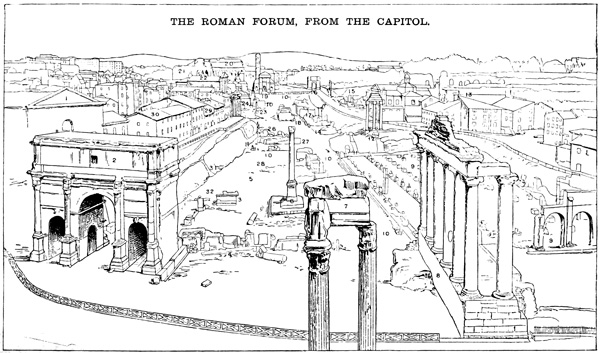
THE ROMAN FORUM, FROM THE CAPITOL.
1. Senate House.
2. Arch of Septimius Severus.
3. Monument of Marcus Aurelius.
4. Rostra ad Palmam.
5. Comitium.
6. Column of Phocas.
7. Temple of Vespasian.
8. Temple of Saturn.
9. Basilica Julia.
10. Sacred Way.
11. Vicus Tuscus.
12. Temple of Castor and Pollux.
13. Palace of Caligula.
14. Temple of Vesta.
15. Palatine Hill.
16. Arch of Titus.
17. House of Cæsar.
18. Arcade of the Pearl-Dealers.
19. S. Francisca, Forum of Cupid.
20. Colosseum.
21. Basilica of Constantine.
22. Temple of Venus and Roma.
23. Temple of the Penates.
24. Temple of Romulus.
25. Temple of Antoninus Pius.
26. Temple-Tomb of Cæsar.
27. Site of the Arch of Fabius.
28. Curtian Lake.
29. Site of Basilica Æmilia.
30. Site of Basilica Porcia.
31. The Janus or Exchange.
32. Site of Original Rostra.
View larger image.
It was destroyed by fire when the body of the tribune Clodius was burned, A.U.C. 702. Rebuilt by Faustus, the son of Sylla. Destroyed a second time, to do away with the name of Sylla, on pretence of erecting the Temple of Felicity; rebuilt by Julius Cæsar, A.U.C. 711, completed by the Triumvirs, and consecrated by Augustus, who named it the Curia Julia. Again destroyed by fire under Titus, and rebuilt by Domitian, and called Senatus.
It was approached by a flight of steps; for "Tarquin carried old Servius out of the Curia, and threw him down the steps to the bottom" (Livy, i. 48).
This was the proper Senate House; and when we read of the senators meeting in other places, there was always some special reason for their so doing. The tradition of the church, S. Adriano, is, that it was erected out of the remains of the Senate House, the bronze doors of which were carried off to the Lateran by Alexander VII., where they still remain.
An anonymous writer, quoted by Eckhard, states that in A.D. 283, under Carinus, a fire destroyed the Curia Julia, the Græcostasis, the Basilica Julia, and the Forum of Cæsar, all of which were restored by Diocletian, 290. The Senate House seems to have been again destroyed, and rebuilt by Flavianus, prefect of the city, in 399, under the title of "Secretarium Senatus;" another prefect, Eucharius, restored it in 407.
The Church of S. Martino occupies the site of
THE GRÆCOSTASIS AND SENACULUM.
Varro ("Ling. Lat.," v. 155) says: "The Græcostasis was on the right of the Curia, and projected in front of it; and here the Senate received the foreign ambassadors in audience. The Senaculum lay above the Græcostasis, and towards the Temple of Concord, and the senators deliberated in this building with the magistrates who were not entitled to enter the Senate House."
Between S. Martino and S. Adriano the Via Bonella runs out of the Forum on the line of
THE ARGILETUM,
which passed through the Fora of Cæsar and Augustus to the Suburra. It was the Paternoster Row of ancient Rome. "Thou preferrest, little book, to dwell in the shops in the Argiletum" (Martial, i. 3).
At its entrance stood
THE BRONZE SHRINE OF JANUS.
In A.U.C. 39, "Numa built a shrine to Janus, near the foot of the hill Argiletum, which was to notify a state either of war or peace" (Livy, i. 19). Ovid ("Fasti," i. 259) says, "Thou hast a shrine adjoining two Fora" (the Forum of Cæsar and the Roman Forum). "There was a Janus in the Forum before the Curia. This temple was made entirely of bronze, and of a square form; it was hardly large enough to hold the figure of Janus. The bronze image was four cubits high; in other respects like a man, except that it had two faces, one looking towards the east and the other towards the west. There were bronze doors in each front" (Procopius, "Bel. Got." i. 25). A brick podium under the right end column of the Arch of Severus marks its site.
Somewhat in the foreground is
THE ARCH OF SEPTIMIUS SEVERUS,
erected, A.D. 205, in honour of the emperor and his two sons, Caracalla and Geta, by the senate and people of Rome.[4] The sculptures adorning it are interesting, and represent his victories over the Parthians, Arabians, and Adiabenes.
A chariot, containing the statues of the emperor and his sons, drawn by six horses (now in S. Mark's, Venice), stood on the summit. The sculptures represent details of the Roman military harangues, sieges, camps, assaults with battering-rams, and the submission of prisoners. The front towards the Forum represents the emperor addressing his troops, the taking of Carrha, the siege of Nisibis. The front facing the Capitol represents another harangue, the siege of Atra, and the passage of the Euphrates and Tigris.
In front of the arch are the bases of
THE DUILIAN COLUMN,
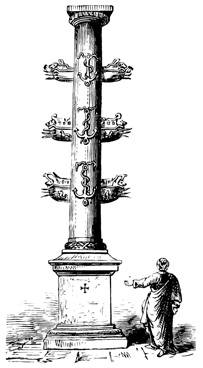
DUILIAN COLUMN. View larger image.
erected A.U.C. 493. "Caius Duilius was the first to gain a naval triumph over the Carthaginians: his column still remains in the Forum" (Pliny, xxxiv. 11). It was of bronze, made out of the rostra of the captured ships. Being struck by lightning, it was restored by Germanicus, under Tiberius, and part of his inscription is still to be seen in the column made to receive it by Michael Angelo in the Palazzo dei Conservatori, on the Capitol.
THE MÆNIA COLUMN
"was erected in honour of C. Mænius, who conquered the ancient Latins, A.U.C. 416, and to whom the Romans gave a third of the spoil" (Pliny, xxxiv. 11).
Immediately behind the Arch of Severus are the remains of
OPIMIUS'S TEMPLE OF CONCORD.
Here was originally a shrine erected by Flavius. Livy (ix. 46) says, "In A.U.C. 449, to the great displeasure of the nobles, Caius Flavius performed the dedication of the Temple of Concord, in the area of Vulcan."
Pliny (xxxiii. 6) gives us further particulars, and points out the exact site:—"Flavius made a vow that he would consecrate a temple to Concord, if he should succeed in reconciling the privileged orders with the plebeians; and as no part of the public funds could be voted for the purpose, he accordingly built a small shrine of bronze near the Græcostasis, then situated above the Comitium, with the fines which had been exacted for usury.
"Here, too, he had an inscription engraved upon a tablet of brass, to the effect that the shrine was dedicated 203 years after the consecration of the Capitoline Jupiter."
The third temple, Livy (xxii. 33) says, "was erected in the Citadel, A.U.C. 538, the Temple of Concord vowed by the Prætor Lucius Manlius, on occasion of the mutiny of some soldiers in Gaul, A.U.C. 536."
The fourth temple was dedicated to Concord by the Consul Lucius Opimius, after the death of Gracchus, A.U.C. 632. Appianus (i. 26) says "it was in the Forum." Varro ("L.L." v.) says, "The Senaculum was above the Græcostasis, towards the Temple of Concord and Basilica Opimia." Festus says it was "between the Capitoline Hill and the Forum."
The Senaculum was distinct from the Curia. Thus Livy (li. 27) says, "The censors constructed a portico from the Temple of Saturn on the Capitol to the Senaculum, which was above the Curia." The inscription has been preserved to us:—
S. P. Q. R. AEDEM CONCORDIAE VETVSTATE COLLAPSAM IN MELIOREM FACEM OPERE ET CVLTV SPLENDIDIORE RESTITVERVNT.
THE BASILICA OPIMIA.
At the back of the ruins of the temple are the remains of the Basilica Opimia. Part of the ground-plan is shown on a fragment of the marble map of Rome, with a fragment of a basilica behind. On examination of the ruins, the two buildings can be distinctly made out.
In front are the ruins of the steps and portico, with the cella behind. There seems to have been at the back of the cella an entrance into the basilica, both being closed with independent doors. The marble threshold of the temple is in situ, and upon it is cut a caduceus, the emblem of Concord, which was once filled in with bronze; parallel to this, but distinct, is the marble threshold of the basilica, with the holes where the pivots of the doors turned. Under the podium of the basilica is a long narrow vault of opus incertum, but it does not lead into the Tabularium, that being built long afterwards, A.U.C. 675, as the old inscription records, B.C. 78. It was probably the place where the utensils for the temple were deposited. Some of the marble decorations of the basilica still remain; and this was no doubt the hall used when the Senate are spoken of as having sat in the Temple of Concord. "The Senate assembled in the building near the Temple of Concord" (Dion Cassius, lviii. 2). "In this temple, in which, whilst I was advising the Senate, you placed around it armed men" (Cicero, "2 Phil." vii. and viii.). "Here, in this Cella of Concord, on the slope of the Capitol."
It may be that this is the basilica spoken of in later times as the Basilica Argentaria, probably taking that name from being frequented by the silversmiths. It was restored, after a fire, by Septimius Severus, and the inscription quoted is probably of his date. In A.D. 731–741, Pope Gregory III. turned the remains into a Christian church, which exists no longer. In 1817, three inscriptions were found here, referring to the temple and basilica. Cicero ("Per Sest." lxvii.) tell us "that the monuments of L. Opimius in the Forum were very much frequented."
A Temple of Concord seems to have been decorated with many statues, but there is nothing to show whether it was that of Camillus on the Capitol, or Opimius's.
"Piston also made the statues of Mars and Mercury, which are in the Temple of Concord at Rome." "Sthenius made the statues of Ceres, Jupiter, and Minerva, which are now in the Temple of Concord." "Augustus consecrated in the Temple of Concord, as something marvellous, four figures of elephants made of obsidian stone." "Also, a picture of Marsyas bound by Leuxis" (Pliny, xxxiv. 19, xxxv. 36, xxxvi. 67).
"Vitellius left the palace to lay down the ensigns of sovereignty in the Temple of Concord" (Tacitus, "H." iii. 68).
To the left is
THE TEMPLE OF VESPASIAN.
Vespasian having rendered such services by restoring the Capitol, and collecting the records in the Tabularium, no more suitable site could be found for the erection of a temple to the deified emperor than in front of an old entrance to this latter building. The three pillars, which are all that remain of the building, stand upon a lofty terrace; and the skill of the architect in concealing the limited depth of the space allotted to the temple is shown in his having placed the columns of the flank nearer to each other than those of the front.
The beauty of this ruin excites universal admiration. It approaches that of the Temple of Castor and Pollux in the Forum. The inscription on the architrave, copied, whilst still entire, by a monk of the monastery of Einsiedeln, in the eighth century, refers to the restoration of the building by Septimius Severus and Caracalla, who appear to have also restored other sanctuaries in the same neighbourhood.
DIVO. VESPASIANO. S. P. Q. R. IMP. CAES. SEVERUS. ET. ANTONINUS. PII. FELIC. AUG. RESTITUERUNT.
Looking across the front of this temple is
THE TEMPLE OF SATURN.
"The temple was consecrated to Saturn, upon the ascent leading from the Forum to the Capitol. Before this, the altar erected by the followers of Hercules stood there" (Dionysius, vi. 1. See ibid., i. 34).
Only eight Ionic columns, with their capitals and architraves, remain. It was on the steps of this temple that the generals took the oath that they had given a correct account of their spoil and prisoners. It contained the public treasury, and, according to Solinus, was called the Treasury of Saturn. Livy (ii. 21) says, "In the consulate of Aulus Sempronius and Marcus Minucius, A.U.C. 257, the Temple of Saturn was dedicated." Plutarch says, "Publicola appointed the Temple of Saturn to be the treasury, which they still make use of for that purpose, and empowered the people to choose two young men as quæstors or treasurers." The inscription is still in situ.
SENATUS . POPULUSQUE . ROMANUS . INCENDIO . CONSUMPTUM . RESTITUIT.
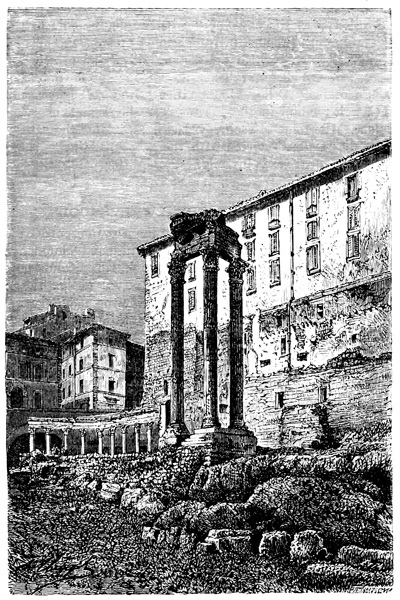
TEMPLE OF VESPASIAN, TABULARIUM, AND PORTICO OF THE TWELVE GODS. View larger image.
THE MILLIARIUM AUREUM,
or Golden Milestone, set up by Augustus (Dion Cassius, liv. 5), the site of which is at the angle of the temple on the side of the old Clivus Capitolinus, the ancient road leading up from the Forum. It was a gilded stone, on which the distance of all the principal towns was recorded, the distance being always measured from the city gates. Suetonius ("Otho," vi.) tells that "Otho gave his accomplices notice to wait for him in the Forum near the Temple of Saturn, at the Golden Milestone." Tacitus ("H." i. 27) relates the same; and Plutarch (in "Galba") agrees with them both, adding, "There terminate all the great roads in Italy."
Behind the Temple of Saturn, in the corner, is
THE PORTICO OF THE TWELVE GODS,
the Schola Xantha, and the portico of the Dii Consentes, restored by Visconti in 1858, marked by eight Corinthian columns, partly modern, but with antique capitals and architraves; and the cellæ arranged in compact masonry behind them. It was called the Schola Xantha, from Fabius Xanthus, a curator of the monuments, who placed here the images of the household gods of Rome—Dii Consentes, because admitted to the council of Jove—Juno, Vesta, Minerva, Ceres, Diana, Venus, Mars, Mercurius, Jovi', Neptunus, Vulcanus, Apollo (Ennius). The inscription tells us they were reinstated under Vettius Pretextatus, A.D. 367.
Facing towards the Forum, at the back of the line of buildings at its top, is
THE TABULARIUM.
(See page 170.)
In front of the Senate House, S. Adriano, is
THE COLUMN OF PHOCAS,
which formerly supported the statue of that emperor. It faced the Senate House; and is placed upon a pedestal rising from a pyramidal basement of steps, the whole evidently the plunder of other edifices.
It was erected by Smaragdus, the Exarch of Italy, in A.D. 608, and was excavated by the Countess of Devonshire in 1816.
It is thus mentioned by Byron,—
"Tully was not so eloquent as thou, Thou nameless column with the buried base!" Childe Harold, iv. 90.
Between the Temples of Saturn and Castor are the remains of
THE BASILICA JULIA,
on the site of the Basilica Sempronia, erected by Sempronius Gracchus, B.C. 169 (Livy, xliv. 16). This was burned down, and rebuilt by Julius Cæsar, and called Julia, after his daughter. It was destroyed by fire, and rebuilt by Augustus (Dion Cassius, "Augustus"). It was again destroyed by fire, and rebuilt A.D. 283. Suetonius tells us that Caligula, "during three days successively, scattered money to a prodigious amount among the people, from the top of the Julian Basilica" ("Caligula," xxxvii.). It is shown on two pieces of the marble plan.
In the "Mon. Ancyr.," Augustus says, "He rebuilt the Basilica Julia between the Temples of Castor and Saturn." Thus we see that the Will of Augustus, the marble plan, and the ruins, all three exactly agree. The portico was dedicated to his grandsons, Lucius and Caius (Suetonius, "Augustus," xxix.). It was the great court of appeal. (See Pliny, Jr., "Letters," v. 21, vi. 33.)
The old pavement has been well exposed, and put in proper condition for preservation; the remnants of frieze, and cornices, and columns found in the diggings have been set up on brick pedestals,—an innovation of Signor Rossa's. The old bits of pavement have been very smoothly linked together by the laying of Venetian mosaic cement, and the contrast between the modern and the antique is very apparent.
The principal streets that ran into the Forum were:—
THE VIA SACRA.
It commenced on the Palatine Hill at the Ædem Larium. Passing by the Arch of Titus, it turned to the left: thus far it was called the Clivus Palatinus and Summa Sacra Via; the slope down to the Forum was called the Clivus Sacer. It entered the Forum at the Temple of Antoninus, past which it turned again to the left, passing in front of the Temple of Cæsar; then turning to the right, passed through the centre of the Forum to the foot of the Capitol. The ascent here was called the Clivus Capitolinus. It was paved B.C. 174 (Livy, xli. 27).
Its windings are easily accounted for when we remember that it had to come from the top of the Palatine to the top of the Capitoline, passing through a narrow valley. It was called the Sacred Way from the sacred processions that passed along it, and from the sacred buildings that lined it.
Between the Basilica Julia and the Temple of Castor
THE VICUS TUSCUS
ran to the forum of the cattle-dealers and Circus Maximus. "They had ground allotted to them for building houses, which was afterwards called the Vicus Tuscus" (Livy, ii. 14). "Verres had caused it to be paved so badly, that he made a point of never going along the street that he had taken the contract for paving" (Cicero, "Ver." i. 59). It was the route for the festal processions to the Circus and Aventine. Where it entered the Forum was a statue of the Tuscan god Vertumnus, the base of which statue was found near where the street first touched the Basilica Julia. This street was sometimes called the Vicus Thurarius, from the perfumers' shops.
THE VICUS JUGARIUS
went out of the Via Sacra between the Temple of Saturn and the Basilica Julia, running under the Capitol to the Porta Carmentalis, the gate in the wall from the Capitol to the river that led into the forum of the vegetable-dealers. Where it left the Via Sacra it was spanned by the Arch of Tiberius, erected A.D. 16 in commemoration of the lost eagles of Varus being recovered by Germanicus (Tacitus, "Annals," ii. 41). In this street was the Lacus Servilius.
Under our (right) side of the Temple of Castor are some remains of
THE STREET OF THE OX-HEADS.
From the Porta Romana on the Palatine, a short street went to the right out of the Via Nova into the Forum, ending between the Temples of Castor and Vesta. "It chanced that I was returning from the festival of Vesta by that way by which the Nova Via is now joined to the Roman Forum" (Ovid, "Fasti," vi. 389.) We wish Mr. Naso had been a little more explicit, and had given us the name of this short street; but we will endeavour to demonstrate what the name of this street was. We know from Suetonius that under the Palatine was the temple to the deified Augustus, and over it Caligula built his bridge, connecting the Palatine with the Capitol. Now, at the corner of the Palatine we have the ascent to this bridge remaining, so that it will not be difficult to find the probable site of the Temple of Augustus. Horace (O. iii. 3) implies that it was between the Temples of Castor and Hercules. Servius says it was near the Tuscan colony. Suetonius tells us it was on the site of the house in which he was born, and gives us the name of the street: "In the quarter of the Palatine Hill, and the street called the Ox-heads, where now stands a temple dedicated to him, and built a little after his death" ("Aug." v.). We conclude from the above that the probable name of this short street was Ad Capita Bubula, and in confirmation of this, ox-heads may still be seen sculptured on the fragments found at the end of this street, between the Temples of Castor and Vesta.
MINOR STREETS.
We must call attention to a cross street that ran from the Clivus Capitolinus to the Prison and the Clivus Argentarius, the name of which we cannot determine, unless it was reckoned part of the Argentarius. When the triumphal processions arrived at this point, the general and prisoners separated. He went up the Capitol to sacrifice, they to the Prison to death.
The road passing under the Arch of Severus is of very late date, and artificially formed. It ran from the cross street down the north side of the Forum for a short distance, when it turns to the left, apparently passing out of the Forum between the Curia and the Basilica Porcia. The roads, as a rule, did not pass under the triumphal arches, as they are represented on reliefs and coins, with the archways occupied with statues.
The open paved space, which was very much larger in the time of the Republic, was called
THE COMITIUM.
Varro says it was so called "from coïre, to meet,—the place of the ratification of the treaty between the Romans and Sabines." Livy tells us "it was an open space marked out in the Forum, where the assemblies called Comitia Curiata took place for the purpose of electing ministers of religious rites, making laws of a certain description, and deciding some suits, and inflicting punishment on criminals."
Domitian ordered the gallants of Cornelia, the president of the Vestal Virgins, to be whipped to death with rods in the Comitium.
A line of seven brick bases for honorary statues occupies one side; the edge of the paved area marks the top; the remains of a row of shops, destroyed by Signor Rossa in 1872, the bottom. The line of the modern road on the right was called
THE JANUS.
This was the Roman Exchange, where the money-changers transacted their business, and must not be confounded with the Temple of Janus already mentioned; nor must it be thought that there were a series of arches here, as some authors have supposed. Horace says (Sat. ii. 3), "Since all my fortunes were dissipated at the middle exchange" (Janus). Again (Ep. i. 1), "O citizens, money is to be sought first; virtue after riches. This is inculcated from the top to the bottom of 'change." He here distinguishes the summus, medius, and imus, or the top, middle, and bottom of the exchange.
SHRINE OF VENUS.
Having thus pointed out the principal buildings of the Forum, we will descend to its level, and identify some of its historical sites.
At the left-hand corner of the Vicus Tuscus and the Via Sacra, a brick pedestal marks the site of the Shrine of Venus Cloacina, erected in commemoration of Tarquin making the Cloaca Maxima. Cloacina comes from cluere = purgare, to purge.
THE DEATH OF VIRGINIA.
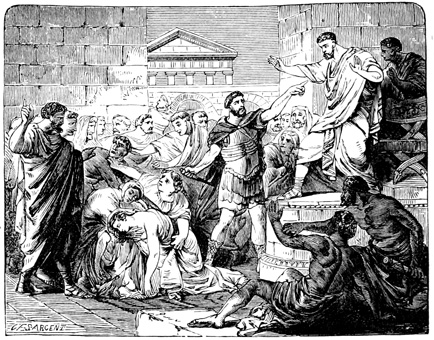
DEATH OF VIRGINIA. View larger image.
Opposite this shrine, facing up the Vicus Tuscus, is some brickwork—remains of a line of shops that faced towards the Temple of Cæsar, and which were destroyed by Signor Rossa in making the excavations. The end shop only was saved. This was the site of the butcher's stall from which Virginius snatched the knife that saved his daughter's honour.
"Virginius demanded to speak with Virginia; and permission being granted, he drew the maiden and her nurse aside to the shops near the shrine of Cloacina, now called the new shops, and there, snatching a knife from a butcher's stall, plunged it into his daughter's breast" (Livy, iii. 48).
THE FOUNTAIN OF JUTURNA.
At the left-hand corner, facing the Temple of Castor, the oval basin of this fountain has been cleared, and the spring which supplied it is covered with an iron grating, and has been turned into the Cloaca. It is no doubt the same at which the twin-gods, Castor and Pollux, washed their horses after fighting for Rome in the battle of Lake Regillus, when they announced to the people that the battle was won. Similar stories are told by Florus. When the Romans conquered Perses, king of Macedonia, the twin-gods washed themselves at the Lake of Juturna; and when they defeated the Tigurini, the gods were seen to deliver a letter to the prætor in front of their temple.
Juturna was the sister of Turnus, immortalized by Jupiter, and turned into a fountain, whose waters were used in Vesta's sacrifices, and had curative powers.
THE FORNIX FABIUS
stood between the Temples of Cæsar and Castor; some slight remains can still be seen. It was erected to Fabius Maximus, the conqueror of the Allobroges, now Savoy. It was erected B.C. 121, being the first triumphal arch in the Forum. The Romans originally called their triumphal arch fornix, not arcus.
The pseudo-Ascon says it stood before the Temple of Castor. The inscription was found in the sixteenth century, and is given by Gruter, ccccvi. 5—
Q . FABIO . ALLOBROGICINO MAXIMO.
Another fragment is given in the Vatican Codex, 3368, 4—
Q . FABIUS . Q . F . MAXIMUS . AED . CVR . REST.
Cicero is the first author who speaks of this arch, and he alludes to it several times. In "Verres" (i. 7) he says: "He (Caius Curio) sees Verres in the crowd by the Fornix Fabius. He speaks to the man, and with a loud voice congratulates him on his victory." Asconius, commenting on this passage, says: "Fornix Fabius arcus est juxta Regiam in Sacra Via a Fabio censore constructus, qui a devictis Allobrogibus Allobrox cognominatus est, ibique statua ejus posita propterea est."
In "Pro Plancio" (vii.) Cicero says: "When I am hustled in a crowd, and pushed against the Arch of Fabius, I do not complain to the man who is at the top of the Sacra Via, but to him who pushes me." Again ("De Orat." ii. 66) he says: "Crassus said in a speech to the people that Memnius, though himself so great a man, as he came into the Forum, stooped his head at the Arch of Fabius."
Seneca ("De Constantia Sapientis," i.) says: "Cato was dragged from the (old) Rostra to the Arch of Fabius"—that is, nearly the whole length of the Forum. Trebellius Pollio ("Saloninus Gallienus," i. 10) says: "There was at this time at the foot of the hill Romulus (Palatine) a statue, that is before the Sacred Way, between the Temples of Faustina and Vesta, near to the Arch of Fabius." This exactly describes the site.
We have two views of this arch preserved to us on ancient reliefs. The first, from the Arch of Marcus Aurelius, now on the stairway of the Palazzo dei Conservatori on the Capitol, represents the arch on the left of the Temple-Tomb of the deified Cæsar. The second, a relief on the monument of Marcus Aurelius on the Comitium, nearest the Arch of Septimius Severus, depicts the Arch of Fabius to the right of the Temple of Castor and Pollux.
Under the bank of earth to the right of Cæsar's Temple-Tomb stood
THE ARCH OF AUGUSTUS.
Dion Cassius records (liv. 8) that Augustus built an arch in commemoration of the Parthian treaty near the Temple-Tomb of Cæsar. This is borne out by Maii, an interpreter of Virgil ("Æn." viii. 606), who says the Arch of Augustus was near to the temple of the deified Julius. The "Mirabilia" mentions it, and gives the same site: "Templum Minervæ cum arcu conjunctum est ei, nunc autem vocatur Sanctus Laurentius de Mirandi;" that is, the Temple of Antoninus Pius and Faustina, now the Church of San Lorenzo in Miranda. Accordingly, it was on the right of the Temple of Cæsar. Between it and the Temple of Antoninus the following inscription on marble was found in 1540–46:—
SENATVS . POPVLVSQVE . ROMANVS IMP . CAESARI . DIVI . IVLI . F . COS . QVINCT COS . DESIGN . SEX . IMP . SEPT REPVBLICA CONSERVATA. (Gruter, ccxxvi. 5.)
It is doubtful whether this refers to the Arch of Augustus or to the Temple of Cæsar, both having been built by Augustus. A coin of Augustus represents this arch, with the legend, CIVIB . ET . SIGN . MILIT . A . PART . RECVP. In the early part of 1884, on the Via Sacra, near the Temple of Antoninus, some thirty travertine voussoirs—which formed part of an arch, the diameter of which was 12 feet 17 inches—were brought to light. So far, the excavations do not show where this arch stood; but when the road between the Temples of Cæsar and Antoninus is cut away, we may hope to find the site.
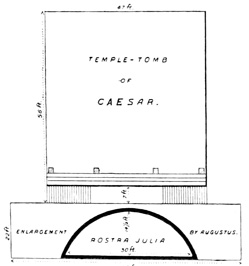
PLAN OF THE ROSTRA, AND TEMPLE-TOMB OF CÆSAR.
View larger image.
THE ROSTRA JULIA.
We know from Dion Cassius that Cæsar encouraged the popular business to be carried on at the lower end of the Forum, and that he turned the steps of the Temple of Castor into a temporary rostra. On this becoming popular he built a new rostra, which was called the plebeian rostra or Rostra Julia. We learn from Suetonius that it was before the Temple of Cæsar. Cicero, speaking from it against Mark Antony, bids his audience look to the (their) left at the gilt equestrian statue of Antony which stood before the Temple of Castor.
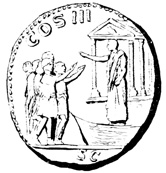
HADRIAN ADDRESSING THE PEOPLE FROM THE ROSTRA JULIA.
View larger image.
This is one of the most interesting spots in the Forum. Cæsar built the second rostra with its rear towards the Forum, represented by the darker lines in the above plan. In front, towards the curved edge, Antony spoke, Cæsar's body being on the level below. The body was burnt and buried "in the Forum in that place visible from the old monumental Regia of the Romans. On the spot was placed an altar where now is the Temple of Cæsar" (Appian, ii. 42). "The same men were erecting a tomb in the Forum who had performed that irregular funeral" (Cicero, "First Phil." ii.).
It was decorated with the rams of the captured ships of Antony and Cleopatra. It was the custom to speak from the circular edge; but when the Temple of Cæsar was built, it was erected close up to his rostra, on the site where the people had previously stood, and so they had to turn about and address the people from the flat edge. "As he was seated on the rostra at the festival of Pan, Mark Antony placed upon his brow a royal diadem" (Velleius Paterculus, ii. 56).
MARK ANTONY'S SPEECH.
When Cæsar was killed, it was not in the Capitol, as Shakespeare makes it, nor in the Senate House upon the Forum, but in Pompey's Senate House (see page 195). From there the body was carried to his house, and next day into the Forum, on its way to the Campus Martius, and was placed in front of the Rostra Julia for some friend to make the funeral oration over it. Mark Antony mounted the rostra, and there made his famous speech, "which moved the people to that degree that they immediately burned the body in that very place, and afterwards interred his ashes" (Dion Cassius, "Cæsar").
Livy ("Epit." xcvi.) says that "Cæsar's body was burned before the plebeian rostra." Dion Cassius says his temple-tomb was built on the very spot where his body was burned.
Unfortunately Antony's address has not come down to us, so we must accept Shakespeare's immortal version.
THE CURTIAN LAKE.
Crossing the Sacred Way, which passes along the front of Cæsar's Tomb, we arrive at the space occupied by the shops destroyed in excavating. The construction remaining shows that they were rebuilt at a late date. It will be noticed that the soil is damp and sandy. This spot was once marshy, and took its name from Mettius Curtius, a leader of the Sabines, getting mired here in the battle which took place about the carrying off of the women. Plutarch, Livy, Dionysius, and Ovid agree in this; and not from the fable related by Livy (vii. 16) of the Forum opening, and Marcus Curtius jumping in, horse, armour, and all. The former event is commemorated in a relief in stone now in the Capitol; whilst the latter fable is depicted in the marble relief now in the Borghese Museum.
THE PEDESTAL OF THE STATUE OF DOMITIAN.
The Statue was destroyed by the people after his death, and the base of the pedestal is all we have left, standing upon the travertine pavement of the Forum. It is interesting to archæologists as putting to rest the arguments in reference to the names and positions of the different buildings in the Forum. The poet Statius ("Silvæ," i. 1, 22) describes the relative position of the different buildings and this statue. He tells us that the statue was situated in the middle of the Forum, near the Curtian Lake. In front of it was the temple of the deified Julius; behind it were the Temples of Vespasian and Concord; on one side the Basilica Julia, and on the other the Basilica Æmilia; whilst the rider looked towards the Temple of Vesta and the Imperial Palace.
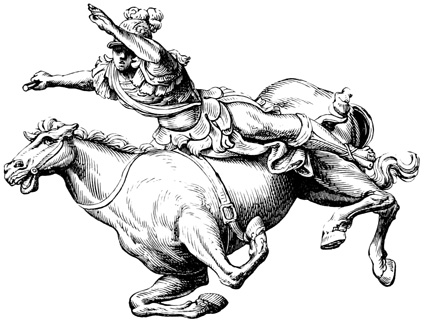
MARCUS CURTIUS LEAPING INTO THE GULF. (Relief in the Villa Borghese.)] View larger image.
Suetonius tells us that the tablet inscribed upon the base of Domitian's triumphal statue was carried away by the violence of a storm, and fell upon a neighbouring monument.
A little beyond this pedestal, to the right, are the remains of another pedestal, a deep round hole recently closed, and beyond it a third pedestal.
Upon the first we will place
THE STATUE OF MARSYAS.
Servius informs us that this statue was put up in the principal forum of every city as an emblem of civic liberty and even-handed justice. It stood in front of the old rostra. Horace and Martial both refer to it as being near the judge's seat. It had a pig-skin of wine on one shoulder, denoting the plentiful supply to the city, and had the other arm extended with the hand open, showing that every one should have equal justice.
Over the round hole stood
THE PUTEAL SCRIBONIUS LIBO,
or well altar. This is shown on a coin as being round.
"At a small distance from the statue of Attus, both the hone and the razor are said to be buried under a certain altar; the place is called Puteus by the Romans" (Dionysius, iii. 72). Cicero ("De Div." i. 17) says, "It was on the Comitium, and was erected over the spot where the hone and razor were buried." (See also Horace, Ep. i. 19.)
Upon the other base we will place
THE STATUE OF ATTUS NAVIUS.
"Tarquin erected a brazen statue of him in the Forum to eternalize his memory with posterity. This statue is still remaining, and stands before the Senate House, near to the holy fig-tree. It is less than a middle-sized man, and has a veil over the head" (Dionysius, iii. 72). "The statue of Attus Navius was erected before the Senate House, the pedestal of which was consumed when the Senate House itself was burned at the funeral of Publius Clodius" (Pliny, xxxiv. 11). "There was a statue of Attus, with a fillet on his head, in the place where Tarquin had the whetstone cut in two with a razor, on the Comitium, or place of assembly, just by the steps, at the left-hand side of the Senate House" (Livy, i. 36).
THE FICUS NAVIA
was a fig-tree that, according to Festus, was planted by Tarquin in commemoration of his having had the whetstone cut in two with a razor, according to the augury of Attus Navius. It should not be confounded with the Ruminal fig-tree which grew upon the Palatine, as has been done by some writers. It is rather a curious incident that since the excavations were made, a fig-tree sprang up near the pedestal of Marsyas. This is the tree shown on the reliefs of the monument of Marcus Aurelius.
Just beyond these three objects, a semicircular mark on the pavement points to the site of
THE ROSTRA.
The original Rostra was first called the Suggestum or Pulpit, but in A.U.C. 416 the name was changed into Rostra (beaks).
"The prows from the six ships captured from the Antiates were ordered to be placed as decorations on the Suggestum in the Forum, which was hence called Rostra" (Livy, viii. 14; Florus, i. 11; Pliny, xxiv. 11).
"The Rostra stood on the Comitium in front of the Curia" (Varro), from which the orators harangued the people assembled in the open air; and it was evidently only a temporary structure, probably of wood, and not a building like the other two Rostra. It stood upon a circular basement, but the top was square; on the outside were fixed the brazen beaks which belonged to the captive vessels of the Antiates. About the Rostra were placed the statues of the ambassadors put to death by Lar Tolumnius, king of Veii, and others who suffered on similar occasions; the three Fates, Horatius Cocles, Camillus, Hercules, the father of Vitellius, and others who deserved well of their country.
"When Caius Gracchus brought in his bill to regulate the courts of judicature, there was one thing very remarkable: whereas the orators before him, in all addresses to the people, stood with their faces towards the Senate House and the Comitium, he then, for the first time, turned the other way,—that is to say, towards the Forum,—and continued to speak in that position ever after. By this he intimated that the people ought to be addressed, and not the senate" (Plutarch).
Suetonius tells us that on the death of Augustus "two funeral orations were pronounced in his praise, one before the Temple of Julius by Tiberius, and the other before the Rostra, under the old shops, by Drusus." Some read this passage, "from the old Rostra;" but our rendering is more correct, though in either case he is referring to the Rostra that stood in front of the Curia.
The first time Cicero spoke from the Rostra was when he delivered his oration for the Manilian Law, A.U.C. 687, when in his forty-first year. After his assassination, the head and hands of Cicero were placed upon this Rostra, from where he had so often addressed the Romans—"that very Rostra, which he had made his own; nor was there a less concourse to see him there than had formerly been to hear him" (Florus, iv. 6). "That everybody might see them in the very place where he had formerly harangued with so much vehemence" (Dion Cassius, "Augustus").
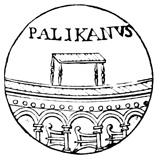
THE ROSTRA.
The form of this Rostra is preserved to us, being represented on a coin.
There is an important passage in Pliny which shows the exact site of the Rostra, as it was used to mark the hour of noon. When the summoner caught sight of the sun passing the edge of the Rostra, he declared the hour of noon. A man standing on this site will roughly represent the Rostra, and as the gun fires at mid-day the edge of the sun can be seen coming past him by a person standing by the pedestal at the bank in front of S. Adriano, who will roughly represent the summoner. We have tried this numerous times with our audience, and it is the only spot on the Forum where it answers.
"The accensus of the consuls proclaiming mid-day aloud, as soon as, from the Senate House, he caught sight of the sun between the Rostra and the Græcostasis: he also proclaimed the last hour, when the sun had gone off the Mænian Column to the Prison" (Pliny, vii. 60).
THE MONUMENT OF MARCUS AURELIUS.[5]
View larger image.
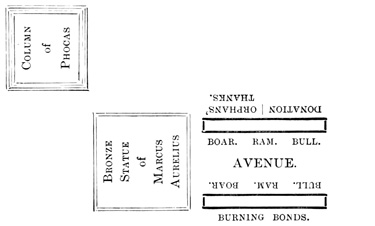
In excavating the open space of the Comitium upon the Forum in the summer of 1872, an interesting discovery was made of two marble screens or balustrades sculptured on each side, the one being some historic scene, the other representing animals. At the time, and since their discovery, many suggestions have been offered as to their signification and use, but none seemed satisfactory, at least to us. After considerable thought, examination of the ground, and putting this and that together, we have arrived at an estimate of their use and meaning entirely different from the hitherto received opinion; in which we are supported by their construction and the classic passages relating to them. They are in situ as found, but a new piece of marble has been put under them.
From this it will be seen that we have made an important discovery bearing upon the topography of the Forum, which will be of interest not only to classical students, but to every one interested in the word Rome.
We have discovered that the reliefs on the screens upon the Comitium in the Forum portray scenes from the life of Marcus Aurelius, showing in their backgrounds the buildings occupying two sides of the Forum—from the Temple of Concord to the Arch of Fabius—and that these marble balustrades led up to the statue of that emperor. The space where it stood can be plainly traced upon the pavement; and that is why these pictures refer to epochs of his life. The statue is still existing, and now stands in the square of the Capitol, where it was erected by Michael Angelo, who brought it from the Lateran in 1538, where it had been placed about 1187, when it was removed from the Forum, near the Column of Phocas, where it had long been looked upon as a statue of Constantine, and is so called in the Regiona Catalogue; hence its preservation.
The whole group was evidently erected in honour of Marcus Aurelius, and in commemoration of the important events in his life depicted on the screens, as recorded by Dion Cassius.
The first relief represents a scene upon the Forum between the old Rostra Marsyas and the fig-tree—burning the forty-six years' arrears of debts which Marcus Aurelius had forgiven the people.
"After that he remitted all that had been due to the Public and Imperial Treasuries for the course of forty-six years, without including therein Hadrian's reign, and ordered all the papers of claims to be burned in the Forum" (Dion Cassius, "Marcus Aurelius").
This was on the marriage of his son Commodus with Crispina.
It will be noticed that the relief is to the right of the fig-tree and Marsyas. Now, if we go round to the other relief, we have the same tree and Marsyas in the same relative positions; but the relief is to the left, and the scenes are taking place between the Rostra Julia, the fig-tree, and Marsyas:—
Giving the donation of eight pieces of gold.
Roma, or perhaps Faustina, thanking him for the Puellæ Faustinianæ.
"After he had come back to Rome, as he was one day haranguing the people, and speaking of the number of years he had spent abroad in his expeditions, the citizens with a loud voice cried out, 'Eight,' at the same time extending their hands to receive as many pieces of gold. The emperor, smiling, repeated, 'Eight,' and ordered every Roman eight pieces, which was so considerable a sum, that so great a one was never given before by any emperor" (Dion Cassius, "Marcus Aurelius").
It will be noticed that two men are holding up their hands with fingers extended, one five, the other three—eight.
The other scene on this relief represents a female figure advancing to the seated figure of the Emperor Marcus Aurelius, leading a child and carrying another, to thank him for the orphan schools he founded in Rome in memory of his wife after her death, and which he named after her. "New Faustinian schools he instituted in honour of his dead wife" (Julius Capitolinus, "M. Antoninus," xxvi.).
THE SUOVETAURILIA.
Upon the inner sides of the Avenue are represented on each balustrade a boar, a ram, and a bull—the animals offered at the triple sacrifice, or suovetaurilia (from sus, ovis, taurus), which was performed once every five years, or lustrum, for the purification of the city.
It was an institution of Servius Tullius, the ceremony consisting in leading the boar, ram, and bull thrice round the assembly of the people, and then offering them to Mars. There is a similar representation upon a relief of Trajan on the Arch of Constantine, and upon a pedestal found near the Arch of Septimius Severus.
To our left of the Arch of Severus is
THE ROSTRA AD PALMAM.
Neither the position nor the construction of this Rostra answers to that of the original Suggestum, which took the name of Rostra from having fixed on it the six bronze beaks of the Antiates' ships. The original Rostra, shown on a coin of Palikanus, the orator mentioned by Cicero ("Brutus," lxii.)—see page 42—was a wooden pulpit. Its exact site we have already identified. The last historical notice that we have of it is in Spartianus's "Life of Didius Julianus" (iv.), A.D. 193. After saying that the emperor addressed the Senate, he adds, "but the people expressly in the Rostra before the Curia."
View larger image.
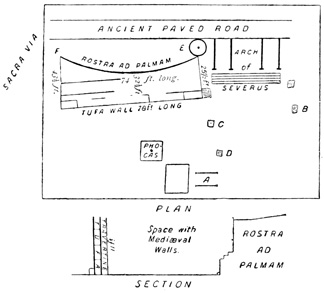
Under the Empire the Rostra had lost its use, and only served occasionally for the emperor to address the people from, or for reading out edicts and proclamations. The western end of the Forum saw many changes after the fire under Commodus, and was rearranged under Septimius Severus, who restored the old edifices, retaining the names of the founders, and erected others (Spartianus, "Severus," xxiii.). In 203 an arch was erected to Severus and his two sons, and a new Rostra was made on the south side of this arch. By cutting away a piece of the slope of the Capitoline Hill, he formed an escarpment 11 feet high, which was faced with a curved brick wall, and cased with Porta Santa marble, in panels 3 feet 1 inch wide. Between each pair of panels there is a space 6½ inches wide, from which a piece of marble jutted out 3½ inches. Only one of these exists. On it there was fixed a bronze beak, probably made in imitation of the old ones, for in that day they had no naval foes from whom to capture ships. If there was one row only, there were eighteen in all; if two rows, thirty-six. This in itself is sufficient to show the ridiculousness of calling this the original Rostra, which had six beaks only. The peculiar marble casing also shows late work. At the north end of this platform was erected the Umbilicus (E), and on the south end was placed the Milliarium Aureum (F). From the level space on the top of this escarpment the orator would speak; whilst at a short distance in his rear was the street Clivus Argentarius, leading from the Via Sacra to the Porta Rutuminia. This Rostra was popularly known as the People's Rostra, because from it they were addressed—"Deinde ad Rostra Populum convocarunt" (Capitolinus, "Maximus et Balbinus," iii.). The narrowness of the level space on the top of this Rostra caused great inconvenience; and as room could not be gained in the rear, it had to be taken in front, encroaching on the Comitium. Forty-three and a half feet in front of the curved wall of Porta Santa a straight wall was built of travertine and tufa, 78 feet long, with side walls from it back to the extreme ends of the Rostra, and this was cased with Carrara white marble, the space between the two walls being filled with earth, thus making a large platform with a square instead of a curved front. The blocks of tufa and marble were tied together by iron clamps, of which fragments remain, of a shape not used in the earlier days, but used now. That the curved wall and the straight wall are not contemporary is shown by the construction, as well as by the fact that the curved wall is faced with coloured marble, which would not have been the case if it had not at one time been open to the Forum. The curved wall is on a line with the Arch of Severus; but the tufa wall comes out 25½ feet beyond the arch, and is not parallel with the curved wall behind it. The tufa and travertine wall is erected on the travertine pavement of the Comitium.

We believe these changes on this Rostra were made in the time of Aurelian (270), after the death of Claudius II., whose statue was erected on this Rostra. "Illi totius orbis judicio in rostris posita est columna palmata statua superfixa" (Pollio, "Claudius," iii.). Upon this Rostra also Aurelian erected a statue of the Genius of the Roman People. Aurelianus—"Genium Populi Romani in rostra posuit" ("E Chronicis antiquis excerpta Aurelianus"). The fourth century guides, "Curiosum Urbis" and "De Regionibus" (in Regio viii.), mention the Genium Populi Romani, the latter adding "aureum." They both mention three Rostra in the Forum. The statue of Claudius was not represented as wearing the Roman toga, but the Greek pallium, from which this Rostra became known as the Rostra ad Palmam; and this part of the Forum in later times was called ad Palmam.
Theodoric—"Deinde veniens ingressus urbem venit ad Senatum, et ad Palmam populo adlocutus" ("Excerpta Valesiana," lxvi.).
"Ligaverunt ei manus a tergo et decollaverunt extra Capitolium et extrahentes jactaverunt eum juxta arcum triumphi ad Palmam" ("Acta SS., Mai." vii.).
Ammianus Marcellinus (xvi. x. 13) describes Constantius's visit in 356 to this Rostra: "When he arrived at the Rostra, he gazed with amazed awe on the Forum, the most renowned monument of ancient power; and being bewildered with the number of wonders on every side to which he turned his eyes, having addressed the nobles in the Senate House and harangued the populace from the Rostra, he retired." This expresses the feelings of many visitors in our day. The site commands a good view of the Forum.
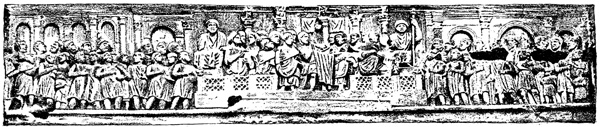
RELIEF FROM THE ARCH OF CONSTANTINE REPRESENTING THE ROSTRA AD PALMAM, ETC. View larger image.
The remains of this Rostra are best illustrated by the representation of it in the relief on the Arch of Constantine; and by no possible imagination can it be made to agree with the coin of Palikanus.
In the centre is a platform with a straight front, having a lattice balustrade; on the right is a statue of Claudius II., and on the left the statue of the Genius of Rome. A group of people stand behind the railing and surround Constantine, who is addressing the people. Behind are five Corinthian columns surmounted with statues. The balustrade stood on the top of the tufa wall, and some of the fallen gray granite columns still exist. To our right, clear of the Rostra, is the Arch of Severus, a group of people being in front, looking up to the Rostra. On the left, in the background, are the Arch of Tiberius, spanning the Vicus Jugarius, and four of the arches of the Basilica Julia—the foreground being occupied by a crowd of people facing towards the Rostra.
The scene here depicted was no doubt that which took place on the entry of Constantine into Rome: "And with a loud voice and by inscriptions he made known to all men the salutary standard" (Eusebius, "Life of Constantine," xl.).
In the relief the head of Constantine is unfortunately missing; but it seems very appropriate that he should be represented addressing the Roman people from that Rostra, which was decorated with the statue of his ancestor Claudius II.
There are no beaks shown on the relief; but along the tufa wall, at regular intervals of 3 feet 4 inches, are cut grooves 6½ inches wide and 1½ inch deep: in these grooves are holes which, if they were to sustain beaks, would give thirty-six for a single row, and seventy-two for a double row.
We doubt if these grooves and holes were for beaks. They were more probably for the supports of the marble casing; they do not go completely through the wall.
Some authorities call these remains on the Clivus the Rostra Vetera, or the original Rostra. But it does not answer classic description, and the construction shows it to be of late date. It does not stand on the Comitium, or before the Curia, nor under the old shops. Besides, it looks down the Forum; so from here how could Gracchus have turned from the Senate House and Comitium towards the Forum?
THE UMBILICUS
was a monument marking the centre of the Roman world. The ruin of the Umbilicus is at the side of the Arch of Septimius Severus, at the end of the Rostra ad Palmam. Its pyramidal shape upon a round base can easily be distinguished.
THE ASYLUM OF ROMULUS.
This was between the Clivus Capitolinus and the Pass of the Two Groves (Via Arco di Septimo Severo), under the Capitoline Hill, and served afterwards as an advanced fort to the citadel. "He opened a sanctuary, in the place where the enclosure now is, on the road down from the Capitoline [Temple], called the Pass of the Two Groves" (Livy, i. 8). "He surrounded it with a high stone wall" (Ovid, "Fasti," iii. 231). The gate leading into it was called the Porta Pandana—"ever-open gate" (Solinus, i. 13. See Plutarch, in "Romulus;" Dionysius, ii. 15; Florus, i. 1; Varro and Festus). The remains of the tufa wall exist on the left of the Clivus, in front of the Temple of Saturn.
THE CLOACA MAXIMA,
or great drain, begun by Tarquin the Great, containing a large stream of water rushing along, as it did over two thousand years ago, is exposed to view at the east end of the Basilica Julia.
It was finished by Tarquin the Proud, B.C. 556 (Livy, i. 38, 55).
"Men spoke in admiration of the public sewers, too, a work more stupendous than any, as mountains had to be pierced for their construction, and navigation might be carried on beneath Rome; an event which happened in the ædileship of M. Agrippa, after he had filled the office of consul." (See Dion Cassius, "Augustus," A.U.C. 721.)
"For this purpose there are seven streams turned into the artificial channels, and flowing beneath the city. Rushing onward, like so many impetuous torrents, they are compelled to carry off and sweep away all the sewerage" (Pliny, xxxvi. 24).
FRAGMENTS
of different buildings lie scattered about; to what edifices they belonged "pronounce who can." More than two hundred columns, and fifty capitals of exquisite workmanship, have been discovered in the excavations of the Forum. Near the reliefs on the Comitium is a pedestal with the following inscription:—
TO THE ANNIHILATOR OF TYRANTS, AND THE AUTHOR OF PUBLIC SAFETY, TO OUR CONSTANT AND FELICITOUS LORD, ARCADIUS AUGUSTUS. ALBINUS, PREFECT OF THE CITY, ETC., HAS ERECTED THIS.
Having now made the circuit of the Forum, we will proceed to
THE SCALÆ ANNULARIÆ.
Beyond the Temple of Castor, to the right of the Temple of Vesta, are remains of these stairs.
"Augustus lived at first near the Roman Forum, above the Ringmaker's Stairs, in a house which had once been occupied by Calvus the orator" (Suetonius, "Augustus," lxxii.). Calvus the orator, a friend of Cicero, lived on the Palatine; and the Scalæ Annulariæ was a flight of stairs that led from the east end of the Forum up the north side of the Palatine to the Clivus Victoriæ.
On the 12th of April 1882, a piece of the marble plan was found here which, curiously enough, represents this part of the Forum, showing the side of the Temple of Castor and the Ringmaker's Stairs.
HOUSE OF THE VIRGINS.
Between the Temple of Vesta and the Sacra Via was the original dwelling-place of the Vestals, of which little remains beyond tufa walls beneath the more recent level. These walls were again exposed to view in some excavations made in the spring of 1886. They are marked in black on our Plan (page 61), being now again covered up.
Martial (i. 70), in addressing his book which he sends to Proculus, says, "You will pass by the Temple of Castor, near that of ancient Vesta, and that goddess's virgin home."
Dionysius (ii. 67) says: "They live near by the temple of the goddess."