Front matter (continued 3)
Reading edition
"Thanks; I'll think about it."
"A question sure to be asked, and therefore one I may as well put: Any special reason for changing a commercial life for an agricultural one?"
"N—o; except that I was not getting on as well as I should have liked, and so determined to make an entire change."
Puffey noticed that this last answer was not given quite so promptly as the replies to his other questions had been, from which fact he was not slow to draw his own conclusions.
It suited his purpose to induce the belief in Fellows' mind, that the mounted police presented a good opening for the employment of his abilities; but that it was an opinion likely to find support in official quarters, should application be made for an appointment, was a matter of no moment to him whatever.
Quitting the track, by which the small towns along the line of the railway were usually reached, he started to return by a cross-cut over the open prairie with which he was familiar, in the hope that by so doing he might possibly come across farm-hands from whom something further could be learned.
He had not proceeded far, before he saw three men seated beneath the shade of a sheltering clump of trees bordering a small stream not above three to four feet deep, and therefore easily fordable. The spot selected was a small hollow, thickly covered with that short crisp variety of grass known as "buffalo grass," on which they were now resting after partaking of the usual midday meal.
Riding up to where they were seated, he saluted them with—
"Good-day, comrades! Do you remember me?"
"No fear, Puffey, after once seen."
"You were with us at the capture of Red Dick, I think?"
"Two of us were."
"Ah, I have just been over and seen Fellows, to thank him, and all who were with him, for the excellent help rendered to the police on that occasion."
"What will be done with the prisoner?"
"That will be decided at Quebec."
"Have they sent him there?"
"Yes."
"Then he has not much chance left."
"Well, we shall see."
"You say you saw Fellows?" the men inquired.
"Yes; he's a smart chap, and I have been trying to persuade him to join our force."
"What next? Is he inclined to do it?"
"I can't say yet. He has promised to think the matter over, which is all I could expect at first."
"And I hope it will end there; he's too good a pal to lose."
"Do you know much about him then? Has he been here long?"
"Not many months, but he is good company, plenty to talk about, and inclined to be sociable."
"Does he bear a good character?"
"We know nothing about him before he came here, but we have never heard a word against him since he has been amongst us."
Evidently there was nothing to be gained by pursuing this conversation, so shortly after he wished them "Good day," and rode off.
On the whole, he felt satisfied with the result of his inquiries. He had not added much that was new, but what he had heard tended to confirm that which was already known.
He would like to have scraped together a little more knowledge of Barton, but he had been afraid to inquire, there being no good opening given him to do so.
CHAPTER XXI.
JESSIE RUSSELL.
"It is my lady; O, it is my love! O, that she knew she were!" Romeo and Juliet, Act II. sc. ii.
"Now, Jess, buck up, my girl! I've brought a companion home with me to-night to have a bit of supper and a smoke, so look alive."
"All right, dad! Don't make a fuss about such a trifle," was the response.
"Come along, Fellows; don't stand outside like that, man alive! Come in, and make yourself at home."
The frugal board was soon spread with the customary evening meal, which Russell and his daughter were in the habit of partaking alone, but which on the evening in question he had invited Fellows to join them in.
When this was finished, the table cleared, and the pipes lighted, the woman's fingers found full employment upon garments which needed repairing, whilst the men occupied their time in discussing the events of the day, only occasionally allowing those of the larger outer world to engage their attention, since those were matters about which they heard at very irregular intervals.
Fellows had not yet found that convenient opportunity he had given Ranger to understand he was waiting for, that he might make Jessie the confidante of his most cherished desires.
And now, with the father present, he did not feel that this was an opportune moment.
"Puffey was telling me yesterday about the proposal he had made to you of joining their force. Do you intend giving that proposal any serious consideration?"
"Well, I scarcely know," laughingly replied Fellows.
"But you don't mean to say the prospect it holds out is better than the one before you here?"
"No, I don't think it is. The only charm about it is the excitement it offers."
"There may be some attraction in that to a single man, with youth and health in front of him; but the advance is slow and uncertain, and the life somewhat precarious."
"Surely you are not thinking of leaving us so soon?" chimed in Jessie, with just a shade of eagerness in her tone.
"I can hardly say that," said Fellows thoughtfully. "But the life here is so dull and monotonous, I must have a change of some sort. I want excitement. I feel at times as if I should go mad!"
"Isn't there any of the men you can make companions of, to spend an occasional evening with?"
"Well, I am afraid not; they don't seem quite my style."
"What about the Bartons? I should have thought that one or both of those would have just been about your mark."
"I don't dislike the elder of the two men," said Fellows, "but I can't say I like the younger one."
"Now you mention him," replied Russell, "he certainly does not impress one very favourably. He never has much to say for himself, and seldom joins in our conversation."
"Women are stupid creatures, you'll say, and jump to all manner of ridiculous conclusions," said Jessie; "but for all that I must say I don't like him. There's something about the man's look and manner which makes me feel queer whenever I see him."
Fellows looked up with a smile, as he said, "I don't think women such stupid creatures; they have a sort of power, which we men do not appear to possess, called intuition, which enables them to form conclusions a great deal more rapidly than the members of the opposite sex; and, what is more to the point, their rapidly formed conclusions are less frequently wrong than are the more laboured ones which we indulge ourselves in delivering, often with a great assumption of authority, more impressive than the argument or its conclusion."
"Wisely spoken, Sir Oracle!" exclaimed Russell, as he clapped his hands together by way of indicating his approval; whilst Jessie's eyes sparkled as she listened to his defence of her sex.
"But we are getting off the track," remarked Fellows. "We were talking about what I was likely to be doing; and on that point, I will frankly confess, I have not yet made up my mind."
"Then don't be in any hurry to do that which may involve a life-long repentance," said Russell.
"Changing the subject," remarked Fellows, "what's your opinion of Barton's project?"
"What? as to going to the Yukon?"
"Yes."
"Why, I think if they are wise they'll stay where they are."
"But it appears to be a wonderful country; and has the greatest seal and salmon fisheries, with cod-banks that beat those of Newfoundland."
"That may be all very true," responded Russell, "if fishing be the object in view; but a man has got to stand the climate."
"No doubt that's a difficulty."
"I should rather think so, if what I read is true, that the ground in certain parts is frozen to a depth of two hundred feet."
"The search for gold must be hard work under such conditions."
"The rapid changes, too, must be awfully trying," added Russell. "Some days it is so warm that one may fairly roast, whilst the next day you would be looking for your overcoat."
"All which goes to show that only the sound and healthy should risk the dangers which undoubtedly will have to be faced."
"Men born in southern latitudes are said to have become insane through the long darkness which prevails."
"Well," said Fellows, "although it is true that hundreds have been driven back, unable to endure the hardships of the place, whilst as many more have been starved or frozen to death, yet I should not at all mind risking my chance if I saw any way of getting there."
"Of course, how to get out is the difficulty; the expenses are so great that a little fortune is needed to begin with."
"Provided the necessary capital can be found, next to good health, what is most needed is a good equipment. The mounted police who have been sent there are all right, because they have been well provided by the Government with food and clothing. Women and children stand the climate; and all reliable testimony is to the effect that the climatic drawbacks are trivial to those who are well equipped."
"It appears to me," said Russell, "that for the inexperienced, and those who know little or nothing of roughing it, to venture into such a region as the Yukon is known to be at its best is the extreme of folly. Under the most favourable conditions it offers so many hardships, that those who have not what the Yanks call 'grit,' and endurance, should keep out of it."
"I quite agree with all you say," replied Fellows. "Yet I think," he added, "that much of the mischief and hardships we hear about have been due to the mode of travelling and the routes taken."
"Which, then, do you regard as the better way to go?"
"Certainly not through the passes over the mountains, in which so many hundreds are said to have met their deaths."
"How then would you propose getting there?"
"By what is now known as the 'All-Water-Route,' up the Yukon River to Dawson City."
"But isn't that a long and tedious way, which, if commenced when navigation opens, is completed so near the end of the season that you have practically no time left for operations that year?"
"I think that was so," said Fellows, "when the rush first began, but the conditions have now been rendered far more favourable."
"Is that so?" asked Russell.
"The agents say that through the passes it takes from forty to seventy days to get from San Francisco to Dawson City; but by the 'All-Water-Route,' although you have to start later from the same port, the time taken need never exceed about four weeks; so that with more comfort and convenience, at the cost of less time, you really reach Dawson City sooner than by means of what may be termed the overland route."
"Well, when I've got a couple of hundred pounds to spare I may think more seriously about the desirability of running the risk, but at present I have not the means, and therefore, however great the facilities, it's no use my thinking much about it."
"That would be my difficulty likewise," said Fellows; "and it is one, too, which it will take the Bartons some time to overcome, I'm thinking."
"My opinion," said Jessie, "is, that if the majority of men who are never satisfied with what they have, but who are ever ready to run after the latest craze, would develop the same amount of energy in trying to improve their position amid existing circumstances as they do when they find themselves in the midst of fresh scenes, with new surroundings, there would be less dissatisfaction and more success in life at home than is usually considered possible."
"Quite true, Miss Russell," replied Fellows; "and I suppose it must be put down as a man's weakness."
"Still, if a weakness, not one that is, or should be regarded as, wholly incurable."
"Yet 'What will Mrs. Grundy say?' is an influence quite as strong in operating upon men as upon women."
"What a misfortune! It seems a sad admission to have to make."
"It is, however, unfortunately too true, since the opinions which others form of us enter very largely into the rule of conduct regulating our daily life. It is seldom until old age begins to overtake us, that men assume that independence of the world's frowns and sneers which alone enables them to act and speak upon sound principles, regardless of consequences."
The time had passed so pleasantly and rapidly that they were not a little surprised to find it was long past the usual hour for retiring.
After a hasty "Good-night," Fellows went home, well pleased with what he had seen and heard, and more than ever determined to make an opportunity, at no distant date, for a confidential talk with Jessie Russell.
CHAPTER XXII.
"DEAD, BUT IS ALIVE AGAIN."
"Alive again? then show me where he is." Henry VI., Part II. Act III. sc. iii.
Mrs. Sinclair had been slowly, yet gradually, recovering from the long illness which had followed upon the news of her son's death, and the terrible revelations with respect to his conduct preceding.
The habits of her small household had of late been considerably disarranged, so that since her illness she had become accustomed to having her morning meal served in her bedroom. As the season advanced, her indisposition to struggle against the growing love for this indulgence became more marked, until it had almost become a recognised habit which it would have been difficult to overcome.
Autumn tints had already begun to tinge with their brilliant hues the lovely summer foliage, which the rough winds were rapidly stripping from twigs and branches, exposing them to all the effects of dews and damps, the chills and frosts of northern skies.
It was a chill October morning, and the sun had not yet attained sufficient power to dispel the mist which hung over the face of nature, as the result of the heavy dew which had fallen.
Jennie, after visiting her mother as usual, had descended to see that her breakfast was sent upstairs at the accustomed hour. A letter addressed to her mother was lying on the table in the hall, which she was surprised to find bore the Canadian postmark. The handwriting did not suggest the writer, so, curbing her curiosity, and carrying it with her, she placed it upon the tray which the maid was already waiting to take up to Mrs. Sinclair's room.
Ten minutes had scarcely elapsed when her mother's bell was rung so violently that Jennie determined to answer it herself.
On entering her bedroom she saw that her mother had fainted.
The breakfast had not been touched, but tightly grasped in her clenched hands was an open letter—the one which had that morning been received.
By the application of a few simple restoratives, with which her daughter seemed perfectly familiar, consciousness soon began to return.
As she opened her eyes, what was Jennie's astonishment to hear her exclaim, "My boy! my boy! Where is Ralph?"
The letter which had been held so tenaciously now lay upon the bed, as it had fallen from her nerveless hand. Picking it hastily up, the daughter looked to see who it was from, and with a surprise which was almost overwhelming, saw the well-known signature of her brother Ralph at the end.
A flood of tears relieved the elder woman, in the midst of which she exclaimed, "Read it, Jennie!—The letter!"
In a state of excitement almost beyond description she proceeded to do so. It was a long letter, and took her some time to get through. It was indeed from her brother—the brother they had long mourned as dead, but who, it appeared, was alive and well in a distant land.
Acting upon the advice which Ranger had given him, he had written a full confession of his conduct, omitting nothing, and not attempting to excuse himself in the least degree, nor to say anything which would tend to palliate the acts of which he had been guilty. He did not fail to express how keen and bitter was the regret he felt at the sorrow he had caused the fond mother whose love for her boy he was deeply sensible of, and could never by any possibility hope to repay. He was unwilling to return home and take the consequence of his acts, not so much because he dreaded the punishment, as that he was fearful of the additional suffering it would entail upon those he still so much loved. He therefore concluded by requesting his mother to see his late employers, let them see all he had written, but to conceal from them the place where he was living.
By the time Jennie had finished reading the contents of the letter, both women had obtained sufficient control over their emotions as to be able to hold converse together.
"My poor deluded boy!" was one of the many exclamations of a similar character with which the mother continually sought to relieve her overburdened mind.
"Poor boy! what he must have suffered! Now mind, Jennie! not a word of this to anyone, but ascertain at once the time of the trains to Broadstone, that I may arrange the most convenient one to travel by; and I must get you to go with me."
"But I think, mother, it would be better to wait a day or two until you have got over the shock the letter has given you, or you will not be in a fit condition to see the people at Broadstone."
"Well, see how the trains serve first, and after I am up I shall be better able to talk about when we may start."
Having rung for the maid, and instructed her to send for a time-table, she proceeded to assist her mother to dress.
* * * * *
The next morning, soon after seven o'clock, Mrs. Sinclair and her daughter started by an early train, due at Broadstone—a station on the main line—shortly before eight o'clock in the evening, which was duly reached, after a fatiguing journey, only some half-hour late.
A telegram, despatched at starting, had secured them apartments at the railway hotel; to these, on their arrival, they at once retired, and, after partaking of an early supper, sought that rest they each so much stood in need of.
The wind, which had been blowing in fitful gusts throughout the journey, grew in intensity as the day wore to its close, and as the night advanced it increased to the force of a hurricane. The poorer class of inhabitants trembled for the security of their little dwellings, not usually constructed in the most substantial manner. And as it swept round corners, or drove through old chimney-stacks, dislodging insecure pots on its way, the whistle became a roar as it rushed down the chimneys, or beat with fury against window-panes, which every now and then seemed on the point of yielding to the vehemence of the gale; many were the would-be sleepers whose nerves were kept on the rack, unable to rest amid the strife of elements which prevailed.
As the morning dawned the wind dropped, and rain fell in torrents.
The two ladies, in their strange apartments, with such a raging storm outside, passed a very restless and almost sleepless night, so that they felt but little refreshed when the time for rising arrived.
Breakfast over, and as the rain continued to descend in torrents without any apparent indications of its early cessation, although the distance to be traversed was trivial, they ordered a cab to be at the door by eleven o'clock, in which they duly made their appearance at the offices of the factory in Broadstone.
Finding the partners were to be seen, they sent up their cards, and, instructing the cabman to wait, were ushered into the private office of the firm, where the two gentlemen were seated.
After greeting them with that warmth and friendliness which is a marked feature in the character of the natives of the Midlands, and which also, from the long-standing friendship existing, might naturally have been anticipated, they sought to know the nature of the special business to which they felt so unexpected a visit was due.
Speaking with much emotion, and not without a strong effort to control her feelings, Mrs. Sinclair, whose pallid features bore vivid traces of unmistakable suffering, said—
"I yesterday received a letter which, when I show you, will, I expect, be as much a surprise to you as it was to myself and daughter."
Pausing for a few moments, as she searched in her pocket for the letter referred to, she added, as soon as the important document was brought to light, "If you will kindly read this, it will fully explain the object of my visit much better than I should be able to do."
Taking the letter which was offered them, they sought and obtained permission to retire into an inner room, where it might be perused without fear of interruption.
On their return, after the lapse of some ten minutes, the younger of the two men remarked;—
"No doubt, Mrs. Sinclair, you were greatly surprised at the news which this letter brought?"
"So much so, sir, that I fainted; and it was some time before I was fully able to recover myself."
"I can well believe it. But you will, no doubt, be still more astonished when I tell you that we are already in full possession of all which that letter reveals, and a little more."
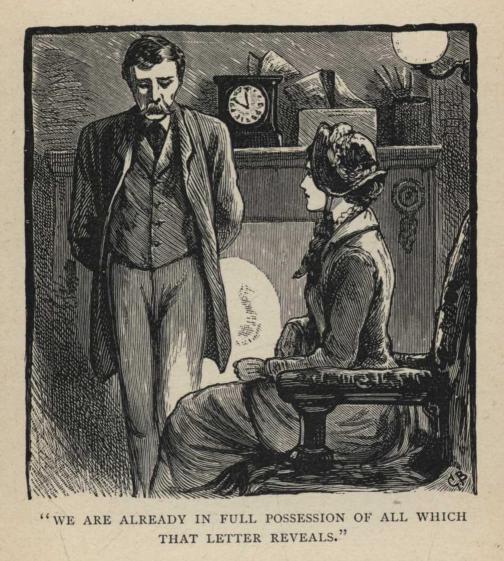
"WE ARE ALREADY IN FULL POSSESSION OF ALL WHICH THAT LETTER REVEALS."
"You certainly do surprise me, sir, since I cannot see how you could have obtained the information, which my son alone was in possession of, since he begs in that letter that it may be communicated privately and confidentially to you."
"As a proof, we can tell you his address when he wrote was at Ranger's Ranch, M'Lean Station, Assiniboia, North-West Canada."
"You will have noticed the address at the top of his letter has been cut away; this I did at his request, that you might not at present be informed as to where he is to be found."
"Yes; and we could not help smiling as we observed what had been done."
"But," said Mrs. Sinclair, much agitated, "may I ask how you obtained your information?"
"Certainly," replied Mr. Quinion. "It is now six or seven weeks ago since we received a letter from a person in Canada, who, although giving us his name, has requested that it may not be made known, conveying just such information as the letter you now bring contains."
"Then it would be useless to ask you for the name of your informant?" said Mrs. Sinclair.
"Well, without the writer's permission it would scarcely be honourable on our part to do so."
"Does he state how he came by the knowledge of what he writes you?" inquired the mother.
"Yes; he states that it was a confession he overheard your son make, but to whom, or under what circumstances, is not mentioned."
"Does he give any reason for writing to you as he has done?"
"All he says on that point is, that he thought it right to do so, in case we should like to know."
"It cannot be regarded as a friendly act," Mrs. Sinclair, after some hesitation, found herself able to say.
"No; that is how we regarded it," said Mr. Quinion quietly.
"May I ask," inquired the mother, with some anxiety, "if you have taken any action in the matter?"
"Well, this is what we have done: through our solicitors here, we instructed agents in Canada to inquire fully into the truth of all the letter contains; to ascertain, beyond a doubt, whether the person referred to is the one in whom we have any interest; the character of the person who has written to us, and the motives which would probably cause him to act as he has done. We are expecting by every mail to receive this agent's report, as by it we propose being guided in the course we ought to adopt."
"Oh, my dear friends! I do hope," said Mrs. Sinclair in anguished tones, "you will not think of having my poor boy prosecuted?"
"That is a matter, Mrs. Sinclair, on which we have arrived at no decision at present," was Mr. Quinion's reply.
"Oh, but is it not possible to let matters remain as they are, without reference to the report you speak of?"
"We do not say that we shall take any action upon it; at the same time, as men of business, as well as in consideration of what is due to society, we shall wait at least this report we are expecting."
"But can't you, gentlemen, for the sake of the long and honourable career of his father, as well as for my sake, and that of my daughter, give up all idea of having him arrested? It would be the death of me, I know; and I feel sure you have no wish to see that take place."
"In that you only do us justice, Mrs. Sinclair; and if it be at all possible, you may rely upon our sparing your feelings, as we have no vindictive aims to gratify."
"If it is the amount my misguided boy has robbed you of which is the difficulty, and its payment will prevent the prospect of harm coming to him, I will willingly realise everything I possess, even if it beggars me, in order that my son may be saved!"
"Don't for a moment think of it, my dear madam; for under no circumstances should we accept the payment you speak of, as that would be to compound a felony. We either prosecute or pardon."
"Oh, let me, let me prevail upon you to decide now, at once!" reiterated Mrs. Sinclair.
"Pray do not say anything more, Mrs. Sinclair, but leave the matter where it is; and trust us, that in whatever we decide we shall endeavour to do that which is right and best for all parties."
It being clear that nothing further was to be gained at present, the ladies rose and took their leave, after receiving an assurance that on the arrival of the report for which they were waiting, they would, without loss of time, let them know their decision.
Returning to their hotel, they ordered luncheon, and announced their intention of departing by the afternoon train, which would enable them to arrive home by breakfast-time the next morning.
On reaching home, the mother's first concern was to ascertain the date of the next Canadian mail out, which she learned was two days hence.
Her next act was to write a very long and loving letter to her boy, giving a full account of her visit to Broadstone and its result. And whilst it was full of sorrow and regret for the past, there was not a word of upbraiding, but expressions of gratitude and joy for the welcome news which had practically given back to her a son previously mourned as dead.
In addition to stating the surprise she experienced on learning that his late employers were in full possession of the information she had come to impart, she could not refrain from adding, that as there was still doubt as to what their intentions might be, on receiving the report for which they were waiting, she must urge him to think very seriously of the desirability of getting clear away from his present station before it might be too late to do so.
CHAPTER XXIII.
THE STORY EVER NEW.
"Let her speak of me before her father."—Othello, Act I. sc. iii.
"Good afternoon, Miss Russell," was the greeting which Jessie received one Sunday afternoon, as, on rounding a bend of the hill, on the other side of which was Ranger's homestead, she was suddenly brought face to face with Fellows, who was rapidly advancing along the track which led to her father's log dwelling.
The air was laden with the refreshing, invigorating scent of the pines from the wood towards which she was wending, but the rapidly falling leaves, and the changing hues of autumn, were everywhere giving indications that summer was nearly over, and that Mother Nature would soon be arrayed in more sober attire, befitting the wintry season of chill and gloom.
Jessie was accustomed to ramble on a Sunday afternoon, when the midday meal had been despatched, whilst her father indulged himself with his pipe, or sat and dozed in a chair at the door of his little shanty, which overlooked the small patch of garden in front.
"I was on my way to call upon you," added Fellows, "so that I am very glad to have met you."
"Father is all alone at home," said Jessie, as the colour mounted to her cheeks.
"If my company is not likely to prove irksome," he added, "I should much prefer a walk with you."
"Rather an unusual request," added Jess, "but I suppose I ought not to object."
After proceeding in silence for some moments, Fellows said, "I have been wanting to have a quiet talk with you, Miss Russell, for some time, and now the opportunity presents itself I scarcely know how to begin."
Jessie, whose face had suddenly become the colour of scarlet, could find no words with which to help him; therefore, after a brief pause, he proceeded to tell her of the feelings he entertained towards her, and the hope he cherished that she might be disposed to give his suit a little favourable consideration.
Whatever writers of romance may say to the contrary, out of an extreme desire to invest their heroines with qualities and attributes which, as a rule, ordinary mortals do not possess, it is seldom that a declaration such as Jessie heard this afternoon can be truthfully said to be altogether unexpected. Words may never pass to convey the intelligence, nevertheless there is a subtle magnetism in the language of the eye which telegraphs to the loved one, more vividly and more surely than words could express, the feelings with which each regards the other. So that generally, long before the declaration is made which is supposed to reveal the feelings with which the man regards the woman, she has discovered it all, and been waiting, expecting the inevitable to happen.
Except during his long illness, when Jessie had carefully and faithfully nursed him back to convalescence,—an illness, be it remembered, which had been brought about by his self-denying efforts on her behalf, in rescuing her from a position of considerable danger,—she had had but few opportunities of seeing him, or being thrown into his society. Few and brief, however, as many of those interviews had proved, they had not been without leaving their effects behind. The eyes as they had looked into each other's faces, or caught stolen glances which were thought to be unobserved, had given rise to thoughts and feelings too subtle for words to express, and too sacred even for themselves to admit, during that process of introspection which from time to time went on.
Jessie, therefore, whilst perfectly conscious in her own heart that the young fellow now by her side was entertaining feelings for her which might eventually find expression in words, was quite unprepared for the meeting this afternoon, and for what was in truth the sudden declaration of his affection for her.
Jessie, it may be added, was a woman possessing a fair amount of common-sense, yet of an ardent and enthusiastic temperament,—capable of loving intensely an object worthy of her affections.
The period which had elapsed since attaining womanhood had been so brief, that she was not yet quit of many of the high ideals and romantic notions with which lovers are wont to invest the heroes or heroines they are in search of; but her rough prairie-training, added to the common-sense shrewdness of her character, had enabled her to see that marriage ought not to be regarded as such a thing of chance as to be left dependent upon the fancied love, growing out of the attractions of a pretty form or a lovely face, calculated as they are to bewitch and bewilder the first enamoured noodle that casts his glances upon them.
It was, therefore, in tones of some hesitation that she expressed the opinion that they had scarcely known each other long enough, or seen sufficient of one another, to be able to judge as to their suitability for such an important arrangement.
"I was fully prepared for something like that, Jessie—if I may call you that?" said Fellows.
"Well then, don't you think it would be better for me to defer any answer at present?" she naïvely asked.
"I don't think so, my dear—and yet——" After some hesitation he added, "How can I venture to tell you all that is on my mind? and yet I feel it would not be fair on my part to win, perhaps, your consent to my suit, without first placing you in full possession of the facts in my past life, which may seriously affect your decision."
"But if the opinion I have been led to form of you be a correct one, it cannot be anything of which you need be ashamed or afraid to tell me."
"Ah, Jessie!" he exclaimed in mournful tones, "I am afraid you have estimated me too highly."
"Tell me, then," she added somewhat eagerly, her moistening eyes betraying only too plainly the anxiety she felt, yet was loath to reveal.
Thus encouraged, Fellows at once confided to her the story of his past life, which was much to the same effect as had been narrated to Ranger, and overheard by Barton, from the place where he lay concealed.
In addition to what he had revealed to Ranger, he was now able to add, that, acting upon the advice then given, he had since written home to inform his mother that he was still alive, and how he had instructed her to act.
It would be difficult to describe the feeling paramount in Jessie's breast, on hearing the singular and startling confession which Fellows had made.
She felt quite unequal to the task of analysing the causes which gave rise to the emotions agitating her. They were of too conflicting a character to warrant a prompt decision on the important question which had been urged upon her.
Like the true woman that she was, there was a thrill of ecstatic pleasure running through every nerve when she fully realised that she was the possessor of a man's true love, and that man one upon whom she had been only too disposed to allow her affections to gather strength and to centre.
Her first impulse inclined her to utter a responsive "Yes" to the impassioned appeal which was addressed to her. The revulsion, however, which followed the second revelation, was one more of sorrow and regret, which left her in a state of mind she was not able to explain to her own satisfaction, nor one which qualified her to give an answer to Fellows.
"Well, Jessie," said Fellows, after waiting some time, "what interpretation am I to put upon your silence?"
"Oh, Mr. Fellows, I wish you would not press me now for a reply!"
"If that is your wish, it shall be my law, and I will wait," he replied.
"You may suppose, from my hesitation, that the avowal you have made is not one of which I entirely disapprove. It is a manly confession, to which any free woman is always proud to listen, even when it may not meet with acceptance. But what you have added is of such a nature, and of so much importance, that I feel it would be only right, before coming to any decision, to hear what father has to say about it, and what he would advise me to do."
"Perhaps you are right, my lass; in fact, I know you are. Therefore by all means consult your father and be guided by him. But don't forget me at the same time, and that on your answer will depend my future as well as my stay here."
With a very warm and sympathetic hand-clasp, which the lovers (if they may be so termed) felt it would at present be unwise to exceed, they separated, after arranging to meet on the next Sunday, under similar circumstances, should nothing transpire to put a stop to such an arrangement.
It was with mixed feelings of elation and anxiety that Fellows returned to the Ranch.
There was much satisfaction at the thought that he was, without doubt, the possessor of the love of a true woman, for notwithstanding the cautious nature of her reply, it was sufficiently obvious the regard she entertained for him. At the same time there was cause for anxiety to a man in his position as to the advice her father might offer, and which he felt, whatever it might be, she would be strongly disposed to act upon.
But a week must elapse before he could be put in possession of her decision. No doubt an embarrassing, but not a novel one, and therefore one which he must be prepared to endure.
CHAPTER XXIV.
"TWICE BLESSED."
"A maiden never bold; Of spirit so still and quiet, that her motion Blush'd at herself."—Othello, Act I. sc. iii.
Four days after his interview and confession to Jessie, Fellows received the letter his mother had written on her return from Broadstone, acquainting him with all the circumstances attending that interview, and of her surprise at learning that they were already in possession of all the facts connected with his escape, as well as the knowledge of where he was at present to be found.
Who could have been the writer of the letter sent to the firm he was entirely at a loss to conjecture. The facts of his life had been revealed to no one but Ranger until Sunday last, when he had taken Jessie into his confidence.
He could not bring himself to believe in the possibility of Ranger having betrayed the trust he had been led to repose in him. He would see Ranger at once and hear what light he could throw upon what seemed so mysterious.
On acquainting him with the intelligence received from home, he expressed astonishment in no measured language, for he did not fail to perceive the suspicion which would naturally arise in Fellows' mind, that, in some way or other, it was due to him the information had leaked out, so as to enable it to be conveyed to Broadstone.
It was hardly necessary for him to assure Fellows that no word had been breathed to a soul of what had been told him. The man honestly believed him. There was, however, still the fact to be explained—how had it become known?
The only possible solution seemed to be that someone must have overheard their conversation, but who that someone could be they were unable to form any conception.
Another circumstance stated in Mrs. Sinclair's letter, calculated to give rise to uneasiness, was that an agent in Quebec had been instructed to make inquiry concerning the facts which the writer of the letter had professed to reveal. Through what channels was that inquiry likely to be made? Someone would probably be deputed to do this on the spot.
It at once occurred to Fellows that "Puffey's" recent visit was associated with that quest.
It explained, too, the man's apparent anxiety that he should become a candidate for admission to the ranks of the police, as without some such plausible excuse he could not have questioned him in the way he did.
On that assumption, his past career was already known to the police. And whatever the decision of the firm might ultimately be, he would in all probability be shadowed by them until it was made known.
They would not yet be able to prevent him leaving the country, if he was so disposed; but his progress from place to place would no doubt be noted, so that, in the event of being eventually wanted, they would know where they could place their hands upon him. How to act, or what to do under the circumstances, he felt at some loss to decide.
Sunday was again close at hand, when he had arranged to meet Jessie, in order to learn her decision, which was to determine his future.
He would await that interview, and at the same time acquaint her with this new factor, so suddenly and unexpectedly imported into his life.
Meanwhile, how had it fared with Charles Barton since the day he had written and posted the letter which had set in motion the causes that had given rise to all this uneasy feeling?
He could not account for having received no reply to the letter he had sent. That it would have been acknowledged was the least he expected. That this had not been done was at once a surprise, and a cause of anxiety as to what it might ultimately lead to, which laid a considerable tax upon his nervous powers, never remarkable for their strength.
In his associations with the men on the farm, his disposition and manners had always presented a marked contrast to those which his elder brother displayed. Whilst James was genial, candid, open, and free, ready at conversation, and willing to join the rest of the men in any little arrangement for the general good, or an evening's amusement, Charles was gloomy, taciturn, and close. He held himself aloof from the rest, as though he thought himself a superior, and was never known to take part in any amusement such as was occasionally indulged in. And it had not failed to be noted, and commented upon, that of late these habits had become even more marked than they were at the first.
His brother would frequently rally him, when they were alone together, as to the cause of his misanthropical behaviour, without effect; nor, however lively he might be himself, nor whatever humour he was able to impart to the topics of conversation introduced, it was rare that he succeeded in creating anything beyond the ghost of a smile, or drawing out more than some monosyllabic reply.
James, with that easy, good-natured disposition which was characteristic of the man, attributed much of this to his habits as a boy, which manhood had only served to develop; to the death of their father, the break-up of the home, and the disappointment which, up to the present, had attended all the glowing visions they had formed of the fortune to be won in the Land of Gold.
Charles had kept as observant an eye as it was possible to do, without exciting unnecessary attention, on the movements of Jessie Russell, but had been unable to discover anything to cause him further uneasiness with regard to the apparent progress of Fellows' suit.
He had been hoping, too, that the result of his letter to England might be to cause the removal of his rival altogether from the present scene of his influence; and this had induced him to refrain from seeking that interview with Jessie which he was so anxious to bring about, until, as he regarded it, the coast was clear for the unimpeded prosecution of his designs.
In the event of that reply being much longer delayed, and no action apparent, he felt that it would not be wise to delay his intended interview indefinitely.
Happening one evening to be in the neighbourhood of her dwelling, he decided to extend his ramble, on the chance that he might meet with her. She was seated on a bench at the door, busily plying her needle, mending a jacket belonging to her father. "Good evening, Miss Russell," he exclaimed a little nervously, as he advanced with some trepidation to where she was seated. "Is your father at home?"
"He has not returned from the field yet," she replied. "Do you want to see him?"
"No—that is—not particularly," he replied, with a confused look. Then suddenly, as if recollecting himself, he added, "I have been thinking, my dear Miss Russell, how much happier I should be with a good wife to look after me, and care for all my wants; and I have seen no woman I should so much like to make my wife as—you! And what I want to ask is, whether you are willing to accept me for a husband? I am a plain man, with very little polish on me, and know very little of the arts by which a girl's love is usually won; but if you will consent to be my wife, I think I can promise to make you a good husband, and I don't think you will ever have any cause to regret it."
Rough and ill-considered as such a proposal may seem to have been, when presented in so plain and unadorned a manner, it was given utterance to in a speech longer than ever he had been known to indulge in, and there was an apparent ring of honesty and truthfulness about it which, notwithstanding all its deficiencies, struck Jessie as being real. Therefore, although her feeling for the man was one of repulsion, which somehow she was unable to overcome, she repressed the strong impulse which at first manifested itself, to laugh at him, and ridicule the idea, by quietly, but firmly, replying that under no circumstances could she be induced to entertain the idea for a moment.
"May I ask why?" stammered out Charles.
"Well," she replied, "I have no present desire to get married."
"Don't you like me well enough?" he asked.
"Not well enough to marry you," was her prompt and candid reply.
"Perhaps you like someone better?" he added.
"And if I did, would there be anything very surprising in that?" she replied.
"No," he managed to get out after a pause; adding, "especially if it is the one I imagine it is."
"I don't see what right you have to imagine anything at all about it," was Jessie's spirited reply.
"The right is that which belongs to every man or woman to warn another of a danger."
"I don't understand you, sir."
"If you are thinking of the man I suppose you are——"
"Sir!" she exclaimed with some vehemence, interrupting him, "your language is insulting, and if my father were here you would not dare address me in the manner you are doing."
"At the risk of what you may think of it, I will still say," he went on, "that the man I refer to is a worthless, dishonest scoundrel, not fit to be the companion of any honest woman."
"I know nothing about the person, nor who it is you are referring to, nor do I wish to know; but this you may as well know, that I am quite capable of defending my own honour as to the company I may be disposed to keep, and any defence I may require beyond that my father is able and ready to afford me. Good evening, sir!" saying which, she rose, entered the house, and, closing the door, left Barton much chagrined at the reception he had received, and the complete failure of his fondly cherished scheme.
* * * * *
As soon as dinner was over at the homestead, Sunday saw Fellows eagerly wending his way to the place at which he had appointed to meet Jessie a week ago.
It was late in September,—harvesting was over generally through the entire length of the great North-West,—but the glory of the summer had not yet departed. The air was dry and invigorating, and not without its effect upon Fellows, which, coupled with the object he had in view, imparted a buoyancy to his spirits he had for days past been a stranger to, and gave an elasticity to his step which enabled him to accomplish his short journey in a much briefer space of time than he had reckoned upon.
He was first at the trysting-place, but he had not been long in waiting when he saw Jessie coming down the trail, a picture of sunny beauty, which the eye of the beholder could rest upon without any feeling of weariness.
Advancing at once to meet her, and noting with satisfaction the good-tempered and winsome smile pervading her rosy cheeks, he augured a favourable response to his suit.
Unable to restrain his impatience, he seized both her hands, exclaiming, "Dearest Jessie! am I right in concluding from your manner towards me, that you do not bring an unfavourable reply?"
"You are presuming, I think, sir," she answered, half averting her head, and shaking her shoulders as she did so.
"Don't say that, dear," he replied.
"What would you have me say then?" she retorted, with an arch twinkle in her eye.
"Say?" he exclaimed eagerly; "why, say that you will be mine, and make me the happiest man existing!"
"Heigh-ho! well, if wilful man must have his own way, I suppose I had better repeat my lesson according to your dictation."
"Oh, you dear, delightful treasure of a woman!" he murmured, as he folded her unresisting form in his strong arms, and kissed her passionately.
After a few moments spent in silent contemplation—moments too sacred for words—Fellows said, "And you do this, Jessie, knowing full well all I am and have been?"
"Yes, Ralph," she replied, looking him fully in the face, with an expression of calm trustfulness and confidence beaming in her large grey eyes.
"Did you tell your father—all?" he asked.
"That you may rest assured I did," was her reply.
"What did he say when he heard of my disgraceful conduct?"
"Naturally he was very sorry to hear it; at the same time he said he thought that a man's past ought not to be regarded as a perpetual barrier to his future upward progress."
"Your father is a kind-hearted man, and I esteem him for his charitable views."
"That's what poor dear mother used to say," she replied.
"Then he had no objection to urge against me?"
"None!" she added; "he gave me his full consent to do whatever my own heart dictated as right."
"God bless you, Jessie! The aim of my life shall be that you may never have a moment's pang of regret for the choice you have this day made."
"Had I feared that, I would never have given you the answer I have," was her confident reply.
Much of the conversation which followed was of that tender and confidential nature, so manifestly not intended for the too inquisitive public ear, that we refrain from repeating it, leaving it to the imagination of the more experienced to supply many of the missing links.
Before separating, he told her of the letter received from home, which had given him so great a surprise, and how much he was at a loss to conceive who could have been the spy and informer.
"Oh!" exclaimed Jessie, as she gave a start.
"What is the matter, dear?" exclaimed Fellows.
"Only a thought that flashed across my mind at what you were saying."
"Tell me, dearest, what it is?"
"It is a matter of such trivial importance, and one which I regarded as so personal to myself, that I should not have said anything about it but for the fact you have just mentioned."
"You need not hesitate, Jessie, to tell me anything, as whatever concerns you will not be regarded as trivial by me."
"Well then," she replied, with downcast eyes, "I had a visit this week from Mr. Barton; and I suppose you'll never guess the object of that visit?"
"Which one?" he inquired.
"Charles," she replied.
"Then I'll not try guessing, dear, since it is so difficult, but leave you to tell me."
"Well then, without repeating all he said, as no doubt I should fail to do him justice, he told me very bluntly that he wanted a wife, and asked me to consent to have him for a husband. Of course, as you may well imagine, I declined that honour. He did not take my reply kindly, at which I was not altogether surprised, as I suppose no man, if he is in earnest (and I have no reason to doubt but that he was), would be likely to do. But after questioning and cross-examining me as to who I was preferring before him, he concluded that he thought he knew who the person was. It was then he said——"
Jessie paused, evidently reluctant to proceed.
"What did he say?" inquired Fellows eagerly.
"I don't feel as if I can tell you," she replied.
"Don't hesitate, dear," he said encouragingly.
"He never mentioned your name, but I felt all the time he was referring to you."
"Never mind, darling, you have gone too far now not to tell me all."
"Well, he said the man he referred to was a worthless, dishonest scoundrel, not fit to be the companion of any honest woman."
"And you had sufficient confidence in me not to be influenced by that statement?"
"Can you doubt it," she replied, "after what has passed to-day?"
"Not for one moment, dearest," he hastened to reply.
"You will easily see my reason for not intending to tell you this."
"I do, Jessie; and honour you, my love, all the more for your consideration."
"But the thought that flashed into my mind, when you told me of how your secret had somehow got known, was, could Barton in any way have become the possessor of that information, and in a fit of jealousy written the letter to England?"
"Such a thing may have been possible, but I scarcely like to regard it as probable," was Fellows' candid rejoinder.
Presently he added, "But say nothing about this to anyone, Jessie, at present, as it is a circumstance which will bear thinking about, and I will turn it over in my mind and see what is to be made out of it."
And with this understanding they parted.
CHAPTER XXV.
THE BROADSTONE DECISION.
"Let's make the best of it."—Coriolanus, Act V. sc. v.
Nearly two months had elapsed since the date when the agents in Quebec were instructed to make certain inquiries on behalf of Messrs. Quinion of Broadstone, when one morning, according to appointment, their solicitors called and were shown into the private offices of the firm.
The solicitors were present, in the person of a dapper little bald-headed man of about fifty, wearing coloured glasses which concealed a pair of restless grey eyes, that allowed nothing to escape their observation.
Laying his hat upon a chair, he took from a small valise he was carrying a bulky-looking document tied with the inevitable piece of red tape, which he declared was the report of their agent, come to hand the day preceding. After carefully untying and spreading the folio sheets in front of him, he, at the bidding of the two partners, who were seated at the table facing him, commenced to read their contents.
Divested of the legal phraseology in which they were cast, and omitting the redundancy of expression so dear to the man of law, yet so bewildering to the average man of common-sense, the purport of what he read was to the effect—
That the inquiry having been intrusted to the local police, they had placed the matter in the hands of one of the most trusted and skilful members of the force, who, from inquiries made on the spot, and information received through a variety of sources, was now fully able to confirm the statements made in the letter received from their correspondent.
The motive prompting that letter, so far as the agent had been able to learn, was one of jealousy, the two men, Barton, and Fellows otherwise Sinclair, appearing to be rivals for the possession of a certain young woman employed on the same farm. And it was conjectured that Barton hoped, through the law being set in motion, to accomplish the arrest of Fellows, so that by his removal from Canada and the scene of his present influence the other might be left in unimpeded possession of the ground, to be able to press his suit with the greater probability of success.
"That, gentlemen, is our report; and it shows, I think," said the lawyer, "that we have done our best to get all the information for you that was possible."
"Quite so," nervously responded the elder of the two men, who never spoke without conveying the impression that, whilst desirous of making his presence felt, he was terribly apprehensive lest he should say anything which might be construed in a sense other than was intended.
"But," added Mr. E. Quinion in a rough, hard, and curt tone, "beyond generally confirming what the letter told us, it adds very little to our knowledge."
"No," replied the elder of the two men. "Perhaps not, perhaps not. It at least gives a motive for that letter."
"Which, after all," said the other, "is not of so much importance to us."
"Well, that I am not so sure about; the motive is, or seems to be so to me, a most unworthy one, which, if possible, we should do our utmost to discourage."
"Suppose we drop this consideration for the present," said the younger man, "and consider what are perhaps the more important features of the case. Sinclair, in the first place, betrays the trust we had reposed in him, through the influence of the company he got into,—spends money which he had no right to, and so defrauds the firm of a very large sum. Being unable, and afraid, to face the consequences, he bolts, but succeeds in covering his escape by a ruse, which enabled him to take advantage of an accident occurring in the nick of time, of which he was prompt to avail himself. He deserves very little consideration from us, I think."
"All you say is quite true," was the other's reply, "but I don't want to forget the fact that his father for years held a very responsible and honourable position in this firm, and died respected by all who knew him."
"You think, then, that his good deeds should be capable of hiding a multitude of his son's sins," was the smiling comment of the younger man.
Taking no apparent notice of the remark, the other continued, "Then there is his mother,—a lady for whom I have the very highest esteem,—who has always been regarded as a friend, and is at present in a rather delicate state of health. I feel much sympathy for her, and would be disposed to strain a good many points before venturing to do anything which would add to her grief."
"Yes, I feel that as much as you do," replied the younger man; "but it must not be forgotten, with every desire to be merciful, we have a duty which as citizens we owe to the community, and that obligations are placed upon us by the laws which govern us which cannot always be safely set aside."
"True; but there is no law which prevents a man forgiving another a trespass, rather the contrary."
"Nor should we forget what is, after all, a most important consideration for us," said the other, "the mistaken interpretation which may be given to any act of leniency on our part, and the impression likely to be produced by it on those at present in our employ."
"You are quite right there. It certainly is a most important point for our consideration. But, coming back to the point from which we started, the motive of the man who has written to us, which is most unworthy, and one I don't at all like to encourage; that it is a matter which we have long ago wiped out of our books; for the sake of his dead father's memory, and of the mother whom we have promised to consider as much as possible, I am decidedly of opinion we can very well let the transaction remain as at present, and take no steps to have the man arrested."
"Very well," said the younger man, after a little hesitation. "I'm not quite sure we are doing our duty, but, on the principle that one ought always to give the prisoner the benefit of the doubt, as I am in some little doubt myself, let Sinclair have the benefit of it, and I will agree with you that nothing further be done."
"That being settled, I think it will be best for you, Mr. Gaze, to have the briefest possible letter written to Mr. Barton, thanking him for his communication, the contents of which have been duly noted, but that no action is contemplated thereon."
The lawyer having taken his leave, a letter was sent to Mrs. Sinclair acquainting her with the decision at which they had arrived, and expressing the pleasure they felt at having been able so far to fall in with her wishes.
When this letter reached Railton Hall, the joy it occasioned none but a mother in similar circumstances can fully realise.
The transition from fear to hope, and again from hope to despair, had been terribly trying to a constitution never strong, and already much enfeebled by the trials it had been called upon to endure.
The tidings which had so unexpectedly reached her, that the son, so long mourned as dead (under circumstances which seemed to leave no room for reasonable doubt of its correctness), was still alive, had filled her with a new-born hope of yet once again looking upon those well-remembered features,—features which bore the unmistakable image of her dead husband,—giving rise to ideals and imaginings which the depths had apparently overwhelmed and shut out from all possibility of realisation.
But such hopes and such visions had been shattered and dispelled as quickly as they had arisen by her visit to Broadstone, and the possible consequences which might result from the intelligence which was there being awaited from the North-West. Woman-like, she had anticipated the worst, and had even allowed her dire apprehensions to manifest their existence in the letter she had written Ralph. She advised—almost entreated—him to escape from Ranger's whilst there was time, lest the officers of justice should be set upon his track, before such a course became impossible.
Once again, however, was hope rekindled in her breast, when the letter arrived which conveyed the welcome intelligence that the firm had abandoned all thoughts of having her son arrested.
Again the reaction from the gloom of despair to the joys of hope was almost more than the poor mother could endure. Scientists tell us that joy never kills. It may be true. At all events its effects are not always as salutary as one could desire, and in Mrs. Sinclair's case it was some time before she could command sufficient strength of will, or obtain the control of her nervous system, to render her capable of dictating a letter to Jennie for her brother, to inform him of the gratifying news.
Her anxiety now was, lest, acting upon the advice given in her previous letter, he should have put into practice the course she had thought it so desirable to urge upon him. It was possible a telegram might reach him in time to arrest his departure; she could scarcely hope to forestall her letter, which had probably already been received and its advice acted upon.
Jennie was, however, instructed to lose no time in sending a "wire" to Ranger's, which ran—"Stay—All right," in the hope that it might produce the effect desired.
The letter which followed was such as only a mother might be expected under the circumstances to write, and was filled with anxious inquiries as to his future intentions.
CHAPTER XXVI.
MARY TRUMAN.
"... He beheld a vision, and adored the thing he saw." WORDSWORTH.
Mary Truman, the young woman so suddenly deprived of her only relations by the unfortunate accident on the railway near to M'Lean Station, and whose prospects had been so terribly blighted, had not been an idle spectator at the Ranch of the events which have been transpiring.
With no fixed or clearly defined duties to perform, since her future was still undecided, she was yet able to find occupation in the house and its belongings of a character sufficient to prevent her from having many idle moments.
Naturally of a cheerful disposition, she was wont to be considered the embodiment of good humour "in the old house at home."
A pair of laughing blue eyes, a little "tip-tilted" nose, a petite figure, and a mass of rich, wavy auburn hair, added to a saucy expression of countenance, made up an ensemble that her all too sensitive, and it may be sensible, cousin had found it impossible to resist.
Her parents were originally in a small way of business at Exeter, but having the misfortune to lose her mother some three weeks after her birth, the father, within a week following the funeral, disappeared, and nothing had been seen or heard of him since.
His brother, who farmed a few acres of land just outside the city, when appealed to, at once came forward, and agreed to adopt the little waif rather than it should be taken charge of by the Union.
When the business was sold, and the debts paid, there remained nearly one hundred pounds, which the uncle very considerately, and with no thought of self, caused to be invested for the child.
At the age of ten the aunt died, after a lingering illness, and in process of time, as the years rolled on, little Mary, besides being the life of the household, became also its presiding deity, and the ruler of all the domestic life and arrangements of the place.
When, therefore, the lease of John Truman's holding expired, and it became a necessity to seek another dwelling, they determined to try their fortunes in the Far West, and of course it was inevitable that Mary should form one of the party.
She felt her physical strength was rapidly returning. The pure dry air,—so notable a feature of the Dominion,—the sunshiny days, and the abundant opportunities for out-door life, had, combined with rare constitutional endowments, contributed in no ordinary degree to that recovery which was every day becoming more manifest.
With the restoration to health there was a corresponding improvement in spirits, as the buoyancy and elasticity of youth asserted their influence, and she began to throw off much of that gloom and depression, so unnatural to the young, and quite foreign to Mary's nature, but which the tragic events with which the swift current of her life had been so suddenly arrested sufficiently accounted for.
The elder Barton had not been unmoved, although a silent spectator of the change that was taking place.
He had witnessed, with a daily increasing interest, her growing health; but it was with even more satisfaction that he marked the improvement in her spirits, as it indicated the arrival of that period when, with some degree of assurance, he might hope to be able to express to her in words the feelings which he had allowed himself to cherish towards her.
Life at the Ranch was uneventful as a rule, and comparatively lonely. Visitors were rare, and the settlers, with their own people, were thrown much together, not only during the hours of labour, but for that companionship which human nature naturally looks for.
The frequent opportunities which such occasions offered for little delicate attentions, kind inquiries, and the like, John was not slow in taking advantage of, nor in noting their effect.
The encouragement which such attentions received was not much; nor could it be regarded as a very safe foundation on which to build hope for the future, yet he did not feel altogether without warrant for so doing.
So when, one evening after the work of the day was over, as the twilight was deepening, and Mary was standing at the entrance to the dairy, watching the stars as they one by one made themselves visible, Barton's approach was all unnoticed until he was close upon her.
"What, star-gazing, my lass?" he exclaimed.
"Well, what if I was, Mr. Impudence," she retorted.
"Oh, nothing," he replied, somewhat at a loss what to say.
"It's a lovely night for star-gazing, as you call it," she added, with a little less asperity in her tones, as if to make amends for the sharpness of her previous retort.
"Haven't seen many better," replied Barton.
"You'd scarcely guess how my thought was then running?"
"If you tell me, I shall know without the trouble."
"I was back in my childhood, and thinking of that sweet little couplet auntie used to repeat so often—
'Twinkle, twinkle, little star,
How I wonder what you are.'"
"I am sorry that I so rudely broke in upon your reflections. I always turn to the memory of my childhood's happy days with pleasure and satisfaction."
"Bless me, how extremely sentimental we are getting! But I must be going——"
"Stay a moment, Mary, I would like to have a word or two with you, if you can spare a few moments?"
"What impudence, sir!"
"In what way, may I ask?"
"Since when, and by what right, have you taken to address me by my Christian name?" she inquired, with a good-humoured smile.
"It was a liberty, I must confess, but one which I hope my explanation will lead you to pardon."
"Well, if it's going to take long I am afraid I shall not be able to stop and listen."
"I daresay I can manage it in a few words, although it's a subject I have had no previous experience of. Until I saw you, Mary,—for so I must call you until forbidden to do so,—I never set eyes upon the woman I could say I truly loved. But, from the day you first made your appearance amongst us, the feeling has been growing, until I now fully realise you are that other half I need to make my life complete."
"What a very pretty speech. I suppose I ought to feel flattered. For a novice—professing no experience—I think I may say you have accomplished the task charmingly," was Mary's laughing reply.
"Be serious, Mary, there's a dear girl; for it's a serious matter to me."
"Oh well, Mr. Longface, then I'll try. To speak candidly, I've not thought about the matter, and don't want to. So there, you have an answer."
"But not a final answer, I hope?" he added.
"Yes; why not?" she naïvely asked.
"I'd rather you'd say you'll think it over, if what I have said has caused you surprise."
"Surprise? I should think it has! Do you suppose for a moment I was waiting for you to come and tell me what you have?"
"No, Mary," he replied, feeling a little abashed at the thought that he had committed himself by his answer.
"Well then, sir, you had better be content with the answer I have given."
"If you give me credit for sincerity, do you think it possible I can be content with such a reply?" he asked, gazing steadfastly into her half-averted eyes, at the same time attempting to take her hand.
"You are too forward, sir," she exclaimed, as she snatched her hand away.
"Well, take time to think about it, Mary; only give me some little hope.",
"As you please, sir, for I must be going."
"When may I come for my answer—to-morrow?
"Oh, la, no!" she replied; "I shall not be able to make up my mind in that time—that is, if you want a different reply to the one I've given?"
"A week then?" he asked.
"Dear me, how pressing you are! Say a month," she added.
"Don't be so cruel, Mary," he pleaded. "Surely a week is long enough?"
"Well, I'll try what can be done in a week. But mind, I make no promise."
"Good-night, my love! God bless you, and bring you to a right decision," was his reply, as she disappeared into the house.
The stars were twinkling overhead as he made his way to his little shanty, feeling he scarcely knew how, yet strongly tempted to believe that behind the affected gaiety and levity which had been displayed throughout his interview, there was flowing an under-current which might possibly bring him to the haven of his hopes.
CHAPTER XXVII.
BRIGHTENED HOPES.
"Enough, if something from our hands hath power To live, and act, and serve the future hour." WORDSWORTH.
When the telegram arrived, which Mrs. Sinclair had sent in the hope that it might be in time to stay her son from hasty action, there was much rejoicing at the Ranch by all concerned. A load of care and anxiety seemed at once to be lifted, and the course which Fellows had announced his intention of pursuing felt to be fully justified.
All obstacles to future movements being thus removed, it remained to be determined what those movements should be.
If the telegram from his mother conveyed the meaning which he hoped it did, then the way was open for his return to England without any fear of the consequences which might have been expected to attend his so doing.
But what were the prospects which returning held out to him? He had lost his reputation. Under the most favourable conditions he could never expect to be able again to show his face at Broadstone. To be a burden on his doting mother for the remainder of her life was not to be thought of.
He had not been long enough with Ranger to enable him to add much to the little he brought with him on his arrival. Then, added to these reasons, there was the thought of Jessie,—a new factor which had now entered into his life since his arrival at the Ranch, and one which he was not prepared under any circumstances to ignore.
He was willing to be guided by the next letter from home, which the telegram was intended to prepare him for; but in any event he saw, or thought he saw, that it was clearly his best course to stay where he was, and as soon as possible procure a homestead of his own.
Later in the day, when discussing the matter with Ranger, the farmer could not help admitting that it seemed about the only possible thing for him to do.
"And I suppose," said the farmer, "you'll be wanting to make a home of your own as soon as you can, to take Jessie to—eh?"
"That is my next ambition," he replied.
"And a proper one too," was Ranger's rejoinder. "We must see what can be done to get you one."
"Thank you," replied Fellows, "but it need not be hurried over."
"That may be, but if an opportunity offers no time should be lost, as they are soon snapped up."
"Inquiry can be made of the agent when you are next in town to learn what he has on hand."
"I saw to-day, when I was at M'Lean, a holding was for sale which would be likely to fit very well."
"Where was it?" asked Fellows.
"Close to Kinbrae, about eight miles from the Crescent Lake."
"Did you take notice of the particulars concerning it?" said Fellows.
"No, I did not; except that the owner is returning to the Old Country, and wants to sell."
"Well, it might be worth while to inquire about it."
"Yes, I'll do so," replied Ranger.
When the work of the day was over, Fellows lost no time in visiting Jessie at her father's shanty to acquaint her with the receipt of his telegram, in order to relieve her of all fears with regard to the possibility of his being arrested.
The way in which this was likely to affect his future was a question very naturally presenting itself.
"I suppose you will want to return home?" she asked, with just a suspicion of anxiety in her voice.
"No, I think not, Jessie."
"But if your mother desires it?"
"I shall wait and see what she says, but I don't think it will make much difference."
Jessie coloured slightly as she asked, "Why not, Ralph?"
"For two reasons, Jessie," he added. "First, there's your dear little self, whom I could not think of leaving even for mother, much as I should like to see her; then, if I returned I do not know what I should do; and as I have no desire to be a burden to those at home, I have very nearly decided to stay where I am at present."
Not quite knowing how to reply, or what argument to urge against two such weighty reasons, Jessie, as most sensible women would have done under like circumstances, held her tongue without venturing to look up.
Fellows was first to break the silence by saying, "Ranger, who has been more like a father to me than a master, is going to inquire about a homestead, and should the one in view be suitable in every way, I hope soon to be the possessor of a home, to which I shall ask you to accompany me, Jessie."
"But what about father, Ralph? Have you thought of him?"
"Yes, Jess, I have; and my idea is, if he and you are willing, that he should form one of our party,—an arrangement which would give rise to no separation, and he would be very useful."
The conversation having arrived at this point, the entry of Russell himself was looked upon as rather opportune than otherwise, as Fellows at once acquainted him with the subject which was engaging their attention, adding, "Supposing the farmer raises no objection to your going, would you be willing to transfer your services to me and take the management of my farm?"
"Well," he replied, "your proposal is a bit sudden, and I scarcely know what to say about it; but I suppose you don't want a reply at once?"
"Oh no, for I haven't got the farm yet! You had better think about it."
"I'll promise to do that."
"You are perhaps aware that I have very little knowledge of farming beyond what I have picked up during the short time I have been with Ranger, and therefore I shall be obliged to have someone to help me."
"All right, Fellows. So far as I can see at present, I may as well be with you as any other man; more especially as Jess and I will still be near each other."
CHAPTER XXVIII.
CHARLES BARTON.
"... While thou art one with me, I seem no longer like a lonely man."—TENNYSON.
Although the autumn was rapidly advancing, and the foliage was fast fleeing from the trees, which lifted sparsely-leaved branches to the Chinook winds which came blowing in fresh from the Pacific, the days were not yet cold.
The Canadians consider autumn the finest season of the year, for then the air is bracing and free from moisture, often for weeks at a time. But the nights are cold,—even in summer they are cool,—so that fires are an early necessity for comfort.
The day of Ranger's visit to M'Lean Station had been singularly fine and sunny, but as the sun went down the wind began to rise, and the air felt cold and chill.
The hardy, stalwart frame of Ranger, however, was not only weather-beaten, but seemed as if it was weather-proof, so that disregarding Mrs. Ranger's cosy-looking fireside, which might have been considered invitingly tempting to a tired man when the work of the day was over, as soon as the usual evening meal was finished he rose, and, buttoning his jacket, announced his intention of going over to Bartons' cabin to have a talk with Charles.
A ten minutes' walk along a devious track brought him near to a little stream, fed from one of the neighbouring hills, beside which the shanty had been pitched.
The Bartons were at home, as a matter of course, there being nothing and nobody to attract them out in such a place after dark.
The elder Barton was engaged reading the immortal allegory of John Bunyan, with which he seemed deeply interested; Charles was quite as much interested, studying a report of some late doings in the Klondyke.
Ranger's entry was a great surprise to both men. They had never before known him to pay a visit, and at such an hour; it was therefore with unfeigned concern they inquired if anything was the matter.
Avoiding a direct answer to the question, he told them, as he seated himself, "I wanted to have a talk with Charles, and I thought we could get on better now than out in the fields by day."
"Your appearance took us so by surprise," replied John, "that——"
"Oh yes, I quite understand," said Ranger. "Well, to shorten matters as much as possible, I have come to ask Charles what made him write that letter to England about Fellows, which he did some weeks ago?"
"What letter?" he asked, turning a fierce look upon the farmer.
"You know the letter I mean well enough."
"No, I don't," he replied, as his eyes fell beneath the steady gaze of Ranger.
"Do you mean to say you did not write to the firm of Quinion, at Broadstone in England, telling them that Fellows was here if they wanted him?"
"How could I do that, when I don't know anything about him?"
"Don't question me, but look straight in my face and say, if you can, 'I did not write it.'"
"I don't know what right you have to talk to me in this manner, Mr. Ranger."
"You are only trying to evade my question, that you know well."
"I can only say, I don't know what you are talking about."
"Then it would be very easy for you to say, 'I never wrote such a letter,' if you did not."
"I don't recognise your right to ask me such a question, and therefore I don't choose to answer."
Ranger felt he was getting roused by the man's prevaricating manner and his attempt at bounce,—for it appeared to him to be nothing else,—but by a strong effort he managed to control himself sufficiently to say—
"Will you tell me whether you have written a letter to Quinion, Broadstone, any time within the last six weeks?"
After waiting a few seconds for the reply which Charles—who sat with his eyes intently gazing into the fire—did not attempt to give, John chimed in with, "Why not say at once, Charles, if you know anything about the matter?"
"I have," he exclaimed after a pause; but the tone in which this was uttered was not one calculated to carry conviction with it.
"You darn'd skunk!" shouted the farmer in wrathful tones; "so you refuse to reply, do you?"
"I refuse to give you any other reply than what you have got."
"Then take this from me," said Ranger, in somewhat softer tones, but yet with a display of a considerable amount of excitement, "the first thing, to-morrow morning, you pack, and be off from here as quick as you can, for I will not allow such a miserable sneaking hound to remain here in my employ a day longer than I can help."
"You mean it?" said Charles.
"Mean it? I should think I do! Don't you doubt it for one minute," he added, as he brought his fist down with an impressive thump on the table, making the jugs standing on it to quiver.
"This is rather sudden, farmer," broke in John. "What's he going to do when he leaves here?"
"I don't know, and I was going to add, I don't care, but I won't say that; still, that is for him to decide."
"You have used some strong language to my brother, Mr. Ranger; but what it's all about I am quite in ignorance of."
"That I quite believe, John," added Ranger in quieter tones; "that's why I've not included you in anything I've said."
"Can I say or do anything to smooth matters? Tell me what it's all about."
"Ask that coward, he knows well enough, and perhaps will tell you when I'm gone."
"But would it not be better for you to tell me yourself?"
"Don't you interfere, Jack," exclaimed Charles, "as after what that blackguard——"
"Repeat that word, you cur," shouted the farmer angrily, as he advanced upon Charles, "and I'll shake the life out of you! Repeat it, I say, if you dare!"
"I was about to say, when I was stopped, that I should not think of staying now under any circumstances."
"No fear that such a sneak as you have shown yourself to be would be asked."
"I think," broke in John, "it would be as well, Mr. Ranger, if you were now to give me some idea what it all means."
"Well, I'll tell you, John. About two months ago I had a private conversation with Fellows, as we were one evening seated outside the homestead. He and I were supposed to be the only two persons present; but there was another listening, concealed in the bushes, who not only overheard all that was said, but sent a report of our conversation at once to Mr. Quinion, at Broadstone in England."
"How have you learned this?" asked John.
"From Fellows' mother; who upon calling at Broadstone, by her son's request, to acquaint them with incidents known only to myself and him, was surprised to find they were already in possession of the information she had come to bring them."
"Did they say how they had obtained their information?"
"From a correspondent in Canada, who desired that his name might not be made known."
"Well, farmer, how do you fix my brother with the writing of that letter?"
"That's my matter," replied Ranger. "You ask that pale-faced hound over there, and let him deny doing so, if he can, without prevaricating."
It must be admitted that Ranger was playing "high." He was by no means certain of the ground he had taken up. But, feeling pretty confident in his own mind that the knowledge which had escaped had been obtained by Charles, in the manner indicated, he was determined to see if the fellow could be "bluffed" into an admission of his guilt.
Up to the present the attempt had not proved successful, although from the man's manner, and the assumption of indignation, which sat very ill upon him, and which the shrewd farmer thought he could see through, he felt more than ever confirmed in his opinion that the man was guilty.
After Ranger had left, the two men sat silent for some time, smoking, and occupied with their own thoughts.
John felt the position was an awkward one. His brother had been practically dismissed. Where was he to go? What could he do to avert it? He knew his brother's ways too well, and was conscious that it would be no easy task to manage him. But time was pressing, and it was of the utmost importance that whatever was decided upon should be promptly and vigorously carried out.
The silence, which was becoming painful, was at length broken by John, who, laying down his pipe, and turning to his brother, said, "This is a rather unpleasant wind-up to our expectations, Charley?"
Receiving no reply from Charles, who sat moodily gazing into the fire, he continued, "We've been together now ever since we were babies, and although there will come a time when we must be separated, it does seem a pity that out here it should have to take place in such a manner."
"Well, who's to blame?" asked Charles savagely.
"You heard what Ranger said?"
"And of course you believe him?"
"I don't say that I do. I want to hear your version of his story."
"You heard what I said also?"
"That amounted to nothing. You had better have told him you had not written the letter."
"Why should I? What right had he to ask such a question?"
"It would have been so easy, and would have no doubt put an end to the matter."
"Don't you believe it. That man had come with his mind made up, and any denials on my part would have been of no avail."
"It would have put him to the proof of his statement, at all events; and we should have known better the value to attach to it."
After a short pause, John added, "Well, Charley, I am sorry to be obliged to confess it, but from the way in which you avoid the question, I am beginning to be of the opinion there must be some truth in Ranger's charge. Tell me candidly, did you write that letter?"
"Don't you bother your head about what you have nothing to do with."
"It is something I have to do with. You are my brother, and we are the only remaining members of a once united and happy family. Anything that affects your honour or happiness equally affects mine, and I hope you feel the same towards myself. If we are to be separated,—as seems very probable,—don't let it be in anger. If you will give me the assurance that Ranger is mistaken, and that you did not write the letter, I'll believe you."
"It's a question that neither you nor Ranger have any right to ask. I shall give no further answer. You may both think what you like, and do as you like. I shall answer no more questions."
Rising abruptly, as if to put an end to what was clearly an unpleasant topic of conversation, he retired to his room, leaving John to ruminate alone upon the difficulties which lay before him.
CHAPTER XXIX.
TO FRESH FIELDS.
"All about him shadows still."—TENNYSON.
The Bartons were early on the move the next morning, and Charles was soon busily engaged arranging and packing, ready for departure.
"Then you mean to go, Charley?" asked John, anxious to say something.
"Of course I mean to go! Didn't Ranger tell me to?"
"I know that; but I thought you might have made up your mind, after sleeping upon the subject, to go and explain matters and put things straight."
"Not likely, John! I wouldn't stay here now if he was to ask me."
"I'm very sorry to hear it, for you may travel a long way before meeting with another man who will be as kind and considerate of his men as Ranger is."
"I don't feel that I have much to thank him for."
"Ah, you are prejudiced at present."
"I don't think so,—I speak as I feel."
"Yes, yes! But, mark my words, you'll make a different statement before long."
"We shall see!" Then, after a pause, he asked, "I suppose, John, you will be able to drive me and my luggage over to M'Lean Station?"
"I don't suppose there will be much difficulty about that,—we are not busy now. But where do you think of going?"
"I shall go for Maple Creek first. There I shall make inquiries, and have a good look round. If I can't find anything there, I shall go on to Calgary, which is a busy city, where I think I am pretty sure to succeed."
"Yes, I should think it about as good an arrangement as you could make."
"I am only sorry, John, you are not going with me; I should have been glad for us to have continued together."
"So am I, Charley. You can't tell how I feel your going."
"Well, it is not too late now, if you have a mind to make one with me. I should be very glad if you would, John."
It was the first time he had appeared to evince any feeling at the prospect of parting, and it moved his brother deeply. But his reply was calmly and unhesitatingly given—
"It's no use, my boy; however much I might have liked to, it's too late now!"
"What do you mean by too late?"
"I was on the point of letting you into a secret last night, when Ranger came, and then the 'rumpus' with him upset all my little plan."
"What was it?" inquired Charles, with some astonishment.
"Why, nothing more nor less than that I am going to get married, as soon as I can properly fix up matters."
"Never! Who are you going to marry?"
"I am only waiting for Mary Truman's answer, which she has promised in about another week."
"Then it is not yet settled?"
"No, not quite," he replied rather solemnly.
"Well, you know 'there's many a slip'——"
"Yes, I am aware of all that, but I don't anticipate one here."
"But if she does—shall you stay on?"
"No, not I!"
"In that case you could then come on and join me, so I'll take care to let you have my address. But there, John, I hope you'll be more successful than I have been."
"You don't mean to say that you have already proposed and been refused by Mary?" asked John anxiously.
"No, no! not by her, but Jessie Russell."
"Oh, she's going to have Fellows! Didn't you know that?"
"I did not know it, but I thought so," he replied, as a fierce light gleamed in his eyes.
"You've kept your little affair very quiet," was John's sly rejoinder.
"It's not a pleasant experience to talk about," he added. "It makes, however, another reason why I am not sorry at having to leave the place."
"I'm sorry for you, Charley, my boy; but I think she'll get a good husband in Fellows."
"I'm not so sure about that. My advice to you is, be careful about him."
"Why! what do you mean?"
"He's a man I should trust only as far as I could see him."
"Know anything against him?"
"Don't ask me any more questions."
The subject was dropped, and Charles went on with his packing, whilst John went over to the Ranch to acquaint the farmer with his intention of driving Charles to town.
There was no difficulty in arranging this, and Ranger having paid him the wages due to Charles, together with a month's salary in lieu of notice, in order that he might have something to go on with, he returned and prepared for the journey before him.
After spending about a week at Maple Creek,—a small but flourishing township, contiguous to the Crane Lake, from whence a distant view of the Cypress Hills in the South may be obtained,—and finding nothing offering to suit him, Charles Barton determined to proceed on to Calgary, which lies about seventy miles east of the "Rockies."