Front matter (continued 2)
Reading edition
At the end of that period, when the jury reassembled, very little fresh light was thrown upon the case by the additional evidence produced; and the jury, whilst strongly condemning the carelessness of the signalman, which had undoubtedly been the cause of all the mischief, returned a verdict of accidental death.
Subsequently, an official inquiry was held by the C.P.R. Company, which ended in the signalman, who was deemed to blame, being dismissed the service.
A heavy bill of indemnity ultimately had to be faced, which the Company on the whole met and liquidated in a fairly generous spirit.
Whilst the inquest was pending, the Bartons found it impossible to leave the neighbourhood, as they were required to give evidence.
During their enforced stay at Farmer Ranger's, they had had frequent opportunities of canvassing their plans for the future with him.
His opinion coincided with their own, that it would be folly to attempt to penetrate into the Yukon with no better provision for their needs than what they at present possessed.
He therefore arranged to give them work in the harvest-field at one dollar per day each, and their board, until means could be found for procuring them a small holding of their own, whilst acquiring the means for their journey, if so desired, into the Yukon.
Their next proceeding was to write home and inform Arnold of what had happened, and how they were at present circumstanced; the conclusion at which they had arrived being, that for the present they must give up all thoughts of going farther, and the realisation of their golden dreams would have to be indefinitely postponed.
This decision, as may well be imagined, was not arrived at without much discussion; and it was only after long reflection that they came to the conclusion to abandon the prospects they had in view.
It was a great blow to the sanguine hopes and expectations they had been indulging; but it was a condition of things they had been preparing themselves for since leaving Montreal, the scene of their misfortunes, which their own carelessness or thoughtlessness had so largely, if not entirely, contributed to.
Charles, the younger of the two, did suggest the thought of asking Arnold to advance them the money needed for the completion of their journey as originally mapped out; but the notion was one so repugnant to the feelings of the elder brother, and so stoutly resisted by him, that it was not pressed, and no hint was given in the letter subsequently written that any such desire prevailed.
CHAPTER XII.
A DREAM OF GOLD.
"...thou gaudy gold, Hard food for Midas, I will none of thee." Merchant of Venice, Act III. sc. ii.
Arnold's position was not one to be envied. For a flagrant misdemeanour he had been dismissed from Messrs. Quinion's London establishment, where he had been employed for many years. But with a display of energy, for the possession of which few had given him credit, he at once commenced business on his own account as an agent.
The letter which came to hand from his cousin Jack Barton, told of their adventures in Montreal, their narrow escape from death at Manitoba, and their determination for the present to make their stay there, being under the necessity, through want of means, to abandon for a time their journey to the Klondyke.
Coming, as this letter did, at a time when his mind was so much exercised by events at home and his uncertain prospects for the future, it is not surprising if it revived thoughts, and imparted some life and vigour to aspirations and secretly cherished desires for a participation in some of those visions of wealth which from day to day the papers were revealing as amongst the things possible to men of energy and resource.
So much has been said and written, of late, as to the enormous riches of such regions as the Kootney, Cariboo, and the Klondyke, that, without disparaging in the least other regions of the Dominion, it is not surprising to find the eyes of thousands turned wistfully in their direction.
It was only a few days prior to the receipt of his cousin's letter that he had read in one of the papers a statement made by an ex-Mayor of Ottawa, to the effect "that the new Yukon goldfields were the richest the world has ever seen."
True, that which followed was calculated somewhat to damp the ardent enthusiast.
It was not pleasant to be told that "hundreds of the people who are now going there will be starved and frozen to death."
Some, however, would win success, and why not he?
What if he were to join his two cousins already on the way, help them to complete their arrested journey, and, by making one common cause, unite their forces, and perhaps succeed in winning a success eclipsing the dreams of the most avaricious!
It was a subject which he felt was one to be thought over, and not hastily decided upon.
The next letter to his cousin was one in which, with some amount of detail, he described the position in which he had unexpectedly found himself placed, and the thoughts, not yet matured, which he entertained of joining them. He closed his letter with the expression of a desire to hear from them on the subject.
The lapse of a month brought the expected reply, strongly advising him to join them, and proposing that if he did so, and found the means for all to go forward, they would consent to his receiving a half share of whatever was realised, they taking the remaining half between them.
The proposal seemed eminently fair, so that it only remained for him to well consider the situation before him, and whether the ways and means could be procured for the undertaking.
His wife, who had not been informed of the plan lie was contemplating, had yet to be won over to his views. This proved not so easy a matter as he had dared to hope.
To the woman's mind the journey was fraught with risks and dangers which far outweighed whatever possibility might exist of realising the golden dreams, which at present, at all events, were too far distant for serious contemplation.
Furthermore, to say nothing of the toils and hardships he would have to face, and which she was fain to believe he was not man enough to endure, she wanted to know how long he expected to be away, and what he proposed for her and the children to do until his return.
So far as his own powers of endurance were concerned, he told her, he had no fears; and was prepared to face all the terrors and hardships of the journey, as well as the risks and dangers, in the search for gold.
The question of her own and the children's subsistence during his absence he confessed he had not carefully gone into, as he first wanted to get at a general expression of her views before considering what really was the most difficult aspect of the subject.
"I understand your mother is coming this afternoon; so suppose we leave the matter as it stands at present, that you may talk it over with her, hear what she has to say, and then when I come home we can go more fully into it together."
On his return in the evening, he was quickly informed that the two women regarded the scheme as being altogether a mad and impracticable proposal; one which no sensible married man ought for a moment to entertain.
Nor, if the truth were told, did Arnold himself quite see how the thing could be accomplished.
The main difficulty was how to provide for his family during an almost two years necessary absence. His wife's mother could have rendered this part of the task easy enough, had she been so disposed; but since no such proposal came from her, he himself was not willing to suggest it.
For the present, therefore, the idea was abandoned, and in the course of a week or two he wrote his cousins, stating fully the difficulties as they had presented themselves, and explaining that the financial bogey alone rendered it impossible for him to undertake the exploit, and that it was with infinite regret he had been compelled to that conclusion.
CHAPTER XIII.
BROADSTONE LIBERALS.
"Now, afore heaven, 'tis shame such wrongs are borne." Richard II., Act II. sc. i.
A parliamentary election was pending at Broadstone, through the decease of one of its sitting members.
The several election agents were busy marshalling their forces, in readiness for what it was believed would be a sharp contest. Party clubs were rallying their members, so that each club might bring forward the strongest possible candidate it could find. The local press were putting out feelers as to this man and that man's suitability, evidently with no very definite notion as to which of those named the choice was likely to fall upon.
Energetic correspondents were at work detailing to an open-mouthed clientele that So-and-so was being approached with a view to stand, only to furnish a paragraph for the next day's issue to the effect that the intelligence so reported was premature or unfounded.
The Radical caucus at length brought out their man in the person of Mr. E. Quinion, who was declared to be the "Working-Man's Friend," the foe to all tyranny and oppression, the advocate of Home Rule, and the extension of the popular vote. The Conservative party showed themselves equally eager for the political fray, declaring that their man was a staunch supporter of the rights of labour, but a determined opponent of Home Rule.
Canvassers began to be busy, meetings were arranged for, and the leading men from the London clubs were sent down to aid the cause of the candidates by their floods of eloquence.
As much of the rank and file of each party as could be usefully and judiciously employed was freely pressed into service. The Conservative agent having by some means got wind of Roberts and his grievance, invited him down to a meeting at Broadstone of the working-men, where, with several others, he was announced as a former employé of the great house of H. & E. Quinion.
Not being a trained speaker, but a man nervous as to his own capabilities, and without experience of an election audience, he felt that he had undertaken a risky business, and therefore it was with considerable apprehension he ventured to face a somewhat noisy assemblage, in a crowded hall, in a quarter of the city tenanted chiefly by the working classes.
Commencing in a low key at first, he was very soon met with exclamations from various parts of the hall of "What is thee afraid of?" "Speak up, mon!" "Hold thy head up!" which, instead of disconcerting, seemed to kindle what little fire there was in him, so that, in a voice which was heard at the other end of the hall, he cried out—
"Men of Broadstone, listen to me! The issue you are called upon to decide is an all important one, inasmuch as it affects not you only but the country at large. You have to decide which of two men is the most fitting to represent your interests in the Parliament of the nation. And it is with regard to one of these that I am chiefly concerned this evening. Your Radical friends have brought forward one they describe as 'The Working-Man's Friend'" (a voice, "So he is!"—Loud cheers). "Well, I shall be content if you will decide that question when I have finished. Nearly thirty years ago I entered the service in London of the firm of which he is a member, serving them faithfully and well, as letters in my possession will show. During that period they paid me well, and treated me fairly, and to that extent I have no fault to find with them. Whilst in their service I was the means of detecting successively six men who were robbing them. Two were at once sent away; one fled, and was never again heard of; one died whilst inquiry was pending; and the other two, at my instigation, were forgiven and retained.
"But what happened to me? At the end of nearly thirty years, I was given a month's notice to leave, and on inquiring the reason was told they had no fault to find with me, but they wanted to make certain changes which rendered this course necessary.
"Another man, who had served as long as I had done, and with an equally clean bill of health, was similarly treated. And when the gentleman who now wants to pose as the Working-Man's Friend was spoken to, as to the injustice of retaining a man in their employ who had been detected robbing them, and sending away honest men, with no flaw in their characters, at an age, and after such a lengthened period of service, when it would be quite impossible for them to obtain employment elsewhere,—I say, when your Working-Man's Friend was told this, he simply shrugged his shoulders and said 'he was sorry'!
"How did he manifest it? I asked him to reinstate me, but he declared that could not be done. I suggested that he ought to pension me! But the idea was not entertained.
"Two men in London were retained who were known to be 'lushers,' and did eventually drink themselves to death. One was frequently so intoxicated during business that he has been seen to sprawl his length across the showroom, and to be picked up almost helpless. After receiving notice to leave he managed to overcome the scruples of the firm, so that he was eventually retained, and gradually lapsed into his old ways, which ultimately were the death of him. This, I suppose, is what he calls being the Working-Man's Friend! I could mention other cases, but it seems to me that these are—or ought to be—enough to show that the man who wishes to be thought your friend has such a doubtful record that you will do well, before you decide to give him your votes, to put a few questions to him concerning the facts I have so imperfectly endeavoured to present to your notice."
When Roberts sat down, after comparing and commenting upon the political programme of the two candidates, it was with a round of applause uninterrupted by any opposing sound, and it was soon evident that an impression had been produced most unfavourable for the Radical candidate.
Much capital was subsequently made of the facts and statements uttered by Roberts, and an unusual amount of election literature was the outcome.
Efforts were made by the other side to deny the facts as stated, but without success.
He was prevented by the circumstances of the case from publishing the names of the individuals referred to, but particulars of these were supplied by him to the candidate, rendering it possible to verify the truth or falsity of his statement.
His efforts during the progress of the election, together with those of the party he was associated with, resulted in the triumphant return of the Tory candidate by a big majority, much to the chagrin and bitter disappointment of Mr. Quinion and his friends.
Privately, he was heard to say that had he anticipated the advent of Roberts into the fray, he would never have come forward to contest the seat, and Roberts' coming was not made known until it was too late for him to withdraw.
Flushed with the result of his efforts at Broadstone, Roberts returned to town, hoping, although scarcely expecting, that he might hear something from Mr. Quinion with regard to the statements he had made whilst on the stump.
He knew him to be a man who prided himself on his public reputation for fair dealing, and as this had been seriously impugned, he would not have been surprised had he received such a communication.
But the Oracle remained dumb, and Roberts' prospects did not improve; so that in a little while it threatened to become a serious question in what way he was to keep the wolf from the door.
He was told, however, on reliable authority, that one of the members of the firm had been heard to say he was very sorry they had been induced to make the changes complained of—it was no doubt a mistake, but it was too late now to rectify, as they dare not contemplate recalling their acts or retracing their steps. For good or ill, a certain course had been marked out, and it must be pursued.
CHAPTER XIV.
CONVALESCENTS.
"Our remedies oft in ourselves do lie, Which we ascribe to heaven." All's Well that Ends Well, Act I. sc. i.
During the months which had intervened since we last followed the fortunes of our friends at the Ranch, events had been moving forward most favourably.
Fellows had so far recovered that he was now able to resume work, and but for the scars of the burns received, which were still visible on face and hands, there was little outwardly to denote the terrible sufferings he had gone through.
The young woman who had suffered so severely in the fatal railway collision was just capable of getting about, but the doctor said it would yet be some time before she acquired the full use of her limbs.
To lighten the arduous duties of Mrs. Ranger, which the care and attention needed by the invalids had necessarily thrown upon her, the services of Russell's daughter, so opportunely rescued by Fellows, were called in, and proved a most invaluable aid.
Miss Russell, to whom Sir Walter Scott's descriptive line might well have been applied, "Sweet was her blue eye's modest smile," was a remarkably intelligent young woman, scarcely nineteen, who three years before, on the death of her mother, had emigrated with her father, and found employment at Farmer Ranger's Ranch. She was not regarded as a field-hand, but employed in domestic and home duties, which, properly attended to, were sufficient to occupy the major portion of her time, leaving little to be wasted in idleness.
A fresh hut or shanty had very speedily been raised upon the site of the one destroyed by the fire, and Russell had resumed his old habits.
The attention which her father's home required, and the duties she was called upon to discharge at the homestead, fully occupied all the hours of the day at her disposal, besides making frequent inroads upon those which should have been reserved for repose.
Yet, notwithstanding these demands, she still found it possible to have an occasional chat with Fellows, a strong friendship having sprung up between the two during the period of her attendance, whilst he was being nursed back to convalescence, and which promised to ripen into a closer attachment still.
A dwelling had been raised for the Bartons some few yards from the homestead itself, in which they had been comfortably installed, whilst awaiting the result of their correspondence with Arnold in London.
When the letter from Arnold arrived, the contents of which has already been indicated, it created a profound feeling of disappointment and regret.
From the tenor of his previous communications they had been led to hope for a very different result, and in anticipation of a rather early forward movement had allowed their imagination freer play than was perhaps good for them. The disappointment was, therefore, all the keener when this letter reached them, which at one blow shattered the structures their fancy had been at such pains to elaborate.
After carefully considering their position, and the funds still at their disposal, they held a consultation with Ranger as to the course it would be best to adopt. That advice was readily given.
"A little capital," said he, "makes the start easier, and saves valuable time. But I have known many men do without it. Hundreds have arrived in these parts without any capital whatever, and by first working for wages have prospered and become substantial farmers. My advice to you, therefore, would be, don't be in a hurry, but continue to keep your eyes and ears open, and in the event of any suitable homestead being obtainable, let me know, and we may be able to so arrange matters as to secure it for you. And whatever you do, don't let the Klondyke craze divert your mind from that which is possible and within comparatively easy reach."
The two men thanked Ranger very heartily for his advice, and promised to think over what he had said.
"I don't understand how Jim managed to make such a fool of us as well as himself," remarked the elder Barton, when, seated smoking their pipes at the door of their hut, in the cool of the evening, they discussed the events of the day.
"Nor I," said his brother.
"Very likely, however, his wife wouldn't hear of his going away."
"That may have had a great deal to do with it."
"It's very disappointing, as it seems to me we shall be forced to act upon Ranger's advice."
"Which, of course, means that we must give up all idea of getting out to the Klondyke."
"Does that follow, Charley, as a matter of course?"
"I think so, Jack; for if we get settled here on our own location, it will not be so easy to throw that up and run off."
Farmer Ranger's education as a youth had been sadly neglected, and in later years he missed much of that enjoyment which is theirs who have a well-trained or a stored mind.
As a boy he was sent to the village school, where he was introduced into some of the mysteries of the three "R's," but the death of his father, when he was quite young, compelled his mother to send him into the fields to maintain the home over their heads. Subsequently, for a brief period, he went to the parish school on Sunday, where, after the appointed lesson in the Bible had been read, the remainder of the time was usually given up to some goody-goody story, which the children regarded as the most interesting feature.
As may be judged, his secular and religious knowledge were of a very limited character, and when he left school it was with no very exalted conceptions of the value of the education he had received.
One habit, however, was formed by his attendance at the parish school,—which grew with his growth,—and that was the daily reading of the Bible. Whatever else was neglected, this he was never known to omit. He had never been in the habit of attending church or chapel, and since his arrival in the regions of the "Wild West" such a thing as a clergyman, or a preacher of any description, was a rarity. But he was a man of good moral principles, one who never sought to obtain the best of a bargain by any underhand methods, ever ready to do unto others as he wished others to do to him.
He loved his neighbour as himself, nor stayed to inquire "Who is my neighbour?" He had but to be shown the need, to render all the help it was in his power to give.
His wife, having been a farmer's daughter, had proved herself in every way adapted for the kind of life they had adopted.
"Well, so long as we continue to work for the farmer, we had better be as economical as possible; save all we can, and then, when the time or opportunity arrives, and a suitable homestead is to be had, we can determine whether to put what we possess into it and settle down to a farmer's life, or if we shall endeavour to make a push and get through to the Yukon."
"Meanwhile, I don't think we could do better than stay where we are and work for Ranger, who seems a thoroughly honest fellow."
Ranger had been located at Qu'Appelle about eight seasons.
Originally a farm-bailiff for a small landed proprietor in North Devon, he had, together with his wife and a son and daughter, determined to try his fortune in the North-West of America. After realising the little property he possessed, he found that he had in hard cash close upon one hundred and twenty pounds.
Being attracted by the general features and local surroundings of the lovely valley of the Qu'Appelle, he was fortunately able, in those early days, to secure a section of land owned by the railway company, not very distant from the railway, by which means increased facilities were afforded for marketing his produce.
Commencing with what is known as a quarter section—one hundred and sixty acres—he had gradually increased his holding, until now he was the proprietor of six hundred and forty acres of some of the finest land to be found in America.
At no period over-burdened with serviceable and experienced hands, he was generally open to avail himself of a favourable offer of help when it presented itself.
The Bartons, with their Old World experience, were additions he was very ready to welcome, and to find them suitable remunerative occupation.
Harvesting, which begins about the middle of August and ends early in September, was nearly over; and the young woman rescued from the railway accident had made such good progress towards convalescence that she was now able to get about and make herself useful.
The farmer and his wife had frequently, of late, taken the opportunity of discussing with her of an evening, when the work of the day was over, the future and its prospects, without being able to arrive at any very satisfactory conclusion.
Her case was a peculiarly sad one. When the accident overtook her, of which she was so unfortunate a sufferer, she was travelling in the company of an uncle and his two sons, who contemplated settling in the neighbouring province of Alberta.
She was anticipating being married shortly to one of her cousins, in the event of everything turning out favourable; but to her inexpressible grief she was informed, as soon as recovery had sufficiently advanced to render such a communication safe, that all three had been killed; so that she was now alone, in a strange land, without a friend save those who had so kindly acted the part of "Good Samaritan."
Although for a time the consequences of such a revelation seemed likely to be serious, youth and a good constitution in the end triumphed, and she began to regain a little of that buoyancy and activity which those who had known her would have expected her to display.
But the memory of those dear to her, of whom she had been so suddenly and painfully bereaved, could not be so easily effaced; and the languor of her manners, and the melancholy expression which in hours of idleness would steal over her, sufficiently served to mark the influence which reflection was bound to exert, and the grief too deep for utterance which remained.
The railway company had arranged to make ample provision for her, so that little concern was felt on that score; but for the present it was undecided what course it would be best for her to pursue.
In the unsettled, or only half settled, districts of the great North-West, where woman, if not a minus quantity, is very often in many parts a rara avis, the advent of one is always regarded with marked attention and considerable interest.
Under any circumstances Mary Truman would have been a welcome guest at Farmer Ranger's, whilst from the unfortunate nature of her surroundings she was now made to feel doubly welcome.
To the elder Barton, it was very easy to be seen, she had become an object of peculiar interest, but her sorrow and suffering were yet of too recent a date to admit of much safe speculation with regard to the future.
CHAPTER XV.
NAT LANGHAM'S.
"You wrong me, sir, thus still to haunt my house." Merry Wives of Windsor, Act III. sc. iv.
It is not so many years ago that the lands through which the lines of the Great Trunk Railway of Canada run, after leaving Winnipeg, away up to Calgary in the "Rockies," were the happy hunting-grounds of the Cree and Blackfeet Indians. Now the traveller sees little besides a number of small towns and thriving settlements, all along the line.
Occasionally a nondescript representative of the almost extinct races may be observed, disillusioning the mind of the beholder of whatever romantic notions he may have imbibed from the pages of Fenimore Cooper. But away in the hills, or out on the more distant prairies, where even if the pioneer has ventured the settler has not yet attempted to follow, encampments of these "children of nature" still exist.
And it is only at extremely rare intervals that we hear of them being upon the "war path."
Like the buffalo he was wont to hunt, or the aboriginal Australian, the North-American Indian promises soon to be but a figure of history.
Amongst the foot-hills of the "Rockies," as well as in the glens and valleys amid the higher peaks, and secluded amongst the hills and woods which abound in the far interior, down through the provinces of Alberta, Assiniboia, Saskatchewan, to Manitoba, roving bands of lawless men are to be found, guided occasionally by one or more of what are known as "half-breeds" or native scouts, who, if not the last of their race, are more frequently for some delinquency the outcasts of their tribes.
The cattle-lifting frays of these bands of desperadoes are dreaded events in the lives of the peaceably disposed settlers, their tracks being generally marked by the destruction and ruin of happy homesteads, and the murder of their defenceless occupants.
Only recently a raid had been made on a settlement at the foot of the Beaver Hills, some distance to the north of Ranger's homestead, but sufficiently near to set him on the alert, and give rise to some anxiety for his own safety as well as the lives of the many dependent upon him.
The mounted police—a thoroughly efficient and well-organised body—had been scouring the country in all directions, in hopes of striking the trail of this band of marauders, but hitherto to little effect.
Nat Langham's Store, in the neighbourhood of the Pleasant Hills, was a well-known place of resort for the miners and lumber-men for miles round. He was said to have been a prize-fighter in his time, and thither all the loafers and idlers and the ne'er-do-wells, which ever hang on to the skirts of a community, were in the habit of gathering.
Drinking, betting, and gambling were the order of the day—and night too. And many were the scenes of riot and bloodshed which had been witnessed at his store.
Being the only store where liquor could be obtained, and play of a certain kind indulged in, it was freely resorted to by most of that class whose tastes led them in the direction of what was known as conviviality and sport.
The police, when in search of information, or for doubtful or dangerous characters, were frequent visitors at his shanty.
The recent raid in the vicinity of the Beaver Hills had woke up the slumbering zeal of the authorities to increased activity and watchfulness, and their attention of late to this particular locality had been of a very marked character.
One of the most successful of the small but energetic little band of the police stationed at Wolseley was a man named "Puffey," from a habit he had acquired of inflating his cheeks, until they stood up in hillocks on each side of a little red snub nose, looking for all the world like a well-rounded Burgundy bottle with its red sealed cork flanked by the dark ruby of the glass.
Although the butt of his companions, he was a good-tempered little fellow, ever ready to render effective aid when called upon, but whose kindness of heart often threatened to override his judgment, or to play havoc with the discretion which at times it was needful to exercise. He was a man in the prime of life, not more than thirty-four or thirty-five years of age; strong, wiry, and active, with a pair of small, keen grey eyes, whose steady gaze were capable of reading character, to the confusion of many an ill-conditioned ruffian and the upsetting of his well-considered plans.
Formerly a member of the detective force in England, on migrating to the States, after a short but not very successful career in New York, he had crossed the border, and soon found ready employment in the ranks of the mounted police, where his reputation had been steadily growing for some years past.
It was a dull chilly day towards the close of September, as late one afternoon he dismounted at the door of Langham's shanty, and giving his horse into the charge of a slim youth, who had emerged from the dwelling on hearing the sounds of an approaching horseman, with the laconic remark of "Stable him, my lad," entered through the public-room, where Nat Langham was to be seen behind a roughly constructed bar, possessing none of those outward attractions which are found so alluring to the denizens of our big cities and towns.
The conversation, which had been noisy and general, was hushed as soon as it began to be whispered who the new-comer was.
Casting a careless glance around, but a glance which enabled him to rapidly survey the assembled groups, with a nod to Langham he passed on into a small room on the right of the bar, in which were seated a few of the more select spirits of the neighbourhood.
The men were engaged in the exciting game of "Poker," and as they glanced up for a moment on his entry, one of them shouted—
"Hullo, Puffey! What's up?"
"Not much yet," the officer replied.
"Who do you want?" was the next inquiry.
"No one here."
"That's all right. Have a drink?" was the prompt rejoinder.
That he was well known might have been inferred from the fact of all three offering him glasses. Having drunk with them on the score of good fellowship, and called for the glasses to be refilled, he sat down at an unoccupied corner of the table, and lighting a small briar pipe, which by its appearance looked to have been in constant demand for some time, he prepared to watch the game going on.
Two of the men were apparently stockmen, and hailed from a Ranch a few miles distant; the other was an engineer in the employ of the railway company.
"Puffey," or to give him his proper name as it appeared on the books of the force, John Stone, sat for some time apparently watching the play of the three men, but in reality listening to the sounds proceeding from the bar, which could be plainly heard in the room in which they were seated.
Presently, arousing himself, and addressing the players, he inquired—
"Seen anyone looking round lately, Sam?"
"A couple of trappers came over from Indian Head two days ago."
"Where did they hail from?"
"The Wood Hills."
"What sort did they look?"
"One was a dark man, with great black eyes, a large beard, and a nose like a Jew's; he was about my own height, five foot ten or thereabouts. His companion was rather shorter, looked pale and sickly, as if a meal or two would not be thrown away upon him; and both were under forty years old."
"Bravo, Sam! you'll make a good 'tec in time."
"Why, do you know them?" said Sam, with a surprised look.
"Know them? I should think I do! Your description fits the men I want to a T."
The three men stopped their game, whilst he who had been addressed as Sam, and had saluted the officer as "Puffey," inquired—
"Who are they?"
For answer, Stone asked, "Did you hear about the murder at the Beaver Hills?"
"Yes; my mate was telling me all about it only last night."
"Old Robson and his two sons made a plucky stand, but the band was too strong for them."
"Were all three of them killed?"
"They set fire to the homestead, and when the flames at length compelled them to fly they were shot down like rabbits."
"What became of the two women?"
"They were fortunately away on a visit to a friend at Wolseley, and did not return that night."
"They succeeded in driving away about forty head of cattle, which have been traced into the neighbourhood of the Touchwood Hills."
"But," said Sam, after a pause, "what has this to do with the two men we were talking about?"
"Everything," responded Stone. "Perhaps you have heard of the Warple Band?"
"To be sure I have."
"Well, the Warple Band are believed to have been for some time located in the 'Touchwood'; and now I feel certain about it, for the description you gave of the two men who were here answers exactly to that which I have obtained of the two leaders, from one of whom it gets its name."
"Do you think so?"
"I don't think at all about it—I'm certain!" added Stone, as he brought his fist down on the table with a thump.
"Well, what will be your next move then?"
"Ah! that remains to be seen," he added, with a far-away look in his eyes.
"Well, certainly appearances are deceiving, for I should never have taken the two fellows, who, as I told you, looked like trappers, to be the desperate characters you say they are."
"No; and yet they are wanted for some of the foulest and darkest of crimes."
"What are you going to do to-night?" asked Sam.
"I shall return at once to Wolseley and report."
Calling to Langham, he bade that worthy have his horse saddled and brought round at once; and, having settled his score, bade good-night to the friends he was leaving, and taking a good look round the drinking-bar as he passed through, he mounted his horse, and rode off into the fast gathering darkness.
CHAPTER XVI.
THE WARPLE BAND.
"These high wild hills, and rough uneven ways, Draw out our miles, and make them wearisome."— Richard II., Act. II. sc. iii.
In the course of the ensuing week the farmers and ranchers for miles round had notice from the police of the district of their intention to raid the Touchwood Hills, in search of a nest of robbers believed to be hiding there.
The settlers were directed to assemble at a point named, at a certain hour, on a given day, with all the able-bodied men they could muster capable of bearing arms, and to be prepared for what might probably prove a stiffish job.
Early in the morning of the day appointed, a special train, which started from Winnipeg the previous day, and calling at the various stations on its way up had entrained detachments of mounted police, reached M'Lean Station with a force of fifty horsemen, which was at once sent forward across the prairie to the place of rendezvous.
After advancing about ten miles, they halted on the banks of a running stream, so as to give the farmers who were expected to join them an opportunity of coming on.
Some they found already at the place appointed, and others, by twos and threes, kept dropping in, until by noon they had assembled about one hundred and twenty all told.
The farmers, with their men, were in many cases as well mounted as the police; their uniform and discipline differed, but in other respects they looked equal to any amount of fatigue, and capable of holding their own and rendering good service to the force they were about to accompany.
Twenty-five of the police were sent on a little in advance, followed by their ambulance waggons and staff, under the command of Captain Lean; the yeomanry—for such they might be termed—formed the centre, followed by their waggons, which were made to serve for ambulance purposes, and were placed under the direction of Fellows from Ranger's Ranch, who, by training and experience acquired as an officer in a Volunteer corps in England, it was considered, might safely be entrusted with that important command. The rear was brought up by the remainder of the police; the whole force being commanded by Major Scott, a man who had seen much service in the "States," was well acquainted with Indian tactics, and had frequently been employed in border forays, and that guerilla style of fighting, the men they were now in search of were likely to indulge in.
Having accomplished another fifteen miles of their journey, they halted at the edge of a wood and prepared to make such dispositions for a night on the plains as their resources would admit of, due precautions being taken to guard against a night surprise, which, however, did not take place.
They were stirring with sunrise; and after watering and feeding their horses, and supplying their own wants, they saddled up, and with military precision were ready to start by eight o'clock, in the same order as on the previous day.
No incident of importance occurred to mark their progress, and as the second day began to close in they reckoned to be within about ten miles of their destination.
Arrived on the bank of a small river, which, besides affording water for both man and beast, in other respects seemed suitable for camping purposes, a halt was sounded, fires lighted, and preparations soon in progress for a good meal and a night's repose.
Up to the present they had met with little difficulty in following in the trail of the raiders, which was well marked.
The Major's plan, as communicated to his lieutenants, was, if the trail continued, to advance up to the foothills of the Touchstone, and then, at suitable points to be selected, plant small bodies of the force at his disposal round the base of the hill, which at a fixed hour were to advance up the slopes, passing over intervening valleys or depressions, to the centre, where the whole would be expected to assemble.
Before eight o'clock the next morning the little force was on the move, silent, and alert for the developments of the next few hours.
After the lapse of about three hours they came to a spot covered with thick clumps of trees, bordering a lake nearly a mile in extent from east to west. The intervening spaces were uneven and billowy, running into deep depressions covered with heavy luxuriant grasses. The hill they were making for was plainly visible in the distance, and had been for some time.
Major Scott, halting his force here, resolved to await the return of a scout sent on in advance two days previous, with orders to penetrate into the recesses of the hill, and learn, if possible, the number and location of the enemy. Vedettes were assigned to positions, and no precautions neglected which might prevent a possible, yet not an expected, surprise.
Scarcely had these dispositions been arranged, when the return of the scout was announced, and in a few minutes, without much ceremony, he made his way into the presence of the Major, who was seated on an upturned camp-kettle.
"Well, sonny, what success?" he cried out.
"You shall hear, Major. It was a dark night when I reached the foot-hills, which, for my purpose, was fortunate. Making my way as cautiously as possible through the pines and cedars, and the masses of thickly-growing fern which are abundant there, in a short while I found myself overlooking a grass-covered glade of some extent, at the extremity of which the face of the hill seemed to rise sheer and steep for hundreds of feet. Seated round a bivouac fire, engaged in an animated conversation, were a dozen men, with their blankets over their shoulders. They were rough-bearded looking fellows with one exception, and he had all the appearance of a half-breed; and no doubt was, as I took him to be, the guide of the band. Their feet were encased in moccasins, and provided with big rowelled spurs. A similar number of horses were not far distant, hobbled, Indian fashion, with strips of hide.
"From the conversation, which reached me but indistinctly, I gathered that four of the band were doing duty as sentries, making sixteen in all. They were all fully armed with pistols and knives and Winchesters. No signs of cattle were visible. They did not seem to be under any fear of a surprise; and as there appeared to be little further to learn I hastened back as rapidly as possible."
The band was smaller than the Major had expected, he therefore resolved to move forward at once.
Dividing his force into four sections, he directed one to proceed to the west, and another to the east, and each to penetrate the hill until they met. A third section was directed to skirt the hill until they faced its northern side, and then, in like manner, ascend, until they met the two flanking columns, when they would unite and advance south until they came across the band, or met his column, which would move up in time to join them.
Whilst the three columns were making a detour round the hill to reach the posts assigned, the Major resolved to wait where he was at present, until daylight was on the wane, to give time for each to be well advanced before he attempted to move forward, and so possibly the better escape detection by any watchful eye which might be on the look-out for the unexpected.
The day wore to its close. The sky was obscured with dense masses of heavy clouds, indicating a coming storm. The waning moon would not make its appearance yet for some hours. The occasional rumble of distant thunder was to be heard, whilst vivid flashes of lightning from time to time lit up the wide expanse, only to render the succeeding darkness the more intense.
Favoured by the elements, Major Scott cautiously but steadily advanced his little force until they were close up to the ascent of the hill, but well screened by the wild luxuriance of the vegetation, the growth of ages, as yet undisturbed by the demands or needs of man, or the onward march of those civilising forces which are ever working for the advancement of the race.
Pulling their blankets around them, his men bivouacked where they had halted, to snatch a few hours' repose, in order that they might be the better prepared to face what was before them.
A little more than an hour had passed when the distant sounds of rifle-firing came echoing down the hill, which no sooner reached the slumbering groups than Major Scott gave the signal, and his bugler sounded the call to arms, and in a very brief space of time his little party was up, saddled, and in motion at a brisk trot.
Guided by the information which their scout had brought them,—and who was now to the front, with the Major, leading,—they soon reached the spot described by him, where he had seen the band encamped.
Save the dying embers of a solitary fire, the darkness was too profound to render objects visible at a distance. Nor could they detect the sounds of any life present, except those which came from their own party.
As the men moved across the plain, the horse of one stumbled over an object in the darkness, which its rider, on dismounting, found was the body of a man apparently lifeless, indicating that the firing which had aroused them must have been in this locality, and that the place could only recently have been abandoned.
In a few moments their attention was arrested by the sounds of approaching horsemen, and an occasional shot being fired.
That familiarity with darkness which renders objects at first all but invisible gradually distinguishable through the gloom, had enabled Scott and his contingent with some degree of certainty to fix their surroundings, as well as to form a tolerable conception of their position.
Directing a trooper to sound a bugle blast, it was answered by one from the advancing party, and in a short while they could distinguish the figures of men and horses as they came round a bend of the hill to the left of where they had halted.
In answer to the Major's challenge, these forces were soon discovered to be the two divisions which had ascended to the hill on its eastern and western slopes.
It appeared that, warned of the danger with which they were threatened, the band had fled before they could reach them, but from sheltered clefts in the hills above they had kept up a desultory fire upon their pursuers, without exposing themselves to danger.
It would have been useless in the darkness to endeavour to search for a concealed foe well acquainted with the ground, to which they were comparative strangers, exposing themselves to chance shots which they might possibly be in no condition to return.
They were compelled, however, to await the arrival of the fourth division of their force, which, advancing by the northern slope, owing to the longer distance to be covered, might yet be some time before reaching the appointed rendezvous.
An hour went by, when from the other side of the hill there came faint sounds of a rifle discharge, repeated at more frequent intervals.
Turning in the direction from which they proceeded, and putting their horses to the trot, Major Scott's division, reinforced by the other two bands, made such haste as the nature of the ground to be traversed, and the dim light to guide them, would permit, in order to reach their comrades, who appeared to have met with the band of outlaws.
Aided by rifts in the clouds overhead, through which "the stars in their courses" occasionally looked down, rendering objects slightly less obscure than during the earlier hours of the night, they were able to make fair progress.
But the country being so well covered with clumps of pine and maple, spruce and cedar, and the dense bush and scrub, with hundreds of interlacing creeping plants making up a tangled mass difficult to penetrate, speed had frequently to be slackened until a passage could be found, or forced, through the obstructions which nature with such prodigality and lavishness had spread in their path.
Emerging at length on to a spacious plateau, they found themselves facing a series of well-wooded terraces, from which, however, they were separated by a deep ravine, now dry, but in the rainy season the source of drainage from the hills to the plains.
As they came into the open they saw before them, in the dim and uncertain light of early day, Red Dick and his lawless band of followers spread out at the edge of the plateau, taking pot-shots at their pursuers, just discernible on the terraced slopes the other side of the ravine.
Bold and reckless as Dick's band was reputed to be, they felt that they were now in what might be called "a tight fix."
With an impassable gorge in front, and a rapidly advancing force in their rear, their only chance left was to gain a narrow winding pathway in the face of the hill which led down into the bed of the ravine.
The alternative was to throw up the sponge and to allow themselves to be taken prisoners, but as that meant certain death, since their many crimes had long since placed them beyond all claims to mercy, they determined to make a virtue of necessity, and run. Two were shot down in attempting to reach the descending path; one missed his footing and was dashed headlong to the bottom; whilst the fourth was fatally wounded by a shot from the opposite side of the ravine.
Parties of mounted men were at once despatched to try and intercept the escape of the fugitives at each end of the bed of the torrent.
They were successful to the extent of making two captures, but when it was discovered that one of these was no less a personage than the redoubtable Red Dick himself, the entire party felt that all their efforts had been well rewarded.
When the roll was called, five of the constabulary were reported killed and eleven wounded; whilst of the farmers one had been killed and seven wounded.
With the capture of the leader of this desperate band, the chief object of the foray had been attained; it was therefore considered useless to delay the return in the hope of securing the remainder of the outlaws.
The return was accomplished without incident, and the two prisoners safely lodged at Regina, to await instructions from Ottawa.
CHAPTER XVII.
A CONFESSION.
"My life upon her faith."—Othello, Act I. sc. iii.
To the average man, woman is a riddle. Her ways are past finding out.
Without doubt, the noble deeds of women are not always those which are blazoned forth to the public eye in books and pamphlets, or by means of the press.
The quiet, unobtrusive host of duties they perform in the midst of unheard-of difficulties; their patient endurance of suffering; the privations they are willing to undergo for those they love; the obscurity and loneliness in which much of their lives are passed, yet the unmurmuring and ungrudging way in which devoted service is given: all this is known to the few, and has yet to be revealed.
It was probably due to one or more of these phases or traits of character, which the illness of Fellows had developed in Jessie Russell, that had caused the feeling of friendship he imagined he entertained for her to reveal itself to him as that of a much warmer and tenderer attachment, which might more properly be attributed to one of those well-directed shafts from Cupid's artillery which the little god, with so much precision, is so well able and so ready to discharge.
Fellows was in love with Jessie Russell. He had to admit that to himself, and he was longing to confess it to her.
But whenever the occasion presented itself—and opportunities occurred in abundance—remorse restrained him and kept him silent. Dare he link her future with one whose past was a record of shame and crime? If she cared for him—as he sometimes flattered himself she did—need he trouble her with that which could not possibly do her any good, and might do much harm?
Whatever may have been the follies and sins of his past life, his moral perceptions were still keen enough to see that such a course of conduct would be most dishonouring and dishonourable to the woman he professed to have a supreme regard for.
Thoughts such as these naturally cast a shadow over his life; he avoided the society of his fellows, or, when circumstances compelled him to associate with them, he was moody, taciturn, and reserved, so that in the house or in the field his converse or communications were of the briefest, and marked by no feature to lead to its continuance.
His habits and general demeanour had not escaped the notice of Mrs. Ranger, and, with that womanly intuitiveness so characteristic of the sex, she had not been long in divining the cause.
Taking advantage of an opportunity one evening when alone together, and the work of the day was over, she mentioned the subject to her husband.
"Have you noticed how quiet and reserved our chap Fellows has been lately?"
"Yes, I have, Bess; it seems difficult to get a word out of him."
"What do you suppose to be the cause?"
"Well, I have thought at times he was in love with that girl of Russell's."
"And if he is, I can't see the reason for his going about moping as he appears to be doing."
"Nor can I; although I know how hard it is to understand the goings on of two people in love."
"I'm sure it's not because there is any difficulty on her side. She is quite as much in love with him as ever he is with her. It's a case where the man has only got to ask to have."
"I wonder whether he has said anything yet to Jessie on the subject?"
"Well, you need not wonder long, for I can tell you that he has not."
"How do you know that, Bess?"
"Why, of course, from the girl herself. Having a women's natural curiosity, and exercising that privilege which my age gives me, I asked her if there was anything between them, and she assured me there was not."
"Well then, I'll tell you what my opinion is, wife; the chap has got something else on his mind which troubles him."
"What makes you think that?"
"Little things I have noticed from time to time; but more especially the few words dropped when he first came here, to the effect that his had been a wasted life. He said, if I remember right, that he had disgraced a good name, and now wanted to hide and escape recognition."
"Have you ever tried to gain his confidence?"
"No, Bess, for I have always felt a delicacy about it. In my opinion, the confidence that is worth the name, should be given willingly, and not forced."
"A little encouragement might not be thrown away,—natures, you know, are so different."
"Well, the very next opportunity that offers I will endeavour to draw him out."
Not many days after this conversation had taken place, Ranger was seated with Fellows, at the close of the day's labour, outside the house, smoking their pipes, which seemed to offer the opportunity the former was waiting for.
Breaking the silence which had reigned for some time, Ranger started by saying—
"Look here, Fellows, you have been here now sufficiently long to know that I am not the sort of chap that is anxious to pry into the private affairs of other people, and therefore what I am about to say is not with any desire to gratify an idle curiosity."
"That I am quite prepared to believe," he replied; "and anything you want to know, which I am able to tell, I shall be quite ready to do."
"Well then, to come to the point at once, from your manner of late I should judge you have something on your mind which is troubling you. Am I right?"
"Suppose I have! What then?"
"Why, my boy, it will relieve your mind if you feel you can tell me what is troubling you. And who knows but that I may be able to help you, as I shall be willing to do if I can."
"Your kindness touches me, but I am afraid your offer will not avail me much."
"The way to prove that will be by letting me know your difficulty."
"My difficulty, farmer, is the story of my life, which recent events have brought more prominently before me. For some time I have felt that I needed a friend,—one in whom I could confide, and who would be capable of advising me.
"Well, all I will say is, that if you feel you can do so, you may trust me; and if I am not able to help you, you will find that Ranger is not a man to betray a trust reposed in him."
"I quite believe you, my friend; and as a proof of the opinion I had formed of you, I may say I have several times of late been on the point of opening my mind to you, but something or other has occurred to prevent my doing so."
After pausing awhile, he proceeded—
"When I came over to this country, I left, away up in the north of England, a widowed mother and sister with the full conviction that I had met my death by drowning. This is how it happened: I was travelling for a well-known firm of manufacturers in the Midlands, and had been absent on the Continent for some months. I had collected a lot of money on their account, when I was tempted one evening, with a so-called friend, to visit one of the many gambling hells which abound in most Continental cities. I was persuaded to play, and under the influence of the cursed drink, and the excitement of the game,—in which I met with some success at first,—I was led to plunge recklessly; until, when at length I was induced to leave, I found that I had lost heavily, and, what was worse, it was not my own money I had lost. In returning I had formed no clear idea as to what I was to do about the money lost, until, on board the boat I was travelling by, an event occurred which in a moment shaped out my course.
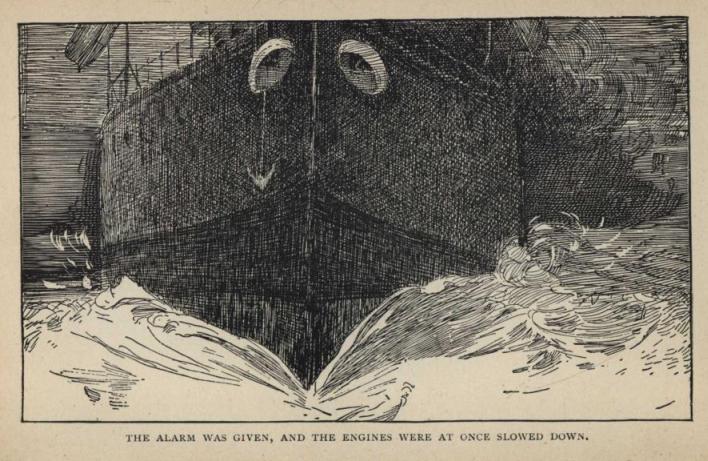
THE ALARM WAS GIVEN, AND THE ENGINES WERE AT ONCE SLOWED DOWN.
"During the passage, which was a rough one, a man fell overboard. The alarm was given, the engines were at once slowed down, and a boat was lowered, and for an hour every effort made to recover him. It was unavailing, as the body was not found.
"I had seen the man who was lost, and had been led to notice him rather closely, from the fact of his having taken up what I regarded as a dangerous position, with such a sea as was then on, in the stern of the vessel. So that when, from the sheltered position in which I was standing on the cabin stairs, I saw him fall over, I blamed myself that I had not warned him of the danger he was in.
"Whilst the attention of all on deck were engaged with the efforts being made to recover the body, a thought occurred to me which I at once proceeded to give effect to.
"I hastened down below, sought out the bunk in which I had seen the missing man during the morning,—it was next but one to my own,—and, as I remembered he was about my own age and size, I felt little hesitation in changing my own clothes for such of his as I found there, and with the result that, by remaining silent as to what I knew, on my clothes being found where his had been, and with papers in the pockets proclaiming who they belonged to, it was reported that I had been lost; whilst nothing, so far as I was able to learn, appears to have ever been said about the real man who was drowned, so that he must have had very few friends to inquire after him.
"Having thus effaced myself, I resolved to expatriate myself for fear of being discovered, and that is how I come to be here."
"A very infamous ruse on your part," said Ranger, who had listened with attention to all that Fellows had been relating. "Have you never written to let your mother know that you were alive?"
"No; I have always felt that that would be too risky a proceeding."
"Well, since this must have been a great trouble to you, and a burden on your mind ever since you went wrong, what circumstance has given rise to your present anxiety?"
"You may well ask, since, but for what has lately arisen, I should not have sought to inflict upon you my life's sad story."
"Out with it then, man, and make an end of the matter!"
"The simple fact is, I have formed what some would consider, in my circumstances, a mad attachment to Jessie Russell."
"No need to be ashamed of that, my boy! She's as fine a girl, and as good a girl, as can be found anywhere this side of the Rockies!"
"That thought, if anything, only increases my difficulty. You see, at present she is quite ignorant as to my past; and my fear is that if I tell her what I feel she ought to know, she will be inclined to despise me, and refuse to listen to me. On the other hand, if the goodness of her heart should prompt her to overlook my past misdeeds, and to favourably consider my suit, the knowledge of my past will only serve to increase her anxiety on my account, and burden her with a load of care which silence on my part might materially lessen. I cannot make up my mind as to what to do."
Ranger refrained from giving any immediate reply, and appeared for a time to be lost in thought. After considerable reflection he said—
"I have no hesitation about the advice I am going to give. There is undoubtedly much force in what you urge, as to the advantages of concealing all that relates to your past life; but I look upon it, that the woman who is to be a man's wife ought to be one he can trust. They should both possess each other's confidence. There should, therefore, be no secrets between them. And especially to begin married life it forms a bad precedent.
"Besides, we none of us know what the future may turn up for any of us; and although what you have told me seems hidden away secure enough at present, it would be almost too much to say that no circumstance, or combination of circumstances, could ever bring the past to light. And since it would be not only very awkward, but might be the means of wrecking your happiness, if anything should cause the past to be revealed, I say, by all means risk the reception it is likely to meet with, and tell Jessie all you have told me. She has a right to know the kind of man who is asking her to marry him. She deserves to have every confidence placed in her; and, unless I am very much mistaken in her character, she is not likely to cause a man's past to be a bar to his future in the matter contemplated, if she has any regard for him."
"I am neither surprised nor disconcerted at your advice," was Fellows' rejoinder. "It is, in fact, just what I expected from you. It is counsel which is quite in accordance with my own feelings, and what my conscience tells me is the correct course to pursue. I feel strongly disposed to act upon it at once; but I will just let the matter rest where it is at present, whilst I think over what you have said."
"But there is still another bit of advice I should like to add, if I may," said Ranger.
"I think I can guess what that is,—still you may as well give it."
"Write at once home, and to your employers, a full account of all you have told me."
"Why? In order that a detective may be put upon my track?"
"That was not my idea. But if you fear such a result, then why not write your mother, and get her to call upon your firm with a statement from you, but without naming your present place of abode, and leave her to decide, after seeing them, whether it would be wise to let them know where you are?"
"I am very much obliged to you, farmer; but as what you have suggested will require very careful thought, and very delicate handling, I will let that stand over for further consideration. It has waited so long that no harm will be done by a still further delay."
"Except so far as your mother is concerned,—you do not know what state she may be in at present."
"Quite true! Yet— Well, I will think it over, and let you know in a day or two."
It was with that understanding they separated.
But their rest would have been less easy had they known that all which had passed between them that night had been overheard, and was being treasured up for future use.
CHAPTER XVIII.
A SNAKE IN THE GRASS.
"... Warily I stole into a neighbour thicket by, And overheard what you shall overhear." Love's Labours Lost, Act V. sc. ii.
Ranger's homestead had been erected on a clearing, in the midst of what at one period was a well-wooded stretch of country, thickly overgrown with the pine, balsam, maple, and other trees indigenous to the soil, interspersed with a rich undergrowth of luxuriant vegetation, the alternate growth and reproduction of ages.
The rear of this house, which all this wealth and prodigality of nature's productions extended up to, had been left untouched by the axe or saw of the invader, except where a narrow path had been cleared to admit of easy access to a patch of garden-ground beyond. Here and there a trailing creeper had been captured, until it seemed to have become part and parcel of the dwelling itself, so that at times it was not easy to decide where the house ended and the scrub or wood began.
If Ranger and his companion had been less intent upon the subject of their conversation, their attention might have been attracted by a suspicious movement, which occasionally agitated the undergrowth not far from where they were seated. It passed, however, unnoticed.
It was dark when they closed their conversation and entered into the house.
When, however, all was quiet around, the figure of a man might have been seen stealing stealthily away from amidst the thick bush which lay within a few feet of where the two men had been holding converse, and making towards a log-shanty, dimly discernible in the darkness on a piece of rising-ground beyond the circle forming the enclosure of the homestead.
It was the abode of the Bartons; and Charles, the younger of the two brothers, was the figure from the wood now to be seen entering the door.
The room was unoccupied, John having been sent on business to M'Lean Station, which would prevent his return until next day.
Procuring a light, and seating himself at a table, he seemed to be reflecting deeply. His thoughts were inspired by the conversation which had been passing between Ranger and Fellows, and to which it must be confessed he had been an attentive, because an interested, listener.
It was while passing through the bush behind the former's homestead, on his way home, at the close of work for the day, that his attention had been arrested by the mention of a name which caused him to stop, and gradually but quietly to draw as close to the speakers as he felt it would be safe to do. On discovering the nature of the conversation, he did not hesitate remaining concealed, in such a position, however, as would enable him to hear the whole of what was passing.
Charles Barton, for some time a silent admirer of Jessie Russell, had been only waiting a favourable opportunity to declare his passion.
But Jessie was not a girl who would willingly afford any young man the opportunity so desired, if she had the slightest suspicion that it was being looked for. She was no prude, yet she was not a flirt; and that, in an unsettled region where men were in abundance, whilst the women were few and far between, was saying a great deal in her favour.
She had not failed to notice that several times of late Charles was to be seen lounging in the neighbourhood of her father's shanty, and this had caused her to still more carefully seclude herself from the rough settler's gaze.
Charles was a man with big ideas, but a small soul. The god he worshipped was self; and anything that seemed to stand in the way of self must be made to give place by fair means or foul. Scruples he had none, where self was in question. He had learned this evening, for the first time, of the additional difficulty which lay in his path to Jessie Russell's affections. After long and careful reflection he made up his mind how he would endeavour to get that difficulty "entirely removed."
Having provided himself with pen and ink and paper, he sat down at the table and began to write rapidly. At the end of about an hour he had finished a letter, which lay folded, sealed, and addressed in front of him.
It bore the inscription—
Messrs. H. & E. Quinion
Broadstone England.
It contained a statement of the confession he had that evening heard given by Fellows, with an intimation of where he was now to be found in case the firm felt any desire to possess that information.
After hinting at sources of further information, it concluded with an urgent request that the writer's name, which was communicated in strict confidence, as a proof of bonâ fides, should be kept a profound secret.
How to get this letter posted without its destination becoming a topic for conversation, was the difficulty which next presented itself.
For several days he was at a loss to know how to overcome this obstacle to the success of his scheme.
On the fourth day after the events narrated, Ranger announced his intention of riding over to Wolseley Station on business which would detain him until the evening of the next day.
It was too good an opportunity to be missed; so a few hours after the farmer's departure, securing a horse from amongst the many that are allowed free range without detriment, it being only imported horses of the better class which, as a rule, are stabled, he soon had it saddled, and was off for "Indian Head," where he expected to find a post-box convenient, into which his letter might be dropped.
After a couple of hours' sharp ride, he entered the little town, where, without much difficulty, he discovered the object of his search.
Having accomplished his mission, and given his horse breathing time, he set out on his return. The moon had not yet risen, but the stars shone out in a clear sky; and objects were plainly visible on the road to be traversed.
Mounting the crest of a hill, he was proceeding at an easy trot to descend a winding pathway which led on to the plains, when something—it was never known what—caused the horse to swerve and stumble, and the next minute, before its rider could recover himself, he was pitched forward with the horse on top of him.
Recovering his feet without much difficulty, the horse stood for a few moments, and then, as if it had taken in the situation, galloped off in the direction of home.
Barton was stunned by the fall, and lay on the road insensible.
Two hours passed before the man showed signs of returning consciousness. Then the keen wind which blew across his face, as he lay extended on the ground, caused a tremor to pass through his body, and opening his eyes he endeavoured to sit up, but at first the pain which the effort inflicted was so great he lay for a time trying to collect thoughts which were confused and scattered. A second effort was attended with more success, when he proceeded to make a careful examination of his limbs, to ascertain what, if any, injury had been sustained.
Satisfied with the result that no bones had been broken, yet suffering intensely from a sprained ankle and an injured knee-joint, which he found would prevent him standing, let alone attempting to walk, he realised that however desirous he might be of making progress, there was nothing for it but to remain where he was, with what fortitude he might be able to summon to his support.
By dint of a little exertion he managed to crawl on to the bank at the side of the track, and there, against the trunk of a large oak, he prepared to make the best of his position, in the hope that help of some kind would sooner or later turn up.
He had lain there some time—dozing between whiles—when he became conscious of sounds as of the distant grind of heavy wheels, and the slow measured tread of horses' feet. Listening intently, he soon made it out to be a waggon-team, which he judged to be from some neighbouring homestead, on its way to one of the stations,—M'Lean or Indian Head,—and, as subsequently proved to be the case, with produce to be railed on to Regina or Winnipeg. When within range of his voice, Barton had little difficulty in arresting the attention of the teamster, who, stopping his horses and dropping the reins, quickly dismounted, and, with lantern in hand made his way to the side of the track from whence the sounds proceeded.
The position of affairs was explained, when, calling his companion to help him, they together lifted the all but helpless man into as comfortable a position as it was possible to make for him in the waggon, an operation which was only accomplished with considerable difficulty, seeing that nearly every inch of space was well occupied with farm produce of a marketable kind.
Indian Head—his destination—was reached as daylight began to break, when, handing Barton over for the time being to some of the railway officials, he had just sufficient time left to get his load transferred to one of the empty trucks in waiting, before the whistle sounded and the heavily loaded train steamed out of the station on its way to Regina, distant about some forty miles farther.
Having successfully accomplished the object he had in view, the waggoner—a farmer whose homestead was but a few miles off the rail—next proceeded to question Barton as to what was to be done with him.
On learning that he was one of Ranger's men, and that Ranger could probably be found at Wolseley, having intended to stay the night there, he at once decided to send on a wire in the hope of intercepting him there and getting him to take Indian Head as his route home in order to pick up Barton.
In the course of the morning a reply came to say he would be there; and late in the afternoon Ranger drove up, not a little surprised at discovering who it was that was awaiting him, as well as the condition he was in.
Having had the injured man transferred to his own conveyance, he mounted and drove off.
On reaching home, he found an uneasy feeling had been spreading at the prolonged absence of Barton, especially when it got reported that a horse, saddled and bridled, had been found grazing, which it was believed must have been the one Barton had started out upon the evening before, and which had apparently returned riderless; but where his rider had been left, no one had any means of telling, since it did not appear to be known in which direction he had gone.
The farmer's return with the missing man at once put an end to all doubts, and, with as little delay as possible, he was conveyed to his own shanty, where both his sprained ankle and damaged knee received the attention needed, so that he was soon able to resume his usual duties on the farm.
When Barton explained to Ranger the object of his journey, which he did as they drove home, it was one of such common occurrence that it left no impression upon his mind as to there being anything peculiar in it.
CHAPTER XIX.
HESITATING.
"... At this hour Lie at my mercy all mine enemies." The Tempest, Act IV. sc. i.
When, in due course, Barton's letter reached Broadstone, the astonishment and surprise it gave rise to was beyond all description. The excitement it created in the breasts of the partners was intense. Old memories were aroused with regard to incidents long since regarded as for ever buried.
The circumstances under which they were now revived seemed to possess more the character of fiction than fact. Yet the details given, and the circumstantial nature of the narration, seemed to preclude all possibility of doubt.
What ought to be the action of the firm in the matter now? This was the problem which faced them, demanding a decision,—but a decision which they found themselves unable to agree upon.
It was therefore wisely resolved to leave the matter where it was at present, and to return to the subject later on, after each had been able to think out what was the best course to pursue.
A week went by, during which the solicitors to the firm had been seen and consulted. Their advice was friendly, but cautious. Whilst from a strictly legal point of view it might be right to take steps to have the culprit arrested and prosecuted, perfectly legitimate reasons could be adduced for taking no notice of the letter and refraining from any action in the matter.
Their advice was to have inquiries made, through their agents in Ontario, as to the truth of the information forwarded, and the character of the writer of the letter; as well as to learn, if possible, his object in writing. It was pointed out that this need not involve any very great expense, and on the information received they could then decide how to act.
They resolved to follow this advice, especially as the further delay would afford additional opportunity for reflection.
Acting upon instructions received, their solicitors wrote their agents in Quebec, by the next outward mail, giving a full account of their client's case, and requesting them to obtain, through the agency of the police—or by any other means, if considered more desirable: The character of Ranger, his holding and belongings, and his status in the country; whether anyone known as Fellows—but whose real name was Ralph Sinclair—was at present in his employ; the date when he came there; where he came from; what position he was filling; and the reputation he was held in.
The same information as to a Charles Barton; and, as this was the person sending certain information with regard to the first named, to ascertain to what extent they associated, and, if possible, the causes which had induced him to reveal what he had done about the man known as Fellows.
It was specially enjoined that the information was to be obtained with the greatest caution, as on no account must it leak out that these inquiries were being made from England.
As the matter seemed to be one possessing features of interest which might lead to important developments, the agents lost no time in seeking an interview with the chief of police; who, after a careful perusal of the letter from their correspondents, promised he would write for full information to their headquarters staff at Regina, who would no doubt be able to get what was wanted.
In the attitude taken up by the great firm of Quinion towards their former employé, there was no feeling of vindictiveness manifested. They had, in fact, never yet been known to prosecute a defaulting servant, although many opportunities had offered for so doing. Their leniency towards men who had been detected defrauding them had almost become proverbial, so that they were beginning to look upon it themselves as a matter of reproach.
The members of the firm were men of high principle, anxious not only to stand well in the public gaze, but desirous that their motives should be beyond suspicion. They were nominally religious men, but making no very pronounced profession of their opinions and beliefs. Crooked and perverse as the treatment of their London employés had been, their conduct was so surrounded with sophisms for arguments, that shadows had assumed substantial form, and they seemed to have persuaded themselves, if not others, that in all that they had done they had been guided only by the highest principles of moral rectitude, leaving nothing of which they need feel ashamed.
Burns has very aptly said—
"Oh, wad some power the giftie gie us
To see oursel's as others see us!
It wad frae monie a blunder free us
And foolish notion."
They had not lost sight of the mother of Sinclair,—or Fellows, as we must continue to call him,—since their first impulse was to acquaint her with what they had heard.
Upon reflection, they felt it would be wiser to wait until, with the fresh light which they hoped to receive as the result of the inquiries set on foot, their mind was better made up as to the course they ought to pursue.
CHAPTER XX.
ON THE TRAIL.
"Thou art a fellow of a good report, Thy life hath had some snatch of honour in it." Julius Cæsar, Act V. sc. v.
Regina, which, prior to the advent of the Great Trunk Line of the Canadian Pacific Railway, was possessed of but a few straggling log-shanties—the rough dwellings of settlers and squatters, the early pioneers in the great North-West of those civilising forces which are marching with so much rapidity across the face of the American Continent—is not only the principal town, but has the honour of being the capital of the province and the seat of the legislature.
Yet, rejoicing in a population of not more than some two thousand, it is making such rapid advances as bids fair to raise it, in a very little while, to a position of importance and pre-eminence.
The mounted police have here their headquarters, and it was therefore in the order of things official, as well as natural, that the inquiry set on foot at Quebec should be forwarded to this little but important centre for further elucidation.
To John Stone, or "Puffey," as the name by which he is best known, was entrusted the task of obtaining the required information.
The work, although of an eminently peaceful character, was beset with no ordinary difficulties, from the secrecy with which the information had to be obtained.
Taking Nat Langham's Store on his route, he soon found himself in the midst of a company of the roughest and lowest of the labouring-class population of the district. Smoking, drinking, gambling, and betting, were the usual order of proceedings; occasionally varied by a free fight, in which the use of knives and firearms were not unknown.
Beyond a few brief glances from carelessly turned heads—the usual greeting to a fresh-comer—but little notice was taken of his advent into their midst. Calling for a liquor, and lighting his pipe, he joined a group at one of the tables, where play was in progress, and soon became an apparently interested spectator.
Presently one of the players, turning to Stone, asked—
"What are they going to do with Red Dick, Puffey?"
"Oh, he is of too much importance to be dealt with by the authorities hereabouts."
"What! do they intend sending him up to Quebec?"
"Yes," replied Puffey; "and there he'll stand a very poor chance."
After a pause, "What do you know about him?" inquired Puffey.
"I don't know the fellow, and don't want to," was the rejoinder. "I only felt interested because I was with the force when he was caught."
"Oh, I see! you were one of the volunteer force that aided the police."
"That's so, sonny."
"What was the name of him who took command of the volunteer force? Do you remember him?"
"Yes, very well. It was a chap named Fellows, at Ranger's."
"Not been hereabouts long, has he?" inquired Puffey indifferently.
"Not above six or seven months, I believe," was the reply.
"Came from England, I think we were told?"
"Yes."
"He seemed to understand his business very well. Know much about him?"
"I only know that he is said to be on friendly terms with Ranger, and is believed to be rather sweet on one of the women on his station."
"Is that so?" added Puffey. "Then the fellow hasn't lost much time."
"Well, I can't say for certain," continued the speaker, "as I work on a neighbouring farm; but I heard one of my mates talking a while ago about him."
Puffey felt that here, at all events, was a source from whence some useful information might in all probability be gathered, but he was anxious not to appear too eager, for fear of exciting unnecessary inquiry.
Allowing the conversation to drop, he sat and watched the players until the one he had held converse with gave signs of intending departure.
Rising from his seat, Puffey sauntered out of the store, and lounged about for a while until he saw the other come out, when, accosting him, he said—
"Look here, mate, I should like to have a word or two with you, if you can spare a few moments."
"All right, Puffey," replied the fellow; "say on."
"You were speaking of a girl on Ranger's farm that the chap Fellows was supposed to be sweet on. Now, as there is one on the same farm that I have had my eye upon for some time, you'll understand the interest I may appear to be taking in this matter. I should like to know the name of the girl referred to, if you can tell me?"
"Oh! is that how the wind blows?" laughed the other.
"Well, I don't want you to go blabbing about the matter; we've all got soft moments in our lives."
"Never fear, my boy! Jack Hart's not the chap to spoil sport."
"Call it sport if you like, but tell me who is the girl this Fellows is after?"
"Her name is Jess Russell. She is the daughter of one of Ranger's men; and they do say as fine a looking specimen of the sex as is to be found in the North-West."
"That's not the one I was thinking about. I don't know her; but beauty though she maybe, I'll back my girl to go one better."
"Poor old Puffey! Hit at last! I shouldn't have thought it of you."
"Well, it's not a case yet; so mind what I've said, that 'mum's' the word."
"Right you are! Nor is it a clear case yet with that Fellows, as it is said a chap named Barton has been noticed sneaking round after the same girl."
"Oh," was Puffey's comment; "then there's likely to be ructions there before long, if that's the case."
"Just as likely as not," was the reply. "Well, good-night, Puffey. I must be going."
"So long, old chap," was his parting salute, as Puffey mounted his horse and rode away, feeling that he had learned one thing from what he had heard, and that was the cause which had led up to Barton's letter.
The next day Puffey, pursuing his quest, ventured to ride boldly up to Ranger's homestead and inquire for Fellows by name. He was told he was at work in the fields, but on receiving directions where he was to be found, and how he might know him, he resolved to go in search of Fellows, first stating, in order to allay any fears as to his motives, that he was commissioned by his officer personally to thank him for the part he had taken in the recent raid.
After a rather extended search, he at length came across his man, out on a distant part of the prairie cutting corn.
Some astonishment was naturally manifested at the sight of a member of the mounted police inquiring for one of the workers on the farm.
There are certain people who are seldom regarded as welcome visitors. A man never hears that a policeman is inquiring for him without a feeling of uneasiness beginning to steal over him, he could not perhaps tell why, although all the time perfectly conscious that there was no need to be at all apprehensive as to his object.
With Fellows it was different, since, although he had no reason to think that his secret had been discovered, there was his own consciousness of guilt, ever present, and ready to start into activity at the first symptoms of coming danger.
Puffey—like the keen observer he was reputed to be—did not fail to note the start which Fellows gave when he heard his name inquired for.
His sunburnt countenance did not, however, betray his momentary agitation. Recovering his self-control, he advanced at once to the constable, and looking steadily in his face, in a clear voice, unmarked by the least tremor, exclaimed—
"My name is Fellows. What do you want with me?"
"You see who I am, Mr. Fellows; not always the most welcome of visitors?"
"That's true, sir, no doubt; but I have no reason to regard you as unwelcome."
"Nor will you," added Puffey, "when you learn the object of my visit."
The men who were working with Fellows had ceased their labours, and were crowding round to hear what the detective had to say.
"I am commissioned by the Major," said Puffey, "who commanded the force which recently made that successful raid, ending in the capture of Red Dick, to return you his thanks for the very valuable aid rendered him on that occasion, in the promptness with which his orders were carried out, and for the precision with which the duties you undertook were discharged. He fully recognises that the success of that enterprise was in no small measure due to the alertness and cohesion of your force, as well as to the able way in which that force was handled by you."
"Many of these men," replied Fellows, "standing round me, were present on the occasion referred to, and in their name, as well as my own, you may tell the Major that, whilst warmly thanking him for the flattering words addressed to us, we were all only too pleased to serve with so brave a force as the men he brought to lead us."
"That ends my mission with you," said Puffey. "Not a very terrifying one, you must admit."
Presently he added, as if a new idea had suddenly struck him, "Are you satisfied with your present occupation?"
"Yes; don't I look as if I was?" he asked.
"It was only a passing thought, which that moment occurred to me; you are just the sort of chap we could very well do with in our force. Would you care to join us?"
"No such idea has ever entered my head, and I don't feel as if I should much care for the life."
"Well, I've no authority to ask you, but you might think it over."
"No harm in my doing that," he replied.
"How old are you, if it is not a rude question to ask?" said the constable.
"Just turned twenty-nine."
"English, I judge?"
"Yes."
"Been long in the Colony?"
"Only about seven months."
"Any trade or profession?"
"Was a commercial in the Old Country."
"Married or single?"
"Single."
"Hope to remain so?"
"That depends on circumstances."
"You'll excuse my being so inquisitive, but I wished to make sure you were qualified for the post I just now suggested to you; and from all you tell me, I have no reason to doubt but our people would only be too pleased to accept you if you choose to apply."