INCIDENT IN THE INDIAN SPORTING TOUR OF ALIBI PASHA (COLONEL ALIAS ALIBI).
Reading edition
ir,—You were sending your Correspondents all over the world, and you never did a better thing than when you summoned me to your presence, and said, "Colonel, are you ready?" and I replied, "I am!" If it hadn't been for my uncommon clearness of vision, the party of detectives whom you sent out in search of me would never have discovered me in my rocky lair on the southern coast of Cornwall, to which secluded spot I had for a time retreated, your Colonel en retraite, the only time he ever retreated in his life, and then not from foes, but from too many and too kind friends, in order to scheme out at my leisure a new and original plan for tracing the real and only source of the Nile at half the cost of Stanley's expedition, with double the profits. "The Genuine Nile Water Company Limited," and the "Nile Sauce for Cheops and Steaks," will be two of the greatest financial successes of this or any other time.
"Yeo ho, my boys! Yeo ho!" I shouted from the height above to four toiling minions in the cockle-shell of a boat below. My! how glad they were. Odds Colonels and cockle-shells! but, it I hadn't exerted my lungs, they'd have returned disconsolate to you, as you were waiting at the railway station, with your baggage all labelled, and your dog Toby waving adieux to your followers. What a wigging they'd have got! But, seeing me, you smiled as you wert wont to smile, and in two-twos the historic question was asked—"Colonel, are you ready?" (as I have already reminded you), and the equally historic answer had been given, "I am!"
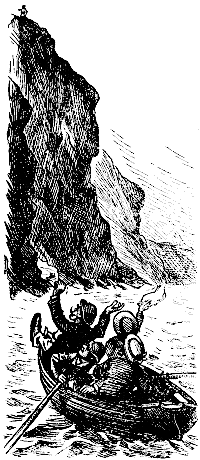
"Yeo ho, my boys! Yeo ho!" I shouted.
My weapons and my sporting togs are always at hand, packed for travelling at the shortest possible notice. And here let me remark to you that, when you were in the desert, had you been armed with my patent revolving, twenty-times-a-second, double-action repeating rifle, the strange story of the conflict between yourself and the ostrich would have been utterly impossible. Excuse me, Sir, but, as it is, I consider it scarcely within the bounds of probability. I know probability will take big bounds, and I'm a bit of a traveller myself, but your escape uninjured from that wild bird, and the escape also of Toby, who is not a sporting dog, is one of the strangest tales on record, by the side of which, perhaps, even the daring exploit, which I am now about to narrate as a plain unvarnished tale, may seem a mere ordinary, every-day occurrence. But to proceed.
To India. I promised you my diary of sports and pastimes from the moment of my arrival. Here it is, from the first day to the moment of my posting you the last scrap by special messenger. Now, to commence * * * (We omit the first six hundred pages.) * * * The next day Swindlah Khan came to my Kabob where I was sitting, wiling away the time by teaching my favourite Cheetah the three-card trick, which the sagacious animal can now perform as easily as if he were the learnedest pig in Europe—(I am bringing him over, to back him for matches of this sort in England—shall probably get up a company to work it—Learned Pig and Cheetah Company (Limited). Capital, £280,000,000—but of this, more anon)—and, after accepting the puffum, which is always offered to a visitor filled and lighted, Swindlah waited for me to open the conversation.
"Swindlah, mebhoy," said I, addressing him familiarly, in his own native language, in which I am a proficient, and shall now give a translation, "What's up?"
"Alibi Pasha," he replied, bending his head, and looking out of the corner of his eyes—a trick he has when he means mischief—(I know the old rascal by this time)—"Is it on or off?"
For the moment I had forgotten our wager of the previous night. I confess I had imbibed so much loshun that for once and away I was not quite certain whether I was actually sober or not—nor, indeed, did I decide the point until I had argued it out myself, and settled that, if I went to bed in my bhootahs (worn here on the foot, and very much worn under it), I must be more or less inebriated, but that, if I assumed the ordinary shimmy dinnee—(do you remember my song on this Indian night-habit, to the tune of "Bonnie Dundee"?—it was in the cold weather, when the stinging winter night-fly is about, and I couldn't find the article of apparel anywhere,—
Then haul down my curtains, and call up my men, And search every cupboard agen and agen. It has a frilled border as far as the knee— It's the prettiest thing is my shimmy dinwee.
But, as I didn't quote this to Swindlah Khan, I only allude to it here, and you will find it in extenso, as they did in the linen-press, further on, during the course of these Memoirs)—and retired to my dhownee (bed), I must be all right. Dhownee v. Bhootah, and the first won. Yet next morning it was with difficulty I could exactly recall the term of the wager.
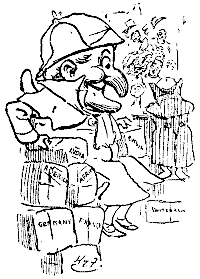
Waiting for the Colonel.
"Yes, Swindlah," says I. "It is the Wild Hog Hunt to which you are alluding." He bowed. "Fifty thousand lakhs of rupees," I continued, "which your executors pay to mine in case you come to grief, or mine to yours in case the like happens to me." Again he bowed, and I went on. "And if we both survive, the money is paid to whichever of us two kills the Wild Hog of Ghrûntah." We shook hands over it. I didn't, as a rule, shake hands with Swindlah Khan, who was the veriest old thief in all India, and an abominably cruel tyrant into the bargain.
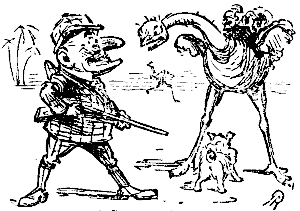
A Strange Story.
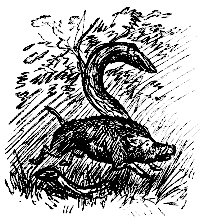
The fact is, that this Wild Hog, which from time to time ravaged various parts of the country that trembled under the sway of Swindlah, was secretly fed, kept alive, and incited to ferocity by the minions of the cunning despot, who, when he wanted a larger loan than usual, or coveted the property of some private person, would privately order this Hog to be starved for a fortnight, and then suddenly let out to run a-muck.
Naturally the poor natives, and the rich ones too for the matter of that, clamoured for protection at the hands of their ruler, who pretended he could see no other way of dealing with the difficulty than by raising a force of sharpshooters, armed with lances and bows and arrows, no guns being permitted, as the noise would disturb the Swindlah, who, about this time, invariably feigned to be laid up at home with a bilious headache. His subjects had to subscribe for the support of these sporting warriors, and the money came in from all quarters into Swindlah's treasury for the purpose of killing this formidable scourge. The presence of this Wild Hog obstructed trade, as no Travellers, commercial or otherwise, would run the risk of encountering this dangerous monster. Of course, the Hog was never killed, as to have put an end to its existence would have been analogous to killing the Goose that laid the Golden Eggs. When I came into the country, Swindlah did his best to entrap me. I had thirty of the narrowest escapes that ever man experienced. (Here we omit 1200 pages of this most thrilling narrative.) Swindlah had dared me to kill the Wild Hog alone: I had replied, "Yes, but it must be worth my while. So make it a bet, which will slay the beast, you or I, and I'm on. And the entire beast must be brought back as evidence. A leg, or a tusk, or an eye, or a bristle won't do. It must be the whole Hog or none."
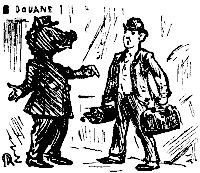
An Awful Boar for Travellers.
As I have said, so 'twas done. The barbarous Swindlah had determined on collaring my coin, and taking my life. He had secreted men in the jungles, in the passes, on the mountain-tops, to spear me, arrow me, shoot me,—if they could. What did I care? I had the whole country at my back, for they were ready to rise as one man—(and, as a matter of fact, only one man did rise, and he was beheaded at once by the nearest native policeman, who afterwards apologised handsomely to the family for the mistake),—and take vengeance on the tyrant. But this depended on my success; otherwise, so crushed and craven were even the noblest spirits among them, they dared not move one little finger. Shall I proceed? Yes. I bore a charmed life. The Wild Hog was wilder than ever. Mounted on my good old mare, Wheezer, which had carried me over many a stiff country in Old England, and accompanied by my faithful hound, Yelpa, I sought out the wild beast in his lair. Swindlah himself came by a circuitous route.
Suddenly there was an awful roar—I call it a roar, but it was really the noise of a volcano in action—and the place shook as though in the throes of an earthquake. Above me, on a rock, on the other side of a ravine (eighty feet by fifty) stood the huge monster, hideous, raging, tearing up roots, trees, stocks, stones, anything and everything. In all my life I never saw such a horrid boar! "At him, Yelpa!" I cried, giving at the same time my well-known whistle of attack. Yelpa cleared the ravine at a bound. Then followed an awful struggle. Swindlah below looked up in delight. "If the dog kills him, it's no bet!" he shouted.
"Come on, and kill him yourself, if you can!" I cried, putting Wheezer at the leap. My brave mare needed no spurs.
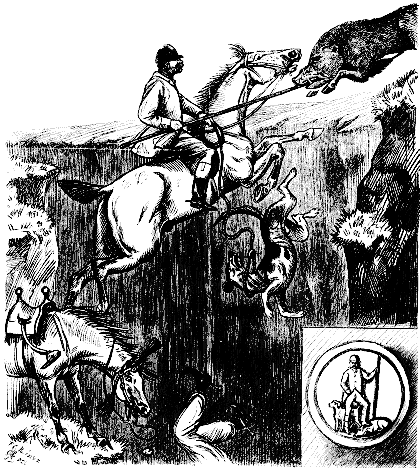
A HAZARDOUS LEAP!
At that moment Yelpa missed his footing and fell. In less than the 100th part of a second I had lassoed him round the collar, and saved my gallant and faithful friend; but there was no time for attending to his wounds, as at that instant the Wild Hog, frantic with rage, sprang from the rock straight at me, mouth open and bristles erect. One billionth part of a second of suspense, and the next minute my pig-sticking spear had passed through him, and Wheezer, I, and the Hog sank exhausted on the other side of the ravine, just as a shriek broke on my ear, and I was able to see that Swindlah's underbred horse having refused a narrower place lower down, had, in consequence (for this, strange as it may appear, was the first time that braggart Swindlah had ever been out riding) pitched Swindlah right over his head into the abyss below. I returned home in triumph. Bonfires and rejoicings all night. Torch and Nautch till daybreak. No one thought of looking for Swindlah till next morning, when nothing was found of him except his turban. His horse was browsing peacefully within a few yards of the spot where Swindlah had disappeared. The money I had fairly won was never paid, but the nobility and gentry subscribed towards a medal, which was struck in commemoration of the event. I send one to you, one to the Vatican, and a third to the British Museum. I need hardly say that after this—(We omit the remainder, as the work will probably be published in full at some future time).