A HAGGARD ANNUAL.
Reading edition
(Specially written by Walker Weird, to usher in the Year 1890)
Unredd, the writer, and Spoylpaperos, the sketcher, were in the presence of a weird figure, that grotesquely genuflected before them.
"Fear not, my sons," explained the Weird, cutting a sad caper; "fear not. He-who-must-be-obeyed has need of ye. And, as He has need, ye must be well-bred," as we say in the yeast.
"And you are?—"
"The Ghost of a Joke!" murmured the extinct witticism, sadly; "and my name is Sillibilli." And then a strange thing happened.
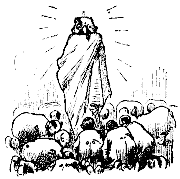
All of a sudden the Writer and the Sketcher found themselves thrust into the presence of He-who-must-be-obeyed. After pushing down his two captives, Sillibilli himself fell upon his hands and knees, like a pig journeying to market. The men of the pen and pencil looked about them, and for miles could see nothing but prostrate forms. In front of them was a heavy white drapery, seemingly hiding a figure. At length the curtain began to move, and suddenly, from above its folds, appeared a most beautiful red nose—never had they seen such a long and curved nose. Then came a voice, sweet and soft, and yet full of power, reminding those present of something between a murmuring brook and a thunderbolt.
"Strangers!" said the voice, in English, but much purer and more classical English than the Arriarris talk, "Strangers, When is the portal to a saloon not the portal to a saloon? Tell me that, O Strangers!"
"When it is an Egyptian potsherd," stealthily whispered Sillibilli.
"Begone, thou white headed old fool!" cried He-who-must-be-obeyed, angrily. "It is not the answer; and, if it were, who art thou to thus reply? Begone, thou feeble cry of a donkey long defunct!" The voice rose in its anger clear and cold, and the Writer and the Sketcher fancied they could see two gleaming eyes above the drapery.
Sillibilli beat his stupid old head thrice on the ground, and crawled out of the apartment as he had crawled into it.
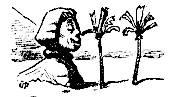
"It made a quaint gesture with the assistance of a palm-tree."
"Neither of ye know," continued the Lord of the beautiful red nose. "Then begone, and search for that joke—trace it to its source—to its saucy source."
There was a pause, and then a strange thing happened. A mighty shout of laughter rose from the very depths, and seemed to fill the entire universe. He seemed pleased, and gracefully inclined his nose as if acknowledging a compliment. Then he continued, less sternly,
"Away to the land of the Joks, and the Judimows—the Quipps and the Kranx. Away, to find a way!"
Once again came the roar of mighty laughter. From far, far away it came with a dreadful muttering noise, that grew and grew to a crash and a roar, which combined in itself all that is terrible and yet splendid in the possibilities of sound. Then it passed away, and disappeared in a murmured guffaw.
Then Unredd and Spoylpaperos, feeling sure of the presence of two gleaming eyes above the beautiful red nose, turned sharply round and fled.
And they journeyed on and on, through the snow and the ice, until they came to the land of the desert, in which they found themselves (strange to say) in a warmer atmosphere than that to which they had grown accustomed in the regions of the North Pole. Then a strange thing happened. They witnessed a fight between an elephant and a cat. The elephant managed to get well on the bank of the river which ran (conveniently) through the desert, in spite of the cat nipping on to one of its legs. Gradually the cat began to swallow the leg, then the body, then the head, until nothing but the trunk of the elephant was left. A strange thing had happened—the elephant had been swallowed by the cat!
"He was evidently going out of town," said Unredd, airily.
"So I see," replied Spoylpaperos, and he pointed to the trunk. Once more came the dreadful muttering noise that ended in a roar of laughter, and again a shadowy form floated past them—the Ghost of a Joke! And when they looked towards the cat it too had gone, having disappeared (so they subsequently ascertained) with a grin. They then knew the creature's breed—it was a Cheshire cat!
And now they were in front of the Sphinx, who was looking down upon them with a most fiendish and terrifying expression. Surrounding this ancient Egyptian Monument were numberless scrolls (many inscribed "Δεκλ.νεδ—Θανκς") sent there by a forgotten people. Unredd picked up one of comparatively modern date. It was a strange scroll, full of hieroglyphics and languages of many races. Here was the ancient Greek—and the more modern Arabic. There was something that seemed to be Russian—there a line that might be antediluvian Irish. All jumbled up together, in seemingly hopeless confusion.
"See," cried Unredd, excitedly, "I can make out 'When is the door of the neighbour'"—and then he stopped.
"Quite so," replied Spoylpaperos, "but it has no answer. Stay though—what is this? 'The duck of the gardener (gardener's duck) puts his head into the pond belonging to the grandmother of the sailor (sailor's grandmother) for the reasons of the diver (diver's reasons.)' This is very strange!"
"Indeed, it is," acquiesced Unredd, and then he cried, on making a farther discovery, "See the Author's name!"
And then they found inscribed on the scroll a word written as follows:—

Perfectly bewildered, they threw the paper away. Then a strange thing happened. All of a sudden, with one accord, they put to the Sphinx the question that He-who-must-be-obeyed had asked them. The mouth of the head seemed to move, and one of the huge eyelids appeared to quiver. Moreover, it made a quaint gesture with the assistance of a palm-tree. Then came a voice, saying, in hieroglyphics—
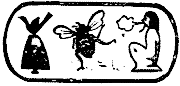
There was a pause, and then Unredd, in consultation with his companion, deciphered the meaning.
"You be blowed?" they both shouted, and the Sphinx gravely inclined its head. Then, of a sudden, after jumping from one mountain-top to another mountain-top, clinging to a precipice by their eyebrows, and sliding down a glacier and an avalanche, the two travellers came to the source of nothing, or, to use the local name, the source of the Nihil.
"When is a door not a door?" they asked, impelled as if by some hidden power.
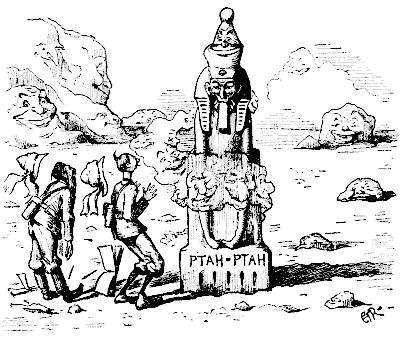
Ded'-an-Gone; or, Jest Departed.
"In a moment the most beautiful Joke that ever was known appeared before them. It had the semblance of something they had seen before—lovely beyond compare. A flood of liquid laughter followed, and the Joke bathed in it, dancing about in the merry mixture most joyously. It was a dread and wonderful sight."
In a moment the most beautiful Joke that ever was known appeared before them. It had the semblance of something they had seen before—lovely beyond compare. A flood of liquid laughter followed, and the Joke bathed in it, dancing about in the merry mixture most joyously. It was a dread and wonderful sight.
They felt that but half their task was accomplished—but only half. Had not He-who-must-be-obeyed ordered them to seek out the solution of the Great Conundrum? That Great Conundrum had lived through the ages. It had been known to the Romans and the Greeks, and had died (for a while) with the Dead Languages. It had been buried in the land of the Assyrians, from whence had come a kindred spirit, the precursor of the Hibernian bull. That bull, which was in the changing seasons to cause roars of mighty merriment echoing into the far ages of the Future from the distant dimples of the Past. So, after their first surprise, they welcomed the gladsome Presence. They watched it as it jumped and leaped in the flood of liquid laughter. They were mad with a nameless delight, and danced round and round in a wild delirium of quaint possibilities! The Joke smiled upon them, and seemed to recognise in them the followers of the Great Jo-Mill-Ar, or One-who-has-caused-the-dullest-dogs to-shake-their-heavy-sides-with-tuneless-laughter.
Then the Joke grew in comeliness. The Question was only half of its stature—it required the Answer. They felt that the reply would come with the mighty murmur of merriment that the Writer and the Sketcher had already noticed. At length it was upon them. The Answer came!——
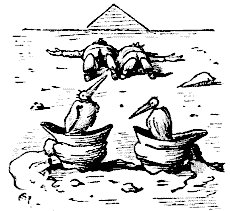
"They had their desert!"
"When it is an egress."
"Look!—look!—look!" shrieked Unredd.
The Joke was growing old before their eyes! The wit was shrivelling up! The fun was evaporating! Smaller and smaller it grew, until it was nearly gone.
"I will not die!" came a cry. "Generations yet unborn shall hear me. Many shall think me good—many shall be amused. Oh—h—h!" and the Joke had fallen flat! They knew its real name, then—it was "Ded an-Gone, the Jest Departed." And now it was still!
And so were Unredd and Spoylpaperos. Alas! for their melancholy fate—they had died of laughter! They had their desert!