Volume 93 — ESSENCE OF PARLIAMENT.
Reading edition
From the Notes of a Colleague of the Member for Barkshire.
House of Commons, Monday, August 29.—I was afraid that Toby would give himself a holiday. For some time since the Whips have kept an uneasy eye upon the most independent, the most talented, the most industrious of their following. And now he has gone! "He will return—I know he will," before the end of the Session; but for the moment he is away—the deadly dulness that prevailed at Westminster a fortnight since was too much for him; and so I follow him in the House—be it well understood, at a respectful distance. His absence will not be pleasing to any one—even the sprightly Akers Douglas, forgetting for the moment the destination of votes, will regret him. But, as he good-naturedly observes, under the impression that he is adapting Shakspeare to the exigencies of the situation, "Votes may come and votes may go, but the Session seemingly goes on for ever!"
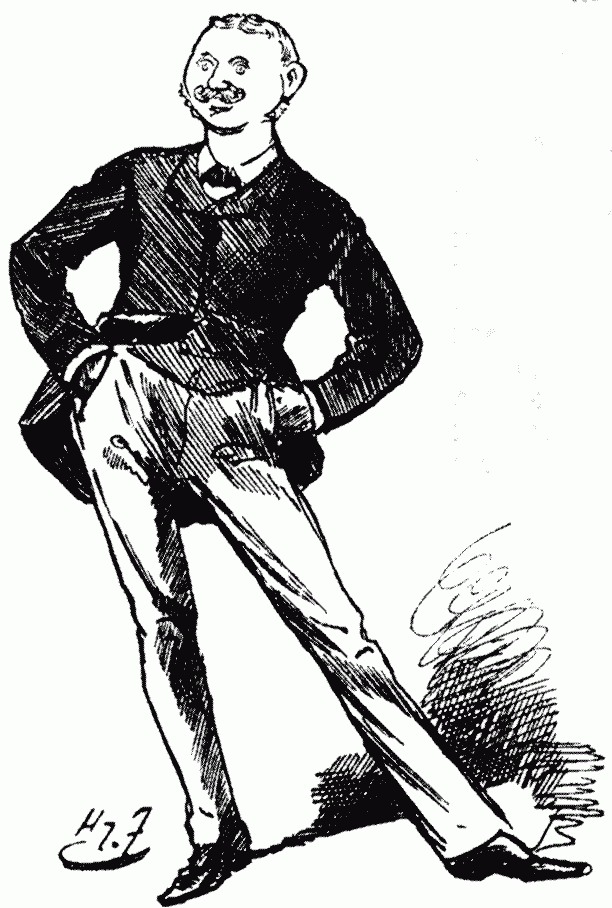
A. Ak-rs D--gl-s.
To return to August 29. The Patriots have determined it shall be a grand week for the "Ould Counthry." Many previous weeks have been equally grand weeks, or as they would put it "months." When the Speaker took his seat, scarcely a quorum present. Ministerialists "in reserve," (like policemen when some one writes to tell Sir C. Warren he is going to demonstrate in Trafalgar Square) in various parts of the House. Gladstonian Whips well en évidence to act as guides to sole representatives of the Non-Dissentient Liberals, Woodall and Childers.
Unprejudiced North Briton Douglas Crawford has a question for young Northcote about pig-iron and coal. Seemingly Scotch firms have been overlooked. Surveyor-General of Ordnance very gravely answers question, goes home and tenders his resignation, "in consequence of recommendation of Committee reporting upon War Office organising and suggesting changes." Northcote had enough of it. Couldn't even say something funny about "burning questions re coal generally ending in smoke."
After Joicey had wanted to know why great guns should be let off at Tynemouth Castle, and Stanhope had promised that for the future they should be fired (if possible) in a whisper ("Savours of a bang," put in Childers, sotto voce), the Irish gentlemen got to their favourite sport, King-Harman baiting. They had one or two good sets-to, making it particularly unpleasant for the Under Secretary about the trial of O'Brien, Resident Magistrates, and Horse-breeding. But this "illigant divarsion" was only a sort of hors d'œuvres to the pièce de résistance, "Supply—Irish Votes," which was as strong and savoury as the National Stew itself.
Dillon began the ball by moving a reduction of the Constabulary Votes, saying that the chief duties of the officers were, driving out with the Country Gentlemen, flirting with all the Young Girls, and shooting with the Landlords.
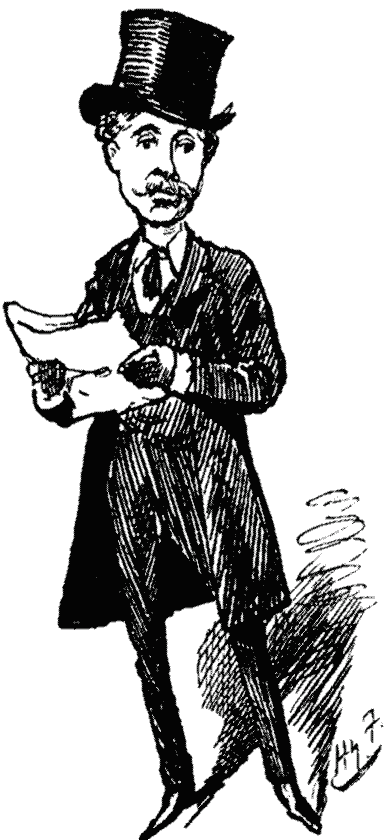
H. N-rthc-te.
"Ah, so it is," said Joseph Gillis, with a flush of scarlet indignation mounting his noble brow, "It's not the driving and shooting I object to—it's the flirting!"
Joseph Gillis is very excitable when the fair sex is mentioned, and no doubt meant what he said.
Tim Healy followed on, regretting that Grandolph was not there, no doubt for the same reason that the Irish gentleman with a shillelagh was sorry to see no bald pates neat and handy. He said that the Boycotted were the happiest inmates of the distressful country, possibly feeling that they had plenty of time for drinking and fighting.
Then the various votes were taken and "talked at," in the customary way until the hands of the clock marked Three in the morning. Whenever a chance showed itself of a war-whoop—whiz—and down came the club upon somebody—anybody. A couple of hours after midnight the Irishmen became more conciliatory, soothed by the thought that on the following evening they would have King-Harman at their mercy.
"He will take a deal of bating," said Tim, "but whist, you will see how I shall get at him. He's been to Cremorne——"
"Fie, for shame!" cried Joseph Gillis, "don't talk of such sinful places!"
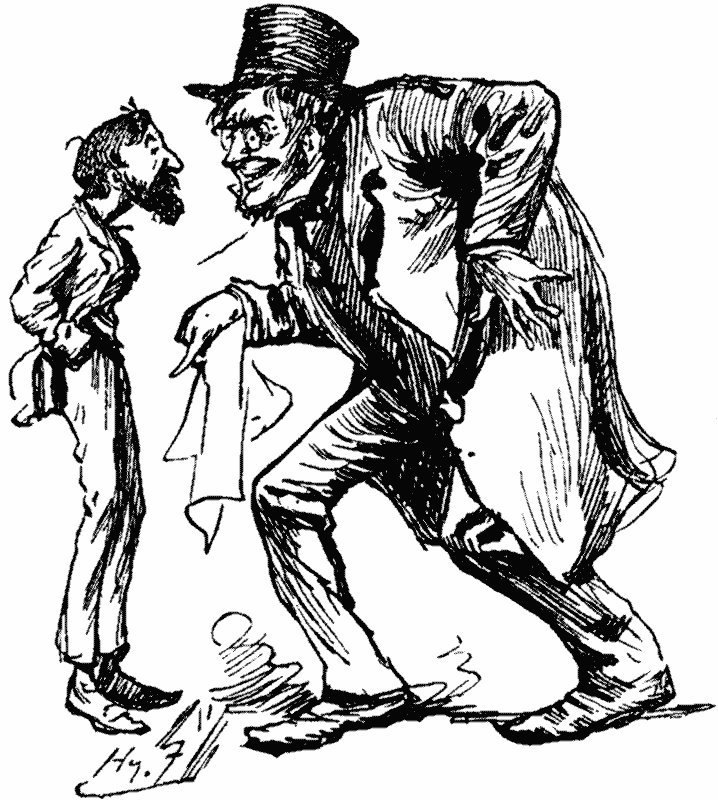
Sm-ll and B-gg-r.
Tuesday.—Lords had a real good afternoon's work. The Lord Chancellor (with his usual grace—rather suggestive of the pavan in the Gray's Inn Maske) took his seat at 4·30. Squabble about the Woman's Suffrage Bill, which, after being deferred for six months, had come up again—scowling. Lord Denman proposed "previous question," but Lord Chancellor (great tactician, but not great lawyer) suggested the matter should stand over until the next sitting. Reproach of "got no work to do" consequently removed from the Upper House.
Lords adjourned at Five o'Clock for a week, to recover from their exertions.
"Whist, bhoys, be aisy now," said Tim, in the Commons, when King-Harman was seen going to his dinner. Then came the deluge.
"It is grand, Sorr," said the only Home-Ruler who does not use an accent; "it is just illigant, Sorr; and it's myself is proud of this day."
Tim walked into the Under Secretary with "joy." He "scathed" him, and said all manner of things about him. He used, amongst other weapons his legal knowledge (Tim is a great authority upon all legal questions) to describe him as a "returned convict."
"Look at that now!" observed Joseph Gillis. "It's disgraceful that we should be ruled by a man who has assaulted the perlice!"
In the midst of the excitement King-Harman suddenly returned from his dinner. No doubt he had sacrificed, in his haste to defend himself, or rather, what the only Home-Ruler who does not use an accent calls his "Ka-rack-tare," from the aspersions of the "inimy," three courses, a dessert, to say nothing of a cup of coffee and a chasse. He drew a picture of being a lad of two-and-twenty when he assaulted the police at Cremorne. Would not Hon. Members of Home-Rule persuasion have done the same at that age? Indignant denial of the entire Home-Rule Party, who are horrified this suggestion! "Would they tread on the tail of anybody's coat? And at two-and-twenty? Look at that, now! Bedad! they would just like to get at the Under Secretary's head with a shillelagh for making such a suggestion."
And so the war was carried on, Tim's heart being at last softened by King-Harman declaring that he had saved him from ill-treatment at Dungannon at the hands of some gentlemen who wanted to show him "how to cheer for the Queen" with a stick. "I got hold of the men by the neck and hurled them back," cried King-Harman, unsuccessfully controlling his emotion, "and now he—he—he says I got into a ro—ow—ow at Cremorne."
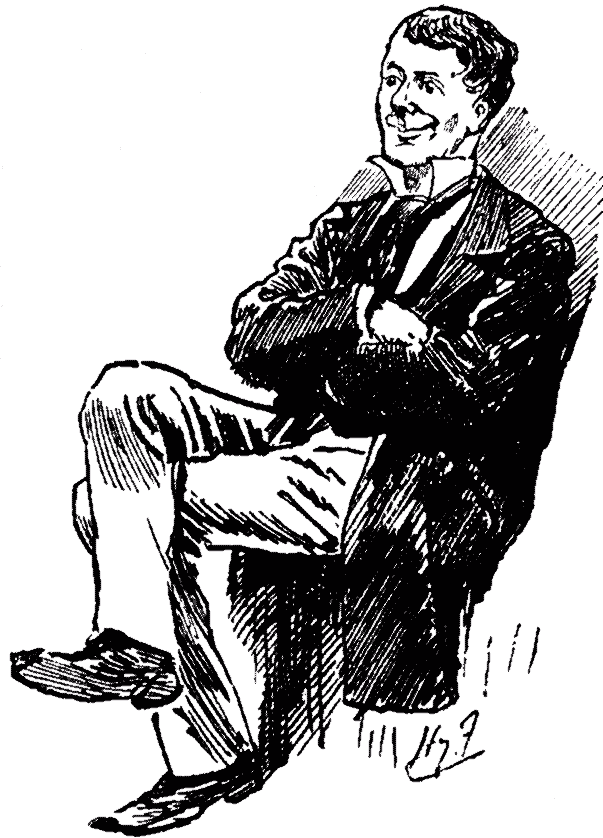
M-tth-ws.
"Craymorne, not Cremorne," shouted the Home-Rulers who are proud of accuracy.
And while all this excitement reigned around, the Home Secretary sat smiling, glad for once and away to be out of his customary hot corner. However, all passed off peacefully and no bones were broken.
Thursday.—House very thin during Question Time, and attendance of Ministerialists during the entire sitting very scanty, considering the programme. Then there was an incident. Incident came about this way. Dillon had been seen during hour allowed for Minister-baiting reading the huge print of an enormous green placard. First impression he had grown short-sighted, and required larger type; second, that he meant mischief. Second impression right one. So to raise the question of the proclamation of the Ennis County Clare Meeting he asked permission to move adjournment of debate. Speaker put it, were there requisite number of Members present ready to sanction a regular first-class, A 1, whack-where-you-will, go-as-you-please, Irish row? Speaker used more Parliamentary language than this, but that was about his meaning. Sixty Members sprang to their feet to testify their desire not to quarrel, but to uphold constitutional privileges in the most peaceable manner in the world. And then the row began.
Dillon had first shot. Meeting was to be of the most peaceful character. All that the boys wanted to do was to remind one another of their inalienable right to denounce the wanton and overbearing conduct of the Government. They would say this in the most illigant manner imaginable, without giving offence to anybody. He was going to speak to the boys himself, and so was Mr. William O'Brien, and so was Mr. Philip Stanhope. Sure, now, what harm could there be, especially as the meeting was not to be held in a part of the country that wanted pacifying? And because some rack-renting landlords, wild with fury, and shaking in their shoes with apprehension, asked for it to be proclaimed, it was to be! Could this be tolerated? No! He would be off that very evening to brave the bayonet, the buckshot, the battle and the breeze!
Balfour mildly remonstrating. Ennis, County Clare, best possible place in the world; but meeting might cause peasantry to lose the Arcadian innocence for which they are at present distinguished. Murmurs from Home-Rulers, and, later on, "outrage" by Phil Stanhope, who actually had the audacity to speak of Chief Secretary as a "whimsical and lackadaisical gentleman." The Speaker sprang to his feet, and sharply rebuked the outrager. Only fancy! Calling Arthur Balfour's manner whimsical! and lackadaisical! So monstrous! So blood-curdling! so untrue!
The usual gentlemen who patronise the "divarsion" having had their full share of the fun, the debate was brought to a conclusion. Then the gentlemen turned their attention to the remaining Irish Estimates, and enjoyed themselves until the next morning.
Friday and Saturday.—Sittings at this time of the year get so mixed, that they take two days to give a single date. Committee of the House as before; Irish Estimates as before; "illigant divarsion" as before. And so, half asleep, the remains of what, a few months ago, had been a self-respecting House of Commons continued its dreary Session.
Total for the Week.—Irish Business carried on in Irish manner, and Chamberlain booked for Canada.