Volume 93 — DRURY LANE WITH PLEASURE.
Reading edition
My Dear Mr. Punch,
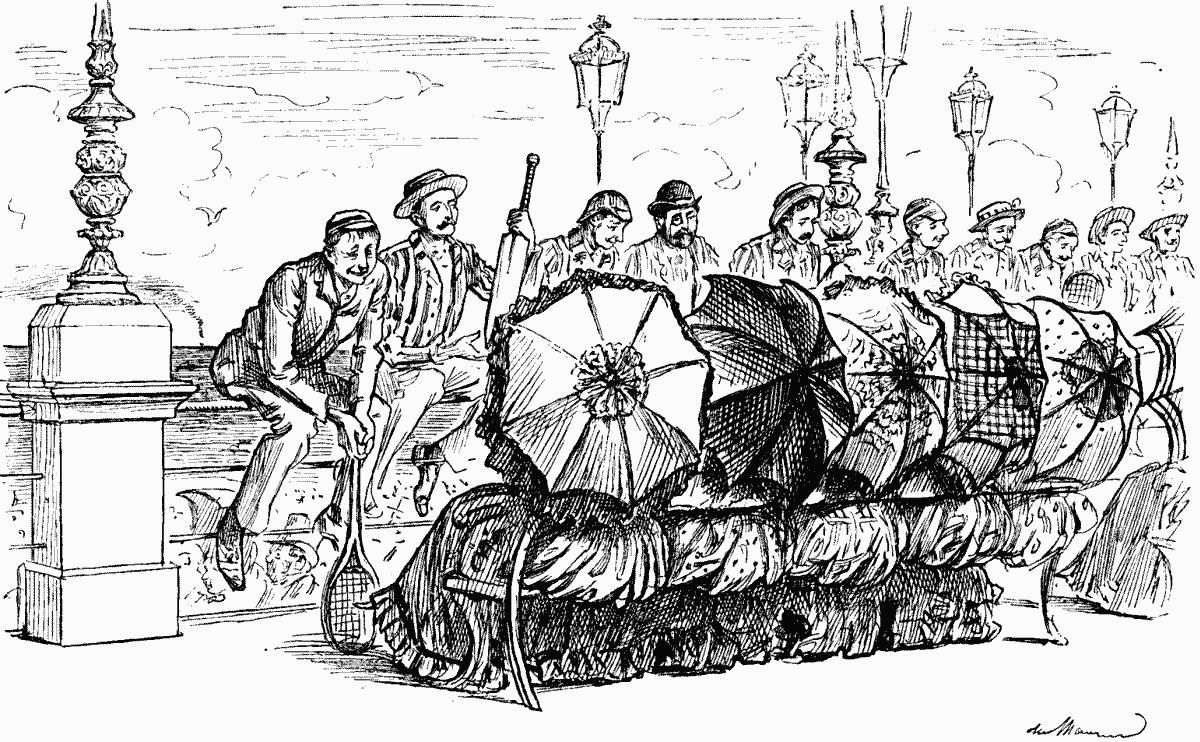
Pleasure Parties.
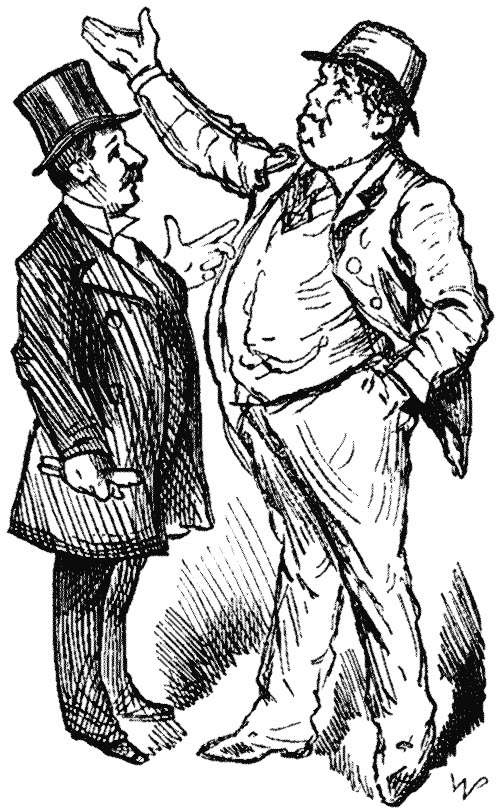
It was only what might have been expected that a large audience should assemble in the National Theatre to see the new piece by Messrs. Paul Merritt and Augustus Harris. The very title was inviting, and when to that title were added scenes in Oxford, Monte Carlo, Nice and Gloucestershire, who could refuse the invitation? Certainly not I. So I accepted, with pleasure, and was present at the initial performance. I refreshed my recollection of college life at Oxford where men certainly were not quite as serious as Mr. Jack Lovell, in the long since of the "fifties." I could not help regretting that the Oxford of thirty years ago had not the unconventional Mr. Nicholls amongst the Undergraduates. Had he been there at the period to which I refer, I undoubtedly should have sought the honour of his acquaintance, but on the condition that he did not introduce me to the aforesaid Jack Lovell, who on matriculating at Drury Lane was about as lively as a mute at a funeral. I was not at all surprised to find him rather out of sorts. Frankly, Mr. Jack Lovell in Pleasure is not a nice young man. He reads for the Church and gets plucked, as indeed he should, as he seems to have employed the time that he ought to have occupied in hard reading, in behaving in the most disgraceful manner to Miss Jessie Newland, otherwise the ever charming Miss Alma Murray. Very properly refused a family living, he succeeds to a peerage, and immediately publishes the story of his betrothed and refuses to marry her.
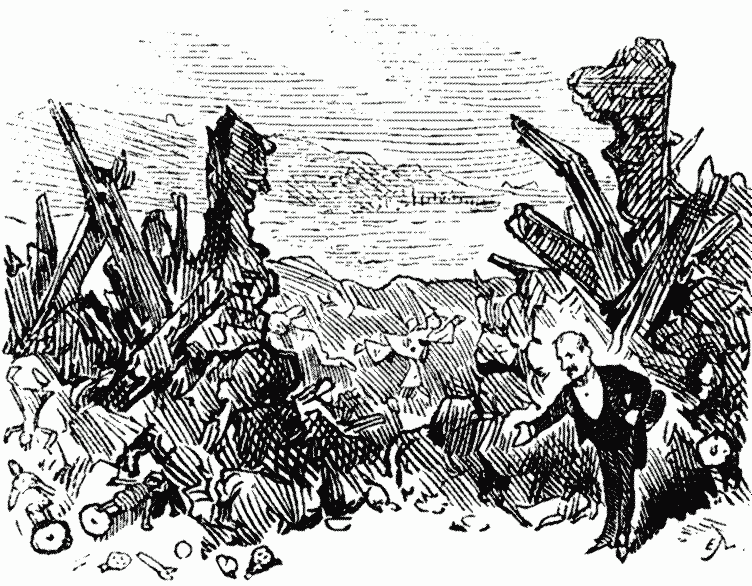
Bringing Down the House.
Personally, I must admit that I received with joy the news that he was drinking himself to death, and only felt the deepest regret when I learned that he had not perished in an admirably contrived Earthquake.
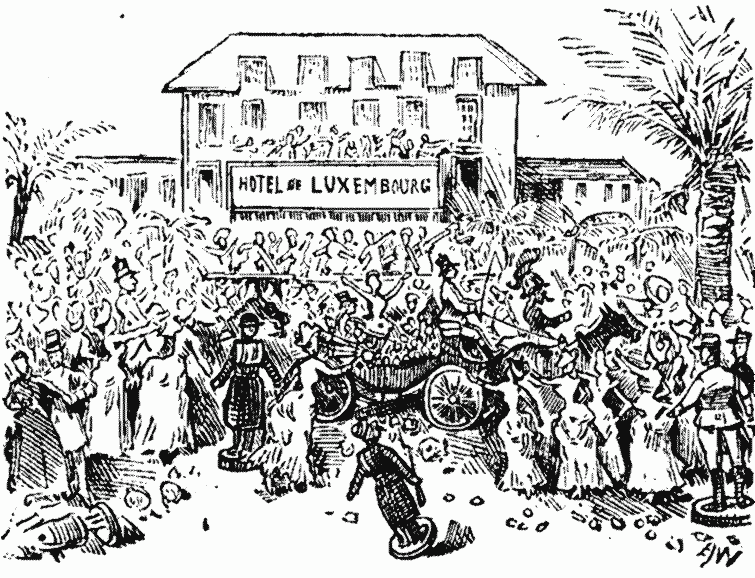
Sweets to the Sweet.
But, in spite of Mr. Jack Lovell, Oxford, at Drury Lane, contained a number of interesting persons. The Doddipotts, father and son, with their American relative (Miss Brough), were most amusing, and I was quite satisfied to accompany them to Nice and Monte Carlo, to see the Battle of Flowers, the Carnival Ball, and last, but not least, the Earthquake. This latter effect, in more senses than one, "brought down the house." In Pleasure the stage-management is excellent throughout, and, of the joint authorship of the piece, I think I may safely say that its chief merit lies in the name of Harris. Not a mythical "Harris," like unto the friend of Mrs. Gamp, but some one far more substantial, the great Augustus Druriolanus himself. Whether one is gazing upon the Sheldonian Theatre (the background to an Oxford Mixture of no common kind), or the Barges, or the Promenade des Anglais, or the Carnival Ball, the presence of an excellent master of effect is seen in every group, in every detail.
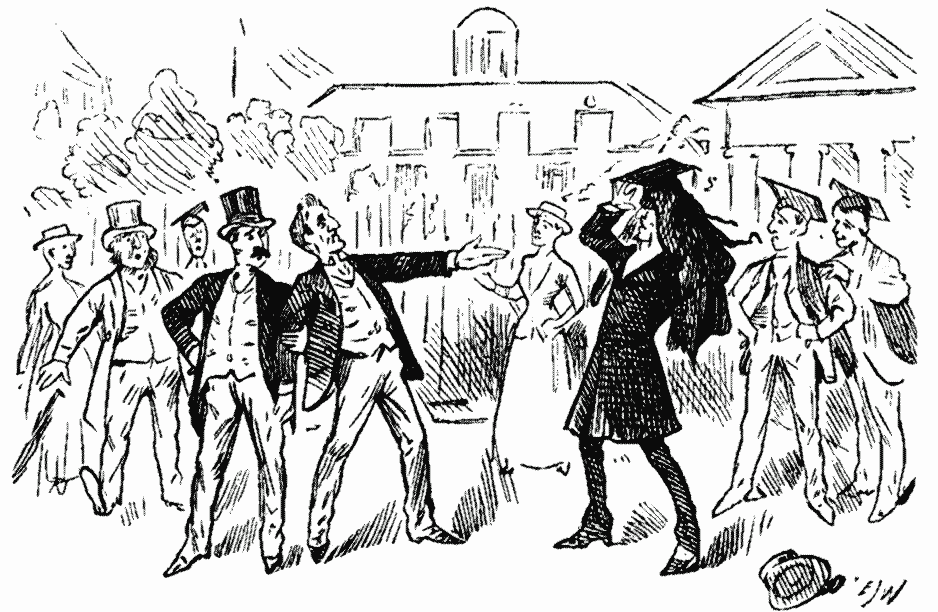
An Oxford Mixture.
Pleasure is described as a Comedy-Drama, and the plot is not, perhaps, as strong as some of its predecessors. As "strength" at a theatre invariably spells "murder" or "sudden death," I am not at all sure that this absence of the ultra-melodramatic is not to be welcomed, in spite of the taste for the horrible which is supposed to be the characteristic of those who patronise the pit and gallery. But what the People (with a capital initial letter) lose in the ghastly, they certainly gain in the beautiful. If the scenery at Drury Lane of the Riviera does not cause "Personally conducted tours" to be more numerously attended next year than ever, I shall be more than surprised—I shall be disappointed. Even the Earthquake should not be a deterrent, for as far as I could learn from "the incident" at Drury Lane, no one was a penny the worse for the shaking. Even the unworthy Lovell escaped—I fancy up the chimney. If this were so, it would only be in keeping with his character.
In the first Drury Lane success, The World (by the same authors as Pleasure), there was a wonderful clergyman, played by the late Mr. Ryder, whose cynicism was equal to his audacity. This strange ecclesiastic I remember, having sown an unusually large crop of wild oats in his youth, on his return from Evening Service in his middle age, imperiously refused to allow a lady to remain in his parish because she had once been deeply attached to him, and had loved him "not wisely, but too well." I shall never forget the dignified earnestness of the late Mr. Ryder as he explained to this lady his position as a married man, and sternly ordered her to move on. Had Mr. Jack Lovell been ordained, I fancy he would have made an excellent curate to this reverend gentleman, and that between them they would have formed what is satirically termed a "pretty pair."
It is possible that the original intention of the authors of Pleasure may have been to have conferred on the hero of their piece a Deanery, or even an Archbishopric, and that the recollection of this prior clerical creation may have influenced them to alter their contemplated Church patronage into a temporal peerage linked with twenty thousand a-year. Be this as it may, Jack and his prototype will rest in my memory as companion pictures, of what a clergyman might, could, would (but should not) be. The scenery and the admirable stage-management make Mr. Lovell and his doings bearable. They pull him through. For the rest, Pleasure is an amusing play, well mounted, and capitally acted, and should keep the boards until December brings to Drury Lane and a delighted world the Christmas Pantomime. On the first night all went well up to the end of the Fifth Act; but the last, after the excitement of the Riviera scenes, came as rather an anti-climax.—I beg to sign myself, in compliment to and emulation of the Earthquake,
One who had Gone to Pieces.
A Hint to the Howlers.
Betwixt Paddies who kick up wild hullabaloo, And rude Radical raffs who will play the Yahoo, There apparently is not a Tanner to choose; Though the Irishmen boast of the better excuse! Rads the Message of Peace will not hasten, I trow, By taking a hand in this Donnybrook row. To "trid on their coat-tails" is policy mad, But to help them to swing the shillelagh's as bad. To ape angry Pats in their weakness for fights, Is the very worst way to get Ireland her "rights."
An Address to Parliament.—Shut up!