Volume 93 — "GESTA GRAYORUM."
Reading edition
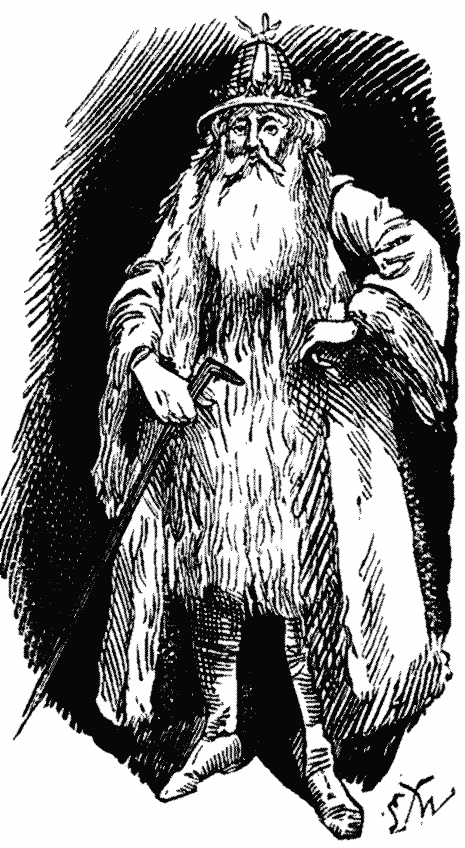
Embodiment of an Arthurian legend. The Master of the Revels.
The Times of Thursday last in a learned article on the Gray's Inn Masque, records that "On the 28th February 1587, eight members of the Society were engaged in the production of The Misfortunes of Arthur" but on the occasion of The Maske of Flowers in 1887, the Honourable Society of Gray's Inn showed what could be done with the Success of Arthur; that is, of Master Arthur W. à Beckett, Master of the Revels. And indeed what could be done in Old Gray's Inn, was on that occasion quite a Revel-ation to most of us. Mr. Punch heartily congratulates the Honourable Society of Gray's Inn on possessing such a Revel-Master—he ought at once to be created Lord Revel-stoker—who is able to give life and form to so excellent an idea, who can design such exquisite costumes, compose such appropriate music, paint such perfect scenery, and instruct amateur pupils in the arts of elocution, action, singing and dancing.
Mr. Punch is perfectly aware that the costumes were due to Mr. Lewis Wingfield's designs and Mr. Alias's workmanship, that the scenery was painted by the old stager John O'Connor, that the music was composed and arranged by Messrs. Prendergast and Birch-Reynardson, and that the dances were invented "with the assistance of MSS." (old English for "Master of the SeremonieS") and taught by the experienced Mr. D'Auban. But the lawyers of Gray's well know that "Qui facit per alium facit per se,"—and in the case of the costumes, Qui facit per Alias facit per se—and so with the merit of what Master Arthur W. à Beckett executes by his chosen agents he himself is to be credited. It was a great success, from first to last. Just one word at parting. Mr. Punch hopes that the Maske, as it is, is not to be reproduced on the public stage. Such a proceeding, by depriving it of its venerable and appropriate surroundings, would vulgarise an entertainment which should have remained, within the precincts of Gray's Inn, archaic and unique.
In Gray's Inn Hall.—Notes by a Very Ordinary Person.—Crushed. Difficulty with hat. That's why I dislike a Matinée, because you can't come in a crush hat. But you're sure to go away in a crush hat. Opera-hat in daytime looks so disreputable: suggestive of having been out all night. While hiding my hat, lost my book. Probably under lady's dress. No use trying for it. Band outside plays National Anthem, and a voice from a dark recess shouts out some word of command to the Beefeaters—(poor chaps, in this hot weather "the Overdone-Beefeaters"—fine-looking fellows with prime joints)—and then enter Royalties. Can't see them. They're seated. Enter, in front, tall young men in coloured tunics, knicker-bockers, and turn-down collars. What are these? The Backward Pupils of Gray's Inn? No. The Orchestra. It commences. There are fiddles, and basses, and a second-hand cracked piano, suggestive of having been hired from itinerant Minstrels on Margate Sands. My neighbour asks me if the band is "Coote and Tinney?" My reply is evident—"More Tinny than Coot." Neighbour informs me that the cracked piano is really a very old instrument, in use about the time of Queen Elizabeth. Exactly: just what I should have thought. The Benchers ought to have been rich enough by now to have bought a new one. When a thing is to be done, do it well. No cracked pianos. Not worth fourpence an hour.
Curtain up. Low arch representing entrance to Old Gray's Inn. Enter a Giant with a long white beard. I think he is Great Grandfather Christmas off Gog and Magog's twelfth-cake. He solemnly salutes the audience in military style. Why military? It suddenly occurs to me, "Is a Masque funny?" I ask my neighbour. He is uncertain. Evidently a cautious man; he will reserve his reply till he has seen it. Enter a Columbine, like "My Lady" used to be on a May Day. She talks to Great Grandfather Christmas, who seems frightened, and tries to back out of it. At present I don't quite catch the plot. Next neighbour says he doesn't think there is a plot. I ask him to look at his book. He says he is looking at it; but it's printed in some dialect he doesn't understand. Enter another Giant, dressed as a Jester. It appears that Great Grandfather Christmas has forgotten his part, or left it in the dressing-room, and the Giant Jester has kindly brought it him. No jokes as yet. No good lines. My neighbour says this is the sort of thing Queen Elizabeth liked. Did she! And the cracked piano, too, for music, which, on the exit of the Giants and the Columbine, comes out as strong as the poor old thing can when supported by violins and violoncellos.
Enter "Silenus and his Crew." I hear some one say this. Not a bit like a crew. Not a sailor among them. Perhaps as this is a Mask, they are sailors in disguise. Silenus is, of course, supposed to be intoxicated. If he is intended to represent an ugly old man, dismally drunk, and making painful efforts to catch a note, he succeeds, to the life. Not funny, but clever. Splendid pantomimic property in the shape of a gigantic tobacco-pipe, carried by an Indian. My neighbour says, "Old Elizabeth would have liked all this sort of thing." Poor dear! I pity her, I ask if Indian is to be taken as an advertisement for the Wild West? Neighbour replies, hesitatingly, that he knows the book has been altered from what it was three hundred years ago to suit the present time, so that perhaps I may be right. The cracked piano, which is having a hard day of it, breaks out into a lively measure. Red Shirt, Silenus, "and his crew" join in a dance, "Crew Junction"—but why not a hornpipe, if they're a crew?—and the Curtain descends on Part the First.
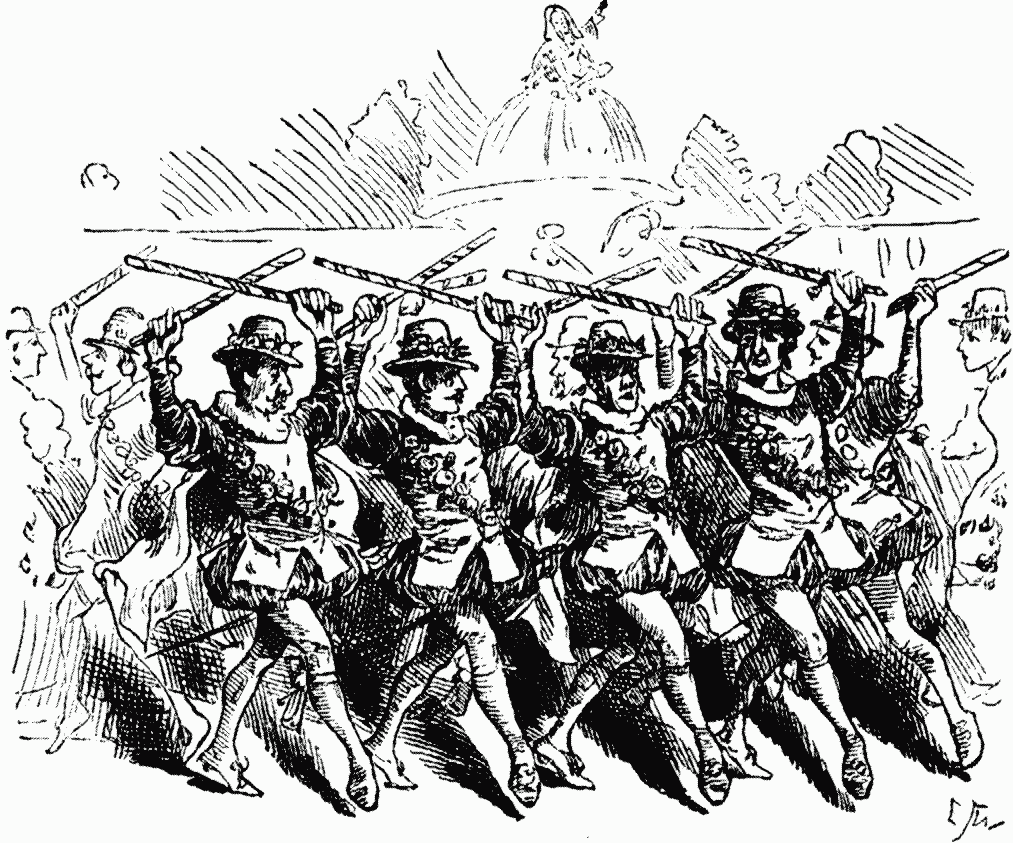
Limbs of the Law.
Part the Second.—Young Elizabethan Maidens in front of a bank of roses, and a fountain lighted up, as is the garden, with variegated lamps. "Figures look like Old Chelsea," my neighbour says. I return (because the variegated lamps and the illuminated fountains and the arbours appeal to bye-gone memories),—"Old Chelsea? Yes—Cremorne." Then the Maidens sing a dirge. Perhaps mourning, or Cre-morning, for the departure of lost glories. Then they open out gracefully, and discover the Columbine of Part the First with a lot of young men—(Oh!),—all seated together in the basin of the fountain. The young men in masks—(Aha!—now I see why this is called a Masque!—Now I am happy, whether Queen Elizabeth would have liked it or not!)—come out of the fountain, quite dry, rather unpolitely leaving poor Columbine still in the basin under the dripping water. Maids of the Inn can and do sing charmingly. The Masquers can and do dance. Plot no object. It's all elegant and graceful, but distinctly sad, as how can it be anything else to the accompaniment of that cracked piano, whose temporary absence must deprive Margate Sands of much harmless enjoyment. "They haven't smiled once," I say to my neighbour. "No more have I," he replies crustily, but then explains that Queen Elizabeth didn't like smiling unless she smiled first. The Masquing men are most anxious and attentive to their steps; the Ladies all delightful. Great applause. Encores. And during all this, the unfortunate Columbine remains sitting in the basin, with her feet in cold water, and her head apparently under a dripping douche. She must be of a most contented disposition, as whenever I catch sight of her she is smiling, somewhat vapidly it is true, but still smiling, and beating time on her knees, perhaps to keep herself as warm as possible in such a peculiarly damp situation.
The end is approaching: for the first time I notice some of the bolder Revellers begin to smile. At length re-enter the Giants, Great Grandfather Christmas & Co., and the Indians. They rescue Columbine from the fountain. Now I think I see the plot. I mention this to neighbour, triumphantly; but he says I mustn't talk while Royalty is leaving, as Elizabeth wouldn't like it. So we join in "God Save the Queen!" and it's all over. Exeunt omnes. Must get a book.