Volume 159 — PHILOSOPHERS.
Reading edition
We are all different, and often our differences are of the widest. Some men can be knocked prostrate by the most trifling disappointment, while others can extract comfort or even positive benefit from what looks like complete disaster—such as the Cambridge youth I met last week, raving about Turner's "Fighting Téméraire."
"But I didn't know you were interested in pictures," I said.
"Oh, yes, I've always been, in a way," he replied; "but it wasn't till the rain ruined the first day of the Varsity match that I ever had a real chance to get to the National Gallery, and when it came down like blazes again on Tuesday I went back there. Did you ever see such painting? And the pathos of it too! And then that frosty morning scene in the same room! Why, Turner was too wonderful."
How some of the other dampened enthusiasts tided over their loss I can only guess; but this ardent one reminded me of the Shipwrecked Entomologist, and I placed him on a niche somewhere near that radiant soul.
And who was he?
Well, he was the curator of his own department in some Indian museum—I think at Calcutta—and when the time came for his holiday he took a passage for Japan on a little tramp steamer. Everything went well until a few hours out of Shanghai, when a typhoon began to blow with terrific force. The ship was driven on the coast of Korea, where she set about breaking up, and only with the greatest difficulty did the passengers and crew get to shore, bruised and saturated, without anything but their clothes and what their pockets could hold. Some lives were lost, but my man was saved.
It was a desolate part, with nothing but the poorest huts for shelter, dirty and verminous, so that the discomforts of the land were almost equal to the perils of the sea.
Naturally, on his return to Calcutta the curator was plied with questions. How did be feel about it? Wasn't it an awful experience? If ever a man deserved sympathy it was he. And so forth. But he wouldn't rise.
"Sympathy?" he said. "Good Heavens! I don't want sympathy. Why, I had the time of my life. Do you know that during the night in that Korean hovel I found five absolutely new kinds of bug."
E.V.L.
"Notice to the public, that John ——, Toronto, will not be responsible for debts hereafter contracted by any one."—Canadian Paper.
Very sensible of him.
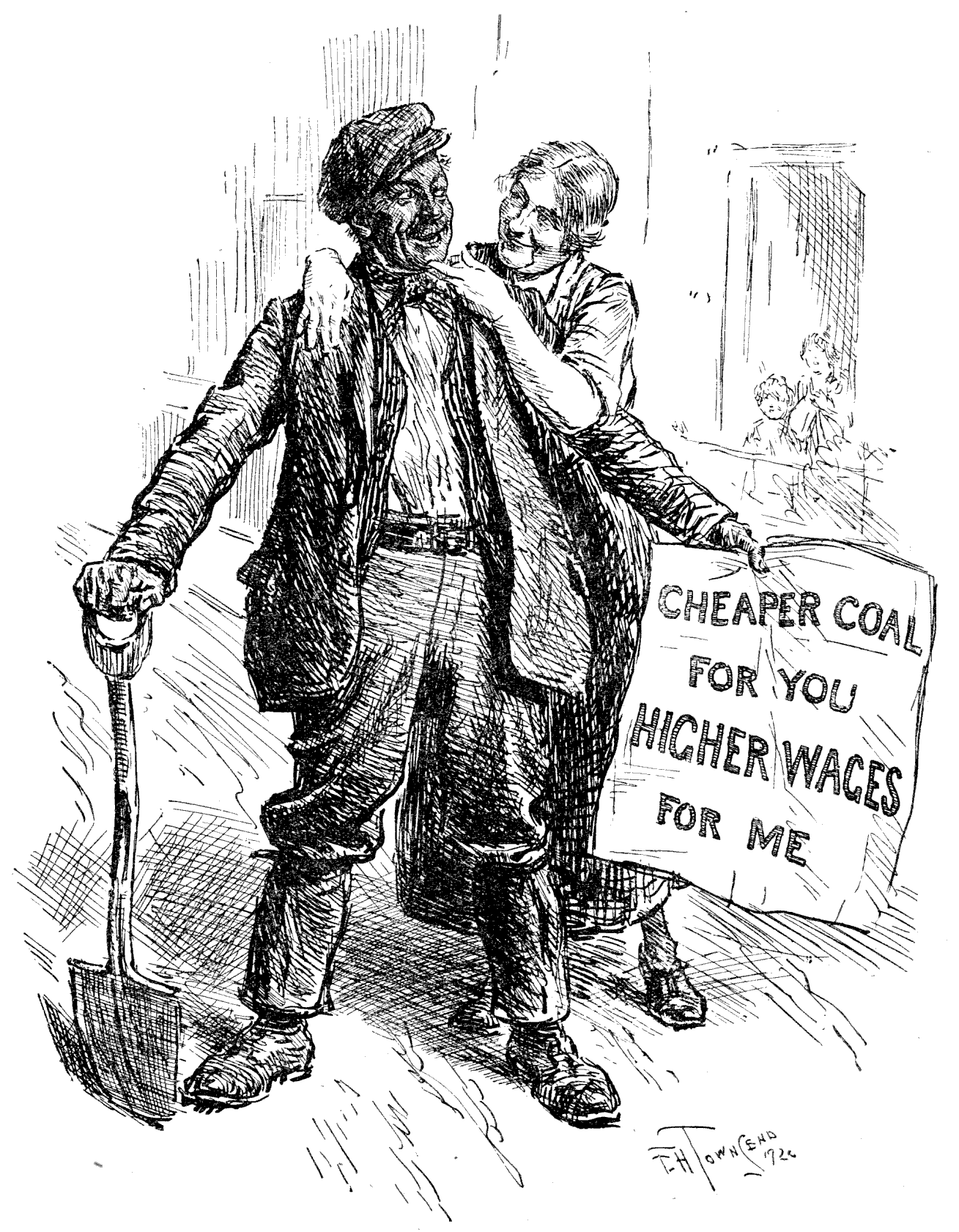
SUBJECT TO REVISION.
British Housewife. "DO YOU REALLY MEAN IT?"
Miner. "WELL, PART OF IT, ANYWAY."
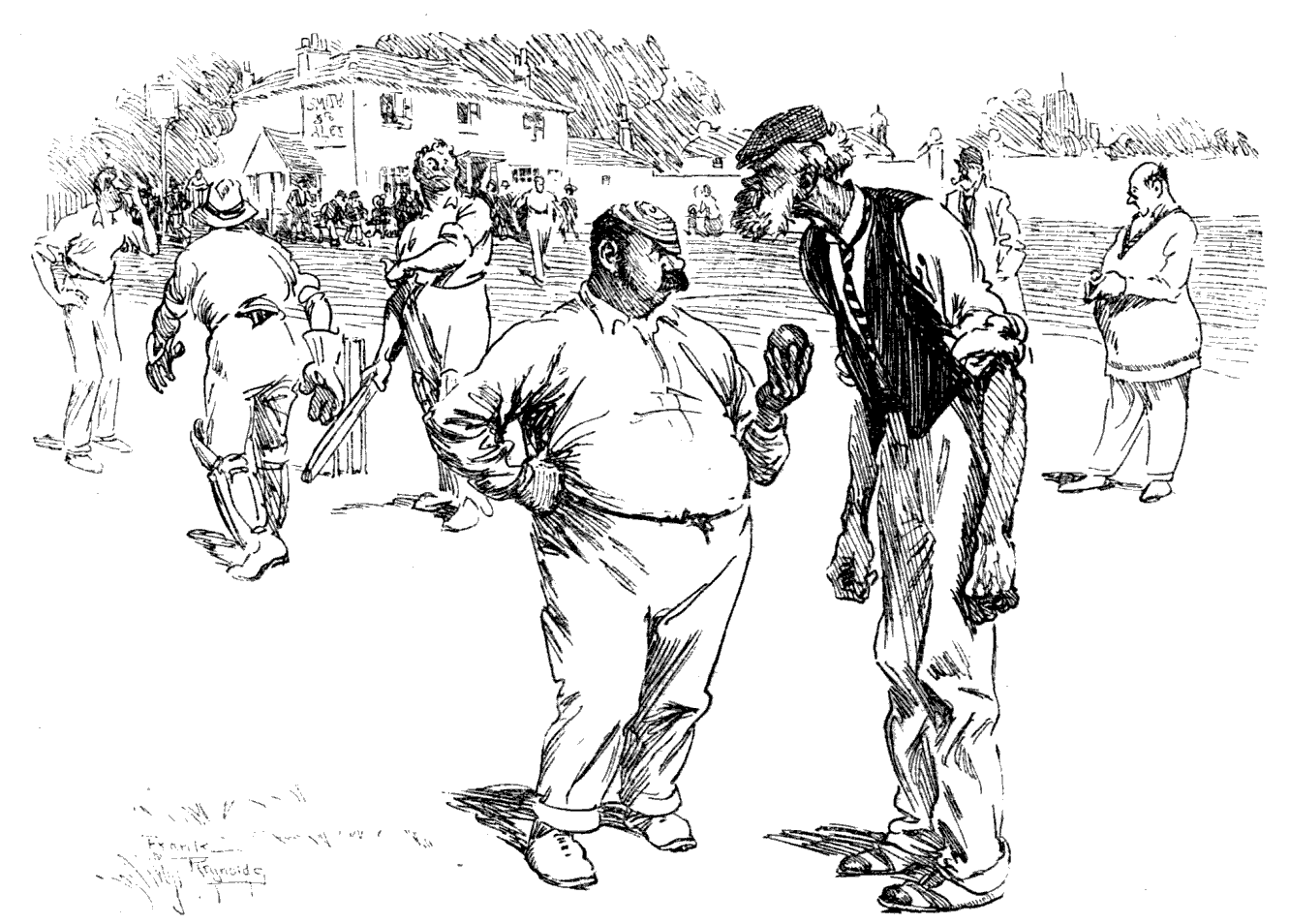
Captain (to very unsuccessful lob bowler). "Oi be sorry to 'ave to take 'ee off, Garge, but I must let the Vicar 'ave a go before the ball gets egg-shaped."
SANTAMINGOES.
A Fancy.
[The santamingo is a kind of Oriental bird believed by foolish sailor-men to confer on its possessor great content and peace of mind.]
East from the Mahanadi and north of the Nicobar You will come to Evening Island where the santamingoes are; Their wings are sunrise-orange and their tails are starlight-blue; You catch a santamingo and all your dreams come true. They've a crest of flaming scarlet and a purple-golden breast, And their voice is like all the music that ever you liked the best, And their eyes are like all the comfort that ever you hoped to find; You catch a santamingo and you'll get peace of mind. You won't find buried treasures, you won't get sudden luck, But things'll just go smoothly that used to get somehow stuck— The little things that matter, the trumpery things that please, You catch your santamingo and you're always sure of these. You don't get thrones and kingdoms, you don't turn great or good, But you know you're just in tune with things, you know you're understood, And wherever you chance to be is home and any old time's the best When you've got your santamingo to keep your heart at rest. If ever you've dreamed of a golden day when nothing at at all went wrong, Or a pal who'd want no tellings but would somehow just belong, Or a place that said, "I was made for you"—well, sailor-men tell you flat, You catch your santamingo and you'll find it all like that. * * * * * I've sailed from the Mahanadi to north of the Nicobar, But I can't find Evening Island where the santamingoes are, Though I've taken salt to put on their tails and all that a hunter should— Perhaps you can't really catch them; but don't you wish you could? H.B.
"Capitalist who will consider financing Canadian oil fields or will send English theologist to investigate property."—Daily Paper.
And do the clerical work, we suppose.
From a description of the V.C.'s at Buckingham Palace:—
"There were a sergeant-major arranged in nine separate groups, and an attempt had been made to get old comrades together as far as possible."—Provincial Paper.
The reassembling of the sergeant-major must have taken a bit of doing.