Volume 159 — HARDING AND COX.
Reading edition
(Being an inquiry into the two Candidates for the Presidency of the United States of America.)
I wish I knew some facts regarding The private life of Mr. Harding; I wish that I had simply stocks Of anecdotes of Mr. Cox. In U.S.A. (where both are resident And each one hoping to be President) Their favourite hymns, their size in boots, Their views on liquor and cheroots Are known to all; not Julius Cæsar Is quite so much renowned as these are. In England, where they do not dwell, No one appears to know them well. One cannot say if Cox's liver Keeps well upon the Swanee River, Nor whether Harding finds, when glum, Any relief in chewing gum. It may be that they both have good rows Of dental ornaments like Woodrow's, The waist of Taft, the Roosevelt eye For pinking hippopotami. It may be Harding had some flickers Of Cleveland's spirit whilst in knickers, And Cox while yet a puling babe Dreamed tiny dreams of Lincoln (Abe); And both, although they knew they'd catch it, Cut fruit-trees with a little hatchet; Both may have been, when glorious youths, Too proud to fight or tell untruths. I cannot say. I know they wrangle On points I dare not disentangle, That one of them's a Democrat And t' other's not. And that is that. Evoe.
GEE!
On the upper floors of a shop in the Strand, between Wellington Street and the Savoy, is a well-known maker of fowling-pieces, who gave me a terrible start the other day; and probably not me alone, but many passers-by who chanced to look upwards at his windows. For he is at the moment advertising the most undesirable article in the world, a commodity for which I can conceive of no demand whatever. Yet there—the result of the caprice of adhesive cement or the desire of one letter of the alphabet to get level with its neighbour and be dropped too—the amazing notice is, in conspicuous white enamel:—
SECOND HAND UNS.
The Domestic Problem Solved.
"A Lady wishes to meet with a gentleman or lady to share her home as sole paying guest; one with a hobby for gardening preferred; every home comfort; terms, £300 per annum."—Sunday Paper.
We are desirous of entertaining, on the same terms, a lady (or gentleman) with a penchant for cooking and washing-up.
"The Hindus and Mahomedans are the two eyes of India, but have long been engaged in a tug-of-war. On account of this cleavage both have suffered, but now the wall of separation is broken down, and they are coming together like sugar and milk, the bitter feelings between them having been pulled out like a thorn. They are advised to give up biting each other for the future."—Indian Paper.
Or our contemporary will have exhausted its stock of metaphors.
A STORY ABOUT A CLOCK.
Our move-in took place in no furtive or clandestine fashion; our installation of ourselves in our semi-detached was performed well under the eye of the neighbouring public. Our furniture waited on the public thoroughfare until our new home was ready to receive it. Small children played games on our sofa; enthusiastic acquaintances played tunes on our piano. In a word, our move-in was a local festival; everyone took part. This is the sad tale of the man who took the most expensive part—the clock.
If the hard choice had been put to Diana, my wife, to say which she could least sorrowfully part with, me or the clock, the clock would have stayed. If I had been put to the same dismal alternative as to Diana or the clock, Diana would have gone. In fact, directly the clock was safely in Diana had gone out. That was all she cared about; small children might play on the sofa, enthusiastic acquaintances might play on the piano, and I might toil unremittingly with everything else, for all Diana cared. So, the clock being in, out she went upon her lawful or unlawful purposes. As she departed she said something about my seeing to the clock. I remembered that later on, but I remembered it wrong. This is how I did it.
The man sat a little on my own special chair (at that time on the pavement) before he came in. I asked him what he was sitting there for. He got up and came inside. Then I asked him what he had come in for, and he said, "The clock." I looked at the clock and it had stopped. I gave it a shake, and it still stopped. He said it was no good shaking it; that only annoyed it. He said he had come to look after it. He then took off his hat and his coat, moved the fingers about, put his ears to it to hear its heart beating, and asked me what I had been doing to it. I said I hadn't been doing anything to it; he watched me doing things to everything else, and adopted an expression as if to say he didn't believe me. He gave me the feeling that I was a very interfering person, and that he didn't want to have anything more to do with me. He said he should have to take the clock away. I asked him when he would bring it back. He said he didn't know. He appeared to take a pessimistic view of it. I asked him cheerfully if he would ever bring it back. He gave me a contemptuous look and, without another word, went, taking the clock with him.
When Diana came back she asked where the clock was. I said it had gone. "Gone where?" asked Diana. I said I didn't know; the man had taken it. "What man?" asked Diana. I was trying to move the sofa at the moment and I was inclined to be short-spoken. I said that the man who had taken it was, no doubt, the man whom Diana had gone forth to find and bid take away our clock. Diana said that, if the man had said that she had said that he might take our clock away, the man was a liar. Had the man said that she had said he might take the clock away? The answer was in the negative.
Then the truth emerged. The man had stolen our clock. I had assisted the man to steal our clock, helping him to lift it off its perch and handing him his bowler hat as he left.
It all sounds incredible, doesn't it? But you will admit, I am sure, that it is a thing which could quite easily happen to anyone. Isn't it?
To be quite frank, I have improved the story a bit. The clock wasn't really stolen.
Was the man really taking it away to repair it? No; to tell you the truth he didn't actually take it away at all. In fact, I might as well own that no man ever came into the house while I was shifting the furniture in from the street. And, if you want to know, I never had a clock ... nor a wife ... nor a house.
The mere fact of my pretending that there are such things as semi-detacheds for people to move into these days ought to have put you wise from the start that the whole tale was a fabrication.
CURES WORTH MAKING.
(By our Medical Expert.)
The Times, in its daily summary of "News in Advertisements" recently called attention to the appeal of an invalided officer who "will be glad to give a hundred pounds to any doctor, nerve specialist or hospital that can cure him of occupation neurosis and writer's cramp." A careful study of other newspapers shows that offers of handsome remuneration for cures are not confined to those who have suffered from the War, but are made by civilians and officials of the highest position in public life. We append a few outstanding examples of the splendid opportunities now provided to psycho-pathological specialists:—
A Cabinet Minister of massive physique, perfect self-confidence and immovable determination, who has had varied experience in different business callings and (up to a certain point) unvarying success, offers five thousand pounds to any professor of deportment or member of the Old Nobility in reduced circumstances who will impart to him suavity of manner, tact and diplomatic courtesy, the lack of which constitutes the sole obstacle to his achieving immortality. If the instructor can succeed in making him (the Cabinet Minister) really beloved the honorarium will be doubled.
An Editor of thirty years' experience as a journalist, first-rate linguist, deeply versed in geography, Central European politics, etc., will give five hundred pounds to any mental specialist, registered or unregistered, who will cure him of an irresistible temptation on all occasions, with or without provocation, to utilise every incident, occurrence, calamity or disaster as a means of assailing and undermining the position of the Coalition Government in general and the Prime Minister in particular.
A Member of Parliament, formerly attached to one of His Majesty's services, is prepared to offer fifty pounds to any phrenologist who without inflicting undue pain will reduce or remove the Bump of Curiosity which at present impels him without rhyme or reason to bombard Ministers with irrelevant questions contrary to the public interest and calculated to produce the maximum amount of irritation even amongst Members who sit on the same side of the House.
A Peer of great wealth, striking physiognomy, affectionate disposition and wonderful general knowledge will pay the sum of twenty thousand pounds to any psychiatric practitioner who succeeds in eliminating from his system the microbe of filmolatry, the ravages of which have latterly threatened to infect his monumental mind with histrionic monomania highly deleterious to the best interests of the community.
A neo-Georgian poet, disciple of Freud, pacificist and vegetarian, will gladly pay five pounds to any psychopathic suggestionist who will extirpate from his subconsciousness the lingering relics of an antipathy to syncopated rhythms which retard his progress towards a complete mastery of the technique of amorphous bombination.
Another "Substitute."
"For the first time on record snow has fallen at Albany, Western Australia.
The Food Ministry announces that this surplus will therefore be available for home jam-making."—Provincial Paper.
"The Roman poets, all of them inveterate Cockneys, talk of the joys of the country, of purling streams and lowing kine and frisking lamps."—Weekly Paper.
And their verses occasionally smell of them.
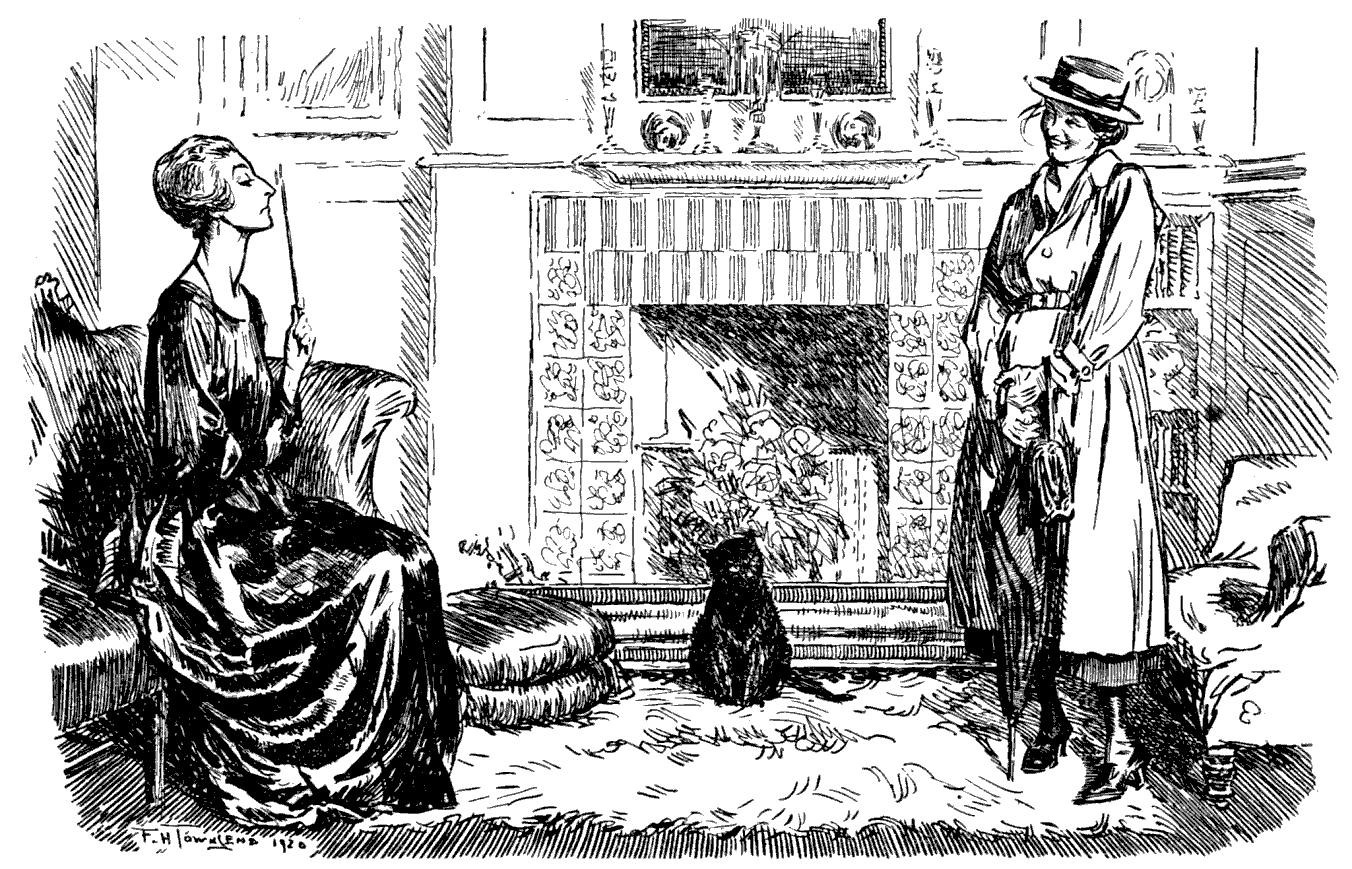
Prospective Mistress. "Are you a consistently early riser?"
Maid. "Not arf! Why, Mum, in my last place the master's pet name for me was 'the early worm.'"