Volume 159 — HEART OF MINE.
Reading edition
(Being a rather hysterical contribution from our Analytical Novelist.)
Friday.—I suppose one never realises till one is actually dead how nearly dead one can be without actually being it. You see what I mean? No. Well, how blithely, how recklessly one rollicks through life, fondly believing that one is in the best of health, in the prime of condition, and all the time one is the unconscious victim of some fatal infirmity or disease. I mean, take my own case. I went to see my doctor in order to be cured of hay fever. He examined my heart. He made me take off my shirt. He hammered my chest; he rapped my ribs with his knuckles to see if they sounded hollow. I don't know why he did this, but I think he was at one time attached to a detective and has got into the habit of looking for secret passages and false panels and so on.
Anyhow, he suspected my chest, and he listened at it for so long that any miscreant who had been concealed in it would have had to give himself away by coughing or blowing his nose.
After a long time he said, "Your heart's dilated. You want a complete rest. Don't work. Don't smoke. Don't drink. Don't eat. Don't do anything. Take plenty of exercise. Sit perfectly still. Don't mope. Don't rush about. Take this before and after every meal. Only don't have any meals." I laughed at him. I knew my heart was perfectly sound, much sounder than most men's. I went home. I didn't even have the prescription made up.
Saturday.—Now comes the tragic thing. That very night I realised that he was right. There is something wrong with my heart. It is too long. It is too wide. It is too thick. It is out of place. It would be difficult to say exactly where the measurements are wrong, but one has a sort of sense ... you know?... One can feel that it is too large.... A swollen feeling.... Somehow I never felt this before; I never even felt that it was there ... but now I always know that it is there—trying to get out.... I put my hand on it and can feel it definitely expanding—like a football bladder. Sometimes I think it wants to get out at my collar-bone; sometimes I think it will blow out under my bottom rib; sometimes some other way. It is terrible....
I have had the prescription made up.
Sunday.—The way it beats! Sometimes very fast and heavy and emphatic, like a bad barrage of 5.9's. Fortunately my watch has a second-hand, so that I can time it—forty-five to the half-minute, ninety-five to the full minute. Then I know that the end is very near; everyone knows that the normal rate for a healthy adult heart is seventy-two. Then sometimes it goes very slow, very dignified and faint, as when some great steamer glides in at slow speed to her anchorage, and the engines thump in a subdued and profound manner very far away, or as when at night the solemn tread of some huge policeman is heard, remote and soft and dilated—I mean dilatory, or as when—But you see what I mean.
Monday.—How was it, I wonder, that all this was hidden from me for so long? And now what am I to do? I am a doomed man. With a heart like this I cannot last long. I have resigned my clubs; I have given up my work. I can think of nothing but this dull pain, this heavy throbbing at my side. My work—ha! Yesterday I met another young doctor at tea. He asked me if there was any "murmur." I said I did not know—no one had told me. But after tea I went away and listened. Yes, there was a murmur; I could hear it plainly. I told the young doctor. He said that murmurs were not considered so important nowadays. What matters is "the reaction of the heart to work." By that test I am doomed indeed. But the murmur is better.
Tuesday.—I have told Anton Gregorovitch Gregorski. He says he has a heart too.
Wednesday.—I have been learning things to-day. I am worse even than the doctor thought. In a reference book in the dining-room there is a medical dictionary. It says: "Dilatation leads to dropsy, shortness of breath and blueness of the face." I have got some of those already. I have never seen a face so blue. It is like the sea in the early morning.
Thursday.—The heart is bigger again to-day—about an inch each way. The weight of it is terrible to carry.... I have to take taxis.... This evening it was going at thirty-two to the minute....
Friday.—Last night, when I tried to count the beats, I could not find it.... It must have stopped.... Anton Gregorovitch says it is the end.... This is my last entry....
Saturday.—My face is very blue. It is like a forget-me-not ... it is like a volume of Hansard....
I shall go to see the doctor as I promised ... he can do nothing, but it will interest him to see how much bigger the heart has grown in the last few days....
No more....
Sunday.—The doctor said it was much better.... It is undilated again.... After all I am not going to die. But the reaction to work is still bad. This evening I make it sixty to the minute....
Monday.—This morning's count was seventy-two. It is terrible....
A.P.H.
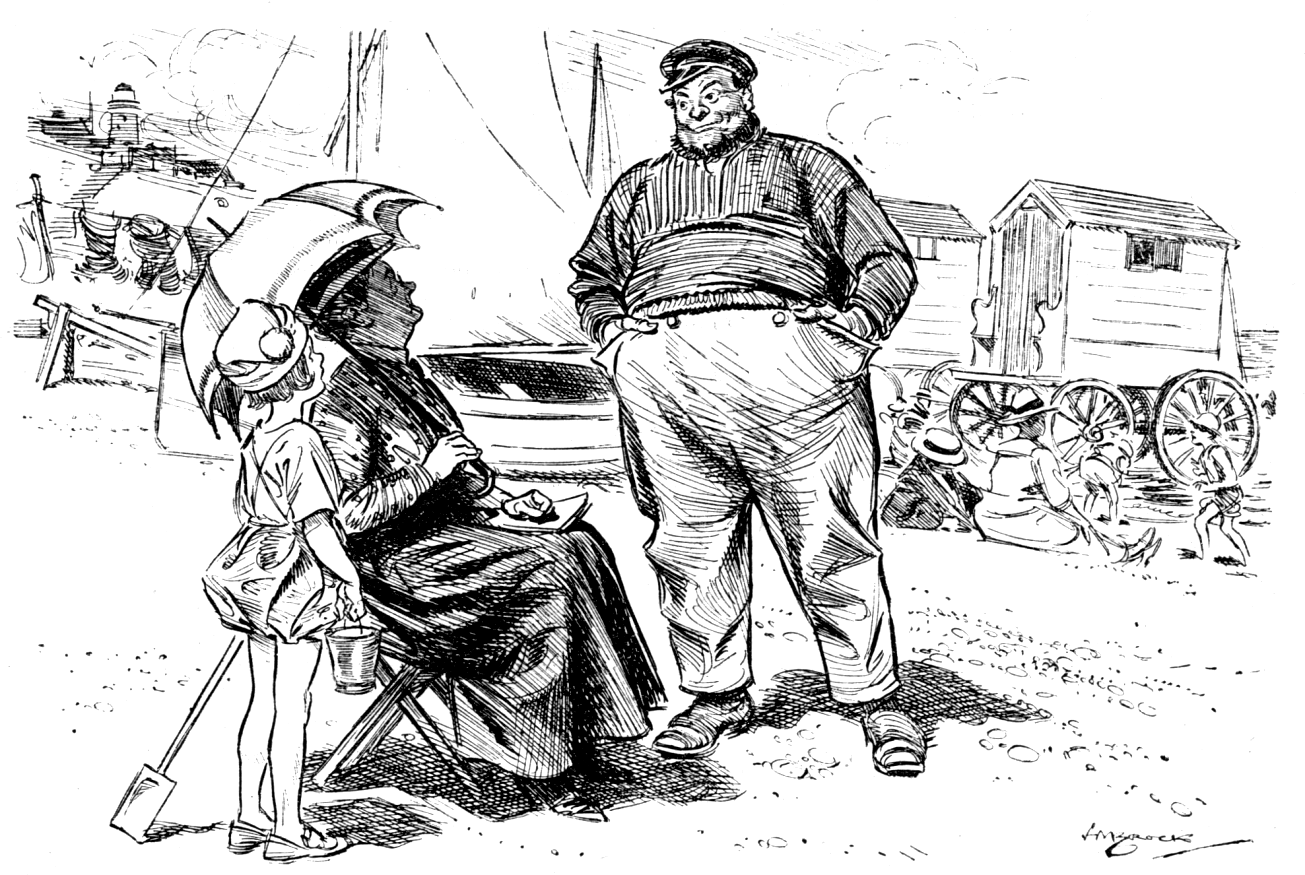
Sympathetic Old Lady. "And when you went down for the third time the whole of your past life of course flashed before your eyes?"
Longshore Billy. "I expect it did, Mum, but I 'ad 'em shut at the time, so I missed it."
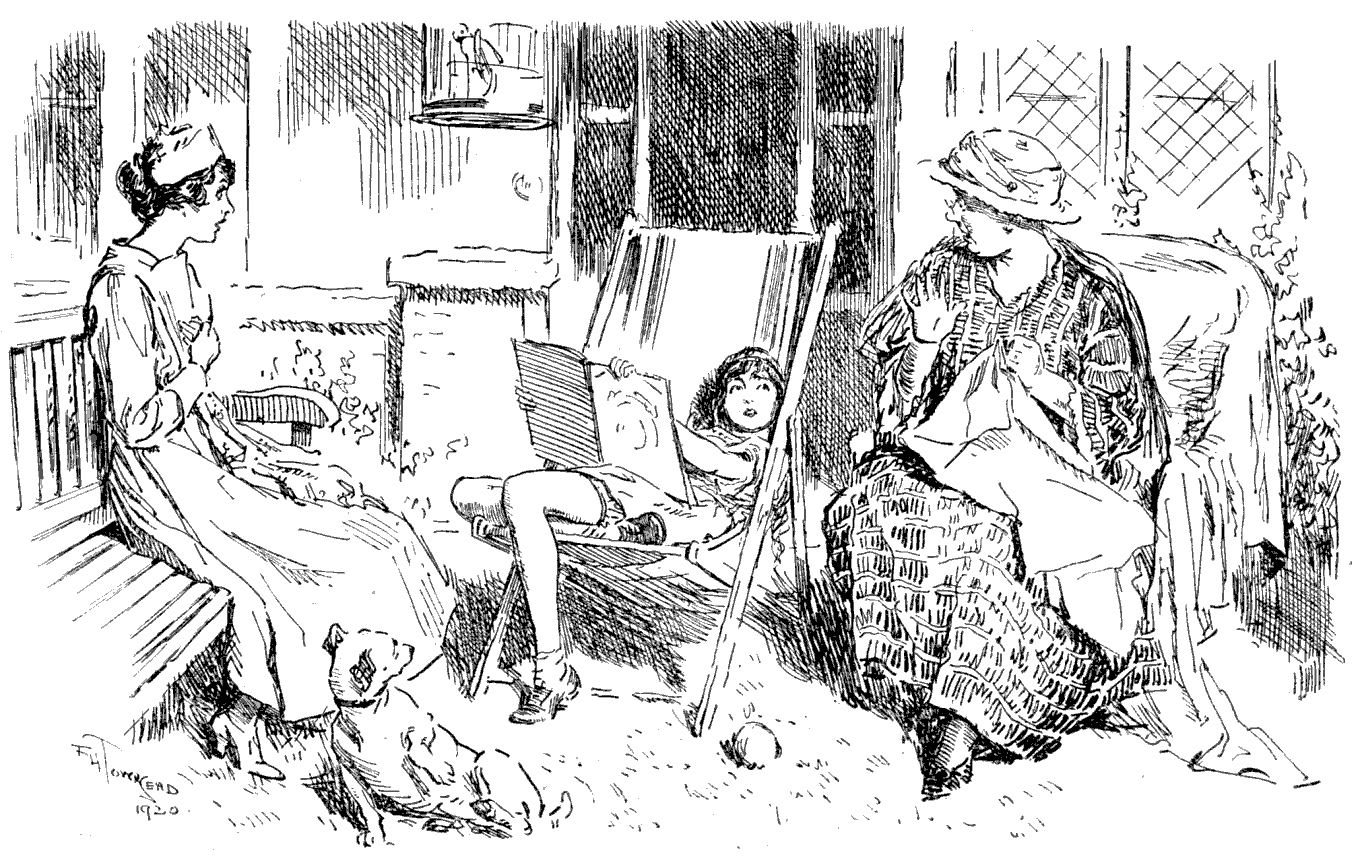
Mollie. "Auntie, don't cats go to heaven?"
Auntie. "No, my dear. Didn't you hear the Vicar say at the Children's Service that animals hadn't souls and therefore could not go to heaven?"
Mollie. "Where do they get the strings for the harps, then?"
FLOWERS' NAMES.
Shepherd's Purse. There was a silly shepherd lived out at Taunton Dene (Hey-nonny-nonny-no for Taunton in the summer!) And oh, but he was bitter cold! and oh, but he was mean! The maidens vowed a bitterer had never yet been seen At Taunton in the summer. He lived to gather in the gold—he loved to hear it chink (Hey-nonny-nonny-no for Taunton in the summer!), And he could only dream of gold—of gold could only think; And all the fairies watched him, and they watched him with a wink At Taunton in the summer. At last one summer noonday, when the sky was blue and deep (Hey-nonny-nonny-no for Taunton in the summer!), They made him heavy-headed as he watched beside his sheep And all the little Taunton elves came stealing out to peep At Taunton in the summer. They opened wide his wallet and they stole the coins away (Hey-nonny-nonny-no for Taunton in the summer!), They took the round gold pieces and they used them for their play, They rolled and chased and tumbled them and lost them in the hay At Taunton in the summer. And when they'd finished playing they used all their magic powers (Hey-nonny-nonny-no for Taunton in the summer!); The silly shepherd woke and wept, he sought his gold for hours, And all he found was drifts and drifts of tiny greenish flowers At Taunton in the summer.
More Work for His Majesty's Judges.
"Potato disease has unfortunately made its appearance in the —— district, the early and second early crops being seriously attacked. The late crops are free from disease up to the present, and it is hoped by judicial spraying to save them."—Local Paper.
From an interview with the Superintendent of Regent's Park:—
"'People seem surprised,' he said, 'when I tell them that within a few minutes' walk of Baker Street Station, and the incessant din of Marylebone Road, such birds as the cuckoo, flycatcher, robin and wren have reared their young.'"—Observer.
To hear of the cuckoo bringing up its own family in any circumstances was, we confess, a little bit of a shock.
"'Idling, my dear fellow!' was Mr. Jerome K. Jerome's decisive answer to my question: 'What do you most like doing at holiday-time?'
'But if, and only when, I am really driven to exertion, let me have a horse between my legs, a pair of oars, and a billiard-table, and I ask nothing more of the gods.'"—Answers.
The next time Mr. Jerome indulges in this performance may we be there to see.
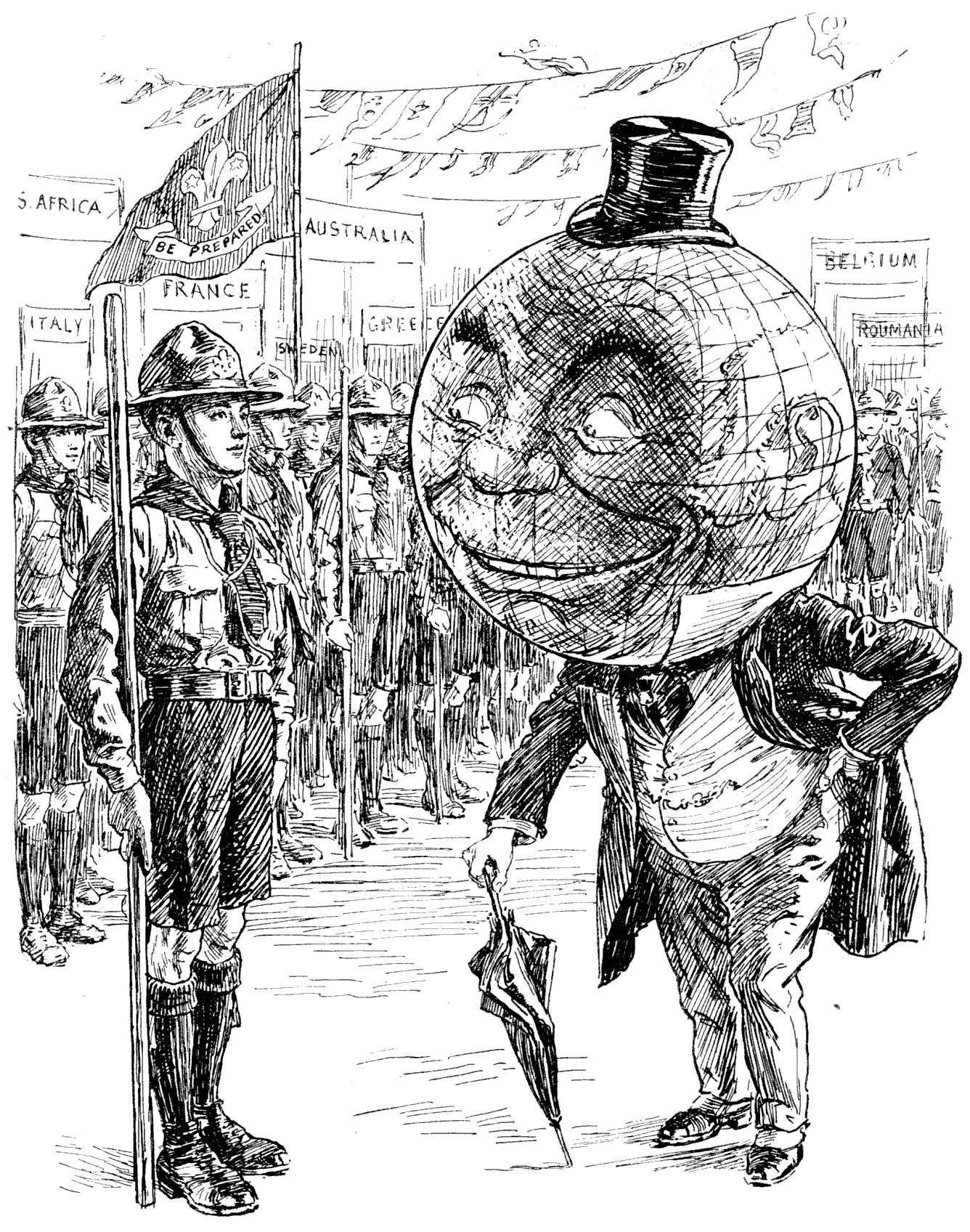
THE LEAGUE OF YOUTH.
War-weary World (at the Jamboree). "I WAS NEARLY LOSING HOPE, BUT THE SIGHT OF ALL YOU BOYS GIVES IT BACK TO ME."