Volume 159 — A VICTIM OF FASHION.
Reading edition
Like everybody else that one knows, Kidger is an ex-service man. During the last year of that war on the Continent some time ago he had the acting rank of captain, as second in command of a six-mangle army laundry.
When I knew him in pre-war days he was an amiable character, with only two serious weaknesses. One of these was an exaggerated fastidiousness about clothes, and the other an undue deference to the dicta of the Press. A leader in The Tailor and Cutter would make him thoughtful for days. This fatal concern about clothing amounted to a mania where neckwear was concerned.
In pre-war days he wore the ordinary single, perpendicular variety of collar, with sharp turn-over points, starched and white to match his shirts.
Before leaving England to join his laundry, Kidger, with a magnificent gesture, abandoned his fine collection of collars to his aunt, bidding her convert them to some patriotic end. The fond lady, however, fearing lest anything should befall her nephew if a hot sector of the line moved up to the laundry, preserved them carefully, and Kidger was very glad to reclaim them on his demobilisation.
One unfortunate day Kidger's morning paper contained one of those Fashions for Men columns, where he learned that the best people were wearing only soft collars, as they couldn't stand being cooped up in starch after the freedom of uniform. Kidger felt that as an ex-army man it was up to him to maintain any military tradition, and he immediately bought several dozen, soft white collars with long sharp points. The fellow in the shop said they were correct.
A week later another expert mentioned in print that no man who had any self-respect wore collars with sharp corners.
Kidger is not a manual worker. He reduced his cigarette allowance and bought some round-cornered ones, white as before. And then his aunt directed the poor fellow's attention to a paragraph by an authority signing himself "The Colonel," which stated that none but the profiteer was wearing white collars, and that you might know the man who had done his bit by the fact that he wore a blue one with slightly rounded corners, accompanied by a self-coloured tie of a darker shade, tied in a neat butterfly bow.
This was a blow to Kidger, but he resigned from his golf club and laid in some haberdashery in accordance with "The Colonel's" orders. Recommendations would be too mild a word. I saw the paragraph—most peremptory.
But in a rival paper "Brigadier" mentioned only three days later that none but the most noxious bounder and tout would be found dead in a blue collar with a white shirt. Kidger saw the truth of this at once; he had receptivity if not intuition. After a trying interview with his banker he bought several blue shirts.
Then the General who contributes "Sartorial Tips" to several leading journals remarked that, since all kinds of people were wearing coloured shirts and collars, the man who desired to retain or achieve that touch of distinction which means so much must at any cost wear white ones; and that, further, Society was frowning on the slovenly unstarched neck-wear of the relapsed temporary gentleman.
Kidger began to show signs of neurasthenia. His stock of pre-war collars was exhausted, or rather eroded. His faithful aunt, however, remembered a neglected birthday and gave him a dozen new ones, of the up-and-down model, to save Kidger's delicate neck. These, with his nice butterfly-bow ties, looked really well, and Kidger recovered his old form.
I warned him to keep to the police and Parliamentary news in the papers, but his eyes would wander. The result was that he learned from "Brigade Major" that the wearing of a butterfly bow with a double event collar was a solecism past forgiveness or repentance, and that its smart appearance was the deadly bait which caught the miserable bumpkin who ignorantly fancied that a man could dress by the light of nature.
Kidger collapsed. His aunt volunteered to sell her annuity and help him, but the innate nobility of the man forbade him to accept this useless sacrifice.
His medical attendant tells me that he is now allowed to read only poetry, wearing a sweater meanwhile, and that arrangements are being made for him to join a sheep-farming cousin in Patagonia, where collars are despised and newspapers invariably out of date.
W.K.H.
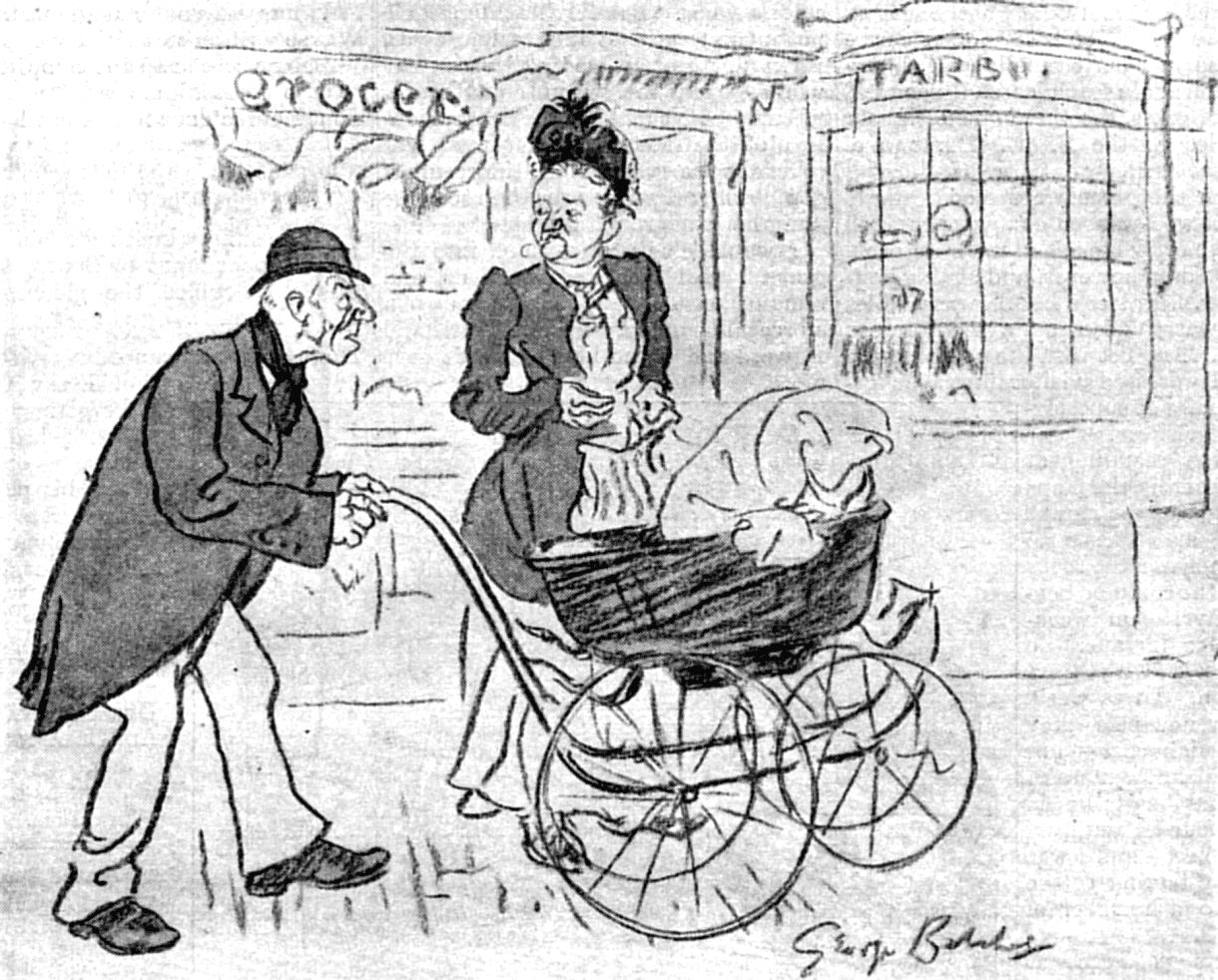
She. "I told 'ee to grease the wheels afore we come out."
He. "It be as much as I can do to keep up with it as 'tis."
A Superfluous Announcement.
"The Government have found it impossible to proceed with the Government of Ireland before the Autumn Session."—Daily Paper.
"Clerk (Junior) Wanted for Spinners' Office, age 1617.—Yorkshire Paper.
"Junior," we take it, is a misprint.
EDWARD AND THE B.O.F.
It was the first Sunday of the season, and the select end of Folkesbourne revealed in each carefully curled geranium leaf, in each carefully-combed blade of grass, the thought and labour expended by the B.O.F. (Borough of Folkesbourne).
Upon the greensward stood orderly rows of well-washed chairs, each with B.O.F. neatly stencilled upon its back. On this day, however, and at this hour (12.30 p.m.) scarce a B.O.F. was visible; each was hidden by a well-dressed visitor. And between the orderly rows of well-dressed visitors paraded orderly pairs of superbly-dressed visitors.
I was standing at the corner by the steps leading to the lower parade and thence to the beach and the rocks where the common people (myself on week-days, for instance) go to paddle with their children. I was wearing my new pale-grey suit which cost—but you will know more or less what it cost; I need not labour an unpleasant subject—and I was actually talking at the time to a member of the B.O.F.
"This is Peace at last," he was saying; "the place really begins to look—"
It was at this moment that Edward appeared. His route was the very centre of the lawn. He was wearing a battered Panama hat, a much-darned brownish jersey, and his nether man—or rather boy, for Edward's years are but four—was encased in paddling drawers made of the same material as a sponge-bag. Black sand-shoes completed his outfit, and a broken shrimping-net trailed behind him. At the moment when Edward first caught my horrified eye a particularly well-groomed young gentleman of about his own age caught Edward's eye in turn. Edward paused to survey this silken wonder with interest. Then, as if prompted thereto by the sight, he snatched off his hat and, casting it upon the ground, kicked it vigorously across the grass.
The removal of the hat was the last straw, for Edward's hair is provocatively red. My friend of the B.O.F. advanced towards him with the intention of exerting authority and restoring discipline. Edward turned at the sound of a stern voice. Possibly he might have put out his tongue—you never know with Edward. But, what was worse, far worse, he saw me. With a glad cry of "Daddy" he rushed to me and, regardless of the fact that his front was covered with green slime, the result of going ventre à pierre over the rocks, he flung his arms round my legs.
I would gladly have sunk into the ground. All eyes were upon us, and remained, as I felt, upon me, even when a breathless nursery-maid had retrieved Edward and borne him seawards once more.
One especially I had noticed, a very superbly dressed female visitor who had paused to witness the whole scene and was now resuming her promenade. I dreaded the comment which I felt I should overhear as she passed me—"What a horrible child!" it would be at the very least. But women are strangely unaccountable, even in so highly civilised an atmosphere as this. I distinctly heard her say, "What a darling!"
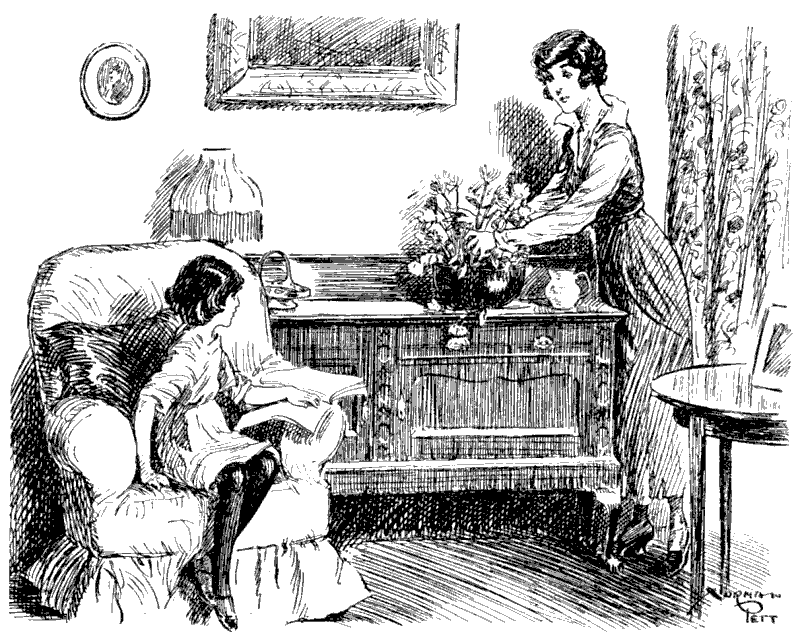
Mother. "It is very naughty to tell untruths, Kitty. Those who do so never get to Heaven."
Kitty. "Didn't you ever tell an untruth, Mummy?"
Mother. "No, dear—never."
Kitty. "Well, you'll be fearfully lonely, won't you, with only George Washington?"
The Horrors of Peace.
"Wanted.—Boy for Butchering, about 15 years old."—Local Paper.
Extract from a solicitor's letter:—
"The sale of the above premises is now nearing completion and we expect to have the conveyance ready for execution in the course of a short period the length of which depends to some extent upon how soon we can obtain the execution of the Bishop."
NEO-TOPICS.
There was a young neo-Delane Whose writing was frequently sane; But the name of Lloyd George So uplifted his gorge That it threatened to swallow his brain. There was an adored neo-Queen Who ruled the whole world on the screen; She simply knocked spots Off poor Mary of Scots, But she doubled the gloom of our Dean. There was an advanced neo-Georgian, Or perhaps we should say Georgy-Porgian, When asked to declare What his principles were, He invariably answered, "Pro-Borgian." There was a great neo-Art critic Whose style was extremely mephitic; He treated van Gogh And Cézanne as dead dog, And John as a growth parasitic.
Our Bloated Pluralists.
"Wanted, Organist. Small country church. Salary £20. Good lodgings. (Could be held with post of Milker on Manor Farm; permanent work; Sundays free; ample salary.)"—Church Times.
"The Grimsby trawler Silurian has towed Sir George Grahame, Minister Plenipotentiary in Paris, to be his Majesty's Ambassador Extraordinary and Plenipotentiary to the King of the Belgians."—Provincial Paper.
We really think the Government might have provided him with a torpedo-boat.
"The one thing which the Cabinet does not intend to do is to authorise the proclamation of marital law. It would engage far too many troops."—Provincial Paper.
The Irish girls are so attractive.
"A friend of mine bought from a bookseller who was also, oddly enough, a bibliophile himself, a copy of Arnold's very rare book, The Strayed Revetter, by A. He gave 6d. It is worth £5."—Book Post.
Surely more than that!
"An Ipswichomnibus pushed its bonnet through the window of a millinery shop."—Daily Paper.
This intelligent animal (believed to be the female of the Brontosaurus) was probably seeking a change of headgear.
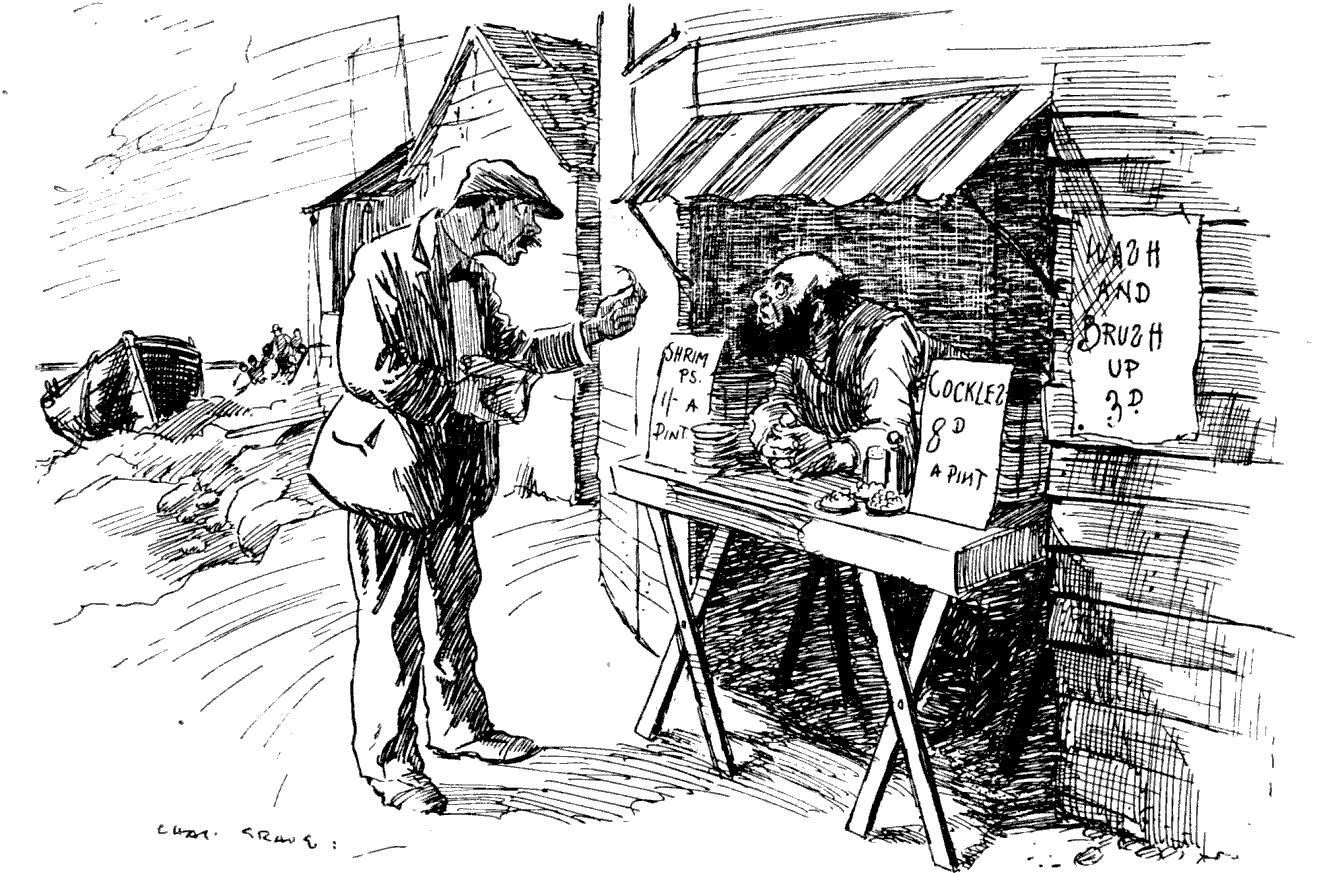
Tripper. "I've a bloomin' good mind to report you for profiteering."
Old Salt. "What yer talkin' about?"
Tripper. "Well, them shrimps I bought off you. One of em's got only one eye."