Volume 159 — WHAT TO DO WITH OUR BOYS.
Reading edition
As a sufferer from the prevailing complaint, house-famine, I have started a Correspondence Bureau, ostensibly for advising parents as to the pursuits their offspring should take up, but really for propaganda purposes, the object being the assuagement of this terrible evil.
Consequently my replies to inquiries are all moulded to this end.
For instance, one mother wrote from Surbiton:—
"My second son, Algernon, wishes to become a house and estate agent. Do please tell me if you think this quite a fitting avocation for one whose father is a member of the Stock Exchange."
I replied, "Quite. There is no nobler, and incidentally there are few more lucrative occupations outside Bradford, unless it be that of a builder, in which the scope is absolutely unlimited. I am enclosing a copy of last week's Builder and Architect, in which you will find some great thoughts expressed. Pray let Algernon read it. It may be the means of inducing him to perform great deeds for England's sake."
Another fond parent wrote:—
"Can you advise an anxious mother as to a career for her only son, John William? He is at present eight and a-half years old, has blue eyes and fair hair and is a perfect darling, so good and obedient, but he is firmly resolved to be a lift-man when he grows up."
I answered her soothingly thus:—
"John Willie is rather young to have made a final decision, I think. Let his youthful aspirations run through the usual stages, liftman, engine-driver, bus-conductor, sailor, etc. At fifteen or so he will have left these behind, and for the next few years will probably settle down to the idea of being nothing in particular, or else a professional cricketer. Then he will suddenly, for good or evil, make his choice. Neither his blue eyes nor his fair hair give any clue as to what that choice will be, but I should let him keep both, as they may be useful to him.
"If he should determine upon a career involving manual work, I should take steps to have him initiated into the Art and Mystery of Bricklaying. At the rate we are moving the working-hours would probably be about eight per week, with approximately eight pounds per day salary, by the time he arrives at bricklaying maturity.
"It is difficult to say yet whether he would have to graduate in Commerce before being eligible, but probably it would be necessary, as the best bricklayers, I'm told, always carry a mortar-board, and there is a sort of caucus in these plummy professions nowadays that is anxious to keep outsiders from joining their ranks. But the country needs bricklayers, and will go on needing them for years. Let John Willie step forward when he is old enough."
To the mother who asked if I considered that her youngest boy would be well advised to adopt the Housebreaking profession I wrote:—
"To which part of this profession do you refer? If to the Burgling branch I would ask, 'Has he the iron nerve, the indomitable will, above all has he the brain power for this exacting craft? Can he stand the exposure to the night air, the exposure before an Assize jury, and the rigours of the Portland stone quarries?' If so, let him take a course of illustrated lectures at the cinema.
"If you refer to the other branch, the mere pulling down of houses, I say, 'No! A thousand times, no!' He should be taught that there is a crying need for a constructive, not a destructive policy. Let him adopt one; buy him drawing-paper and a tee-square at once, and teach him that the noblest work of creation is (unless it be a bricklayer or builder) an architect. Though the War is over we must still keep the home fires burning. This implies chimneys, and chimneys imply houses, and few there be that can plan houses that will both please the eye and pass the local authorities."
Lady Jubb wrote from Toffley Hall, Blankshire, to say that her elder son (seventeen) had no ideas for the future beyond becoming Master of the Barchester when he grew up, but that she was anxious that he should try for some more lucrative post, official preferred.
I replied thus:—
"So your son looks no higher than a Mastership of Foxhounds. Well, well, I suppose that so long as there are such things as hounds he, as well as another, may take on the job of Master.
"But I thoroughly approve of your desire that he should try for something higher in life, especially for some official post; and what official post is or can be superior to that of a Borough Surveyor? Can you not persuade him that this great office is what one chooses to make it, and that, as an autocrat, the M.F.H. is hardly to be compared to the B.S., for, whereas the former can at the most scorch the few people foolish enough to remain within ear-shot, the latter can with a breath damn a whole row of houses and blast the careers of an army of builders with a word."
And so the propaganda proceeds.
If my efforts result in even one house being erected I shall, I think, have earned my O.B.E., though I would rather have the house.
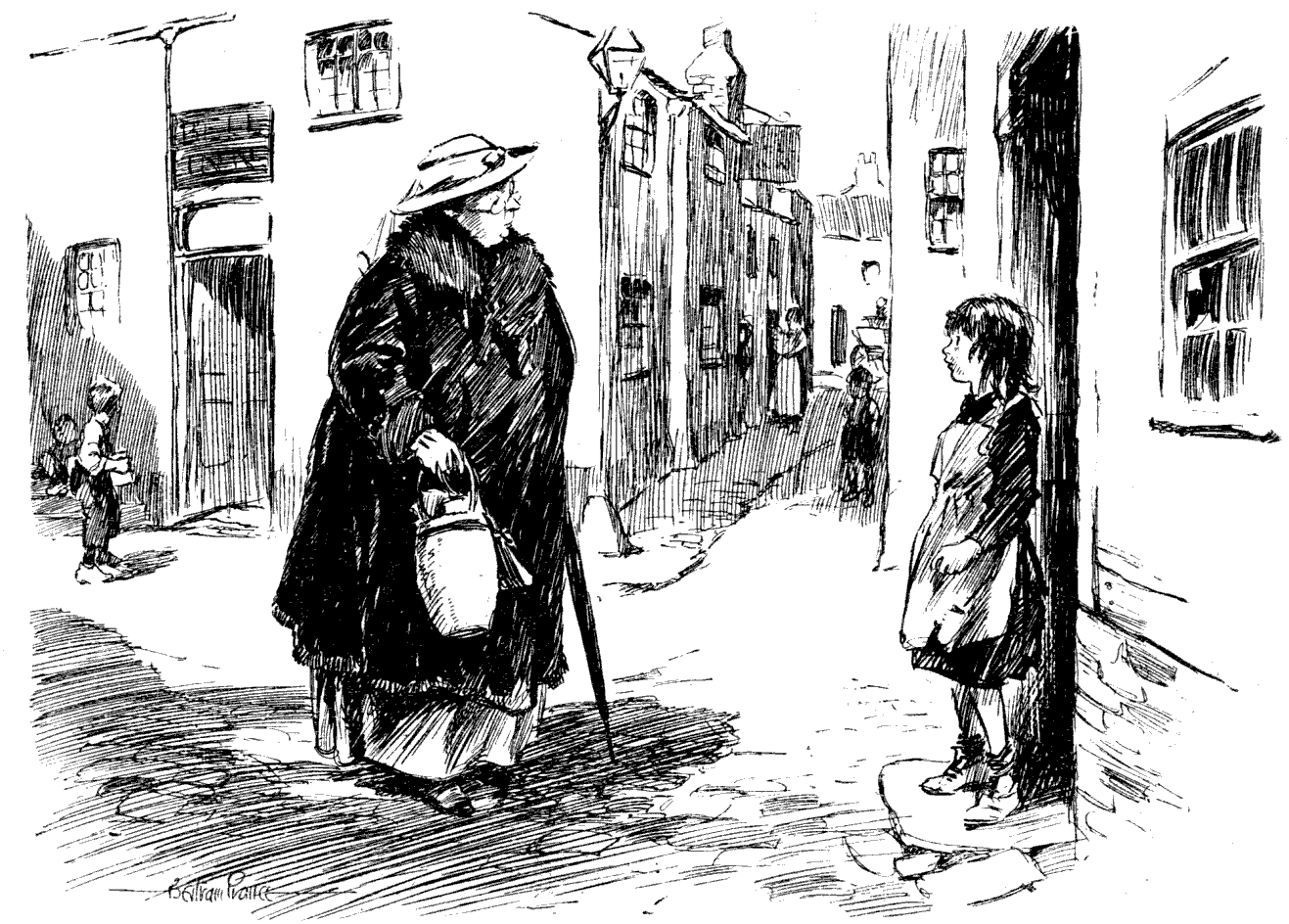
My Lady Bountiful. "So your mother is better through taking the quinine I gave her?"
Little Girl (doing her best to carry out instructions). "Yes'm. But she says she's worse of the complaint wot you gives 'er port wine for."
THE TERRITORIAL.
Oh, civil life is fine and free, with no one to obey, No sergeants shouting, "Show a leg!" or "Double up!" all day; No buttons to be polished, no army boots to wear, And nobody to tick you off because you grow your hair. It's great to sleep beneath a roof that keeps the rain outside, To eat a daintier kind of grub than quarter-blokes provide, To rise o' mornings when you wish and when you wish turn in, To shirk a shave and never hear the truth about your chin; And not to have to pad the hoof through blazing sun or rain, Intent on getting nowhere and foot-slogging back again, To realise no N.C.O. has any more the right To rob you of your beauty-sleep with "Guard to-morrow night!" All this is great, of course it is, yet here we are once more Obeying sergeants just for fun and cheerier than before; We haven't any good excuse, we've got no war to win— But nothing's touched the kit-bag yet for packing troubles in. W.K.H.
A TASTE OF AUTHORITY.
I have often wished I were an expert at something. How I envy the man who, before ordering a suit of clothes from his tailor, seizes the proffered sample of cloth and tugs at it in a knowledgable manner, smells it at close quarters with deep inhalations and finally, if he is very brave, pulls out a thread and ignites it with a match. Whereupon the tailor, abashed and discomfited, produces for the lucky expert from the interior of his premises that choice bale of pre-war quality which he was keeping for his own use.
I confided this yearning of mine to Rottenbury the other evening. Rottenbury is a man of the world and might, I thought, be able to help me.
"My dear fellow," he said, "in these days of specialisation one has to be brought up in the business to be an expert in anything, whether cloth or canaries or bathroom tiling. Knowledge of this kind is not gained in a moment."
"Can you help me?" I asked.
"As regards tea, I can," he replied. "Jorkins over there is in the tea business. If you like I'll get him to put you up to the tricks of tea-tasting."
"I should be awfully glad if you would," said I. "We never get any decent tea at home."
Jorkins appeared to be a man of direct and efficient character. I saw Rottenbury speak to him and the next moment he was at my elbow.
"Watch me carefully," said Jorkins, "and listen to what I say. Take a little leaf into the palm of your left hand. Rub it lightly with the fingers and gaze earnestly thus. Apply your nose and snuff up strongly. Pick out a strand and bite through the leaf slowly with the front teeth, thus. Just after biting pass the tip of the tongue behind the front teeth and along the palate, completing the act of deglutition. Sorry I must go now. Good day."
Now I felt I was on the right track. I practised the thing a few times before a glass, paying special attention to the far-away poetical look which Jorkins wore during the operation.
At the tea-shop the man behind the counter willingly showed me numbers of teas. I snatched a handful of that which he specially recommended and began the ceremony. I took a little into the palm of my left-hand and gazed at it earnestly; I rubbed it lightly with my fingers; I picked up a strand and bit through the leaf slowly with the front teeth. Just after biting I passed the tongue behind the front teeth and along the palate, completing the act of deglutition.
So far as I could judge it was very good tea, but it would never do to accept the first sample offered; I must let the shopman see that he was up against one of the mandarins of the trade. So I said with severity, "Please don't show me any more common stuff; I want the best you have."
The man looked at me curiously and I saw his face twitching; he was evidently about to speak.
"Kindly refrain from expostulating," I went on; "content yourself with showing me your finest blend."
He went away to the back of the shop, muttering; clearly he recognised defeat, for when he returned he carried a small chest.
"Try this," said he, and I knew that he was boiling with baffled rage.
I took a handful and once more went through the whole ceremony. It was nauseating, but the man was obviously impressed. At the conclusion of my performance I assumed a look of satisfaction. "Give me five pounds of that," said I with the air of a conqueror.
Next time I met Rottenbury I told him of my success.
"Oh, Jorkins put you up to the trick, did he?"
"He did. He taught me to titillate, to triturate, to masticate, to deglute—everything."
"And with what result?"
"With the result that I have in my possession five pounds of the finest tea that the greatest experts have blended from the combined products of Assam and China."
"Tea?" he asked.
"Yes, tea of course. You didn't suppose that I was talking of oysters?"
"Did I tell you Jorkins was a tea-taster?"
"Yes."
"Well, then, he's not. He's in tobacco."
"Alured," said my wife, "I wish you wouldn't buy things for the house. That tea is low-grade sweepings."
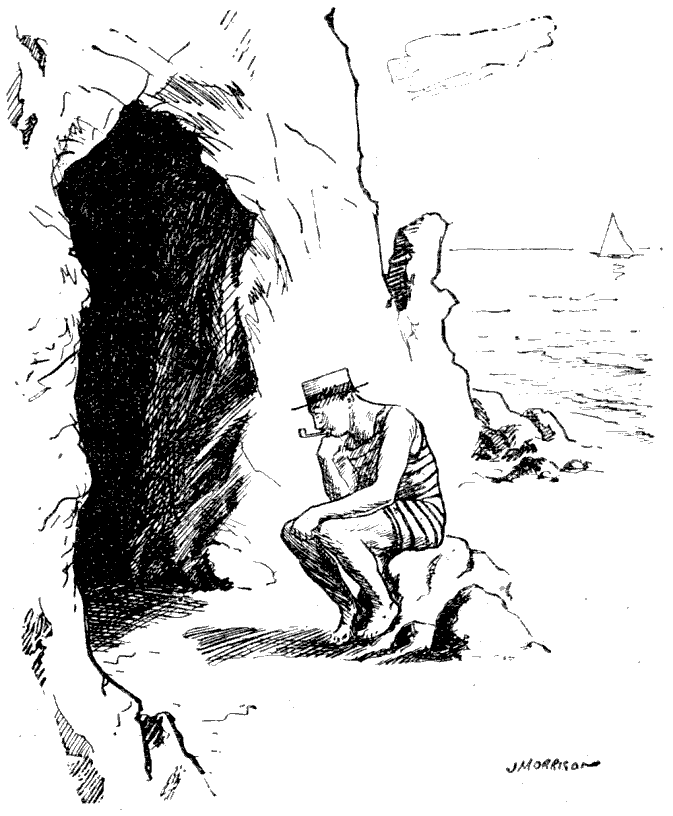
LE GRAND PENSEUR.
(With apologies to the late Auguste Rodin.)
Advertising enthusiast on his holiday seeking inspiration for a new advertisement for the Underground Railway.
"Sir Otto Beit has returned to London from South Africa, where he turned the first sot of the new university."—Daily Paper.
Turned him out, we trust.
"In a brilliant peroration the Prime Minister warned his hearers that a nation was known by its soul and not by its asses."—South African Paper.
Yet some of our politicians seem to think that England is not past braying for.
"The doings (or rather sayings!) in the Legislature we are watching with sympathy and some impatience, much as a bachelor bears with the gambling of children who come to the drawing-room for an hour before dinner."—Weekly Paper.
And the worst of it is that the Legislature is gambling with our money.
"Miss ——, director of natural science studies at Newnham College, Oxford, will preside."—Daily Paper.
We are glad to hear of this new women's college at Oxford, but surely they might have chosen a more original name for it.
A.G.J. writes: "Your picture of 'Come unto these Yellow Sands' in the number for August 4th explains for the first time the obscure following line, 'The Wild Waves Whist.'"
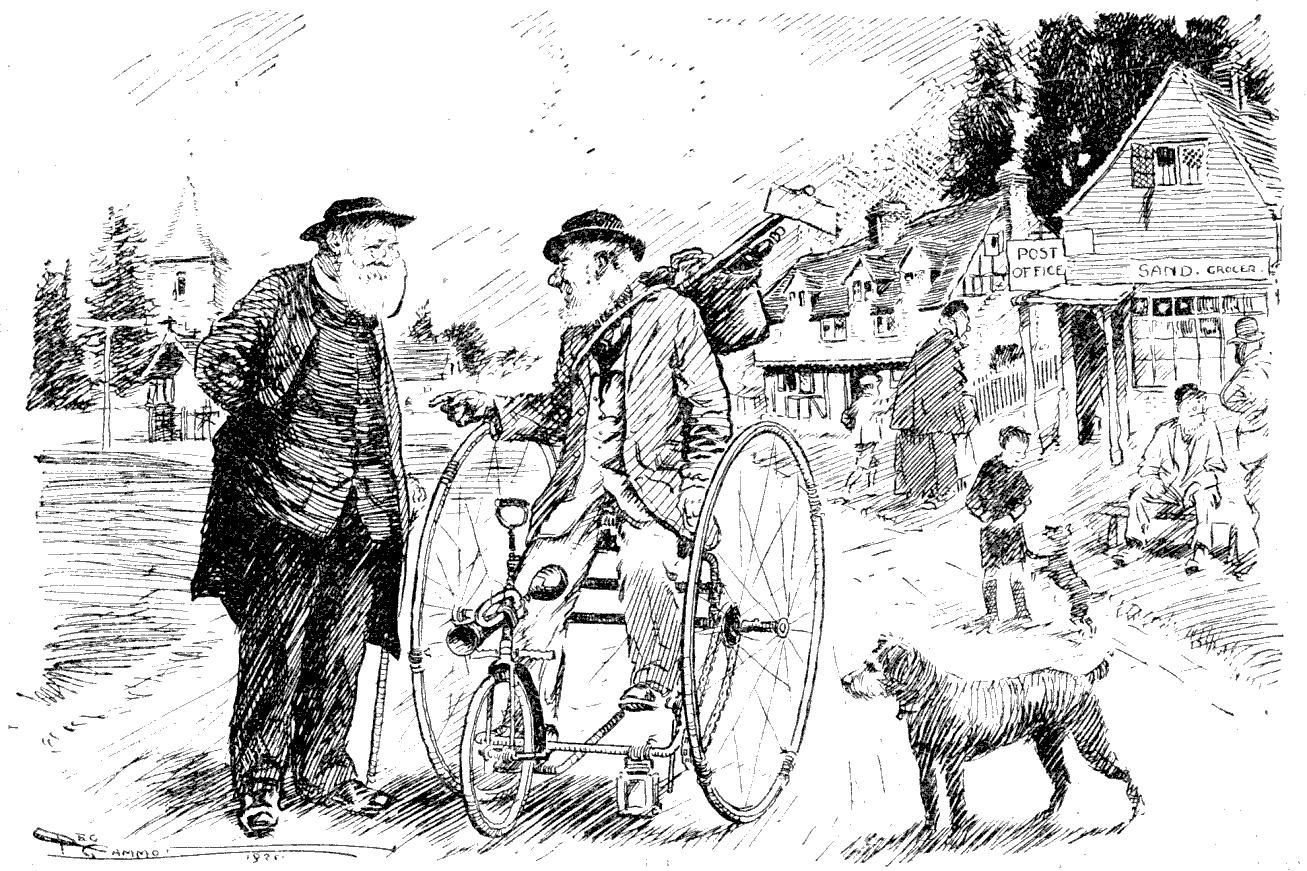
"I have not seen you at church for two Sundays, John."
"No, Sir. No offence t'you, but oi a-bin doin' t' chapel passon's garden, so missus thought we'd better give 'im a turn."