Volume 159 — ESSENCE OF PARLIAMENT.
Reading edition
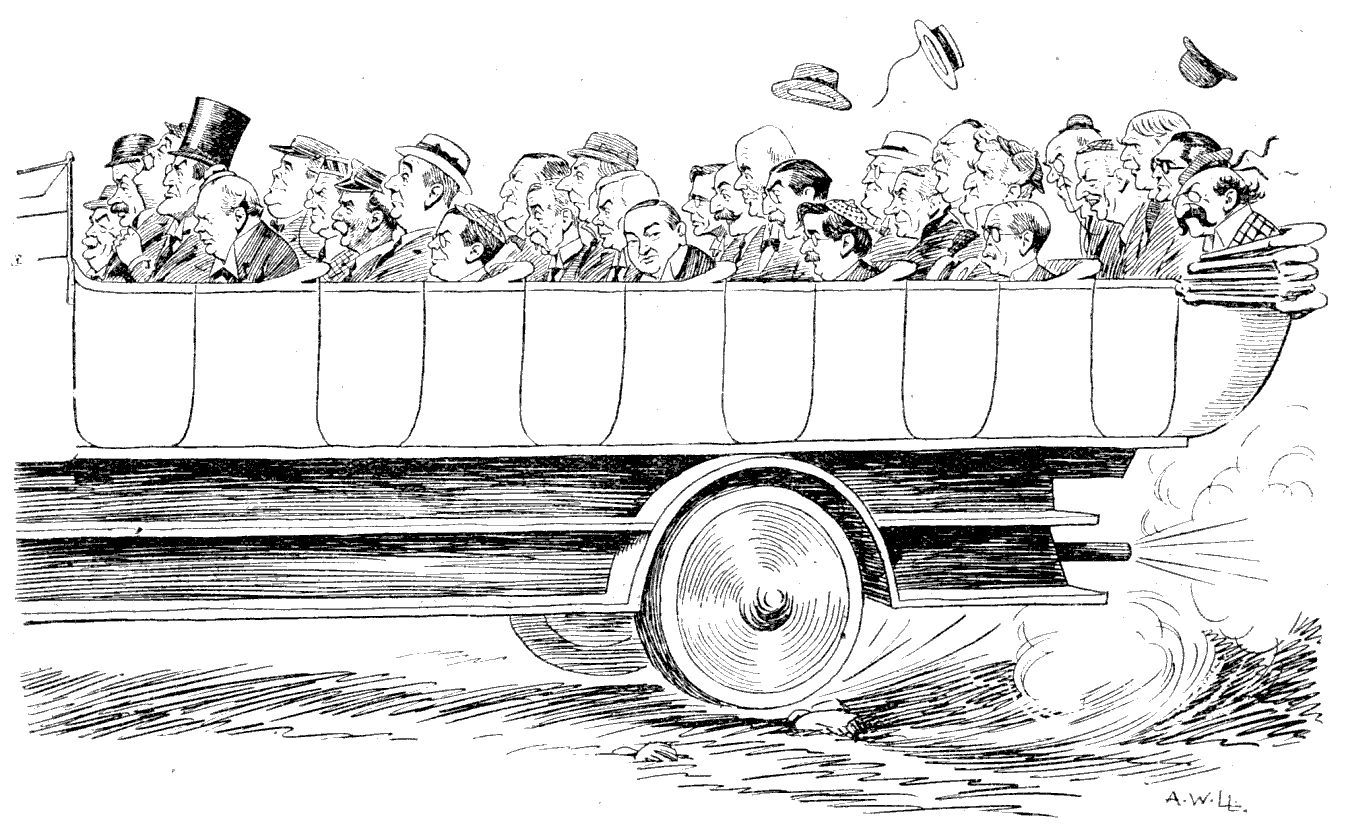
GOING TO THE COUNTRY?
"I think it would be a calamity if we did anything to prevent the economic use of charabancs."—Sir Eric Geddes.
First "Banc." Mr. Lloyd George, Mr. Bonar Law, Mr. Balfour, Mr. Chamberlain, Mr. Churchill.
Second "Banc." Sir E. Geddes, Mr. Shortt, Mr. Long, Sir Robert Horne, Col. Amery.
Third "Banc." Mr. Illingworth, Lord E. Talbot, Mr. Fisher, Dr. Addison, Sir Gordon Hewart.
Fourth "Banc." Mr. Kellaway, Sir M. Barlow, Sir L. Worthington Evans, Sir A.G. Boscawen, Mr. Towyn Jones.
Fifth "Banc." Sir Hamar Greenwood, Mr. Baldwin, Sir James Craig, Mr. Denis Henry, Mr. Neal.
Sixth "Banc." Mr. Montagu, Dr. Macnamara, Mr. McCurdy, Mr. Ian Macpherson, Sir A. Mond.
Monday, August, 9th.—In an atmosphere of appropriate gloom the House of Lords discussed the latest Coercion Bill for Ireland. Even the Lord Chancellor could say little more for the measure than that it might possibly enable some of the persons now in custody to be tried; and most of the other Peers who spoke seemed to think that it would be either mischievous or useless. The only confident opinion expressed was that of the elderly Privy Councillor, who from the steps of the Throne ejaculated, "If you pass this Bill you may kill England, not Ireland." But despite this unconventional warning the Peers took the risk.
The event of the day in the House of Commons was Colonel Wedgwood's tie. Of ample dimensions and of an ultra-scarlet hue that even a London and South-Western Railway porter might envy, it dominated the proceedings throughout Question-time. Beside it Mr. Claude Lowther's pink shirt paled its ineffectual fires.
When Viscount Curzon renewed his anti-charabancs campaign and Sir Eric Geddes was doing his best to maintain an even mind amid the contradictory suggestions showered upon him, the Ministerial eye was caught by the red gleam from Colonel Wedgwood's shirt-front. At once, the old railway instinct reasserted itself. Recognizing the danger-signal and hastily cramming on his brakes, Sir Eric observed that it would be "a great calamity" to prevent the economic use of the charabancs.
Tuesday, August 10th.—As Lord Great Chamberlain, and therefore official custodian of the Palace of Westminster, Lord Lincolnshire mentioned with due solemnity the regrettable incident of the day before. Lord Curzon thought the offender (the Right Hon. A. Carlisle) should be allowed to explain his behaviour, and suggested that he should himself address to him a suitable letter. Several noble lords—anticipating, no doubt, that, whatever else came of it, the correspondence would furnish lively reading—said "Hear, hear."
A week ago the Peers decided by a very small majority—28 to 23—that there should be no Minister of Mines, but only an Under-Secretary. Lord Peel now sought to induce them to change their minds. His principal argument was that a Minister would only cost five hundred pounds a year more than a Secretary and would secure the "harmony in the coal-trade" now so conspicuously lacking. The Peers evidently thought this too good to be true, for they proceeded to reassert their previous decision by 48 to 23.
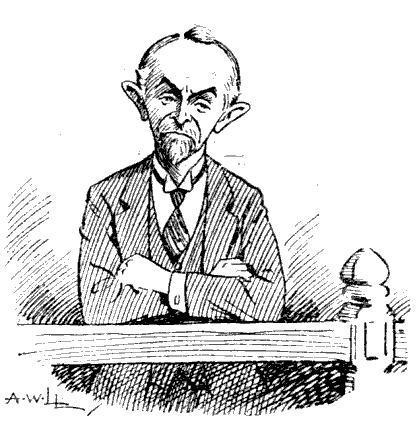
A DISTINGUISHED STRANGER.
M. Krassin contemplates the Commons.
There was a big assemblage in the Commons to hear the Prime Minister's statement on Poland. The Duke of York was over the Clock, flanked by the Archbishop of Canterbury on one side and Messrs. Kameneff and Krassin (who sound, but do not look, like a music-hall "turn") on the other.
Some facts bearing, more or less, on the situation were revealed at Question-time. Mr. Churchill denied that he had ever suggested an alliance with the Germans against Bolshevism, and, as we are keeping the Watch on the Rhine with only thirteen thousand men—just three thousand more than it takes to garrison London—perhaps it is just as well. He has, I gathered, no great opinion of the Bolshevists as soldiers. In his endeavour to describe the disgust of our troops in North Russia at being ordered to retire before "an enemy they cordially despised" he nearly dislocated his upper lip.
For two-thirds of his speech the Prime Minister was the sober statesman, discussing with due solemnity the grave possibilities of the Russo-Polish crisis. The Poles had been rash and must take the consequences. We should not help them unless the Bolshevists, not content with punishment, threatened the extinction of Poland's independence.
Then his mood changed, and for a sparkling quarter of an hour he chaffed the Labour Party for its support of the Soviet Government, an unrepresentative self-appointed oligarchy. To make his point he even sacrificed a colleague. Lenin was an aristocrat, Trotsky a journalist. "In fact"—turning to Mr. Churchill—"my right honourable friend is an embodiment of both."
A brief struggle for precedence between Mr. Asquith and Mr. Adamson ended in favour of the ex-Premier, who doubted whether the best way to ensure peace was to attack one of the parties to the dispute, and proceeded to make things more or less even by vigorously chiding Poland for her aggression. Mr. Clynes, while admitting that the Labour Party would have to reconsider its position if the independence of Poland was threatened, still maintained that we had not played a straight game from Russia.
Later on, through the medium of Lieut.-Commander Kenworthy, communication was established between the Treasury Bench and the Distinguished Strangers' Gallery. Mr. Lloyd George read the terms offered by the Soviet to the Poles, and gave them a guarded approval.
Wednesday, August 11th.—A Bill to prohibit ready-money betting on football matches was introduced by Lord Gainford (who played for Cambridge forty years ago) and supported by Lord Meath, "a most enthusiastic player" of a still earlier epoch. The Peers could not resist the pleading of these experts and gave the Bill a second reading; but when Lord Gainford proposed to rush it through goal straightaway his course was barred by Lord Birkenhead, an efficient Lord "Keeper."
A proposal for the erection at the public expense of a statue of the late Mr. Joseph Chamberlain furnished occasion for the Prime Minister and Mr. Asquith to indulge in generous praise of a political opponent. Mr. Lloyd George (with his eye on the Sovietists) pointed out that, as this was "essentially a Parliamentary country," we did well to honour "a great Parliamentarian"; and the ex-Premier (with his eye on Mr. Lloyd George) selected for special note among Mr. Chamberlain's characteristics that he had "no blurred edges."
A humdrum debate on the Consolidation Fund Bill was interrupted by the startling news that France had decided, in direct opposition to the policy announced yesterday by the Prime Minister, to give immediate recognition to General Wrangel. Mr. Lloyd George expressed his "surprise and anxiety" and could only suppose that there had been an unfortunate misunderstanding. To give time for its removal the House decided to postpone its holiday and adjourned till Monday.
More Headaches for the Historian.
Messrs. Kameneff and Krassin, the Soviet envoys, were in the Distinguished Strangers' Gallery during the Prime Minister's speech on Poland last week. Hence these tears:—
"In conversation they seem to betray only a limited acquaintance with English, but every word of Mr. Lloyd George's utterance seemed intelligible to them. Not only did they follow him with eager interest, but often with animated comment."—Evening Standard.
"The two did not exchange a single remark during the whole of the Premier's speech." Evening News.
"Krassin could follow every word of Lloyd George. His colleague doesn't speak or understand English, so Krassin every few minutes leaned over and whispered a translation into the other's ear."—Star.
"The Soviet envoys, especially M. Krassin, seemed somewhat restless, and appeared to take more interest in the scene than in the speech, but this I heard attributed to their difficulty in following the words of the Prime Minister."—Pall Mall Gazette.
BLEWITT ON REAL PROPERTY.
229th ed., folio, 2 vols. (Sour and Taxwell, 85s.).
All persons interested in this entrancing subject will welcome the new edition of Mr. Blewitt's famous work. The book is one which should be found on every shelf throughout the country, and is undoubtedly, in its combination of erudition and artistic merit, one of the masterpieces of English literature. It has been well described by a more competent critic as one which "it is difficult to take up when once you have put it down," and in this judgment most readers will, we believe, concur.
It seems needless for us to say anything about so well-known a work, and to say anything new is, we believe, impossible. Mr. Blewitt is invariably happy in his choice of subject, and in this treatise on Real Property his sparkling wit, his light style and clearness of expression do ample justice to the perennial freshness of his subject. The reader is swiftly carried from situation to situation and thrill follows thrill with daring rapidity. The plot is of the simplest, but worked out with surprising skill, while the events are related with that vivid imagination which the subject demands. Who is there that does not feel a glow of exaltation and rejoice with the heir when he comes, upon reversion, into the property from which he has been so long excluded? Mr. Blewitt treats this incident with a sense of romance and picturesqueness of language reminiscent of the ballad of "The Lord of Lynn." In its facts the ballad bears a striking resemblance to those so graphically described by our author, but in point of execution lacks the true breath of poetic inspiration which pervades Mr. Blewitt's book.
Nor is his work wanting in pathos. There are few who will not sympathise with the hero when he discovers that the life-estate of the fair widow whom he adores with all the fierce yearnings of his passionate soul is subject to a collateral limitation to widowhood. Mr. Blewitt's silence on the disappointment which embittered his spirit and the doubts which tormented his mind is more eloquent than any soliloquy of Hamlet.
It is not however in description but in characterisation that Mr. Blewitt is pre-eminent. We know of nothing in works of this nature to equal the skilful psychological analysis, the sympathy of treatment and the fidelity to nature with which the author draws line by line the character of Q. The description of him as seised in fee simple is a touch of genius. We can remember nothing in the English language to compare with this unless it be that brilliant passage in which Mr. Blewitt sketches in a few lightning strokes the character of Richard Roe, a man at once pugnacious, overbearing, litigious and utterly regardless of truth and honesty.
The learned editors have rendered a great service to the cause of learning in publishing this new edition. The editing is very creditable to English scholarship. The additional matter is a new note on page 1069, in which the reader is referred to an article in a recent number of the Timbuctoo Law Review, which, in fairness to the editor (of Real Property), is not, of course, quoted here. The student will, we have no doubt, feel himself fully recompensed by this new matter for the price of the new volumes and the depreciation of the 228th edition.
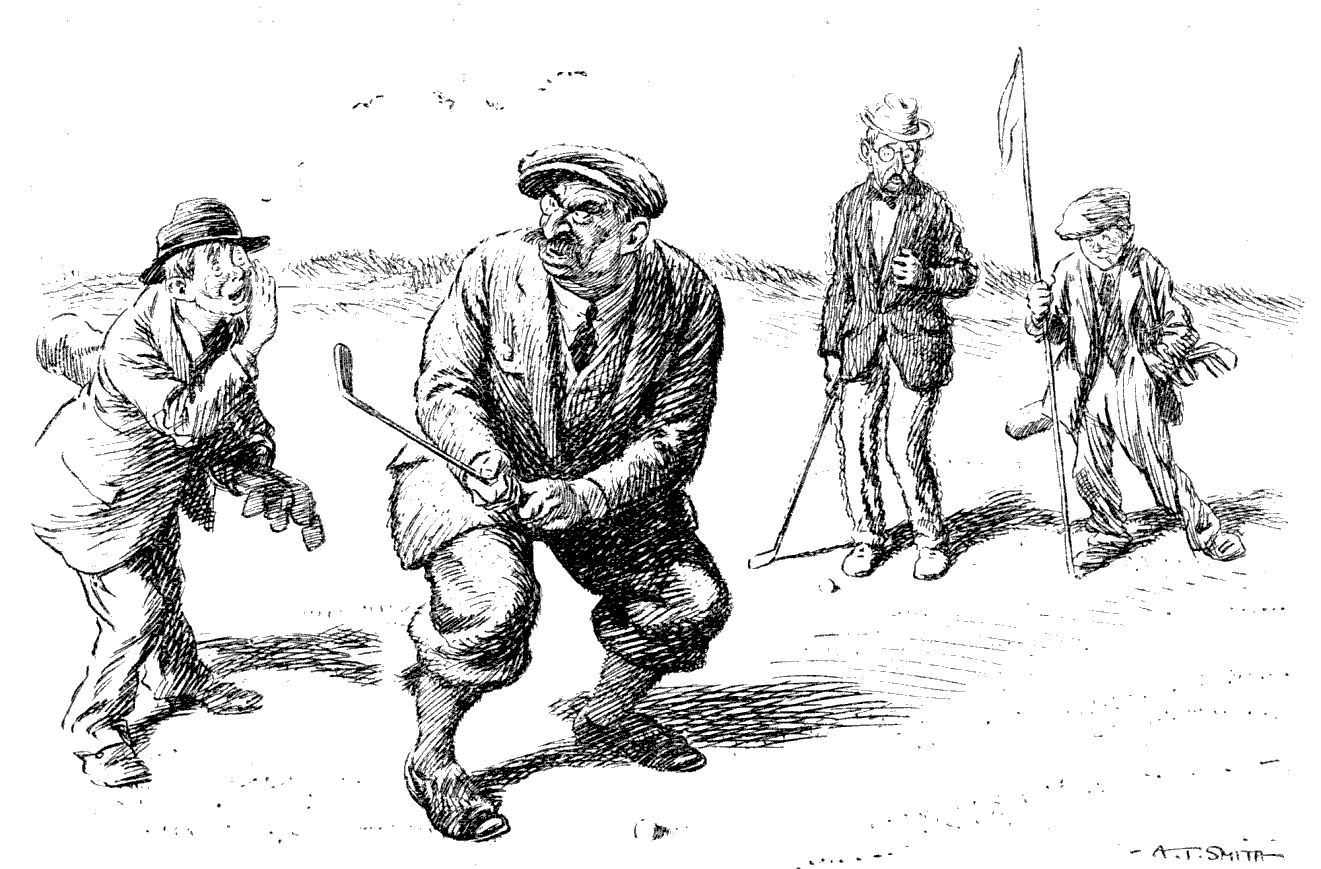
NERVES ON THE GREEN.
Irascible Golfer. "Confound it! what is that infernal oil-engine or something that begins thumping whenever I am putting?"
Caddie. "I think it must be t'other gentleman's 'eart, Sir."
"NEW MOTOR-BUS SERVICES.
Residents in the area between the county town and —— are now able to do their shopping at either place with the maximum of inconvenience so far as travel is concerned."—Provincial Paper.
Just as in London.
GISH-JINGLE.
[The Times in a recent article on events in the Film world announces the impending arrival in Europe of Miss Dorothy Gish, adding, however, that the visit is mainly undertaken for recreation.]
Let others discourse and descant Upon Mannix the martyr archbish, Me rather it pleases to chant The arrival of Dorothy Gish. Among the élite of the Screen She holds an exalted posit.; But in Europe she never has been Hitherto, hasn't Dorothy Gish. And it's well to consider aright That she harbours the laudable wish For a holiday, not for the light Of the lime, does Miss Dorothy Gish. None the less with the wildest surmise Do I muse on the bountiful dish Of sensation purveyed for the wise And the foolish by Dorothy Gish. * * * * * Will you strengthen the hands of Lloyd George Or frown on the poor Coalit.? Will you force profiteers to disgorge, Beneficent Dorothy Gish? Do you hold by self-governing schools? Do you think that headmasters should swish Or adopt Montessorian rules, Benevolent Dorothy Gish? Will they give you an Oxford degree? Will you learn to call marmalade "squish"? Will Kenworthy ask you to tea On the Terrace, great Dorothy Gish? Do you favour the Russ or the Pole? Will you visit the Servians at Nish? Are you sound on the subject of coal? Are you Pussyfoot, Dorothy Gish? Are you going to be terribly mobbed When attending the concerts of Krish? Are your tresses luxuriant or "bobbed"? Do tell us, kind Dorothy Gish! Meanwhile we are moody and mad, Like Saul the descendant of Kish, Oh, arrive and make everyone glad, Delectable Dorothy Gish!
"Wanted, Lady Clerk; one accustomed to milk ledgers preferred."—New Zealand Paper.
But how does one milk a ledger?