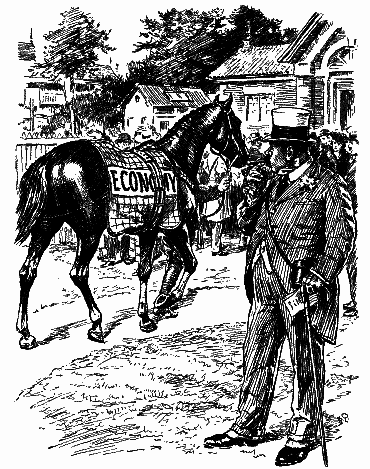
ENVOYS EXTRAORDINARY.
Reading edition
Prime Minister (to Bolshevist Delegates.) "HAPPY TO SEE YOU, GENTLEMEN. BUT WOULD YOU MIND GOING ROUND BY THE TRADESMEN'S ENTRANCE, JUST FOR THE LOOK OF THE THING?"
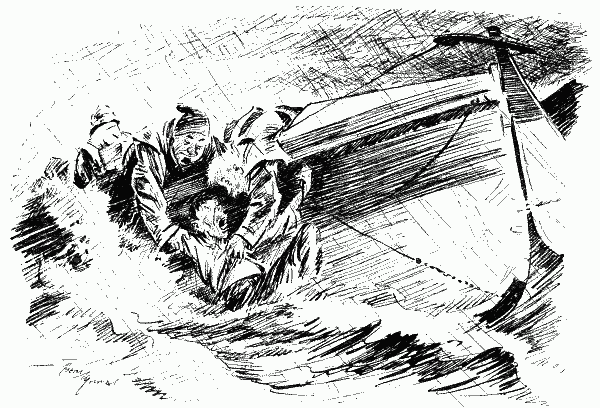
Shipwrecked Mariner. "Ahoy, mates! Wot 's won t' Derby?"
THE RISE AND FALL OF AN AMATEUR EXAMINER.
The Nabobs is, I suppose, one of the best girls' schools in England. Anyhow it is perhaps the most exclusive unless you have money enough. But, as the prospectus says, "it commands an extensive view of the English Channel," and I suppose these things have to be paid for. At all events there is no doubt that the principal, Miss Penn-Cushing, has her heart in her work and is a splendid disciplinarian, and so I sent my niece Mollie there to be finished (her mother being in India).
I have an idea at times that it is Mollie who will finish Miss Penn-Cushing, but I try to preserve a benevolent neutrality combined with a regular supply of food parcels to my niece.
Miss Penn-Cushing is LL.A. of one University and LL.B. of another, and, I think, LL.C. of a third, so that she ought to be more than a match for six Mollies.
I have always had the impression that Miss Penn-Cushing regarded me as a humble entomological specimen until the other day when she paid me a staggering compliment. She herself teaches all the English literature in her academy, and each class in turn goes up to her room to receive its daily dose. Mollie says that when she grows up she is going to give up English literature for ever and read something interesting.
I am glad that the revered Principal is never present to hear Mollie's blasphemies, at which I as an uncle have to shudder. Since the publication of The Cambridge History of English Literature Miss Penn-Cushing has been steadily absorbing it, to help her in her daily task, and has apparently reached the chapter in which is suitably acknowledged the debt of English literature to Punch.
So at least I judge, for she gave the girls a long serious talk on humour in literature, how to detect it and what should be done about it. One rather sensitive child began to cry, but Mollie, who has never kept a secret in her life and in fact loves to drag her uncle's skeletons out of cupboards, blurted out, "Uncle writes for Punch!"
I was somewhat alarmed when I heard of this, for I did not know how Miss Penn-Cushing, who keeps all the girls' uncles in order, might take it. My fears were groundless, perhaps stupid, for the immediate result was an invitation to examine Mollie's form in literature at the forthcoming Christmas examination. I felt uplifted in spirit; I felt that people were beginning to understand me. I even entertained an hallucination that perhaps Mollie might now treat my intellect with respect and stop calling me "Old dear." Three inches taller I sat down to my desk and, thanking Miss Penn-Cushing for the honour paid me, I promised I would do my best, although it would be my first appearance in the rôle.
I determined, however, not to allow this distinction to make me overbearing to my inferiors at our next speech-day. I would be affable to ordinary uncles, common parents and guardians of the other girls, but I would lead the conversation artfully on to other literary critics and examiners of the past. As a preparation I read up Matthew Arnold.
It is not easy to be an examiner, I found. I would rather write ten leading articles than one examination-paper. It appeared that I had to set themes for essays as well as questions in literature. We never learnt literature when I was young and I didn't know you could, but I borrowed a text-book from Mollie and did my best.
The result was a crushing letter from the lady principal. She said that "The Ten Points of a good Doll" seemed a preposterous subject for senior students of literature to write about, and "My Favourite Elopement in Fiction" would be outside the purview of any of her girls. She would substitute instead (with my permission), "The Debt of Literature (as well as Science) to Darwin" and "My Favourite Piece of Epic Poetry." In fine, if I did not really mind, she would herself set all the questions and I should examine the answers. She thought that the more fructiferous course.
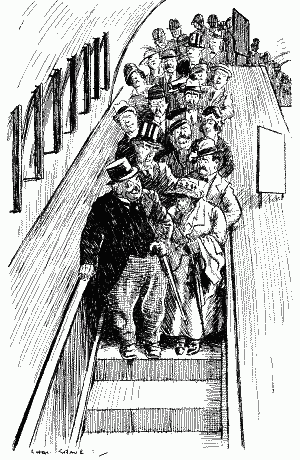
Farmer. "Eh, Lucy, these moving stairs do be vine things vor saving volk's time."
How to mark was my chief difficulty. How many marks should one give a darling with brown eyes and a musical laugh (Mollie has brought her to tea often) who signs herself "Norah O'Brien," and winds up delightful irrelevances about Darwin and her abhorrence of reptiles with a personal appeal to the examiner. I do not know what other examiners do in such cases. It was a beautifully worded and most respectful appeal. I decided to give her forty for Norah and forty for O'Brien. Both names have always appealed to me.
This made it necessary for me to give eighty marks to her sister Kathleen, who wrote really an excellent essay on a subject we had stupidly forgotten to set. It was an excellent subject, and she has even browner eyes than Norah, but as an examiner one must be rigid and impartial.
Eunice came next. This name recalled dear memories of the past and of what might have been. But as an examiner I could not let old dreams weigh down my impartial scales, so I refused to give her more than eighty. Finally, for they are really charming girls and know far more about literature than I do, I gave eighty to everybody except Mollie, and for being Mollie I gave her eighty-two.
I forgot. There was one perfectly horrid little girl called Katie de Pinnock. She never shared her chocolates with anyone; the fact was notorious. She wrote in a copperplate hand sentiments like these: "Milton awes me; Shelley thrills me; Blake, the prophet of self-sacrifice, is ever my consolation and my guide. I ask for nothing beyond." I gave her nineteen.
And now comes the tragedy. Miss Penn-Cushing's letter of thanks was icy. She feared I had been "a thought nepotic," and (with my permission) she would revise my marks.
She dealt me the final blow at our Speech-Day. "I have decided," she gave out, "to award the first prize in Literature to Miss Katie de Pinnock. I am sure, though, that you will not be surprised to hear that Mr. Marcus O'Reilly, our examiner, was so impressed with the literary excellence of all your papers that he has presented the whole class with consolation prizes. We tender him our heartiest thanks."
Commercial Candour.
Extract from a Canadian business-circular:—
"What intelligent car owners have been looking for is a tire that will give them a minimum amount of service for a maximum amount of expenditure. You can get that tire from us."
"THE MASSACRE OF THE INNOCENTS.
By the Rt. Hon. C. F. G. Masterman.
'Die, thou children of stormy dawn,' cries the Prime Minister to-day, as he stamps out the life of his little land taxes."—Daily News.
According to his critic Mr. Lloyd George seems to have done great violence to his syntax as well as to his little land taxes.
"The bride, a tall brunette, looked a vision of golden beauty as she advanced up the aisle on the arm of her father."—Evening Paper.
We do not think that this was the right occasion for an exposure of feminine camouflage.
THE ART OF POETRY.
I.
Many people have said to me, "I wish I could write poems. I often try, but——" They mean, I gather, that the impulse, the creative itch, is in them, but they don't know how to satisfy it. My own position is that I know how to write poetry, but I can't be bothered. I have not got the itch. The least I can do, however, is to try to help those who have.
A mistake commonly committed by novices is to make up their minds what it is they are going to say before they begin. This is superfluous effort, tending to cramp the style. It is permissible, if not essential, to select a subject—say, MUD—but any detailed argument or plan which may restrict the free development of metre and rhyme (if any) is to be discouraged.
With that understanding, let us now write a poem about MUD.
I should begin in this sort of way:—
Mud, mud, Nothing but mud, O my God!
It will be seen at once that we are not going to have much rhyme in this poem; or if we do we shall very soon be compelled to strike a sinister note, because almost the only rhymes to mud are blood and flood; while, as the authors of our hymns have discovered, there are very few satisfactory rhymes to God. They shamefully evaded the difficulty by using words like road, but in first-class poetry one cannot do that. On the whole, therefore, this poem had better be vers libre. That will take much less time and be more dramatic, without plunging us into a flood of blood or anything drastic like that. We now go on with a little descriptive business:—
Into the sunset, swallowing up the sun, Crawling, creeping, The naked flats——
Now there ought to be a verb. That is the worst of vers libre; one gets carried away by beautiful phrases and is brought up suddenly by a complete absence of verbs. However at a pinch one can do without a verb; that is the best of vers libre:—
Amber and gold, Deep-stained in mystery And the colours of mystery, Inapprehensible, Golden like wet-gold, Amber like a woman of Arabia That has in her breast The forsaken treasures of old Time, Love and Destruction, Oblivion and Decay, And bully-beef tins, Tin upon tin, Old boots, and bottles that hold no more Their richness in them. And I——
We might do a good deal more of this descriptive business, bringing in something about dead bodies, mud of course being full of dead bodies. But we had better get on. We strike now the personal note:—
And I, I too am no more than a bottle, An empty bottle, Heaving helpless on the mud of life, Without a label and without a cork, Empty I am, yet no man troubles To return me. And why? Because there is not sixpence on me. Bah! The sun goes down in the West (Or is it the East?) But I remain here, Drifting empty under the night, Drifting——
When one is well away with this part of the poem it is almost impossible to stop. When you are writing in metre you come eventually to the eighth line of the last verse and you have to stop; but in vers libre you have no assistance of that kind. This particular poem is being written for instructional purposes in a journal of limited capacity, so it will probably have to stop fairly soon; but in practice it would go on for a long time yet. In any case, however, it would end in the same way, like this:—
Mud, mud, Nothing but mud, O, my God!
That reasserts, you see, in a striking manner, the original motif, and somehow expresses in a few words the poignant melancholy of the whole poem. Another advantage in finishing a long poem, such as this would be, in the same way as you began it is that it makes it clear to the reader that he is still reading the same poem. Sometimes, and especially in vers libre of an emotional and digressive character, the reader has a hideous fear that he has turned over two pages and got into another poem altogether. This little trick reassures him; and if you are writing vers libre you must not lose any legitimate opportunity of reassuring the reader.
To treat the same theme in metre and rhyme will be a much more difficult matter. The great thing will be to avoid getting mud at the end of a line, for the reasons already given. We had better have long ten-syllable lines, and we had better have four of them in each verse. Gray wrote an elegy in that metre which has given general satisfaction. We will begin:—
As I came down through Chintonbury Hole The tide rolled out from Wurzel to the sea.
In a serious poem of this kind it is essential to establish a locality atmosphere at once; therefore one mentions a few places by name to show that one has been there. If the reader has been there too he will like the poem, and if he hasn't no harm is done. The only thing is that locally Chintonbury is probably pronounced Chun'bury, in which case it will not scan. One cannot be too careful about that sort of thing. However, as an illustration Chintonbury will serve.
It is now necessary to show somehow in this verse that the poem is about mud; it is also necessary to organise a rhyme for 'Hole' and a rhyme for 'sea,' and of the two this is the more important. I shall do it like this:—
And like the unclothéd levels of my soul The yellow mud lay mourning nakedly.
There is a good deal to be said against these two lines. For one thing I am not sure that the mud ought to be yellow; it will remind people of Covent Garden Tube Station, and no one wants to be reminded of that. However, it does suggest the inexpressible biliousness of the theme.
I think "levels" is a little weak. It is a good poetical word and doesn't mean anything in particular; but we have too many words of that kind in this verse. "Deserts" would do, except that deserts and mud don't go very well together. However, that sort of point must be left to the individual writer.
At first sight the student may think that "nakedly" is not a good rhyme for "sea." Nor is it. If you do that kind of thing in comic poetry no editor will give you money. But in serious poetry it is quite legitimate; in fact it is rather encouraged. That is why serious poetry is so much easier than comic poetry. In my next lecture I shall deal with comic poetry.
I don't think I shall finish this poem now. The fact is, I am not feeling so inspired as I was. It is very hot. Besides, I have got hay-fever and keep on sneezing. Constant sneezing knocks all the inspiration out of a man. At the same time a tendency to hay-fever is a sign of intellect and culture, and all the great poets were martyrs to it. That is why none of them grew very lyrical about hay. Corn excited them a good deal, and even straw, but hay hardly ever.
So the student must finish this poem as best he can, and I shall be glad to consider and criticise what he does, though I may say at once that there will be no prize. It ought to go on for another eight verses or so, though that is not essential in these days, for if it simply won't go on it can just stop in the middle. Only then it must be headed "Mud: A Fragment."
And in any case, in the bottom left-hand corner, the student must write: Chintonbury, May 28th, 1920.
A. P. H.
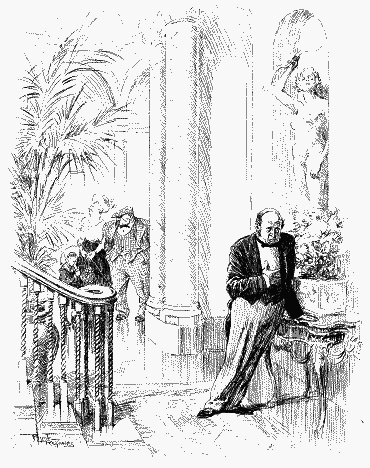
MANNERS AND MODES.
WHAT OUR PROFITEER'S BUTLER (WHO WAS TAKEN ON WITH THE HOUSE AND FURNITURE) HAS TO PUT UP WITH:—MASTER'S RELATIONS.
ELIZABETH'S TIP FOR THE DERBY.
"Talkin' o' the Derby," began Elizabeth.
As a matter of fact I was not talking of the Derby or even thinking of it at the moment. I had just been telling Elizabeth that the omelette which she had served us at dinner was leathery, and her remark struck me as irrelevant.
"Master thinks the omelettes would be lighter if you fried them in more butter," I continued. Of course Master had thought nothing of the kind. But nowadays complaints must be conveyed to domestics in this indirect way.
Elizabeth ignored the omelette. "I'm goin' to win fifty pounds at least," she exclaimed, and in her excitement broke the cup she held—I mean to say the cup came in two in her hand as she spoke. "I've got a bit on an 'orse for the Derby."
I felt slightly shocked. It is always surprising to discover a latent sporting instinct in one's domestics, unless they are highly placed and dignified domestics like butlers or head-footmen; but in a cook-general it seems peculiarly low.
"I shouldn't bet if I were you," I advised; "I think—er—Master thinks," I added involuntarily—"that you might lose money at it."
"But I'm goin' to win money this time," announced Elizabeth triumphantly; "my young man ses so, and 'e knows."
"Which young man?" I inquired.
Elizabeth, I ought perhaps to explain, is uncertain about her young men. She never has any lack of them; but they are like ships that pass in the night (her night out as a rule) and one by one they drift off, never stopping to cast anchor in her vicinity. You know what I mean. Elizabeth can't keep a young man. Perhaps she lacks the charm which Barrie describes as "a sort of a bloom on a woman." Or if she has any of that bloom it must be swamped in the moist oleaginous atmosphere of washing-up which seems to cling permanently about her.
"It's a new young man," said Elizabeth in answer to my question, "an' 'e's got work in a racin' stable, so that's 'ow 'e knows wot's goin' to win. It'll be an outsider, 'e ses, which makes it all the better for me."
"All the better for you?"
"Yes, 'm. You see, the more you puts on the more you wins."
Elizabeth may not have charm but she certainly has simplicity. "You don't mean to say," I cried, a light breaking on me, "that you got your next month's wages in advance just to put it all on a horse?"
"That I did," she replied complacently. "You see, my young man ses that, if you put it on some time before'and, you get a better price, so I thort I'd give it to 'im to put on at once. 'E promised 'e wouldn't waste a minnit over it."
"But this is most foolish of you—to trust your money to an entire stranger," I expostulated.
"'E isn't a stranger—'e's my young man," corrected Elizabeth, tossing her head.
For the following few days she was radiant—but then anybody would be who was certain of the winner of the Derby a week before the race. In addition to this she had got a young man. Those brief periods when Elizabeth's young men are in the incipient stages of paying her attention are agreeable to everybody. Elizabeth, feeling no doubt in her rough untutored way that God's in His heaven and all's right with the world, sings at her work; she shows extraordinary activity when going about her duties. She does unusual things like remembering to polish the brasses every week—indeed you have only to step into the hall and glance at the stair-rods to discover the exact stage of her latest "affair." I remember that, when one ardent swain "in the flying corpse" went to the length of offering her marriage before he flew away, she cleaned the entire house down in her enthusiasm, and had actually got to the cellars before he vanished out of her life.
The follower from the racing stable might aptly be described as "The Man Who Never Came Back." He romped out of Elizabeth's existence on the Sunday preceding the Derby.
"I waited for 'im four-an'-an-'arf 'ours, an' 'e didn't turn up," she informed me next day.
"Perhaps he was prevented from keeping the appointment," I suggested to comfort her, though I felt the outlook was gloomy.
She shook her head. "I'll never see 'im no more. I know 'em," she said, drawing on the depth of her experience of young men who do the vanishing trick. "An' my money gone too. It's 'eartbreakin'. But I might 'ave known that that there 'orse was a bad sign."
"What horse?" I asked, bewildered.
"The one 'e told me to put my money on. The name alone ought to have set me agen it; it was too true to life."
"And what was the name of the horse?" I inquired as she drifted dismally to the door.
"'E Goes," said Elizabeth mournfully.
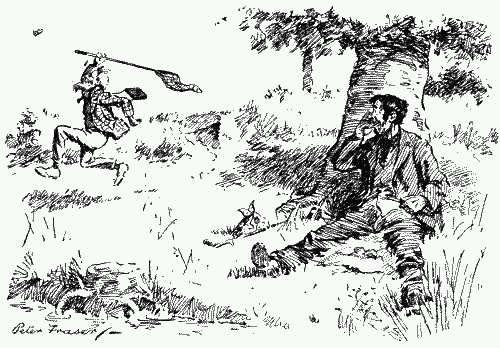
"Try 'im wiv a worm, Guv'nor!"
THINGS NOT GENERALLY KNOWN.
(By our Lunatic Contributor.)
That the notorious King Belshazzar Was noted as the earliest Jazzer; That, on the contrary, Zerubbabel Was most exclusive and unclubbable; That Romulus and brother Remus Were not so tall as Polyphemus; That the one weakness of Calypso Was what is briefly known as "dipso;" That Clodius, very long ago, First bore the nickname of "Old Clo;" That the illustrious Palestrina Did not invent the concertina; That Wagner's methods in Tannhäuser Never appealed to Mrs. Poyser; That the Albanian Prenk Bib Doda Prefers his whisky minus soda; That good Professor Flinders Petrie Did not discover Sacha Guitry.
Our Journalistic Sleuths.
"The circumstances under which the deceased came by his death are shrouded in mystery. From the gun shot wounds it is surmised that he either shot himself or somebody had shot him."—Indian Paper.
"Would Persons present in Restaurant in Shiprow on Saturday Night, when dispute arose with regard to sixpence, please communicate with No. 798 Express Office?"
Scotch Paper.
Who heard the bang?
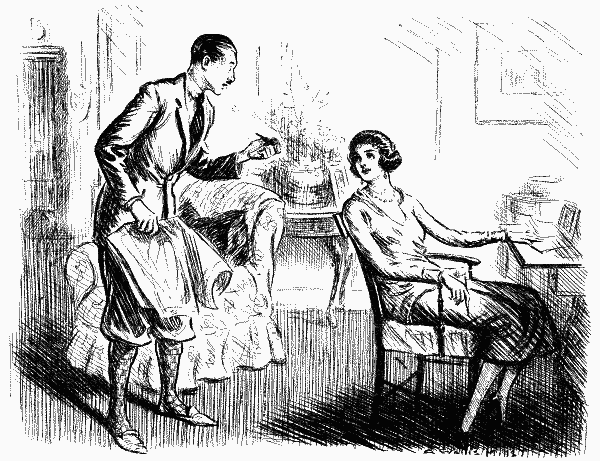
[Week-end hostesses are now giving "Lend-a-hand" parties, at which every guest is expected to do some household service.]
Wife. "I'm asking Dolly Ditchwater this week-end. Bit dull, but she doesn't drop the china."
Husband. "Don't forget Bertie Bunt. Bit of a bounder, but he's an ace at cleaning boots."
AMERICA AGAIN.
A situation of extreme international delicacy has recently arisen. We understand, with regard to the impending strike of Italian organ-grinders and ice-cream merchants in the Metropolis, that Signori Rimbombo Furioso and Fagiuolo Antico, representing the Amalgamated Society of Itinerant Instrumentalists and the National Union of Refrigerated Tuck Sellers, have lately been invited to a conference with Dr. Macnamara, and their economic grievances are now under the consideration of the Minister of Labour. These, briefly, are as follows:
(1) The high price of sugar.
(2) Restricted hours and insufficient emoluments.
(3) Undue interference by the police.
(4) Inadequate supplies of monkey nuts.
It now appears that in order to make a bid for the large Italian vote in the forthcoming Presidential elections in the U.S.A. a violent anti-British propaganda campaign is raging on the other side of the Atlantic, and that an enormous amount of spurious sympathy is being manufactured on behalf of the purveyors of rotary music and frozen confectionery in Soho. Beautiful Italian girls are daily besieging the British Embassy at Washington with placards bearing such inscriptions as—
SHOULD HOKEY POKEY SUFFER?
ENGLAND COERCES HER TRAVELLING ORGANISTS.
AMERICANS! HELP THE DUMB APE!
The agitation is the more uncalled for since, as a matter of fact, both Signor Furioso and Signor Antico, like most of their compatriots in this country, are pronounced Irredentists and filled with aspirations for a larger Italy, so that they have little or nothing in common with anti-Imperialistic America. Nevertheless, so bitter is the feeling which has been aroused that large subsidies are being sent overseas and Black Hand gangs organised to resist the London police. All over the outer suburbs organ-grinders are refusing to move on, and insist on playing well into the early hours of the morning. Deleterious substances of an explosive nature are being mingled with the ice cream, or else it is being supplied in such a watery condition that it is impossible for customers to lick it out of the receptacle without ruining their shirt fronts and waistcoats. Monkeys are being trained to give violent manifestations of ferocity, and, should the present heat-wave continue, rabies is anticipated.
The latest development is a rumoured suggestion from the U.S.A. Government that a representative should be sent over to take part in the Conference, and the names of Mr. Joe Dempsey and Mr. Charles Chaplin have been put forward as possible mediators.
V.
"All is not plane sailing yet for the German in search of foreign markets."—Evening Paper.
But wait till their flying bagmen get to work.
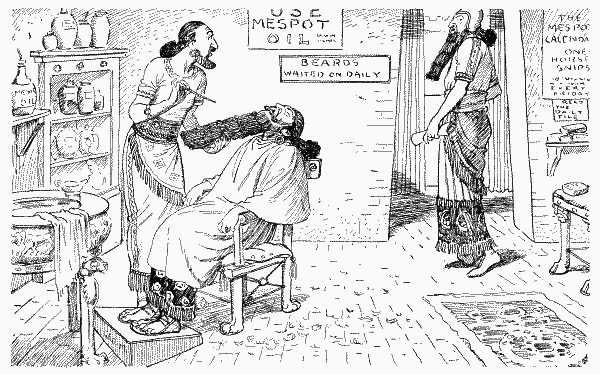
Hairdresser in Ancient Assyria. "Don't go, Sir. I shall be finished with this nobleman in three or four hours."
PRACTICAL ZOOLOGY.
There is nothing which distinguishes your true Briton so much as the systematic study of the ways of wild animals, and there is no kind of instruction which an English child so eagerly accepts.
"The addax or Nubian antelope," how frequently one may hear a father say to his small son in the schoolroom, "has horns very similar to those of the Indian antelope, but is a larger animal." "Yes, father," responds the boy brightly, "it has a tuft of long hair on the forehead and large broad hoofs, adapted for treading on fine and loose sands."
But it is easier perhaps to make these nice points in natural history in the comparative calm of the home than in the more frenzied atmosphere that reigns in the Zoological Gardens themselves. It is for that reason that I have put together the few notes which follow, hoping that they may assist the reader to adopt a definite system in dealing with this great national institution and educate the young mind on a reasoned and scientific plan.
Take the order of visiting the cages first. I do not complain of your natural wish to begin with the giraffe, because it has such an absurdly long neck and may possibly mistake Pamela's straw-hat for a bunch of hay and try to eat it, and because you will be able to see the hippopotamus on the way. As a matter of fact you will find that the giraffe is not standing near the bars at all, but close to its stable, where it is mincing and bridling exactly like a lady in a Victorian novel, and as for the hippopotamus you cannot see the pretty pink part of him because he is giving his famous imitation of a submarine. But never mind that. Your difficulty now will be, "What shall we do next?" and in order to assist you I have constructed a logical order for visiting the various cages. Here it is:—
1. The lions, because you can hear them already roaring most horribly fiercely.
2. The sea-lions, because they are saying "Ock, ock."
3. The lions, because the tiger may be roaring too this time.
4. The Elephant House. No, Pamela, I don't know why he is swaying about like that.
5. The lions, because Tony did not really see the black panther, which was asleep in one corner of its cage.
6. The Monkey House. I suppose we must.
7. The lions, to wait there till they are fed.
The only trouble about this order is that you may not have much time to visit the Mappin Terraces, and it is of course very important that you should go there because of the bears. The bears by rights should be fed on umbrellas, because they suck the stick and the ribs of the frame for all the world as if they were pieces of asparagus, and tear the silk part very carefully into tiny little shreds. But umbrellas are very expensive just now and the keeper does not think they are very good for the bears either. It is better to give them oranges, but oranges are expensive too, so you must make quite certain that you do not waste them on the grizzlies which are not on the Mappin Terraces at all. It is no use giving an orange to a grizzly bear, because it goes down with one quick motion, like the red into the right-hand top pocket. But if you give it to one of the Himalayan bears he opens it and scoops out all the inside and guzzles it up and then sits down and licks his paws exactly like a Christian, and while he is doing that the other Himalayan bear comes up and is so annoyed at not having an orange too that he lies down and groans with rage and flaps himself with his paws. So you have to get another orange.
Another thing that you have missed all this time and ought to see if possible is the Antelope House, where the telephone is. I don't know why the antelopes want a telephone more than all the other animals, but they do. Of course if they knew how bad the telephone is they would realise that with their long legs they could get there and back again in much quicker time than it takes to get a call through.
And then there are the Small Birds. It is not known to everybody, least of all, I think, to poets, that the nightingale sings best of all in a cage in broad daylight and amongst a lot of other birds, all twittering away like anything. We should like to take Mr. Robert Bridges to the Small Birds' House. We should like to take Mr. Robert Smillie there too, and introduce him to the bird just underneath the nightingale, which is called the Talking Mynah.
But you are not very much interested in coal or poetry, and will probably like the Sugar Birds best, for, if there is anything more delightful than being a bird, especially a tiny little bird, blue or green underneath, it must be living on sugar and having grapes stuck in the bars of your cage.
The snakes of course are slimy sort of creatures and their house is a long way off, and, though we fully agree with you that the monkeys were just like real persons, we think we really ought to be starting home now.
No, there is no time to see the lions again....
Evoe.