A DARK HORSE.
Reading edition
Profiteer. "'ECONOMY'? NEVER HEARD THE NAME. LOOKS AS IF HE MIGHT SPOIL MY BOOK, THOUGH."
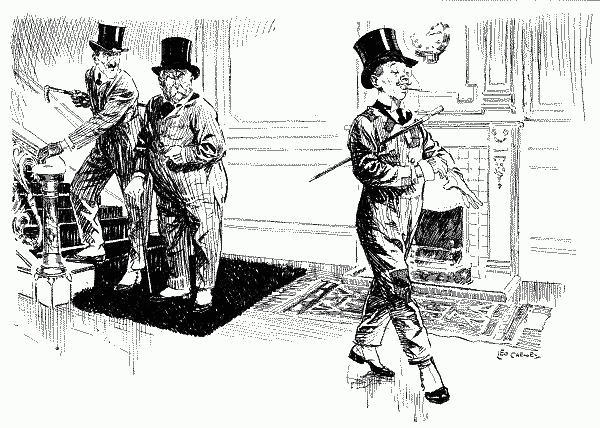
THE NICETIES OF CLOTHES ECONOMY.
"Good Lord! That fellow's actually had his overalls patched!"
"Darned little fop."
THE CAP THAT FITS.
"Gerald, dear," said my wife the other evening, "I wish you'd write and order some more notepaper; we've hardly any left."
"All right, Margaret. What sort do you want? The last lot was beastly—too thick to make into spills and not large enough for drawing up the fire."
"Well, here's a list of the different kinds they have in stock at Jones and Robinson's."
I took it from her and glanced through it. "What do you say to 'Cream Laid,' Margaret? I like the sound of that. It will make me feel so nice and cool in the hot weather to think of the rows of fresh-faced country girls, in their spotless white overalls, pouring the cream delicately over the paper. I wonder how they get it to stop exactly at the edge?"
"It wants a very cool head and steady hand, I expect," said Margaret; "they'd all be picked cream-layers, of course. But how would you like 'thick hand-made paper with deckle edges'? What are deckle edges, I wonder; and how is paper hand-made?"
"Rather like treading grapes, I fancy, only that's done by foot. I mean they smash up the pulp with a very heavy pestle in a huge——"
"Mortar!" cried Margaret triumphantly.
"Yes; but am I telling this story or are you? Well, and then they put it through a mangle——"
"Wurzel," said Margaret.
"Wrong—just a mangle, and roll it out flat, after which they deckle the edges."
"But how do they do that, Gerald?"
"Oh, they just call in the edge-deckler and say, 'See to 't that yon edges be deckled ere set o' sun,' and he sees to 't. His is a most important post, I believe."
Margaret came and sat on a tuffet by my chair.
"Sorry about wurzel," she said. "Now tell me all about machine-made paper, there's a dear. It will be so nice to be able to explain all this to Nat when he's older."
"Paper-making by machinery, my dear," I said graciously, "is a most complicated process. I won't puzzle you with all the details, but roughly the idea is to pulp up the—er—rags and so on in a huge sort of—er—bowl, and then to roll it out thin in the rolling-out machine."
Margaret thought this over. "It sounds just the same as the hand-made," she said.
"Oh, no," I said quickly; "it's all done by machinery, you see. Pistons and rollers and—er—mechanical edge-decklers and so on."
"And what does 'Linen Wove' mean?"
"They employ people to thread the paper with linen threads, my dear. A very delicate performance; that's why Linen Wove is so expensive. Azure Wove is, of course, done with blue flaxen threads. Silurian Bond is made by a fellowship of geologists, and for Chelsea Bank they have a factory on the bank of the Thames at Cheyne Walk. That's all I need tell you, though I know a lot more."
"I never realised before how awfully interesting paper-making could be," said Margaret gratefully. "Write and order me a good supply of Chelsea Cream Wove, will you, dear? Oh, and some other kind for yourself, to write your stories on. Don't forget."
"Very well; Chelsea Cream Wove for you. And what shall I have?"
Margaret's mouth twitched a little.
"Foolscap, I think, dear," she said.
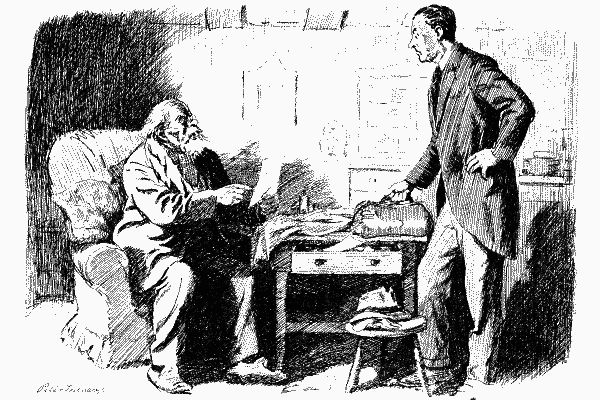
Sandy (viewing doctor's bill). "But the bill is no richt, Sir. Ye've charged me for seven days instead o' six. Dinna ye mind I was deleerious one day an' was not aweer of your presence?"
ANALGESIA.
(With Mr. Punch's best wishes for the speedy recovery of the French President.)
["President Deschanel ... was compelled to take several analgesia cachets. (Analgesia is a condition in which there is incapacity of feeling pain)."]—Evening Paper.
When, haply through excess of cake, In childhood's days of fun and frolic, I suffered from that local ache Known to the Faculty as colic; Or if across the foam I fared And was (invariably) sea-sick, How much distress had I been spared Just by a simple analgesic. In the Headmaster's awesome den, His cane poised o'er me palely bending, A lozenge deftly swallowed then Had eased the smart of its descending. Thus might I have indulged in "rags," Immune from every sore corrective, Nor need I then have stuffed my bags With notebooks, often ineffective. Henceforth, in any sort of fuss— Life's little incidental dramas, As when one boards a motor-bus Or leaps from trains in one's pyjamas— I'll take a tabloid. Deschanel! So much to me your agile feat meant; L'exemple presidentiel Lends quite a cachet to the treatment.
"59 ACCIDENTS IN 5 YEARS.
PROPOSED ROAD WIDENING TO INCLUDE CEMETERY CORNER."
Evening Paper.
The only alternative would appear to be to enlarge the cemetery.
AN ERROR OF JUDGMENT AT EPSOM.
I am not attending the Derby this year. Nor was it my original intention to go last year, but since my beneficent employers, unasked, offered me a day off, Selina insisted we ought to go. It was a national institution, a sight everyone should see once in a lifetime, and so forth. I protested it was an extravagance; that to be married was really more than we could afford, let alone race-meetings. But Selina was firm. She would pay, if necessary, out of the house-keeping money. Besides it need cost nothing. We might win enough money to cover our expenses.
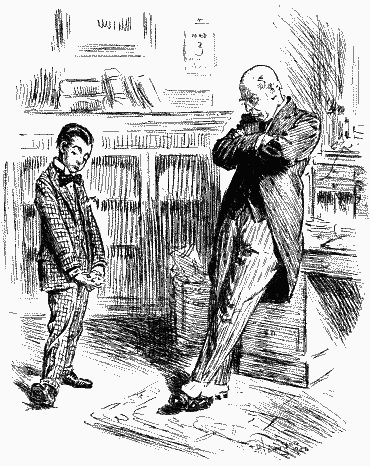
"So you absented yourself without leave, and went to Epsom. What have you got to say?"
"That it was worth it, Sir, even if it do mean the loss of my pension."
Thus the idea of betting was introduced. Gambling in all forms is against my principles; and how I came to give in on the point I scarcely know. From the way Selina argued one might have supposed that a bet on the Derby was a prudent investment, something in the nature of a life-insurance which no careful husband would neglect to make. So I yielded, merely stipulating that our stake was not to exceed one pound: and this amount fortunately satisfied Selina's conception of recklessness.
So upon the appointed day we found ourselves at the famous Heath, or is it the Downs? The selection of a horse to bear our fortunes to victory was not made without anxious debate, since Selina's choice was based upon the colour scheme of the jockey's coats, and mine on the romantic associations of the animals' names. In the end we compromised on a horse called Grand Parade.
Next, equally momentous, we selected a bookmaker who was to oblige us by opposing our fancy at the most advantageous rate. I was in favour of picking a man whose abundance of chin and paunch would, should he default, prevent his attaining more than four miles an hour on the flat. I had already discovered one that answered this description. He was soliciting clients in a voice that made one think a vulture might be rending his liver. Selina, who pretends to read character from faces, declared his eyes were too close together for those of an honest man. She had singled out a more suitable individual, and she indicated to me a slender gentlemanly man dressed in a grey frock-coat with a tall hat of the same colour just pathetically beginning to grow shabby. He also invited custom, but in a refined, almost confidential tone which, in comparison with the braying of his rival, resembled the cooing of a dove. His features, which to me denoted weakness of character, Selina asserted to be those of an honourable man struggling with adversity. It was to support an ailing wife, she felt sure, that he toiled at his uncongenial vocation. I should have liked to explain, though I knew it was useless, that our object in dealing with him was not to contribute to the support of his wife; that our success, indeed, might mean that the unhappy lady would be deprived for many a week to come of those little delicacies that are essential to the comfort of an invalid.
Against my better judgment I gave in and our little stake was deposited in his hands. I almost felt inclined to apologize for its smallness, but his courtesy in accepting it rendered excuses unnecessary. Nevertheless I should have preferred, when taking up a position to view the race, to have chosen a spot from which we could at the same time have kept an eye on his gentlemanly tall hat. Selina however poohpoohed the idea. We therefore walked some little distance to a point on the hill whence, some ten minutes later, we had the satisfaction of seeing Grand Parade gallop home a winner.
In the moment of triumph I had almost forgotten my apprehensions as to our bookmaker. Selina however had not, for, as we caught sight of his elegant grey-clad figure on our return, she could not resist exclaiming, "See how wrong your suspicions were."
The crowd, set loose after the tension of the race, impeded our progress, so that by the time we reached him he was alone. Apparently he had paid off all the other winners, and we were the last claimants to arrive.
"Ah, I was waiting for you," he said in his easy well-bred fashion. "You will think it very strange, perhaps, but for the moment I am unable to pay you. Most absurd. My losses have been rather more than I calculated, and I have unfortunately disbursed all my available cash. You need be under no apprehension, however; if you will kindly give me your address you shall have a cheque by the first post to-morrow."
I tried to recall what one did to welshers. I seemed to remember that one raised a hue-and-cry, that one tarred and feathered them, and rode them on a rail to a pond. I am, however, constitutionally timid about making my voice heard in public, and I was as short of tar and feathers as he was of ready cash. I had therefore no alternative but to draw out my pocket-case and present him with a card.
"Ah, thanks," he said, and with a neat little silver pencil he scribbled on the back a hieroglyph of some sort, doubtless to jog his memory. Then he wished me good-day with many apologies and, politely taking off his hat to Selina, sauntered leisurely in the direction of the railway-station.
I confess that this contretemps somewhat dashed my spirits. Nor was my chagrin lessened by observing, during the remainder of the afternoon, my corpulent friend, notwithstanding the closeness of his eyes to each other, paying off regularly, at the end of each race, a host of customers with the greatest good grace, enlivened by coarse jocularities. I followed the rest of the sport with little zest, and my cup of enjoyment was not filled to overflowing when, possessing first-class return tickets, we had to stand, Selina as well as myself, in a crowded third-class smoker.
Selina however preserved both her spirits and her confidence. Bookmakers, she had heard, were, as a class, most honourable. Their losses could not be recovered by law, but they regarded them as debts of honour. There were exceptions, of course, but the gentleman in grey was not one of them. Something told her so. I should see that she was right.
At breakfast next morning we scanned our post for a letter in an unfamiliar handwriting. There was none.
"It was really rather early to expect one," said Selina.
On the following morning, however, amongst others there lay a letter in a strange writing, addressed moreover in precisely the same style as the description of me on my visiting card.
"What did I tell you?" said Selina.
"Well?" she asked, as I tore open the envelope and read the letter.
"This must be some mistake," I said. "It is a demand from the railway for a first-class fare from Epsom to London. They state that I was detected travelling without a ticket. Ridiculous. I shall pay no attention to it."
In the evening, however, as I started home from the City, I thought better. It would save trouble if I looked in at London Bridge.
"You have come to pay?" said the chief clerk, as I showed him the note.
"Indeed I have not," said I. "On the contrary the Company should refund me the difference between first and third-class fare."
"Do you deny, then, that you travelled back from Epsom without a ticket?"
"Indeed I do."
"You will not deny, perhaps, that this is the card you handed the inspector with a promise to pay?"
I took the proffered card. I could not deny it, for the card was mine. I turned it over. There, faintly legible on the back in pencil, was the hieroglyph that the bookie had scrawled on it.
I explained to the clerk. I also explained to Selina when I got home. She, however, sticks to her original contention. She was not deceived. Fundamentally the man was honest. Only the expenses of his wife's long illness had caused him to deviate from the path of probity.
METHODIC MADNESS.
(By our Medical Correspondent.)
The newspapers have recently devoted a certain amount of space to the American millionaire who, while confined in a psychopathic ward of a private lunatic asylum, by his clever financial manipulations added in the course of six weeks five hundred thousand pounds to a fortune "conservatively estimated at three million pounds." In spite of this achievement the misguided millionaire pleaded earnestly for his release. But the verdict of the New York Sheriffs' Court was adverse. The expert "alienists" admitted that he possessed an extraordinary memory and undoubted genius, but held that he was none the less insane. Accordingly he is to remain in the psychopathic ward to which he was consigned "at the request of his aged mother." A simple sum in addition establishes the fact that, if the patient maintains his present average, he will considerably more than double his fortune in a year. Yet none of the newspaper commentators have realised the tremendous possibilities underlying this achievement.
We are threatened with national insolvency, and here is an infallible remedy ready to hand. Lord Fisher's panacea for our discontents was to "sack the lot"—to dismiss all our rulers and administrators. But he had only a glimmering of the truth. Our cry should rather be, "Lock up the lot." Experience has taught us that if complete latitude is given to eccentrics and incompetents, if, in the words of Professor Soddy, F.R.S., the destinies of the country are entrusted to people of archaic mental outlook, the result is bound to be disastrous and chaotic. But if you treat them as lunatics, there is a strong presumption of their mending their ways and proving valuable factors in the economic reconstruction of the Empire and the world.
Grave evils call for drastic treatment, and in view of the hectic condition of the Stock Exchange and the "vicious circle" round which industrialism is now unhappily revolving I cannot but think that the temporary seclusion of the Ministry in a psychopathic ward might be fraught with economic consequences of the utmost importance. Even if they were only able to reduce our indebtedness at the same rate as that attained by the American millionaire, their combined efforts would represent a magnificent total.
Perhaps it would be wiser to proceed tentatively and not commit ourselves for more than six weeks to start with. It is just conceivable that the treatment might stimulate extravagance instead of economy. Financial thrombosis is not unknown as one of the obscurer forms of megalomania. Still, as I have said, the experiment is worth making.
In other spheres of activity the results achieved are most encouraging. For example, an extremely outré Cubist who was recently consigned to a psychopathic ward at the instigation of his grandmother, developed a remarkable talent for painting in the manner of Marcus Stone; while a neo-Georgian composer under similar treatment has produced a series of études indistinguishable from the pianoforte music of Sterndale Bennett, though he had previously far outstripped the most unbridled and exacerbated aberrations of Scriabine in his latest phase.
Commercial Candour.
"YE OLDE TEA HOUSE
(Opposite the Church).
Home-Made Cakes. Antiques."
Local Paper.
"TO BE SURE.
'Why do you call that performing poodle Sidius?'
'He's a dog star, ain't he now?'"
Canadian Paper.
Still we don't see it.
THE PROVISION MERCHANT.
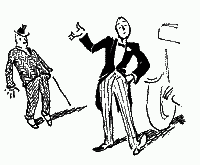
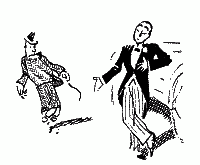
"Can we supply you with a car, Sir? Certainly. This is our 1920 touring model—provisional, of course. By the way, the body, you see, is only a provisional one.
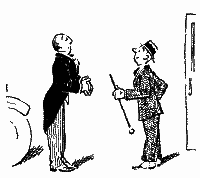
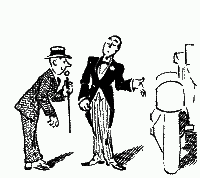
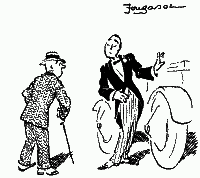
The engine design is purely provisional, you'll understand— and the horsepower is provisionally fixed at 12-78. Delivery is in eighteen months—quite provisional, that is—

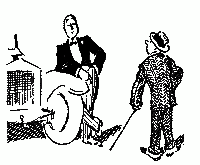
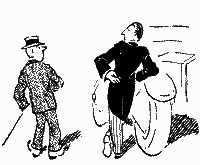
and the price we put provisionally at £1,200. We shall require, of course, a deposit of £600 before we can provisionally accept the order. I may add that a guarantee goes with each car—provisional, naturally—
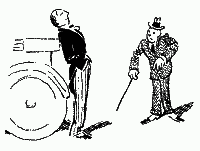
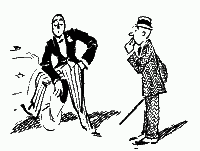
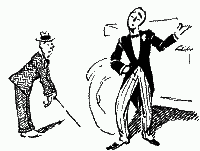
and we will provisionally undertake to inform you of any provisional alterations— that we may make in our provisional designs if you apply to our provisional works— —provided——No, Sir, I cannot tell you where you can hire a push-bike!!!"
AT THE PLAY.
"The Mystery of the Yellow Room."
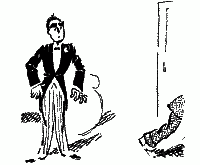
Gentlemen of the Press having been tactfully requested not to give away this awesome mystery, I am barred by the fastidious sense of honour which distinguishes our profession from spoiling your pleasure in this matter—a course which otherwise I should naturally have preferred.
Not that I have any too clear idea of what it was all about or why an innocent gentleman should be apparently going to be guillotined for it. For there was no question of anyone having been murdered, the only tangible crime before the Court that I could see being the abstraction of some scientific papers. However don't imagine that this vagueness will deprive you of the pleasures of shock. Only don't go thinking about it. Remember Rosamund and her Purple Jar.
I think I am free to tell you that a young journalist possessing (characteristically) "fantastic humour and exuberant gaiety," a famous amateur detective to boot, outwits all the official police, robs the law of its prey and finds a long-lost mother for himself.
If this doesn't excite you sufficiently you can extract fun from subsidiary details. It is always diverting to the unspoilt soul when the principal lady goes to turn up one lamp and the other promptly glows instead; or when, a particularly obvious and commonplace knock assaulting the ear, she exclaims in tragic accents, "There's someone at the door;" or when the detective drags from the bottom of the lake a pair of the driest of dry old boots.
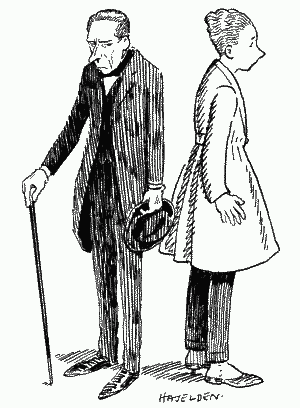
Joseph Rouletabille (Mr. Arthur Pusey) to Frederic Larsan (Mr. Franklin Dyall). "Father, I am a journalist; I cannot tell a lie. You did it!"
Or, if you are superior to this kind of thing, you can amuse yourself by deducing from the practice before you the famous Rules for Revolvers, which, mutatis mutandis, are as old as the Aristotelian unities and, for all I (or, probably, you) know to the contrary, were laid down at the same time by the same hand.
Rule 1. "All Innocent Characters expecting murderous assault from Particularly Desperate Villains will provide themselves with revolvers. Before retiring for the tragic night they will, grasping the revolver firmly in the right hand, place it carefully (as Professor Leacock would direct) on the revolver-stand. The P.D.V. will then know what to do about it. (Note: P.D.V.'s do not carry revolvers. They don't need to.)
Rule 2. "I.C.'s actually attacking P.D.V.'s will on no account fire, but, advancing stealthily, will offer their pistol-wrist to the enemy, who will at once lock it in a deathly grip. After a brief struggle, swaying this way and that, the P.D.V. will, on the word 'Four,' put on another beard and have the I.C. thrown into prison." And so forth.
I have no serious fault to find with these tactics. On the contrary. But I rather think that in the first Act an incident was introduced (no doubt in the spirit of the little girl's explanation à propos of her riddle, "That was just put in to make it more difficult"), which was not quite cricket as it is played by the best people in these stage shockers.
But I am on dangerous grounds. Let me say that Mr. Hannaford Bennett has been distinctly ingenious in his adaptation from M. Gaston Leroux's hectic feuilleton; that Miss Sybil Thorndike put in a much finer quality of work than is usually supplied with this kind of heroine; that Miss Daisy Markham as her friend played very gaily and prettily as long as the situation allowed it, and that Messrs. Franklin Dyall, Lewis Casson, Nicholas Hannen, Arthur Pusey, Major Jones, Colston Mansell and the Prompter all did notable work.
T.
Our Erudite Contemporaries.
"No doubt the inhabitants of the seaside resorts are duly grateful as they turn their faces to the trippers and the sun. Like Niobe, they are all smiles."—Provincial Paper.
"It certainly was a heavy swell, but the good ship 'Onward' had, so to speak, got its sea legs, and so had the party aboard; and although we rolled, it was a long steady roll which in time became almost most enjoyable."
Isle of Man Weekly Times.
It is on occasions like these that the Manxman finds his third leg so useful.
CUTCHERY CATS.
[In order to check the depredations of mice and rats the Government of India have directed the maintenance of cats in every public office ("Cutchery"). Rations do not err on the side of over-abundance, and the cats in consequence are not always the most favourable specimens.]
What time five notes on the cutchery gong The aged orderly rings, And he who calleth the waiting throng Striketh his work and sings, There cometh a man with broken meats, Cheerily calling, and him there greets With wailing of souls that are tried too long, A bevy of Fearsome Things. Ribbed as railings and lank as rods, Stark as the toddy trees, Swarming as when from the bursting pods Scatter the ripened peas, Flaming pupil and naked claw, Gaunt and desolate, maimed and raw, Cats by courtesy, but, ye gods! Never were cats like these. Nay, of a verity these be souls Such as in life were vile, Risen again from the nethermost coals To harry the earth a while; Versed in wickedness, old in sin, Never was hell could hold them in, And back they hasten in droves and shoals To desecrate and defile. Here where the shadow of Ancient Lies Falleth athwart the room, Where the Angel of Evil Counsel plies His chariot through the gloom, Where the Lost Endeavours and Faded Hopes Cluster like fruit in the mango-topes, Here is the perfectest paradise For the damned to work their doom. And swear will I by the Cloven Hoof And the name of the Manichees, By the hair that riseth despite reproof And the rebel veins that freeze, That at night, when the graves give up their dead And the thunder belloweth overhead, You would not get me under this roof For a lakh of the best rupees! * * * * * The Magistrate's risen and eke the Sub, And bicycles homeward spin; The clerks depart with a shrill hubbub And the snores of the guard begin; Ah, lock ye the strong-room sure and fast, For the night draws down and the day is past; Masters, I will away to the Club, For the hour of the cats is in. H. B.
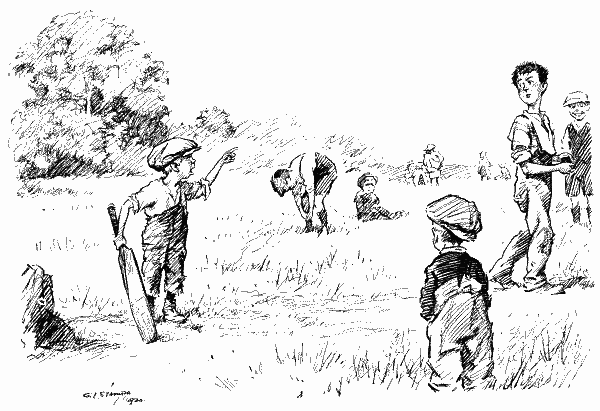
Batsman. "I don't want none of your under'ands. Bowl another an' I takes the bat 'ome—see?"
OUR BOOKING-OFFICE.
(By Mr. Punch's Staff of Learned Clerks.)
Although Madeline of the Desert (Unwin) is published in the First Novel series, it by no means follows that Mr. Arthur Weigall can be considered a beginner in authorship, his various activities already including some volumes on Egyptology that have made for him a wide circle of appreciative readers. You will therefore be correct in guessing that the Desert of the title is Egyptian; also that the story is one in which the setting and the local colour are treated with expert knowledge and an infectious enthusiasm. Of Madeline herself I should say at once that nothing in her life, as shown here, became her like the beginning of it. Her entrance into the tale, arriving out of the desert to consult the recluse, Father Gregory, whose nephew she afterwards marries, does very strikingly achieve an effect of personality. Madeline was a product of Port Said and, when we first meet her, an adventuress of international reputation, or lack of it. Then Robin rescues, marries and educates her. It was the last process that started the trouble. Madeline took to education more readily than a duck to water; and the worst of it was that she was by no means willing to keep the results and her conclusions therefrom to herself; indeed she developed the lecturing habit to an extent that almost (but not quite) ruined her charm. Mr. Weigall is so obviously sincere in all this that, though I cannot exonerate him from a charge of using Madeline as the mouthpiece of his own sociological and religious views, I must acknowledge his good intentions, while deploring what seems to me an artistic error. But, all said, the book is very far from being ordinary; its quality in the portrayal both of place and character is of the richest promise for future stories, in which I hope the author will give us more pictures of the land he understands so well.
I certainly admit that the publishers of The Strangeness of Noel Carton (Jenkins) have every justification for speaking of it as "a new note in a novel." Indeed that clever writer, Mr. William Caine, has here sounded as new, original and (for all its surface humour) horrible a note as any I have heard in fiction for some time. My trouble is that I can hardly indicate it without giving away the whole business. Very briefly the tale is of one Noel Carton, who has married beneath him for not quite enough money to gild a detestable union, and, being an unstable egoist and waster, presently seeks consolation (and pocket money) by writing a novel founded in part on his own position. One may note in passing that Mr. Caine seems to have but a modest idea of the mental equipment required for such a task. Still I suppose he knows, and anyway that isn't the point. The point is that, once Noel has got himself properly projected into his novel, all sorts of the queerest and most bogie coincidences begin to occur. Again to quote the puff preliminary, "as the book develops the reader has a suspicion which becomes almost a certainty, until the great and astounding climax is reached;" concerning which you may justly remark that no reader with a certainty would regard its verification as "astounding." But this takes nothing from the craft with which, on looking back, you see the climax to have been prepared. I could hardly call the tale altogether pleasant, but it is undeniably new and vastly original.
The good Sioux glories in his scalps, and Mr. Isaac F. Marcosson, of Louisville, must surely be the Great Chief of interviewers. Interviewing, he tells us, is, after all, only a form of reporting, and so are history, poetry and romance. What, he asks, were Mommsen and Gibbon, Wordsworth and Keats but reporters, and I can only answer, What indeed? To have been found worthy of tonsure by Mr. Marcosson it is necessary to be very eminent, and to win his highest praise it is essential also to be a good "imparter," though he has a kind of sneaking admiration for the paleface who insists on handing him a written statement and declines to speak. Such a one was Sir Edward Carson. Hanging to Mr. Marcosson's girdle are the chevelures of Mr. Lloyd George, Lord Haig, Marshal Foch, Sir James Barrie and Mr. Roosevelt, to name no more. Naturally Adventures in Interviewing (Lane) is full of side-lights on the recent war. How could it be otherwise when so many celebrated brains are laid bare? One quotation I cannot refrain from giving. Speaking of Lord Beaverbrook he says, "He had come to London a decade ago, to live 'the life of a gentleman,' but was drawn irresistibly into politics." I challenge our literature to produce a more beautiful "but."
Miss Edith Dart has grouped against her Dartmoor setting in Sareel (Philip Allan) just the characters to act out the well-worn story of the mutual infatuation of a young man of birth and an ignorant country maid. But though Sareel, the little workhouse-reared servant at the farm, falls in love in the accepted fashion with the best-looking of the three young men who lodge there on a reading tour, and though he duly falls in love with her, the innocence of her soul keeps their passion on the highest plane. What is more, when Alan, as such young gentlemen in fiction generally do, changes his mind Miss Dart provides a happy ending, without even a suicide to spoil it, and without inconsistency either in her own point of view or in that of her characters. I don't really believe that Devonshire people say that they like things "brave and well" quite as often as Miss Dart makes hers, and I wish she had not so great a fondness for the word "such" that she must invent phrases as weird as "though he had not sought such" in order to bring it in; but apart from these trifles Sareel, as something like a feminine version of a book by Mr. Eden Phillpotts arranged for family reading, will certainly please a great many people.
If you would like to see a white lady ride on a white horse to Banbury Cross and elsewhere with a body-guard of men in tin hats, carrying The Banner (Collins) and proclaiming the League of Youth (against war and other evils) and forcible retirement from all offices of profit or power under the Crown at the age of forty, get Mr. Hugh F. Spender's new and, as it seems to me, rather ingenuous novel. Love is not neglected, for a peer's son, deaf and dumb through shell-shock, so responds to the counter-irritant of seeing this modern Joan riding through Piccadilly that he recovers both speech and hearing and promptly uses them to put her a leading question and understand her version of "But this is so sudden. However——" There is a people's army; a rose-water revolution with the King accepting it as all in the day's dull work; a fight or rather an arming of a few last-ditchers of the old order, and much else that is not likely to happen outside Ruritania. Also candid expression of the opinions of (I take it) the "Wee Frees" concerning Glamorgan Jones.
If Mr. Alan Graham does not unsettle my conviction that it is easier to begin a story of hidden treasure than it is to finish it, I can nevertheless promise you a good day with the sleuth-hounds, should you decide to Follow the Little Pictures (Blackwood). For some not too lucid reason I went to the meet with a fear in my heart that the command in the title referred to the "movies," and my relief was great on discovering that it was taken from a cipher containing the key to the treasure. The scene of this hunt is laid in Scotland, and the most notable figure among its followers is a certain Laird Tanish. The pecuniary fortunes of the Tanish clan were at a low ebb, and in his determination to improve them by winning the prize the Laird broke all the rules of the game and gave way to terrific outbursts of rage in the manner of those explosive gentlemen with whom Miss Ethel Dell has familiarised us. There is both ingenuity and originality in this story, and I should be doing the author and his readers a great disservice if I disclosed the details of the plot. Anyone with a bent for treasure-hunting will be missing a fine opportunity if he refuses to have a day (or a night) with Mr. Graham's hounds.
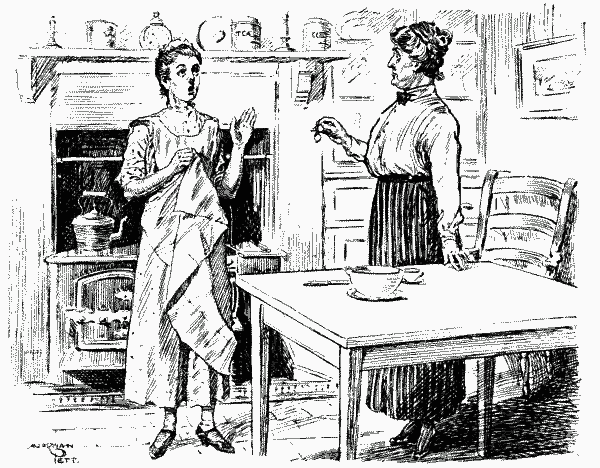
Mistress. "Norah, do you ever repeat anything you hear the master and myself say to each other when we have a slight difference of opinion?"
Domestic. "The Saints forbid, Mum!"
A Sympathetic Auditor.
"Dr. R. C. Ghostley, of Edmonton, was in the city last week and attended Sir Oliver Lodge's lecture."—Canadian Paper.
"W. W. ——, the Rugby International forward, won his third success in four days at Chesham Oddfellows' and Foresters' sports yesterday, when he took first prize in the 10 yards open event, with 7½ yards start, in 9 2⁄5 sec."—Daily Paper.
His strong point, we gather, is not speed but staying-power.
À propos of the De Keyser case:—
"Unfortunately, the Dora regulations against free speech and printing were never taken before the High Court, and our ancestors will wonder at our timidity."—Daily Herald.
We understand that Sir A. Conan Doyle has already received several urgent messages on the subject.
Transcriber's Note: Corrections are indicated, in the text, by a dotted line underneath the correction. Scroll the mouse over the word and the original text will appear. Summary of Corrections: p. 438: Removed extraneous "'s" from "GASTON'S" ... [M. GASTON LEROUX'S] p. 440: Changed "9 2-5" to "9 2⁄5" ... [in 9 2⁄5 sec."--_Daily Paper_.]