Volume 156 — THE ANNIVERSARY.
Reading edition
The 23rd. To-day, my son, Two turgid years ago, Your father battled with the Hun At five A.M. or so; This was the day (if I exclude A year of painful servitude Under the Ministry of Food) I struck my final blow. Ah, what a night! The cannon roared; There was no food to spare; And first it froze and then it poured; Were we dismayed? We were. Three hundred yards we went or more, And, when we reached, through seas of gore, The village we were fighting for, The Germans were not there. But miles behind a 9·2 Blew up a ration dump; Far, far and wide the tinned food flew From that tremendous crump: And one immense and sharp-toothed tin Came whistling down, to my chagrin, And caught me smartly on the shin— By Jove, it made me jump. A hideous wound. The blood that flowed! It was a job to dress; I hobbled bravely down the road And reached a C.C.S.; Nor was I so obsessed with gloom At leaving thus the field of doom As one might easily assume From stories in the Press. Though other soldiers as they fell— Or so the papers say— Cried, "GEORGE for England! Give 'em hell!" (It was ST. GEORGE'S Day), Inspiring as a Saint can be, I should not readily agree That anyone detected me Behaving in that way. Such is the tale. And, year by year, I shall no doubt relate For your fatigued but filial ear The history of this date; Yet, though I do not now enhance The crude events of that advance, There is a wild fantastic chance That they will grow more great. So be you certain while you may Of what in fact occurred, And if I have the face to say On some far 23rd That on this day the war was won, That I despatched a single Hun, Or even caught a glimpse of one— Don't you believe a word. A.P.H.
Another Impending Apology.
"Miss —— looked sweetly pretty in an emerald-green satin (very short) skirt, white blouse, and emerald handkerchief tied over her head—an Irish Colleen, and a bonie one too!"—Colonial Paper.
"According to a Vienna message, the Government has introduced a Bill dealing with the former reigning Mouse of Austria."—Provincial Paper.
Alas, poor KARL! Ridiculus mus.
"Wanted one hour daily from ten to eleven morning at convenience an English Talking Family for practice of talking. Remuneration twenty rupees per mensem."—Times of India.
We know one or two "talking families" that we should be glad to export.
"In finding the defendant £3, Mr. Price told the defendant that he would get into serious trouble if he persisted in his conduct."—Evening Paper.
And he may not meet such a generous magistrate next time.
"Englishman, well educated, desires afternoon engagement; experienced in the care of children; good needlewoman; or would assist light housework."—Canadian Paper.
We hope we shall hear no further complaints from Canada that Englishmen are not adaptable.
COMMUNICATIONS.
I was sitting in the Club, comfortably concealed by sheets of a well-known journal, when two voices, somewhere over the parados of the deep arm-chair, broke in upon my semi-consciousness.
"... Then poor old Tubby, who hasn't recovered from his 1918 dose of shell-shock, got a go of claustrophobia and felt he simply had to get out of the train."
The speaker paused and I heard the clink of glass.
"Well?" said the other voice.
"So, before we could flatten him out, he skipped up and pulled the communicator thing and stopped the train; consequently we ran into Town five minutes behind time. There was the deuce of a buzz about it."
"What's five minutes in this blissful land of lotus-eaters? Why, I've known the Calais-Wipers express lose itself for half-a-day without a murmur from anyone, unless the Brigadier had run out of bottled Bass."
"But, my dear fellow," the first voice expostulated, "this was the great West of England non-stop Swallowtail; runs into Town three minutes ahead of time every trip. Habitués of the line often turn an honest penny by laying odds on its punctuality with people who are strangers to the reputation of this flier."
"A pretty safe thing to bet on, eh?" said the other voice. Again there was the faint clink of glass and then the voices drifted into other topics, to which, having re-enveloped myself in my paper, I became oblivious.
A few days later I was called away from London, with Mr. Westaby Jones, to consult in a matter of business. Mr. Westaby Jones is a member of the Stock Exchange and, amongst other trivial failings, he possesses one which is not altogether unknown in his profession. He cannot resist a small wager. On several occasions he has gambled with me and shown himself to be a gentleman of considerable acumen.
Our business was finished and we were on the way back to Town by the great West of England non-stop Swallowtail. We had lunched well and discussed everything there was to discuss. It was a moment for rest. I unfolded my paper and proceeded to envelop myself in the usual way.
I seemed to hear the chink of glasses ... a voice murmured, "A pretty safe thing to bet on."
Then in a dreamy sort of manner I realised that Fate had delivered Westaby Jones into my hands. When we were within twenty miles of London I opened the campaign. I grossly abused the line on which we were travelling and suggested that anybody could make a fortune by assuming that its best train would roll in well after the scheduled time.
Westaby Jones, having privily ascertained that the engine-driver had a minute or so in hand, immediately pinned me down to what he thought (but wisely did not say) were the wild inaccuracies of an imbecile. He did it to the extent of twenty-five pounds, and I sat back with the comfortable feeling of a man who will shortly have a small legacy to expend. At the moment which I had calculated to be most auspicious I suddenly threw off the semblance of boredom, rose up, lurched across the carriage and pulled the communication cord. (For the benefit of those who have not done this I may say that the cord comes away pleasantly in the hand and, at the same time, gives one a piquant feeling of unofficial responsibility.) Westaby Jones was, for a stockbroker, obviously astonished.
"What on earth are you doing?" he exclaimed.
"Sit down," I said; "this is my improved exerciser."
"But you'll stop the train," he shouted.
"Never mind," I replied; "what's a fine of five pounds compared to physical fitness? Besides," I added significantly, "it may be a good investment after all."
For perhaps twenty seconds there was the silent tension of expectation in the air and then I realised with a shock that the train did not show any signs of slackening speed. It was, if anything, going faster. I snatched frantically at the cord and pulled about half-a-furlong into the carriage. We flashed past Ealing like a rocket, and I desperately drew in coils and coils of the communicator until I and Westaby Jones resembled the Laocoon. It was no good. Smoothly and irresistibly we glided into the terminus and drew up at the platform three minutes ahead of time.
I have paid Westaby Jones, who was unmannerly enough to look pleased. I have also corresponded with the railway company, claiming damages on the grounds of culpable negligence. Unfortunately they require more evidence than I am prepared to supply of the reasonable urgency of my action.
From a theatre programme:—
"The name of the actual and responsible Manager of the premises must be printed at least once during every performance to ensure its being in proper order."
So that explains the noise going on behind the scenes.
NATURE NOTES.
The Cuckoo has arrived and will sing as announced.
One of the results of the arrival of the Cuckoo is the prevalence of notices, for those that have eyes to see, drawing attention to the ineligible character of nests. These take a variety of forms—such as "All the discomforts of home," "Beware of mumps," "We have lost our worm cards," "Serious lining-shortage"—but the purpose of each is to discourage the Cuckoo from depositing an egg where it is not wanted.
From all parts of the country information reaches us as to the odd nesting-places of wrens and robins. A curious feature is the number of cases where letter-boxes have been chosen, thus preventing the delivery of letters, and in consequence explaining why so many letters have not been answered. Even the biggest dilatory correspondent is not ashamed to take advantage of the smallest bird.
The difficulty of obtaining muzzles is very general and many dog-owners have been hard put to it to comply with the regulation. From these, however, must be excepted those who possess wire-haired terriers, from whose coats an admirable muzzle can be extracted in a few minutes.
The statement of a telephone operator, that "everything gives way to trunks," is said to have caused great satisfaction in the elephant house at the Zoo.
PLEASE.
Please be careful where you tread, The fairies are about; Last night, when I had gone to bed, I heard them creeping out. And wouldn't it be a dreadful thing To do a fairy harm? To crush a little delicate wing Or bruise a tiny arm? They 're all about the place, I know, So do be careful where you go. Please be careful what you say, They're often very near, And though they turn their heads away They cannot help but hear. And think how terribly you would mind If, even for a joke, You said a thing that seemed unkind To the dear little fairy folk. I'm sure they're simply everywhere, So promise me that you'll take care. R.F.
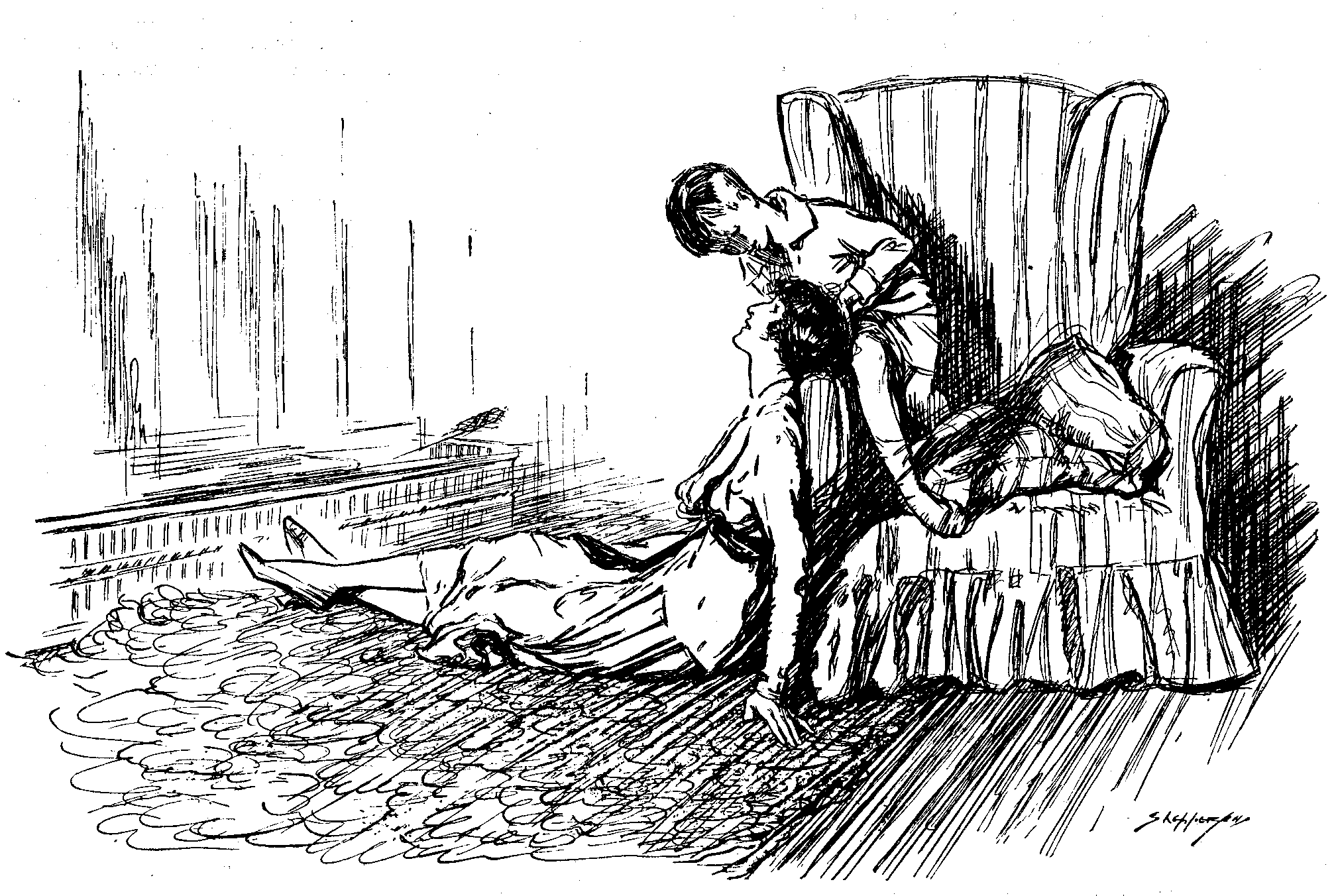
Harold (after a violent display of affection). "'TISN'T 'COS I LOVE YOU—IT'S 'COS YOU SMELL SO NICE."