Volume 156 — ESSENCE OF PARLIAMENT.
Reading edition
Tuesday, April 29th.—When the House of Commons re-assembled this afternoon a good many gaps were noticeable on the green benches. They were not due, however, to the New Year's Honours, which made a belated appearance this morning, for not a single Member of Parliament has been ennobled. The notion that not one of the seven hundred is worthy of elevation is, of course, unthinkable. But by-elections are so chancy.
Mr. JEREMIAH MACVEAGH still has some difficulty in realising that the Irish centre of gravity has shifted from Westminster to Dublin. He indignantly refused to accept an answer to one of his questions from little Mr. PRATT, and loudly demanded the corporeal presence of the CHIEF SECRETARY. Mr. MACPHERSON, however, considers that his duty requires him to remain in Ireland, where Mr. MACVEAGH'S seventy Sinn Fein colleagues are keeping him sufficiently busy.
In explaining the swollen estimates of the Ministry of Labour, Sir ROBERT HORNE pointed out that it is now charged with the functions formerly appertaining to half-a-dozen other Departments. He has indeed become a sort of administrative Pooh-Bah. Unlike that functionary, however, he was not "born sneering." On the contrary, he made a most sympathetic speech, chiefly devoted to justifying the much-abused unemployment donation, which accounts for twenty-five out of the thirty-eight millions to be spent by his Department this year. But let no one mistake him for a mere HORNE of Plenty, pouring out benefits indiscriminately upon the genuine unemployed and the work-shy. He has already deprived some seventeen thousand potential domestics of their unearned increment, and he promises ruthless prosecution of all who try to cheat the State in future.
Criticism was largely silenced by the Minister's frankness. Sir F. BANBURY, of course, was dead against the whole policy, and demanded the immediate withdrawal of the civilian grants; but his uncompromising attitude found little favour. Mr. CLYNES thought it would have been better for the State to furnish work instead of doles, but did not explain how in that case private enterprise was to get going. France's experience with the ateliers nationaux is not encouraging, though 1919, when "demobbed" subalterns turn up their noses at £250 a year, is not 1848.
Wednesday, April 30th.—Mr. AUSTEN CHAMBERLAIN, returning to the Exchequer after an interval of thirteen years, made a much better Budget speech than one would have expected. It was longer, perhaps, than was absolutely necessary. Like the late Mr. GLADSTONE, he has a tendency to digress into financial backwaters instead of sticking to the main Pactolian stream. His excursus upon the impracticability of a levy on capital was really redundant, though it pleased the millionaires and reconciled them to the screwing-up of the death-duties. Still, on the whole, he had a more flattering tale to unfold than most of us had ventured to anticipate, and he told it well, in spite of an occasional confusion in his figures. After all, it must be hard for a Chancellor who left the national expenditure at a hundred and fifty millions and comes back to find it multiplied tenfold not to mistake millions for thousands now and again.
On the whole the Committee was well pleased with his performance, partly because the gap between revenue and expenditure turned out to be a mere trifle of two hundred millions instead of twice or thrice that amount; partly because there was, for once, no increase in the income-tax; but chiefly, I think, for the sentimental reason that in recommending a tiny preference for the produce of the Dominions and Dependencies Mr. CHAMBERLAIN was happily combining imperial interests with filial affection.
Almost casually the CHANCELLOR announced that the Land Values Duties, the outstanding feature of Mr. LLOYD GEORGE'S famous Budget of 1909, were, with the approval of their author, to be referred to a Select Committee, to see if anything could be made of them. If only Mr. ASQUITH had thought of that device when his brilliant young lieutenant first propounded them! There would have been no quarrel between the two Houses: the Parliament Act would never have been passed, and a Home Rule Act, for which nobody in Ireland has a good word, would not now be reposing on the Statute-Book.
In the absence of any EX-CHANCELLOR OF THE EXCHEQUER the task of criticism was left to Mr. ADAMSON, who was mildly aggressive and showed a hankering after a levy on capital, not altogether easy to reconcile with his statement that no responsible Member of the Labour Party desired to repudiate the National Debt. Mr. JESSON, a National Democrat, was more original and stimulating. As a representative of the Musicians' Union he is all for harmony, and foresees the time when Capital and Labour shall unite their forces in one great national orchestra, under the directing baton of the State.
At the instance of Lord STRACHIE the House of Lords conducted a spirited little debate on the price of milk. It appears that there is a conflict of jurisdiction between the FOOD-CONTROLLER and the MINISTER OF AGRICULTURE, and that the shortage in the supply of this commodity must be ascribed to the overlapping of the Departments.
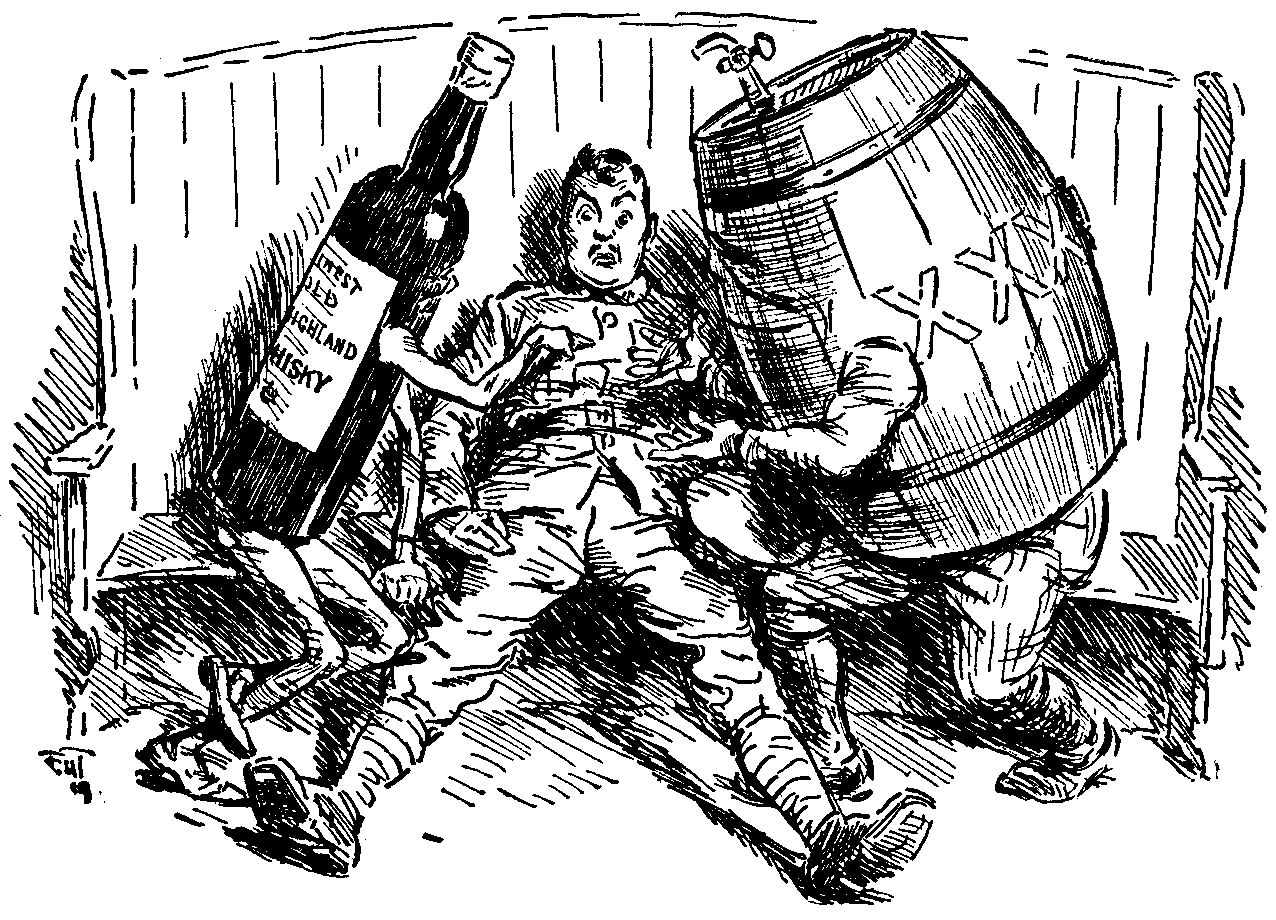
Budget Victims. "YOU MAY HAVE WON THE WAR, BUT WE'VE GOT TO PAY FOR IT."
Thursday, May 1st.—Sinn Fein has decreed that nobody in Ireland should do any work on May Day. Messrs. DEVLIN and MACVEAGH, however, being out of the jurisdiction, demonstrated their independence by being busier than ever. The appointment of a new Press Censor in Ireland furnished them with many opportunities at Question-time for the display of their wit, which some of the new Members seemed to find passably amusing.
Mr. DEVLIN'S best joke was, however, reserved for the Budget debate, when, in denouncing the further burdens laid on stout and whisky, he declared that Ireland was, "apart from political trouble," the most peaceful country in the world.
The fiscal question always seems to invite exaggeration of statement. The CHANCELLOR'S not very tremendous Preference proposals were denounced by Sir DONALD MACLEAN as inevitably leading to the taxation of food and to quarrels with foreign countries. Colonel AMERY, on the other hand, waxed dithyrambic in their praise, and declared that by taking twopence off Colonial tea the Government were not only consecrating the policy of Imperial Preference, but were "putting the coping-stone on it."
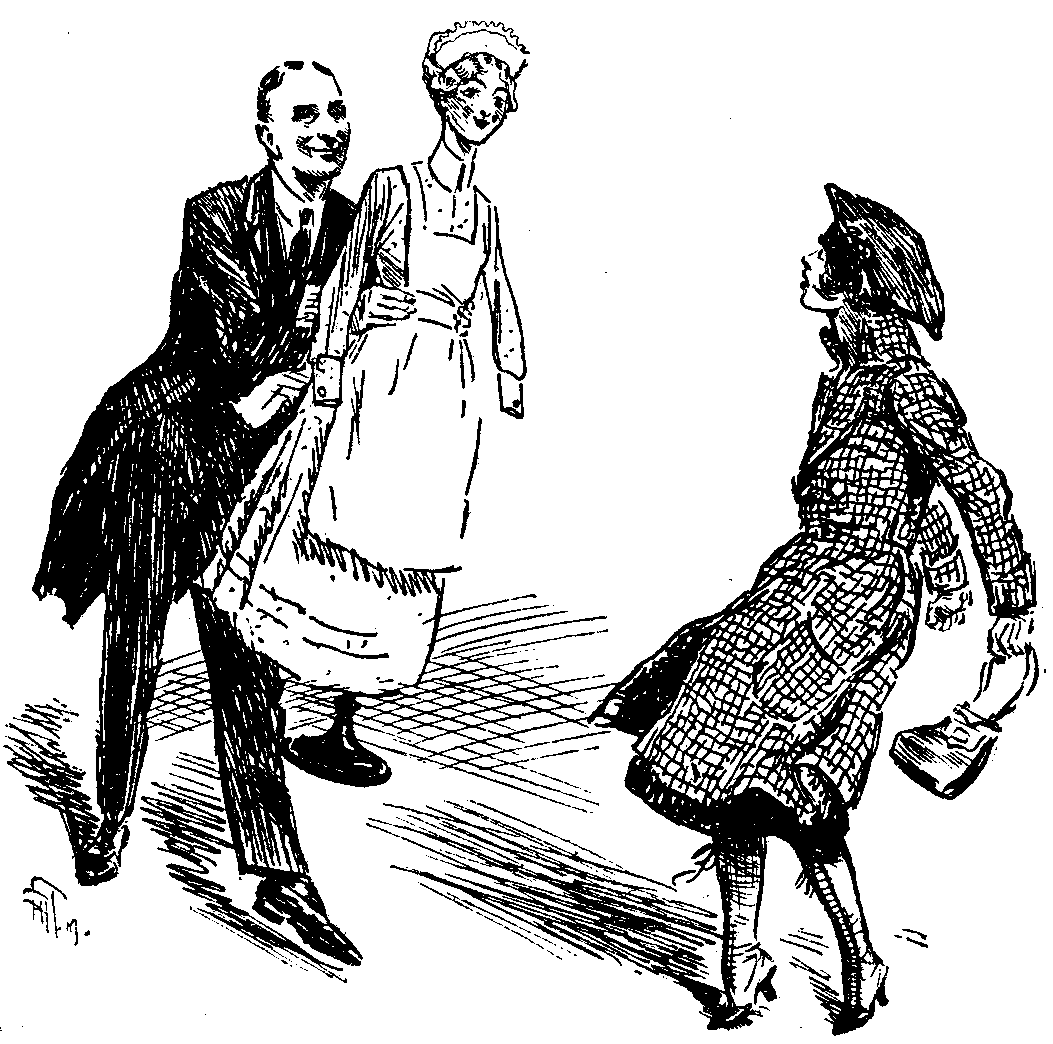
The Minister of Labour (anxious to find work for the ex-munitionette drawing unemployment pay). "HERE, MODOM, IS A CHARMING MODEL WHICH WOULD SUIT YOU, IF I MAY SO PUT IT, DOWN TO THE GROUND."
A CELTIC COUNTER-BLAST.
The continued domination of the Russians in the domain of the ballet has already excited a certain amount of not unfriendly criticism. But our Muscovite visitors are not to be allowed to have it all their own way, and we understand that negotiations are already on foot with a view to enabling the Irish Ballet to give a season at a leading London theatre in the near future.
The Irish Ballet, which is organised on a strictly self-determining basis, is one of the outcomes of the Irish Theatre, but derives in its essentials directly from the school established by Cormac, son of Art. That is to say it is in its aims, ideals and methods permeated by the Dalecarlian, Fomorian, Brythonic and Firbolgian impulse. Mr. Fergal Dindsenchus O'Corkery, the Director, is a direct descendant of Cuchulinn and only uses the Ulidian, dialect. Mr. Tordelbach O'Lochlainn, who has composed most of the ballets in the répertoire, is a chieftain of mingled Dalcassian and Gallgoidel descent. The scenery has been painted by Mr. Cathal Eochaid. MacCathamhoil, and the dresses designed by Mr. Domnall Fothud O'Conchobar.
The artists who compose the troupe have all been trained during the War at the Ballybunnion School in North Kerry, and combine in a wonderful way the sobriety of the Delsartean method with the feline agility of that of Kilkenny. Headed by the bewitching Gormflaith Rathbressil, and including such brilliant artists as Maeve Errigal, Coomhoola Grits, Ethne O'Conarchy, Brigit Brandub, Corcu and Mocu, Diarmid Hy Brasil, Murtagh MacMurchada, Aillil Molt, Mag Mell and Donnchad Bodb, they form a galaxy of talent which, alike for the euphony of its nomenclature and the elasticity of its technique, has never been equalled since the days of ST. VITUS.
We have spoken of the work of Mr. O'Lochlainn, who is responsible for the three-act ballet, Brian Boruma; a fantasy on the Brehon laws, entitled The Gardens of Goll; Poulaphuca, and the Roaring of O'Rafferty; but the repertory also includes notable and impassioned compositions by Ossian MacGillycuddy, Aghla Malachy, Carolan MacFirbis and Emer Sidh. The orchestra employed differs in many respects from that to which we are accustomed, the wood-wind being strengthened by a quartet of Firbolg flutes and two Fodlaphones, while the brass is reinforced by a bass bosthoon, an instrument of extraordinary depth and sonority, and the percussion by a group of Dingle drums.
But enough has been said to show that the Irish ballet is assured in advance of a cordial reception from all admirers of the neo-Celtic genius.
"A Bill has been introduced in Florida providing that 'from and after equal suffrage has been established in Florida it shall be lawful for females to don and wear the wearing apparel of man as now worn publicly by him.'"—Western Morning News.
Happily they cannot take the breeks off a Highlander.
COLLABORATION.
Biddick has placed me in a most awkward position. I am a proud man; I cannot bring myself to accept a gift of money from anybody. And yet I cannot help feeling I should be justified in taking the guinea he has sent me.
Biddick is a journalist. I was discussing the inflation of prices and asking his advice as to how to increase one's income. "Why not write something for the Press, my dear fellow?" he said. "Five hundred words with a catchy title; nothing funny—that's my line—but something solid and practical with money in it; the public's always ready for that. Take your neighbour, old Diggles, and his mushroom-beds, for instance. Thriving local industry—capital copy. Try your hand at half a column, and call it 'A Fortune in Fungus.'"
"I 'm afraid I know nothing about mushrooms, with the exception of the one I nearly died of," I replied, "and I'm not sufficiently acquainted with Mr. Diggles to venture to invite his confidence respecting his business."
"My dear man, I don't ask you to tell Diggles you're going to write him up in the newspapers; he'd kick you off the premises; he doesn't want his secrets given away to competitors. Just dodge the old man round the sheds, get into conversation with his staff, keep your eyes open generally and you'll pick up as much as you want for half a column. And when you've got your notes together bring 'em along to me. I'll put 'em shipshape for you."
I thanked him very gratefully.
The mushroom-sheds are situated in a field some distance from my residence, and I found it rather a fatiguing walk. After tedious watching in a cramped position through a gap in the hedge I saw Mr. Diggles emerge from a shed and move away from my direction. I lost no time in creeping forward under cover of my umbrella towards an employee, who was engaged in tossing manure. I drew out my note-book and interrogated him briefly and briskly.
"Do you rear from seeds or from cuttings?" I asked him. He scratched his head and appeared in doubt. "Are your plants self-supporting," I went on, "or do you train them on twigs? What would be the diameter of your finest specimen?" He continued in doubt. I adopted a conversational manner. "I suppose you'll be potting off soon? You must get very fond of your mushrooms. I think one always gets fond of anything which demands one's whole care and attention. I wonder if I might have a peep at your protégés?"
I edged towards the door of one of the sheds, but he made no attempt to accompany me. Instead he put his hands to his mouth and shouted, "Hi, maister!"
Mr. Diggles promptly responded to the summons. There was no eluding him. I put my note-book out of sight and inquired if he could oblige me with a pound of fresh-culled mushrooms. He could, and he did. I paid him four-and-sixpence for them, the control price presumably, but he gave me no invitation to view the growing crops. I retraced my steps without having collected even an opening paragraph for "A Fortune in Fungus."
The next day found me again near the sheds. Mr. Diggles was nowhere in sight. I approached unobtrusively through the hedge and accosted a small boy.
"Hulloa, my little man," I said, "what is your department in this hive of industry? You weed the mushrooms, perhaps, or prune them?" He seemed shy and offered no answer. "Perhaps you hoe between the plants or syringe them with insecticide?"
Still I could not win his confidence, so I tried pressing sixpence into his palm. "Between ourselves, what are the weekly takings?" I said. He pocketed the coin and put his finger on his lips.
"Belge," he said. Then he bolted into a shed and returned accompanied by Mr. Diggles. There was nothing for it but to purchase another pound of mushrooms. I was no nearer "A Fortune in Fungus" than before.
Two days later, having received apparently reliable information that Mr. Diggles was confined to his bed with influenza, I ventured again to visit the sheds. I was advancing boldly across the field when to my consternation he suddenly appeared from behind a hayrick. I was so startled that I turned to fly, and in my precipitancy tripped on a tussock and fell. Mr. Diggles came to my assistance, and, when he had helped me to my feet and brushed me down with a birch broom he was carrying, I could do nothing less than buy another pound of his mushrooms.
I felt it was time to consult Biddick. He was sitting at his desk staring at a blank sheet of paper. His fingers were harrowing his hair and he looked distraught.
"Excuse the interruption," I said, "but this 'Fortune in Fungus' is ruining me;" and I related my experience.
At the finish Biddick gripped my hand and spoke with some emotion. "Dear old chap," he said, "it's my line, after all. It's funny. If only I can do it justice;" and he shook his fountain-pen.
This morning I received a guinea and a newspaper cutting entitled "A Cadger for Copy," which may appeal to some people's sense of humour. It makes none to mine. In the flap of the envelope Biddick writes: "Halves, with best thanks."
Upon consideration I shall forward him a simple formal receipt.
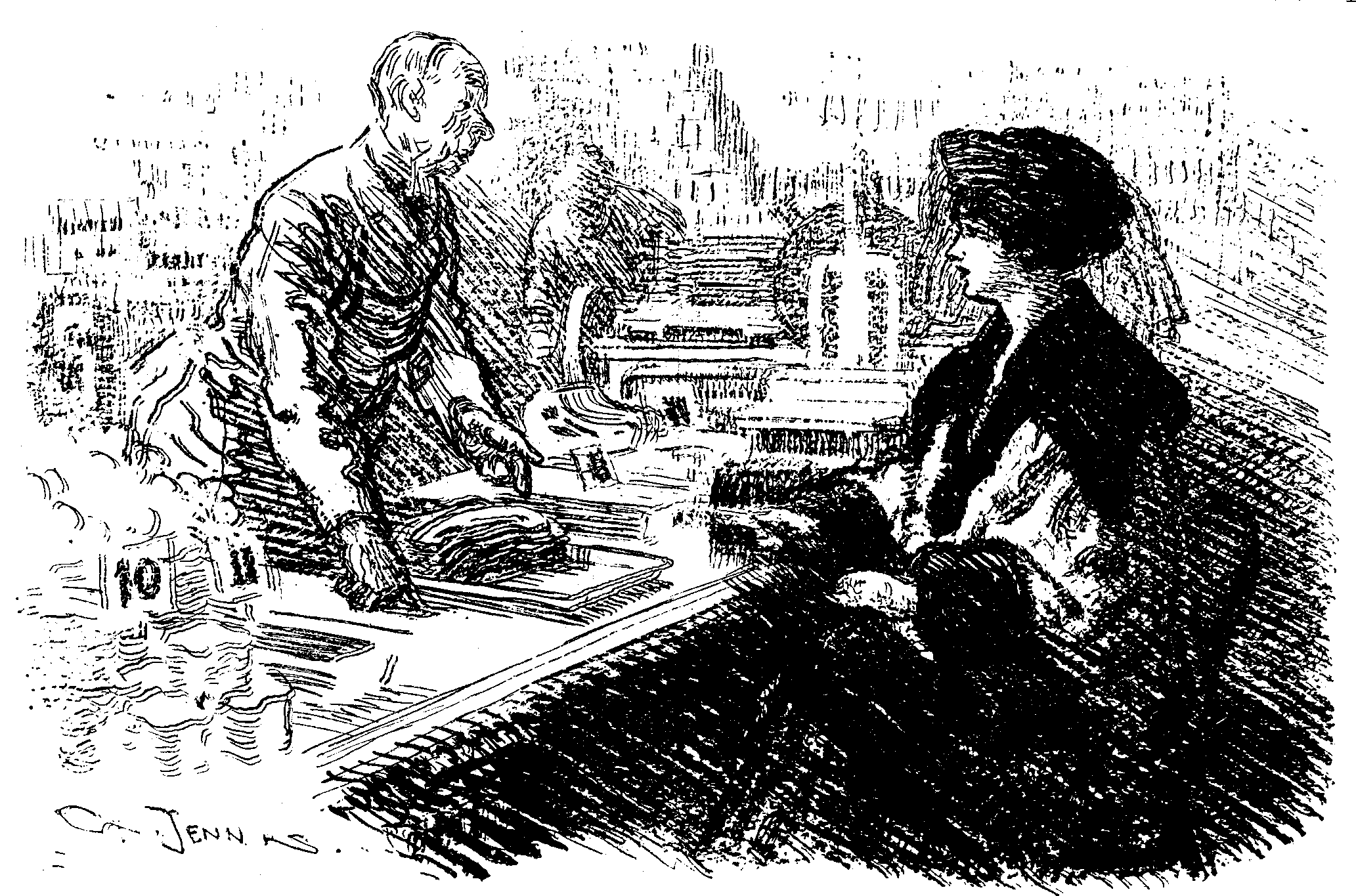
"IT LOOKS QUITE LIKE PRE-WAR BACON."
"ON THE CONTRARY, MADAM, PERMIT ME TO ASSURE YOU IT IS OUR FINEST 'POST-BELLUM STREAKY.'"
From a bookseller's catalogue:—
"THE ART OF TATTING.
This book is intended for the woman who has time to spare for reading, Tatting being such quick and easy work that busy fingers can do both at the same time."
An edition in Braille would appear to be contemplated.