Volume 156 — MURMAN AMENITIES.
Reading edition
This was to have been an essay from an igloo, describing the awful privations of the writer and the primitive savagery of his surroundings on the Murman coast. It was to have wrung the sympathetic heart of the public and at the same time to have enthralled the student of barbaric life with its wealth of exotic detail. While embodying all the best-known newspaper clichés appropriated to these latitudes it was to have included others specially and laboriously prepared after a fascinating study of Arctic literature.
But circumstances have blighted its early inspiration, and the article it was to have been will never be written, the telling word-pictures designed on board the transport never executed.
Figure the disgust of five adventurers who, landing at the Murman base, sternly braced to encounter the last extremity of peril and of hardship, to sleep in the snow and dig one another out o' mornings, to give the weakest of their number the warmest icicle to suck, the longest candle to chew—found themselves billeted in a room which the landladies of home would delight to advertise! Its walls were hung with such pictures as give cheap lodgings half their horror; it was encumbered with countless frail chairs and "kiggly" tables, and upon every flat surface had settled a swarm of albums, framed photographs, china dogs, wax flowers, penholder-stands, and all the choicest by-products of civilization struggling towards culture. As we were not to be frozen by exposure or immediately attacked by Bolshies, we might reasonably have expected to be asphyxiated by the Russian stove; but even this consolation was denied us, since Madame, convinced that the English are mad in their love of fresh air, consented to leave it unlit.
When first we arrived, five large soldiers with five large kits, the aspect of the room filled us with terror. The fiercest frost or foe we could have faced, but the bravest man may quail before wax-flowers and fragile tables top-heavy with ornaments and knick-knacks, and all felt that to encounter such things within the Arctic Circle was an unfair test of our fortitude. Why had not the War Office or some newspaper correspondent warned us?
Madame, however, proved to have a sense of proportion or humour; or perhaps the collection was not her own. In any case she showed no reluctance to displace family photographs or china dogs, and rapidly had the room cleared for action; so that now, when we roll about the floor in friendly struggle, it is only someone's toilet tackle that crashes with its spidery table, instead of cherished artificial fauna and flora.
Thanks to our serviceable and becoming Arctic kit and the steady approach of the Spring thaw, heralded by the preparation of spare bridges to replace the existing ones, we can defy the eccentricities of the climate. Even the language begins to reveal what might be termed hand-holds; though possibly, when the natives echo our words of greeting, painfully acquired from textbooks on Russian, they are simply imitating the sounds we make under the impression that they are learning a little English.
More difficult problems arise, however, regarding questions of military etiquette. Not King's Regulations, nor Military Law, nor any handbook devotes even a sub-paragraph to light and leading upon certain points which we have here to consider every day. For example, if a subaltern glissading on ski down the village street, maintaining his precarious balance by the aid of a "stick" in each hand, meets a General, also on ski and also a novice, what should happen? What does happen we know by demonstration: the subaltern brandishes both sticks round his head, slides forward five yards, smartly crosses the points of his ski and then, plunging forward, buries his head in the wayside drift, while the General Officer sits down and says what he thinks. But we do not know if these gestures of natural courtesy are such as our mentors would approve. No authority has set up for us any ideal in such matters. From official rules of deportment the British soldier knows how to salute when on foot or mounted on bicycle, horse, mule, camel, elephant, motor-lorry or yak, but no provision has been made for the case of an army scooting on ski. So here we are at large in the Arctic Circle, coping with new conditions by the light of nature, and paying such perilous "compliments" to senior officers as our innate courtesy and sense, of balance suggest and permit.
Further, consider the question of dress. Even the gunners, who in the late war used to wear riding-breeches of their favourite colour, no matter what it was, the kind of footgear they most fancied, and any old variety of hat they thought becoming, are shocked by the fantastic kit that is countenanced in this latitude. It must be borne in mind that most of us are old campaigners and old nomads whose tailors have grown accustomed to build us appropriate gear for various climes. Fashions for fighting in France, in Egypt, in Mesopotamia, have gained a hold upon our affections, to say nothing of those designs for civil breadwinning or moss-dodging in Central Africa, Bond Street, Kirkcaldy or Dawson City. The consequence is that here, pretty well out of A.P.M. range, sartorial individualism flourishes unchecked. Thus the eye is startled to behold a fur headdress as big as a busby, an ordinary service tunic, gaberdine breeches, shooting stockings and Shackleton boots, going about as component parts of one officer's make-up; or snow-goggles worn with flannel trousers, or sharp-toothed Boreas defied by a bare head and a chamois-leather jerkin; or the choice flowers of Savile Row associated with Canadian moccasins.
What idea will the North Russians retain of the outward appearance of the typical British officer? How will the little Lapps, befurred and smiling, who come sliding to market behind the trotting reindeer, report of us to the smaller Lapps at home? In any case I hope we shall found a legend of a well-meaning if peculiar and patchwork people.
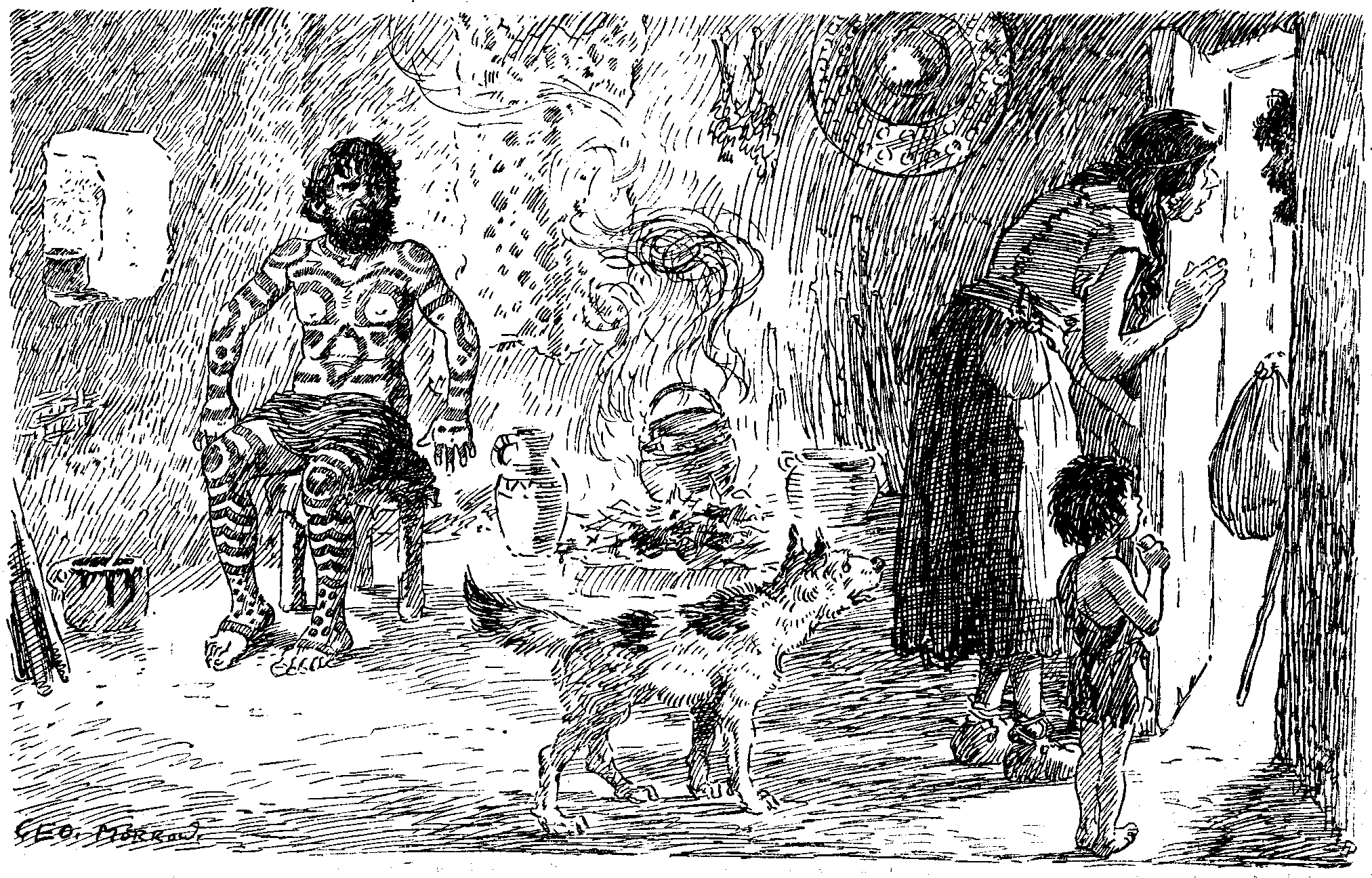
British Matron (whose husband has just had his weekly coat of woad, to visitor). "I'M SORRY, SIR, BUT MY HUSBAND CAN'T SEE YOU TILL HE'S DRY."
"Gas Stoker wanted for 11 million works, used to gas engine and exhauster; 50s. per week of seven 12-hour shifts."—Advt. in Daily Paper.
In the circumstances the reference to "exhauster" seems superfluous.
NEW AIDS TO THE ANGRY.
The readers of the Personal Column of The Times were lately refreshed by the following entry:—
"Would the person in the green Tyrolese hat note that though it may be a custom on his own course to pocket golf-balls on the fairway, it is not done elsewhere."
For long the Personal Column has been a vehicle for appeal and regret, for affection and grief, in addition to its other manifold uses; but as an instrument of admonishment it is fresh. The tragic thing is that up to the time of going to press the green Tyrolese hat has made no reply. Either it does not read The Times or it has been rendered speechless. We were longing for some first-class recriminations.
The new fashion is sure to spread. For example, any morning we are liable to find this:—
Would the lady (?) in the purple toque note that, though it may be the thing in her home to disregard the feelings of others, the abstraction of someone else's chair at a White Sale at Blankridge's is not the thing.
And again:—
The female with a red parasol, who thought it her duty to struggle like a wild-cat for a place on a No. 11 bus, opposite the Stores, on Friday afternoon last at a quarter to three, may be interested in learning that the service is not run solely for her.
And a more intimate note still may be struck. Something like this may be looked for:—
Will Lydia Lopokova take pity on an unhappy and neglected wife, whose husband has stated that he would resume dining at home only on condition that the table was laid as it is laid in The Good-Humoured Ladies?
BEFORE.
Before I was a little girl I was a little bird, I could not laugh, I could not dance, I could not speak a word; But all about the woods I went and up into the sky— And isn't it a pity I've forgotten how to fly? I often came to visit you. I used to sit and sing Upon our purple lilac bush that smells so sweet in Spring; But when you thanked me for my song of course you never knew I soon should be a little girl and come to live with you.
R. F.
More Dillydallying.
"Arbitration is to be adopted first in disputes between members of the League, then meditation by the Council."—Liverpool Paper.