Volume 156 — ESSENCE OF PARLIAMENT.
Reading edition
Monday, May 19th.—The coalminers lately received concessions in wages and hours that are going to cost the country twenty millions sterling in the present financial year. The first result of this boon (teste Sir AUCKLAND GEDDES) is that they are turning out less coal per man than ever, and that the unhappy consumer must look forward to a further reduction in his already meagre ration. It is rather hard upon Mr. SMILLIE, who daily dilates in the Coal Commission upon the hardships of the miner's life, that his clients should let him down like this.
For a thorough-going democrat commend me to Lieutenant-Commander KENWORTHY, the new Member for Central Hull, whose latest idea is that before British troops are sent to any new front the approval of the House of Commons should be obtained. I suspect that if, during his active-service days, some Member had proposed a similar restriction on the movements of the Fleet the comments of the gallant Commander himself would have been more pithy than Parliamentary.
LADIES IN GOVERNMENT MOTOR-CARS. General Seely. "WELL, HARDLY EVER."
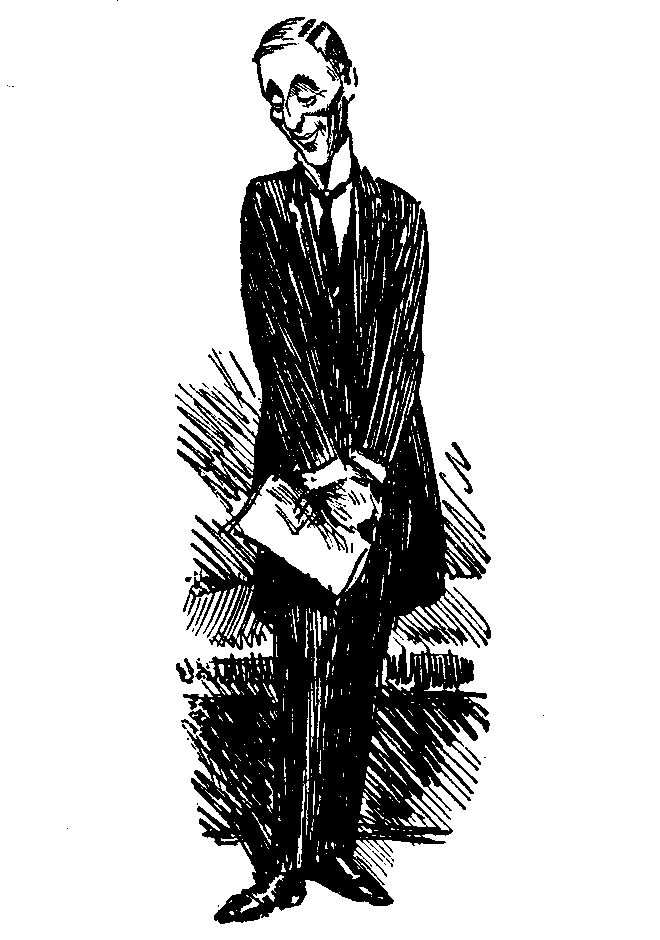
The number of motor-cars at the disposal of the Air Ministry now stands at the apparently irreducible minimum of forty-two. Quite a number of the officials use train or bus, like ordinary folk; some have even been seen to walk; and there has been such a slump in "joy-riding" that when asked if ladies were now carried in the official chariots General SEELY was able to assure the House that that never happens; though I think he added under his breath—"well, hardly ever."
There was barely a quorum when Colonel LESLIE WILSON rose to introduce the estimates of the Shipping Controller. This was a pity, for he had a good story to tell of the mercantile marine, and told it very well. He was less successful on the subject of the "national shipyards," which have cost four millions of money and in two years have not succeeded in turning out a single completed ship. With the wisdom that comes after the event Sir CHARLES HENRY fulminated ferociously against the "superman" who had imposed this "disastrous scheme" upon the country.
This brought up the superman himself, Sir ERIC GEDDES, who in the most vigorous speech he has yet delivered in the House defended the scheme as being absolutely essential at the time it was initiated. It was a war-time expedient, which changing circumstances had rendered unnecessary; but if the War and the U-boat campaign had gone on it might have been the salvation of the country. After all you can't expect to have shipyards without making a few slips.
Tuesday, May 20th.—The advance of woman continues. Very soon she will have her foot upon the first rung of the judicial ladder, and be able to write J.P. after her name, for the LORD CHANCELLOR, pointing out that in this matter the Government were bound to honour the pledges of the PRIME MINISTER, gracefully swallowed Lord BEAUCHAMP'S Bill. He took occasion, however, to warn the prospective justicesses (if that is the right term) that, as the Commissions of the Peace were already fully manned, it might be some time before any large number of ladies could be added to the roll of those who, in the words of the Prayer-book, "indifferently administer justice."
Quite unintentionally, of course, Mr. BOTTOMLEY did the Government a real service in the Commons. Every day since his return from Paris Mr. BONAR LAW has been pestered with inquiries as to when, if ever, the House was to be allowed to discuss the Peace terms, and has evaded a direct answer with more or less ingenuity. This afternoon Mr. BOTTOMLEY, after hearing that the LEADER OF THE HOUSE had "nothing to add" to his previous replies, asked if he was right in supposing that, when the Treaty came up for ratification, the House must take it or leave it, and would have no power to amend it in any respect. Mr. LAW joyfully jumped at the chance of ending the daily catechism once for all. "That," he said, "exactly represents the position, and I do not see in what other way any Treaty could ever be arranged."
In anticipation of the debate on the Finance Bill Mr. SYDNEY ARNOLD sought an admission from the CHANCELLOR OF THE EXCHEQUER that the income-tax on small incomes was hardly worth retaining, owing to the cost of collection. Not at all, said Mr. CHAMBERLAIN. It costs six hundred thousand pounds and brings in eight million. Of course, he added, it costs more proportionately to collect small amounts than large. If the whole of the income-tax could be paid by one individual the cost of collection would be nil. One imagined the CHANCELLOR on the eve of the Budget wishing, à la NERO, that the whole of the British people had but one purse, into which he could dip as deeply and as often as he pleased.
The debate on the Finance Bill was largely devoted to the proposed "levy on capital," which a section of the "Wee Frees," who already display fissiparous tendencies, have borrowed from the Labourites. After their amendment was framed, however, Mr. ASQUITH spoke at Newcastle, and ostentatiously refused to say a word about the new nostrum. Sir DONALD MACLEAN, anxious to avoid displeasing either his old leader or his new supporters, contented himself with the suggestion that a Commission should be set up to consider the subject.
The CHANCELLOR had little difficulty in disposing of the amendment. He might, indeed, have contented himself with quoting the War Bond advertisements, which daily inform us that the patriotic investor "will receive the whole of his money back with a substantial premium."
The Preference proposals which Mr. ACLAND had described as bred "by Filial Piety out of the Board of Trade" received the unexpected aid of Sir ALFRED MOND, who disposed of his Cobdenite prejudices as easily as the conjurer swallows his gloves, and unblushingly asserted that the tiny Preference now proposed, far from being the advance-guard of Protection, was in reality a very strong movement towards Free Trade. Comforted by this authoritative declaration Coalition Liberals helped the Government to defeat the amendment by 317 to 72.
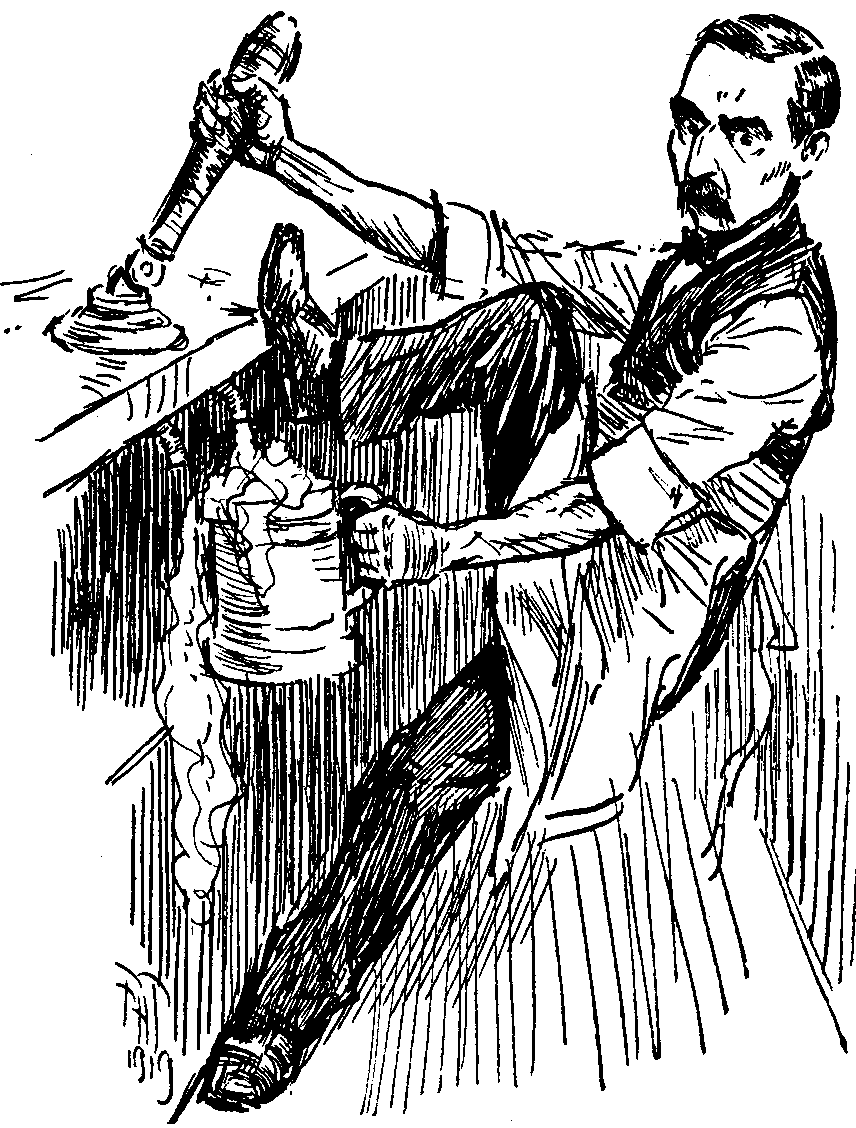
THE LONG PULL. MR. ROBERTS RESPONDS TO HIS COUNTRY'S CALL.
Wednesday, May 21st.—The Peers being as usual rather short of work at this period of the Session, the LORD CHANCELLOR introduced a Bill "to enable the Official Solicitor for the time being to exercise powers and duties conferred on the person holding the office of Official Solicitor."
The rumours that have lately appeared in the papers, to the effect that the FIRST COMMISSIONER OF WORKS was contemplating revolutionary alterations at Hampton Court—in particular that he was going to transform the famous pond-garden into something quite different: a MOND-garden, in fact—are, it seems, grossly exaggerated. All that he has done is to appoint a Committee of experts to advise him what, if any, changes are desirable.
The resumed debate on the Finance Bill was enlivened by some personal details. By way of showing that even without a levy on capital the rich man bears his share of the burdens of the State, Sir EDWARD CARSON remarked that, when he receives a retainer, he immediately allows for the super-tax and enters it in his fee-book at only half the amount. He had had one that very morning. "Say it was five pounds"—and the House laughed loudly at such an absurd supposition.
Then we had Lord HUGH CECIL pointing his argument that the importance of the proposed Preference to the Dominions was political rather than economical by the remark that if he was going to be married—which he fervently hoped would not happen to him—he would expect his mythical bride to value his engagement-ring less for its pecuniary than its sentimental value.
A capital speech by Mr. STANLEY BALDWIN, one of the few men in the House who talks finance as if he really understood it, wound up the debate, and procured the Finance Bill a second reading nem. con.
Thursday, May 22nd.—The Ministry of Health Bill came up for third reading in the Lords. An eleventh-hour attempt by the Government to provide the new Minister with an additional Under-Secretary was heavily defeated, Lord DOWNHAM being appropriately enough one of the Tellers for the Opposition.
The Commons heard some good news. Mr. KENDALL'S pathetic story of an angling-party which, after walking five miles along a dusty road to its favourite hostelry, found it adorned with the now too frequent notice, "Closed—No Beer," brought a most sympathetic reply from Mr. GEORGE ROBERTS, who boldly confessed, "I am a believer in good beer myself," and later on announced that the Government had decided to increase the output from twenty million to twenty-six million standard barrels.
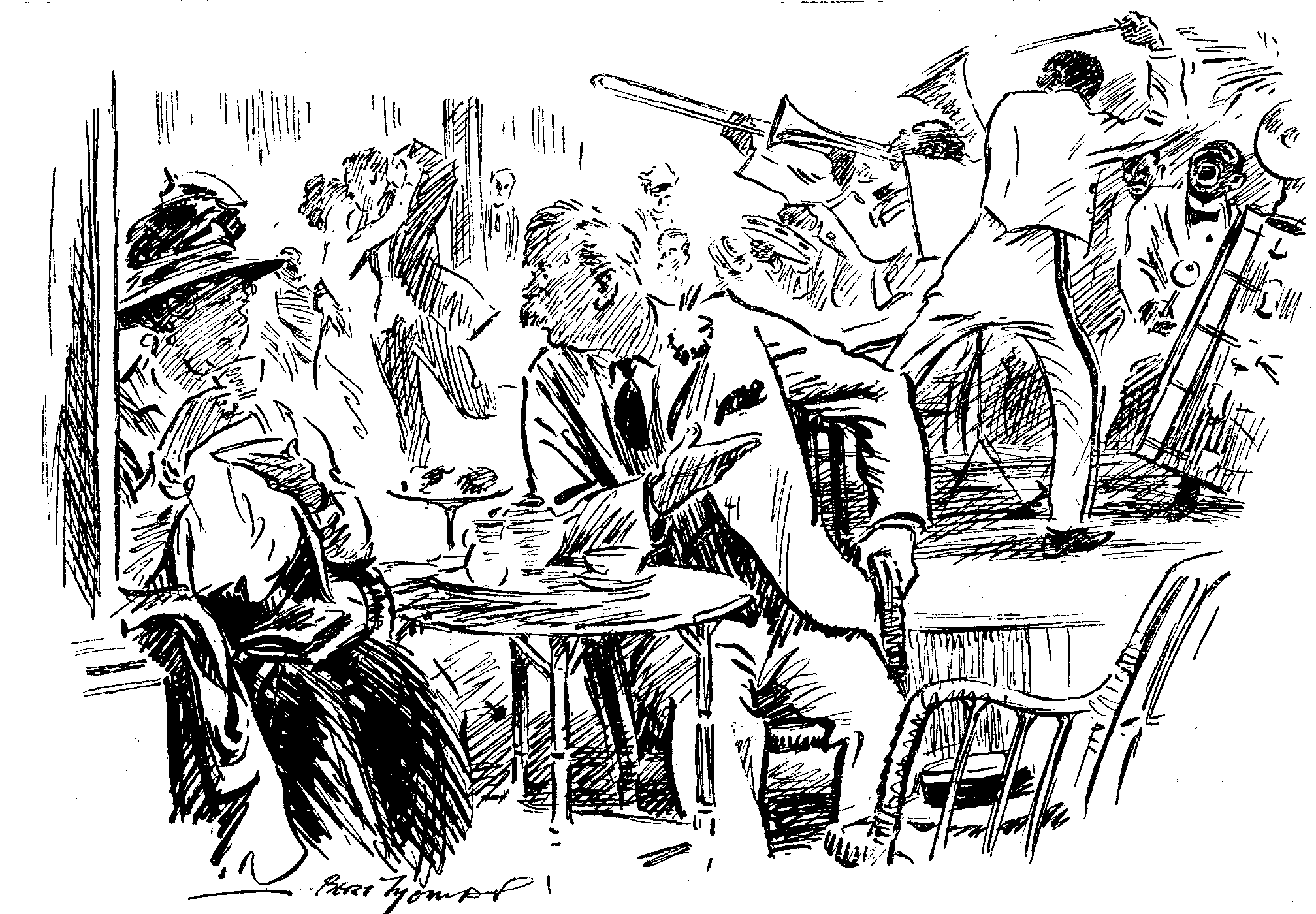
Geordie (after intently watching conductor of Jazz band for some time). "AH'VE HAD ENOUGH O' THIS. YON CHAP WI' STICK'S ONLY CODDIN'. HE'S NOT HIT ONE OF 'EM SINCE WE CAAME IN."
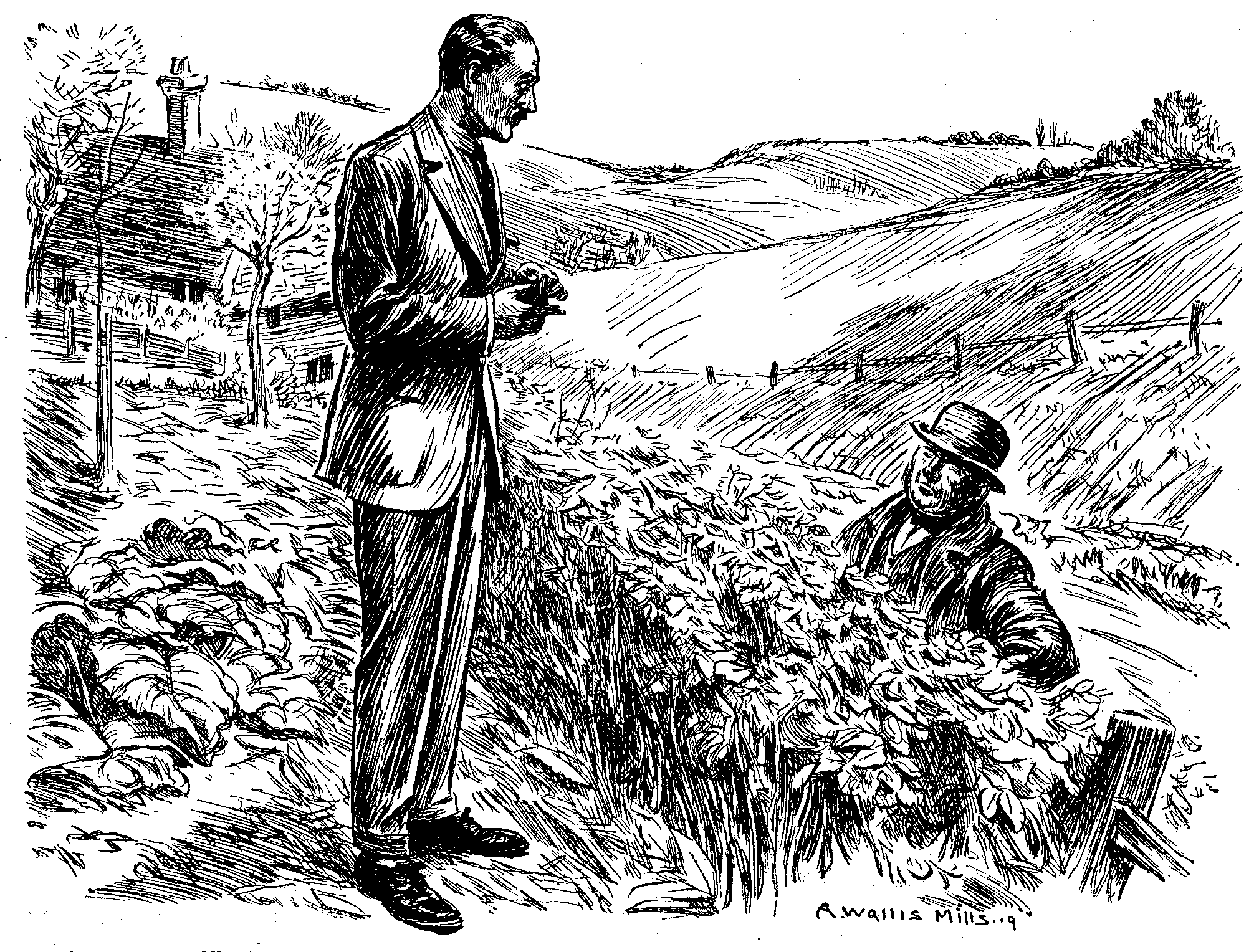
Farmer. "WELL, I BE MAIN GLAD TO SEE YOU BACK FROM THE WAR. I SUPPOSE YOU'LL BE THINKING OF TAKING TO WORK NOW?"
WHAT'S IN A NAME?
The original answer to the question at the head of these insignificant remarks was (correct me if I am wrong) nothing. "A rose," said Juliet, "by any other name would smell as sweet." But of course she was wrong. If a rose were handed to a visitor in the garden, with the words, "Do see how wonderful this onion is!" such a prejudice would be set up as fatally to impair its fragrance. There is, in fact, much in a name; and therefore the attempt of a correspondent of The Daily Express to find a generic nomenclature for domestic servants should be given very serious attention; the purpose being to meet "the objection felt by so many women servants to being either called by Christian or surname."
As a means of placating this very sensitive class the correspondent writes:—
"One nearly always calls a cook by the name of her calling. I therefore suggest that a name be adopted beginning with the first letter of the class. For example:—
Lady's-maid Louise.
Parlourmaid Palmer.
Housemaid Hannah.
General Gertrude.
Scullerymaid Sarah."
Here we have materials for a sweeping innovation which might, if it spread, not only simplify life but reinforce the language. For why confine such terms to domestic servants? If all parlourmaids are to be called "Palmer," why not, for example, call all editors "Eddy" (very good Eddy, or very bad Eddy, according to taste)? And all London County Councillors, "Elsie"?
But let us look a little narrowly at the specimens given. "Palmer" for "parlourmaid" is good; but "Louise" does not reproduce the sound values of "lady's-maid." Some such word as "Lais" would be better, or why not "Lady-bird," which combines the desired similarity with the new euphemism "home-bird," invented to help transform domestic service to a privilege and pleasure? "Hannah" for "housemaid" is also wrong, although for "handmaid" it would be good. On the analogy of "Palmer," why not call all housemaids "How"? or even "House"?
If American Colonels can be called HOUSE, why not English housemaids? For generals "Jenny" would be better than "Gertrude"; and for scullery-maids "Scully." "Scully" is quite a good name; there is a distinguished psychologist named SULLY, and there was an M.P. for Pontefract named GULLY. No scullery-maid need be offended.
It is odd how we call some persons by their profession or calling, and others not. We say "Doctor," but we do not address our gum-architect as "Dentist." We say "Carpenter," but we do not address a plumber as "Plumber." (Incidentally, all plumbers might be called Warner). We say "Gardener" and "Coachman," but we do not address an advocate as "Barrister." If we had a definite rule everything would be simple, but as we have not it is necessary to find several more names. I am not at all satisfied with The Daily Express's test. For example, what would a second parlour-maid be called? If three were kept they might be called Palm, Palmer and Palmist. A long vista of difficulties opens.