Volume 156 — THE PERILS OF REVIEWING.
Reading edition
A most unfortunate thing has happened to a friend of mine called —— to a friend of —— to a friend of ——. Well, I suppose the truth will have to come out. It happened to me. Only don't tell anybody.
I reviewed a book the other day. It is not often I do this, because before one can review a book one has to, or is supposed to, read it, which wastes a good deal of time. Even that isn't an end of the trouble. The article which follows is not really one's own, for the wretched fellow who wrote the book is always trying to push his way in with his views on matrimony, or the Sussex downs, or whatever his ridiculous subject is. He expects one to say, "Mr. Blank's treatment of Hilda's relations with her husband is masterly," whereas what one wants to say is, "Putting Mr. Blank's book on one side we may consider the larger question, whether ——" and so consider it (alone) to the end of the column.
Well, I reviewed Mr. Blank's book, Rotundity. As I expected, the first draft had to be re-headed "A Corner of Old London," and used elsewhere; Mr. Blank didn't get into it at all. I kept promising myself a sentence: "Take Rotundity, for instance, the new novel by William Blank, which, etc.," but before I was ready for it the article was finished. In my second draft, realizing the dangers of delay, I began at once, "This remarkable novel," and continued so for a couple of sentences. But on reading it through afterwards I saw at once that the first two sentences were out of place in an article that obviously ought to be called "The Last Swallow;" so I cut them out, sent "The Last Swallow: A Reverie" to another Editor, and began again. The third time I was successful.
Of course in my review I said all the usual things. I said that Mr. Blank's attitude to life was "subjective rather than objective" ... and a little lower down that it was "objective rather than subjective." I pointed out that in his treatment of the major theme he was a neo-romanticist, but I suggested that, on the other hand, he had nothing to learn from the Russians—or the Russians had nothing to learn from him; I forget which. And finally I said (and this is the cause of the whole trouble) that ANTOINE VAURELLE'S world-famous classic—and I looked it up in the Encyclopaedia—world-renowned classic, Je Comprends Tout, had been not without its influence on Mr. Blank. It was a good review, and the editor was pleased about it.
A few days later Mr. Blank wrote to say that, curiously enough, he had never read Je Comprends Tout. It didn't seem to me very curious, because I had never read it either, but I thought it rather odd of him to confess as much to a stranger. The only book of VAURELLE'S which I had read was Consolatrice, in an English translation. However, one doesn't say these things in a review.
Now I have a French friend, Henri, one of those annoying Frenchmen who talks English much better than I do, and Henri, for some extraordinary reason, had seen my review. He has to live in London now, but his heart is in Paris; and I imagine that every word of his beloved language which appears, however casually, in an English paper mysteriously catches his eye and brings the scent and sounds of the boulevards to him across the coffee-cups. So the next time I met him he shook me warmly by the hand, and told me how glad he was that I was an admirer of ANTOINE VAURELLE'S novels.
"Who isn't?" I said with a shrug, and, to get the conversation on to safer ground, I added hastily that in some ways I almost liked Consolatrice best.
He shook my hand again. So did he. A great book.
"But of course," he said, "one must read it in the original French. It is the book of all others which loses by translation."
"Of course," I agreed. Really, I don't see what else I could have done.
"Do you remember that wonderful phrase ——" and he rattled it off. "Magnificent, is it not?"
"Magnificent," I said, remembering an appointment instead. "Well, I must be getting on. Good-bye." And, as I walked off, I patted my forehead with my handkerchief and wondered why the day had grown so warm suddenly.
However the next day was even warmer. Henri came to see me with a book under his arm. We all have one special book of our own which we recommend to our acquaintances, regarding the love of it as perhaps the best passport to our friendship. This was Henri's. He was about to test me. I had read and admired his favourite VAURELLES—in the original French. Would I love his daring LAFORGUE? My reputation as a man, as a writer, as a critic, depended on it. He handed me the book—in French.
"It is all there," he said reverently, as he gave it to me. "All your English masters, they all come from him. Perhaps, most of all your —— But you shall tell me when you have read it. You shall tell me whom most you seem to see there. Your MEREDITH? Your SHAW? Your —— But you shall tell me."
"I will tell you," I said faintly.
And I've got to tell him.
Don't think that I shall have any difficulty in reading the book. Glancing through it just now I came across this:—
"'Kate, avez-vous soupé avant le spectacle?'
'Non, je n'avais guère le coeur à manger.'"
Well, that's easy enough. But I doubt if it is one of the most characteristic passages. It doesn't give you a clue to LAFORGUE'S manner, any more than "'Must I sit here, mother?' 'Yes, without a doubt you must,'" tells you all that you want to know about MEREDITH. There's more in it than that.
And I've got to tell him.
But fancy holding forth on an author's style after reading him laboriously with a dictionary!
However, I must do my best; and in my more hopeful moments I see the conversation going like this:—
"Well?"
"Oh, wonderful." (With emotion) "Really wonderful."
"You see them all there?"
"Yes, yes. It's really—wonderful. MEREDITH—I mean—well, it's simply—(after a pause) wonderful."
"You see MEREDITH there most?"
"Y—yes. Sometimes. And then sometimes I—I don't" (with truth). "It's difficult to say. Sometimes I—er—SHAW—er—well, it's ——" (with a gesture somewhat Gallic) "How can I put it?"
"Not THACKERAY at all?" he says, watching me eagerly.
I decide to risk it.
"Oh, but of course! I mean—THACKERAY! When I said MEREDITH I was thinking of the others. But THACKERAY—I mean THACKERAY is— er—" (I've forgotten his name for the moment and go on hastily) I mean—er—THACKERAY, obviously."
He shakes me by the hand. I am his friend.
But this conversation only takes place in my more hopeful moments. In my less hopeful ones I see myself going into the country for quite a long time.
A.A.M.
Another Impending Apology.
"The book contains a portrait of the author and several other quaint illustrations."—Daily Paper.
"Miss Leitch played delightful golf up to the hole, but when once she had arrived there the result was almost ludicrous, as she could not hit the ball truly with her puttee."—Evening Paper.
Personally we have always found this an ineffective weapon.
ROYAL ACADEMY-SECOND DEPRESSIONS.
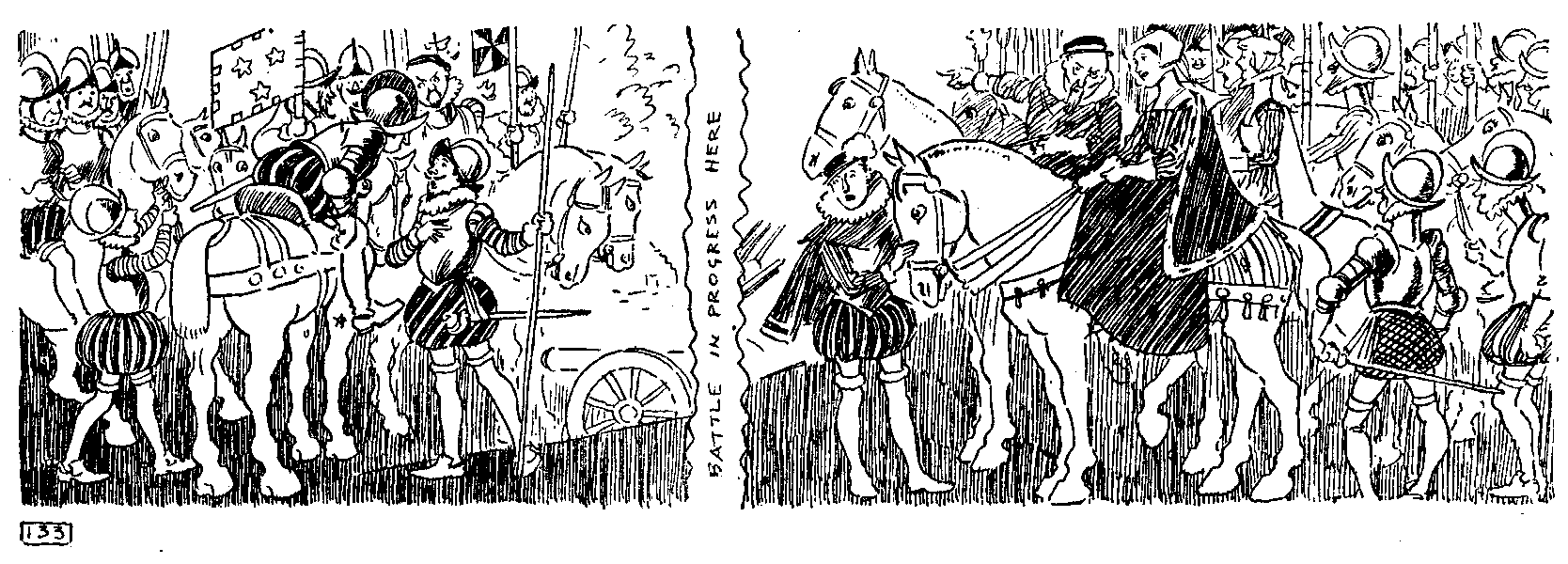
IN THE DAYS OF AULD LANGSIDE.
The Despatch-Bearer. "EXCUSE ME, SIR, BUT THE QUEEN IS HERE. YOU ARE REQUESTED TO MAKE AS LITTLE NOISE AS POSSIBLE, AND, ABOVE ALL, NO BLOODSHED." Bothwell (to Mary, Queen of Scots). "IF YOU WOULD DEIGN TO TURN YOUR HEAD A LITTLE, DEAR MADAM, YOU WILL FIND THAT THE BATTLE IS OVER HERE."
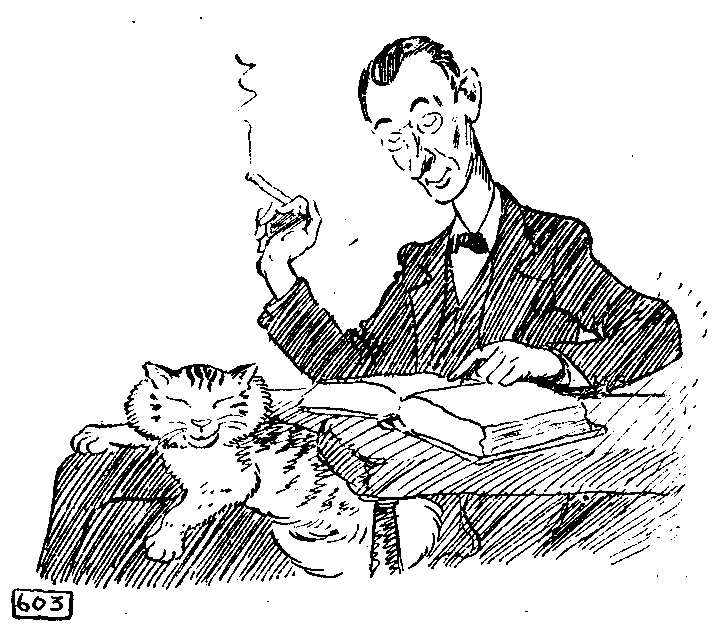
The Cheshire Cat. "I NEVER GET TIRED OF THIS STORY ABOUT DICK WHITTINGTON."
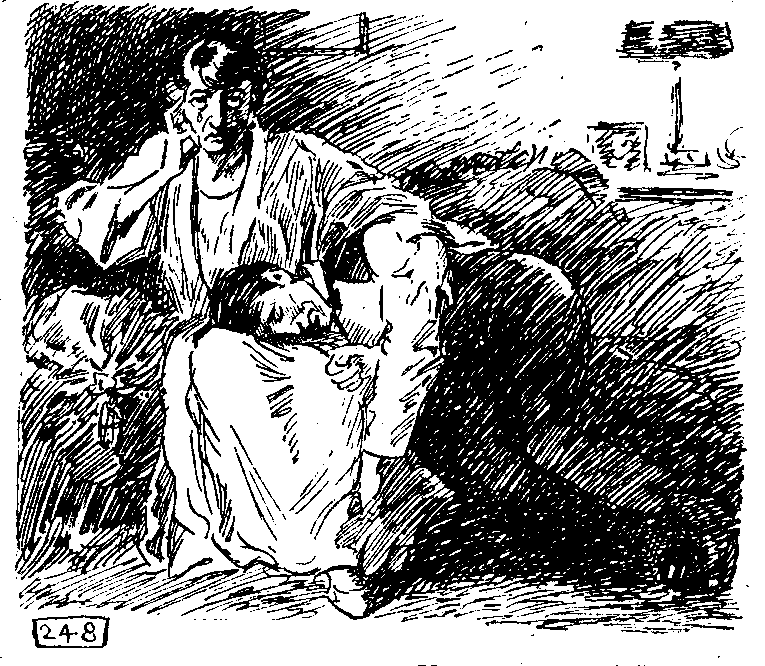
The Profiteer's Wife (sadly). "POOR WILLIAM HASN'T BEEN HIMSELF SINCE ARMISTICE DAY."
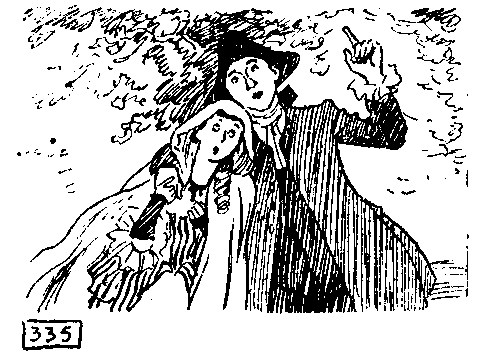
The Man (listening to the lark and quoting the poet). "UP WITH ME, UP WITH ME INTO THE CLOUDS."
The Lady. "OH, JOHN, LET US STAY HERE. I DON'T FEEL IN AN AVIATING MOOD TO-DAY."
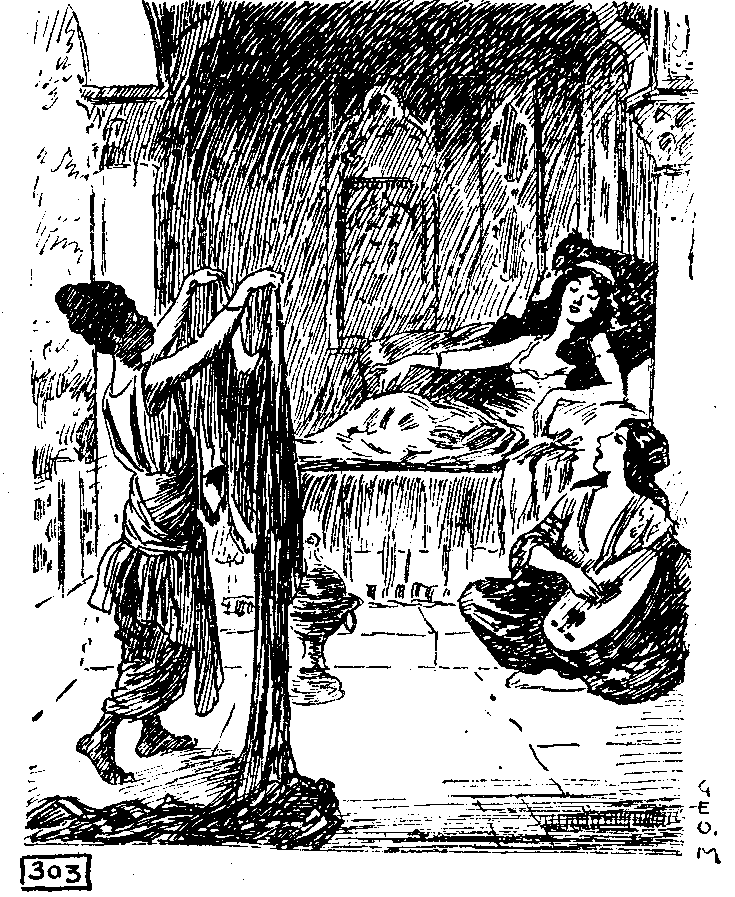
MISS WINNIE WENDOVER SELECTS HER COSTUMES FOR THE NEW REVUE. THE CHARMING AND TYPICALLY ENGLISH ACTRESS IN HER DELIGHTFUL TURKISH BUNGALOW NEAR STAINES.
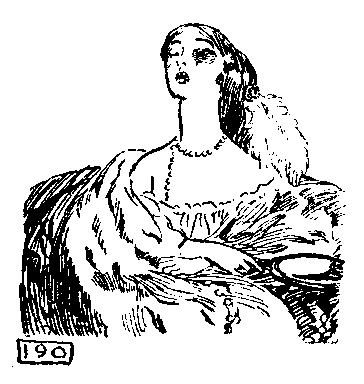
The Spoilt Beauty. "WHAT ROTTEN LUCK! I SIMPLY DAREN'T GO JAZZING WITH THIS BLACK EYE!"
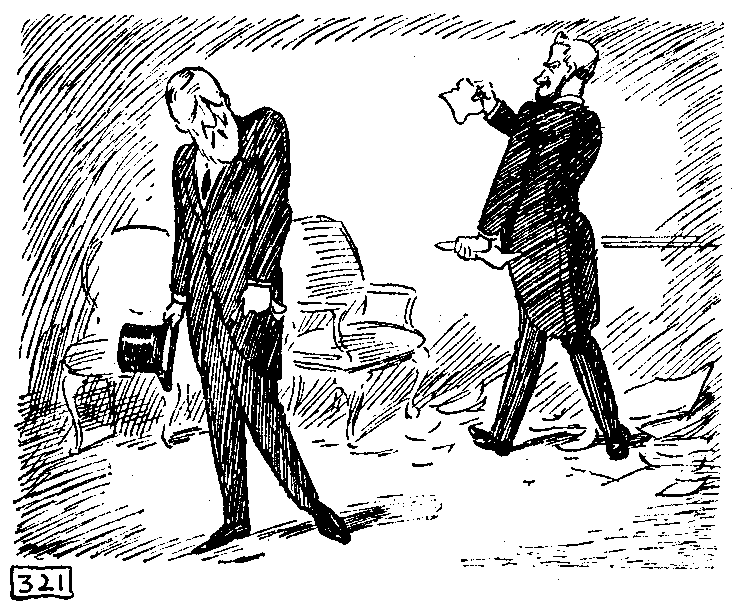
"THE SCRAP OF PAPER." Both (mentally). "WHAT A FINE DRAMATIC SUBJECT THIS WOULD MAKE FOR AN ACADEMY PICTURE!"
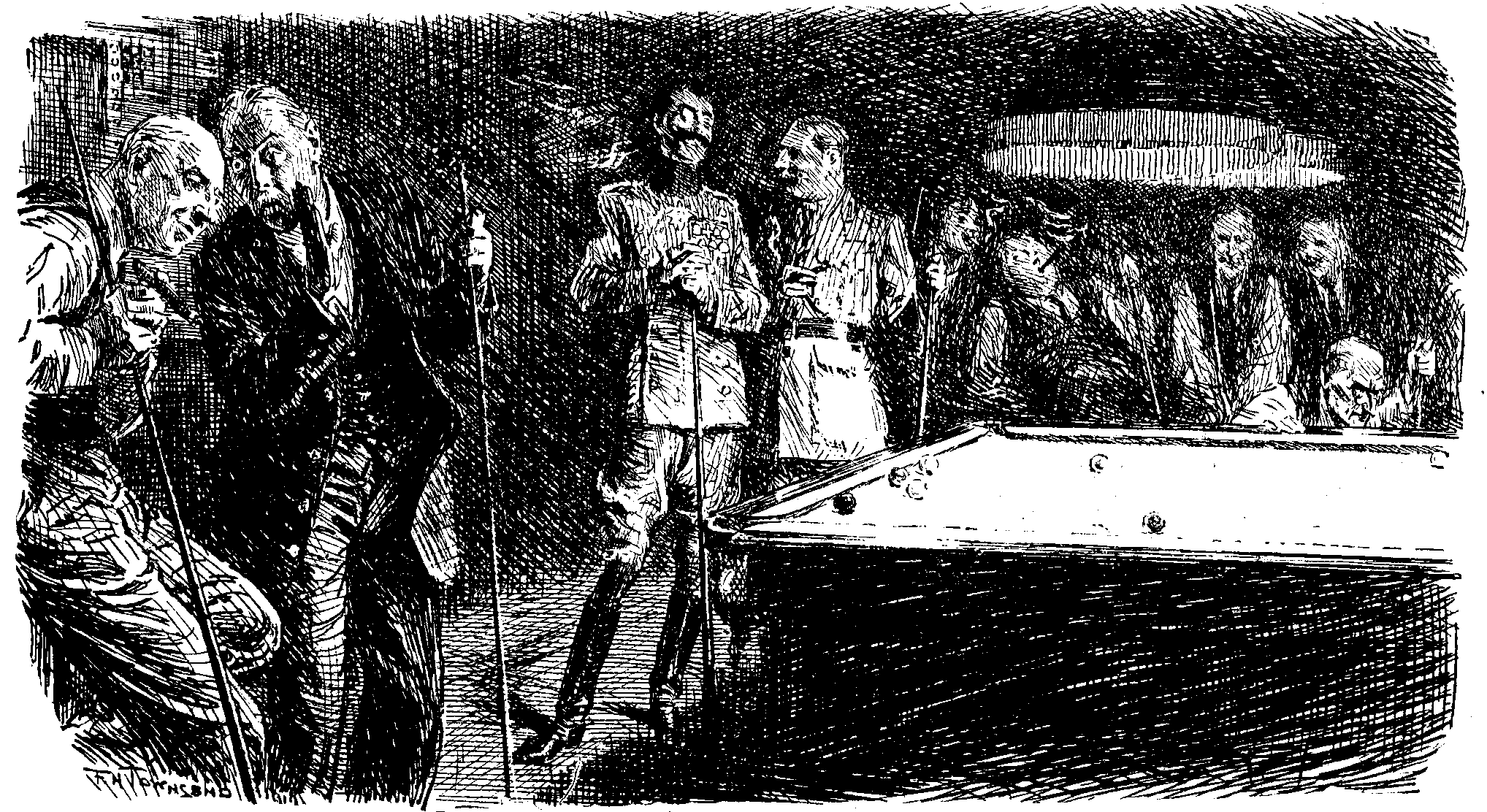
Billiard-marker (awed by rank of visitor—a foreign prince who has joined in a game of pool). "SHOULD I CALL 'IM 'YER ROYAL 'IGHNESS, SIR, OR 'SPOT YALLER'?"
THE HAIRIES.
We have carried our lancer's, hussars and dragoons And tugged in the batteries, columns and trains, On pavé that smoked under white summer noons And tracks that washed out under black winter rains. We've shivered in standings hock-deep in the mud, With matted tails turned to the drift of the sleet; We've seen the bombs flash and been spattered with blood Of mates as they rolled, belly-ripped, at our feet. We've dragged ammunition up shell-smitten tracks, Round bottomless craters, through stump-littered woods; When the waggons broke down took the load on our backs And somehow or other delivered the goods. But the dread roads, the red roads will know us no more; Oh, it's England, chum, England for you and for me! The countryfolk wave us as westward we pour Down the jolly white highways that lead to the sea. There's a mist of frail blossom adrift in the trees, The Spring song of birds sets the orchards a-thrill; And now on our brows blows the salt Channel breeze, The busy port hums in the lap of the hill. So warp out your transports and bear us away From the Yser and Somme, from the Ancre and the Aisne, From fire-blackened deserts of shell-pitted clay, And give us our Chilterns and Cotswolds again. Oh, show us old England all silver and gold, With the flame o' the gorse and the flower o' the thorn; We long for lush meadow-lands where we were foaled And boast of great runs with the Belvoir and Quorn. The pack-pony dreams of a primrosy combe, A leisurely life in a governess-cart, Plum-cake and a bottle-nosed gardener-groom; The Clyde has a Wensleydale farm in his heart. We whinny and frolic, light-headed with bliss, Forgetting leg-weariness, terror and scars; Ye ladies of England, oh, blow a soft kiss To the hairy old horses come home from the wars. PATLANDER.
TO-MORROW.
"To-morrow," said the brave young subaltern, "if my Company Commander curses my men for having long hair, I'll whip off his own hat and show him to be three weeks overdue at the barber's.
"To-morrow, if the Adjutant finds fault with my salute, I'll give him a faithful imitation of his own ridiculous ear-flip.
"To-morrow, if the Major strafes me for my handling of the platoon on the barrack-square, I'll challenge him to detail 'presenting arms, by numbers.'
"To-morrow, if the Colonel checks my men for being slovenly turned out on parade, I'll publicly point out to him that the buttons of his own pockets are undone and that the ends of his bootlaces are hanging out.
"To-morrow, if the General curses a man for rubbing his nose while at attention, I'll openly suggest to him that it is not smart and soldierlike to slouch along with one hand in your pocket while inspecting the ranks.
"To-morrow, if I get the chance, I'll do all these things. I have put off doing them far too long."
So spake the brave young subaltern, knowing full well that he is to be demobbed to-day.
"A Tooting hen is laying two eggs a day."—Evening Paper.
Then it seems to us that she is quite justified in tooting.
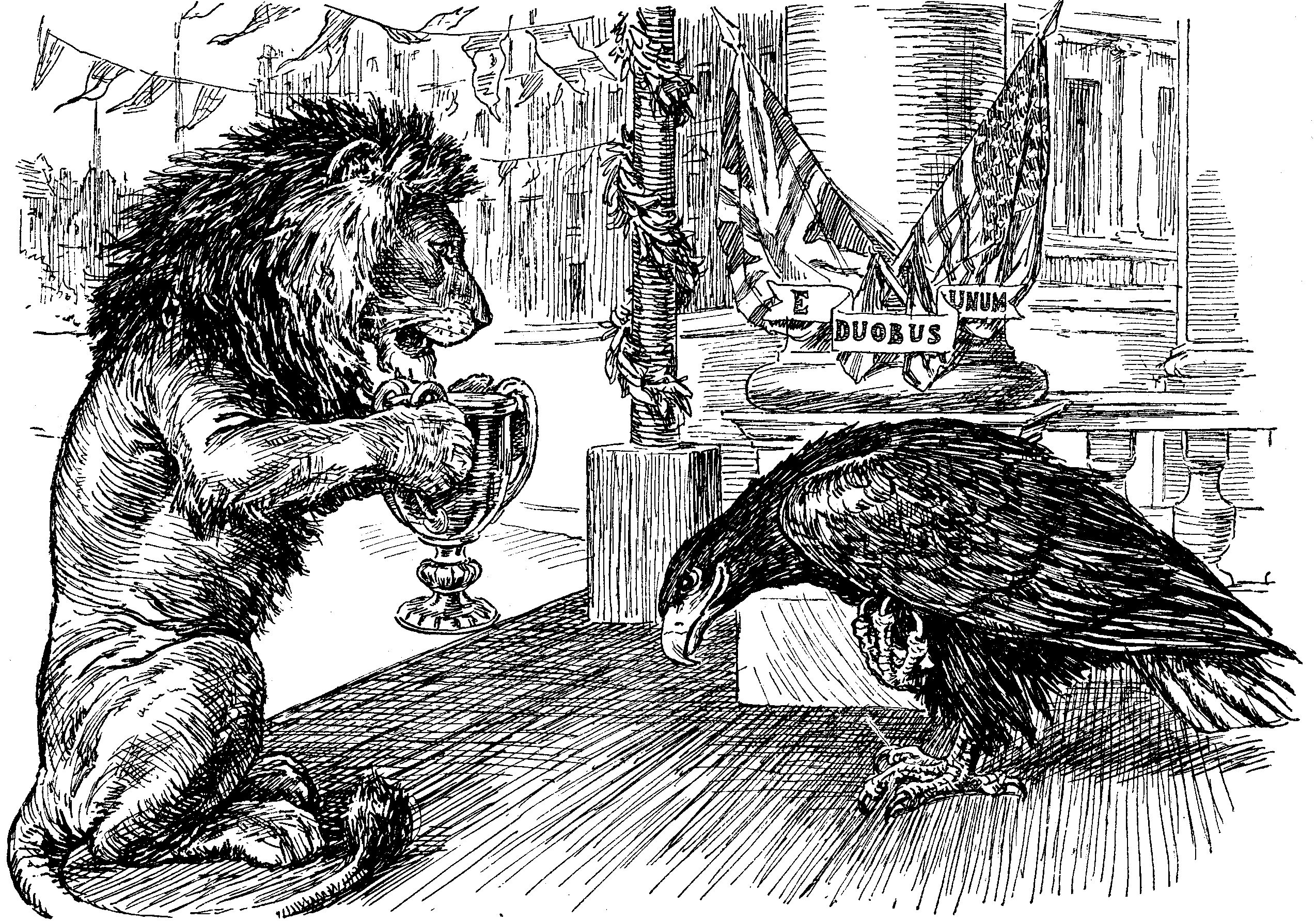
THE LOVING CUP: A PARTING TOAST.
BRITISH LION
(to American Eagle).
"HERE'S LUCK TO YOU. YOU BROUGHT IT TO ME."