Volume 156 — MORE MUSICAL RECONSTRUCTION.
Reading edition
(By our Special Reporter, who is also busy with the Coal Commission.)
At the three hundred and seventeenth sitting of the Musical Reconstruction Commission Mr. Justice Bland, the President, said he felt sure he would be voicing the feelings of all present in tendering his congratulations to Sir Leonardo Spaghetti Coyne on his elevation to the peerage as Viscount Vermicelli of Milan, and to Mr. Gladney Jebb on receiving the honour of K.P.O. (Knight of the Proletarian Order).
A memorandum on the economics of the Russian Ballet and the probable cost of its reorganisation on a Marxian basis was read by Mr. Ploffskin of the Garden City Gymnosophist Guild. By a scheme for a uniform salary for all dancers, compulsory vegetarian diet, and the exclusive use of the balalaika, Mr. Ploffskin was of opinion that a Bolshevist Ballet might be safely organised so as to satisfy the artistic aspirations of the proletariat and counteract the pernicious influences of the pseudo-Ethiopian style affected by the idle rich.
Examined by Sir Edwin Edgar, O.M., Mr. Ploffskin admitted that none of the famous Russian composers of recent years had associated themselves with the Revolutionary movement, and that the Russian Ballet had originally been an integral part of the Imperial Opera. But he had no doubt that on a proper proletarian basis it would function with a far more beneficent activity. He pointed out that there was a strong facial resemblance between TROTSKY and M. PADEREWSKI, and between LENIN and BEETHOVEN. In reply to a question from Mr. Moody MacTear, Mr. Ploffskin said that he had been down a coal-mine in Siberia.
Sir Mark Holloway, who next occupied the witness's chair, admitted, in reply to the questions of Sir Gladney Jebb, that, since his student days, he had seldom been engaged in manual labour on any instrument for more than two hours a day. It was not necessary for a conductor. But he knew of pianists who practised for six or even eight hours a day with impunity.
Sir Gladney Jebb. Do you not think that if all compositions were written in the key of C it would materially conduce to the greatest happiness of the greatest number?—The President has already deprecated the multiplication of hypothetical questions, which have reached a total of more than fifteen thousand.
Viscount Vermicelli. Do you think that the unrestrained performance of Jazz-music conduces to the moral betterment of the simian proletariat?—That seems to me to be a question which bears on the administration of the Unnecessary Noises Act.
Are you in favour of the establishment of a Ministry for the Control of Syncopation?—No; but I would cordially support a Bill for the Compulsory Segregation of Irresponsible Collectivists.
In reply to Mr. Moody MacTear, Sir Mark Holloway said that he had never been down a coal-mine, but that he had a few shares in a gold-mine, which had cost him five pounds a-piece, but had never borne any dividends and were now quoted at one-and-sixpence.
The next witness, Dame Frisca, the famous Californian singer, was subjected to a remarkably severe examination by Mr. Moody MacTear.
Mr. Moody MacTear. Do you consider that the assumption of the title prima donna is compatible with democratic principles?—I never assumed it; it was bestowed on me by the free suffrages of the musical world.
Mr. MacTear. Then you admit that you possess it. Are you prepared to submit proof of your title to the Commission?—Certainly; but it would probably mean bringing forty van-loads of press-cuttings and cause considerable congestion of traffic.
Mr. MacTear. Is it not the case that the prima donna has been condemned by the best musical critics as an obsolete anachronism, tending to perpetuate the abuses of the "star" system and to foster breaches of the Decalogue and to enhance the soloist at the expense of the chorus?—I believe that WAGNER held the view expressed in the opening part of your question, but he was unable to get on without her, wrote a famous address to the Star of Eve, and gave the chorus practically nothing to do in many of his operas.
Mr. MacTear. Is it not the case that the operatic tenor has been pronounced on good authority to be not a man but a disease?—The authority was a German conductor, who was presumably speaking of German tenors.
Mr. MacTear. Have you ever been down a coal-mine?—No; but I was presented with a diamond brooch by the diggers of Kimberley.
BAKERLOONACY.
This is a song of the Tube— Let us begin it By cursing the furies who fight and who bite ev'ry night To get in it; The folk who see red and who tread on the dead And climb over the slain, And who step on your face in the race for a place In the train. The pack! The wolves who attack, Attempting to kill you until you Fall flat on your back; The tigers who tear at your-hair and who swear As they tread on your neck, Leaving you battered, bespattered and shattered, An absolute wreck. From these sharks, These mild-looking typists and clerks, May Heaven defend you. They'll rend you—up-end you (I carry the marks), This meek-looking, sleek-looking, weak-looking clique With the Bolshevist brains Inflamed at the thought that they ought to have caught Much earlier trains. Mourn For the hat that is flat And the collar of which you were shorn. Shed a tear for the dear little ear that you had And the bags which to rags have been torn. Weep for the fellow who tried but who died at your side As the tide swept along. He was a victim. They tricked him and kicked him to death, Though he'd done them no wrong. This is a Song of the Tube. A ballad of sorrow, A grey sort of lay of To-day and a greyer To-morrow; A dismal, abysmal, chaotic, neurotic Creation Of one who was done after running a mile To the station.
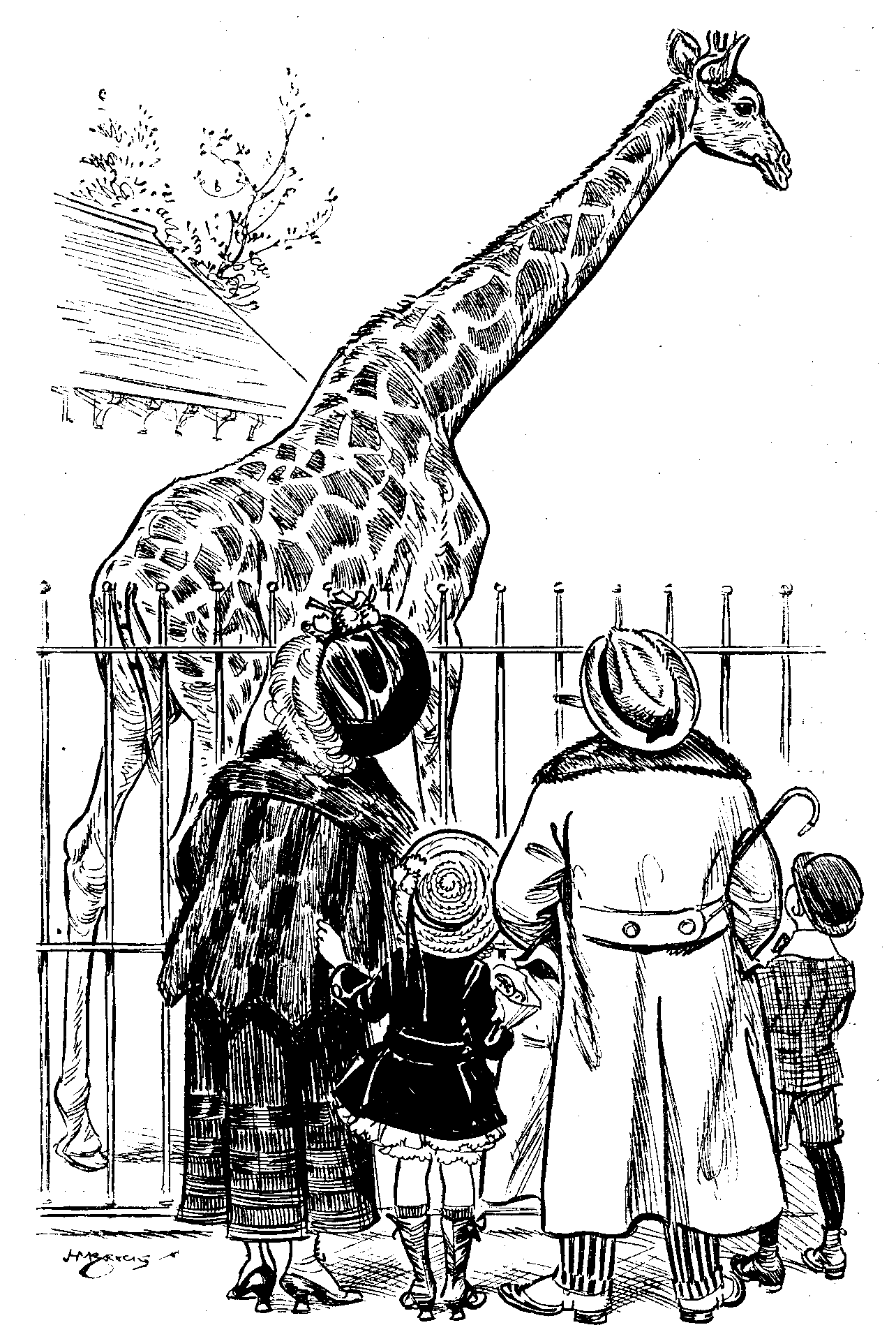
Munitionaire. "I THINK I'LL MAKE A BID FOR THAT CHAP, MARIA, FOR A HALL-MAT AND STAIR-CARPET."
From a report of the Coal Commission:—
"The next witness was Lord Dynevor. He said he had 8,270 acres of coal land in Carmarthenshire. His interest in the estate came to the family through one of three collieresses."
Even Mr. SMILLIE would admit that that ought to constitute an absolute title.
More Impending Apologies.
From a bookseller's advertisement:
"NEW FICTION.
Reason and Belief—By Sir Oliver Lodge. Man and the Universe—By Sir Oliver Lodge. The Great Crusade—By Right Hon. D. Lloyd George."—Canadian Paper.
"It was essential for Great Britain that France should emerge from this war strong and able to defend herself. The recognition of this fact explains the change of British policy at Pars during the Wonference of Peace."—The Times.
We like the new title for the victors' conclave, but do not care so much for the unusual spelling of the French capital, though it may have been adopted in deference to American prejudices.