Volume 156 — OUR BOOKING-OFFICE.
Reading edition
(By Mr. Punch's Staff of Learned Clerks.)
Within The Rim (COLLINS) is, I suppose, the last of the posthumous volumes of Mr. HENRY JAMES. It is a short book, produced with the beauty that I have already grown to associate with the imprint of its publishers, and containing five occasional pieces. Of these the first, which gives its title to the whole, is the most considerable: an essay of very moving poignancy, telling the emotion of the writer during the earliest months of the War, in "the most beautiful English summer conceivable," months that he "was to spend so much of in looking over from the old rampart of a little high-perched Sussex town at the bright blue streak of the Channel ... and staring at the bright mystery beyond the rim of the farthest opaline reach." In the thoughts to which HENRY JAMES here gives expression one may find much of the love and sympathy for this country that subsequently led to that assumption of British citizenship which he intended as their demonstration to the world. Of interest also in this same paper is the revelation of a mind that knew already by a personal experience (of the American Civil War) "what immensities our affair would carry in its bosom—a knowledge that flattered me by its hint of immunity from illusion." I would not be understood that this is a volume for the casual reader, or even for one desirous of making a first acquaintance with the Master, since much of it exemplifies not only the beauty but the perplexities of his later style; but it is certainly one which his disciples will not willingly be without.
Notebooks of a Spinster Lady (CASSELL) is smallish talk about biggish wigs of the Victorian era, but not on that sole account to be condemned. Perhaps rather wholesome as showing how little distant we are from an age of government of the people by superior people for superior people. The notebooks cover the years 1878-1903, but the anecdotes have a much wider range, are often indeed of a venerable antiquity. The lady of the notebooks was not, I fancy, of a critical temper, and versions not too credible of well-known contes figure in her quiet kindly pages. There are moreover stories which I should not hesitate to describe as of an appalling banality if they were not concerned with such very nice people. On the whole I don't think it quite fair to the spinster lady to have published her notes. They may well have been painstaking jottings to provide material for polite conversation and have sounded much better than they read in cold print. For myself the real heroine of the book is Maria, the poet's wife, who, on being waked and adjured by her spouse to get up and strike a light for that he had just thought of a good word, replied in un-Victorian mood, "Get up yourself! I have just thought of a bad one."
Love—on Leave (PEARSON) is the sufficiently expressive title that Miss JESSIE POPE has chosen for a small book of little courtship tales. You never saw a volume of its size, more packed with love, which is shown leaping walls, laughing at locksmiths and generally making the world go round in its proverbial fashion. The pace of the revolutions may be found a little disconcerting. You will perhaps be inclined to amend the title and call the collection "Love on Short Leave," to mark the regularity with which the respective heroes and heroines fall into each others' arms at the end of every dozen pages or so. As a matter of fact, the incident that is to my mind the best of the bunch is an exception to this rule of osculation—a happily imagined little comedy of a young wife who thought to avoid the visit of a tiresome sister-in-law by betaking herself for the night to the branches of a spreading beech. Whether in actual life this is a probable course of conduct need not exercise your mind; at least not enough to prevent your enjoyment of her arboreal adventure, which comes, as I say, with the more freshness as a break in what might else be a surfeit of proposals. In effect, a gallant little florin's worth of fiançailles; though, if you wish to avoid feeling like a matrimonial agency, you will be well-advised to take it by instalments rather than in bulk.
Among the pacific warriors in the great 1914-18 struggle there is probably none who did better work, often under conditions of the gravest peril, than Mr. G.M. TREVELYAN for the Red Cross in Italy. Disqualified both by age and health from joining the army of attack, he threw himself into the task—a labour of love—of tending the sick and wounded of that country which he knows so well and of whose greatest modern hero he is the classic biographer. That the eulogist of GARIBALDI should hasten to the succour of Italian soldiers was fitting, and how well he performed the task the records of the Villa Trenta Hospital, near Udine, and of the ambulance drivers under his command, abundantly tell. The story of this beneficent campaign and of much besides is told with too much modesty by Mr. TREVELYAN himself, in a book entitled Scenes from Italy's War (JACK), which gives a series of the vividest impressions of the Italian effort, and is remarkable for the best analysis that I have yet seen of the causes that led to the disaster of Caporetto. The pages in which Mr. TREVELYAN paints the portrait of a typical Italian soldier, home sick and perplexed, are likely to be borrowed by many more pretentious historians of the War for years to come.
Mr. JOHN HARGRAVE, the author and illustrator of The Great War Brings It Home (CONSTABLE) has already a wide reputation in the world of Scouts, gained not only by his enthusiasm but by his profound knowledge of scout-craft. Here he tells us very plainly that the War has brought home to us the fact that, if we are to make good our losses in the ranks of the young and the fit, we have got to give our children a better chance of living healthy, wholesome lives. He urges the need of more outdoor education and as many open-air camps as possible, and shows that, if we are to carry out such a scheme as he lays in detail before us, scoutmasters and still more scoutmasters are wanted. With reason he complains that none of these good fellows is paid one halfpenny, and that nearly all of them are young men who have to get a living. "Offer them," he says, "a living wage and how gladly would they become national scoutmasters in charge of national camps." You may, if you are on the look-out for it, find much that will seem fantastic in Mr. HARGRAVE'S ideas; his appeal, however, is not to those of us who, even in a case of great national urgency, cannot get away from the tyranny of convention. Intrinsically his idea is sound, and I plead with all my heart for a fair consideration of his schemes and for help in their development.
Mr. REX BEACH is one of the few prolific writers whose stories increase in power as they increase in number, and this though they are essentially novels of action rather than novels of thought. Of his latest effort, The Winds of Chance (HODDER AND STOUGHTON), one may say that there is not a tedious page in it. The scene is laid in Yukon, a very vortex of life and colour and excitement in fiction, whatever it may seem to the actual inhabitants. The true hero of the story, Napoleon Doret, the French voyageur, wins his heart's desire in the end and we breathe a sigh of relief. The other hero is left the accepted swain of the daughter of the Colonel of the North-West Mounted Police at Dawson, and this we find a little hard to swallow, seeing what shady, not to say immoral, company, male and female, he had just been basking in. He is a weak creature and certainly should have married the Countess Courteau, an Amazonian lady, who would have kept him in order. But that is to be fastidious. The story is crisp and vivid, and, anyway, those ancient prospectors, Tom Linton and Jerry McQuirk, are worth twice the money.
Mr. Punch has great pleasure in commending to his readers two volumes of verse—Rhymes of the Red Ensign (HODDER AND STOUGHTON), by Miss C. FOX SMITH, and The Poets in Picardy (MURRAY), by Major E. DE STEIN—in which they will recognise many poems that have appeared in his pages.
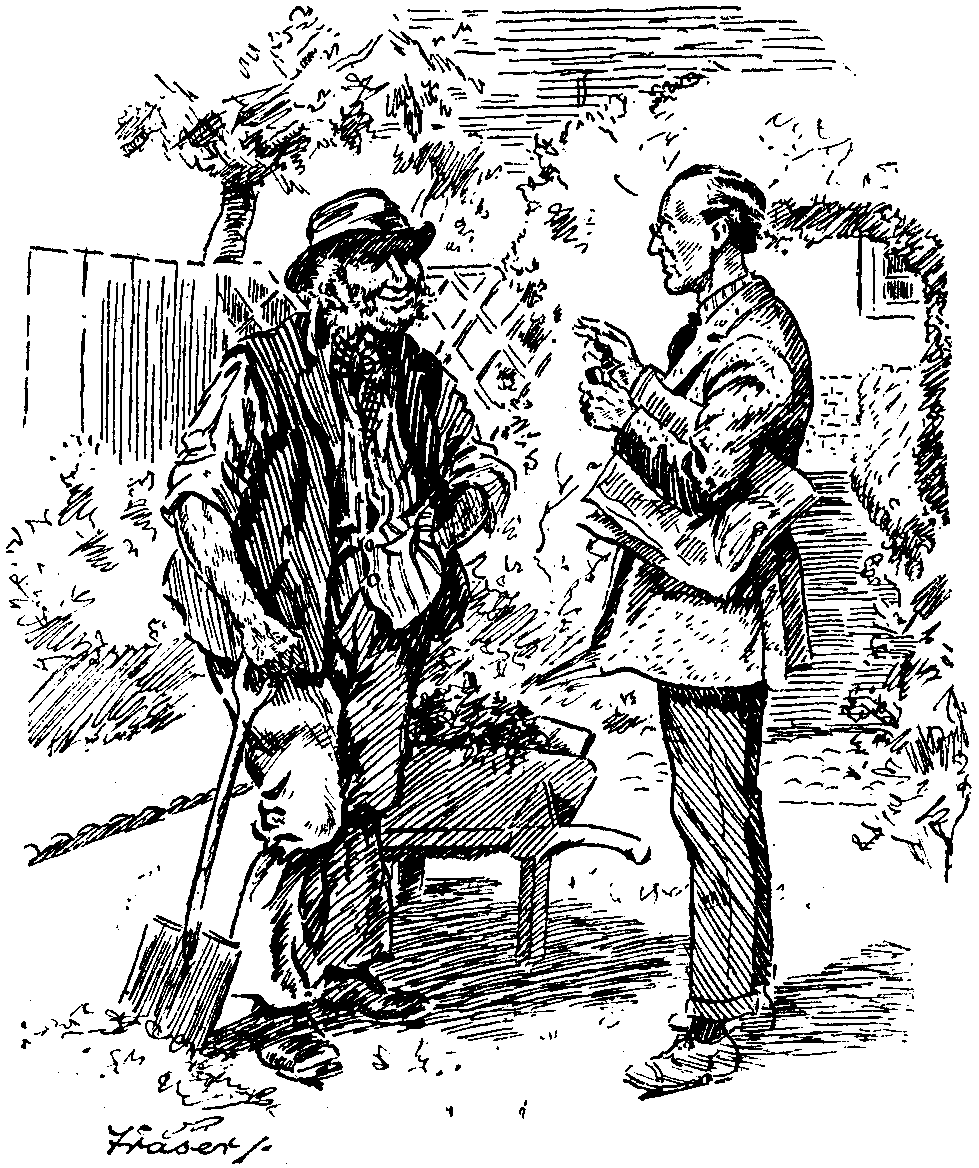
Master. "BUT, JENKINS, THE NAME OF THE COMPLAINT IS NOT PEWMONIA. SURELY YOU'VE HEARD ME AGAIN AND AGAIN SAY 'PNEUMONIA'?"
Man. "WELL, SIR, I 'AVE; BUT I DIDN'T LIKE TO CORRECT YOU."
How to Solve the Food Problem.
"Superior Working Housekeeper and young Maid for Ladies' College. No cooking; students sleep only."—Church Times.
Commercial Candour.
"The interesting announcement is made that a regular air service for perishable goods and passengers is to be established at Edinburgh."—Scotsman.
"The London season has begun with its usual extensive programme of religious services in various London churches."—Scots Paper.
The best comment that we have yet seen on this statement occurs in the following (also from a Scots paper):—
"The Commander-in-Chief has borne testimony on behalf of the Grand Fleet to the work that the Scittish Bishops have done for the Navy during the War."