Volume 156 — GALLERY PLAY.
Reading edition
It wasn't till Panmore noticed its absence on his return from France that I remembered the little oil painting which I had left at the Ferndale Gallery on sale or return, during the early days of the War, when my financial outlook was bad.
Panmore said he had always wanted to buy it, but hadn't liked to ask me if I would part with it. I assured him that excess even of delicacy was a mistake and that I would try to get the picture back.
So I wrote to the Gallery thus:—
DEAR SIRS (it seemed absurd to write "Dear Gallery"),—In 1914 or 1915 I brought you a small oil painting, which you agreed to sell or return to me. As I haven't heard from you since, I conclude that there has been nothing doing in such pictures and I should like to have it back. The picture is quite a small one, about the size of an ordinary book, and so far as I recollect it portrays a man looking at a horse, to see if its withers stand where they did; or perhaps wondering whether he would sell it and buy a scooter. As a matter of fact I never took particular notice of the picture, not caring for it, but a friend of mine who knows it well appears interested in it and wants to buy it. So please let me have it back as soon as possible.
Yours faithfully,
THEOPHILUS B. PIPER-CARY.
P.S.—By the way, there's a cow, I remember, in the background; a red one. Not a red background; a red cow.
This was the answer I received:—
DEAR SIR,—In reply to yours of the 13th inst., we remember your visit, but cannot trace having such a picture as you describe in our possession at present. We believe you dealt with our Mr. James Langford, who joined up in May, 1915, and is not yet demobilised. He is in Egypt at the moment, we understand, and we are afraid it would take some time to get into communication with him.
We shall be glad if under the circumstances you will allow the matter to rest until his return.
In any case we are afraid we cannot hold ourselves responsible for the picture, unless you can produce a receipt from us proving that it reached us.
We are, Yours obediently,
pp. THE FERNDALE GALLERY.
J.S.
The last paragraph in their letter gave me the impression that they knew they had the picture but had mislaid it. Meanwhile Panmore seemed so hot on it and I was so badly hit by the War that I thought I would have another shot at recovering it. So I addressed the Gallery as follows:—
DEAR SIRS,—Thanks for your letter, and in reply I should be obliged if you could get another search party out. I have found a receipt for the picture, signed with a name that might, if straightened out, be James Langford.
My friend is getting quite excited about it, and he is the sort of person one wants to humour. He is a Lieut.-Colonel, an O.B.E., and, what is more important still, one of the feoffees of Buckley's Hospital (a fifteenth-century foundation here), and whatever a feoffee may be he is not the kind of man to toy with in a small town like this.
I forgot to mention that there is an inn on the left of the picture, and a girl coming out of it carrying, perhaps, a bran-mash for the horse or some Government dope for the man, and there are some hens, all fully regardant and expectant, at her feet.
Hoping to hear in the course of a post or two that you have found the painting,
I am, Yours anxiously,
THEOPHILUS B. PIPER-CARY.
P.S.—Don't forget there's a cow in the background; a red cow.
Three days later I received a picture (not mine) from the Gallery with this letter:—
DEAR SIR,—After a most exhaustive search we have found and send herewith what we believe to be your picture, though it does not quite answer to your description. It is, however, the only one of which we do not appear to have any record.
Our Mr. Langford seems likely to be abroad for some months, so unless you will accept this picture in settlement of the matter we do not see any present way out of the difficulty.
Confident that, if it is not yours, it is at least just as good, we trust that you will agree to cry quits.
We are, Yours obediently,
pp. THE FERNDALE GALLERY.
J.S.
Why they should feel sure it was just as good, unless they remembered my picture, wasn't very clear, but evidently the receipt had put the wind up them, and I wrote and accepted the substitute at once, because Panmore liked it better even than the original picture. He said it was an Alken and gave me far more than I would have thought of asking for it, or for the original one.
About a week after selling it I received this wire from the Gallery:—
Please return painting sent in error. Very valuable Alken. Have customer.
FERNDALE.
"Diamond cut diamond," I said to myself. And I replied thus:—
DEAR SIRS,—I received your wire, but regret that I cannot comply with your request. Firstly, because I have already accepted the picture which you regarded as mine or its equivalent, in place of the one that was mine and is now yours; and, secondly, because my friend the feoffee has already bought it, the one that was yours and is now mine, or rather his (you know what I mean, don't you?), and I haven't the heart to ask him to return it.
Perhaps yours (the one that is now yours and was mine before), being the equivalent of the one that was yours and is now mine (or rather the feoffee's), would suit your client. I can only suggest your having another look for it; the matter so far as I am concerned is at an end. Yours faithfully,
THEOPHILUS B. PIPER-CARY.
P.S.—You'll know it when you find it. There's a red cow in the background.
"Sentence of Mike Ancon, found guilty of housekeeping, was postponed yesterday afternoon."—Manitoba Free Press.
This species of crime is almost extinct in England.
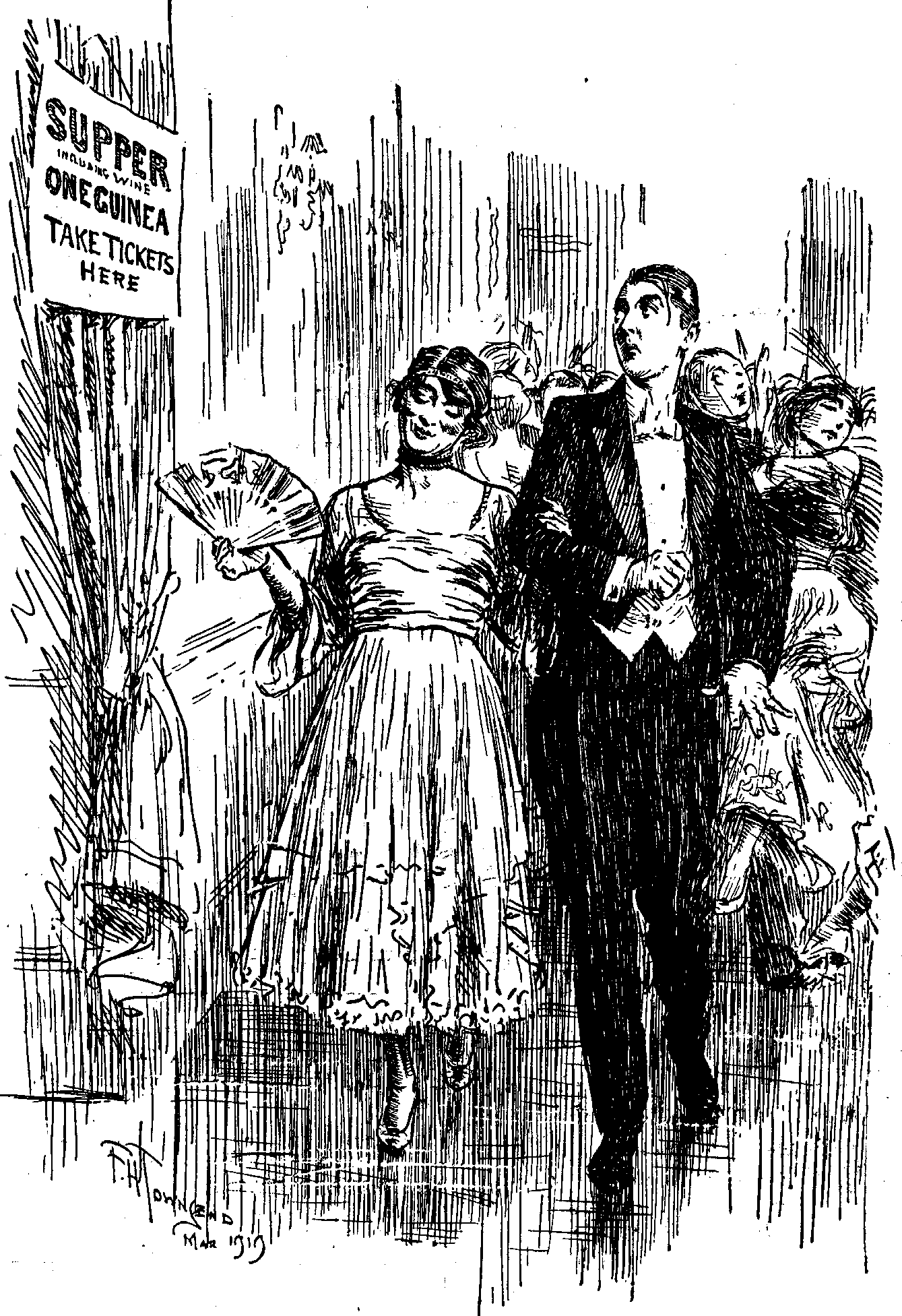
THE "HESITATION" WALTZ.
The Rising Egg.
Whatever may be the decline in the price of eggs their social movement is clearly upwards. The following passage from The Croydon Advertiser gives an admirable life-history of the egg, from shell to profit-sharing:—
"Eggs will be dated and graded and sold accordingly, and as soon as they have done laying fattened for table purposes, also young cockerels. They will be killed and plucked, and the feathers will be sorted and sold in the best markets. So you see they will receive full market price for their produce; then if they are shareholders they will receive a further profit in the difference between the cost and the selling, also the very big amounts received for the skins and the feathers."
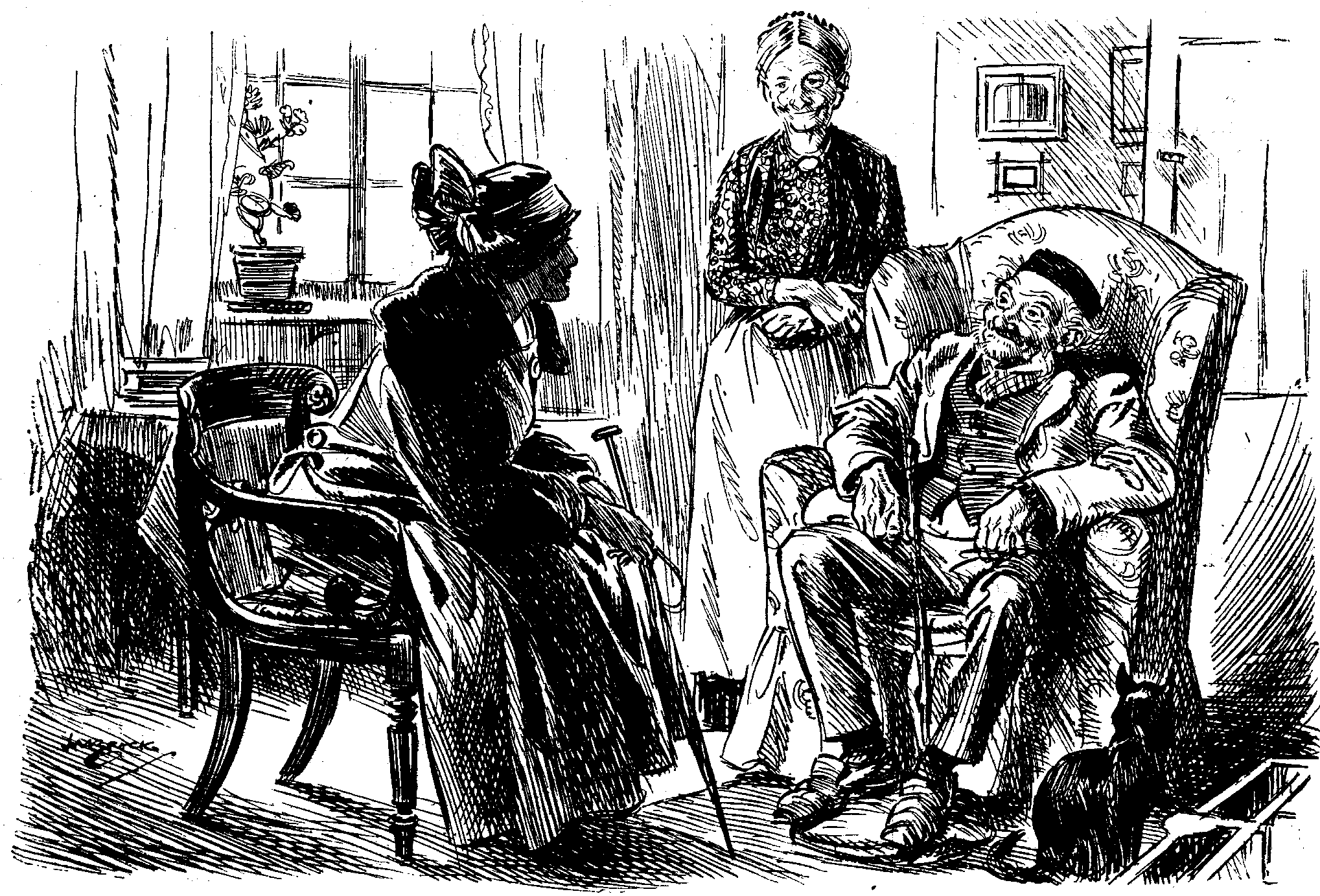
HOPE SPRINGS ETERNAL.
Oldest Inhabitant. "I NEVER EXPECTED TO LIVE TILL THE END OF THE WAR, MA'AM; BUT NOW I'M HOPING TO BE SPARED TO SEE THE BEGINNING OF THE NEXT ONE."
CHOICE BOOKS OF THE WEEK.
THE NEW PARIS SKETCH-BOOK; OR, THE FIRST FIFTY THOUSAND. By GLADYS FLAPPERTON, O.B.E., Author of Peace and Plenty of It.
This charming volume describes in detail the delightful Parisian holiday which has been provided by the Government under the best possible conditions for young ladies with (and without) a knowledge of typewriting.
TIGER LILY, A POEM IN FOURTEEN SPASMS. By WOODROW WILSON. Affectionately dedicated to M. CLEMENCEAU.
THE HISTORY OF FREDERICK THE GREAT. BY HAROLD SMITH, M.P. ("England's Harold.") With an Introduction by the LORD CHANCELLOR.
O SMILLIE, WE HAVE MISSED YOU, AND OTHER LYRICS. Highly recommended by Messrs. MUDIE and SANKEY (the Author). Copies of this beautiful work have been accepted by several mining royalties.
THE GEDDES BIOGRAPHICAL DICTIONARY. Publication of the Second Volume (AUC—ERIC).
It is hoped to complete in twelve handsome volumes this the first attempt to record and codify the achievements and services of the GEDDES family in the Great War.
WASTEWARD HO! A ROMANCE OF CIPPENHAM. With an Introductory Apologia by Mr. WINSTON CHURCHILL.
THE NEXT WAR.
["As the result of a conference called by the War Office it has been decided to wage a war of annihilation against the warble-fly. It is hoped that by means of concerted action through the country this pestilent insect, so injurious to the hides of horses and cattle, may be completely stamped out."—Daily Paper.]
The warble-fly, the warble-fly Is absolutely doomed to die. They've summoned all the General Staff, There's going to be a mighty "strafe," And soon the land from shore to shore Will echo with the din of war, As arméd hosts with martial cries Descend upon the warble-flies. We've got the shells, we've got the guns (The same that overwhelmed the Huns), And, what is more, we've got the Man; With WINSTON riding in the van I do not think there's any doubt That we shall put the foe to rout, And, scorning peace by compromise, Annihilate the warble-flies. In tranquil peace the gentle beeves Shall chew their cud through summer eves; No more shall that alarming warble Affright the calm of heifer or bull, And send them snorting round the croft With eyes of fear and tails aloft. Till every warble-fly be floored Whitehall will never sheathe the sword.
The Growth of Impropriety.
"Her hair is always exquisitely dressed, and her shoes in perfect shape. No more in the way of dress is required of any woman."
Daily Mirror.
"PROPOSED IMPROVEMENT OF A DANGEROUS CORONER." Headline in Provincial Paper.
The best plan, possibly, would be to get the jury to sit on him.
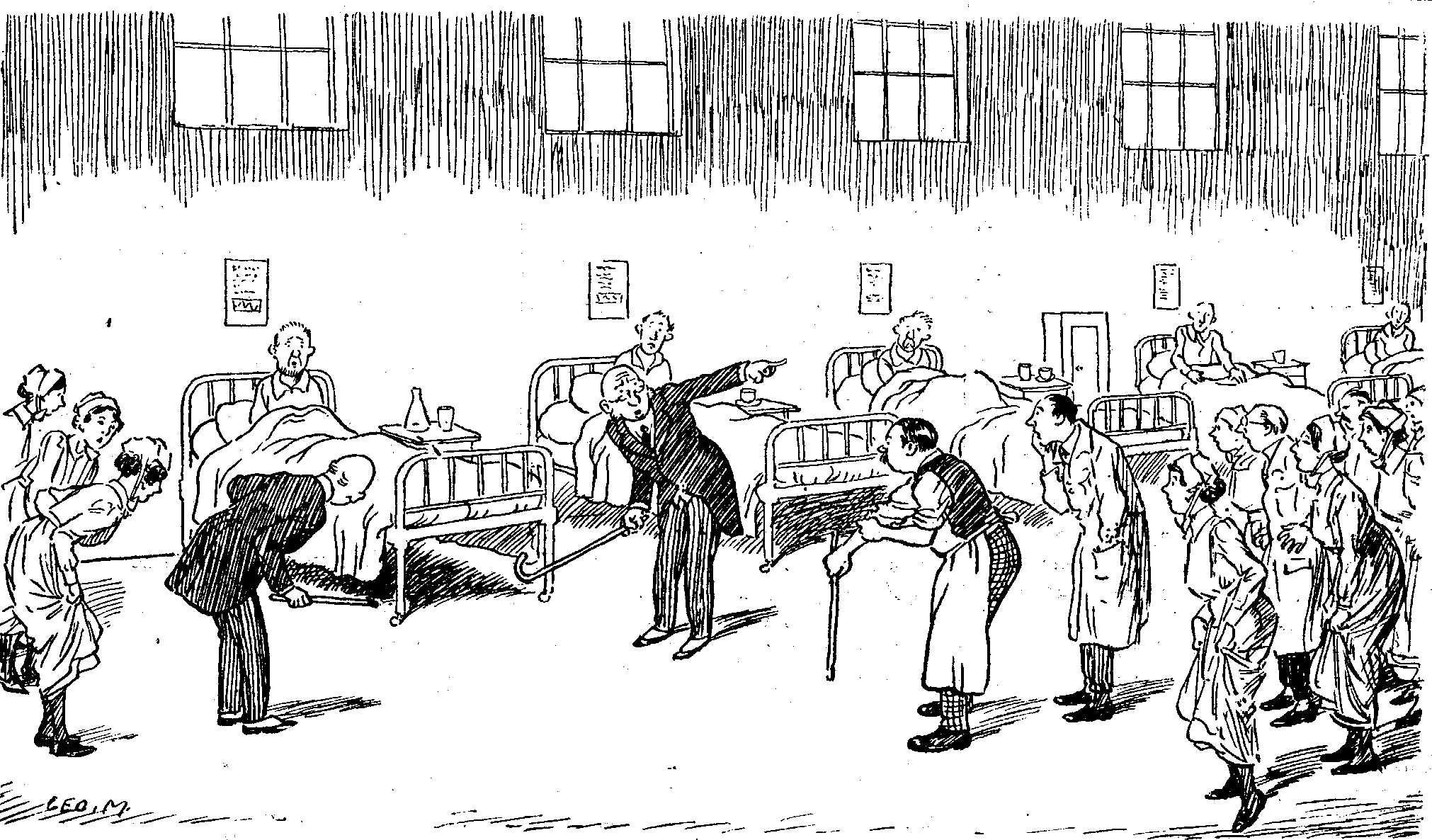
NEWSPAPER HEADINGS POPULARLY ILLUSTRATED.
"INFLUENZA MICROBE DISCOVERED AT A LONDON HOSPITAL."