Volume 156 — ON THE RHINE.
Reading edition
II.
There is an expression here which I expect will shortly become as familiar as "Na poo," and that is, "Hoot up!" When I first beard our mild and gently-mannered Carfax employ it as a vigorous word of command to a civilian in this small German village, I thought he had gone a little mad. For no good military purpose, it seemed to me, could possibly be served by demanding an imitation of an owl at eleven o'clock on a wintry morning. It argued a perverted sense of humour at least; and in truth I had been expecting a slight lapse from the paths of sanity on the part of our Mr. Carfax for some time. For, you see, he is a pivotal man who cannot get away until others arrive to replace the pivots, and it is difficult to persuade him that all is for the best. But he informed me that "Hoot up" had nothing whatever to do with, the night-cries of owls or any other kind of bird, but was in fact the idiotic way in which the natives of this country pronounce "Hut ab" (Hat off).
Now you realise what horrid Huns we are. Civilians are obliged to take off their hats to British officers—a very grim business. In reality, except that we are the hated English, it makes very little difference to the Bosch, for the innkeeper here says that orders concerning the taking off of hats to all and sundry became so stringent in 1918 that the local postman was constantly interrupted in his duties to answer the salutes of people who wished to be on the safe side.
Bosches who have really fought for their country do not object to "Hoot-upping." They of course are the first to realise that inhabitants of occupied countries were forced by them to "hoot up," and that therefore there is a certain justice now in the retaliation. Anyway, from these people the procedure does not greatly interest us; but the overdressed Bosch profiteer, fat and muttony—to hoot him up in his own village! Really, you know, in some ways the War has been worth while.
But the knowledge that he is carrying out a perfectly definite order does not make the subaltern turn any the less pink the first time he ticks off a civilian for failing to comply with the regulations. No, you can't produce a really good Hun without lots of practice. I made almost a companion of the Sergeant-Major at first, because he used to say it for me; but the second day I got caught. It came as I was picking my way down the main (and only) street of the village. My attention being riveted upon keeping my feet, for there are little streams on either side of the street which freeze and flood it, making life in army boots difficult, I did not notice the approach of the fellow until he was on me. And then I saw it was a real Hunnish Hun; and, oh joy! he had a fur coat and a face which I had not thought could exist outside bad dreams. His wicked little eyes glared insolently at me, and he strolled by with his hat stuck at a rakish angle; and for the life of me, would you believe it? I could not remember the magic words. Turning in desperation I commanded him without further delay to "hot hoop." He appeared surprised. He made no sort of motion to comply with my order. "Hut hop!" I cried, purple with vexation, and still the abominable article of headgear remained jauntily perched over his square ugly face. Advancing threateningly I thundered out that it was my firm intention that he should, under peril of instant arrest, "take his confounded, hat off!" At this final command (the first he had found intelligible) he grabbed hastily at the offending article, slipped up on the ice, and, in my moment of triumph, so did I.
It is a sickening business sitting on the ground opposite a man you don't like, but I had the better of it in the end, for I had sat down where the water was already frozen, and he hadn't.
Our Mr. Carfax too had an awkward incident happen to him. We were walking down the street discussing the Pay Warrant, which gives the young Army of Occupation a bonus from February 1st, and gives us nothing for doing their job until May, when suddenly a civilian passed us with a mere nod. Mr. Carfax went on with his insubordinate conversation, oblivious to the insult.
"Mr. Carfax," I said sadly, "when will you learn that private affairs must never be allowed to interfere with military duties?"
"Sir," he said, surprised and aggrieved, "though a pivotal man of some years' standing I really am taking an interest in my platoon—"
"It is not that," I said; "but do you know you allowed a civilian to pass on your side without taking his hat off?"
Scarlet with chagrin he rushed back after the offender and "hooted him up" more sternly than I could have believed possible for anybody but a Hun to the manner bred.
"I'm most awfully sorry," said the man, "but I've only just got out and didn't know about it." It transpired (as they say) that he was an Englishman who had been interned in the village for four years.
L.
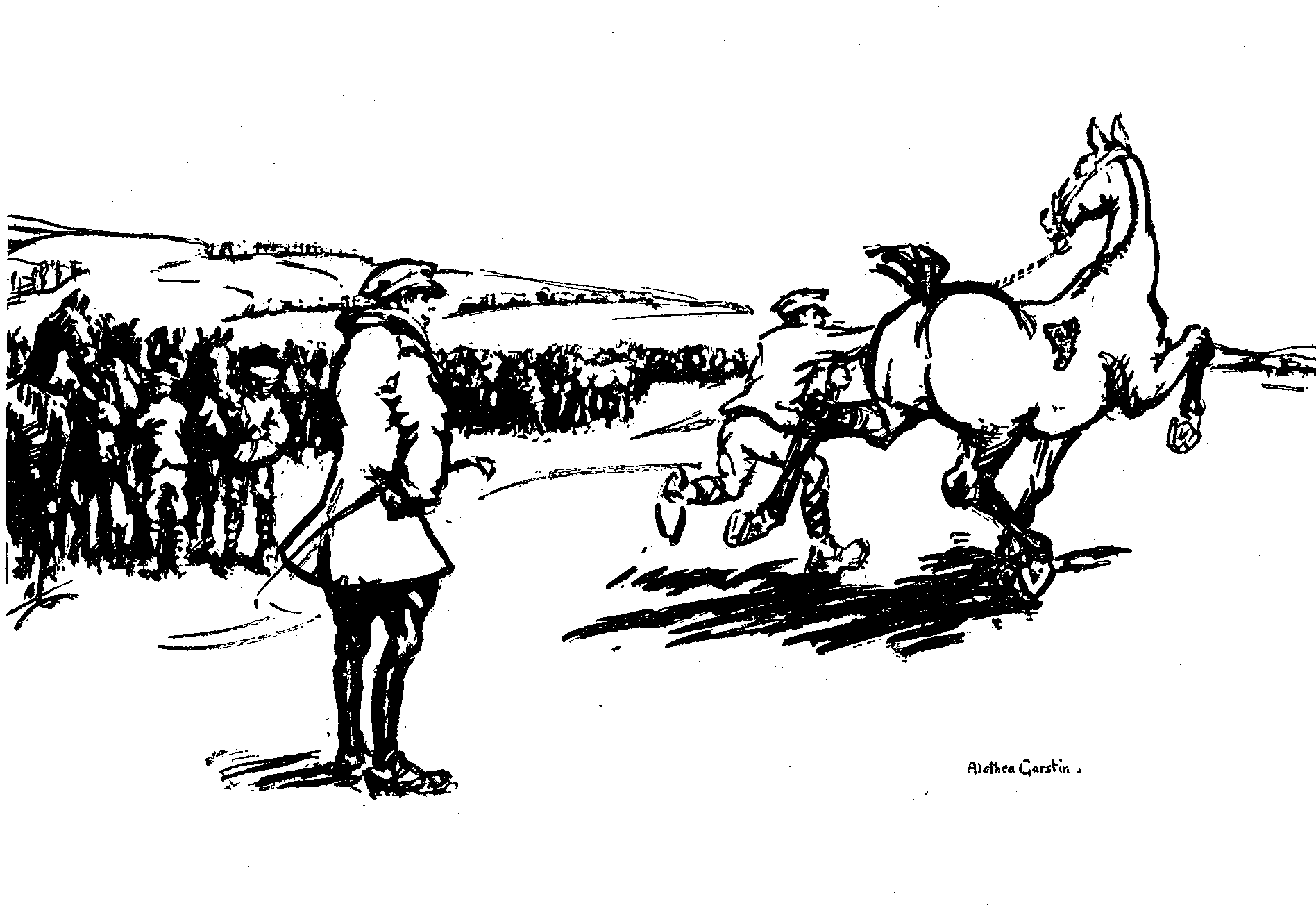
["All horses selected from the Expeditionary Forces for shipment to the United Kingdom must have the letter Y clipped on the off saddle."—-Remount Regulation.]
Elated War-Horse (on completion of operation)
. "HOME, JOHN!"
"Mr. —— will play the flue obbligato for Miss ——, and none better could be found."—Provincial Paper.
Very kind of him, no doubt, but most of us would prefer to do without this accompaniment.
PUNCH'S APPEAL FOR "OUR DAY."
The following letter, dated March 12th, has been received from Sir ARTHUR STANLEY:—
"The completion of the Fund which Mr. Punch has raised in connection with the 'Our Day' appeal gives me the opportunity of again expressing my grateful appreciation of this splendid effort.
"The total remittances we have received from you amount to £11,040 5s. 5d., and the long list of subscribers shows how loyally and generously the readers of Punch have rallied to your appeal.
"On behalf of the Joint War Committee of the British Red Cross Society and the Order of St. John, I should like to thank you and your readers most cordially for the welcome assistance you have provided for the relief of the sick and wounded."
"To-day in the garden:—
"Refine the onion-bed thoroughly."—Daily Mail.
Have you tried eau-de-Cologne?
NOUVELLES DE PARIS.
Paris, March 1919.
DEAREST POPPY,—I have a piece of news to send you from here that will give you a veritable frisson d'angoisse. No, it doesn't concern the Peace Conference; it's something far worse than that. Figurez-vous, the new style of coiffure is severe to the point of being absolutely terrifying—that is to the woman who has been shivering on the brink of thirty for any length of time.
Foreheads are coming in again—que c'est embêtant! I thought they'd been abolished long ago. I wish I could get hold of the méchant (for I know it's a man) who is introducing them now. I had my hair dressed chez Manet to-day in the new style, and when I saw myself afterwards I sat down and wept like the women of Babylon.
Quel horreur! My locks were strained, brushed, tightened back, and I was left high and dry with my exposed brow revealing four furrows to an unsympathetic world. C'est navrant. We're not to be allowed even the soupçon of a wave or the lightest bouffée, while side-curls are quite démodés.
I think the situation is really tragic. So few women can afford to have a forehead. The result will be that lots of our débutantes of some seasons ago will be "coiffées à Ste. Catherine" in more senses than one.
The "jewellery" one wears now is made of wood; we have carved wooden beads, wooden bracelets, even wooden rings. "Therefore it will be cheap!" you exclaim. Vous vous trompez, mon amie. I read a story the other day of an American who said that if you want an egg here for breakfast it is cheaper to buy the hen and hope she'll lay next morning, and in any case you've got the hen. Eh bien, should you desire a set of wooden jewellery you might save money if you bought a forest.
Paris has done more than extend le bon accueil to the Peace delegates; she is giving their names to the latest thing in vêtements. Thus we have the Lloyd George cravate, the Wilson gilet and the "Bonarlaw" chapeau melon. It's surprising how far-reaching are the effects of a Peace Conference.
A number of nous autres Anglais over here started a perfectly thrilling idea. It was really in the way of being an adventure. We have been exploring the quaint little cafés of Paris, with results tout à fait étonnants. We were served with provokingly delicious plats, at a price absurdly moderate compared with what is extorted from us in the hotels. Of course we were all enchanted. We became habitués of cafés and ceased to take any meals at our hotels beyond the matutinal café complet.
And then, quite suddenly, a horrid newspaper article appeared which conveyed suggestions extrêmement désagréables. It insinuated, ma chère, that "things are not what they seem"—at any rate things in the bill of fare at the moderately-priced eating-house.
It went on to speak of the many uses that domestic animals are put to after their labours on earth are ended. If it was horse that figured in the boeuf bourguignon served up to me, or the potée de boeuf aux choux (of which I will admit I raffole) I have no quarrel with it. It's the "lapin" I have had occasionally that's giving me the most qualms. I can't look at a cat now without a shudder.
As for Bertie, he says whenever he thinks of the tripes à la mode de Caen he so often favoured, he's very glad that he has even less imagination than his friends credit him with.
Of course the article may have been inspired by the keepers of hotels who were losing our custom. I think it's more than likely. But we've decided for the present to give the hotels the benefit of the doubt.
Toujours,
Your well-devoted ANNE.
DELYSIOUS DETAILS.
A contemporary, hearing of the reported engagement of two well-known persons in the world of Music and the Drama, interviewed the lady and obtained from her the following synopsis of the crucial moment:—
"I was lunching with my costumier this afternoon, and among the people there was M—— After luncheon he asked me to be his wife. I said 'Yes,' and the marriage takes place next week. We've been friends since I was twelve years old, and his music is the finest I have ever heard."
Spurred to emulation by this striking example of journalistic enterprise, correspondents in all parts of the world are composing piquant descriptions of similar contracts. We offer two examples:—
1. Miss Fanny V. Adie consented to give the correspondent of The Poppleton Observer a few particulars of her engagement to Captain Scorcher, O.B.E.:—
"I was sitting on my ambulance having a biscuit and tin of bully with Alphonse (my French poodle), when suddenly there was a terrific crash. It appears, as I learnt later, that Captain Scorcher was motoring to Lille to purchase whisky and other medical comforts, when the steering-gear of his 60-H.P. Rolls-Ford came away in his hands, with the result that he nose-dived into the rear of my ambulance at forty miles per hour. When I came to my senses my head was in the ditch and the rest of me in mid-air. Captain Scorcher, crawling out of the wreckage, said, 'Do you reverse?' and then asked me to be his wife. I said 'Yes,' meaning I reversed, and the marriage takes place as soon as we arrive at the same hospital. We have been more or less bosom-friends for five minutes, and I think his moustache is the sweetest thing I ever met."
2. Asked if she could confirm her reported engagement to Lord Bertie Brasshatte, Miss Fifi Thistledowne—who dances "The Camisole Squeeze" so daintily in "Really, Girls!" (the Mausoleum revue)—recounted to the correspondent of The Jazzers' Gazette the following romantic story:—
"I was having oysters and stout with my chiropodist at his place in Stepney, and among the people there was Lord Bertie Brasshatte, who is a martyr to cold feet, contracted during his visit to Boulogne in 1918. (How can we ever repay these brave men for the hardships they have suffered?) Well, after the tenth oyster he passed me two slips of buff paper, pinned together. On the first was written, 'For information and necessary action, please;' and on the other, 'Are you engaged tomorrow?' I said, 'No,' and the marriage takes place as soon as my agent can make arrangements with the illustrated papers. We've been friends ever since Lord Bertie left a lovely diamond tiara in my waste-paper basket, and I think his suppers are the finest I have ever tasted."
HIMALAYANS AT PLAY.
(Suggested by the sequel to a recent Lecture.)
The Chairman, Sir Norman Everest, after congratulating the lecturer on his interesting address and beautiful photographs, observed that he remained unconvinced by his arguments in favour of approaching Mount Amaranth from the North. The climatic difficulties of that route were in his opinion insuperable, to say nothing of the hostility of the natives of the Ong-Kor plateau and the Muzbakh valley. He still believed that the best mode of approach was from the South-West, following the course of the Sissoo river to Todikat, where an ample supply of yaks could be obtained, and thence proceeding along the Dagyolong ridge to Tumlong.
Sir Francis Oldmead said that he had seldom heard a more interesting lecture or seen a finer collection of photographs. He must be allowed to demur, however, to the lecturer's description of the heavy snowfall in the highlands of Sandjakphu. During his visit to that district, as they would see from the photographs which he would presently show on the screen, he enjoyed uninterrupted sunshine; nor had he met with the slightest difficulty from the Pangolins of Phagdub. As for the best approach to Mount Amaranth he was convinced that the only feasible route was to work up the Yulmag valley to the Chikkim frontier at Lor-lumi, crossing the Pildash at Gonglam, and, skirting the deep gorge of the Spudgyal, ascend the Takpa glacier to Teshi Tsegpa.
Professor Parbatt expressed his keen appreciation of the vivid descriptions of Himalayan scenery given by the lecturer, and the admirably-selected photographs which had enlivened his address. He wished, however, that he could have furnished more details as to his camp equipment. Had he, for example, used Nummulitic beds for his party? Then there was the question of geoidal deformation, on which he had remained unaccountably silent. As for the vital problem of approaching Mount Amaranth, he ventured to differ from all the previous speakers. The Northern, South-Western and Eastern routes were all equally impracticable, as he would conclusively demonstrate from the photographs he had brought with him. But there were at least fourteen routes from the West, of which he would confine himself to four. (1) Starting from Yeh, the party might cross the Tablung-La pass to Gorkpa Nor, and thence follow the Yombo to Chilgat, where they would be only twenty-five miles from the foot of the western face of Amaranth. (2) They could follow the old Buriat pack-road to Amdo, diverge by the narrow defile of Koko-Pir-Panjal to Tumbung, and thence make for Ghapchu-Srong and Chyang-Chub-Gyultshan. (3) They might start from Pongrot and cross the Tok-Tok pass to Pilgatse. (4) They might construct a tube from Darjiling to Grogma-Nop, and thence proceed by aeroplane to the saddle of Makalu, or, better still, to the summit of Amaranth itself. The last route was far the shortest and quickest, but it involved a certain amount of preliminary expense.
The Chairman having expressed his regret that Sir Marcon Tinway was not present to describe his experiments with man-lifting kites and trained albatrosses, the assembly dispersed after singing the Tibetan national anthem.
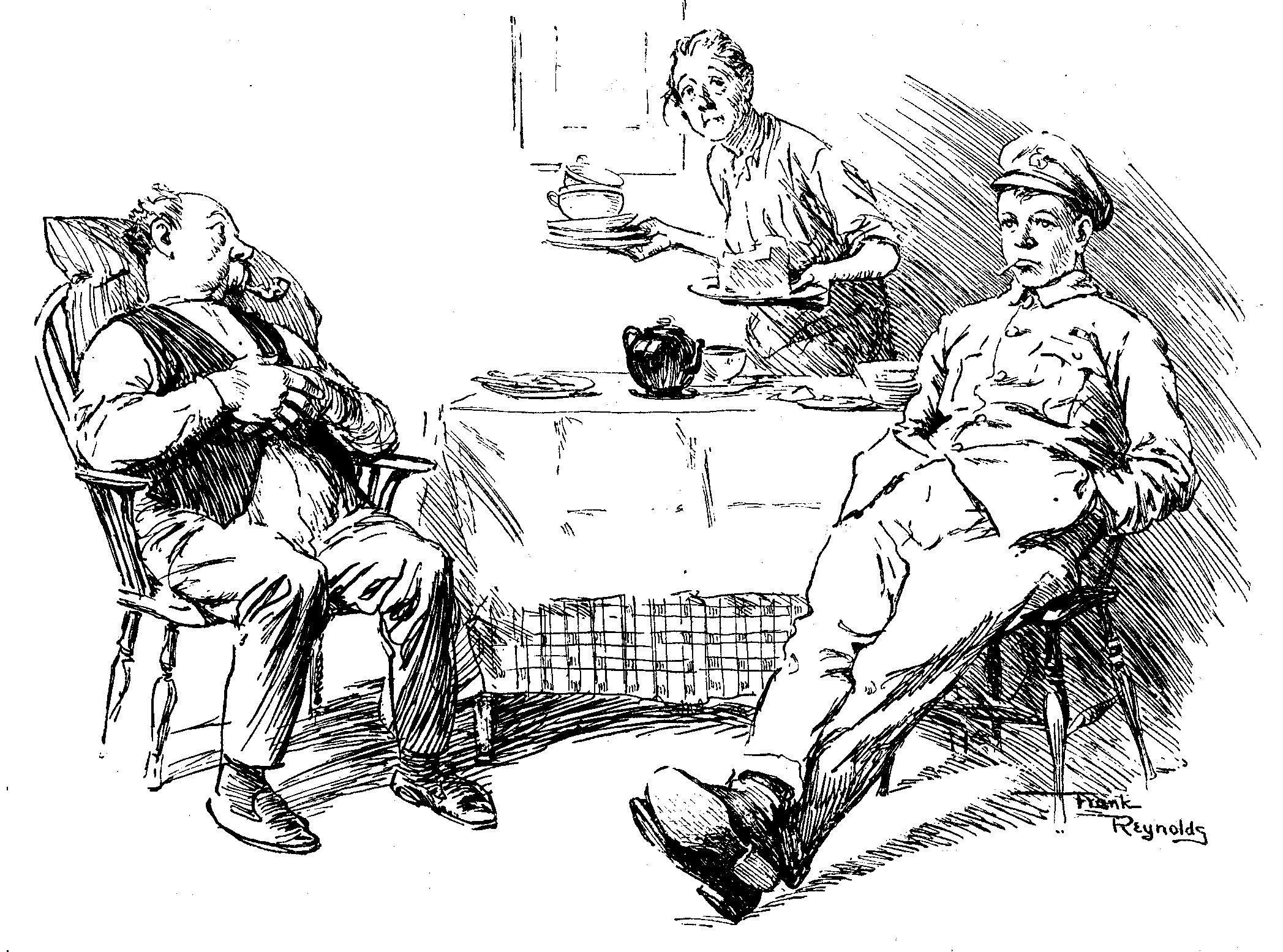
HOW TO BRIGHTEN THE PERIOD OF REACTION.
Mother (to son who has fought on most of the Fronts). "DON'T YOU KNOW WHAT TO DO WITH YOURSELF, GEORGE? WHY DON'T YOU 'AVE A WALK DOWN THE ROAD, DEAR?"
Father. "AH, 'E AIN'T SEEN THE CORNER WHERE THEY PULLED DOWN SIMMONDSES' FISH-SHOP, 'AS 'E, MA?"
A hitherto unrecorded incident in the life of M. CLEMENCEAU:—
"A little later in his career—at the time of the Commune, in fact—another man very nearly escaped being shot in mistake for him."—Egyptian Gazette.
There are, we understand, several Frenchmen who can boast that they escaped this fate altogether.
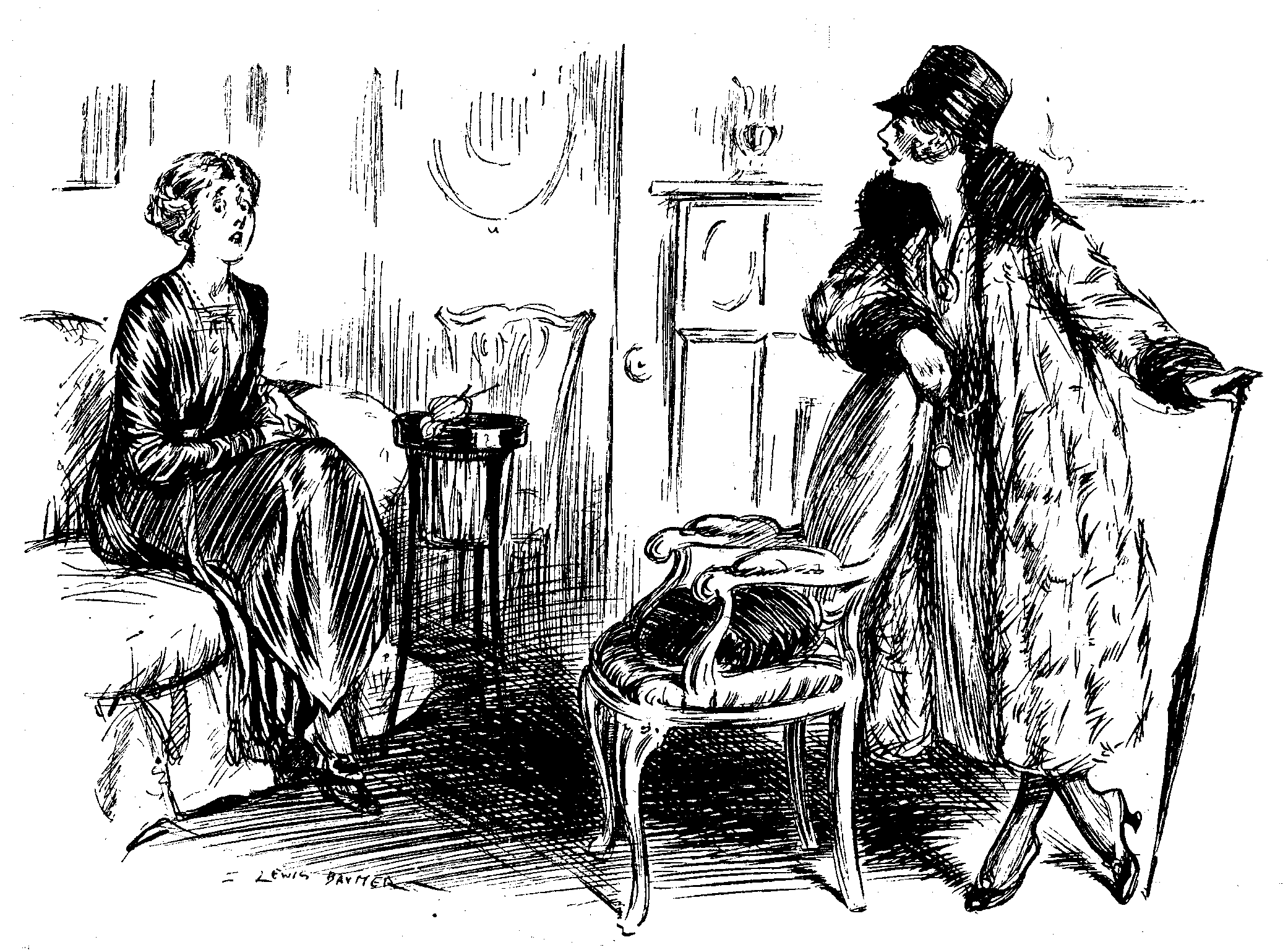
Lady (to prospective daily housemaid). "THE HOURS WILL BE FROM NINE TO SIX-THIRTY, WITH AN HOUR AND A-HALF OFF FOR DINNER."
D.H. "FOR LUNCHEON, I SUPPOSE YOU MEAN. AND I SHOULD HAVE TO LEAVE AT SIX, AS I ALWAYS DINE AT MY CLUB AND HAVE TO DRESS FIRST."
AN UNHAPPY HERO.
Poor Clayton-Vane's case is one of the most poignant peace tragedies that have come to my notice. He had just acquired an inexplicable but genuine enthusiasm for stockbroking when the War gave him the opportunity of developing into a remarkably brilliant officer. Not only did he attain his majority, but gathered a perfect chestful of decorations, including all the common varieties and several which leave civilians guessing.
Yet strange to say the man who has won these honours in war detests soldiering with all his heart. He fought as a duty, and did his share with furious energy in the hope of so shortening the War. His hatred of the military profession is indeed equalled only by his love of stockbroking and by his natural pride in having scrapped right on from the word "Go!" till November 10th, 1918, when he was sent home slightly wounded.
Now the tragedy of which he is the pathetic central figure is the result of his remarkably youthful appearance. Every time his portrait figures in The Daily Scratch, people say, "Why, he looks a mere child! But then these Press photographs always do distort one so." Yet in this instance people are unjust. Clayton-Vane, after a four years' flirtation with death, has the face and figure of a careless chubby schoolboy. When he is in uniform this youthfulness only adds lustre to his blushing honours.
Now my unhappy friend is on the horns of a dilemma. He pines to go back to broking as sincerely as some men pine to travel or to write poetry, but every time he ventures out in mufti some painful incident warns him what he will have to suffer as a civilian, with his round rosy face, innocent blue eyes, curly hair and bright smile. He hears himself referred to as a chip of the old block. Chance acquaintances ask him if his father or big brothers were at the Front. To-day, he told me very bitterly, he was asked if he did not wish the War had lasted a little longer so that he might have been old enough to go out and fight!
"I can't bear it, old man," he said. "There's something about me that draws out their sentimentality, and they've all got to say something about my youth, and the heritage of peace that the 1917 conscripts won for me. They talk as if I had been busy with a feeding-bottle instead of compressing my silly face in a box-respirator."
His dilemma is a very painful one for a man so sensitive and at the same time so enamoured of stockbroking. Hard as the renunciation will be, I really believe he will end by turning his back on the Exchange for ever and taking a regular commission, though I try to persuade him that if he will only brave the horrors of peace as he braved the horrors of war he will win through in the end and grow out of his face.
Promotion.
"Ex-Batman wanted as General in private house."—Times.
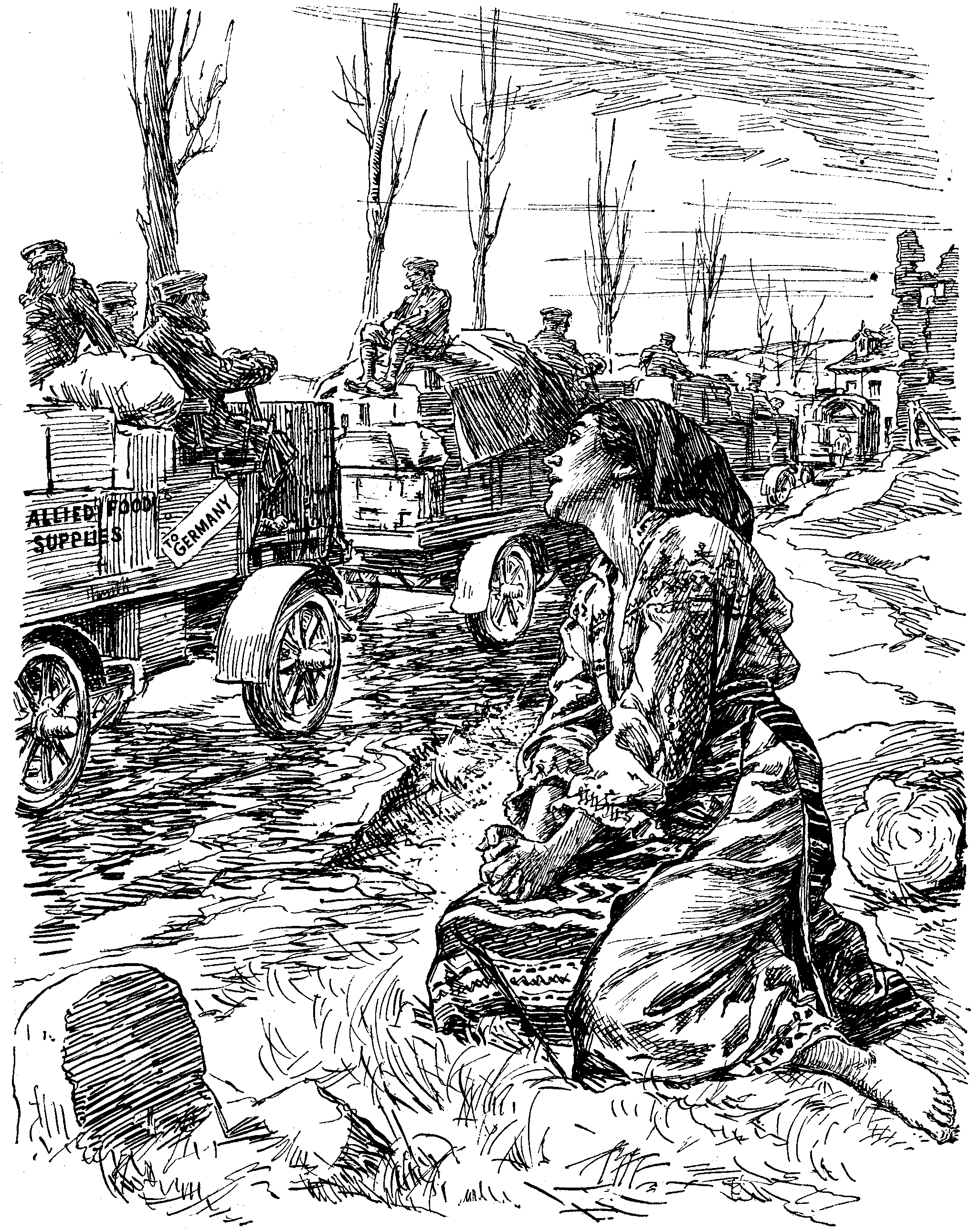
AN IRRESISTIBLE CLAIM.
ROUMANIA. "I HOPE, WHILE THEY'RE FEEDING THEIR STARVING ENEMIES, THEY WON'T FORGET THEIR STARVING FRIENDS."