Volume 156 — ESSENCE OF PARLIAMENT.
Reading edition
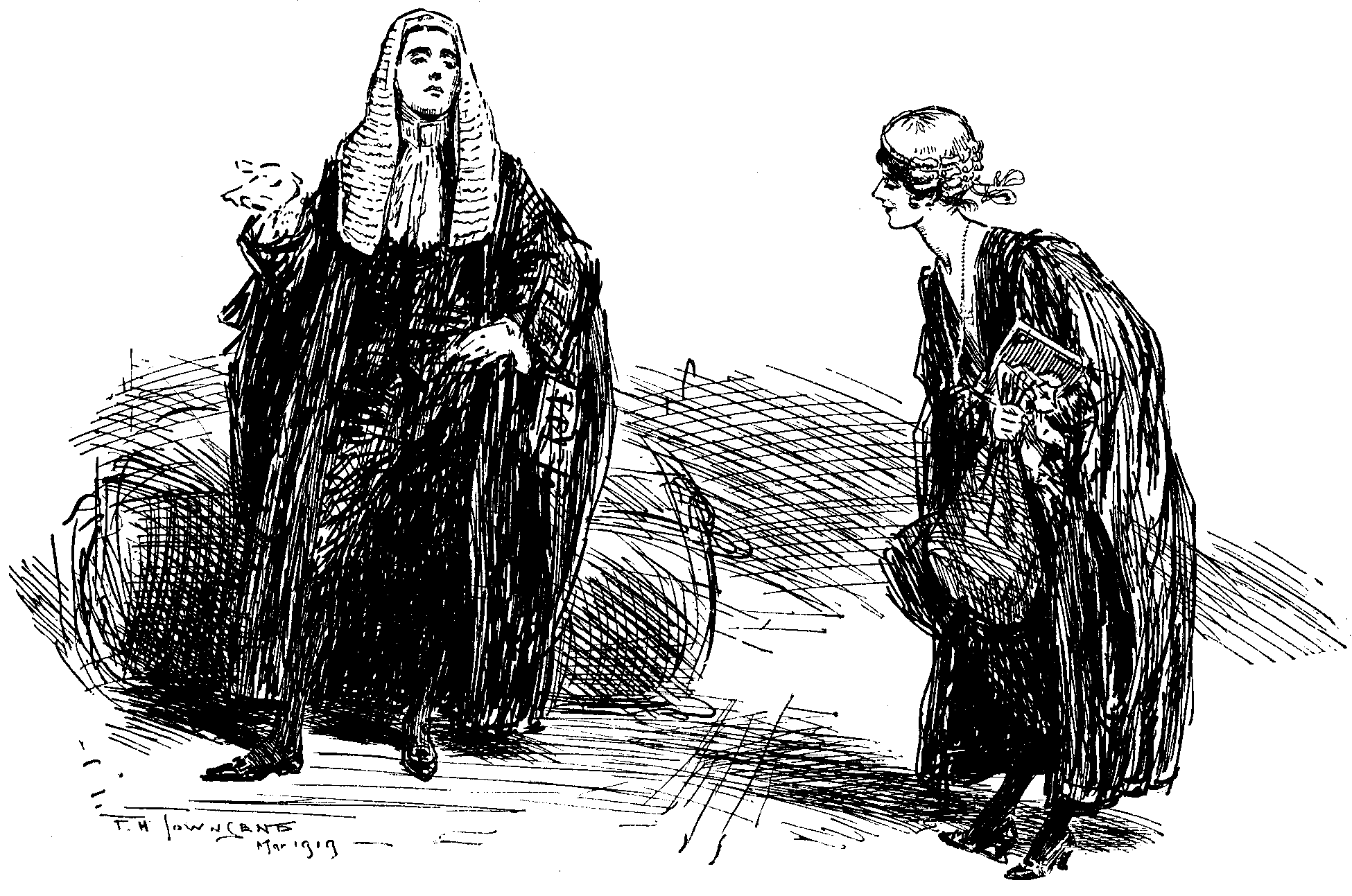
Duke of Venice (the Lord Chancellor), to Portia. "YOU ARE WELCOME: TAKE YOUR PLACE."—Merchant of Venice, Act IV. Sc. 1.
Monday, March 10th.—Sir JAMES AGG-GARDNER asked two questions dealing with the distribution of poisons. By a singular coincidence—or was it design?—the hon. baronet was himself, as Chairman of the Kitchen Committee, accused by Mr. BOTTOMLEY of having purveyed poison in the shape of stale fish to sundry Members of the House, thereby causing them serious internal disturbance. Happily he was able to show that the charge was entirely baseless.
Scots legal terminology always puzzles me. The "peremptory diets" which Mr. MACQUISTEN urged upon the attention of the SECRETARY OF THE TREASURY as a remedy for the grievances of Glasgow's financiers are not, as you might suppose, a synonym for forcible feeding; nor have they anything to do with the substitutes for "parritch" to which, as I gathered from Mr. STURROCK, the people of Scotland are being obliged to resort owing to the high price of oatmeal.
Members rubbed their eyes a little when they heard Colonel AMERY declare that the general policy of the Government regarding Imperial Preference had been "clearly defined" and in the ensuing debate Sir DONALD MACLEAN declared that, on the contrary, their whole fiscal policy was "wrop in mystery."
The veil was lifted to some extent by Sir AUCKLAND GEDDES, the Ministerial "handy man," who, in the absence through illness of Sir ALBERT STANLEY, explained how the Government proposed to regulate imports and exports during the transitional period. Up to September 1st our manufacturers are to enjoy a sort of close-time, free from foreign competition, but after that they must, like the partridges, take their chance.
Later in the evening the House welcomed a new orator in Dr. MURRAY, who sits for the Western Isles. He made a rousing appeal on behalf of the men—practically the whole able-bodied population—who had gone from them to fight the Empire's battles. In his view the SECRETARY FOR SCOTLAND was too mild in his methods, and should be "bristling with thistles and flourishing the claymore" when he tackled the reform of the Land Laws. Mr. MUNRO was evidently flattered by this tribute to the martial potentialities underlying his eminently pacific exterior.
Tuesday, March 11th.—In moving the Second Reading of his Bill to enable women to become barristers and solicitors, Lord BUCKMASTER thought it necessary to assure the House that there was no danger of its flooding the Inns with prospective Bar-maids. He might have spared his apologetics, for there was no opposition. The LORD CHANCELLOR welcomed the Bill on behalf of the Government, and expressed the conviction that the Benchers, though not "avid of this change," would nevertheless loyally co-operate if Parliament saw fit to adopt it.
Having caught the infection from the Commons the Peers then proceeded to discuss their own procedure. From Lord CURZON we learned, somewhat to our surprise, that the House possesses certain Standing Orders. At present it honours them chiefly in the breach, and in its Leader's view it would do well to imitate the more orderly procedure of another place, even to the adoption of "starred questions" and the abandonment of the practice by which any noble Lord, by the simple process of addressing an inquiry to a Minister, can initiate a full-dress debate. Lord CREWE'S pious hope that these suggestions would enable more noble Lords to take part in the debates was welcomed by Lord AMPTHILL, who remarked that, after nearly thirty years in that House, he had never before been made aware of this desire for backbench orations.
As originally introduced the Rent Restriction Bill was strictly limited in its operation. But landlord-baiting is a sport to which the House of Commons is much addicted, and by the time the measure emerges from Committee its own draughtsman will hardly recognise it.
The best of the many Amendments complacently accepted, after a show of reluctance, by the Government spokesmen, was one providing that no increase of rent shall be chargeable except in the case of a house "reasonably fit for habitation." That should make some of our slum-owners sit up and take notice.
Wednesday, March 12th.—An apparently innocent request from Lord SUDELEY for the reinstatement of the system of guide-lecturers in the Museums led to quite a lively debate. Other noble lords used the motion as a peg for a fierce indictment of the Government's treatment of these institutions during the War. Lord CRAWFORD, who has probably forgotten more about Art than some of his critics ever knew, concealed his real sympathy for the motion under a mask of official obstructiveness, but was compelled eventually to give it a strictly provisional acceptance.
In the old days when the possession of a seat was secured by the deposit of a hat it was no uncommon thing, on the morning of a big debate, to see a Member staggering in under a load of toppers, with which he proceeded to secure seats for his friends. To put an end to this nefarious practice the card-system was introduced; but that, it is said, has now been similarly abused. One man one card, however, is in future to be the rule. Colonel WILL THORNE feared that it might still be circumvented by the "stage army" trick; but the SPEAKER thought the attendants might be trusted to recognise and defeat any Member who essayed it.
Rear-Admiral Sir REGINALD HALL, having added to his laurels by defeating a NELSON at Liverpool, took his seat this afternoon, and was loudly cheered for the manner in which he came into action. He and his supporters maintained their "line abreast" and discharged their salvoes of salutes to the Chair with faultless precision.
Later on the gallant Admiral earned further cheers for a capital maiden speech on the Naval Estimates. These were introduced by Mr. LONG, who told the story of the Navy's triumph with all a landsman's enthusiasm. Its future size may to a certain extent depend upon the Judgment of Paris, but he was certain that, come what may, the Nation would always insist on having a Fleet sufficient for our needs—a sentiment which received the welcome endorsement of Mr. BRACE for the Labour Party.
According to Commander NORMAN CRAIG it was anything but sufficient for our needs when war broke out. It lacked docks, destroyers, submarines, air-ships—everything, in fact, save Dreadnoughts, which, in the absence of these accessories, had to belie their name and rush from one unprotected anchorage to another in fear of the German mosquito-craft. Only the courage of the officers and men saved us, and up to the present—that was the tenor of many of the speeches—they have reaped but a scanty reward.
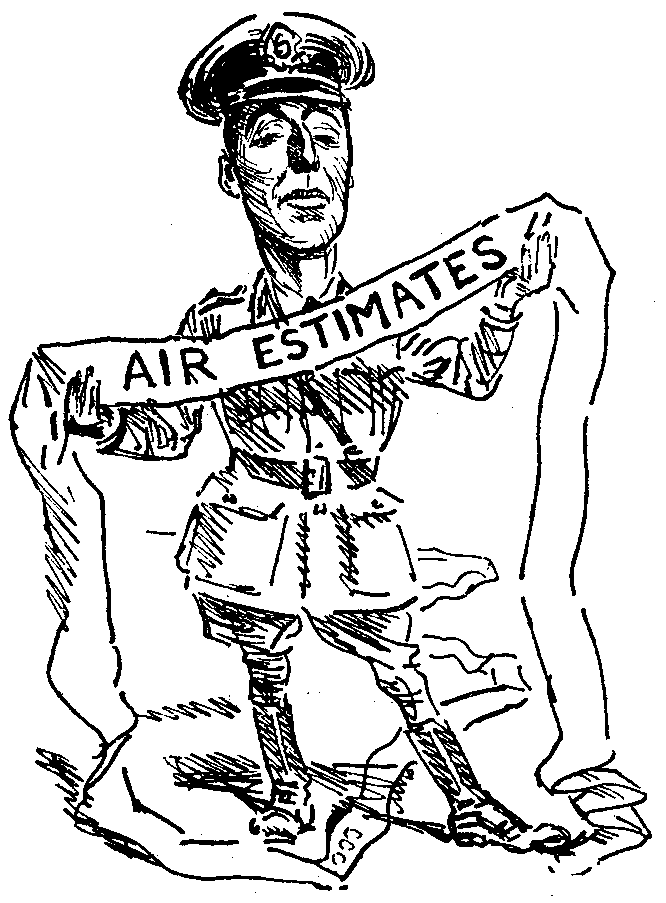
GENERAL SEELY'S NON-STOP FLIGHT.
Thursday, March 13th.—Ministers left at home to "mind the shop" would rather like, I fancy, to put up a notice over the Palace of Westminster, "Closed till after the Peace Conference." Nearly every problem presented to them depends for its ultimate solution upon the decisions arrived at in Paris. Lord STUART OF WORTLEY, for example, put a series of most pressing questions regarding the present condition and future prospects of Poland; but Lord CURZON in reply could only shrug his shoulders (at considerable length) and refer him to the Conference.
The LEADER of the House of Commons labours under similar disabilities, which are beginning to try even his amiable temper. Until Paris has spoken he cannot give definite information about the Government's fiscal policy, the amount of the German indemnity and other pressing topics, and, as he told some of his persistent questioners this afternoon, it is no good putting the same question to him every week and expecting a different answer.
The best news of the day is that there will be an ample supply of currants for Whitsuntide school-treats, and Smith minor's translation of "Non cuivis homini contingit adire Corinthum" as "Not everyone is lucky enough to find a currant in his war-bun" will no longer be applicable.
Five years ago General SEELY, then Secretary of State for War, asked timidly for a single million for aircraft. To-day, as Under-Secretary for Air, he boldly demanded sixty-six millions, and explained that but for the Armistice the amount would have been two hundred millions. And the House, after hearing his glowing account of the wonderful achievements of our airmen, readily voted the money. A good deal of it is to go, quite rightly, to relieving the hardships of demobilisation, which fall with peculiar severity on men whose special training is not much use to them in civil life. The least we can do when they are forced to descend from their chosen element is to insure them against a bad landing.
TO A VEGETABLE-MARROW.
O monstrous, O Gargantuan, overgrown! O huge! O gross! O squat! Whose one redeeming virtue—one alone— Is that you weigh a lot; Who will not thrive upon the common soil, So that the patient digger e'en must toil To raise a special mound Above the level ground That you may sun yourself upon the sloping earth And, like the wicked, wax to an uncommon girth. But it is not your vast circumference That stirs this passing strain; I would not sing although, to move you hence, They fetched their biggest crane; It is that men should shovel tons of that Into the maws of some capacious vat, Add sugar (half-a-pound) And stir it round and round; Then, at the last, throw in some ginger with a spade And label the result as "Lemon Marmalade."
From a description of the first flight of R 33:—
"Alas, the meteorological conditions, at first considered probable, turned out worse."—Yorkshire Paper.
Nothing so likely as the improbable.
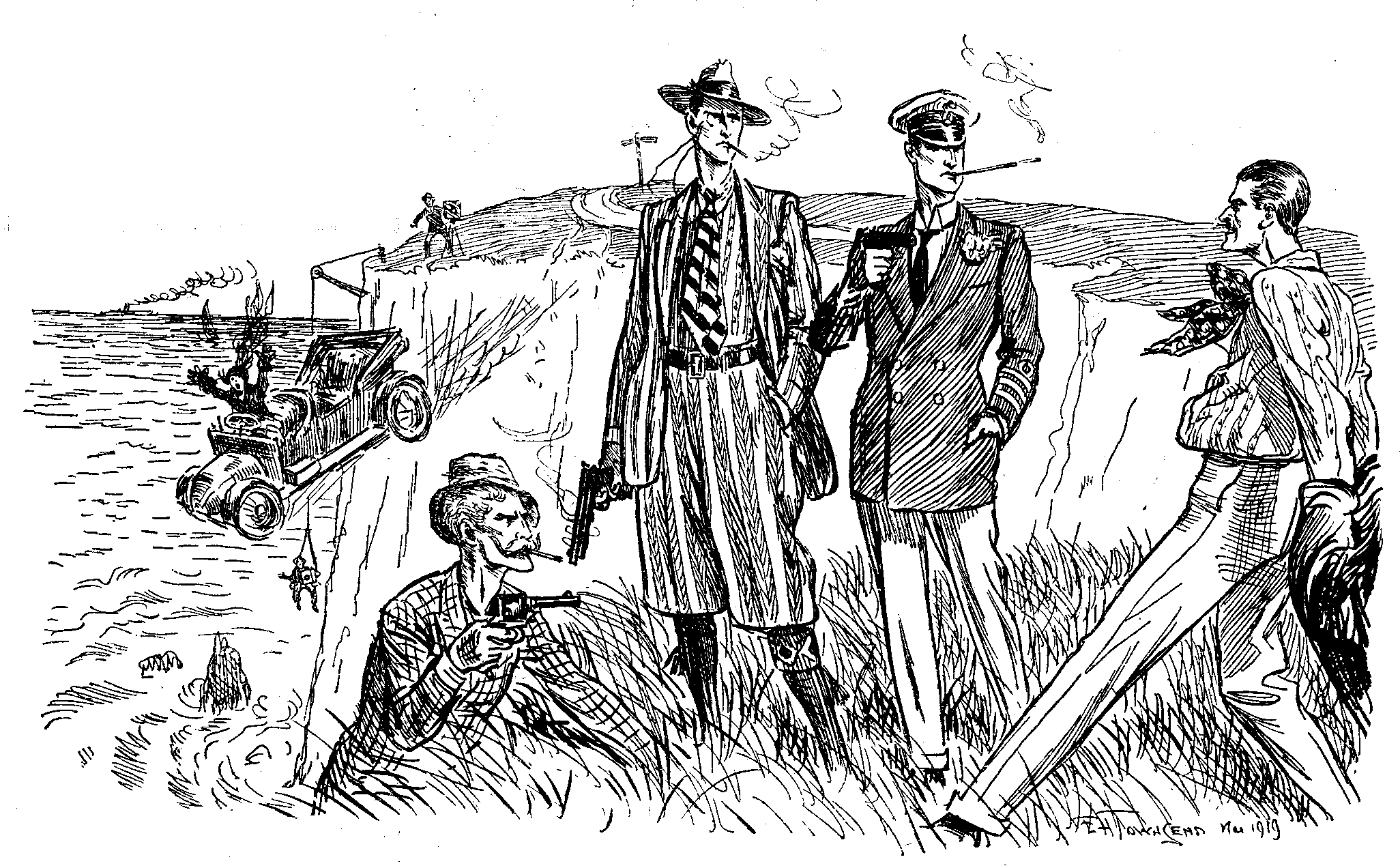
SENSATIONAL SURPRISE STRIKE OF HEROES IN CINEMA-LAND.
PICKETS OF HEROES PREVENT BLACKLEG COLLEAGUE FROM WORKING WHEN THE HEROINE MOST PARTICULARLY NEEDS HELP.
THE BIBLE IN PAIN.
MR. H.G. WELLS' new novel, based on the Book of Job, and Mr. ARNOLD BENNETT'S new play dealing with the story of JUDITH and HOLOFERNES, by no means exhaust the Biblical and Apocryphal motives from which our popular writers are now drawing inspiration.
Mrs. HUMPHRY WARD'S next novel will be a minutely analytical study of the contrasted temperaments of ESAU and JACOB, the one standing for revolt and the other for a rather smooth and supple orthodoxy.
Mr. E. PHILLIPS OPPENHEIM is turning his attention to a new spy romance woven about the experiences of CALEB and JOSHUA.
Professor CHALMERS MITCHELL has long been engaged on a monograph on the Ark and its inmates, in which the famous zoologist will explain the conditions under which the animals lived, the segregation and food problems, and how the complexities following disembarcation were dealt with by NOAH and his family. Lord PIRRIE is contributing a chapter on the structure of the vessel, and there will be an appendix on the dangers of overcrowding by Sir ARTHUR NEWSHOLME.
Mr. GALSWORTHY has also been turning his attention to the Ark, and the inhumane congestion of the creatures that were packed into it. The result should be a very interesting psychological and sociological work, the leading character being HAM'S wife, whom the novelist figures as a protester to her father-in-law against his treatment of all the animals, but in particular of the two Pekinese spaniels.
Mr. ALEC WAUGH has nearly completed an indictment of private tuition based on the story of SAMUEL and ELI.
Mr. H.B. IRVING, turning aside for the moment from the study of more recent turpitude, is preparing an analytical memoir on the first murder, that of ABEL by CAIN. With all his well-known thoroughness he reconstructs the crime and shows in what particulars CAIN, although an innovator, proved himself also an adept.
Mr. GEORGE MOORE is meditating a revised version of the story of JOSEPH and his Brethren, which in his opinion is sadly in need of re-writing, suffering as it does from an unsophisticated simplicity of diction and thought.
Mr. CONRAD is busy with a new romance treating of JONAH and the whale, in which, for the sake of verisimilitude, JONAH will himself recount his strange adventure to a few personal friends. As the narrative runs to over a hundred thousand words the reader may be sure that no detail of realism is omitted from the description of the luckless voyage.
Mrs. ELINOR GLYN'S new novel will be called The Heart of Solomon.
The movie-producers are not idle. After the greatest difficulty in procuring an actor of prophetic mien willing to undertake the rather trying part of DANIEL, an intrepid dompteur has been found in France and the story of the Lions' Den is to be filmed at once. Possibly some assistance from the drug whose power was illustrated by Mr. GEORGE MORROW in last week's Punch may be called for.
Meanwhile a company is being formed for the exploitation of a new system of muscular development under the name of "Samsonism," and a powerful company of public men is being enlisted to write daily articles in its praise.
Another Impending Apology.
"London's Premier Turn Coat Specialist."—Advt. in Daily Paper.
"Writers, mostly town-bred, infatuated with the country-side, have raved of the statuesque repose of the rural maiden. A statute is no doubt a beautiful object, but you do not want to take it to a dance."—Daily Paper.
We shouldn't, but the LORD CHANCELLOR might.