Volume 156 — THOSE DRESSES.
Reading edition
(Being a Midsummer Night's Dream, or thereabouts.)
More gay than day and plumier Than Birds of Paradise, It was no Court Costumier That made them look so nice; No milliners nor drapers On mortal business terms Of those sweet modes were shapers, Though several evening papers Mention the actual firms. But fairies wove that raiment Of starshine and of flowers; They asked no better payment, They craved no shorter hours; With eglantine and lilies They worked a June night long, And that is just where "Phyllis" In "Ascot frocks and frillies" Goes absolutely wrong. 'Neath beech-tree and 'neath cedar, In rings of moonlit green.... What bilge, you say, good reader? My very dear old bean, Think of the state of Prices, Think of the slump in Trade, Turn to the Paris Crisis, Ponder the cost of ices And buns and gingerade. New War-loans shriek for money; All work is at an end; It seems extremely funny There's any cash to spend; Yet still the tide of laces, The foam of fluff and silk Comes round in cardboard cases To lots of people's places As punctual as the milk. While, sworn to get revenge in, And waiting at the door, That grim three-handed engine Prepares to strike once more, Who built these gowns we mutely Admire on lawn and lea? Who bought them (think acutely), With England absolutely As broke as she can be? Therefore I say the fabric Was wrought of faery woof, Not made in walls of drab brick Nor won with mortal oof; Delicate, dream-like, pretty As sunshine after rain, Worn by Miss Hodgson ("Kitty")— It seems a dreadful pity She spilled the iced champagne. Therefore I say that, toiling With wild white roses' bloom— No printers' vats a-boiling Nor labour of the loom— With fern and foxglove chalice On tiny feet or wings Titania's elves made sallies, And that's how Lady Alice Had on those lovely things. EVOE.
A Happy Thought.
"When the blessing had been pronounced and the bridal pair were kneeling at the altar Dame Nellie Melba, wearing a blue dress and hat, crept from the side chapel to the choir and to the joy of the audience sang the pathetic 'Ave Maria' that Desdemona sings in the last act of Verdi's Othello when she feels her predestined doom approaching."—"Evening Standard" on a Society wedding.
"Mr. Bottomley objects to By Jingo."
Daily Paper.
Yet in one or another of his "powerful" articles we seem to have seen something like "Damn the Kaiser" and "To Hell with Hindenburg."
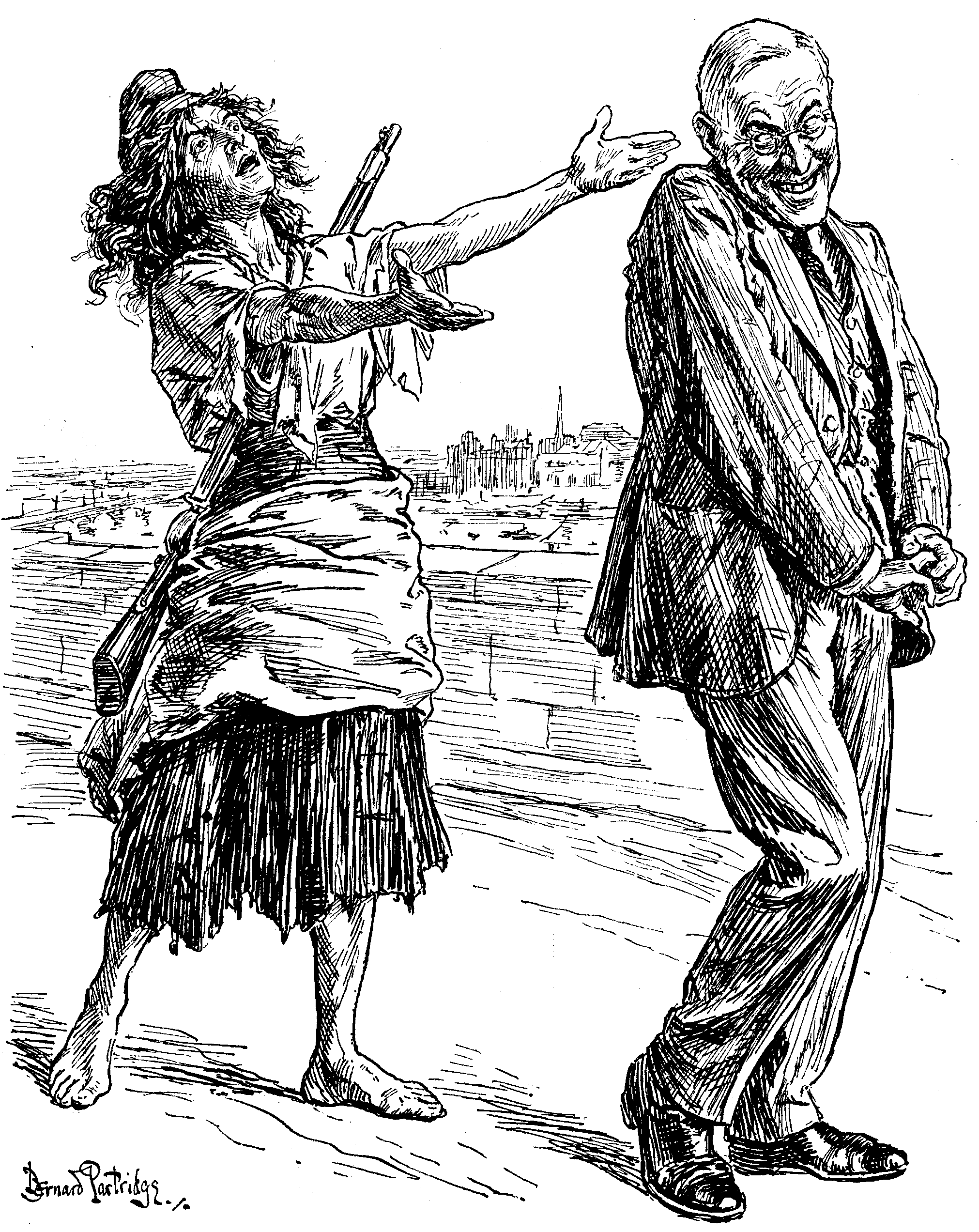
THE PHILANDERER.
SINN FEIN. "BE MINE."
PRESIDENT WILSON. "I DO HOPE I HAVEN'T GIVEN YOU TOO MUCH ENCOURAGEMENT—BUT I CAN NEVER BE MORE THAN A BROTHER TO YOU."
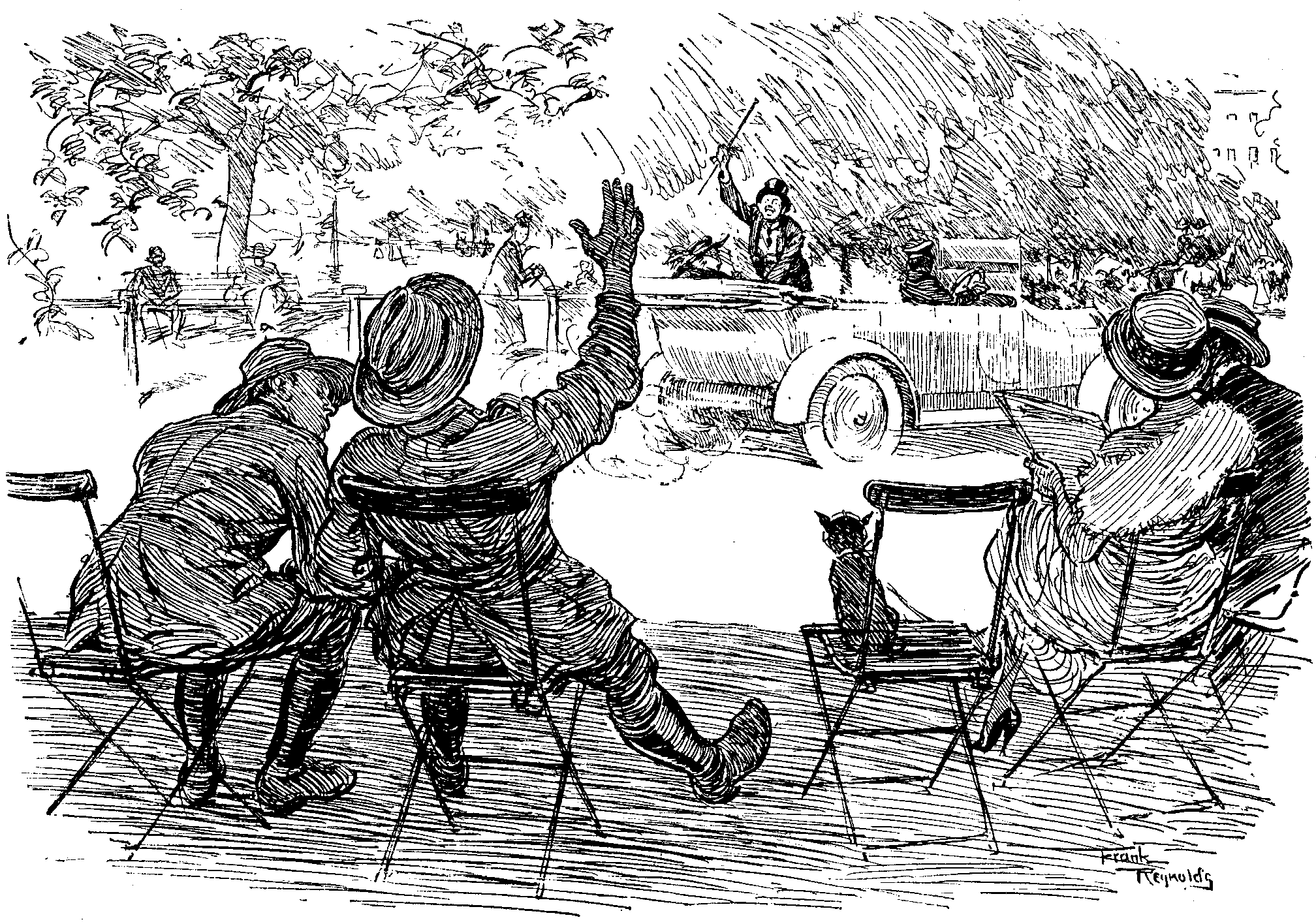
First Australian. "'OO's YER SWELL PAL, DIGGER?"
Second Ditto. "I DUNNO HIS NAME, BUT I REMEMBER HIS FACE. I GIVE HIM A BIT OF BACON JUST OUTSIDE ST. QUENTIN."
WHY DRAG IN MRS. SIDDONS?
DEAR MR. PUNCH,—Nothing annoys me more than the assumption that wit, learning, fancy, etc., were the monopoly of the past. For example, a correspondent of one of our leading dailies has been trotting out Mrs. SIDDONS' use of blank verse in familiar conversation, and quoting from LOCKHART:—
"John Kemble's most familiar table-talk often flowed into blank verse; and so indeed did his sister's [Mrs. Siddons']. Scott (who was a capital mimic) often repeated her tragic exclamation to a foot-boy during a dinner at Ashestiel—
'You 've brought me water, boy,—I asked for beer!'
Another time, dining with a Provost of Edinburgh, she ejaculated, in answer to her host's apology for his pièce de résistance—
'Beef cannot be too salt for me, my lord.'"
This is all very well, but just as good blank verse is commonly used by eminent men and women to-day; indeed some of them excel in impromptu rhymes. Thus in Mr. HAROLD WESTMORELAND'S interesting volume, Eavesdroppings, there is this charming story of the first meeting of Madame CLARA BUTT and Miss CARRIE TUBB. They were introduced at a garden-party at Fulham, and Mr. WESTMORELAND overheard the memorable quatrain in which Madame CLARA BUTT greeted her sister-artist:—
"In our names we 're alike But in minstrelsy—ah no! For I'm a contralto And you're a soprano."
To the same veracious chronicler I am indebted for a specimen of the impromptus which Lord READING frequently throws off, to the delight of his friends. Mr. WESTMORELAND was having a pair of boots tried on at a famous Jermyn Street bootmaker's when Lord BEADING was undergoing a similar ordeal, and electrified the courteous assistant by observing:—
"The right-foot boot to me seems rather tight; The left, per contra, feels exactly right."
But perhaps the finest exponent of the art is a famous General, whose obiter dicta in verse are innumerable. I have only space to quote one, spoken to a soldier with whom he had shaken hands:—
"You are the proudest man in France, Or at any rate in Flanders, For you've shaken hands, in a great advance, With the greatest of Corps Commanders."
Surely in the light of these examples, which might be indefinitely multiplied, there is no need for the present to fear comparison with the past in the sphere of conversational verse?
I am, dear Mr. Punch,
Yours faithfully,
NOSTRI TEMPORIS LAUDATOR.
Culture in the Sty.
"Yorkshire Pork Pies, possessing character and individuality, 5 lb. Price, 15s.—Daily Express.
"COLUMBUS OF THE AIR.
Captain Alcock's Story of his Great Atlantic Flight."—Dublin Evening Telegraph.
Would not Vimy-bus be better?
Slough Verdict: Dulce est de-Cippenham in loco.