Volume 156 — A TANGLED TRIANGLE.
Reading edition
The Pâtisserie Delarue et Salon de Consommations is situated just on the edge of Europe. Being a place of extreme military importance I dare not indicate its position with greater exactitude, but may go so far as to say that it can be found by stepping off the boat, crossing the bridge and then inquiring of the Military Police. Its importance is due to the quality of its crème éclairs, which attract the gilded Staff in such large numbers that the interior is usually suffused like an Eastern sunset with a rich glow of red tabs and gilt braid. Within its walls junior subalterns, now, alas, a rapidly diminishing species, dally with insidious ices until their immature moustaches are pendulous with lemon-flavoured icicles and their hair is whitened with sugared rime.
There it was that Frederick discovered Percival feebly and mournfully pecking at a vanilla ice.
"Greeting, old Spartan," said he. "Training for the Murman coast?"
"Would that I were!" replied Percival. "I'm refrigerating my sorrows. I've tried to drown them, but they float; so I'm by way of freezing them under."
"Poor Perce!" murmured Frederick. "I suppose it's Cox again?"
"Au contraire, I'm his sorrow. My present trouble is that I've got to find a wife."
"Nothin' easier, old thing. Your photo in the illustrated papers, with appropriate letterpress—"
"You misunderstand me," interrupted Percival. "It's someone else's wife I've got to find. Écoutez. Teddy Roker has got permission for his wife to visit him out here. He's expecting her by this afternoon's boat and has got a billet fixed up all right, but he's been suddenly rushed away on a court-martial case, so he's asked me to meet her, and I've never seen her before."
"But didn't he give you the specifications—kind of descriptive return?"
"That's just it!" groaned Percival. "He was only married last leave, and his description goes like a Shakspearean sonnet. I gather that I've got to look out for a combination of Titania, GLADYS COOPER and HELEN OF TROY. I tried to nail him down to externals, but he only went off into another rhapsody.
"'What does she wear?' I asked.
"'Wear?' said he dreamily. 'Oh! beautifully draped garments nebulous as summer clouds and filmy as gossamer webs. Nothing really definite.'
"'That sounds probable enough, as the present fashions go,'" said I.
"Seems to me," said Frederick, "that this is a case to refer to higher authority. The sleuth-hound instinct of one Frederick is indicated. Having absorbed the available data I will e'en amble round myself to assist you."
"There speaks my stout-hearted haricot!" said Percival. "But be careful. Teddy won't like it if he gets the wrong wife. He made a point of that. So in case we miss each other your instructions are briefly these: you will meet what you honestly think to be Mrs. Roker outside the Customs House, explain Teddy's absence, take her to his rooms at 10 bis, Rue Dufay, make her comfortable and report to me here at 6.15."
Punctually at 6.15 they met again in the Pâtisserie Delarue. Both were radiant.
"'Tis done!" said Percival proudly; "and without the assistance of the puissant Frederick. At 5.0 o'clock I was outside the Customs House and saw her looking round with an anxious eye. 'Mrs. Roker, I believe?' said I. She confessed right away, so I rattled her off in a cab to 10 bis, Rue Dufay, and left her there nibblin' biscuits and drinkin' tea as happy as a flapper."
"Percival," replied Frederick slowly, "for sheer imbecility you have surpassed yourself. I myself met Mrs. Roker outside the Customs House at 5.30, being detained en route. I took her to 10 bis, Rue Dufay, where at the present moment she is partaking of coffee and chocolate caramels. Shortly, no doubt, she will discover the spurious female that you have decoyed thither and the First Act of a triangle drama will be rung up."
"By Jazz," exclaimed Percival, "I'd stake my gratuity on the genuineness of my Mrs. Roker. She knows Teddy's favourite breakfast food."
"No," said Frederick decidedly, "mine is the only authentic article. All others are imitations. She knows dearest Edward's size in gloves."
"Well, we can't both be right."
"Did Teddy say anything about expecting two wives?" asked Frederick hopefully.
"Idiot!" said Percival. "As I see the situation, one of us—presumably you—will presently be the central figure in a court-martial or police court on a charge of abducting an innocent female. The remaining reels in the film will be devoted to Teddy chasing you with a 5·9 howitzer for jeopardizing his connubial happiness. But these unhappy concluding incidents may be averted if you return the wrongful lady to her rightful owner before Teddy gets back. So we'll take the necessary action immediately."
"But which one are we going to discard if they both claim to be the genuine Mrs. R.? Hadn't we better wait for Teddy? He'd be almost sure to be able to decide."
"You make me tired. It's got to be settled before he comes back."
It was a brace of dejected subalterns that wended their way to 10 bis, Rue Dufay. Percival knocked at the door of the drawing-room and in response to an invitation they entered. A pretty and extremely composed young lady greeted them.
"My wife!" said Percival and Frederick simultaneously.
"Excuse me," said the lady with dignity; "the only husband I possess at present is Mr. Roker."
"What I mean to say is," explained Percival lamely, "that you are the wife of Mr. Roker that I met at the Customs—I mean, Mr. Roker's wife that—"
"Me too!" broke in Frederick.
"Well, that's easily explained," said the lady, addressing Percival. "After you had kindly escorted me here I suddenly remembered that I had left my keys at the Customs House. Feeling confident of finding my way about I returned for them. On emerging I was claimed by your fascinating friend who is at this moment engaged in winding up his monocle [Frederick guiltily stowed it away in his fob pocket]. He seemed so delighted at having discovered me that I hadn't the heart to explain that I'd been found before. Of course I'm excessively grateful to both of you—Oh, here's dear old Teddy at last!"
During the scene of rapturous greeting that followed Frederick showed that he indeed had his moments of inspiration.
"What about a vanilla ice at the Pâtisserie Delarue, old bean?" said he to Percival.
And, unnoticed by the happy couple, they stole silently away.
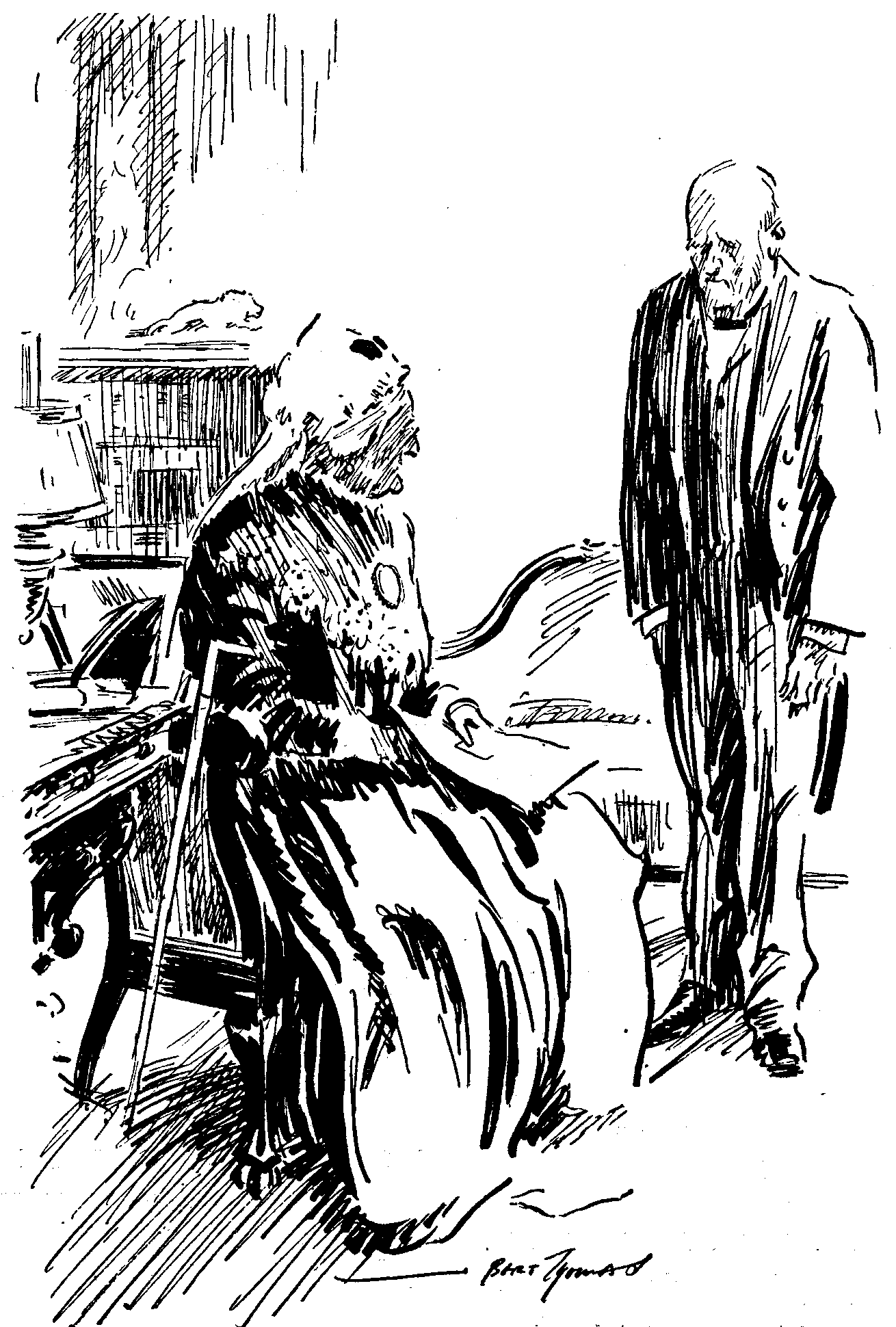
Lady who has been handed the card of wife of new baronet-profiteer). "ER—LET ME SEE. DO I KNOW LADY HOGGINS?"
Butler. "YOUR LADYSHIP HAS NOT RECEIVED HER SINCE THE CREATION."
"Surplus Government Property for sale:—Brass Islets."—Disposal Board "Surplus" Magazine.
But why is the geographical position of this alluring archipelago not given? Is it for enemy reasons?
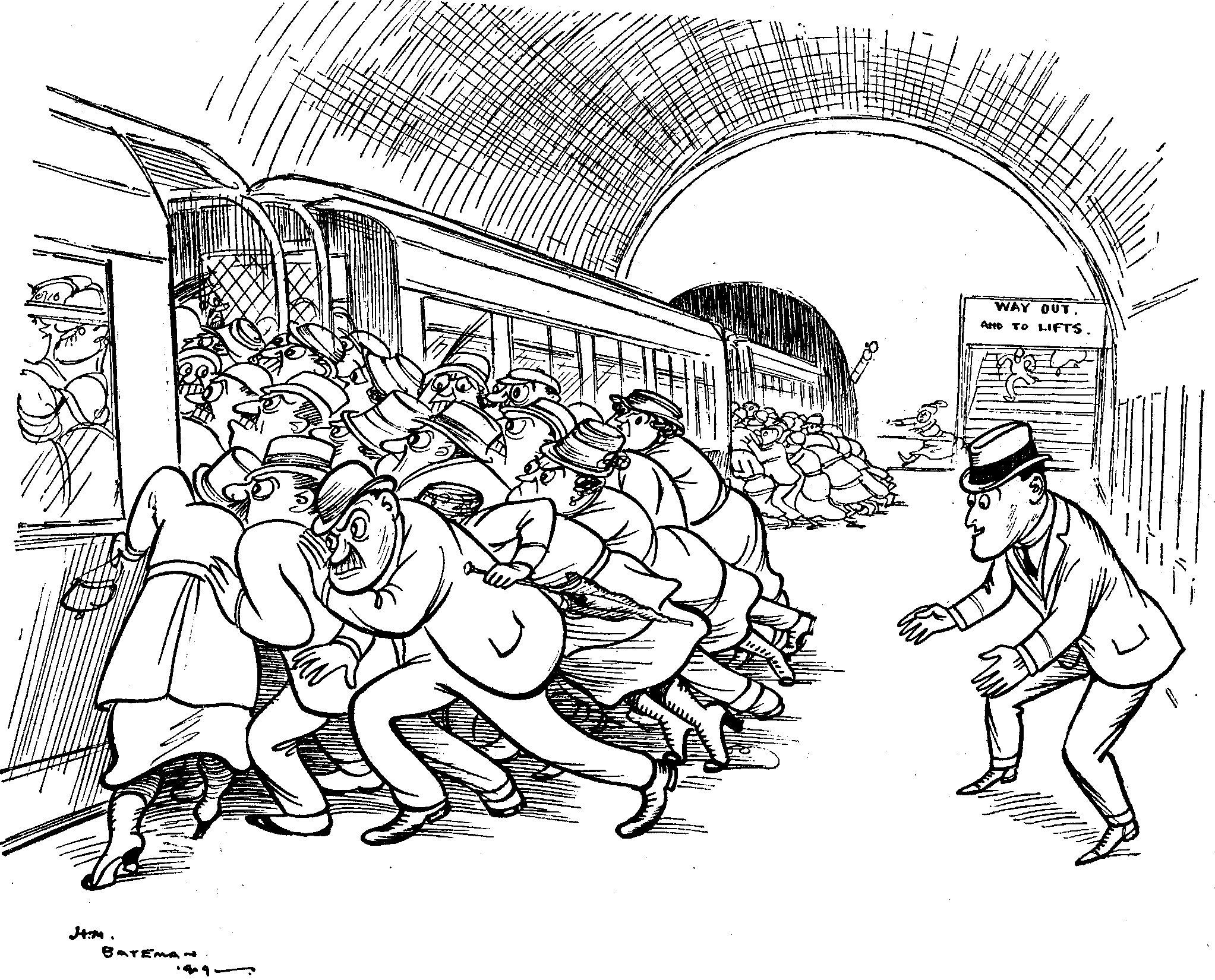
FORCE OF HABIT—THE SCRUM HALF.
THE NEED OF OUR TIMES.
["The modern world is badly in need of a Pindar. Alone of the poets, Pindar could do justice to the exploits of the day."—The Times.]
"We're badly in need of a Pindar" To fan in these tropical days Our stock of emotional tinder With gusts of tempestuous praise; To foster the flame, not to check it Or let it die suddenly down, In honour of HAWKER and BECKETT, Of ALCOCK and BROWN. We do not require a CATULLUS (We've MASEFIELD and WAUGH and SASSOON) Nor pastoral pipers to lull us To rest with a sedative tune; But the worship of beer and of Bacchus In verses familiar and free Might win for a latter-day FLACCUS A Knighthood (B.E.). Bland VIRGIL'S beyond resurrection; The voice of the moment is harsh; The nightingale's golden perfection Offends the young ravens of MARSH; ARISTOPHANES, grossly facetious, Is but a "compulsory" god, And HOMER as well as LUCRETIUS Too frequently nod. There's scope for the truculent passion Of JUVENAL'S masculine muse To flagellate folly and fashion In dress and in manners and views; But we've plenty of prophets and poets; We've few who are sober and sane; We don't want another DE BLOWITZ; We want a DELANE.
"BETTER BEER ON THE HORIZON."
Daily Express.
A beer in the hand is worth ten on the horizon.
A TUBE NIGHTMARE.
Have you ever dreamed a dream of a terrible tube journey, in which every one of the appalling things which might happen does actually occur? I dreamed one last night.
The journey began with a disaster. On reaching the booking-office window I could not find any money, and it was only when the waiting crowd behind me, which had mounted to hundreds, was becoming offensively hostile that I succeeded in producing a five-pound note.
The booking-clerk took her own time to count out the change, and on leaving the window I found four policemen struggling to keep back an infuriated mob of people, all shrieking imprecations and asking for my blood.
There was but one thing for it—to get to a train before this angry horde could secure its tickets; so I made a wild dash for the moving-staircase, shedding Bradburys en route like a paper-chase.
As I rushed past the ticket-puncher she made a vicious lunge at my out-stretched hand with an enormous pair of pincers, missing the ticket and partially amputating my thumb.
As I have always expected to do, but have never yet done, I missed my footing at the top of the escalator, and my desire to outstrip my enemies was realised beyond my wildest hopes as I crashed, by a series of petrifying somersaults, down the entire flight, to be belched forth like a sausage from a machine at the bottom.
Tattered, torn and in unspeakable agony I picked myself up and found my steering-gear so damaged that I could only move sideways, crab-fashion, and in this manner I crawled on to the platform just as a train was beginning its exit.
I make a leap for it. The gates crash to! Am I inside them or out? Neither. I am pinned there with the first half of my body struggling inside the car while the second half protrudes over the fast-receding platform.
I remember how in my agony it flashed across my mind that I would never again slay a wasp with my fork.
I must have been pulled into the car just in time to stop the tunnel (which is a dreadfully close fit) from bisecting me, for the next thing I remember was being dropped into a corner seat and severely admonished by the guard for getting into the train whilst it was in motion.
I was now a quivering and shapeless mass; nobody pitied me, nobody helped me, so loathsome a spectacle did I present.
Of course the train passed my station, and at the next I was thrown out like a mail-bag, to be trodden on by massed formations of travellers fighting to enter and leave the car by the same door at the same time.
When the multitudes had dispersed and I was alone, by superhuman efforts I contrived to wriggle on my stomach to the foot of the ascending stairway, but not having sufficient strength to wriggle off on arrival at the top, my long-dreaded horror of being sucked under the barrier, where moving stairways disappear, was realised.
By now immune to pain, I regarded the next process (akin to being passed through a mangle) as child's play. To my amazement, after a few minutes amongst giant cog-wheels, I again found the light on the down-going staircase, which precipitated me to the spot from which I had started.
Having thrice performed this revolution, by which time I was as flat as a pancake, I was eventually scraped off by a porter and upbraided for joy-riding.
Finding that those rebukes left me unmoved, for I was practically lifeless, certainly boneless, and, to their horror, ticketless, they folded me up and put me in a drawer pending the arrival of the police.
I was still there when the dream mercifully stopped.
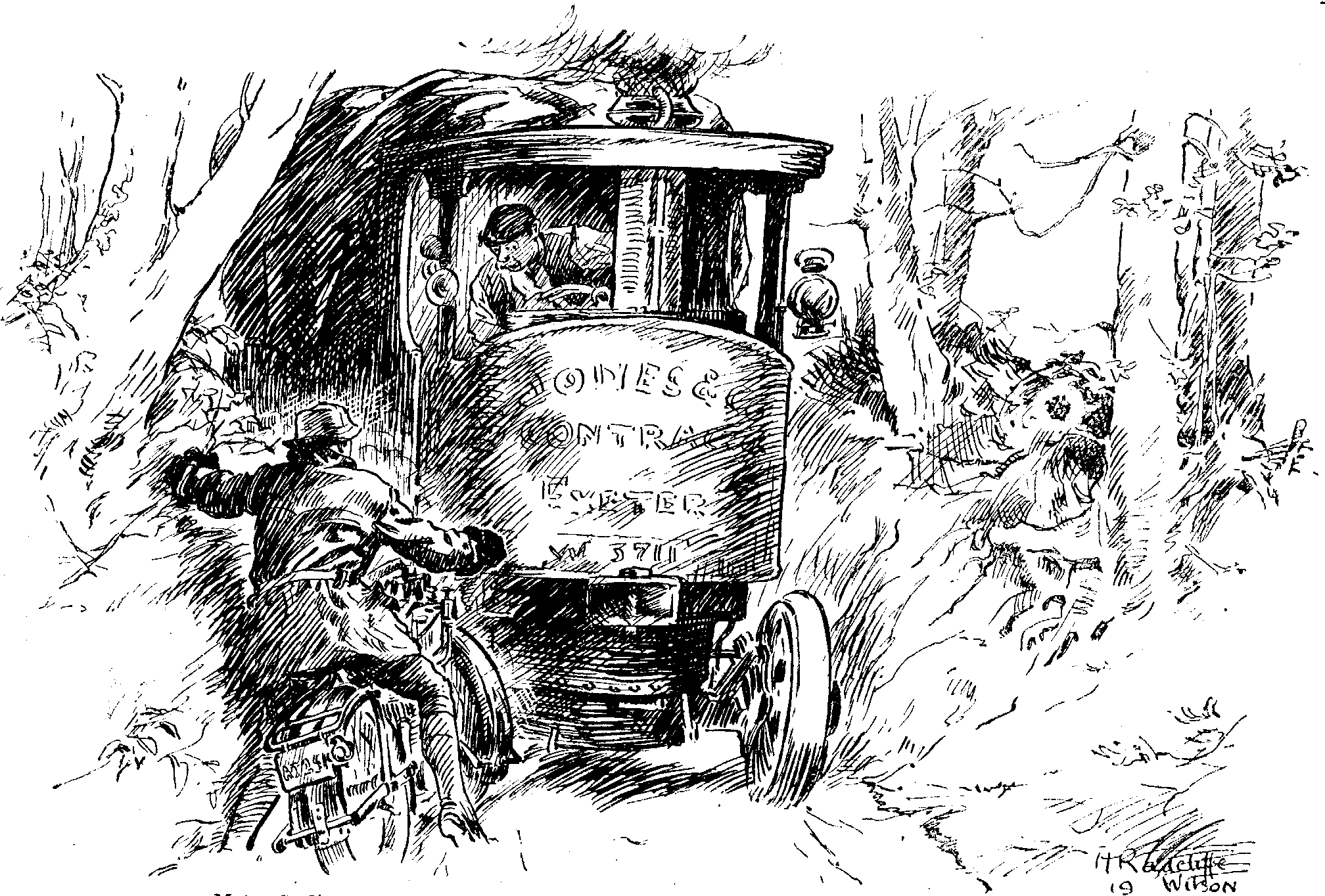
Motor Cyclist. "WHY THE DEUCE DON'T YOU DRIVE ON THE PROPER SIDE OF THE ROAD?"
BIRD-LORE.
II.—PEACOCKS.
Peacocks sweep the fairies' rooms; They use their folded tails for brooms; But fairy dust is brighter far Than any mortal colours are; And all about their tails it clings In strange designs of rounds and rings; And that is why they strut about And proudly spread their feathers out. R.F.
"Wanted.—Good stage electrician. No good stage electrician."—The Stage.
There ought to be no difficulty in finding the latter.