Volume 156 — ESSENCE OF PARLIAMENT.
Reading edition
Monday, June 2nd.—The Lords seldom sit die Lunae, and were perhaps feeling what humbler folk call "rather Mondayish" at being summoned from their week-end pleasaunces to put the Local Government (Ireland) Bill through its final stages. Anyhow they developed some eleventh-hour criticisms. The sad case of the Belfast Water Commissioners attracted Lord STUART OF WORTLEY. There are fifteen of them—one each for the existing wards. But under the Bill Belfast is to be divided into ten wards; and fifteen into ten won't go, even in Ireland. Lord PEEL considered that while Lord STUART'S arithmetic was impeccable his fears were exaggerated. If Belfast drinks its whiskey neat it will not be for want of Water Commissioners.
In the Commons Members were disappointed to learn from Sir AUCKLAND GEDDES that he had no idea of the time when railway-fares would be reduced to the amount printed on the tickets. Nor were they much consoled by his promise to consider the suggestion that as the fare cannot be brought down to the ticket the ticket shall be brought up to the fare. We should not lightly part with our few reminders of the cheap dead days that are no more. In fact it would be a salutary thing if other tradesmen imitated the "commercial candour" of the railways and ticketed their goods with the pre-war value in addition to the present charge.
There is a juvenile impulsiveness about Sir HENRY CRAIK which reminds one of "the boy who wouldn't grow up," and may account for his keen interest in Kensington Gardens. Dissatisfied with an assurance of the FIRST COMMISSIONER OF WORKS that he was doing his best to get the War Office to clear away their hutments he burst out, "Could he not attempt to use some disciplinary action against the obstinacy, the stupidity, the slackness, the carelessness of those who are responsible?" Swept away by this spate of sibilants Sir ALFRED MOND essayed no further answer.
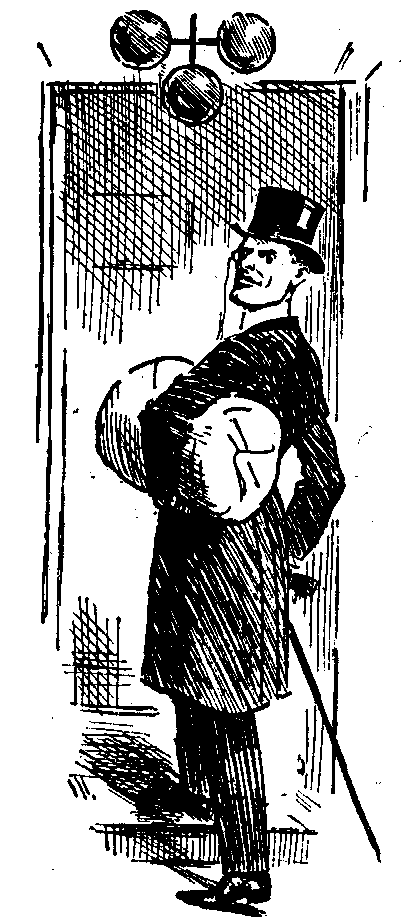
ANOTHER VISIT—AND IN BROAD DAYLIGHT.
MR. AUSTEN CHAMBERLAIN.
After less than an hour's debate the House gave the CHANCELLOR OF THE EXCHEQUER power to borrow a trifle of two hundred and fifty millions, to square this year's account, plus an undefined sum to enable him to fund the floating debt, now amounting to close on two thousand millions. Even Sir FREDERICK BANBURY had no serious objection to raise, his chief anxiety being that everyone, and not merely the plutocratic holders of Treasury Bills, should be permitted to subscribe to the new loan. Mr. CHAMBERLAIN assured him that it was a case of "Let 'em all come."
Tuesday, June 3rd.—According to the view of Major WOOD and his friends the Mother of Parliaments is played out. The Grand Committees which were to have restored her vigour have left her more enfeebled than ever, and unless she devolves a large part of her duties upon subordinate assemblies her end is near. But I noticed that, although Ireland was expressly excepted from their resolution, most of them talked of little else, and I fancy that but for Dublin we should not have heard much of devolution.
As a statesman His Grace of CANTERBURY has hitherto enjoyed the reputation of being "safe" rather than dashing. But that is evidently a mistake, for in introducing the Bill which is to enable the Church to free itself from some of the trammels imposed upon it by the State he begged his hearers not to be afraid of "brave adventurous legislation." His appeal was quite lost upon Lord HALDANE, who was shocked by the terrible possibilities of the measure, and warned the PRIMATE that if the Bill became law he would have signed the death-warrant of the Establishment. Coming from a Presbyterian who helped to disestablish the Church in Wales, this showed the heights of altruism to which a real philosopher may rise.
THE MOTHER OF PARLIAMENTS.
"AM I REALLY SUFFERING FROM SENILE DECAY?"
Colonel WEDGWOOD was shocked to learn that in the occupied territories Germans had to take off their hats when addressing British officers. But it would be a mistake to assume that his concern was due to any tenderness for our foes. On the contrary, it was exhibited out of regard for the feelings of British officers. Mr. CHURCHILL regretted the inconvenience, but pointed out that it had always been the practice—even in Belgium—for an Army of Occupation to exact certain acts of respect from the inhabitants.
Mr. KELLAWAY, who announced last week with such pride that "the Government have struck oil," was now able to state that the oil had reached a height of 2,400 feet and was still rising steadily. There is some talk of inviting the successful engineers to put down bores at Westminster.
Wednesday, June 4th.—Complaint was made recently that under the new Rules of Procedure Members were expected to be in three places at once. I fancy that a good many of them settled their difficulty to-day by betaking themselves to a fourth place, not in the precincts of the Palace of Westminster.
There was anything but a Grand Parade on the green benches, and the faithful few who were present put a good many questions "on behalf of my honourable friend." The Front Benches were well manned, however, and Mr. LONG had quite a busy time explaining to Commander BELLAIRS why the Admiralty thought it inadvisable at this date to hold courts-martial in regard to the Naval losses of 1914. The House was more interested to hear that the Peace celebrations will include a Naval procession through London, and that there will be a display in the Thames of war-ships of various classes, including, possibly, some of those captured from the enemy.
A feature of the afternoon was Mr. MACQUISTEN'S brief comments upon Ministerial replies. Divorced from their setting, such remarks as "Fish is very dear!" (à propos of Admiralty parsimony in compensating the owners of drifters) or "By thought-reading?" (when the best method of ascertaining native opinion on the future of Rhodesia was in question), may not sound particularly funny, but, when delivered in a voice of peculiar penetration and "Scotchiness," at precisely the right moments, they were sufficient to convulse the Benches. Mr. MACQUISTEN must be careful or he will soon be a spoiled DARLING.
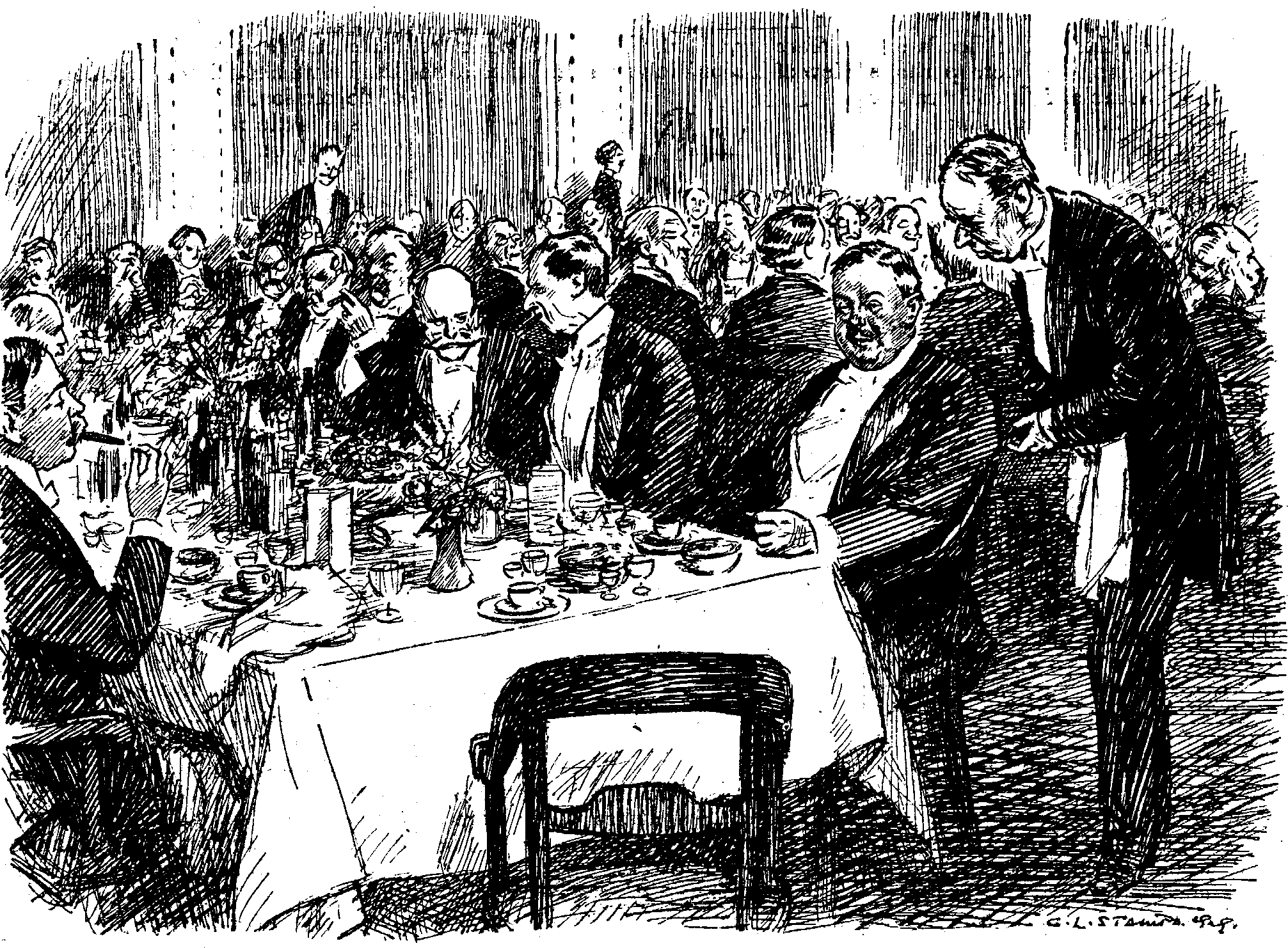
Waiter (at public dinner, to very hot and red-faced diner). "I'M GOING NOW, SIR. ANYTHING MORE I CAN GET YOU? BRANDY OR PORT? NO, SIR? SHALL I GET YOU A COOL CHAIR, SIR?"
"Cigar smokers will be interested very much in the likelihood of that luxury being soon dearer than ever.... It will most likely develop into a habit of getting the very last whiffff ffffout of every cigar."—Provincial Paper.
The printer would seem to be practising already.
"HOW TO HEAR MUSIC."
(With humble acknowledgments to the critic of "The Times.")
We were grateful to Mlle. Snouck Hugronje for giving us an opportunity of hearing the Violin Concertos of Prenk Bib Doda in C sharp minor, and of Basil Tulkinghorn in the composite key of F.E. The latter work, we may explain, is dedicated to Lord BIRKENHEAD. Doda's work is so rarely played that Mr. ERNEST NEWMAN has wittily suggested that he ought to be renamed Dodo. But let that pass. Here he is abundantly like himself, rich in self-determining phrases which emerge from a Hinterland of wild surmise, and tower aloft in peaks of Himalayan majesty like Haramokh or Siniolchum —— Mr. CANDLER must finish this sentence.
Tulkinghorn is also a master of transcendental effects, and as relentless in pushing home his points as Mr. SMILLIE when examining a duke before the Coal Commission. But he is not always to be trusted. He lacks the architectonic faculty. In between the clusters of clear-cut phrases there are too many nebulae of gaseous formation and spiral type, which deflect the orbital movement of his essentially electronic melody and impair its impact on the naked ear.
But when Mlle. Snouck Hugronje plays you forget all about self-determination, syndicalism, guild-control, proletariats, sunspots and even Mr. SMILLIE. If you are a poet, and we are all poets nowadays, you dream yourself into a punt on the Sonning backwater, wondering if the summer was ever so amazing before, nearly being shipwrecked on a sandy spit, startling moorfowl or it may be dabchicks, sending a frisson into the fritillaries, losing and regaining your punt-pole, always believing that the next bend —— Mr. FILSON YOUNG must really finish the sentence.
If you are a musician and an occultist you will, by due concentration of your pineal gland and pituitary body, rise with the rapidity of a HAWKER to astral altitudes immune from all mundane disquiet. You will notice —— However, this is best, left to Mr. CYRIL SCOTT or Sir RABINDRANATH TAGORE or Sir OLIVER LODGE. But if you are a mere listener you will listen and be thankful. But if you never go to concerts you will still be able, by the aid of the New Criticism, to attain to an ecstasy of appreciation far greater than if you had relied on the crude medium of your senses.
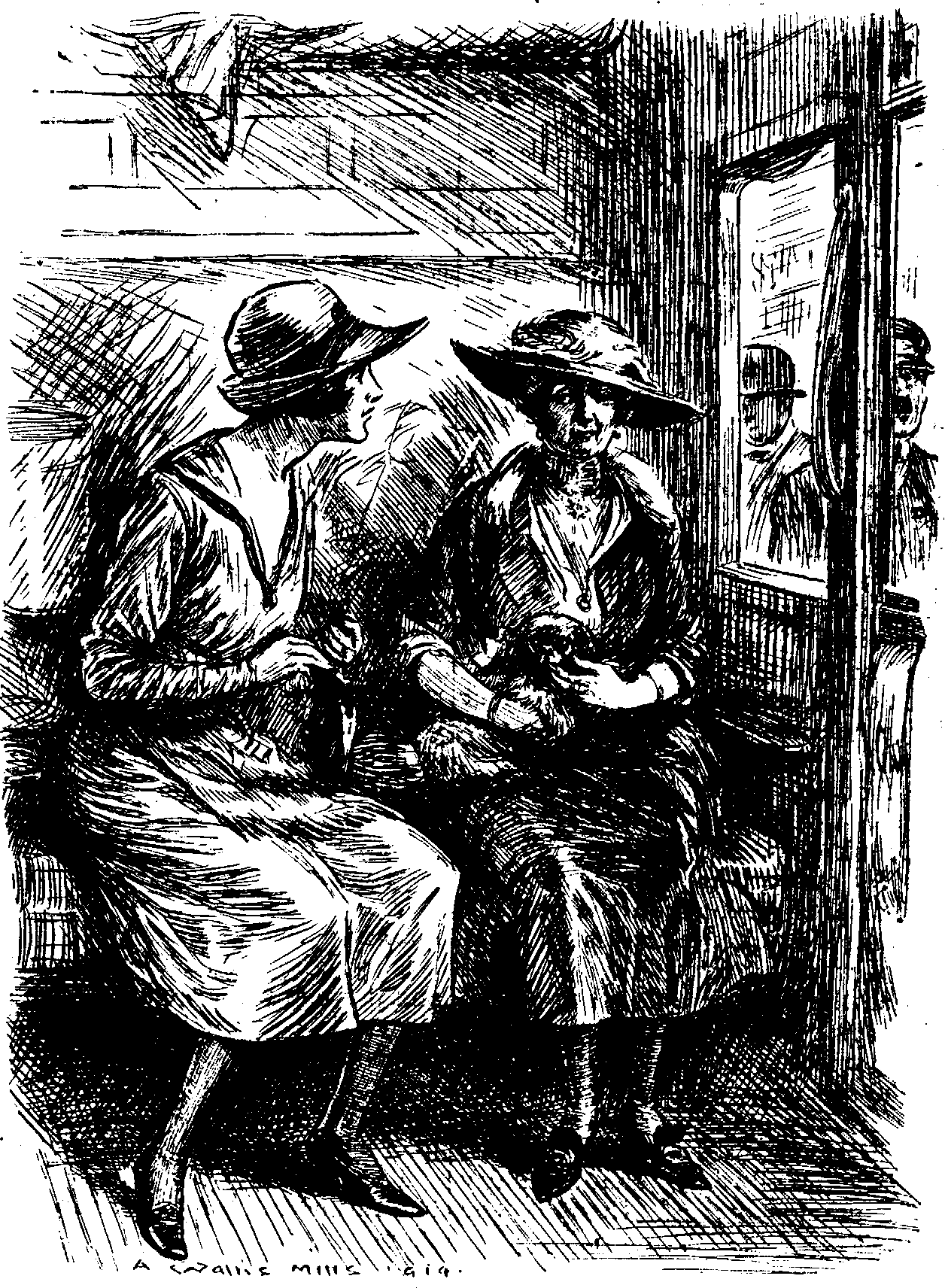
Niece. "BUT AREN'T YOU GOING TO GIVE THAT NICE PORTER A TIP, AUNTIE? HE'S AN OLD SOLDIER."
Aunt. "EXACTLY, MY DEAR. MUCH TOO POLITE TO BE UNPLEASANT TO ONE."
THE CONSCRIPTION OF BRAINS.
PROGRESS OF THE COMMISSION.
The Literary section of the Nationalisation Commission met last Friday. Before evidence was taken the Chairman, Mr. ROBERT WILLIAMS, said that as their Report must be delivered in less than a week the Commission had decided not to summon Lord MORLEY, Lord ROSEBERY or Mr. THOMAS HARDY, but hoped in the few days still available, to hear the evidence of Sir THOMAS HALL CAINE, Lady WARWICK, Mrs. BARCLAY, Mr. SPACKMAN and Mr. SMILLIE.
Mr. EDWARD MARSH read an interesting Report on the State Remuneration of Poets. He was of opinion that poets, if they could be shown to be of the authentic Georgian brand, ought to be secured a reasonable salary quite irrespective of the views which they expressed. They must never be expected to glorify or approve of the CHANCELLOR OF THE EXCHEQUER, but should be perfectly free to criticise or attack him. No attempt should be made to impose any metrical constraint on their verse. But he thought it desirable that for the purpose of bringing them to the notice of the public a State chaperon should be appointed to provide suitable introductions and biographical details. He also advocated the multiplication of poetry tea-shops, where pure China tea and wholesome confectionery should be supplied gratis to all poets whose works had been favourably noticed in The Times Literary Supplement.
The CHAIRMAN. What is your idea of the minimum wage for poets?—In view of the present purchasing power of the sovereign I should put it at eight hundred pounds a year. Modern poets require an extra amount of nourishment, owing to the nervous strain involved in production, and their requirements in the matter of dress are often difficult to satisfy. I understand that the price of sandals has gone up two hundred per cent.
Mr. CHARLES GARVICE, the next witness, stated that he did not think the literary quality of novels would be necessarily improved by nationalisation. Speaking for himself he did not think it would affect his output. But if the State took over this industry it should be liberal in affording novel-producers facilities for obtaining fresh material, local colour, etc. At all costs the output of salubrious and sedative fiction must be maintained if only as an antidote to the subversive and revolutionary literature now freely disseminated among the proletariat.
COLONEL WEDGWOOD. HOW do you expect a workman earning only three pounds a week to afford seven shillings for every novel that he buys?—Personally I should like to see the cost reduced, but I understand that if the price of novels were fixed at one shilling it would involve the State in an expenditure of ten million pounds annually, even with the present reduced output of novels, which has fallen during the War to little over twenty million tons.
Mr. HAROLD BEGBIE declared himself a whole-hearted supporter of nationalisation. There was something extraordinarily uplifting in the notion of consecrating one's talents to the State. Publishers were too often callous individualists. Here one would be working for humanity. If his interview with the KAISER had been issued under State sanction he believed that the Peace would have been signed months sooner.
Official Candour.
"TELEGRAPHIC NOTICE.
Public is hereby informed that delays to and from offices in Punjab are normal."—Indian Paper.
Same here.
Our Veterans.
"London Rifle Brigade, 40 strong, of the 1st Battalion, which went out in 1814, arrived in London from France at mid-day yesterday."—Daily Paper.