Volume 156 — ALAS! POOR PANTHER.
Reading edition
I went to the Derby fully intending to back the favourite—The Panther.
But the cross-currents immediately set in—as they always do.
I began by making the mistake of reading the forecasts of all the experts—the gallant Captains and Majors, the Men on the Course, the Men on the Heath, the Men on the Spot—all of whom, although they mostly favoured The Panther, had serious views as to dangerous rivals, supported by what looked like uncontrovertible arguments.
I also had an early evening paper with a summary of forecasts, none of which (as it was to turn out) mentioned the winner at all.
I was even so foolish as to glance at some of the advertisements of the wizards who are so ready to put the benefit of their knowledge at the service of the public and make fortunes for others rather (apparently) than for themselves, all of whom hinted at some mysterious long-priced outsider whose miraculous qualities of speed were a secret. But of course I was too late to profit by these; they merely unsettled me.
Not content with this I was forced to overhear the conversation of others in our compartment, each of whom fancied a separate animal, arguing with reasons that could not be gainsaid.
In this way I learned that The Panther would win in a canter and would be badly beaten; that he was a stranger to the Epsom course; that he was ready for anything; that he liked soft going; that he was no good except when he could hear his hoofs rattle; that his jockey was not strong enough; that his jockey was ideal; that he was sounder than any horse had ever been, and that trouble was brewing.
All this naturally left me shaken as to my first decision. Was I wise, I asked myself, to trust all my eggs (forgive, Sir ALEC BLACK, the poorness of this metaphor) to one doubtful basket?
Having admitted an element of doubt I was the prey of every suspicion and began to consider the other candidates. All Alone headed the list. I liked the name, because it suggested the corollary: the rest nowhere. Also it belonged to a lady—to the only lady owner, in fact—and lady—owners were said (by a man with a red beard opposite me who smoked cigarettes so short that I was certain it was made of dyed asbestos) to be in luck this season. "Always follow the luck," he added. But then, on the other hand, what could be more lucky than Colonel BUCHAN, author of Mr. Standfast and an excellent History of the War, into whose lap so many good things fall? Why not back a horse named after him? Besides, was not Buchan third favourite?
I was making a note of Buchan's claims, when a man with a Thermos flask lashed to his side began to praise Dominion. Dominion, it seems, was third in the Two Thousand Guineas—only just behind Buchan, who was just behind The Panther. Many people thought The Panther unduly lucky that day. A very different course, too, at Newmarket from that at Epsom. Obviously Dominion must be remembered. Moreover he was being greatly fancied and some of the best judges looked to him to win the Blue Riband for Lord GLANELY. The fact that Lord GLANELY drew his own horse in the Baltic Sweep was not to be sneezed at either, said some one. That's an omen if there ever was one! And it knocked out Lord GLANELY'S other horse, Grand Parade.
"Well, here's a tip," cried a man with a frock-coat and a straw hat. "Blest if I've got a single coin left—nothing but paper money. That's good enough for me. I shall back Paper Money."
The carriage agreed that that was his duty. "Of course you must," they said. "When everyone disagrees in the way that the experts do, you might as well take a tip like that as anything."
Paper Money had therefore to be added also to my list of possibles.
"Besides," said another man, "DONOGHUE rides him; our leading jockey, you know." I had forgotten to look at the jockeys' names. How absurd! Of course one must back DONOGHUE.
But just then, "Give me WHALLEY," said the man with the asbestos beard, and, as WHALLEY was riding Bay of Naples, I had to consider him too. Naples was a jolly place and I had had a lot of fun there. Hadn't I better make that my tip?
But, on the other hand, what about Tangiers? I had had fun there too, and more than one fellow-passenger had darkly hinted that this was a much better animal than public form proclaimed. Looking for particulars, I found that he once "ran Galloper Light to a head;" which had a promising sound. He was trained at Lambourne too, and I like Lambourne. There is a good inn there and it is a fine walk to White Horse Hill.
"Well," said another man, who had been borrowing matches from his neighbour ever since Victoria, "I always had a feeling for a Marcovil colt. Marcovil is a good sire. I 've had some very special information about Milton, the Marcovil colt, to-day."
MILTON!—one of my favourite poets, and also one of Mr. ASQUITH'S, as he said in that lecture last week. Yes, but is Mr. ASQUITH exactly lucky just now? Perhaps not. And did not MILTON write Paradise Lost? True. But, on the other hand, he wrote Paradise Regained. You see how difficult tip-hunting can be!
And so it went on and I emerged from the Epsom Downs station in a maze of indecision, in which one fact and one only shone with crystal clearness, and that was that whatever won the race The Panther had no better chance, even though it had been made favourite, than any other.
"Besides," as one of the two men who sat on my knees had said, "What's a favourite anyway? Very often a horse is made a favourite by the bookies, in conjunction with the Press, just so as everyone will back it. No, no favourites for me. Give me a likely outsider at good odds. Look what you have to put on The Panther to win anything."
In the result I backed—well, I am not going to tell you; but they "also ran."
The moral of this story—if it has one—is either don't bet at all, or, if you do bet, draw the horse from a hat at random, and, having drawn it, stick to it. No one, as the failure of The Panther proves, can possibly know more than you.
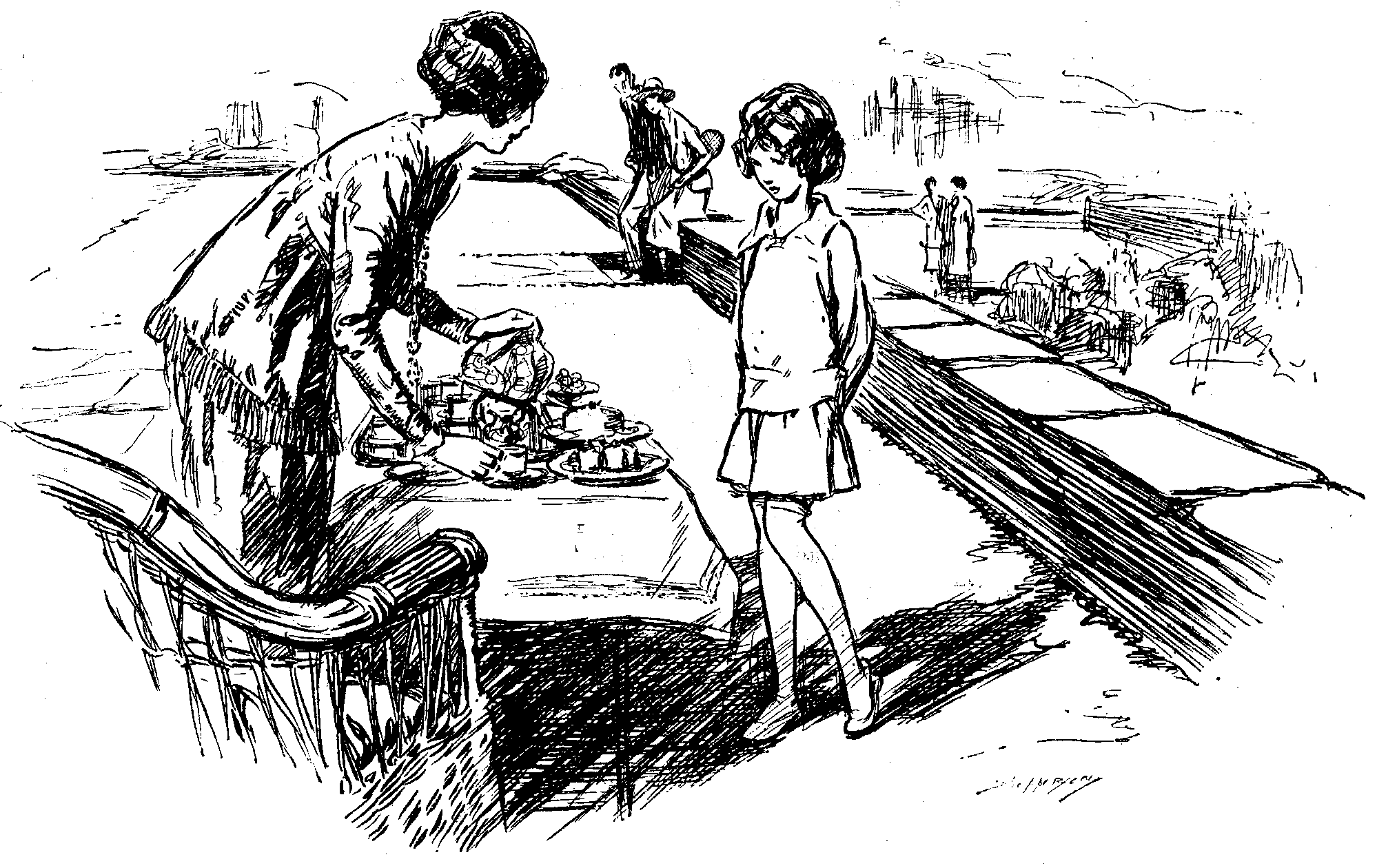
Daphne. "I MUSTN'T HAVE ANY CAKE TILL I DON'T ASK FOR IT, MUST I?"
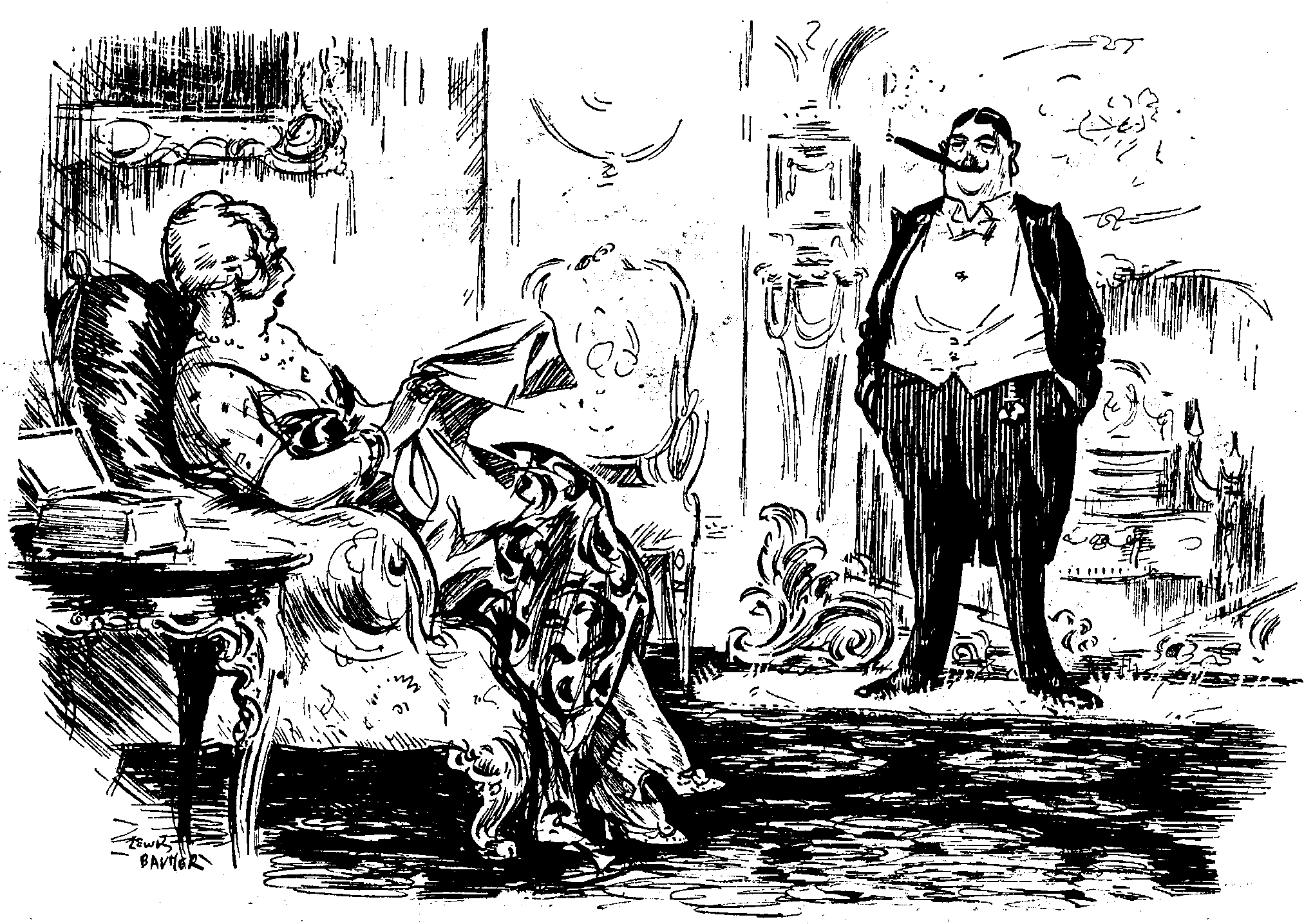
Wife. "HOW ABOUT SEAHAVEN FOR THE HOLIDAYS? I HEAR IT'S VERY PICTURESQUE."
Profiteer. "NOT OUR CLASS, MY DEAR. TOO QUIET—SORT O' PLACE THE NOUVEAUX PAUVRES GO TO."
TECHNICAL TERMS.
When Ernest asked me to take a run in his car I took advantage of the invitation because there are times when I think that life is less joyful without a car and that one day I shall slip out and buy one. I should love to grip the wheel and sweep the countryside and listen to the soft purr of the engine. So we started sweeping the countryside, Ernest and I; but we had not swept very much of it before the soft purr developed a kind of cough and the car stopped.
Ernest coaxed and petted her. He tried kindness, while I helped him with sarcasm. He tried hauteur and then a little bad temper.
Eventually he decided to send for the local motor engineer, and it was when this gentleman arrived with his mate that I decided that motoring was not for me and that I should have to fall back on fretwork or tame mice for my recreation.
"Here, Bill," said Overalls-in-Chief, "just hold up the Ding-dong."
His mate did as instructed and up went the Ding-dong.
"Now hand me the Doo-dal," he went on; "and while I tune up the old Jig-jig you get the Pipety-pip and clean it out.
"Now get the Tick-tick and just give me a tap here with the Ooh-jah, while I give the Thing-a-me-tight a couple for his nob.
"See that?" he shouted at me. "Would you believe it? Easy as winking. See, it was like this. The What's-a-name here, as kept the Tiddley-um-tum in place, was sort of riding on the Squeak-box, so as the Tiddley-om-pom and the other Jigger sort of gave the half-seas-over to the Thing-a-me-bob and missed the Rum-ti-tum. Simple, ain't it, Guv'nor?"
"Yes," I answered, "quite simple."
But I have decided to give up all idea of buying a car. I should never learn the language.
LITTLE GREY WATER.
Little Grey Water, my heart is with you In the loop of the hills where the lone heron feeds, Where your cloak is a cloud with a lining of blue, And your lover a wind riding over the reeds. Little Grey Water, I know that you know What the teal and the black duck are dreaming at noon, And the way of the wistful wild geese as they go Through the haze of the hills to keep tryst with the moon. Little Grey Water, folk say and they say That the homing hill-shepherd, benighted, has heard A song in the reeds, 'twixt the dawn and the day, That was never the song of a breeze or a bird. But I know you so silent, so silent and still, And so proud of your trust that you'll never betray What the fairies that gather from Grundiston Hill Tell the stars before morning to witch them away. W.H.O.
FAITH RESTORED.
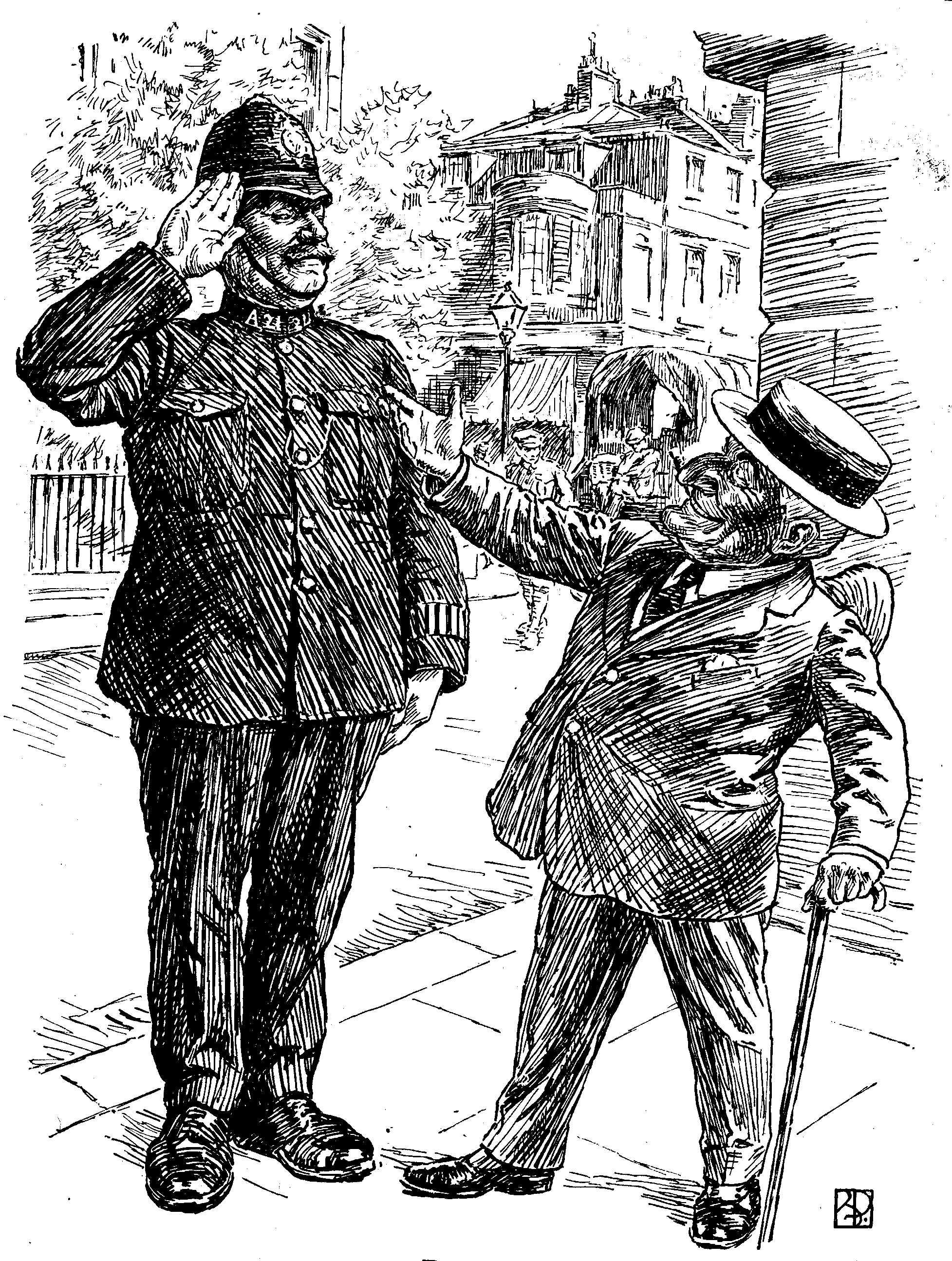
MR. PUNCH. "STANDS ROBERT WHERE HE DID? GOOD! I WAS AFRAID FOR A MOMENT THAT MY IDOL HAD FEET OF CLAY."