Volume 156 — THE ROAD TO THE RHINE.
Reading edition
BUSINESS LEAVE.
Of course we know demobilisation is proceeding apace. We know that pivotal men are simply pirouetting to England in countless droves. We know it because we see it in the papers (when they come), and it is a great source of comfort to us. But since it is six days' train journey and four days' lorry-hopping from where we sit guarding the wrong side of the river to the necessary seaport, perhaps they have forgotten us, or they are keeping all the pivots in this area for one final orgy of demobilisation at some future date, which for the moment I am not at liberty to disclose.
At present my poor friend Cook is sitting in the Company Mess with his thoughts all of the inside of Army prisons, instead of the glowing pictures he used to have of himself exchanging his battle-bowler for the headgear of civilisation. He says I'm responsible for his state of mind, because I first put the idea into his head. Well, I did; but I don't see how you can blame the fellow who filled the shell if some silly ass hits it on the nose-cap with a hammer.
It started like this. After the Demobilisation General Post had sounded Cook spent his time writing to everybody who did not know him well enough to down his chances, filled up all the forms in triplicate and packed his valise ready to start off any time of the day or night for England, home and wholesale hardware, which is his particular pivot. I may say here that nominally this business is run by him and his brother, and the fact that they are now both in the Army is probably the chief reason why the manager in charge is able to make the business pay. However, you know what people are; if they draw receipts from a business nothing will persuade them but that they must be there, "on the spot you know," to "look after it." So, seeing his face grow longer and longer as the days went by without the Quarter-Master coming round and handing him his ration trilby hat, civvy suit and the swagger cane he hopes for, I said, "Why don't you put in for two months' business leave?"
The air was at once rent with a fearful rush of leaves of his A.B. 153, and he ceased to take any interest in his platoon from that moment. In vain I urged upon him the consummate folly of neglecting to inquire more closely into the case of a reprobate in No. 11 Platoon who had so far forgotten all sense of discipline as to set out his kit with haversack on the left instead of the right (or vice-versâ, I forget which, but the Sergeant-Major spotted it.). He even went the length of saying he didn't care a cuss; and when I asked him sarcastically if he had forgotten the Platoon Commander's pamphlet-bible, "Am I offensive enough?" he said he thought he was, and I agreed with him.
When the whole mess-room was simply a-flutter with torn-out leaves from his A.B. 153, representing his abortive attempts to put down his application succinctly and plausibly, we all began to take an interest in his case. We crowded round and offered him most valuable hints. Together we got through two very pleasant evenings and three or four A.B.'s 153, and still the application remained in a tentative state. We got on all right to start with, but it was after the "I have the honour to submit for the approval and recommendation of the Commanding Officer this my application for two months' business leave" that we got stuck.
Of course I know it was no use, anyway. I have seen these things go forward before. They have no chance.
It was then that a stroke of genius (unfortunate, as it turned out, but a stroke of genius nevertheless) occurred to me. "Why not say that your manager is a complete fool and in his hands the business is going to rack and ruin?" I said. He bit at it like a tiger, and only the law of libel prevented him putting it into execution there and then; but all the same we had a jolly fine argument (six of us) about it for some three hours, and nobody got put out of the room for introducing acrimony into the discussion.
Finally, he said that he was sure his brother wouldn't mind his saying it about him, and the application went in as follows:—
To Adjutant, First Crackshire Regt.
Sir,—I have the honour to submit for the approval and recommendation of the Commanding Officer this my application for two months' business leave in the following special circumstances:—
The necessity of my presence in the business (wholesale hardware) has become more and more urgent of late. It is imperative that I should get home at once owing to the total incapability of my partner to carry out simple directions which are dictated by letters, and it is no exaggeration to say that the business, which has been built up almost entirely by my efforts, must inevitably collapse unless it receives my personal attention at once.
My address would be, etc., etc., London.
I am, Sir, Your obedient Servant, etc., etc.
The Adjutant looked serious when he read it. So did Cook, for he thought the Adjutant had noted the London address and had remembered the business was in Bristol. But it was all right. It wasn't that at all really. Pencil and squared paper are poor means of conveying information at any time, and when the Adjutant had been assured that the business was really "wholesale hardware," and not "wholesale hardbake," as he had first read it, everything went swimmingly. The C.O. signed it and off it went on its momentous journey. Cook began to take a renewed interest in his platoon, and, having discovered the recalcitrant one of No. 11 actually coming on parade with only the front of the tip of his bayonet-scabbard polished, he took a fiendish delight in seeing the criminal writhing under the brutal and savage sentence of three days' C.B.
A week later he got a great surprise. His brother-partner turned up with a draft of men and found himself posted to the battalion. The brothers met, as only brothers can, with the words, "What the deuce are you doing here?" Highly elated, Cook told him about the application for business leave and gloated over his chances of being home first, and on full pay too. His brother was intensely amused, and they both laughed heartily, when he told us that he himself, while waiting at the reception-camp with the draft, had put in much the same kind of application, saying the same kind of things about Cook.
But when they realised that both applications would be forwarded to the same Divisional Headquarters for consideration the joke lost some of its savour. And when the Adjutant called them up and handed the two returned applications pinned together both brothers needed all their qualities of toughness and rigidity which, as I understand, are acquired in the wholesale hardware business.
L.
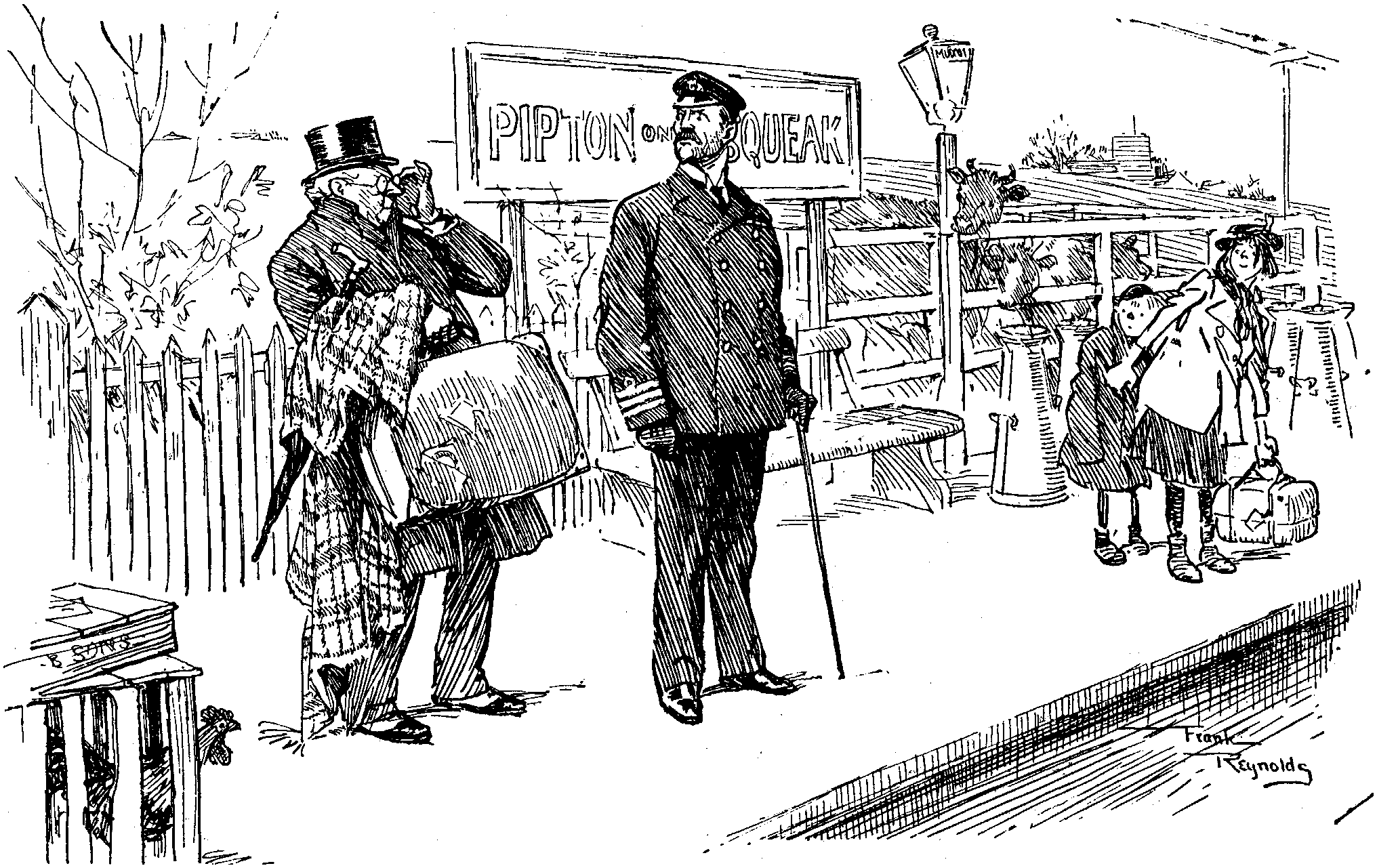
Shortsighted Traveller. "IS THERE SOME DELAY ON THE LINE, MY GOOD MAN?"
Naval Officer. "WHO THE —— DO YOU THINK I AM, SIR?"
Traveller. "ER—N-NOT THE VICAR, ANYWAY."
"Homes Furnished Complete."
"Oak bedstead, 3 ft. 6 in., with wife and Wool Mattress, new condition, £5 10s. 0d. lot."—Provincial Paper,
"One Parsel Furnishing goods curtains, cushion covers, etc., Rs. 26; one bundle babies, Rs. 5.—Apply Mrs. ——."—Ceylon Independent.
"Temporary Cook wants Hampshire."—Morning Post.
Really quite moderate. Some cooks nowadays seem to want the whole earth.
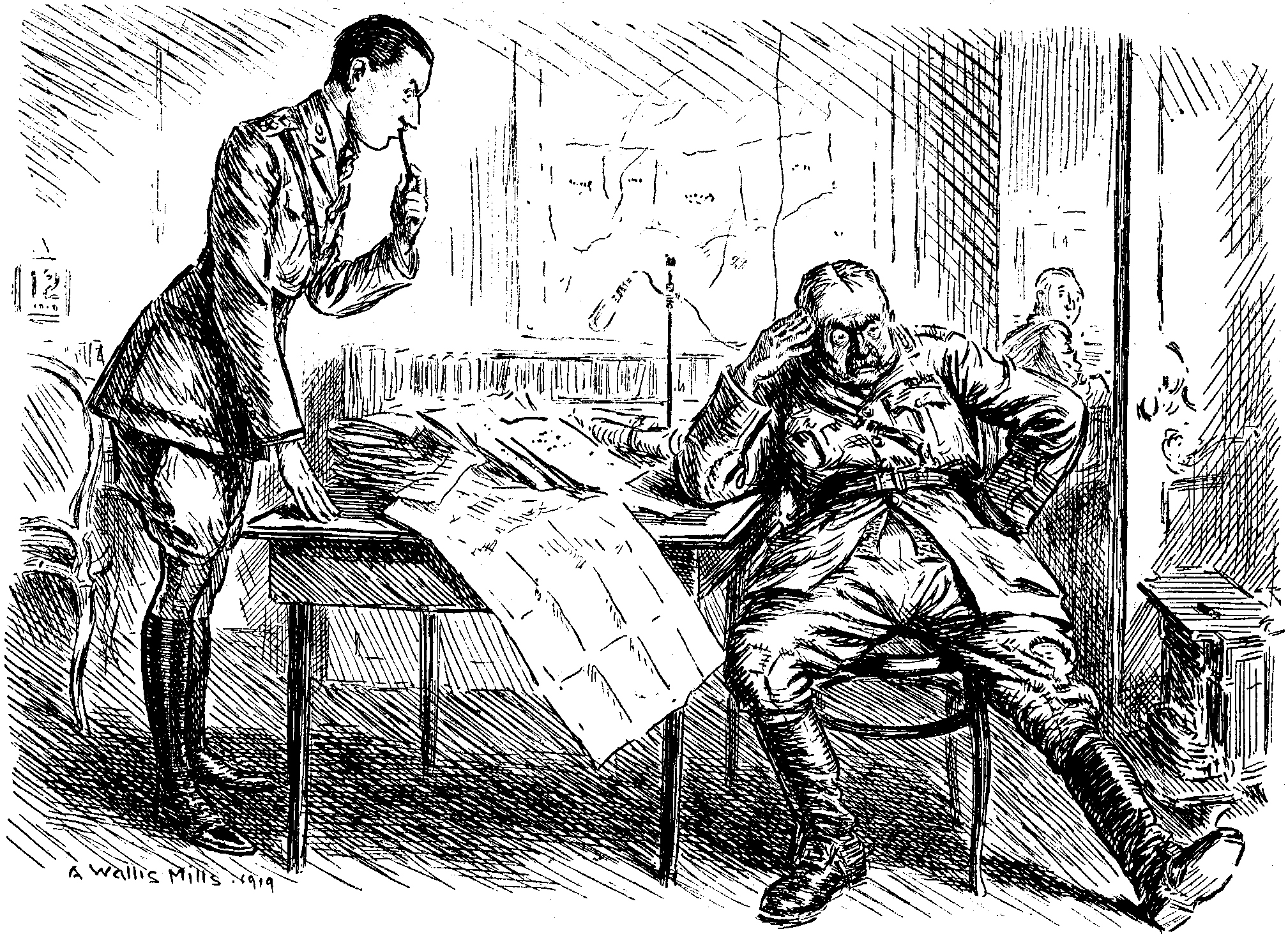
POST-WAR PROBLEMS.
Adjutant (who has been interrupted in his real work by a summons from Colonel). "YES, SIR?"
Temporary Colonel. "I SAY—ER—SMITH—IT'S SO UNCERTAIN HOW LONG WE SHALL BE OUT HERE—DEMOBILISATION, YOU KNOW. ER—FACT IS—DO YOU THINK IT WORTH MY WHILE GETTING ANOTHER PAIR OF BREECHES?"
THE VISITOR.
When yesterday I went to see my friends— (Watching their patient faces in a row, I want to give each boy a D.S.O.)— When yesterday I went to see my friends, With cigarettes and foolish odds and ends (Knowing they understand how well I know That nothing I may do can make amends, But that I must not grieve or tell them so), A pale-faced Inniskilling, tall and slim, Who'd fought two years and now was just eighteen, Smiled up and showed, with eyes a little dim, How someone left him, where his leg had been, On the humped bandage that replaced the limb, A tiny green glass pig to comfort him. These are the men who've learned to laugh at pain, And if their lips have quivered when they spoke They've said brave things or tried to make a joke; Said it's not worse than trenches in the rain, Or pools of water on a chalky plain, Or bitter cold from which you stiffly woke, Or deep wet mud that left you hardly sane, Or the tense wait for "Fritz's master stroke." You seldom hear them talk of their "bad luck," And suffering has not spoiled their ready wit, And oh! you'd hardly doubt their fighting pluck, When each new operation shows their grit; Who never brag of blows for England struck, But only yearn to "get about a bit."
"The Allies had threatened to destroy the Dardanelles if the Medina garrison did not surrender."—Birmingham Mail.
So, being reduced to its last Straits, the garrison surrendered.
"MATRIMONY—Young Lady (21), good prospects, wishes to correspond with young man, similar age, with a view to above; no rebels need apply."—Irish Paper.
But we guess there will be one Home Ruler in the family.
"Replying to a query concerning the rumour that Messrs. Guinness were in treaty for the purchase of the National hell Factory, Parkgate Street, a representative of that firm said this afternoon: 'We have no statement to make at all.'"—Irish Paper.
We gather that the printer is a Prohibitionist.
"At Doncaster on Saturday, Messrs. —— sold for £7,100 the fully licensed house at Armthorpe known as the Plough Inn to the Markham Main Colliery Company, the proprietors of the colliery being sunk in the parish."—Yorkshire Post.
Not spurlos versenkt, we trust. Perhaps it is hoped that the Plough will unearth them.