Volume 156 — BLIGHTY IMPRESSIONS.
Reading edition
THE BARBER.
I went into a tobacco-shop, tendered a pound note and asked for a packet of cigarettes and a box of matches. With much regret and a smiling face, she informed me she had the goods but no change.
What a dilemma! A shop with cigarettes and matches, but I couldn't spare a pound note for them.
An inspiration!—I would go into the hairdressing establishment behind the shop, have a shave—which I really didn't need—obtain change and make my purchase. Besides, with so many barbers closed owing to the strike, it was an opportunity.
This is what happened.
"Good morning, Sir. Your turn next but six."
A long, long interval.
"Shave, Sir? Lovely weather we're having. Razor all right, Sir?"
I said as little as possible; it is the only safe thing.
"Face massage, Sir?"
"No, thanks," I mumbled.
"Wonderful thing for the face, Sir; make a new man of you. Invigorates the circulation, improves the complexion—"
"Oh, all right," I gasped.
And then for about twenty minutes snatches of conversation floated to me through bundles of wet towels. My head was having a Turkish bath. My face was covered with ointments and creams. Currents of electricity played about my brow.
"Just trim your hair, Sir?"
I swear I said "No," but before I knew what was happening the scissors were running merrily over my head.
"Singeing, Sir?"
"Er—no. I—"
"Finest thing in the world, Sir. It's a treat to see hair like this. Just a bit 'endy,' but singeing will soon put that right."
Even had I been blind I should have discovered that I was undergoing the process.
"What would you like for the shampoo, Sir? Eau de Quinine—Violet—"
"I don't think—"
My feeble protest was cut short.
"I always recommend Violet," he said, sprinkling my head profusely.
More rubbing, more towels, more electricity and finally a brush and comb.
"I've a hair-lotion here, Sir—"
"No, thank you."
I meant it.
He helped me on with my coat, brushed off a deal of imaginary dust, said something about skin softeners and bath requisites, but I'd had enough for one morning, and I was yearning to get those cigarettes and have a smoke.
I tendered my pound note.
He took it, and with his best smile said—
"Another sixpence, Sir, please."
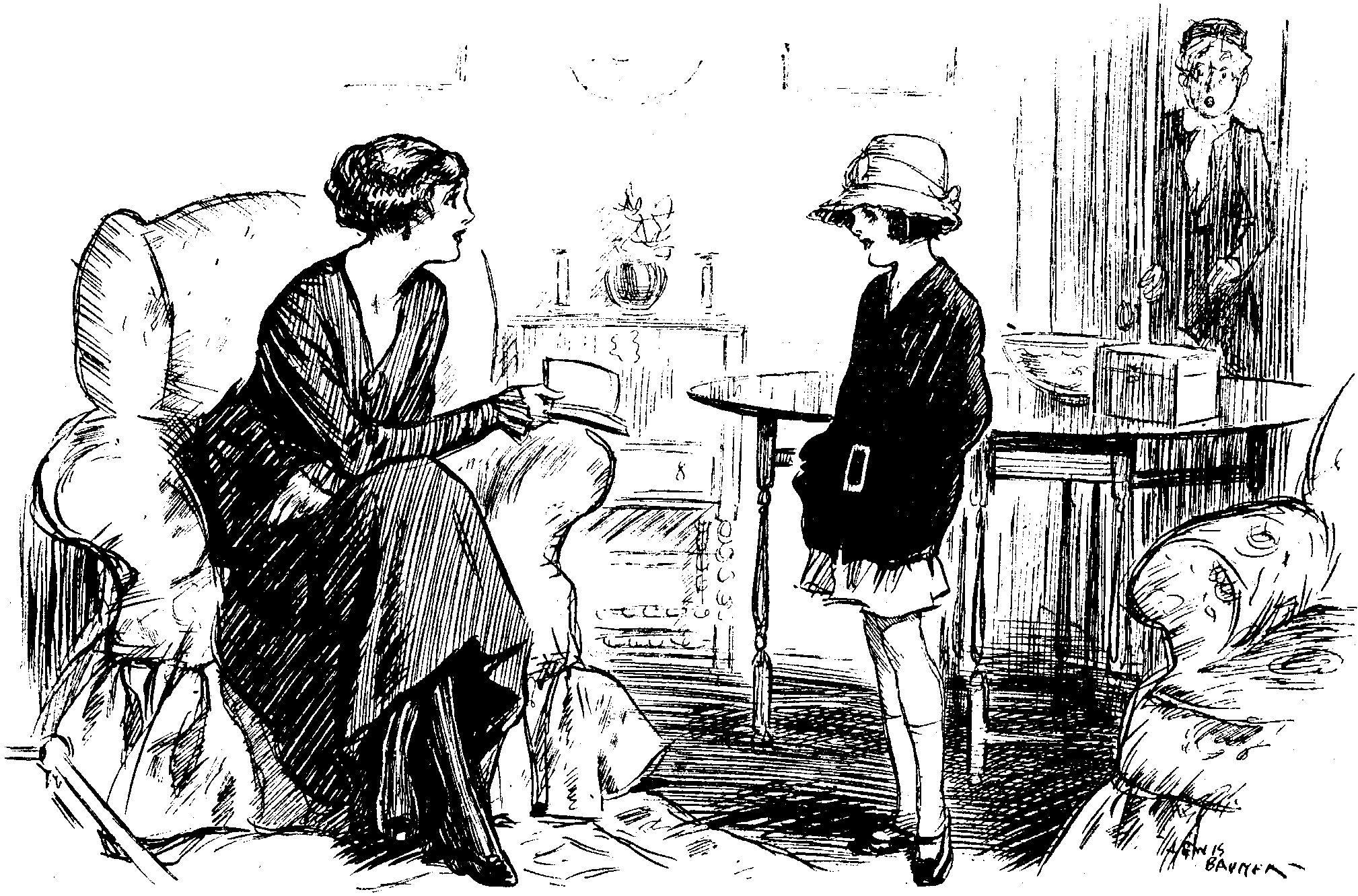
"MOTHER, I HAVE BEEN GOOD TO-DAY—SO PATIENT WITH NURSE."
BLIMP!
There are many things Dora kept dark That she's now letting into the light, And to-day an astounding aerial barque Has suddenly sailed into sight; But its past makes no sympathies burn, And its future leaves interest limp, Compared with the rapture I feel when I learn That its name is the Blimp. Who gave it its title, and why? Was it old EDWARD LEAR from the grave? Since Jumblies in Blimps would be certain to fly When for air they abandon the wave. Was it dear LEWIS CARROLL, perhaps Sent his phantom to christen the barque, Since a Blimp is the obvious vessel for chaps When hunting a snark? And to-day, in the first-fruits of joy, I scarcely believe it is true That Blimp is a word we shall one day employ As lightly as now Bakerloo; And my reason refuses to jump To the fact that a man, not an imp, Can flash through the other and land with a bump From a trip in a Blimp.
"It needs no very profound knowledge of the politics of South-Western Europe to surmise that neither Rumania nor Greece would lend military assistance of this kind without being promised something in return.—Manchester Guardian.
But a rather more profound knowledge of the geography might be useful.
THE OLD INVINCIBLE.
It is late in the day to draw attention to Mr. Punch as a prophet. Everyone knows that his eyes have always discerned the farthest horizon. None the less it is pleasant now and again to succumb to the temptation of saying "I told you so," and especially when it is the finger of a friendly reader that points the way to the Sage's triumph. Were we in the habit of quoting from past numbers, as many of our contemporaries do, we should print the following paragraph from the issue of September 2nd, 1871:—
"A REAL DANGER.
"'According to Le Havre, about forty Prussian officers in mufti leave Dieppe every morning for England, their object being to visit the military establishments of Great Britain.'
"Here at last is an actual invasion! Prussian officers landing on our defenceless shores, on the transparently flimsy pretext of making themselves acquainted with our military establishments, at the rate (excluding Sundays) of 240 a week, or in this present September, of 1,080 a month, or, amazing and terrifying total, of 12,520 a year! We commend this startling announcement to the attention of the Cabinet (Parliament, unfortunately, is not sitting), the Commander-in-Chief, the War Office, the Commanders of all Volunteer Corps, the Author of 'The Battle of Dorking,' Sergeant Blower, and Cheeks the Marine."
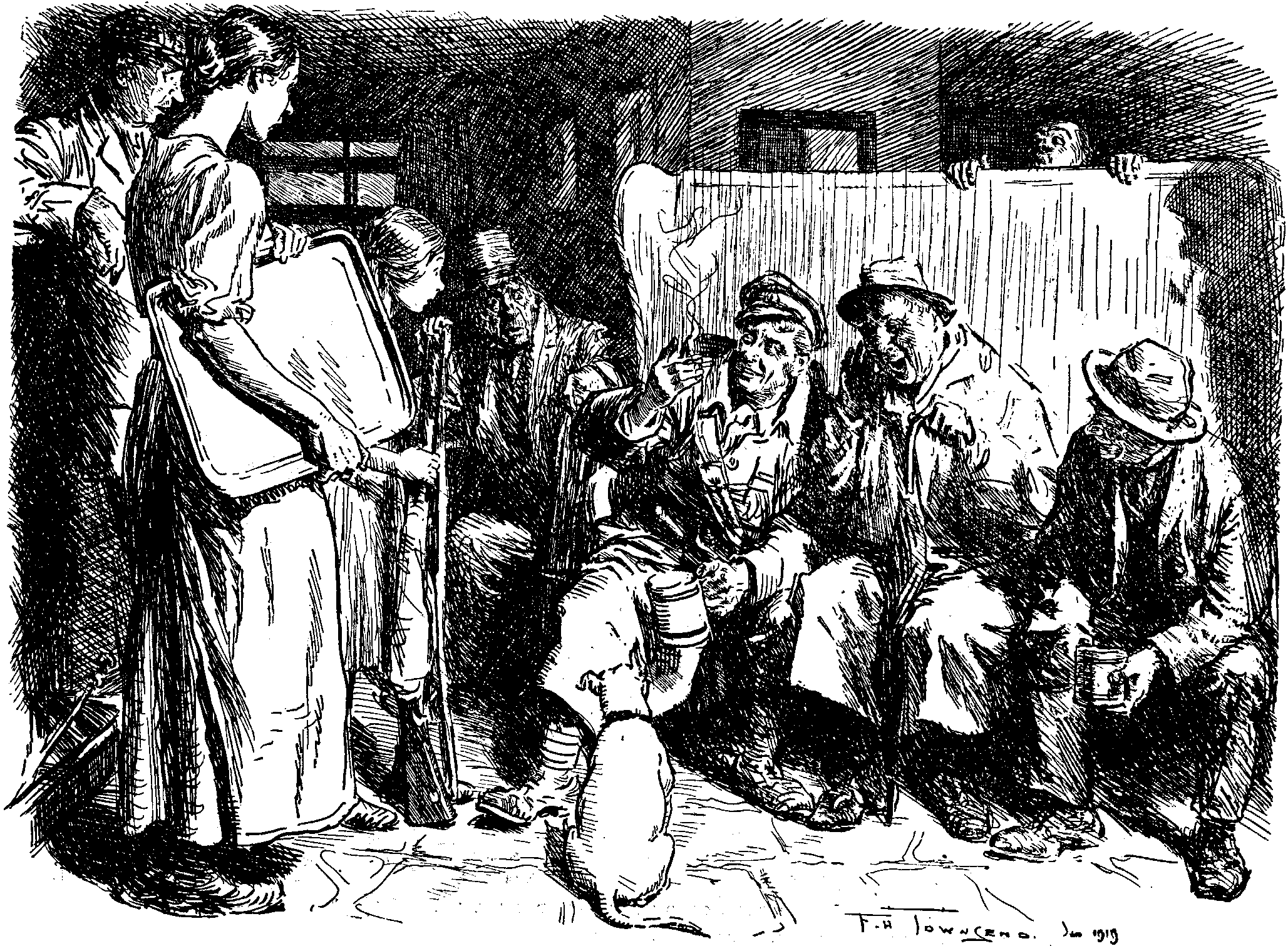
Tommy (homeward bound, and determined not to disappoint). "WHY, MISSY, THREE DAYS BEFORE THE ARMISTICE THE AIR WAS THAT THICK WITH AEROPLANES THE BIRDS HAD TO GET DOWN AND WALK."