Volume 156 — LÈSE-MAJESTÉ.
Reading edition
Our triumphal march into Germany having been arrested just west of the Meuse, Sir DOUGLAS HAIG (through the usual channels) gave me ten days' leave to visit the historic town of St. Omer. As I only asked for seven-days and he gave me ten I knew there was a catch somewhere. It appeared that the ten days was worked out on the idea that it would take me five days to get there and five to get back. Needless to say I ignored trains, which are a snare and delusion in these days. I lorry-hopped. Most people would think many times before lorry-hopping from Charleroi to Lille viâ Brussels and Tournai, but there is nothing that a man with a leave warrant in his pocket will not do—except perhaps save money.
It was during this leave that I barged right into GEORGE, "George" being our very own King, besides being Emperor of India.
To bridge the apparent gap between my arrival and the perturbing catastrophe referred to, it is only necessary to add that if you enter from the main route from Hazebrouck you will find just off the road a convoy of some sixty dear things seeing as much life as can be beheld while groping into the insides of the Red Cross motor ambulance which it is their job to feed, wash, coax and drive.
I have the entrée here (except when the relentless Miss Commanding Officer chases me out for breaking the two-and-a-half rules which govern the place), and when I admitted incautiously that the only place on the Front that I had not seen or been frightened at was Passchendaele, they smiled pityingly and promised to take me there on Sunday for a joy ride. Shades of 1917! What whirligigs of circumstance time and the armistice have brought us! It was in the joy ride we nearly upset a dynasty.
To accomplish the journey in greater comfort, Vee and her hut companion Sadie got hold of a perfectly good Colonel man who had a perfectly good car and had, moreover, a perfectly good excuse to go to Passchendaele (he was really going to Boulogne), but wanted to get a good flying start, and we set off. We were a perfectly organised unit, consisting of four sections (including two No. 2 Brownie Sections), A.S.C. complement (one lunch basket), Aid Post (bandage and thermometer, carried as a matter of course by Sadie, who thinks of these things), a Scotch dog (mascot) and a flask of similar nationality (medical comforts for the troops).
On our arrival at Ypres the traffic man held up his hand. That in itself would not have been important, for we have it on great authority that the blind eye may be employed on really special occasions, but the fellow stood determinedly in the middle of the road, and even traffic men, we have always insisted, should not be run over except on great provocation.
"All traffic stopped between 12 and 2," he said; "the KING is passing by."
We looked blankly at one another. I have an extraordinary respect for HIS MAJESTY, but I did wish that he did more of his work by aeroplane at times.
We ate sandwiches, selected and sited positions for sniping the royal progress with our No. 2 Brownies and photographed everything we saw, including an American cooker, the historic "Goldfish Chateau," and a Belgian leading a little pig, with the inscription, "The only good Bosch in the country"; but on the whole Ypres on a Sunday afternoon is hardly more exciting than the "great commercial centre" of Scotland.
At intervals the Staff dashed up and spoke a word or two to the traffic man, but they departed again and nothing happened. We all had a turn at that traffic man, and what we don't know about his home life, pre-war and probable post-war troubles, isn't worth putting on any demobilisation paper. And each time we tackled him we got a different idea of the KING'S movements—HIS MAJESTY must have had an extraordinarily complex journey that day.
Suddenly we were free! The KING was going to lunch near the Cloth Hall and would not be by till 2.30 P.M. Knowing that any order emanating from a Staff is liable to instant cancellation we rushed back to the car and told the driver to "Go!" with the "G" hard, as in shell fire. Whether we went round or over the traffic man I don't know, but we slid with terrific speed into Ypres. Traffic was a little congested round the ruined cathedral, and we barged right up against a panting Ford, which had one lung completely gone and the other seemingly a little porous. A stream of traffic was coming down our side of the road; no matter, we must get on. Urged on by our advice the driver pulled out from behind the dying Ford and tried to pass. It was fearfully exciting. Some Staff on the bank began to wave to us. Thinking perhaps they knew some of us, or thought the girls looked nice, I smiled and nodded back. More Staff waved more arms. We were awfully pleased with our reception. Still three abreast on the road, the Ford having flickered up before death, we reached the crossroads as a large car with a flag on it came round the corner. The car stopped dead. So did we. The two cars glared at each other. The Ford writhed forward hideously in its death agony. I thought I felt funny, and when Vee whispered something about "the Royal Standard" I knew why. Royal Standard? Good Lord! I had visions of three laboriously acquired pips being torn from my sleeves by outraged authorities. The air was rent by my wild yell to our driver to go on—go on and carry the Ford with us on our bonnet if necessary.
What happened next is not very clear in my memory. I have a hazy picture of purple A.P.M.'s, of our GEORGE sitting calmly in a Rolls Royce, of irrepressible woman poking a No. 2 Brownie against the window of our car and trying to find a perfectly good king in a small viewfinder; of the Colonel on my right saluting, with a fearful waggle of the hand, without his hat on, that article having been simply swept off by my own tremendous "circular-motion-thumb-close-to-the-forefinger-touching-the-peak-of-the-cap, etc., etc." Through the haze I saw HIS MAJESTY graciously return our salute and I seem to recollect Vee taking his salute as a personal compliment to the feminine element in the car, and smiling back delightedly in return.
The next thing I remember was that the car had passed, the traffic man was gazing reproachfully at us, the Ford had expired and our chauffeur had stopped his engine. I don't know what Sadie did all this time, but since, from her position, she must have seen the whole thing in better perspective, I don't wonder the girl looked white.
Returning to consciousness I heard Vee utter a tremendous sigh of intense satisfaction.
"I sniped him," she said, and cuddled the No. 2 Brownie affectionately.
"Did you turn it round after the last one?" I asked suddenly.
"No, didn't you?"
And of course we hadn't. And there, in the undeveloped spool lies HIS MAJESTY superimposed on the back of the Bosch piglet we had photographed outside Ypres. Isn't that just the hardest of luck?
I'm going to ask if I can develop the film without running the risk of losing my commission. After all it's not so very inappropriate, is it?
L.
"Extensive floods are reported in the Home Counties. Mr. Noah —— had a narrow escape from drowning at —— on Saturday."—Scotch Paper.
And yet people say, "What's in a name?"
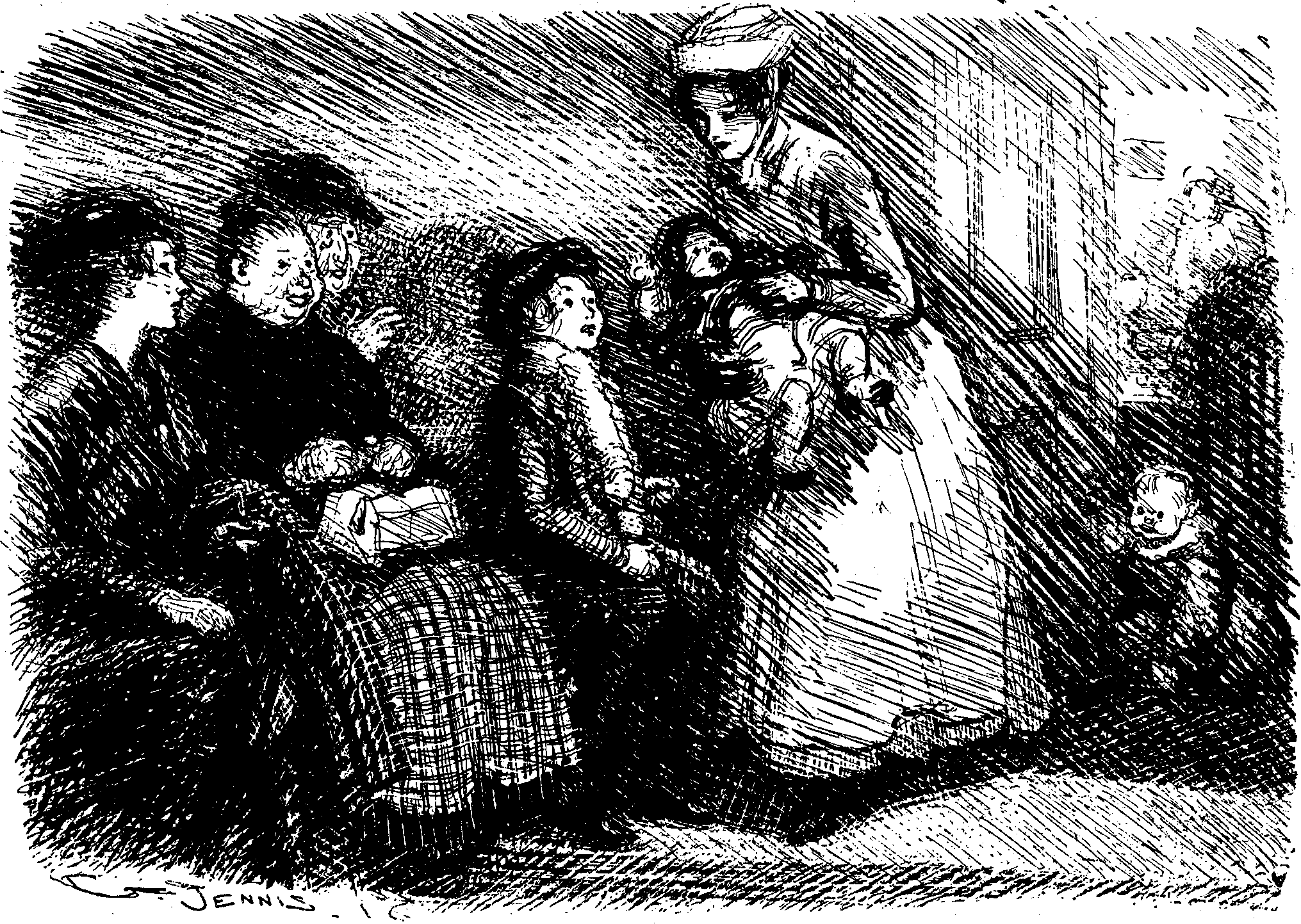
THE WAR NURSERY.
Nurse. "WHICH BABY HAVE YOU COME FOR?"
Little Girl. "THANK YOU, NURSE—I'M BEING SERVED."
TO A V.A.D. HALL-PORTERESS.
(With apologies to R.K.)
If you can keep your courage and your curls up When life a whirling chaos seems to be Of amorous swains who want to ring their girls up And get them through at once (as you for me); If you can calm the weary and the waxy, When no appeals, however nicely put, Can lure from rank or pub. the ticking taxi, And they, poor devils, have to go on foot; If you can stem the rush of second-cousins, Who crowd to get a glimpse of darling Fred, When Father, Mother, Aunts and friends in dozens Already form a circle round his bed; If, in a word, you run a show amazing, With precious little help to see you through it, Yours is a temper far above all praising, And—here we reach the point—I've seen you do it.
"Annie —— was fined £2 for failing to have the name attached to apples at a stall in —— Market. Mr. —— said the public were being wilfully kept in ignorance as to what they were buying."—Provincial Paper.
We think the Magistrate was rather pernickety. Most people know an apple when they see one, but the trouble in these days is to see one at all.
THE RULE OF THE ROAD.
I admire all poilus, and especially did I admire Pierre. Once only did I find him at fault. It was one of my functions on a hospital ship plying between —— and —— to wheel about the more fortunate of the patients. On the occasion on which I met Pierre he was journeying to his mother in London and was temporarily engaged in the same pursuit. I beheld him approaching with his charge and immediately ported my helm. He bore down on his, keeping to his right, and we collided.
"Keep to your left, you fool!" I cried as the crash came.
"Mais non! le droit, M'sieur."
Here was a deadlock indeed. It was an English ship, therefore the English rule of the road should be maintained. On the other hand, the fact that we were still in French waters was in his favour. But my stubborn British will would not give way, and Heaven knows how long we should have remained there had not one of the invalids grunted, "Caan't thee keep t' the rule o' the waater?" and I saw a dignified way out of the difficulty. I withdrew to the right, and we passed on with no animosity towards one another. Still, it was a near thing for the Entente.
"The unfortunate lady was examining an unloaded pistol when it went off and caused instantaneous death."—Times of Ceylon.
In the circumstances we trust we are justified in thinking this tragic intelligence to be the result of a false report.