Volume 156 — THE TRAGEDY OF THE SUPER-PATRIOT.
Reading edition
If you happen to be standing upon the platform of Ealing Common station at about nine o'clock on a week-day morning you will see a poor shrunken figure with a hunted expression upon his face come creeping down the stairs. And as the train comes in he will slink into a carriage and hide himself behind his newspaper and great tears will come into his eyes as he reads the correspondence column and thinks of the days when his own letters used to be published over the signatures of "Volunteer," "Patriot," or "Special Constable of Two Years' Service." And this sorry figure is Mr. Coaster, whose patriotism proved his undoing.
Before he lived in Ealing he had a little cottage at Ramstairs, on the Kentish coast. Every morning he would travel up to the City, and every evening he would return to Ramstairs, not to the carpet slippers and the comforts of home, but to the brassard and the rigorous routine of the drill-hall.
And the little drill-hall was filled with the noise of war as the Men of Kent marched hither and thither, lashed by the caustic tongue of the Territorial sergeant, with all the enthusiasm of the early Saxons who flocked to HAROLD'S standard in order to repel the Danes.
For Mr. Coaster was as great a patriot as any of the old Saxons. In a burst of enthusiasm he joined the Special Constables; in an explosion of wrath, following the bombardment of Scarborough, he enlisted in the Kentish Fencibles, and in a wave of self-sacrifice he enrolled himself in the Old Veterans' Fire Brigade. And he had badges upon each lapel of his coat and several dotted all over his waistcoat.
He belonged to a noble company of patriots. All true Men of Kent who were past the fighting age joined one or other of these institutions, but luckily not more than one.
On a certain fatal night a general alarm was given. In due course a notification of it was conveyed to Ramstairs, and instantaneously the members of the Special Constabulary, the Kentish Fencibles and the Veterans' Fire Brigade were summoned from their beds. Then did Mr. Coaster realise his terrible position. Since he belonged to all three, to which of them should he now report? After some agonising moments of doubt he hung up his three types of headgear upon the hat-stand and, shutting his eyes, he twirled himself round twice and made a grab at them. His hand touched the helmet of the Veterans' Fire Brigade. Fate had decided. Seizing his fireman's axe he rushed off down the street.
The result of this was inevitable. He was dismissed with ignominy from the Special Constables and was condemned to death, with a recommendation to mercy, by a court-martial of the Kentish Fencibles. His old friends among the Men of Kent cut him dead; the tradesmen of his platoon refused to serve him. He had to leave Ramstairs and he retired to Ealing. The catastrophe ruined his health. But he still gets a little solace when, as he wipes the tears from his eyes after reading the correspondence column of his penny paper, he sees upon his waistcoat the crossed axes surmounted by a fire bucket, the emblem of the Veterans' Fire Brigade.
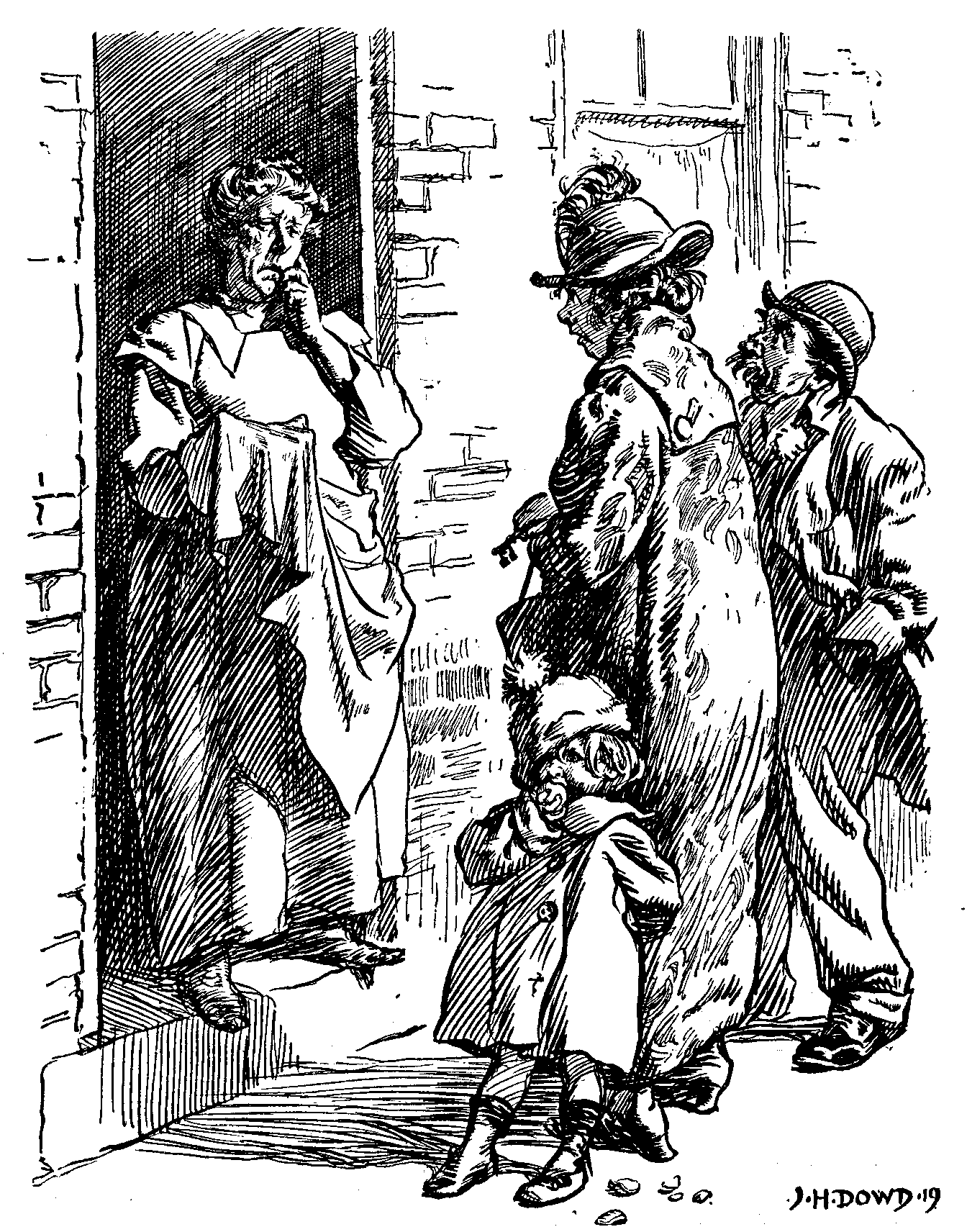
Aunt (guardian of little nephew who has run away). "EVERY COMFORT ALBERT 'AD—INCLUDIN' WHITE MICE IN 'IS BEDROOM."
Paradise Regained.
"Lady tired of her clothes wishes to sell them all very cheaply."—Pioneer (Allahabad).
A Stayer.
"In this race County Cricket was left at least eight lengths and yet managed to cover up ground and was only beaten by half a week, greatest surprise to all those who noticed it."——Bombay Chronicle.
We gather that it was only noticed by a few spectators who happened to be staying on over the week-end.
From a publisher's advertisement of Mr. CHESTERTON'S works:—
"A SHILLING FOR MY THOUGHTS, Fcap. 8vo. 2s. net."
Is "G.K.C." also among the profiteers?
"Private Frank Edwards, Canadian Forces, a native of Berwick, has been presented to the King as the oldest soldier on active service with the B.E.F. He enlisted as a private in the 50's and went right away to fight in France."—Edinbro' Evening News.
We calculate that he is entitled to at least fifty-nine blue chevrons and one red.
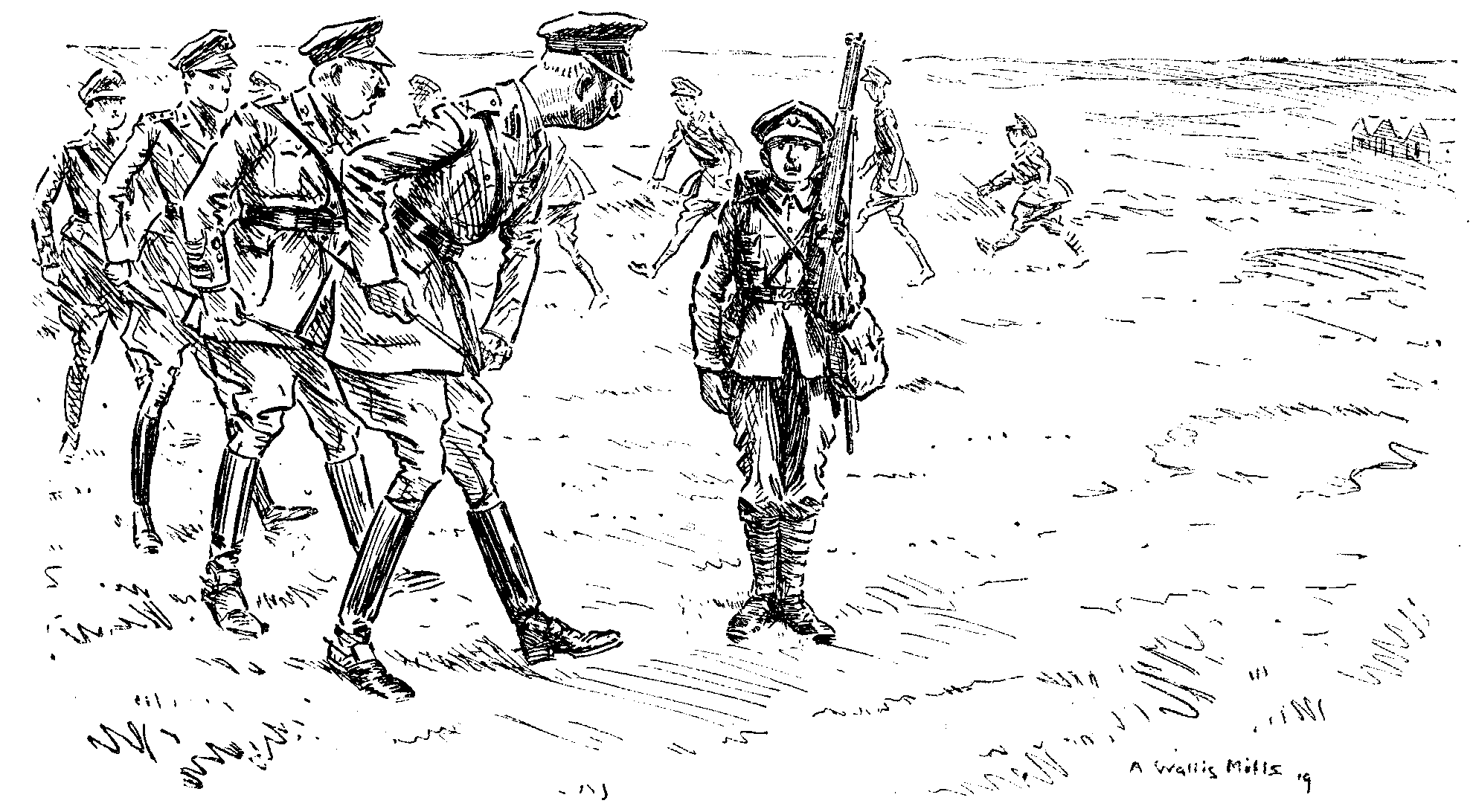
BATTALION INSPECTION IN FRANCE.
MEN ARE BEING DEMOBILISED FASTER THAN OFFICERS.