Volume 156 — THE COUNTER-REVOLUTIONARY COLLAR.
Reading edition
Mr. Bingley-Spyker pleaded surprise. He pointed out that he had been in bed for a fortnight, "laid aside," as he said, "through the prevailing epidemic." In the meantime the revolution had taken place, and he had heard nothing about it.
"Well," said the President gruffly, "we carn't 'elp that, can we, comrades? While this 'ere citizen 'as been restin' in the lap o' luxury, so to speak, we workers 'ave been revolutin'. An' that's all there is to it."
"But fair play," persisted Mr. Bingley-Spyker gently, "is a jewel. At least so I have always understood."
"Not so much of it, me lad," interrupted the President sharply. "Now then, comrade, wot's the charge?"
An unkempt person stepped up to the front and, clearing his throat with some emphasis, began:—
"About ten-thirty this morning I see this gentleman—"
"What? " The interruption came simultaneously from several members of the tribunal.
"—this party walkin' down Whitehall casual-like, as if the place belonged to 'im instead of to us. 'What ho!' I says to myself, 'this 'ere chap looks like a counter-revolution'ry;' and with that I comes closer to 'im. Sure enough he was wearin' a 'igh collar, about three inches 'igh, I should say, all white an' shiny, straight from the lorndry. I could 'ardly believe my eyes."
"Never mind your eyes, comrade," the President said; "tell us what you did."
"I accosted 'im and said, 'Ere, citizen, wot do you mean by wearin' a collar like that?'"
"An' what was the reply?"
"He looked at me 'aughty-like, an' says, 'Get away, my man, or I shall call the police.' An' thereupon I said, 'P'r'aps you don't know it, citizen, but I am the p'lice, an', wot's more, I arrest you for wearin' a white collar, contrairy to the regulations in that case made an' perwided.'"
"Very good, comrade," murmured the President, "very good indeed. Did he seem surprised?"
"Knocked all of a 'eap. So I took him into custody and brought him along."
"You did well, comrade. The Tribunal thanks you. Step down now, me lad, and don't make too much noise. Now then, prisoner, you've 'eard the charge; what have you got to say about it?"
"Only this," said Mr. Bingley-Spyker firmly, "that I am not guilty."
"Not guilty?" shouted the President. "Why, you've got the blooming thing on now!"
"Yes," said the prisoner mildly. "But observe."
Somewhat diffidently he removed his collar and held it up to view. "You call this a clean, white, shiny collar? Well, it's not. Fawn-colour, if you like; speckled—yes; but white—clean? No! Believe me," continued Mr. Bingley-Spyker, warming to his subject, "it's years since I've had a genuinely clean collar from my laundry. Mostly they are speckled. And the specks are usually in a conspicuous position; one on each wing is a favourite combination. I grant you these can be removed by a penknife, but imperfectly and with damage to the fabric. When what I may call the main portion of the collar is affected, the speckled area may occasionally be concealed by a careful disposition of one's tie. But not often. The laundress, with diabolical cunning, takes care to place her trade-mark as near the top rim as possible. I have not by any means exhausted the subject," he concluded, "but I think I have said enough to clear myself of this particular charge."
It seemed then to Mr. Bingley-Spyker that all the members of the Tribunal were shouting together. On the whole he gathered that he had not improved his position. He had been "attacking the proletariat."
"'Ard-working gyurls," panted a woman-member excitedly, "toilin' and moilin' at wash-tubs and mangles for the likes of 'im! It's a rope collar he wants, Mr. President. Make it a 'anging matter, I should."
"Silence, comrades!" commanded the President. "Let me deal with 'im. Prisoner, the Tribunal finds you guilty of wearing a collar, contrary to the regulations. Collars are the 'all-marks of a slave civilization; they 'ave no place in a free state. The sentence of the Court is that you be committed to a State laundry for ten years, with 'ard labour, principally at mangles. Remove the prisoner."
So they removed Mr. Bingley-Spyker....
He was glad when he woke up to find himself in his own room in his own Government office at Whitehall, with the afternoon sun streaming deliciously through the windows. Involuntarily he felt for his collar.
THE HANWELLIAD.
When I come into my kingdom, which will happen very soon, I shall ride a milk-white palfrey from the Mountains of the Moon; He's caparisoned and costly, but he did his bit of work In a bridle set with brilliants, which he used to beat the Turk. Then they called their Uncle Edward and they blew without a check, Keeping time with much precision, down the back of Uncle's neck, Till he fled to get an iceberg, which he providently found Half on land and half in water, so he couldn't well be drowned. Oh, his gait was very silent, very sinuous and slow— He had learnt it from a waiter whom he met about Soho; He was much the best tactician of the migratory band And he earned a decent living as a parcel packed by hand. "Sergeant James," we said, "how goes it?" but the Sergeant looked askance; Not for him the mazy phalanx or the military dance; He could only sit and suffer, with a most portentous frown, While a crowd of little gipsies turned the whole thing upside down. Aunt Maria next surprised us: for her massive back was grooved, And her adenoids gave trouble, so we had them all removed; If we hadn't done it neatly she'd have gone and joined the dead, As it is she hops politely while she walks upon her head. So we'll all fill up a cheque-form on some celebrated Banks— It's a pity that a cheque-form should be made so much of blanks— And we'll give the Bank of England all the credit that is due To her hoards of gold and silver; and I wish they weren't so few.
"Mr. —— has been actively connected with the last two Victory Loan drives, in the last one raising $15,282,000. As an appreciation of his work the salesmen presented him with a (fifteen million dollar) diamond ring."—Canadian Paper.
We are glad that something was left for the Loan.
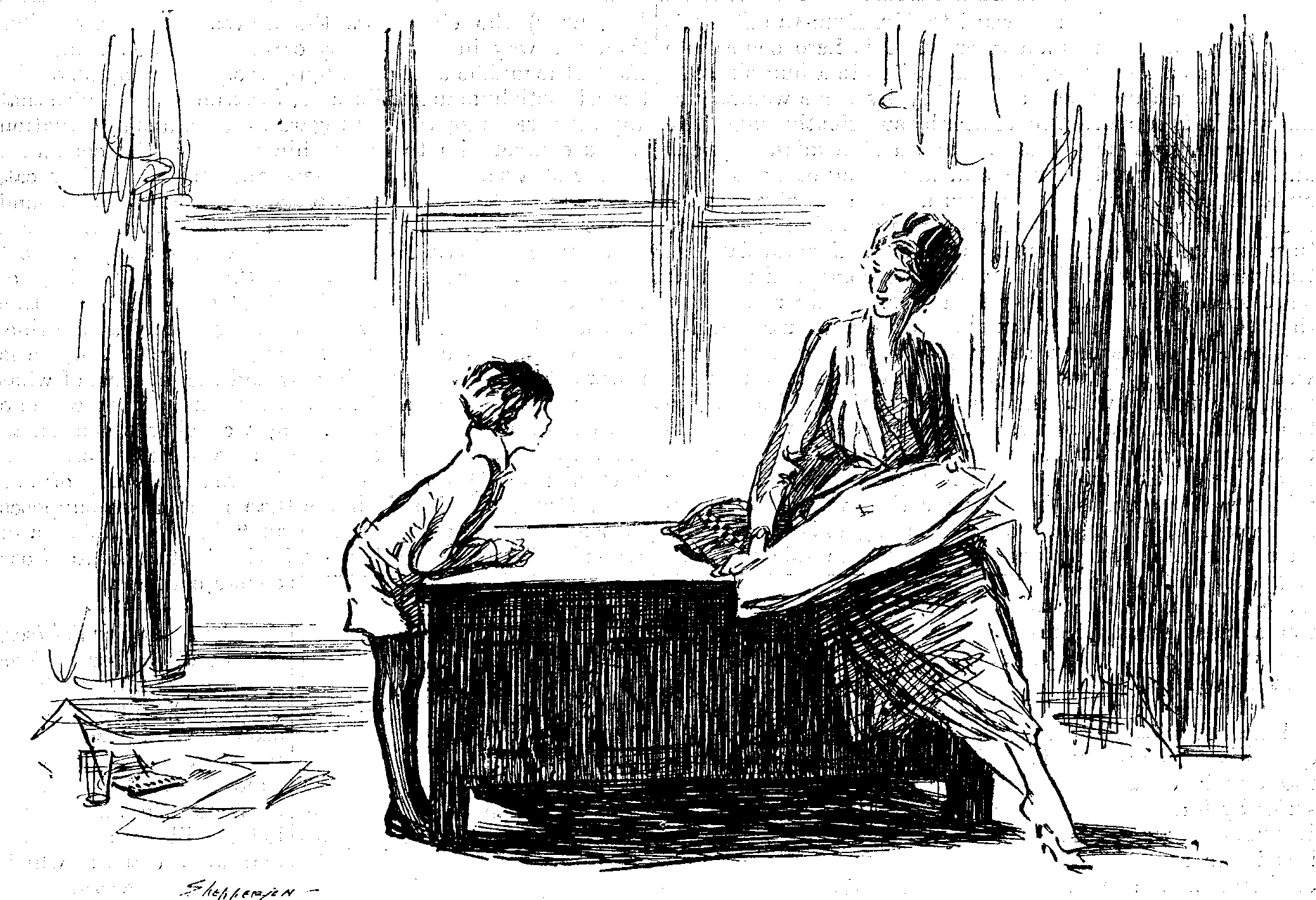
Small Boy (who has been promised a visit to the Zoo to-morrow). "I HOPE WE SHALL HAVE A BETTER DAY FOR IT THAN NOAH HAD."