Volume 153 — PETHERTON AND THE RAG AUCTION.
Reading edition
A letter I received last Friday gave me one of those welcome excuses to get into closer touch with my neighbour, Petherton, than our daily proximity might seem to connote. I wrote to him thus:—
DEAR MR. PETHERTON,—Miss Gore-Langley has written to me to say that she is getting up a Rag Auction on behalf of the Belgian Relief Fund, and not knowing you personally, and having probably heard that I am connected by ties of kinship with you, she asked me to approach you on the subject of any old clothes you may have to spare in such a cause.
Of course I'm not suggesting you should allow yourself to be denuded in the cause (like Lady GODIVA), but I daresay you have some odds and ends stowed away that you would contribute; for instance, that delightful old topper that you were wont to go to church in before the War, and that used to cause a titter among the choir—can't you get the moths to let you have it? Neckties, again. Where are the tartans of '71? Surely there may be some bonny stragglers left in your tie-bins. And who fears to talk of '98 and its fancy waistcoats? All rancour about them has passed away, and if you have any ring-straked or spotted survivors, no doubt they would fetch something in a good cause. I hope you will see what you can do for
Yours very truly,
HENRY J. FORDYCE.
Petherton's reply was brief. He wrote:—
SIR—Had Miss Gore-Langley chosen a better channel for the conveyance of her wishes I should have been only too pleased to do what I could to help. As it is, I do not care to have anything to do with the affair.
Yours faithfully,
FREDERICK PETHERTON.
But he was better than his word, as I soon discovered. So I wrote:—
DEAR PETHERTON,—I have had such a treat to-day. I took one or two things across to Miss Gore-Langley, who was unpacking your noble contributions when I arrived. Talk about family histories; your parcel spoke volumes.
I was frightfully interested in that brown bowler with the flat brim, and those jam-pot collars. Parting with them must have been such sweet sorrow.
I feel like bidding for some of your things, among which I also noted an elegantly-worked pair of braces. With a little grafting on to the remains of those I am now wearing, the result should be something really serviceable. I don't mind confessing to you that I simply can't bring my mind to buying any new wearing apparel just now. I'd like the bowler too. It should help to keep the birds from my vegetables, and incidentally the wolf from the door. And seeing it fluttering in the breeze you would have a continual reminder of your own salad days.
Surely the priceless family portrait in the Oxford oak frame got into the parcel by mistake. I am expecting to acquire that for a song, as it cannot be of interest except to one of the family, and I should be glad to number it among my heirlooms.
Miss G.-L. is awfully braced with the haul, and asked me to thank you, which is one of my objects in writing this.
Yours sincerely,
HARRY FORDYCE.
Petherton was breathing hard by this time, and let drive with:—
SIR,—It is like your confounded impertinence to overhaul the few things I sent to Miss Gore-Langley, and had I known that you would have had the opportunity of seeing what my wife insisted on sending I should certainly not have permitted their despatch.
I have already told you what I think of your ridiculous claims to kinship with my family, and shall undoubtedly try to thwart any impudent attempts you may make to acquire my discarded belongings. The photograph you mention was of course accidentally included in the parcel, and I am sending for it.
Yours faithfully,
FREDERICK PETHERTON.
In the cause of charity I rushed over to the Dower House, and pointed out to Miss Gore-Langley how she might swell the proceeds of the sale. I then wrote thus to Petherton:—
DEAR OLD MAN,—Thanks for your jolly letter. I'm sorry to tell you that Miss G.-L. holds very strong views on the subject of charitable donations, and you will have to go and bid for anything you want back. I'm very keen on that photograph, if only for the sake of your pose and the elastic-side boots you affected at that period. Everyone here is quite excited at the idea of having Cousin Fred's portrait among the family likenesses in the dining-room, and its particular place on the wall is practically decided upon.
I shall probably let the braces go if necessary, but I shall contest the ownership of the bowler up to a point.
Why not have your revenge by buying one or two of my things? There is a choice pair of cotton socks, marked T.W., that I once got from the laundry by mistake; they are much too large for me, but should fit you nicely. There's a footbath too. It leaks a bit, but your scientific knowledge will enable you to put it right. It's a grand thing to have in the house, in case of a sudden rush of blood to the head.
Cheerio!
Yours ever,
HARRY.
Petherton simply replied:—
SIR,—It is, I know, absolutely useless to make an appeal to you, and I shall simply outbid you for the portrait if possible; if not, I shall adopt other measures to prevent your enjoying your ill-mannered triumph.
Yours faithfully,
F. PETHERTON.
The Auction was held last Wednesday. I didn't attend it, but got Miss Gore-Langley to run up the price of the portrait as far as seemed safe, on my behalf, which resulted in Mrs. Petherton getting it for £5 15s. I got the hat, but Mrs. Petherton outbid my agent for the braces.
DEAR FREDDY (I wrote), Wasn't it a roaring success—the Auction, I mean? I didn't manage to attend, but have heard glowing accounts from its promoter.
The most insignificant things, I hear, went for big prices; one patriotic lady, I'm told, even going to £5 15s. for a faded photograph of a veteran in the clothes of a most uninteresting sartorial period. It was in a cheap wooden frame, of a pattern that is quite out of the movement. Fancy, £5 15s.!
Did you buy anything?
In haste,
Yours, H.
If you have any stout safety-pins, lend me a couple, old boy. I failed to secure the braces. They fetched 1s. 9d., which was greatly in excess of their intrinsic value.
There has been no reply from Petherton to date.
Journalistic Candour.
"Mr. Wells has no master in controversy with ordinary mortals, but I would seriously warn him that arguing with the 'Morning Post' leads after a certain point to softening of the brain."—"Diarist" in "The Westminster Gazette."
We have always taken a painful interest in The Westminster's quarrels with The Morning Post.
"In 1914-15 there was for the first time a surplus of cereals of about 27,475 tons produced in Egypt."—Times.
For the first time? Shade of JOSEPH!
"A Young Lady is desirous of CHANGE. Has wholesale and retail military experience. Also knowledge of practical."—Daily Telegraph.
Now, then, HAIG.
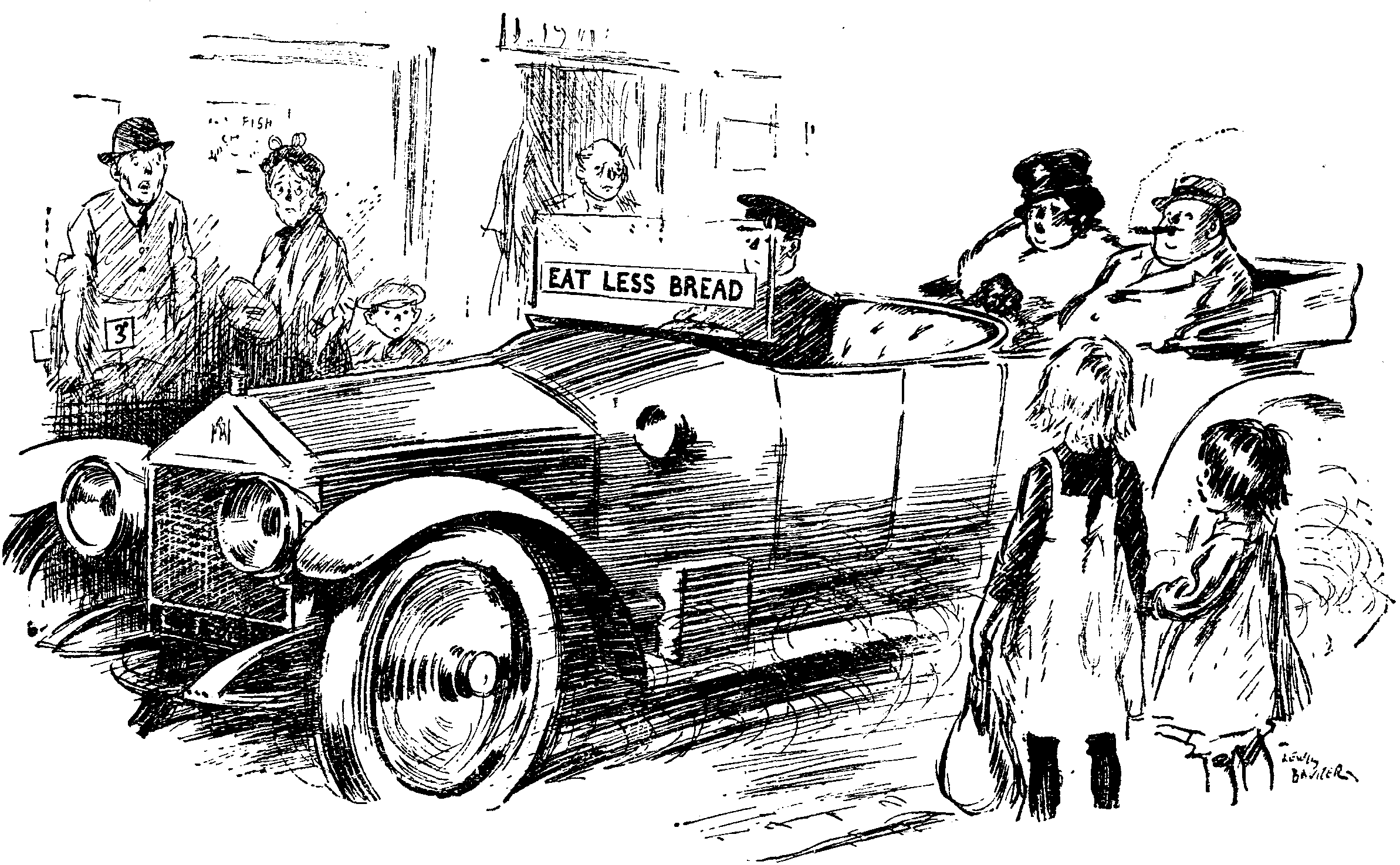
DOING THEIR BIT.
BEASTS ROYAL.
I.
QUEEN HATSHEPSU'S APE.
B.C. 1491.
Now from the land of Punt the galleys come, HATSHEPSU'S, sent by Amen-Ra and her To bring from God's own land the gold and myrrh, The ivory, the incense and the gum; The greyhound, anxious-eyed, with ear of silk, The little ape, with whiskers white as milk, And the enamelled peacock come with them. The little ape sits on HATSHEPSU'S chair, And with a solemn and ironic eye He sees TAHUTMES strap the balsamed hair Unto his royal chin and wonders why; He sees the stewards and chamberlains bow down, Plays with the asp upon HATSHEPSU'S crown, And thinks, "A goodly land, this land of Khem!" The little ape sits on HATSHEPSU'S knee While the great lotus-fans move to and fro; Outside along the Nile the galleys go And the Phoenician rowers seek the sea; Outside the masons carve TAHUTMES' chin, Tipped with the beard of Ra, and lo, within— The ape, derisive and ineffable. The little ape from Punt sits there beside TAHUTMES and HATSHEPSU on their throne, Dissembling courteously his inward pride When the great men of Egypt, one by one, Their oiled and shaven heads before him bend, And thinking, "I was born unto this end; I am the King they honour. It is well."
THE CLINCHOPHONE.
["WANTED.—Loud gramophone (second-hand) for reprisals."—Advt. in "The Times."]
It is just to meet such pressing demands as this that the Gramophobia Company have introduced their remarkable instrument or weapon, described as The Clinchophone. No home is complete without it.
It is supplied with little oil bath, B.S.A. fittings and kick start.
A child can set it in motion, but nothing on earth will stop it until its object is achieved and there is peace with honour.
Installed in a neighbourhood bristling with pianos, amateur singers, gramophones, and other grind boxes it saves its cost in doctors' bills.
It is fatal at fifty yards, and there has been nothing like it since the "Tanks." It can do almost everything except stop before its time.
Read the following testimonials:—
"GENTLEMEN,—While the grand piano next door was playing last evening I pressed the button of The Clinchophone. The piano immediately sat back on its haunches, gibbered and then fell on the player."
"DEAR SIR,—At the first trial of my new Clinchophone my neighbour's gramophone rushed out of the house and has not been heard of since."
"SAVED" says: "Last night the basso profondo two doors away started singing, 'Rocked in the Cradle of the Deep.' He sang two bars and then crawled round to my house on his hands and knees and collapsed on the doorstep with the word 'Kamerad!' on his lips."
Our Stylists.
"The look from his eyes, the ashen colour of his face, the passion in his voice, mute though it was, frightened and bewildered her."—Story in "Home Notes."
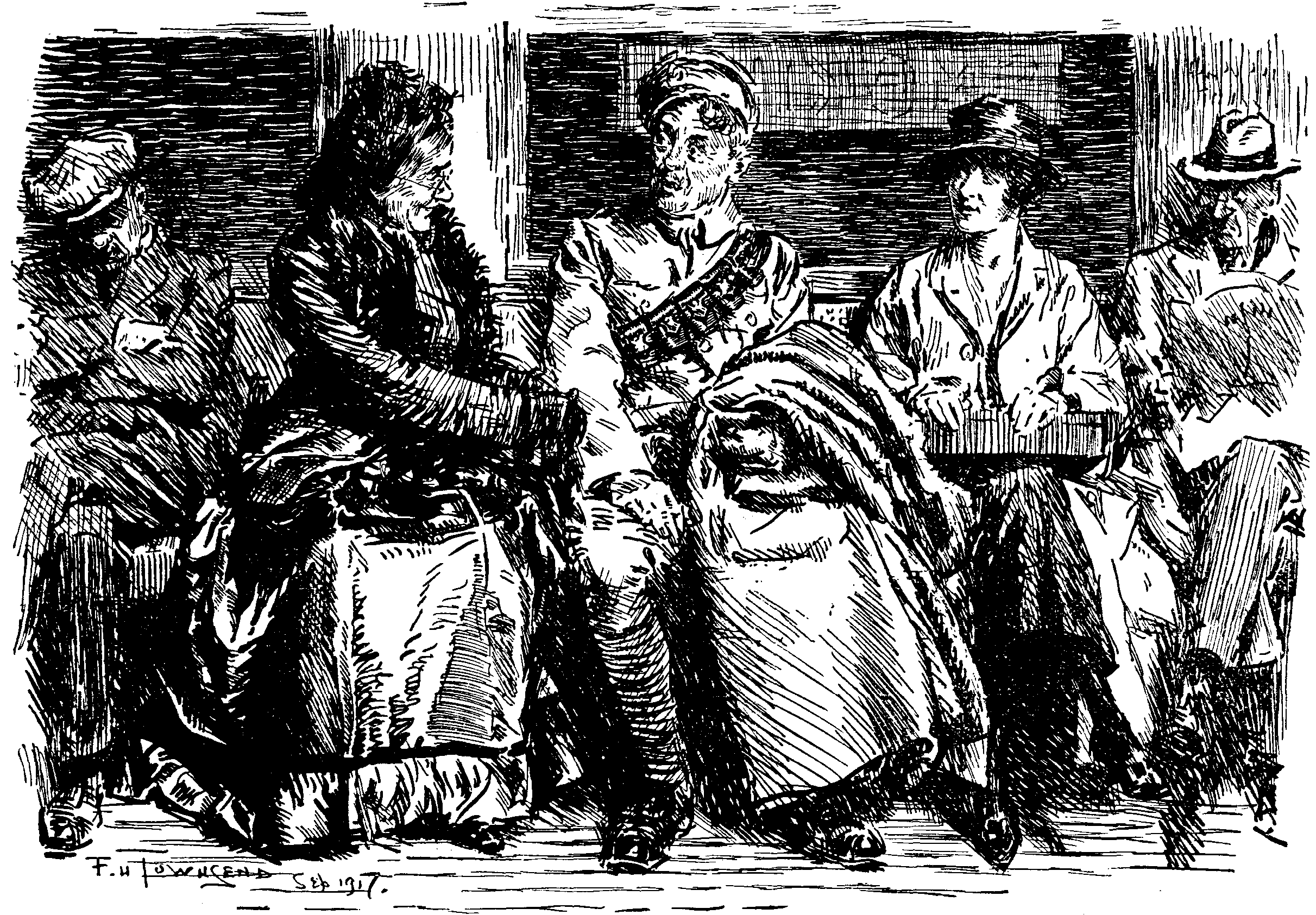
"DEARIE ME, NOW, I SHOULDN'T HA' THOUGHT THEY GIVES YOU ENOUGH MONEY IN THE ARMY TO FILL ALL THEM THERE LITTLE PURSES."