Volume 153 — A STUDY IN SYMMETRY.
Reading edition
The following story, however improbable it may seem to you, is true.
Once upon a time there was an artist with historical leanings not unassociated with the desire for pelf—pelf being, even to idealists, what petrol is to a car. The blend brought him one day to Portsmouth, where the Victory lies, with the honourable purpose of painting a picture of that famous ship with NELSON on board. What the ADMIRAL was doing I cannot say—most probably dying—but the artist's intention was to make the work as attractive as might be and thus draw a little profit from the wave of naval enthusiasm which was then passing over the country; for not only was the picture itself to be saleable, but reproductions were to be made of it.
Permission having been obtained from the authorities, the artist boarded the Victory, set up his easel on her deck and settled down to his task, the monotony of which was pleasantly alleviated by the chatter of the old salts who guard the ship and act as guides to the tourists who visit her. All of these estimable men not only possessing views on art, but having come by now to the firm belief that they had fought with NELSON, their criticisms were not too easily combated and the artist hadn't a tedious moment. Thus, painting, conversing and learning (as one can learn only from a trained imparter of information), three or four days passed quickly away and the picture was done.
So far there has been nothing—has there?—to strain credulity. No. But a time will come—is, in fact, upon us.
On the evening of the last day, as the artist was sitting at early dinner with a friend before catching the London train, his remarks turned (as an artist's sometimes will) upon the work upon which he had just been engaged. He expressed satisfaction with it in the main, but could not, he said, help feeling that its chances of becoming a real success would be sensibly increased if he could find as a model for the central figure some one whose resemblance to NELSON was noticeable.
"There are, of course," he went on, "at the same time—that is to say, among contemporaries—no two faces exactly alike. That is an axiom. Strange as it may sound, among all the millions of countenances with two eyes, a nose in the middle and a mouth below it, some difference exists in each. That is, as I say, among contemporaries: in the world at this moment in which I am speaking. But," he continued, warming to his subject, for, as you will have already gathered, he was not one of the taciturn brush-brotherhood, "after the lapse of years I see no reason why nature should not begin precisely to reproduce physiognomies and so save herself the trouble of for ever diversifying them. That being so—and surely the hypothesis is not too far-fetched"—here his friend said, "No, not at all—oh no!"—"why," the artist continued, "should there not be at this moment, more than a century later, some one whose resemblance to NELSON is exact? He would not be necessarily a naval man—probably, indeed, not, for NELSON's face was not characteristic of the sea—but whoever he was, even if he were an archbishop, I," said the painter firmly, "should not hesitate to go up to him and ask him to sit to me."
The friend agreed that this was a very proper attitude and that it betokened true sincerity of purpose.
"NELSON's face," the painter continued, "was an uncommon one. So large and so mobile a mouth is rare. But I have no doubt that a duplicate exists, and no matter who is the owner of it, even were he an archbishop, I should not hesitate to go up and ask him to sit to me."
(For the benefit of any feminine reader of this veracious history I should say that the repetition which she has just noticed is not an accident, but has been carefully set down. It is an attempt to give verisimilitude to the conversation—because men always say things like that twice.)
The friend again remarked that the painter's resolve did him infinite credit, and the two started for the station, still conversing on the same theme.
On entering their carriage the first thing to take their attention was a quiet little man in black, who was the absolute double of the hero of Trafalgar.
"Good gracious!" whispered the painter excitedly, "do you see that? There's the very man. The likeness to NELSON is astonishing. I never saw anything like it. I don't care who he is, I must tackle him. It's the most extraordinary chance that ever occurred."
Assuming his most silky and deferential manner—for, though clearly not an archbishop, unless in mufti, this might yet be a person of importance—the painter approached the stranger and tendered a card.
"I trust, Sir, that you will excuse me," he began, "for the liberty I am taking, but I am an artist and I happen to be engaged on a picture of NELSON on the Victory. I have all the accessories and so forth, but what I very seriously need is a brief sitting from some gentleman with a likeness to the great little Admiral. Such, Sir, as yourself. It may be news to you—it probably is—but you, Sir, if I may say so, are so like the famous and immortal warrior as almost to take one's breath away. It is astonishing, wonderful! Might I—would it be—could you—would you, Sir, be so very kind as to allow me to paint you? I would, of course, make every effort not to inconvenience you—I would arrange so that your time should be mine."
"Of course I will, guvnor," said the man. "I'm a professional model and I've been sitting for NELSON for years. Why, I've been doing it for an artist this very afternoon."
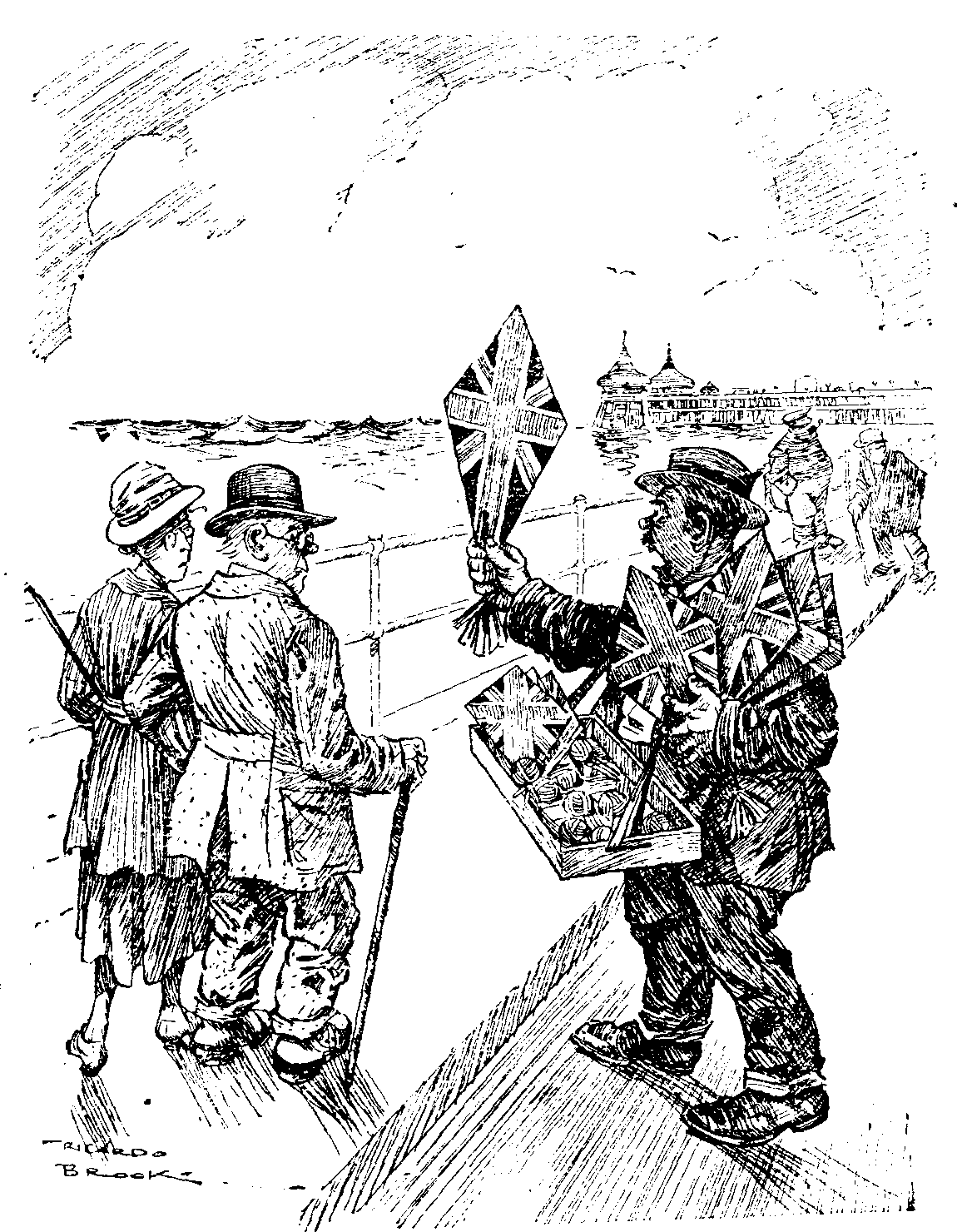
Our Restricted Coast Amusements.
Vendor. "ALL THE OFFICIAL 'OLIDAY FUN. FLY THE PATRIOTIC KITES AND ANNOY THE GOTHAS!
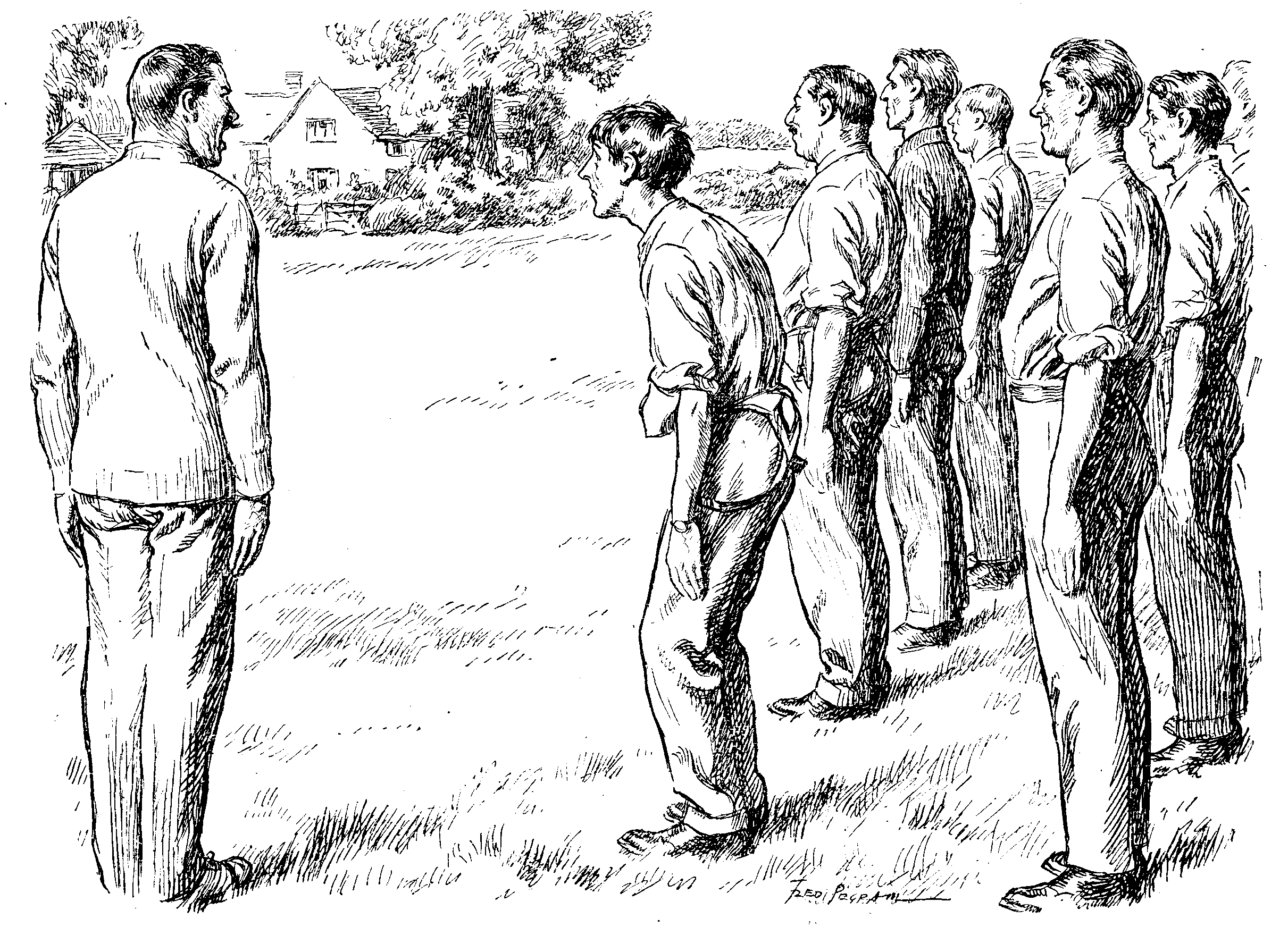
Physical Drill Instructor (to Weak-kneed Recruit). "NAH THEN! IF YOU'RE A-GOING TER JUMP—JUMP!"
A LOST LAND.
(TO GERMANY.)
A childhood land of mountain ways, Where earthy gnomes and forest fays, Kind foolish giants, gentle bears, Sport with the peasant as he fares Affrighted through the forest glades, And lead sweet wistful little maids Lost in the woods, forlorn, alone, To princely lovers and a throne. Dear haunted land of gorge and glen, Ah me! the dreams, the dreams of men! A learned land of wise old books And men with meditative looks, Who move in quaint red-gabled towns And sit in gravely-folded gowns, Divining in deep-laden speech The world's supreme arcana—each A homely god to listening Youth Eager to tear the veil of Truth; Mild votaries of book and pen— Alas, the dreams, the dreams of men! A music land, whose life is wrought In movements of melodious thought; In symphony, great wave on wave— Or fugue, elusive, swift, and grave; A singing land, whose lyric rhymes Float on the air like village chimes: Music and Verse—the deepest part Of a whole nation's thinking heart! Oh land of Now, oh land of Then! Dear God! the dreams, the dreams of men! Slave nation in a land of hate, Where are the things that made you great? Child-hearted once—oh, deep defiled, Dare you look now upon a child? Your lore—a hideous mask wherein Self-worship hides its monstrous sin:— Music and verse, divinely wed— How can these live where love is dead? Oh depths beneath sweet human ken, God help the dreams, the dreams of men!
"The Blessington Papers are included with all their atmosphere of distinguished High Bohemia. Among them are some interesting Disraeli letters—he was ever her staunch friend from the early 'thirties to the late 'forties, when his son had risen and her's—how brilliant!—had set."—Saturday Review.
And up to the present we had been under the impression that both these distinguished persons were childless.
HINT FOR HORTICULTURISTS.
"Mr. ——, undertaker, of Temuka, improved his plant by the purchase of a new hearse."—Timaru Herald (New Zealand).
"Mr. —— hopes shortly to be seen again in revue in the Wet End."—Pall Mall Gazette.
Or, as the CENSOR would put it, "somewhere in England."
Daily Mail (Ordinary Edition), 3 September, 1917: "Lord Halsbury is 92 to-day." Times (Late War Edition), 3 September, 1917: "The Earl of Halsbury is 94 to-day."
Yet, from personal observation, one would never believe that the EX-LORD CHANCELLOR was ageing so rapidly.
From "German Official":—
"With the use of numerous tanks and aeroplanes, flying at a low altitude, the English infantry soon after advanced to the attack on this front."—Evening Paper.
Now that the enemy has given away the secret of our new weapon the CENSOR might let us know more of our flying Tanks.
"Prisoner then seized her round the throat with both hands and hit her on the head with a steel case-opener."—Daily Paper.
Which, presumably, he carried in his teeth.
THE SUNFLOWER.
"Have you," said Francesca, "seen our sunflowers lately?"
"Yes," I said, "I've kept an eye on them occasionally. It's a bit difficult, by the way, not to see them, isn't it?"
"Well," she said, "perhaps they are rather striking."
"Striking!" I said. "I never heard a more inadequate word. I call them simply overwhelming—the steam-rollers of the vegetable world. Look at their great yellow open faces."
"I never," said Francesca, "saw a steam-roller with a face. You're mixing your metaphors."
"And," I said, "I shall go on mixing them as long as you grow sunflowers. It's the very least a man can do by way of protest."
"I don't know why you should want to protest. The seed makes very good chicken-food."
"Yes, I know," I said, "that's what you always said."
"And I bet," she said, "you've repeated it. When you've met the tame Generals and Colonels at your club, and they've boasted to you about their potatoes, I know you've countered them with the story of how you've turned the whole of your lawn into a bed of sunflowers calculated to drive the most obstinate hen into laying two eggs a day, rain or shine."
"I admit," I said, "that I may have mentioned the matter casually, but I never thought the things were going to be like this. When I first knew them and talked about them they were tender little shoots of green just modestly showing above the ground, and now they're a forest primeval. The murmuring pines and the hemlock aren't in it with this impenetrable jungle liberally blotched with yellow, this so-called sunflower patch."
"What would you call it," she said, "if you didn't call it sunflower?"
"I should call it a beast of prey," I said. "A sunflower seems to me to be more like a tiger than anything else."
"It was a steam-roller about a minute ago."
"Yes," I said, "it was—a tigerish steam-roller."
"How interesting," she said. "I have not met one quite like that."
"That," I said, "is because your eye isn't properly poetical. It's blocked with chicken-food and other utilitarian objects."
"I must," she said, "consult an oculist. Perhaps he will give me glasses which will unblock my eye and make me see tigers in the garden."
"No," I said, "you will have to do it for yourself. For such an eye as yours even the best oculists are unavailing."
"I might," she said, "improve if I read poetry at home. Has any poet written about sunflowers?"
"Yes," I said, "BLAKE did. He was quite mad, and he wrote a poem to a sunflower: 'Ah! Sunflower! Weary of time.' That's how it begins."
"Weary of time!" she said scornfully. "That's no good to me. I'm weary of having no time at all to myself."
"That shows," I said, "that you're not a sunflower."
"Thank heaven for that," she said. "It's enough to have four children to look after—five including yourself."
"My dear Francesca," I said, "how charming you are to count me as a child! I shall really begin to feel as if there were golden threads among the silver."
"Tut-tut," she said, "you're not so grey as all that."
"Yes, I am," I said, "quite as grey as all that and much greyer; only we don't talk about it."
"But we do talk about sunflowers," she said, "don't we?"
"If you'll promise to have the beastly glaring things dug up—"
"Not," she said, "before we've extracted from them their last pip of chicken-food."
"Well, anyhow," I said, "as soon as possible. If you'll promise to do that I'll promise never to mention them again."
"But you'll lose your reputation with the Generals and Colonels."
"I don't mind that," I said, "if I can only rid the garden of their detested presence."
"My golden-threaded boy," said Francesca, "it shall be as you desire."
R. C. L.
CONSTABLE JINKS.
Our village policeman is tall and well-grown, He stands six feet two and he weighs sixteen stone; His gait is majestic, his visage serene, And his boots are the biggest that ever I've seen. Fame sealed his renown with a definite stamp When two German waiters escaped from a camp. Unaided he captured those runaway Huns Who had lived for a week on three half-penny buns. When a derelict porpoise was cast on the shore Our village policeman was much to the fore; He measured the beast from its tip to its tail, And blandly pronounced it "an undersized whale." When a small boy was flying his kite on the links It was promptly impounded by Constable Jinks, Who astutely remarked that it might have been seen By the vigilant crew of a Hun submarine. It is sometimes alleged that great valour he showed When he chased a mad cow for three miles on the road; But there's also another account of the hunt With a four-legged pursuer, a biped in front. If your house has been robbed and his counsel you seek He's sure to look in—in the course of the week, When his massive appearance will comfort your cook, Though he fails in the bringing of culprits to book. His obiter dicta on life and the law Set our ribald young folk in a frequent guffaw; But the elders repose an implicit belief In so splendid a product of beer and of beef. He's the strongest and solidest man in the place, Nothing—short of mad cattle—can quicken his pace; His moustache would do credit to any dragoon, And his voice is as deep as a double bassoon. His complexion is perfect, his uniform neat, He rivets all eyes as he stalks down the street; And I doubt if his critics will ever complain Of his being a little deficient in brain. For he's more than a man; he's a part of the map; His going would cause a deplorable gap; And the village would suffer as heavy a slump As it would from the loss of the old parish pump.
A HAPPY JUXTAPOSITION.
"CHEAPER MATCHES. | FRESH LIGHT ON THE KAISER'S PLOTS." Daily Mirror.
From the report of a Royal investiture:—
"The first officer to mount the dais was Major ——, who wore the broad-brimmed slouch hat of the Austrian Infantry." North China Daily News.
A souvenir, of course.
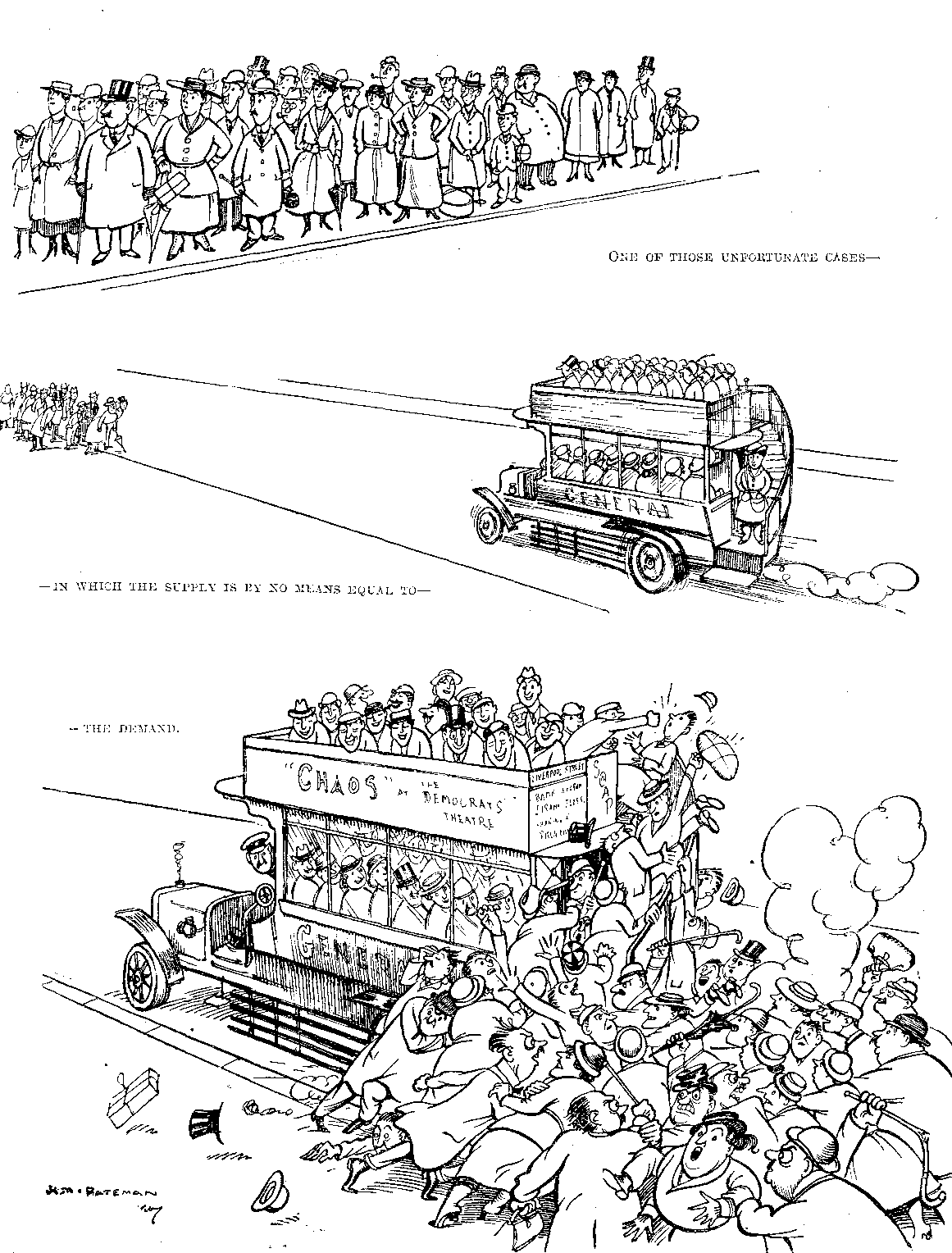
SUPPLY AND DEMAND.
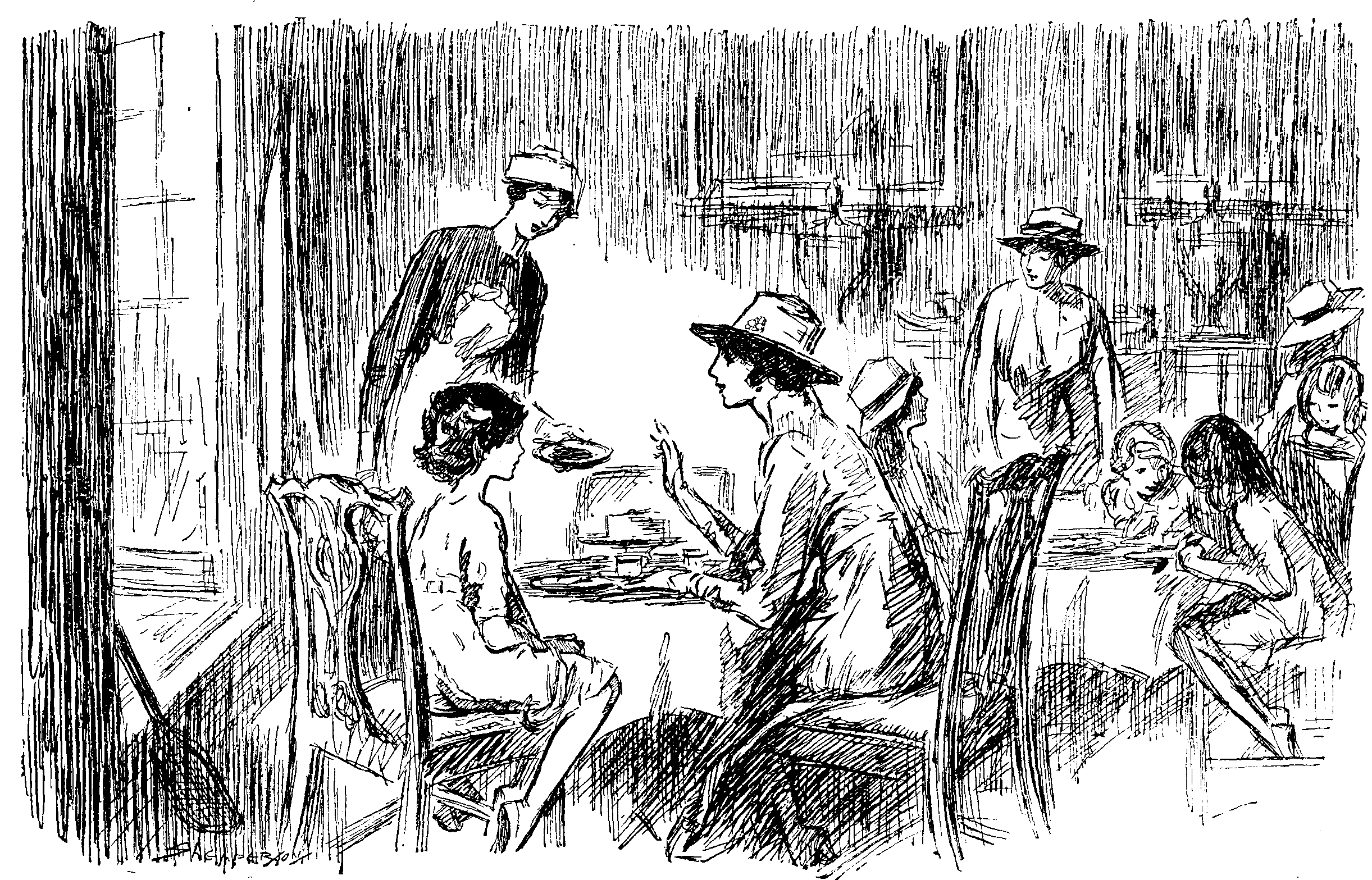
Mother (to maid, who has offered Marjorie some jam). "OH NO, THANK YOU, NOT WITH THE FIRST PIECE." Marjorie. "BUT, MUMMY, I HAVE GIVEN UP HAVING A FIRST PIECE NOW—WAR ECONOMY."
THE TRENCH CODE.
Ah! with what awe, what infantile impatience, We eyed the artifice when issued out, And racked our brains about the Regulations, And tried to think we had them free from doubt! As Rome's old Fathers, reverently leaning In secret cellars o'er the Sibyl's strain, Beyond the fact that several pars Had something vague to do with Mars, Failed, as a rule, to find the smallest meaning, But told the plebs the oracle was plain. So did we study it, ourselves deceiving, In hope to say, "We have no rations here," Or, "Please, Brigade, this regiment wants relieving," And "Thank you for the bombs—but why no beer?" And wondered always, with a hint of presage, Since never word emerged as it was planned, If it was Hermes, Lord of Craft, Compiled the code, or someone daft, So that no mortal could compose a message Which anybody else could understand. Too soon the Staff, to spoil our tiny slumbers, Or, as they said, to certify our skill, Sent us a screed, all signs and magic numbers, And what it signified is mystery still. We flung them back a message yet more mazy To say we weren't unravelling their own, And marked it urgent, and designed That it should reach them while they dined. All night they toiled, till half the crowd were crazy And bade us breathe its burthen o'er the 'phone. But now they want it back—and it is missing! And shall one patriot heart withhold a throb? For four high officers have been here, hissing, And plainly panicky about their job. I know they think some dark, deluded bandit Has gone and given it to KAISER BILL. But though I'm grieved the General's cross, I have no qualms about the loss— If clever men like us can't understand it, I don't suppose the Wilhelmstrasse will!
A. P. H.
SPREAD OF THE TEMPERANCE MOVEMENT.
"I, J.A.H. De la Bere, of Woolsevy Rectory, Morchard Bishop, Devon, desire to Alter my Surname to De la Fontaine."—Times.
"WANTED
end August in Swiss family (2 persons) living in villa near Lausanne
NURSERY'S MAID
able to saw, iron attend at table and take entire care of healthy baby 19 months old Good English accent serious references."
La Tribune de Lausanne.
We are glad to hear that the baby has a good English accent; he will be able to employ it with effect when the Nursery's Maid begins to saw and iron him.
"In the cases in which the surgeon his obliged to vast empty a bone so that offers then itself difficulties therapeuticals not little because of pus and consequenty becauses of impossibility of transplantations, plastics, plombages ecc., the A. propose to go on the bone with specials inesions, not on the surface when the bone is most superficial, but from the surface in which are aboundings and easily cessible wet tissue, removing the margin of the bone's cavity and mathing in mode as, by cause of repaidis process, this tissue by hemselves adhere to a ground of cavity and full it."—La Clinica Chirurgica.
That makes it perfectly clear.