Volume 153 — AT THE PLAY.
Reading edition
"DEAR BRUTUS."
There are great ways of borrowing, as EMERSON said, and in his new Fantasy Sir JAMES BARRIE has given us a very charming variation on A Midsummer Night's Dream (with echoes of Peter Pan and The Admirable Crichton). Certainly I got far more fun out of his deluded lovers in the Magic Wood than I ever extracted from the comedy of errors which occurred between the ladies and gentlemen of the Court of Theseus.
In Dear Brutus the contrast between real life and the life of Magicland is sharply accentuated by the fact that there is not a separate set of characters for each; the same men and women figure in both, making abrupt transitions from one to the other and back again. We have a house party of actual humans (not too obtrusively actual), most of whom, including the butler, imagine that if they could have a Second Chance in life they would not make such a mess of it as they did with the First. One of them thinks he would never have taken to drink and lost his self-respect and his wife's love if he had only had a child; one that he would not have become a pilferer if he had stuck to the City; others that they would have done better to have married Somebody Else. Well, they are all whisked off into the Magic Wood, and there they get their Second Chance. The pilferer becomes a successful tradesman in a large and questionable way; the tippler finds himself sober and attended by the daughter of his heart's desire; various married folk get re-sorted; and so forth.
The moral purpose (if any) of the author, as conveyed to us through the mouth of the leading humourist of the party, is to show that a man's nature would remain the same even if he got a Second Chance. Unfortunately—but what can you expect in the realm of Magic?—the scheme does not work out with any logical consistency. It is true that the philanderer and the pilfering butler show little promise of making anything out of their Second Chance; but, on the other hand, the childless tippler seems to have gone reformation and recovered his wife's regard; and if I rightly interpret certain delicate indications, they propose to have a pearl of a daughter later on. Also the dainty and supercilious Lady Caroline, who in the wood becomes enamoured of the butler-turned-plutocrat (cf. Titania and Bottom) and subsequently returns to her sniffiness, cannot be said to have lost much by failing to utilise her Second Chance.
However, one might never have troubled about Sir JAMES'S logic if he had not declared his moral purpose in set terms. I suppose he had to explain his title, which was sufficiently obscure. It comes, as Mr. SOTHERN kindly informed us, from the lines:—
"The fault, dear Brutus, is not in our stars, But in ourselves."
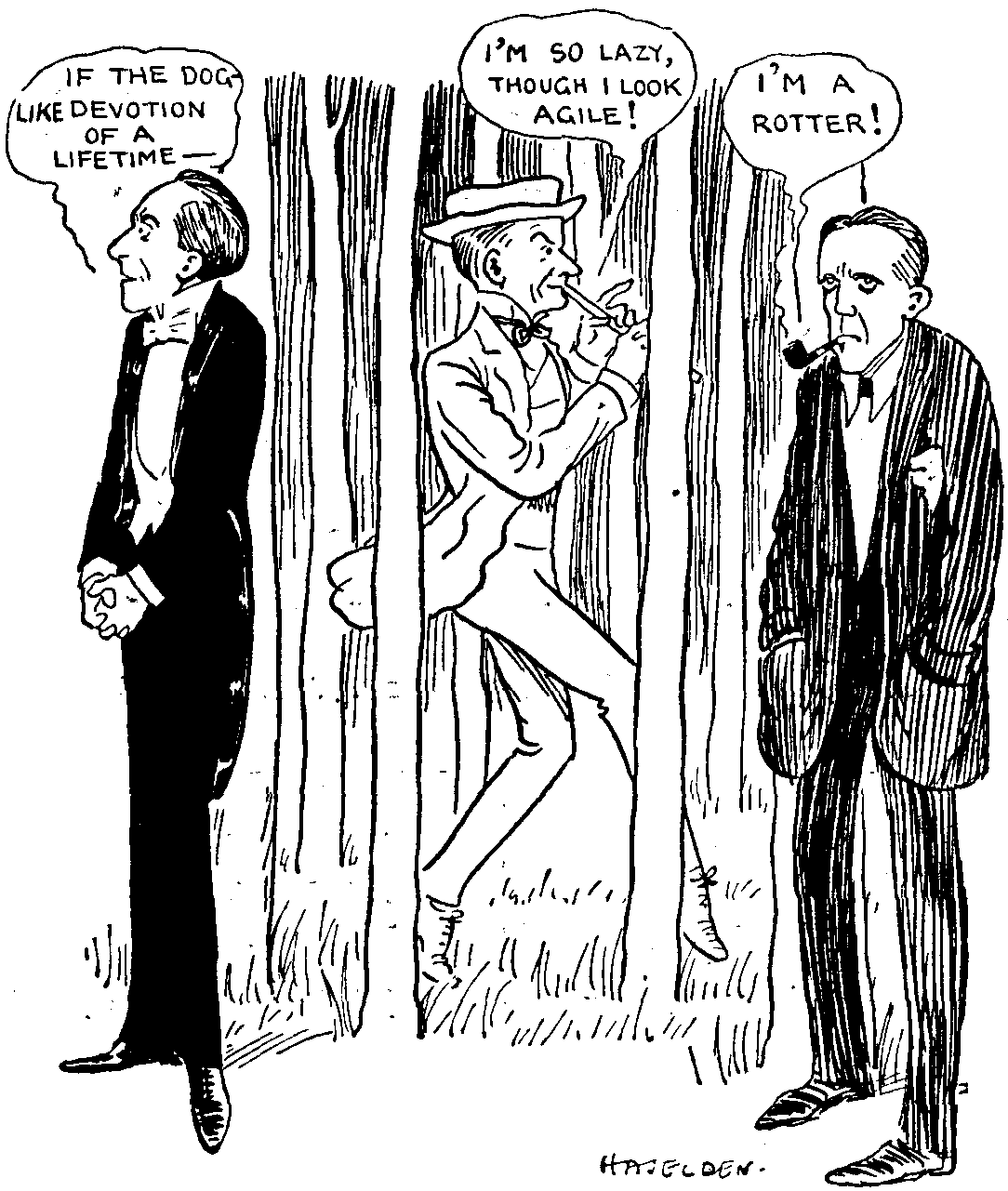
IN AND OUT OF THE WOOD.
Mr. Purdie MR. SAM SOTHERN. Mr. Coade MR. NORMAN FORBES. Mr. Dearth MR. GERALD DU MAURIER.
Brutus, in fact, is the famous general to whom certain things were caviare. He is the typical man in the audience, to whom Sir JAMES says: "You, too, Brutus; I'm talking at you."
Happily (for my taste, anyhow) the humour of the play dominates its sentiment. And where the sentiment of the child Margaret threatens to overstrain itself we had always the healthy antidote of Mr. DU MAURIER'S practical methods to correct its tendency to cloy. He was extraordinarily good both as himself and, for a rare change, as somebody quite different. Miss FAITH CELLI as his daughter—a sort of Peter Pan girl who does grow up, far too tall—was delightful in the true BARRIE manner. It was a pity—but that was not her fault—that she had to end her long and difficult scene on rather a false note. I am almost certain that no child (outside a BARRIE play), who is left alone in a Magic Wood, scared out of her life, would cry aloud, "Daddy, daddy, I don't want to be a Might-have-been." The sentiment of the words was, of course, part of the scheme, but it was not for her to say them.
Mr. NORMAN FORBES, in the Wood, was an elderly piping faun and performed with astonishing agility a sword-dance over a stick crossed with his whistle. Elsewhere as Mr. Coade he played very engagingly the part of the only character who had made such good use of his First Chance that he really didn't need a Second. Both in name and nature he brought to mind the late Mr. CHOATE, who gallantly declared that if he had not been what he was he would have liked to be his wife's second husband. And no wonder that Mr. Coade wanted nothing better than to remain attached to so adorable a creature as his wife, played with a delightful homeliness by Miss MAUDE MILLETT, who has lost nothing of that charm to which, with Mr. Coade, we retain the most faithful devotion.
Mr. WILL WEST was admirable as a Crichton gone wrong; and Mr. SOTHERN, as the philanderer Purdie, took all his Chances of humour, and they were many, with the greatest aplomb. They included some very pleasant satire on stage manners. I have only to mention the names of Miss HILDA MOORE, Miss JESSIE BATEMAN, Miss DORIS LYTTON and Miss LYDIA BILBROOKE for you to understand how excellent a cast it was, both for wit and grace.
Finally, Mr. ARTHUR HATHERTON, as Lob, the host of the party, a kind of hoary old Puck who had a penchant for filling his house every Midsummer Eve with people who wanted a Second Chance, interpreted Sir JAMES'S whimsical fancy to the very top of freakishness.
I hope, but doubtfully, that there are enough Dear Brutuses in London (so many aliens have lately fled) to do justice to BARRIE at his best.
O.S.
Le Mot Juste
.
"Tea is very scarce and that to Irish folks, who like it black and strong, with always 'one more for the pot,' is a source of damentation."—Liverpool Daily Post and Mercury.
"Another Army Order provides that an officer while undergoing instruction in flying shall receive continuous flying pay at the rate of 4s. a day in addition from the public-houses of the town."—Provincial Paper.
Very generous of them; but what will the Board of Liquor Control say?
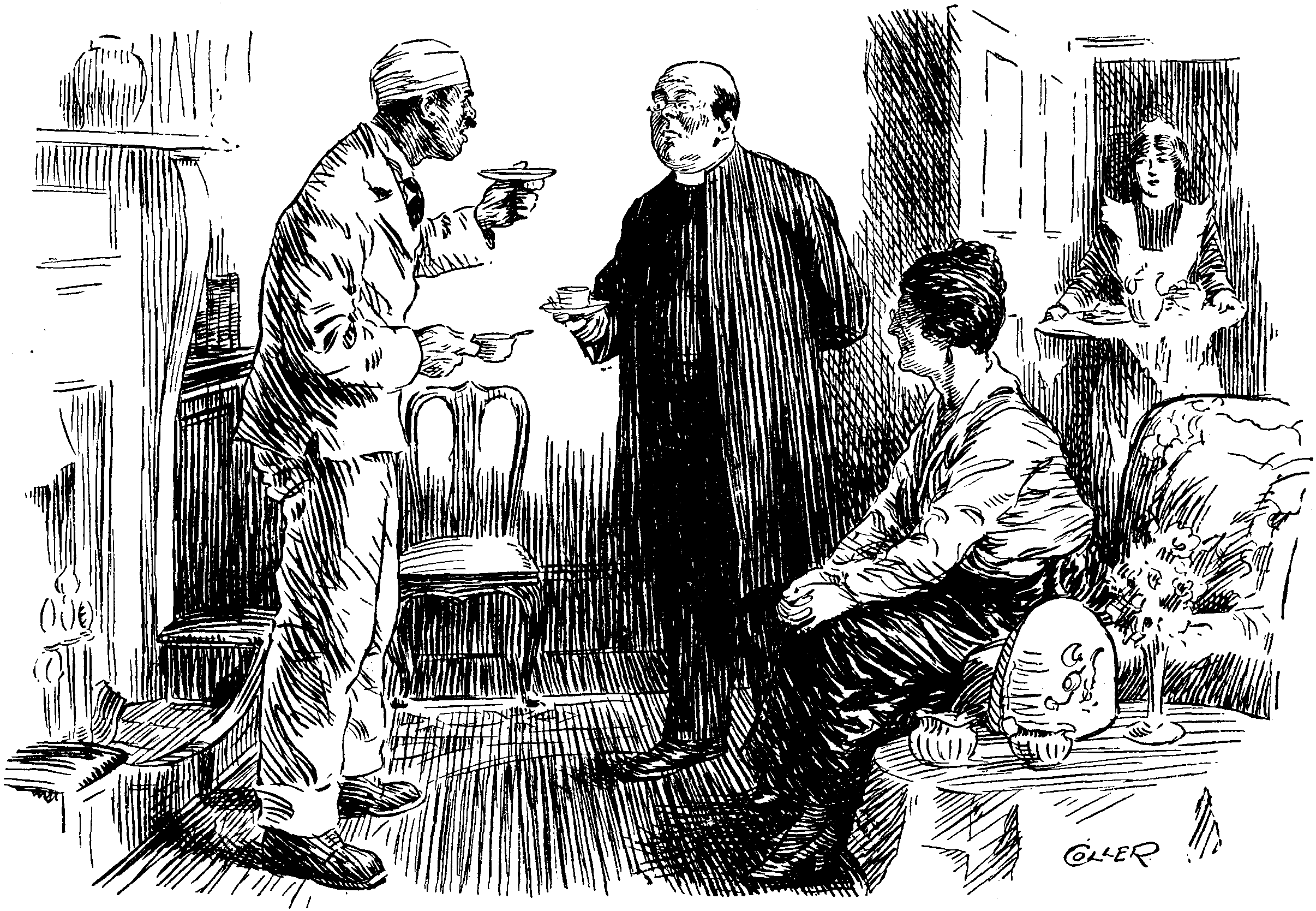
Vicar. "AND WHAT WERE YOUR SENSATIONS WHEN YOU WERE STRUCK?"
Wounded Tommy. "WELL, IT WAS LIKE WHEN THE MISSIS COPS YEH BEHIND THE EAR WITH A FLAT-IRON—YOU KNOW."